The big picture
Daniel's final major revelation begins not with triumphant mastery but with mourning, bodily weakness, and repeated assistance. After three weeks without rich food, meat, wine, or anointing, he sees a radiant figure whose presence leaves him without strength. A touch brings him to his hands and knees, then to a trembling stand. The messenger tells him that his words were heard from the first day, even though resistance associated with the prince of Persia delayed the arrival until Michael came to help. The chapter thus opens a heavenly dimension behind earthly kingdoms without giving a complete map of invisible powers. Daniel loses strength and speech again, and again he is touched and strengthened before more can be said. The coming disclosure is described as written in "the scripture of truth," suggesting that conflict does not make the outcome improvised. The chapter prepares the long sequence of kings in Daniel 11 by showing first how dependent the receiver is on strength supplied to him.
In this chapter
- A Vision Too Great for the Body to Carry Unaided Daniel 10:1-9
Daniel is in Cyrus's third year, already beyond the first year mentioned at the end of chapter 1.
- The Delay Is Not Explained as Unheard Prayer Daniel 10:10-14
A hand touches Daniel and brings him first to his hands and knees, then to a trembling stand.
- Strength Is Given More Than Once Daniel 10:15-19
Daniel's first strengthening is not permanent.
- A Written Truth Beyond the Visible Struggle Daniel 10:20-21
The messenger now links the unseen conflict explicitly to Persia and the coming prince of Greece, the same imperial succession already named in chapter 8.

Scripture beside the summary
Daniel · King James Version · 21Daniel 10:1-9
A Vision Too Great for the Body to Carry Unaided
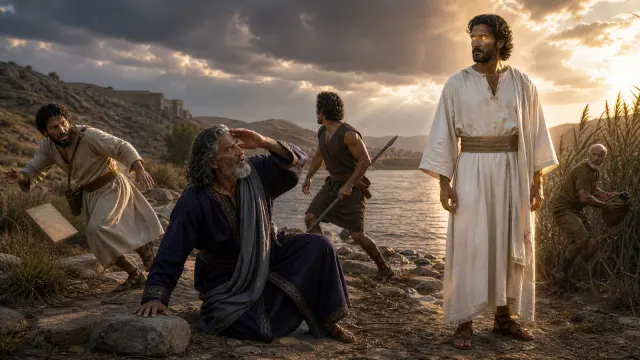
Daniel is in Cyrus's third year, already beyond the first year mentioned at the end of chapter 1. The date quietly confirms that the earlier notice marked continuity of service, not the end of his life. He has been mourning for three weeks, avoiding pleasant bread, meat, wine, and anointing. This is a limited fast, not a claim that he has eaten nothing at all, and the Book of Daniel does not tell us exactly what prompted the mourning. By the Hiddekel River he sees a figure clothed in linen, girded with gold, shining like beryl and lightning, with fiery eyes and a voice like a multitude. His companions do not see the vision, but terror sends them fleeing. Daniel remains alone and loses all strength. The man famous for understanding dreams is not portrayed as naturally equipped to stand before heavenly glory. Greater revelation leaves him more dependent, not less human.
Deep dive
The date is Cyrus's third year, showing that the statement in chapter 1 about Daniel continuing to Cyrus's first year did not announce his death then. Daniel describes a limited fast: he avoids pleasant bread, meat, and wine, rather than claiming to have eaten nothing. The text records his mourning without giving a precise cause, so explanations tied to particular disappointments in Jerusalem remain proposals rather than reported facts.
The figure's linen, gold, fiery eyes, shining limbs, and commanding voice make the appearance more than an ordinary riverside meeting. Christian interpreters differ over whether this is a manifestation of Christ or a heavenly messenger; the chapter does not give the figure a name here. Daniel's companions do not see the vision, yet they experience terror and flee. He remains alone and loses his strength. Seeing more than the others does not leave him more physically self-sufficient. The opening description of understanding is followed by an account of how much help he needs even to remain upright.
Words to trace: vision, voice, Daniel, face, thing, words
Verse-by-verse path
- Daniel 10:1
The third year of Cyrus is about 536 BC, when the first exiles had already gone home and Daniel had not. This is the last time his court name, Belteshazzar, appears. “The time appointed was long” translates tsava gadol, which can mean a great warfare, the hard service of Job 7:1: the word concerned a great conflict.
- Daniel 10:2
The Hebrew is “three weeks of days”, ordinary weeks. After Gabriel’s seventy weeks of years in chapter 9, the text takes care to say that these weeks are counted in days.
- Daniel 10:3
“Pleasant bread” is lechem chamudot, the same rare word Gabriel used for Daniel in 9:23, “greatly beloved”. Anointing the skin with oil was daily grooming in a dry climate, and mourners went without it, as Joab told the wise woman of Tekoa to do (2 Samuel 14:2).
- Daniel 10:4
The first month is Nisan. A fast from the third to the twenty third ran straight through Passover on the fourteenth and the week of Unleavened Bread; Daniel kept those days in mourning. Hiddekel is the Tigris, one of the four rivers of Eden (Genesis 2:14).
- Daniel 10:5
Linen is priestly dress, what the high priest wore into the holy of holies on the Day of Atonement (Leviticus 16:4), and Ezekiel 9:2 saw “one man... clothed with linen” with a scribe’s inkhorn. Uphaz is unknown outside Jeremiah 10:9, possibly a form of Ophir.
- Daniel 10:6
“Beryl” is tarshish, a gem named for the distant port, set in the high priest’s breastpiece (Exodus 28:20) and in Ezekiel’s wheels (1:16). Revelation 1:13–15 draws on this figure for the risen Christ: eyes as a flame of fire, feet like fine brass, a voice as many waters.
- Daniel 10:7
Daniel’s companions feel what they cannot see and run. Paul’s companions on the road to Damascus are in the same position, aware of something, blind to the vision itself (Acts 9:7; 22:9).
- Daniel 10:8
“Comeliness” is hod, splendour or vigour, the word used for royal majesty. It turned to mashchit, ruin, disfigurement: the colour left his face. “Alone” is said twice in two verses, the servant who came in company now by himself.
- Daniel 10:9
Face down, he can no longer see the figure, yet the phrase “the voice of his words” is repeated twice: hearing goes on after sight has failed. The fall is into the stupor of 8:18, but this time the voice keeps speaking into it.
Daniel 10:1-9
King James Version1In the third year of Cyrus king of Persia a thing was revealed unto Daniel, whose name was called Belteshazzar; and the thing was true, but the time appointed was long: and he understood the thing, and had understanding of the vision.
2In those days I Daniel was mourning three full weeks.
3I ate no pleasant bread, neither came flesh nor wine in my mouth, neither did I anoint myself at all, till three whole weeks were fulfilled.
4And in the four and twentieth day of the first month, as I was by the side of the great river, which is Hiddekel;
5Then I lifted up mine eyes, and looked, and behold a certain man clothed in linen, whose loins were girded with fine gold of Uphaz:
6His body also was like the beryl, and his face as the appearance of lightning, and his eyes as lamps of fire, and his arms and his feet like in colour to polished brass, and the voice of his words like the voice of a multitude.
7And I Daniel alone saw the vision: for the men that were with me saw not the vision; but a great quaking fell upon them, so that they fled to hide themselves.
8Therefore I was left alone, and saw this great vision, and there remained no strength in me: for my comeliness was turned in me into corruption, and I retained no strength.
9Yet heard I the voice of his words: and when I heard the voice of his words, then was I in a deep sleep on my face, and my face toward the ground.
Daniel 10:10-14
The Delay Is Not Explained as Unheard Prayer
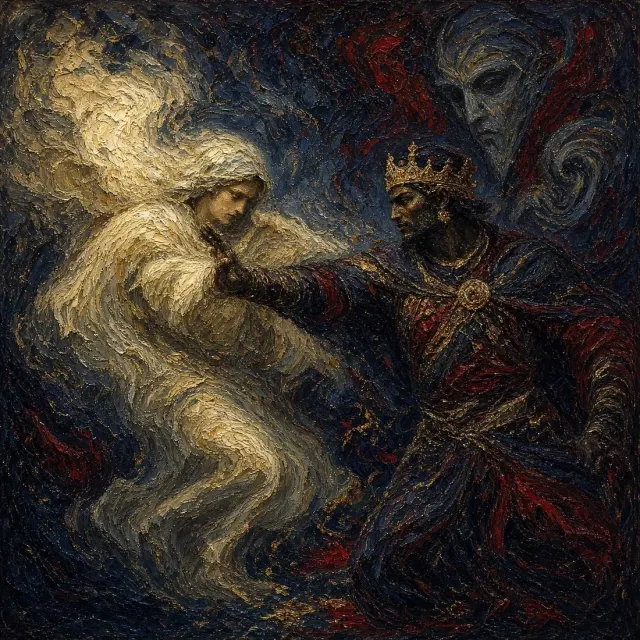
A hand touches Daniel and brings him first to his hands and knees, then to a trembling stand. The physical sequence keeps the command to understand from sounding like a demand for self-generated composure. Daniel is called "greatly beloved" before the messenger explains the delay. His words were heard "from the first day" he set his heart to understand and humbled himself before God. The twenty-one-day wait is therefore explicitly not a twenty-one-day delay in being heard. Resistance from the prince of Persia held the messenger until Michael, one of the chief princes, came to help. The chapter gives a genuine unseen dimension to the struggle surrounding earthly kingdoms, but it does not supply a full catalog of territorial spirits or a method for assigning one to every later nation. The point of the disclosure is narrower: Daniel's prayer was heard immediately, the delay had another cause, and the messenger has now come to explain what concerns Daniel's people.
Deep dive
Daniel first rises onto his hands and knees, then stands trembling. The bodily stages slow the encounter and keep the messenger's call to understand from sounding like a demand that Daniel manufacture strength. He is addressed as greatly beloved before being told why the visit has taken time. His words were heard from the first day he set himself to seek understanding and humble himself before God.
The resistance of the prince of Persia introduces a conflict not reducible to the decisions of the human court. Michael is named as one of the chief princes who came to help. The chapter presents earthly kingdoms with a heavenly dimension, but it does not provide a complete hierarchy of spiritual beings or a method for assigning such beings to later nations. The delay has a specific explanation within this encounter. Its crucial correction is that an answer taking time to arrive does not mean Daniel's petition took twenty-one days to become audible.
Words to trace: days, understand, words, Daniel, Persia, befall
Verse-by-verse path
- Daniel 10:10
The verb behind “set me upon” is nua, to shake or make totter. The hand does not lift him cleanly; it shakes him up onto his knees and palms. He is off his face but not yet off the ground.
- Daniel 10:11
“Unto thee am I now sent” uses the verb shalach, to send, the root of the messenger’s whole errand. The command to stand is obeyed, but “trembling”. Daniel is upright and shaking, the posture Psalm 2:11 recommends: rejoice with trembling.
- Daniel 10:12
“Chasten thyself” is lehitannot, to humble or afflict oneself, the very term the Law uses for fasting on the Day of Atonement (Leviticus 16:29, “ye shall afflict your souls”). The fast of verse 3 is described in the language of Israel’s most solemn day.
- Daniel 10:13
Twenty one days is exactly the three weeks of verse 2. Michael means “Who is like God?”, a question for a name, cousin to Mishael in 1:6, “who is what God is?” The Greek of Theodotion reads the end of the verse as “I left him there with the prince of the kings of Persia.”
- Daniel 10:14
The whole disclosure concerns “thy people”: the empires are the weather, Israel is the subject. “The vision is for many days” repeats the closing word to Daniel in 8:26 and takes the horizon beyond the coming generations.
Daniel 10:10-14
King James Version10And, behold, an hand touched me, which set me upon my knees and upon the palms of my hands.
11And he said unto me, O Daniel, a man greatly beloved, understand the words that I speak unto thee, and stand upright: for unto thee am I now sent. And when he had spoken this word unto me, I stood trembling.
12Then said he unto me, Fear not, Daniel: for from the first day that thou didst set thine heart to understand, and to chasten thyself before thy God, thy words were heard, and I am come for thy words.
13But the prince of the kingdom of Persia withstood me one and twenty days: but, lo, Michael, one of the chief princes, came to help me; and I remained there with the kings of Persia.
14Now I am come to make thee understand what shall befall thy people in the latter days: for yet the vision is for many days.
Daniel 10:15-19
Strength Is Given More Than Once
Daniel's first strengthening is not permanent. As the messenger continues, Daniel turns his face downward, becomes speechless, and describes sorrow, lost strength, and even the absence of breath. The Book of Daniel does not need to invent an emotional response for him because Daniel himself tells us exactly how overwhelmed he is. A touch opens his mouth, and then another humanlike figure touches him again and strengthens him. The words "peace be unto thee" and "be strong" arrive together with the strength they command. That pairing is important. Daniel is not rebuked for failing to produce resilience on demand. He is enabled to do what comes next. His reply is almost a definition of dependence: "Let my lord speak; for thou hast strengthened me." Before chapter 11 describes kings who act according to their own will, chapter 10 has made the receiver of the revelation visibly unable to proceed on willpower alone.

Deep dive
The first strengthening does not end Daniel's vulnerability. He lowers his face, becomes speechless, and can speak only after his lips are touched. His explanation names his sorrow and the absence of strength and breath. The text gives him those words directly rather than requiring an interpreter to invent an emotional response appropriate to the occasion.
A further touch and words of peace restore him again. The repetitions are not wasted motion before the supposedly important predictions begin. They establish the conditions under which those predictions can be received. The messenger's commands to be strong accompany the actual giving of strength, and Daniel answers by asking him to speak because he has been strengthened. The exchange therefore moves from incapacity to reception through assistance, not through embarrassment about human weakness. Before the account describes rulers acting according to their own will, it presents its faithful recipient as someone whose next act of listening depends on a gift.
Words to trace: lord, strengthened, strength, strong, touched, appearance
Verse-by-verse path
- Daniel 10:15
In 9:3 Daniel set his face toward the Lord; here the same Hebrew sets it toward the ground. “Dumb” is ne’elamti, struck silent, the word used when God closed Ezekiel’s mouth (Ezekiel 3:26) and opened it again (24:27).
- Daniel 10:16
A touch on the lips opens a prophet’s mouth, as the seraph’s coal touched Isaiah’s (Isaiah 6:7) and the LORD’s hand Jeremiah’s (1:9). “Sorrows” is tsirim, birth pangs, the word Isaiah 21:3 uses for the pangs of a woman in labour.
- Daniel 10:17
Daniel speaks of himself in the third person, “the servant of this my lord”, the court courtesy he has used before kings, now before a greater one. “Breath” is neshamah, the breath of life God breathed into Adam in Genesis 2:7.
- Daniel 10:18
It is the third touch of the chapter, and each has done a different work: verse 10 raised him to his knees, verse 16 opened his lips, and this one strengthens him. “Came again” means the helper had to come back for a second attempt.
- Daniel 10:19
“Be strong, yea, be strong” is chazaq wachazaq, the double command given when Joshua was commissioned to take the land (Deuteronomy 31:7; Joshua 1:6–9). This time it is spoken to a man in his eighties on a riverbank who has to listen.
Daniel 10:15-19
King James Version15And when he had spoken such words unto me, I set my face toward the ground, and I became dumb.
16And, behold, one like the similitude of the sons of men touched my lips: then I opened my mouth, and spake, and said unto him that stood before me, O my lord, by the vision my sorrows are turned upon me, and I have retained no strength.
17For how can the servant of this my lord talk with this my lord? for as for me, straightway there remained no strength in me, neither is there breath left in me.
18Then there came again and touched me one like the appearance of a man, and he strengthened me,
19And said, O man greatly beloved, fear not: peace be unto thee, be strong, yea, be strong. And when he had spoken unto me, I was strengthened, and said, Let my lord speak; for thou hast strengthened me.
Daniel 10:20-21
A Written Truth Beyond the Visible Struggle
The messenger now links the unseen conflict explicitly to Persia and the coming prince of Greece, the same imperial succession already named in chapter 8. Yet the Book of Daniel remains selective. It does not stop to diagram every relationship between earthly rulers and heavenly princes. The messenger's task is to show what concerns Daniel's people, not to satisfy every question an audience might have about invisible warfare. The crucial phrase is "the scripture of truth." What follows is presented as something already noted in a settled record, even while conflict is actively occurring. The struggle is real, but truth is not being improvised as each side discovers what the other might do. Michael is again connected with Daniel's people and will appear at the opening of chapter 12. These final verses therefore function like a doorway into Daniel 11: conflict continues, kingdoms move, and the disclosure comes from a source described as true before those events unfold.
Deep dive
The reference to Persia is followed by the coming prince of Greece, connecting the heavenly conflict with the succession already described in chapter 8. The account does not pause to explain every correspondence between a ruler on earth and a prince in the unseen realm. Its selectivity matters: the revelation is directed toward what will befall Daniel's people, not toward satisfying every possible curiosity about invisible warfare.
The "scripture of truth" places the coming disclosure within a settled heavenly record. The messenger's engagement in conflict does not mean that truth itself is being improvised as the contest proceeds. Michael is identified in relation to Daniel's people, a connection that will become decisive at the beginning of chapter 12. This chapter thus supplies the frame for the long account that follows: genuine struggle, divine knowledge, and a hearer upheld for the task. The next chapter continues the same disclosure rather than beginning an unrelated prediction.
Words to trace: prince, fight, gone, Grecia, holdeth, Knowest
Verse-by-verse path
- Daniel 10:20
The messenger is between battles: he has come from fighting Persia’s prince and returns to it, and when he is done, Greece’s prince arrives. The sequence of empires in chapter 8, ram and then goat, is here a sequence of adversaries in another realm.
- Daniel 10:21
“The scripture of truth” is a writing of truth, the heavenly book of Psalm 139:16 and the books opened in 7:10, which returns in 12:1. “Holdeth with me” is mitchazzeq, strengthens himself with me, the verb of “be strong” in verse 19: the one who strengthened Daniel has only Michael to strengthen him.
Daniel 10:20-21
King James Version20Then said he, Knowest thou wherefore I come unto thee? and now will I return to fight with the prince of Persia: and when I am gone forth, lo, the prince of Grecia shall come.
21But I will shew thee that which is noted in the scripture of truth: and there is none that holdeth with me in these things, but Michael your prince.
Questions to keep in mind while reading
- Identify the historical crisis, covenant failure, warning, and promised hope.
- Distinguish the prophet’s immediate audience from later biblical connections.
- Do not turn present-day headlines into confident fulfillment claims without textual evidence.
Text first
Where readers differ
The chapter summary begins with what the passage says and how its parts fit together. It does not assume one denomination has already settled every question. Where a conclusion depends on a tradition, literary theory, or historical reconstruction, that dependence is named openly.
The KJV text is presented first. Interpretive conclusions are labeled, and differences are introduced only when they help a reader understand why serious communities do not always reach the same answer.
Comparative interpretive notes for this chapter are in preparation. Until reviewed notes are ready, this page separates the KJV text from summary and application without claiming that serious readers agree on every question.
Questions beneath the surface
- What account of God, human freedom, responsibility, and the good life emerges from Daniel 10?
- Which tension does the chapter refuse to resolve quickly?
- What changes when the chapter is read as part of the whole canon rather than as an isolated moral lesson?
- Where might a sincere reader confuse a familiar tradition with something the text states directly?
Questions for serious personal contemplation
These open-ended questions make room for tension, honest response, prayer, and conclusions that remain accountable to the chapter.
Observe without rushing
What part of Daniel 10 makes you stop, feel unsettled, or feel surprised, and why?
Which detail in the passage would be easiest to overlook? How does that detail change your understanding?
Where do you see tension between what happens and this focus: Daniel 10 develops its own movement around words, vision, Daniel, days, face?
What important question does the passage leave open instead of resolving quickly?
Examine your inner life honestly
Which person, response, fear, or desire in the passage feels most like your own life right now?
What assumption about God, other people, or yourself does this text challenge?
Which part would you rather soften, avoid, or explain away too quickly? What might that reaction reveal?
If this Scripture could ask you one direct question, what do you think it would ask?
Respond with wisdom and courage
What do you need to remember, confess, grieve, thank God for, or trust after reading this passage?
How might another faithful person read this situation differently without ignoring the text?
What obedient response would be costly, uncomfortable, or slow, yet still faithful to Scripture?
What question will you carry into prayer this week, and which verses will you keep in front of you?
Music and video connected to the passage
Related media appears when its Scripture reference overlaps this study. Music and video can illuminate a theme while the biblical text remains the foundation.