The big picture
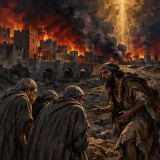
The warnings become attached to a calendar when Ezekiel is told to record the exact day Babylon sets itself against Jerusalem. The city is pictured as a cooking pot, but the vessel that once sounded like protection now holds its inhabitants over the fire. Its corrosion remains even after the contents are removed, and the exposed blood within Jerusalem explains why the pot itself must be heated. Then the chapter moves from public siege to private bereavement. Ezekiel's wife, called 'the desire of thine eyes,' dies, and he is commanded to refrain from the expected signs of mourning. The people ask what his conduct means, and the answer joins his loss to the coming loss of sanctuary, sons, and daughters. The chapter closes with a survivor who will eventually report Jerusalem's fall and with the promise that Ezekiel's restricted speech will open again.
In this chapter
- The Warning Now Has a Date Ezekiel 24:1-5
The siege finally receives a date that Ezekiel is told to write down.
- The Stain Belongs to the Vessel Ezekiel 24:6-14
The problem is not scum that can simply be skimmed off the top.
- A Wife Dies Between Two Mornings Ezekiel 24:15-18
The chapter moves from a public siege to a private loss with almost no transition.
- The Loss Answers the People’s Question Ezekiel 24:19-24
The people know Ezekiel’s unusual behavior is a sign and ask what it means for them.
- A Survivor Will Arrive, and the Mouth Will Open Ezekiel 24:25-27
A survivor will eventually cross the distance between fallen Jerusalem and Ezekiel’s community, bringing the report into the prophet’s own hearing.

Scripture beside the summary
Ezekiel · King James Version · 27Ezekiel 24:1-5
The Warning Now Has a Date
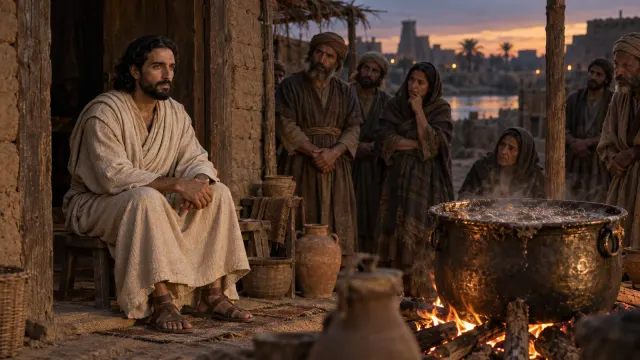
The siege finally receives a date that Ezekiel is told to write down. “This same day” is repeated because the warning has crossed from disputed prediction into an event already beginning. Babylon has set itself against Jerusalem, and the old confidence that fulfillment can always be pushed farther into the future loses its room to operate. The cooking pot then reappears with a bitter reversal. Jerusalem’s leaders had once used a caldron image as though being the meat inside meant security within the city’s walls. Here the same containment places the inhabitants over the fire. The best pieces go in first: thigh, shoulder, choice bones, the select of the flock. Status does not keep anyone out of the vessel. Ezekiel begins with something that could resemble careful preparation for a meal, then steadily reveals that the pot itself has become the setting of judgment.

Deep dive
The ninth year, tenth month, and tenth day are not decorative information. Ezekiel must write the day down, and "this same day" is repeated in the announcement of Babylon’s action. Second Kings 25:1 records the siege beginning on that same numbered day of Zedekiah’s reign. The warning has moved from disputed prediction to an event with a date attached. The sayings about delayed fulfilment challenged in Ezekiel 12 have run out of room.
The cooking pot also has a prior life in the book. In Ezekiel 11:3, Jerusalem’s leaders called the city a caldron and themselves its flesh, language associated with confidence in their position. Here the vessel still contains the flesh, but containment is no promise of protection. The walls that enclose the inhabitants also hold them within the scene of judgment.
The choice thigh, shoulder, bones, and flock stress the quality of what goes into the pot. Status is no exemption from the boiling. The image begins with selected contents and a carefully prepared vessel, then turns steadily toward contamination, removal, and burning. What first resembles provision for a meal will become an indictment of the city and finally of the pot itself.
Words to trace: bones, choice, LORD, month, tenth, Babylon
Verse-by-verse path
- Ezekiel 24:1
The date falls in January 588 BC. Jews still keep the tenth of the tenth month, Tevet, as a fast for the start of the siege, and Zechariah 8:19 already knew “the fast of the tenth month” among the fasts that would one day become feasts.
- Ezekiel 24:2
“Write thee the name of the day” asks for a written, dated record, made in Babylonia hundreds of miles from Jerusalem, that could be checked when news arrived. “Set himself against” is samakh, to lean one’s weight on, the verb for laying a hand on the head of an offering (Leviticus 1:4).
- Ezekiel 24:3
“Set on a pot, set it on” has the beat of a work song, and many scholars think verses 3 to 5 adapt a cooking chant Ezekiel’s hearers knew. “Pot” is sir, a large cooking vessel. The “rebellious house” is given a song and left to discover what it means.
- Ezekiel 24:4
The thigh and the shoulder were the choicest cuts. The right shoulder was the priest’s portion (Leviticus 7:32), and when Samuel honoured Saul at his feast, the cook set the shoulder before him (1 Samuel 9:24). The best of Jerusalem’s people go into the pot first.
- Ezekiel 24:5
“Burn also the bones under it” seems to use bones as fuel. Bones and wood differ by one vowel in Hebrew, ‘atsamim and ‘etsim, and some emend to wood, which verse 10 uses. “Seethe” is the 1611 word for boil, as in the law against seething a kid in its mother’s milk.
Ezekiel 24:1-5
King James Version1Again in the ninth year, in the tenth month, in the tenth day of the month, the word of the LORD came unto me, saying,
2Son of man, write thee the name of the day, even of this same day: the king of Babylon set himself against Jerusalem this same day.
3And utter a parable unto the rebellious house, and say unto them, Thus saith the Lord GOD; Set on a pot, set it on, and also pour water into it:
4Gather the pieces thereof into it, even every good piece, the thigh, and the shoulder; fill it with the choice bones.
5Take the choice of the flock, and burn also the bones under it, and make it boil well, and let them seethe the bones of it therein.
Ezekiel 24:6-14
The Stain Belongs to the Vessel
The problem is not scum that can simply be skimmed off the top. The image points to corrosion stuck to the vessel, an incrusted impurity that remains after the contents are removed. That is why the pot itself ends up on the coals. Jerusalem’s guilt is not pictured as a few bad pieces of meat that can be selected out while the container stays untouched. The exposed blood explains the moral force of the image. It was left on bare rock rather than covered, and God keeps it visible so that its claim cannot disappear. Piece by piece the contents are removed, then the empty brass is heated until the stubborn deposit itself is confronted by fire. Ezekiel does not promise a polished vessel at the end of this paragraph. The emphasis is on impurity that resisted previous purging and on judgment now proceeding according to the city’s own ways and deeds.

Deep dive
The KJV’s "scum" can suggest something floating on the surface, but the Hebrew term here denotes corrosion or an incrusted deposit. That matters when the empty metal vessel is placed on the coals. The problem does not disappear with the removal of the meat. It adheres to the pot. The command to bring out the contents piece by piece, without a lot being cast, leaves no protected selection within the condemned city.
The blood on the rock explains the accusation behind the cooking image. Jerusalem has left shed blood exposed instead of covering it with dust. Then God repeats the action from his side: he keeps that blood visible so that its claim is not concealed. The uncovered blood is evidence of violence, not a detail about poor cooking. The city’s guilt remains on display.
Emptying the pot is followed by heating the pot itself. Removing inhabitants will not make the city’s corruption an imaginary problem that existed only in a few individuals. Verse 13 describes attempted purging that has not produced a purged people. The final sentence therefore returns to Jerusalem’s own ways and deeds as the basis of judgment. The passage offers no painless transition from boiling to cleanliness; its emphasis falls on contamination that has resisted treatment and on a sentence now being carried out.
Words to trace: scum, LORD, filthiness, fire, purged, blood
Verse-by-verse path
- Ezekiel 24:6
In war, captives were divided by lot: Nahum 3:10 says of Thebes, “they cast lots for her honourable men.” Here no lot falls, so no one is picked out to be spared or sold. Everything in the pot comes out piece by piece, and nothing is chosen.
- Ezekiel 24:7
The law required blood to be covered: a hunter “shall even pour out the blood thereof, and cover it with dust” (Leviticus 17:13). Blood left on bare rock cannot soak in; it stays in view and cries out, as Job pleads: “O earth, cover not thou my blood” (Job 16:18).
- Ezekiel 24:8
Now God takes over the act, setting the blood on the rock himself so that it stays visible. Isaiah 26:21 pictures the same moment of reckoning: “the earth also shall disclose her blood, and shall no more cover her slain.” “Fury to come up” rises the way the pot comes to the boil.
- Ezekiel 24:9
The woe of verse 6 comes again. “Pile” is medurah, the heap of fuel, and it is the word Isaiah 30:33 uses of Topheth, the valley of child burning: “the pile thereof is fire and much wood.” This time God himself builds the pile.
- Ezekiel 24:10
The commands come in rapid staccato: heap on, kindle, consume, spice, burn. “Spice it well” uses the verb for mixing spices, the perfumer’s art of Exodus 30:25; the Greek has “let the broth boil away” instead. Either way the cooking goes on until the meat is gone and the bones char.
- Ezekiel 24:11
“Brass” here is copper, the usual metal of a large cooking pot. An empty copper pot left on hot coals burns off whatever is crusted on it, and the language turns from cooking to smelting, with “molten”, as in the furnace of 22:17–22.
- Ezekiel 24:12
The first clause is among the most obscure Hebrew in the chapter, and the Greek omits much of it; the King James “wearied herself with lies” is a guess, and others read “she has wearied me with toil”. The end is plain: the corrosion is going into the fire.
- Ezekiel 24:13
“I have purged thee, and thou wast not purged” has a history behind it, though the verse gives none: Josiah’s great cleansing of the temple and land (2 Kings 23) was undone within a few years by his sons. Purging that did not hold is now replaced by fire.
- Ezekiel 24:14
Six verbs of resolve stand in a row: spoken, come to pass, do, not go back, not spare, not repent. Jeremiah 4:28 says the same of this judgment: “I have purposed it, and will not repent, neither will I turn back from it.” God had repented over Nineveh (Jonah 3:10); here he says he will not.
Ezekiel 24:6-14
King James Version6Wherefore thus saith the Lord GOD; Woe to the bloody city, to the pot whose scum is therein, and whose scum is not gone out of it! bring it out piece by piece; let no lot fall upon it.
7For her blood is in the midst of her; she set it upon the top of a rock; she poured it not upon the ground, to cover it with dust;
8That it might cause fury to come up to take vengeance; I have set her blood upon the top of a rock, that it should not be covered.
9Therefore thus saith the Lord GOD; Woe to the bloody city! I will even make the pile for fire great.
10Heap on wood, kindle the fire, consume the flesh, and spice it well, and let the bones be burned.
11Then set it empty upon the coals thereof, that the brass of it may be hot, and may burn, and that the filthiness of it may be molten in it, that the scum of it may be consumed.
12She hath wearied herself with lies, and her great scum went not forth out of her: her scum shall be in the fire.
13In thy filthiness is lewdness: because I have purged thee, and thou wast not purged, thou shalt not be purged from thy filthiness any more, till I have caused my fury to rest upon thee.
14I the LORD have spoken it: it shall come to pass, and I will do it; I will not go back, neither will I spare, neither will I repent; according to thy ways, and according to thy doings, shall they judge thee, saith the Lord GOD.
Ezekiel 24:15-18
A Wife Dies Between Two Mornings
The chapter moves from a public siege to a private loss with almost no transition. God calls Ezekiel’s wife “the desire of thine eyes” before saying she will be taken away. Those words do a great deal of work because the woman is never named and no fault of hers is supplied. The passage gives no reason to treat her death as punishment for her own conduct. Instead, it establishes her value to Ezekiel and then records the loss with severe brevity. He must not perform the expected outward signs of mourning: no tears, no uncovered head, no removed shoes, no covered lips, no customary bread. His restraint is commanded, so it cannot be read as emotional indifference. Morning speech, evening death, and morning obedience form the entire sequence. Earlier prophetic signs used objects. This one enters Ezekiel’s household through the death of the person he loved.


Deep dive
Before Ezekiel calls her his wife, God calls her "the desire of thine eyes". Her value to Ezekiel is named before her loss is announced. No offence of hers is specified, and the stroke is not explained as a judgment against her. The account provides no final conversation or extended account of her life. It gives the relationship a place of honour in those few words, then records its rupture.
The instructions govern tears and the outward practices of mourning: the head covering stays on, the shoes remain on the feet, the lips are not covered, and the customary bread is not eaten. Ezekiel’s restraint is commanded. It cannot reasonably be treated as evidence that the woman mattered little to him when the passage has just said the opposite.
Verse 18 places public speech in the morning, his wife’s death in the evening, and obedience to the command on the following morning. The spare sequence is part of the passage’s weight. Earlier signs used a tile, food, hair, and packed baggage; this one enters Ezekiel’s household through an actual death. The sign is inseparable from the relationship named at its beginning. Before her death becomes an explanation of Jerusalem's loss, it is the death of Ezekiel's wife.
Words to trace: morning, bind, bread, commanded, cover, dead
Verse-by-verse path
- Ezekiel 24:15
This is the only glimpse of Ezekiel’s household in the book. We know he had a house, where the elders sat (8:1) and where he was told to shut himself in (3:24). That he had a wife we learn only through her death.
- Ezekiel 24:16
“With a stroke” is maggefah, the word for a plague or sudden blow, as in the plague at Kadesh (Numbers 14:37). Her death is sudden. “Mourn” is safad, the loud wailing of funerals, and “weep” the quiet tears; both are forbidden.
- Ezekiel 24:17
“Forbear to cry” is literally “groan silently”: Ezekiel may groan, but not aloud. Aaron, a priest, was forbidden to uncover his head in mourning when his sons died (Leviticus 10:6), and the high priest could not mourn even his parents (Leviticus 21:11). Ezekiel the priest is held to that rule.
- Ezekiel 24:18
Only here does Ezekiel say “my wife”. If the chapter is one unit, she died on or just after the day the siege began. The verse records what he did the morning after in six words, and the lack of any description is itself the only mourning the book allows him.
Ezekiel 24:15-18
King James Version15Also the word of the LORD came unto me, saying,
16Son of man, behold, I take away from thee the desire of thine eyes with a stroke: yet neither shalt thou mourn nor weep, neither shall thy tears run down.
17Forbear to cry, make no mourning for the dead, bind the tire of thine head upon thee, and put on thy shoes upon thy feet, and cover not thy lips, and eat not the bread of men.
18So I spake unto the people in the morning: and at even my wife died; and I did in the morning as I was commanded.
Ezekiel 24:19-24
The Loss Answers the People’s Question
The people know Ezekiel’s unusual behavior is a sign and ask what it means for them. The answer depends on a phrase already used for his wife: the sanctuary is also “the desire of your eyes.” The comparison is about attachment and loss, not about equating a person with a building. God names the temple as the excellence of their strength and then says he will profane it. Sons and daughters left in Jerusalem are included, so the coming disaster reaches families as well as architecture. The exiles are told that ordinary mourning customs will be disrupted for them too, yet the text does not describe emotional emptiness. They will pine away for their iniquities and mourn toward one another. Ezekiel’s behavior therefore becomes a sign of grief constrained by catastrophe, not grief absent. When the announced losses arrive, the sign already interpreted in advance will become harder to dismiss.

Deep dive
The people ask what Ezekiel’s actions mean for them, so the interpretation is supplied rather than left to speculation. The phrase used of his wife now describes their sanctuary: "the desire of your eyes". The connection depends on attachment and loss. God names the temple as the excellence of their strength and then declares that he himself will profane it. Its importance to them does not prevent its surrender.
The sons and daughters they have left behind place the coming calamity within divided families, not merely within damaged architecture. The sign joins a household’s bereavement to the destruction of a place and people held dear by the exiles. It does not say that affection for the sanctuary was itself the offence. The surrounding accusations concern the conduct that had profaned it and the confidence that it would nevertheless remain secure.
The restrictions on mourning are repeated, but the people are also said to pine away for their iniquities and to mourn toward one another. The passage therefore does not describe simple emotional numbness. Ordinary expressions of bereavement are disrupted while grief and responsibility remain. Finally Ezekiel is named as a sign, and recognition is attached to the event’s arrival. The explanation has been given in advance; its fulfilment will make evasion harder.
Words to trace: LORD, mourn, bread, cometh, cover, daughters
Verse-by-verse path
- Ezekiel 24:19
The people’s question takes for granted that Ezekiel’s conduct means something for them. They asked the same when he dug through the wall with his baggage (12:9), and they will ask again when he holds two sticks together (37:18). By now they know he is a living sign.
- Ezekiel 24:20
Ezekiel answers in the first person, reporting a word he had already received. Before explaining anything, he makes clear that the explanation is not his own reading of his grief but something God told him to say.
- Ezekiel 24:21
“The excellency of your strength” is the phrase of Leviticus 26:19, “I will break the pride of your power”, where the same words stand. “That which your soul pitieth” means what your soul longs over and cannot bear to lose. God says “I will profane my sanctuary”, taking responsibility for its fall.
- Ezekiel 24:22
Covering the upper lip was a sign of mourning and shame, prescribed for the leper (Leviticus 13:45); Micah 3:7 says disgraced seers “shall all cover their lips”. Jeremiah was also forbidden to enter a house of mourning or to take the bread of consolation (Jeremiah 16:5–7).
- Ezekiel 24:23
Mourners went barefoot: David climbed the Mount of Olives “barefoot” and weeping when Absalom drove him out (2 Samuel 15:30). “Pine away for your iniquities” is the exact phrase of Leviticus 26:39: those left “shall pine away in their iniquity in your enemies’ lands.” The exiles will be living inside that curse.
- Ezekiel 24:24
Outside 1:3, this is the only place in the whole book where the prophet’s name appears, and God speaks it. “Sign” is mofet, a portent, the word of 12:6 and 12:11, “I am your sign”. The man himself, his house and his grief, have become the message.
Ezekiel 24:19-24
King James Version19And the people said unto me, Wilt thou not tell us what these things are to us, that thou doest so?
20Then I answered them, The word of the LORD came unto me, saying,
21Speak unto the house of Israel, Thus saith the Lord GOD; Behold, I will profane my sanctuary, the excellency of your strength, the desire of your eyes, and that which your soul pitieth; and your sons and your daughters whom ye have left shall fall by the sword.
22And ye shall do as I have done: ye shall not cover your lips, nor eat the bread of men.
23And your tires shall be upon your heads, and your shoes upon your feet: ye shall not mourn nor weep; but ye shall pine away for your iniquities, and mourn one toward another.
24Thus Ezekiel is unto you a sign: according to all that he hath done shall ye do: and when this cometh, ye shall know that I am the Lord GOD.
Ezekiel 24:25-27
A Survivor Will Arrive, and the Mouth Will Open
A survivor will eventually cross the distance between fallen Jerusalem and Ezekiel’s community, bringing the report into the prophet’s own hearing. The things lost are gathered into one heavy list: strength, glory, the desire of the eyes, what the people set their minds upon, sons, and daughters. Jerusalem’s collapse is therefore not a single institutional failure. It is the breaking of a whole structure of attachment. The survivor’s arrival is also tied to the reopening of Ezekiel’s mouth. Later in the book, the report of the city’s fall and the prophet’s renewed speech meet as promised, though the later chronology makes clear that the fugitive does not mechanically cause Ezekiel’s ability to speak. This chapter ends inside the interval. The siege has begun, the final report is still future, and Ezekiel’s silence, loss, and coming speech all remain under the same divine appointment.

Deep dive
The final promise gathers the objects of loss into one sentence: strength, joy, what the eyes desire, and sons and daughters. The language reaches back through the interpretation of the sign and through the description of Ezekiel’s wife. The coming report concerns the collapse of an entire structure of attachment and security. It is not merely the correction of a mistaken forecast.
The survivor’s arrival also brings the long restriction on Ezekiel’s speech toward its appointed end. Ezekiel 33:21–22 records a fugitive reporting that Jerusalem has been struck and specifies that the prophet’s mouth had been opened the evening before the man arrived. That later account fulfils the connection announced here without making ordinary news the source of Ezekiel’s ability to speak.
The timing remains important. The dated siege at the chapter’s beginning is not identical with the city’s fall or the survivor’s later arrival. Ezekiel speaks from within an interval in which the siege has begun but its final confirmation is still ahead. The chapter closes by placing his silence, his future speech, and the coming witness under the same divine appointment. The sign will include not only what the prophet has endured but also the moment when he can speak again.
Words to trace: cause, daughters, desire, dumb, ears, escaped
Verse-by-verse path
- Ezekiel 24:25
Five things are lost: strength, joy, the desire of the eyes, the longing of the soul, sons and daughters. “That whereupon they set their minds” is literally “the lifting up of their soul”, the phrase Psalm 25:1 uses of prayer: “Unto thee, O LORD, do I lift up my soul.” The temple had become what they lifted their souls to.
- Ezekiel 24:26
“He that escapeth” is the fugitive who brings news, a figure of old: “there came one that had escaped, and told Abram” (Genesis 14:13). In 1 Samuel 4 a runner from the battle brought word that the ark was taken, and a young wife died naming her son Ichabod, “The glory is departed.”
- Ezekiel 24:27
The dumbness was imposed at his call: “I will make thy tongue cleave to the roof of thy mouth, that thou shalt be dumb” (3:26), with speech allowed only when God gave a word (3:27). It had shaped his ministry for some seven years, and here its end is promised.
Ezekiel 24:25-27
King James Version25Also, thou son of man, shall it not be in the day when I take from them their strength, the joy of their glory, the desire of their eyes, and that whereupon they set their minds, their sons and their daughters,
26That he that escapeth in that day shall come unto thee, to cause thee to hear it with thine ears?
27In that day shall thy mouth be opened to him which is escaped, and thou shalt speak, and be no more dumb: and thou shalt be a sign unto them; and they shall know that I am the LORD.
Questions to keep in mind while reading
- Identify the historical crisis, covenant failure, warning, and promised hope.
- Distinguish the prophet’s immediate audience from later biblical connections.
- Do not turn present-day headlines into confident fulfillment claims without textual evidence.
Text first
Where readers differ
The chapter summary begins with what the passage says and how its parts fit together. It does not assume one denomination has already settled every question. Where a conclusion depends on a tradition, literary theory, or historical reconstruction, that dependence is named openly.
The KJV text is presented first. Interpretive conclusions are labeled, and differences are introduced only when they help a reader understand why serious communities do not always reach the same answer.
Comparative interpretive notes for this chapter are in preparation. Until reviewed notes are ready, this page separates the KJV text from summary and application without claiming that serious readers agree on every question.
Questions beneath the surface
- What account of God, human freedom, responsibility, and the good life emerges from Ezekiel 24?
- Which tension does the chapter refuse to resolve quickly?
- What changes when the chapter is read as part of the whole canon rather than as an isolated moral lesson?
- Where might a sincere reader confuse a familiar tradition with something the text states directly?
Questions for serious personal contemplation
These open-ended questions make room for tension, honest response, prayer, and conclusions that remain accountable to the chapter.
Observe without rushing
What part of Ezekiel 24 makes you stop, feel unsettled, or feel surprised, and why?
Which detail in the passage would be easiest to overlook? How does that detail change your understanding?
Where do you see tension between what happens and this focus: Ezekiel 24 develops its own movement around LORD, scum, bones, cover, desire?
What important question does the passage leave open instead of resolving quickly?
Examine your inner life honestly
Which person, response, fear, or desire in the passage feels most like your own life right now?
What assumption about God, other people, or yourself does this text challenge?
Which part would you rather soften, avoid, or explain away too quickly? What might that reaction reveal?
If this Scripture could ask you one direct question, what do you think it would ask?
Respond with wisdom and courage
What do you need to remember, confess, grieve, thank God for, or trust after reading this passage?
How might another faithful person read this situation differently without ignoring the text?
What obedient response would be costly, uncomfortable, or slow, yet still faithful to Scripture?
What question will you carry into prayer this week, and which verses will you keep in front of you?
Music and video connected to the passage
Related media appears when its Scripture reference overlaps this study. Music and video can illuminate a theme while the biblical text remains the foundation.