The big picture
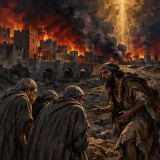
Samaria and Jerusalem become two sisters whose pursuit of foreign powers is told through deliberately severe sexual imagery. The attraction is political, religious, and visual at once: uniforms, horses, painted figures, ornaments, and distant prestige become objects of desire, while idolatry gives that desire its covenant meaning. The powers once courted return as conquerors, and the very military splendor that looked desirable becomes the equipment surrounding the city. Jerusalem's disgust with one alliance does not restore faithfulness; it merely redirects the appetite toward another. The allegory eventually strips away any possibility of treating the charge as only metaphorical. Children are passed through the fire, blood is in their hands, and the sanctuary is entered on the same day. God's own incense and oil appear on a table prepared for others. The final verdict names both idolatry and bloodshed and ends without the covenant restoration that closes Ezekiel 16.
In this chapter
- The Uniforms Become an Invading Army Ezekiel 23:1-10
The first sister’s attraction is described with enough detail to show why Assyria looked impressive.
- Jerusalem Is Captivated by a Picture Ezekiel 23:11-21
Jerusalem watches Samaria’s fate and still intensifies the same pursuit.
- The Admired Equipment Now Surrounds the City Ezekiel 23:22-27
The same qualities that made foreign power attractive now arrive as the equipment of siege.
- The Sister’s Cup Has Room for Both Ezekiel 23:28-35
Jerusalem is handed to people she has come to hate, which exposes the uselessness of both her earlier attraction and her later disgust.
- The Sanctuary Visit Happens on the Same Day Ezekiel 23:36-39
The allegory stops long enough to name the offenses without disguise.
- The Table Is Set with Someone Else’s Oil Ezekiel 23:40-44
Nothing in this scene is accidental.
- The Final Verdict Names Both Offences Ezekiel 23:45-49
The final verdict names the two offenses the chapter has been circling: adultery and bloodshed.

Scripture beside the summary
Ezekiel · King James Version · 49Ezekiel 23:1-10
The Uniforms Become an Invading Army
The first sister’s attraction is described with enough detail to show why Assyria looked impressive. Blue clothing, rank, horses, and military bearing make power visible before the chapter shows what that power will do. Aholah’s desire is not treated as harmless admiration, because her political pursuit is joined to defilement with Assyrian idols. Then the whole image turns. The “lovers” she courted become the hands into which she is delivered. They expose, take, and kill. Strength that looked desirable from a distance becomes conquest at close range. Ezekiel identifies Aholah as Samaria, so the sexual language interprets a city’s allegiance rather than giving the biography of an individual woman. The opening also makes Jerusalem’s position uncomfortable from the start. She is the sister watching this happen, which means the next part cannot be excused as ignorance of where the same path leads.

Deep dive
The names carry the sanctuary into the accusation. Aholah means her tent; Aholibah means my tent is in her. Both names draw on the Hebrew ohel, meaning tent. Jerusalem’s name therefore contains a claim of divine presence, but the chapter will give that claim no protective magic. God also says that both sisters were his. Samaria’s destruction is presented as the breaking of an existing relationship, not a disaster affecting strangers.
Assyria first appears in blue clothing, mounted on horses, with the rank and bearing of captains and rulers. The account lingers over the appearance of power because that is what attracts Aholah. Then verse 7 supplies the religious meaning: association with these men brings defilement with their idols. Military prestige and worship have become entangled. The horsemen do not remain handsome figures at a distance.
The decisive reversal comes in the repeated reference to her lovers. They are the ones into whose hands she is delivered, and those same hands take her children and expose her to violence. Desire has not secured control over the desired power. The sisters are explicitly identified as cities, so the sexual imagery interprets their allegiance; it is not a biographical account of two individual women.
Words to trace: whoredoms, Aholah, committed, daughters, doted, Aholibah
Verse-by-verse path
- Ezekiel 23:1
Chapter 23 is the companion of chapter 16, but it tells a different history. Chapter 16 followed one city from birth through her worship; this follows two sisters through their foreign policy. Jeremiah 3:6–11 had already pictured the two kingdoms as sisters, “backsliding Israel” and “treacherous Judah”.
- Ezekiel 23:2
One mother, two daughters: one people that split into two kingdoms after Solomon’s death (1 Kings 12), north and south. The allegory begins before the split, in Egypt, so the two are sisters from the start rather than rivals who became related.
- Ezekiel 23:3
The unfaithfulness is dated to Egypt, before the covenant at Sinai, as in chapter 20. The verbs for pressing and bruising describe young girls handled by others. The first recorded act of the pattern, the golden calf, was made by a people only weeks out of Egypt.
- Ezekiel 23:4
Leviticus 18:18 forbade a man to marry two sisters, the double marriage Jacob made with Leah and Rachel, and the allegory pictures God in exactly that union. The sisters’ names resemble Oholibamah, a wife of Esau (Genesis 36:2). Samaria is placed first as the elder.
- Ezekiel 23:5
“When she was mine” is literally “under me”, the idiom of a married woman. “Doted” is ‘agav, lust, a word found almost only in this chapter, six times. On Shalmaneser III’s Black Obelisk, Jehu of Israel is shown bowing with tribute, the earliest surviving picture of an Israelite king.
- Ezekiel 23:6
“Blue” is tekhelet, the costly blue-violet dye of the tabernacle hangings and the tassels of Numbers 15:38. “Captains and rulers” are pachot and seganim, both loanwords from the Akkadian titles of Assyrian governors and prefects. Even the vocabulary shows where the admiration was pointed.
- Ezekiel 23:7
“Chosen men” means the elite, the pick of Assyria. The religious side is recorded in 2 Kings 17:16: the northern kingdom “made them molten images... and worshipped all the host of heaven, and served Baal.” Admiration for the empire and its worship arrived together.
- Ezekiel 23:8
Jeroboam’s calves at Bethel and Dan were introduced with Aaron’s words at Sinai, “behold thy gods, O Israel, which brought thee up out of the land of Egypt” (1 Kings 12:28; Exodus 32:4). And Samaria’s last king, Hoshea, fell when he sent to So, king of Egypt (2 Kings 17:4).
- Ezekiel 23:9
Shalmaneser V besieged Samaria for three years, and it fell in 722 BC (2 Kings 17:5–6). His successor Sargon II claimed in his inscriptions to have carried away 27,290 of its people. The lovers she courted were the ones who ended her.
- Ezekiel 23:10
The deportees were settled in Halah, on the Habor, and in the cities of the Medes (2 Kings 17:6), and the northern tribes never returned as a people. “Famous among women” is literally “a name among women”: Samaria became a byword, a proverb for what happens to a faithless kingdom.
Ezekiel 23:1-10
King James Version1The word of the LORD came again unto me, saying,
2Son of man, there were two women, the daughters of one mother:
3And they committed whoredoms in Egypt; they committed whoredoms in their youth: there were their breasts pressed, and there they bruised the teats of their virginity.
4And the names of them were Aholah the elder, and Aholibah her sister: and they were mine, and they bare sons and daughters. Thus were their names; Samaria is Aholah, and Jerusalem Aholibah.
5And Aholah played the harlot when she was mine; and she doted on her lovers, on the Assyrians her neighbours,
6Which were clothed with blue, captains and rulers, all of them desirable young men, horsemen riding upon horses.
7Thus she committed her whoredoms with them, with all them that were the chosen men of Assyria, and with all on whom she doted: with all their idols she defiled herself.
8Neither left she her whoredoms brought from Egypt: for in her youth they lay with her, and they bruised the breasts of her virginity, and poured their whoredom upon her.
9Wherefore I have delivered her into the hand of her lovers, into the hand of the Assyrians, upon whom she doted.
10These discovered her nakedness: they took her sons and her daughters, and slew her with the sword: and she became famous among women; for they had executed judgment upon her.
Ezekiel 23:11-21
Jerusalem Is Captivated by a Picture
Jerusalem watches Samaria’s fate and still intensifies the same pursuit. One of the chapter’s strangest details is how little reality is required to ignite the desire: painted Chaldean figures on a wall are enough. Vermilion, clothing, and princely appearance become foreign policy before the men themselves arrive. The movement is almost embarrassingly clear: she sees, desires, and sends messengers. Later her mind turns against Babylon, but the change is not repentance. She simply looks backward toward Egypt and revives an older attachment. Ezekiel’s animal comparisons strip the whole pursuit of courtly glamour, turning imperial fascination into raw appetite. The chapter keeps showing a busy imagination that never becomes faithful memory. Jerusalem remembers Egypt, remembers former desire, and actively seeks new partners, while the covenant relationship is pushed out of view. Changing lovers does not change the underlying allegiance.

Deep dive
Jerusalem does not repeat Samaria’s conduct because she lacks an example of its consequences. The opening clause makes her a witness. That makes the next escalation especially pointed: the sight of Chaldean figures painted on a wall is enough to prompt messengers to Chaldea. Vermilion, impressive headgear, and princely appearance do diplomatic work before any actual relationship has begun. Ezekiel traces the movement from looking, to desiring, to sending. An image of imperial splendour becomes a policy of pursuit.
The repeated language of alienation is easy to blur. First Jerusalem’s mind turns against the Babylonians; then God’s mind turns against Jerusalem. These are not the same movement. Her revulsion toward a former partner is followed by renewed longing for Egypt, not by restored allegiance to God. Changing the object of desire leaves the underlying course intact.
The animal comparisons in verse 20 make the sexual language deliberately degrading. They strip the pursuit of foreign power of its courtly elegance. The gorgeous clothing has given way to a crude picture of appetite. Memory also works perversely here: Jerusalem summons Egypt as an object of longing, while the chapter will shortly accuse her of forgetting God. She remembers an attachment that enslaves her and puts the covenant relationship out of view.
Words to trace: whoredoms, alienated, doted, mind, sister, youth
Verse-by-verse path
- Ezekiel 23:11
Jerusalem stood about thirty-five miles south of Samaria and watched it fall. “Inordinate love” is ‘agavah, the noun of the verb “doted” in verse 5. Having a sister’s ruin in plain view only made the younger worse, where it should have been a warning.
- Ezekiel 23:12
Judah’s turn to Assyria came before Samaria fell. When Ahaz was threatened by Syria and Israel, he sent to Tiglath-pileser: “I am thy servant and thy son: come up, and save me” (2 Kings 16:7). “Clothed most gorgeously” means dressed to perfection, in full array.
- Ezekiel 23:13
The verse is a single observation from God: “I saw”. The chapter keeps using the verb: Aholibah saw her sister (verse 11), saw the painted men (verse 14), saw them with her eyes (verse 16). Alongside all her looking stands one look she did not reckon with.
- Ezekiel 23:14
“Pourtrayed” is mechuqqeh, carved or engraved, like the glazed-brick and painted reliefs of Babylonian palaces. “Vermilion” is shashar, a red pigment, the same paint Jeremiah condemned on Jehoiakim’s palace, “ceiled with cedar, and painted with vermilion” (Jeremiah 22:14).
- Ezekiel 23:15
“Dyed attire upon their heads” means flowing, dyed turbans. “Princes to look to” are shalishim, officers, originally the third man in a war chariot. “The land of their nativity” is exactly the phrase Genesis 11:28 uses of Ur of the Chaldees, Abraham’s birthplace: the family had come out of the very place she now longed after.
- Ezekiel 23:16
Zedekiah himself went to Babylon in the fourth year of his reign (Jeremiah 51:59), and he sent envoys to Nebuchadnezzar (Jeremiah 29:3). “As soon as she saw them” is literally “at the sight of her eyes”: the whole courtship began with a picture.
- Ezekiel 23:17
“Her mind was alienated” uses yaqa‘, to be wrenched out of joint, the verb for Jacob’s hip put out of joint as he wrestled (Genesis 32:25). Jehoiakim served Babylon three years and then “turned and rebelled against him” (2 Kings 24:1), and his successors did the same.
- Ezekiel 23:18
God’s mind is now wrenched from her with the same verb as hers was from Babylon. Jeremiah 6:8 had warned in the same word: “Be thou instructed, O Jerusalem, lest my soul depart from thee.” The one who was wronged turns away last, and turns away for good.
- Ezekiel 23:19
In 16:22 Jerusalem “hast not remembered the days of thy youth”, meaning her rescue. Here she does remember her youth, but only the harlotry in Egypt. Her memory is selective and it runs backward, toward Egypt, not toward the God who brought her out of it.
- Ezekiel 23:20
“Paramours” is pilagshim, the ordinary word for concubines, used only here of men. The comparison with donkeys and stallions is deliberately coarse. Jeremiah 5:8 uses horses the same way: “every one neighed after his neighbour’s wife.”
- Ezekiel 23:21
The speech changes from “she” to “thou”, turning to Aholibah directly and preparing for the sentence that follows. The last words repeat the image of verse 3, so the account of the younger sister closes in Egypt, where the chapter opened.
Ezekiel 23:11-21
King James Version11And when her sister Aholibah saw this, she was more corrupt in her inordinate love than she, and in her whoredoms more than her sister in her whoredoms.
12She doted upon the Assyrians her neighbours, captains and rulers clothed most gorgeously, horsemen riding upon horses, all of them desirable young men.
13Then I saw that she was defiled, that they took both one way,
14And that she increased her whoredoms: for when she saw men pourtrayed upon the wall, the images of the Chaldeans pourtrayed with vermilion,
15Girded with girdles upon their loins, exceeding in dyed attire upon their heads, all of them princes to look to, after the manner of the Babylonians of Chaldea, the land of their nativity:
16And as soon as she saw them with her eyes, she doted upon them, and sent messengers unto them into Chaldea.
17And the Babylonians came to her into the bed of love, and they defiled her with their whoredom, and she was polluted with them, and her mind was alienated from them.
18So she discovered her whoredoms, and discovered her nakedness: then my mind was alienated from her, like as my mind was alienated from her sister.
19Yet she multiplied her whoredoms, in calling to remembrance the days of her youth, wherein she had played the harlot in the land of Egypt.
20For she doted upon their paramours, whose flesh is as the flesh of asses, and whose issue is like the issue of horses.
21Thus thou calledst to remembrance the lewdness of thy youth, in bruising thy teats by the Egyptians for the paps of thy youth.
Ezekiel 23:22-27
The Admired Equipment Now Surrounds the City
The same qualities that made foreign power attractive now arrive as the equipment of siege. Ezekiel deliberately repeats the language of desirable young men, captains, rulers, and horsemen, but their position in the scene has changed completely. Chariots, wheels, shields, helmets, and an assembled force surround Jerusalem instead of decorating her imagination. The city that wanted their prestige cannot choose the terms on which they now approach. Even judgment is said to pass into their hands “according to their judgments,” a phrase that underscores the loss of control. The violent imagery extends from the personified woman to sons, daughters, wealth, and fire. The promised result is not a tender reorientation but the forced ending of the Egyptian attachment. Eyes that kept turning toward Egypt will stop turning there. The chapter has moved from desire toward foreign power to foreign power closing in from every side.

Deep dive
The catalogue in verse 23 deliberately sounds familiar. Desirable young men, captains, rulers, and horsemen have already appeared as objects of admiration. They now ride toward Jerusalem under a different commission. The repetition is the point: the instruments of imperial power have not changed, but Jerusalem’s position in relation to them has. Chariots, shields, and helmets close around the city that sought their owners’ favour.
The phrase "according to their judgments" marks a further surrender of control. Jerusalem will not dictate the terms on which these powers deal with her. The imagery combines the mutilation of the personified woman with the capture of children, fire, and the stripping of wealth. These are forms of devastation, not merely a change in diplomatic arrangements. Ornaments that earlier displayed desirability are taken away with the clothing.
The announced result is that the Egyptian attachment will cease: no more lifting the eyes toward Egypt, no more returning to it in memory. That reverses the earlier movement of the eyes toward painted foreigners and the backward longing of verses 19–21. The passage describes a relationship forcibly ended. The renewed heart promised elsewhere in Ezekiel is not yet the subject. Here, the eyes that repeatedly sought Egypt will no longer turn that way.
Words to trace: Egypt, Aholibah, alienated, assembly, Assyrians, Babylonians
Verse-by-verse path
- Ezekiel 23:22
“Raise up” is the verb for rousing someone to action. The lover she turned from comes back against her “on every side”. The siege began on the tenth day of the tenth month of Zedekiah’s ninth year (2 Kings 25:1), the day Ezekiel is told to record in 24:2.
- Ezekiel 23:23
Pekod is the Puqudu, an Aramean tribe east of the Tigris known from Assyrian and Babylonian records, and Jeremiah 50:21 puns on its name. Shoa and Koa are probably the Sutu and Qutu, peoples of the same region. “All the Assyrians” had been absorbed into Babylon’s army after Assyria fell.
- Ezekiel 23:24
“Buckler” is the tall body shield, and the “shield” a smaller round one. “Judge thee according to their judgments” means under Babylonian law for rebel vassals, and that is what happened: Zedekiah was brought to Nebuchadnezzar at Riblah, “and they gave judgment upon him” (2 Kings 25:6).
- Ezekiel 23:25
Cutting off the nose was a known punishment for an adulterous wife: the Middle Assyrian Laws allow a husband to do it, and Assyrian kings boasted of mutilating captives in the same way. “Thy remnant” and “thy residue” both mean whoever survives the previous blow.
- Ezekiel 23:26
“Fair jewels” are literally the vessels or articles of your splendour, and kelim is also the word for the temple vessels. Nebuchadnezzar carried those off in 597 and 586 (2 Kings 24:13; 25:13–17), and Daniel 5:2 shows them on Belshazzar’s table.
- Ezekiel 23:27
The promise concerns Jerusalem as a city. After Gedaliah’s murder the survivors did go down to Egypt anyway, taking Jeremiah with them against his warning (Jeremiah 43:5–7). The chapter’s point is that the city’s long habit of looking to Egypt for rescue will end.
Ezekiel 23:22-27
King James Version22Therefore, O Aholibah, thus saith the Lord GOD; Behold, I will raise up thy lovers against thee, from whom thy mind is alienated, and I will bring them against thee on every side;
23The Babylonians, and all the Chaldeans, Pekod, and Shoa, and Koa, and all the Assyrians with them: all of them desirable young men, captains and rulers, great lords and renowned, all of them riding upon horses.
24And they shall come against thee with chariots, wagons, and wheels, and with an assembly of people, which shall set against thee buckler and shield and helmet round about: and I will set judgment before them, and they shall judge thee according to their judgments.
25And I will set my jealousy against thee, and they shall deal furiously with thee: they shall take away thy nose and thine ears; and thy remnant shall fall by the sword: they shall take thy sons and thy daughters; and thy residue shall be devoured by the fire.
26They shall also strip thee out of thy clothes, and take away thy fair jewels.
27Thus will I make thy lewdness to cease from thee, and thy whoredom brought from the land of Egypt: so that thou shalt not lift up thine eyes unto them, nor remember Egypt any more.
Ezekiel 23:28-35
The Sister’s Cup Has Room for Both
Jerusalem is handed to people she has come to hate, which exposes the uselessness of both her earlier attraction and her later disgust. Neither feeling gives her mastery over the relationship. Her accumulated labor is stripped away, and the imagery of exposure makes visible what the alliances and idolatries had concealed beneath political calculation. Then Samaria’s cup passes into Jerusalem’s hand. The vessel is deep and large because the consequences are large, and Ezekiel fills it with drunkenness, sorrow, astonishment, and desolation. The cup does not celebrate a shared sisterhood. It shows the sisters meeting in the same ruin after walking the same road. At the end, the elaborate imagery gives way to one blunt gesture: Jerusalem has forgotten God and cast him behind her back. Her eyes, memory, and diplomacy have been active all along. The forgetting is relational, not intellectual. She has put one claim deliberately out of sight.

Deep dive
The hand that receives Jerusalem belongs to someone she now hates. Earlier attraction provides no lasting leverage, and later disgust provides no escape. The loss includes "all thy labour": the allegory reaches beyond sexual exposure to the stripping of what the city has accumulated. The idols named in verse 30 keep the meaning anchored in broken allegiance rather than leaving the imagery as a spectacle of humiliation.
The cup makes the two sisters’ destinies converge. Jerusalem has walked in Samaria’s way; now she must drink from Samaria’s vessel. Its depth and size emphasise the extent of what it contains. Drunkenness is paired with sorrow, astonishment, and desolation, not celebration. The violent language of draining, breaking, and self-mutilation carries the image beyond an ordinary drinking scene into the destruction of the personified city.
Verse 35 then cuts through the elaborate figures with a bodily gesture that is very simple: God has been cast behind Jerusalem’s back. Throughout the chapter her eyes have been busy, her memory active, and her messengers travelling. Forgetting here is not a lack of mental activity. It is the exclusion of one relationship from all that purposeful attention. The city has cultivated distant powers while treating the God who claims her as someone who can be put out of sight.
Words to trace: Lord, hand, whoredoms, drink, lewdness, sister
Verse-by-verse path
- Ezekiel 23:28
Jeremiah offered Zedekiah a way to live: “If thou wilt assuredly go forth unto the king of Babylon’s princes, then thy soul shall live” (Jeremiah 38:17). He would not, fearing the Judeans who had already gone over. Here he is delivered into those hands anyway, on worse terms.
- Ezekiel 23:29
“All thy labour” is the fruit of all her toil. Deuteronomy 28:33 had warned: “The fruit of thy land, and all thy labours, shall a nation which thou knowest not eat up.” “Naked and bare” is the pair from 16:7, so the two allegories end their sisters in the same condition.
- Ezekiel 23:30
The charge names the nations themselves, “after the heathen”, not their gods alone. Seeking a foreign power’s protection is itself called going a whoring. Isaiah 31:1 had said the same a century before: “Woe to them that go down to Egypt for help.”
- Ezekiel 23:31
The cup of wrath is Jeremiah’s image: “Take the wine cup of this fury at my hand, and cause all the nations... to drink it” (Jeremiah 25:15), and in his list Jerusalem drinks first. Here the cup has a previous owner: Samaria drank it already.
- Ezekiel 23:32
Verses 32 to 34 are a short poem, and many modern Bibles set them as verse. “It containeth much” is literally “much to hold”. The cup is deep, so it takes long to drain, and wide, so there is a great deal in it; the mockery comes from those who watch her drink.
- Ezekiel 23:33
“Astonishment and desolation” is shammah ushemamah, two words from the same root that sound alike, a ringing phrase of horror. This is the last time Samaria is named in the chapter: the sister’s cup is now the only thing left of her.
- Ezekiel 23:34
“Break the sherds” means gnawing the broken pieces once the cup is drained, the last extreme of a drunkard. Isaiah 51:17 pictures Jerusalem having “drunken the dregs of the cup of trembling, and wrung them out”. The breasts of verses 3 and 21, where the harlotry began, are torn in grief.
- Ezekiel 23:35
“Cast me behind thy back” is the charge Ahijah laid on Jeroboam in 1 Kings 14:9, and Nehemiah 9:26 remembers Israel casting God’s law “behind their backs”. Something thrown behind is out of sight while the face looks eagerly elsewhere, toward Assyria, Babylon and Egypt.
Ezekiel 23:28-35
King James Version28For thus saith the Lord GOD; Behold, I will deliver thee into the hand of them whom thou hatest, into the hand of them from whom thy mind is alienated:
29And they shall deal with thee hatefully, and shall take away all thy labour, and shall leave thee naked and bare: and the nakedness of thy whoredoms shall be discovered, both thy lewdness and thy whoredoms.
30I will do these things unto thee, because thou hast gone a whoring after the heathen, and because thou art polluted with their idols.
31Thou hast walked in the way of thy sister; therefore will I give her cup into thine hand.
32Thus saith the Lord GOD; Thou shalt drink of thy sister’s cup deep and large: thou shalt be laughed to scorn and had in derision; it containeth much.
33Thou shalt be filled with drunkenness and sorrow, with the cup of astonishment and desolation, with the cup of thy sister Samaria.
34Thou shalt even drink it and suck it out, and thou shalt break the sherds thereof, and pluck off thine own breasts: for I have spoken it, saith the Lord GOD.
35Therefore thus saith the Lord GOD; Because thou hast forgotten me, and cast me behind thy back, therefore bear thou also thy lewdness and thy whoredoms.
Ezekiel 23:36-39
The Sanctuary Visit Happens on the Same Day
The allegory stops long enough to name the offenses without disguise. Idolatry is adultery within the covenant image, but bloodshed stands beside it as its own charge. The children sacrificed to idols are called sons borne to God, so the passage refuses to treat them as property that adults were free to dispose of. Then comes the detail that makes the sanctuary accusation especially severe: “the same day.” The people kill their children for idols and then enter God’s sanctuary without allowing the first act to interrupt the second. Temple attendance does not cleanse the day or prove that worship remains sound. It becomes part of the profanation. Ezekiel tightens the language with God’s sanctuary, God’s sabbaths, and God’s house. Sacred space and sacred time are still being used, but they are being used by people who carry divided allegiance straight through the door.
Deep dive
Ezekiel is called to judge both sisters together, and the accusation now gives the sexual metaphor its explicit referent: adultery with idols. Bloodshed stands beside it as a distinct charge. The children are described as sons borne to God, which makes their destruction a violation of his claim as well as an act against the children themselves. They are not disposable offerings belonging only to the adults who present them.
The repeated phrase "the same day" is the passage’s terrible precision. Killing children for idols and entering God’s sanctuary are not separated into distant periods, as though a later generation had recovered from an earlier one’s crimes. The same people move from one act to the other. Their attendance does not demonstrate that the sanctuary remains unpolluted by what they have done outside it.
The possessives tighten the charge: God’s sanctuary, God’s sabbaths, God’s house. The worshippers have not formally abandoned every sacred place or sacred day. Instead, they carry their divided allegiance into places and times that already belong to him. This explains why the temple can stand at the centre of the city and still fail to testify to its faithfulness. Its doors remain in use while its holiness is violated.
Words to trace: adultery, committed, idols, moreover, sanctuary, abominations
Verse-by-verse path
- Ezekiel 23:36
The formula changes to “The LORD said moreover unto me”, opening a second indictment of both sisters together. Samaria had fallen over a century and a quarter earlier, yet she is summoned to stand trial beside Jerusalem as though still present.
- Ezekiel 23:37
“Blood is in their hands” appears here and again in verse 45, bracketing the final section. Isaiah 1:15 addressed Jerusalem’s worshippers in the same terms: “when ye make many prayers, I will not hear: your hands are full of blood.” Adultery and bloodshed are the two counts.
- Ezekiel 23:38
Leviticus 19:30 joins the two things violated here: “Ye shall keep my sabbaths, and reverence my sanctuary: I am the LORD.” Sacred place and sacred time are named together, and both are broken together. “This they have done unto me” makes God the injured party.
- Ezekiel 23:39
Jeremiah’s temple sermon made the same charge: “Will ye steal, murder, and commit adultery... And come and stand before me in this house, which is called by my name, and say, We are delivered to do all these abominations?” (Jeremiah 7:9–10).
Ezekiel 23:36-39
King James Version36The LORD said moreover unto me; Son of man, wilt thou judge Aholah and Aholibah? yea, declare unto them their abominations;
37That they have committed adultery, and blood is in their hands, and with their idols have they committed adultery, and have also caused their sons, whom they bare unto me, to pass for them through the fire, to devour them.
38Moreover this they have done unto me: they have defiled my sanctuary in the same day, and have profaned my sabbaths.
39For when they had slain their children to their idols, then they came the same day into my sanctuary to profane it; and, lo, thus have they done in the midst of mine house.
Ezekiel 23:40-44
The Table Is Set with Someone Else’s Oil
Nothing in this scene is accidental. Messengers are sent, bodies are washed, eyes are painted, ornaments are arranged, a stately bed is prepared, and a table is set. The sisters are investing effort in making distant visitors welcome. Then God points to two items on that table with startling simplicity: “mine incense and mine oil.” The resources decorating the reception belong to the very relationship being betrayed. The passage therefore exposes more than foreign fascination. It shows covenant goods being repurposed to support another allegiance. Verse 42 is difficult, and the identity of the additional guests is uncertain, whether Sabeans or a different reading is preferred. Ezekiel does not need that question settled for the scene to work. The crowd comes, ornaments are exchanged, and the welcome continues. Fresh decoration and impressive company cannot turn the old infidelity into something new. The arrangement is elaborate, but the allegiance underneath it has not changed.
Deep dive
Messengers, washing, painted eyes, ornaments, a stately bed, and a prepared table make this a scene of deliberate arrangement. The visitors have been summoned, not merely encountered. The accumulation of preparations measures the effort invested in securing their company. Against that display, God’s claim "mine incense and mine oil" is pointedly brief. What makes the reception impressive has been taken from resources that belong to the relationship being betrayed.
Verse 42 is textually difficult. The KJV names Sabeans from the wilderness; another reading, discussed in the Cambridge commentary and reflected in the KJV margin, understands drunkards. The precise identity of the additional guests is therefore uncertain. The stable features are the crowd, the ornaments, and the continuation of the sisters’ indiscriminate welcome. A detailed reconstruction of a particular ceremony would outrun the passage.
The closing lines return to conduct that persists despite its long duration. The movement between singular and plural draws both cities into the same accusation. Jerusalem cannot turn this portion into a description of Samaria alone. The preparations may be lavish, but the relationship they purchase remains the same one already exposed throughout the chapter. Fresh decoration has not produced a different allegiance.
Words to trace: thyself, adulteries, Aholah, Aholibah, beautiful, bracelets
Verse-by-verse path
- Ezekiel 23:40
“Paintedst thy eyes” uses kachal, the root of kohl, the dark eye paint, found only here in the Bible. Jezebel “painted her face” with a different word before Jehu arrived (2 Kings 9:30). The guests were sent for “from far”, envoys summoned by messenger.
- Ezekiel 23:41
A “stately bed” is a couch of honour for reclining at a banquet; Amos 6:4 condemns those who “lie upon beds of ivory”. “A table prepared” is the phrase of Psalm 23:5, “Thou preparest a table before me”. The table God would set for his people is set by her for others.
- Ezekiel 23:42
“At ease” is shalev, carefree, from the root of the “abundance of idleness” charged against Sodom in 16:49. Sabeans came from Sheba in southern Arabia, traders who appear as raiders in Job 1:15. Bracelets and crowns are the same gifts God gave the bride in 16:11–12, now given by strangers.
- Ezekiel 23:43
“Old” is balah, worn out, the word for clothes and shoes worn through (Joshua 9:13). She is a garment that adultery has worn thin. The Hebrew of this verse is very obscure, and the King James reads it as God’s astonished question.
- Ezekiel 23:44
“Lewd women” uses zimmah, the word Leviticus 18:17 uses for incest, a deliberate and shameless wickedness. It occurs more often in this chapter than anywhere else in Scripture. The verse names the sisters one last time together, Aholah and Aholibah, as partners in one conduct.
Ezekiel 23:40-44
King James Version40And furthermore, that ye have sent for men to come from far, unto whom a messenger was sent; and, lo, they came: for whom thou didst wash thyself, paintedst thy eyes, and deckedst thyself with ornaments,
41And satest upon a stately bed, and a table prepared before it, whereupon thou hast set mine incense and mine oil.
42And a voice of a multitude being at ease was with her: and with the men of the common sort were brought Sabeans from the wilderness, which put bracelets upon their hands, and beautiful crowns upon their heads.
43Then said I unto her that was old in adulteries, Will they now commit whoredoms with her, and she with them?
44Yet they went in unto her, as they go in unto a woman that playeth the harlot: so went they in unto Aholah and unto Aholibah, the lewd women.
Ezekiel 23:45-49
The Final Verdict Names Both Offences
The final verdict names the two offenses the chapter has been circling: adultery and bloodshed. The “righteous men” appear in the role of judges, which means the adjective describes the justice of the verdict within the allegory rather than providing a complete character reference for every human agent of conquest. Stones, swords, fire, and the killing of sons and daughters then merge legal imagery with the devastation of cities and households. Ezekiel does not shrink the consequences to the guilty adults alone. The ruin spreads through the social world built around them. The warning to other women remains inside the allegorical frame, but the closing line returns to the direct charge of idolatry and recognition of the LORD. Unlike chapter 16, this chapter does not end by moving into covenant restoration. It ends with the practices under judgment brought to a stop and the sisters bearing the result of the allegiance they chose.
Deep dive
The "righteous men" appear in the role of judges, and the judgment is specified twice: adultery and the shedding of blood. The description identifies the rightness of the verdict within the allegory. It does not supply a comprehensive moral assessment of every person in the forces that destroy the cities. The accusation rests on the conduct already named, not simply on the fact that a stronger army wins.
Stones, swords, the killing of sons and daughters, and burning houses merge a judicial sentence against the personified women with the experience of conquest. The imagery cannot be reduced to the punishment of isolated adults. Households and the city itself are caught in the devastation. The chapter does not separately assign guilt to each child whose death it announces.
The public warning to other women remains within the allegory’s language, while the final verse returns to bearing the sins of idols and recognising the Lord. This ending differs sharply from Ezekiel 16, where the long accusation eventually reaches an everlasting covenant. No corresponding promise closes this chapter. Its last movement is the end of the practices under judgment and the acknowledgment of the God whom both sisters had displaced.
Words to trace: lewdness, adulteresses, blood, company, Lord, manner
Verse-by-verse path
- Ezekiel 23:45
Habakkuk wrestled with the idea that the Chaldeans could be God’s instrument of judgment: “O LORD, thou hast ordained them for judgment” (Habakkuk 1:12), and then protested that they were worse than those they punished. Here they are called righteous only as the ones executing a just sentence.
- Ezekiel 23:46
“To be removed” is za‘avah, a horror, an object of terror. Deuteronomy 28:25 uses the same word: Israel “shalt be removed into all the kingdoms of the earth”. “Spoiled” means plundered, and the “company” that comes up is the assembly that executes the sentence.
- Ezekiel 23:47
“Dispatch” is the verb bara’ in a stem that means to cut down, used of clearing a forest in Joshua 17:15. The swords hack through the city like woodsmen through trees. The children and houses named at the end make the judgment fall on the whole household.
- Ezekiel 23:48
The law often gave a public penalty a teaching purpose: “all Israel shall hear, and fear” (Deuteronomy 13:11; 17:13). “All women may be taught” carries that purpose into the allegory, with the other nations as the women who watch.
- Ezekiel 23:49
The recognition formula here uses the full title, “I am the Lord GOD”, Adonai YHWH, instead of the usual “I am the LORD”. The Book of Ezekiel uses this fuller form only a handful of times (13:9; 24:24; 28:24; 29:16), and it ends this chapter with no word of restoration.
Ezekiel 23:45-49
King James Version45And the righteous men, they shall judge them after the manner of adulteresses, and after the manner of women that shed blood; because they are adulteresses, and blood is in their hands.
46For thus saith the Lord GOD; I will bring up a company upon them, and will give them to be removed and spoiled.
47And the company shall stone them with stones, and dispatch them with their swords; they shall slay their sons and their daughters, and burn up their houses with fire.
48Thus will I cause lewdness to cease out of the land, that all women may be taught not to do after your lewdness.
49And they shall recompense your lewdness upon you, and ye shall bear the sins of your idols: and ye shall know that I am the Lord GOD.
Questions to keep in mind while reading
- Identify the historical crisis, covenant failure, warning, and promised hope.
- Distinguish the prophet’s immediate audience from later biblical connections.
- Do not turn present-day headlines into confident fulfillment claims without textual evidence.
Text first
Where readers differ
The chapter summary begins with what the passage says and how its parts fit together. It does not assume one denomination has already settled every question. Where a conclusion depends on a tradition, literary theory, or historical reconstruction, that dependence is named openly.
The KJV text is presented first. Interpretive conclusions are labeled, and differences are introduced only when they help a reader understand why serious communities do not always reach the same answer.
Comparative interpretive notes for this chapter are in preparation. Until reviewed notes are ready, this page separates the KJV text from summary and application without claiming that serious readers agree on every question.
Questions beneath the surface
- What account of God, human freedom, responsibility, and the good life emerges from Ezekiel 23?
- Which tension does the chapter refuse to resolve quickly?
- What changes when the chapter is read as part of the whole canon rather than as an isolated moral lesson?
- Where might a sincere reader confuse a familiar tradition with something the text states directly?
Questions for serious personal contemplation
These open-ended questions make room for tension, honest response, prayer, and conclusions that remain accountable to the chapter.
Observe without rushing
What part of Ezekiel 23 makes you stop, feel unsettled, or feel surprised, and why?
Which detail in the passage would be easiest to overlook? How does that detail change your understanding?
Where do you see tension between what happens and this focus: Ezekiel 23 develops its own movement around whoredoms, LORD, lewdness, Aholibah, doted?
What important question does the passage leave open instead of resolving quickly?
Examine your inner life honestly
Which person, response, fear, or desire in the passage feels most like your own life right now?
What assumption about God, other people, or yourself does this text challenge?
Which part would you rather soften, avoid, or explain away too quickly? What might that reaction reveal?
If this Scripture could ask you one direct question, what do you think it would ask?
Respond with wisdom and courage
What do you need to remember, confess, grieve, thank God for, or trust after reading this passage?
How might another faithful person read this situation differently without ignoring the text?
What obedient response would be costly, uncomfortable, or slow, yet still faithful to Scripture?
What question will you carry into prayer this week, and which verses will you keep in front of you?
Music and video connected to the passage
Related media appears when its Scripture reference overlaps this study. Music and video can illuminate a theme while the biblical text remains the foundation.