
The big picture
Joseph serves in Potiphar's house and is entrusted with its management. His success is repeatedly connected with the Lord's presence. A coercive demand and false accusation then send him to prison, where the same divine presence continues.
In this chapter
- Trust Within Enslavement Genesis 39:1-6
Potiphar recognizes that the Lord is with Joseph and delegates the household to him.
- Refusal and Accusation Genesis 39:7-18
Potiphar's wife repeatedly demands sexual access.
- Presence in Prison Genesis 39:19-23
Potiphar imprisons Joseph.


Scripture beside the summary
Genesis · King James Version · 23Genesis 39:1-6
Trust Within Enslavement
Potiphar recognizes that the Lord is with Joseph and delegates the household to him. Blessing reaches the Egyptian house through Joseph. Yet responsibility and success do not mean Joseph is free; he remains subject to a master's authority in a foreign land.

Deep dive
The first verse names a purchase; the second names the Lord's presence. Those statements stand together rather than cancelling each other. Joseph is described as prosperous while living in the house of the man who bought him. His success is real, but it is not independence. Potiphar recognizes that his household benefits from Joseph's work and grants him increasing responsibility. The blessing extends beyond Joseph to the Egyptian's house and field, making another man's estate the immediate beneficiary.
The repeated reference to Joseph's "hand" measures the growth of that trust. Work prospers in his hand, possessions are placed in his hand, and eventually Potiphar leaves the management with him. Potiphar's remaining concern is the food he eats, an economical description of a master who no longer attends to the details. Joseph's appearance is then mentioned at the end of this settled arrangement. The account is about to move from how his work is regarded to how his person is desired. Neither kind of attention gives him control over the household that owns his service.
Words to trace: house, LORD, Joseph, hand, Egyptian, Joseph’s
Verse-by-verse path
- Genesis 39:1
The verse picks up 37:36 almost word for word, closing the bracket around Judah and Tamar. “Brought down” is passive: Joseph does nothing in this sentence. Calling Potiphar “an Egyptian” when he is Pharaoh’s officer sounds redundant, and some have taken it as a hint that foreigners held power in Egypt then; that is an inference.
- Genesis 39:2
Chapter 39 uses the divine name, the LORD, eight times. Everywhere else in Joseph’s account, from chapter 37 to 50, it is “God”, with a single exception in 49:18. The word for prosperous is the one Abraham’s servant used when the LORD “prospered” his way to Rebekah (24:21).
- Genesis 39:3
An Egyptian sees that Israel’s God is with his slave. Abimelech the Philistine said the same of Isaac: “We saw certainly that the LORD was with thee” (26:28). How Potiphar put it in his own words, Genesis does not say.
- Genesis 39:4
Finding grace, chen, is what Noah did in 6:8. “Served him” is sheret, personal attendance, the word used when Joshua is Moses’ “minister” (Exodus 24:13). The verb for making him overseer, paqad, returns when Joseph tells Pharaoh to “appoint officers over the land” (41:34).
- Genesis 39:5
Laban said almost this in 30:27: “the LORD hath blessed me for thy sake.” Both men gained from a son of Jacob working in their houses. The blessing reaches “the house” and “the field”, the whole of an Egyptian estate.
- Genesis 39:6
“Goodly person, and well favoured” is exactly the double phrase used of his mother: Rachel was “beautiful and well favoured” (29:17). No other man in the Bible is described with it. “Save the bread which he did eat” may reflect Egyptian food rules (43:32); Rashi took the bread as a delicate way of naming Potiphar’s wife.
Genesis 39:1-6
King James Version1And Joseph was brought down to Egypt; and Potiphar, an officer of Pharaoh, captain of the guard, an Egyptian, bought him of the hands of the Ishmeelites, which had brought him down thither.
2And the LORD was with Joseph, and he was a prosperous man; and he was in the house of his master the Egyptian.
3And his master saw that the LORD was with him, and that the LORD made all that he did to prosper in his hand.
4And Joseph found grace in his sight, and he served him: and he made him overseer over his house, and all that he had he put into his hand.
5And it came to pass from the time that he had made him overseer in his house, and over all that he had, that the LORD blessed the Egyptian’s house for Joseph’s sake; and the blessing of the LORD was upon all that he had in the house, and in the field.
6And he left all that he had in Joseph’s hand; and he knew not ought he had, save the bread which he did eat. And Joseph was a goodly person, and well favoured.
Genesis 39:7-18
Refusal and Accusation
Potiphar's wife repeatedly demands sexual access. Joseph refuses on grounds of trust and sin against God. When she seizes his garment, he escapes and leaves it behind. She uses the garment to construct a false accusation, turning evidence of escape into an accusation of assault.


Deep dive
Joseph answers the demand by describing the trust already placed in him. The breadth of his responsibility makes the boundary more significant, not less. Everything entrusted to him does not include the master's wife, and he calls the proposed act both wickedness and sin against God. His refusal is therefore expressed in relation to Potiphar and to God, not merely as fear of being discovered. The demand continues "day by day." Genesis makes this a sustained pressure rather than a single encounter efficiently overcome.
When she catches his garment, the language of the hand changes direction. Potiphar has placed his household in Joseph's hand; now Joseph's clothing is in hers. His departure preserves his refusal while leaving her with something she can use against him. Genesis gives the reader direct access to that sequence, so the garment's presence cannot establish consent or attempted assault by Joseph. It establishes that she seized him and that he left. An object capable of proving he was there is about to be made to tell a different account of what he did.
Her account changes the cause of the flight. In the events Genesis has just recorded, Joseph runs because she grabs him. In her speech, he runs because she cries out against an assault. The garment is the same in both accounts; the action assigned to it is reversed. This is the second time a garment separated from Joseph has supported a false conclusion about him. His brothers used one to make him dead in his father's understanding. Here another makes his refusal appear to be an offence.
Her language also shifts with her audience. To the household men, she describes a Hebrew brought in to mock "us." To her husband, she identifies the Hebrew servant he brought to them. Joseph's foreignness and subordinate position are placed beside Potiphar's responsibility for his presence. The accusation is directed at Joseph, but its wording reaches the master as well. She keeps the garment until he returns. Genesis has shown its acquisition before showing its presentation, leaving no uncertainty about the contrast between the visible object and the explanation supplied with it.
Words to trace: house, Joseph, wife, garment, hand, master’s, cried, fled, left, voice, Hebrew
Verse-by-verse path
- Genesis 39:7
“After these things” is the phrase that opened the binding of Isaac, “after these things God did tempt Abraham” (22:1), and often signals a trial. “Cast her eyes” is literally “lifted up her eyes”. Her demand is two words in Hebrew, shikhvah immi.
- Genesis 39:8
In the synagogue chant “he refused” carries the shalshelet, a long wavering note that appears only four times in the whole Torah, including Lot’s lingering in 19:16. “Wotteth” is the old English for “knows”. Joseph’s first argument is about his master’s trust.
- Genesis 39:9
“None greater in this house than I” is the shape of Pharaoh’s words in 41:40: “only in the throne will I be greater than thou.” He speaks of “God”, Elohim, to an Egyptian, not of the LORD. He calls the act not only a wrong against Potiphar but a sin.
- Genesis 39:10
Esther 3:4 uses nearly the same words of Mordecai: “when they spake daily unto him, and he hearkened not unto them.” The Joseph chapters and Esther share more than one phrase, both being accounts of a Hebrew at a foreign court.
- Genesis 39:11
“About this time” is literally “on this day”, and Rashi reported a tradition that it was a festival day when the household had gone out. The Talmud also records a view that Joseph came in with the intention to yield and saw his father’s face (Sotah 36b); that is midrash, and Genesis says only that he came to work.
- Genesis 39:12
The word for garment here is beged, not the ketonet of the coat in chapter 37. Beged sounds like bagad, to deal treacherously, and commentators have noted the pun. He runs out of the house, where anyone might see him fleeing.
- Genesis 39:13
The verse repeats what has just happened from her side, “when she saw”. The pause is where she decides. “Fled forth” is literally “fled outside”: he was seen in the open, which makes her version possible.
- Genesis 39:14
“Hebrew”, ivri, is what outsiders call Abraham’s people, first used of Abram in 14:13. “To mock” is letsachek, from the root of Isaac’s name: it is the “mocking” of Ishmael in 21:9 and Isaac “sporting” with Rebekah in 26:8, so the word carries a sexual edge.
- Genesis 39:15
Her account reverses the order of events. In fact he left the garment and then she cried; she says he left it when he heard her cry. The garment is now “with me”, not “in her hand” as in verse 12, which would admit that she had seized it.
- Genesis 39:16
“By her” is etslah, the same word as in verse 10, where Joseph would not lie “by her”. The garment lies beside her where he refused to be. It waits there “until his lord came home”, and the Hebrew calls Potiphar Joseph’s lord, not hers.
- Genesis 39:17
“According to these words” means the same account again, adjusted for a new hearer. To the servants Joseph was “an Hebrew”; to her husband he is “the Hebrew servant”, a slave, and one Potiphar himself brought into the house.
- Genesis 39:18
The account ends where it must, with the garment as the only exhibit. No hearing follows. Joseph is not asked for his side, and he says nothing at all in the rest of the chapter.
Genesis 39:7-18
King James Version7And it came to pass after these things, that his master’s wife cast her eyes upon Joseph; and she said, Lie with me.
8But he refused, and said unto his master’s wife, Behold, my master wotteth not what is with me in the house, and he hath committed all that he hath to my hand;
9There is none greater in this house than I; neither hath he kept back any thing from me but thee, because thou art his wife: how then can I do this great wickedness, and sin against God?
10And it came to pass, as she spake to Joseph day by day, that he hearkened not unto her, to lie by her, or to be with her.
11And it came to pass about this time, that Joseph went into the house to do his business; and there was none of the men of the house there within.
12And she caught him by his garment, saying, Lie with me: and he left his garment in her hand, and fled, and got him out.
13And it came to pass, when she saw that he had left his garment in her hand, and was fled forth,
14That she called unto the men of her house, and spake unto them, saying, See, he hath brought in an Hebrew unto us to mock us; he came in unto me to lie with me, and I cried with a loud voice:
15And it came to pass, when he heard that I lifted up my voice and cried, that he left his garment with me, and fled, and got him out.
16And she laid up his garment by her, until his lord came home.
17And she spake unto him according to these words, saying, The Hebrew servant, which thou hast brought unto us, came in unto me to mock me:
18And it came to pass, as I lifted up my voice and cried, that he left his garment with me, and fled out.
Genesis 39:19-23
Presence in Prison
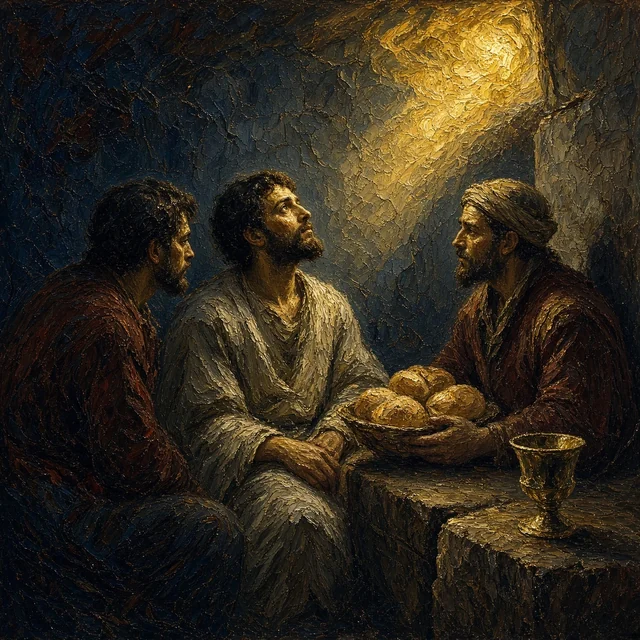
Potiphar imprisons Joseph. The Book of Genesis does not resolve every question about the master's motives or knowledge. Instead, it repeats that the Lord is with Joseph, who gains the jailer's trust. Divine favor has not prevented injustice or immediate loss.
Deep dive
Potiphar's anger is recorded, but Genesis does not identify its precise object or give a private assessment of his wife's credibility. The claim that he secretly knew Joseph was innocent goes beyond these verses. What the text does establish is that he puts Joseph in the prison where the king's prisoners are kept. The charge has consequences even though the reader knows it is false. Joseph's responsible service in one institution has not prevented his removal to another.
The closing account deliberately resembles the opening. The Lord is with Joseph; a superior grants him favour; responsibility passes into his hand; the superior no longer needs to supervise the details. Yet the repetition happens in a prison, not in a restored household appointment. There is no public clearing of his name in this chapter. Divine presence and continuing confinement remain together in the same account. Genesis does not have to call the accusation just in order to describe Joseph's work as prospering, nor does it make prosperity another word for having been set free.
Words to trace: prison, keeper, LORD, hand, Joseph’s, master
Verse-by-verse path
- Genesis 39:19
“His wrath was kindled” is literally “his nose burned”, the Hebrew idiom for anger. She closes with “thy servant”, making the offence one against Potiphar’s own authority: the servant he trusted with everything.
- Genesis 39:20
The prison is beit hassohar, “the round house”, a term found only in the Joseph chapters. Psalm 105:18 remembers it harshly: “Whose feet they hurt with fetters: he was laid in iron.” For a slave accused of assaulting his master’s wife, prison rather than death is a mild sentence, but Genesis gives no reason for it.
- Genesis 39:21
“Shewed him mercy” is chesed, steadfast kindness, the loyalty of a covenant partner. It is the first time the word is used of God’s dealing with Joseph. “Favour” is chen again, the grace of verse 4, now found with a jailer.
- Genesis 39:22
The Hebrew is stronger than the KJV: whatever was done there, “he was the one doing it”. The prison is run by a prisoner. That places Joseph where he will meet Pharaoh’s own officers in the next chapter.
- Genesis 39:23
The keeper “looked not” at anything in Joseph’s charge, as Potiphar knew nothing beyond his bread (verse 6). The chapter closes on the LORD making Joseph prosper, and after this the divine name falls silent in the Joseph chapters until Jacob’s blessing of Dan (49:18).
Genesis 39:19-23
King James Version19And it came to pass, when his master heard the words of his wife, which she spake unto him, saying, After this manner did thy servant to me; that his wrath was kindled.
20And Joseph’s master took him, and put him into the prison, a place where the king’s prisoners were bound: and he was there in the prison.
21But the LORD was with Joseph, and shewed him mercy, and gave him favour in the sight of the keeper of the prison.
22And the keeper of the prison committed to Joseph’s hand all the prisoners that were in the prison; and whatsoever they did there, he was the doer of it.
23The keeper of the prison looked not to any thing that was under his hand; because the LORD was with him, and that which he did, the LORD made it to prosper.
Questions to keep in mind while reading
- Track who acts, who speaks, who is affected, and what changes.
- Notice repeated promises, failures, rescues, and consequences.
- Do not assume the account approves every action that is reported.
Text first
Where readers differ
The chapter summary begins with what the passage says and how its parts fit together. It does not assume one denomination has already settled every question. Where a conclusion depends on a tradition, literary theory, or historical reconstruction, that dependence is named openly.
The KJV text is presented first. Interpretive conclusions are labeled, and differences are introduced only when they help a reader understand why serious communities do not always reach the same answer.
Do not teach that integrity guarantees quick vindication or that a victim is responsible for another person's coercion. Joseph does the right thing and still suffers a false accusation.
Questions beneath the surface
- What account of God, human freedom, responsibility, and the good life emerges from Genesis 39?
- Which tension does the chapter refuse to resolve quickly, especially around integrity, power and vulnerability, presence?
- What changes when the chapter is read as part of the whole canon rather than as an isolated moral lesson?
- Where might a sincere reader confuse a familiar tradition with something the text states directly?
Questions for serious personal contemplation
These open-ended questions make room for tension, honest response, prayer, and conclusions that remain accountable to the chapter.
Observe without rushing
What part of Genesis 39 makes you stop, feel unsettled, or feel surprised, and why?
Which detail in the passage would be easiest to overlook? How does that detail change your understanding?
Where do you see tension between what happens and this focus: Integrity under unequal power?
What important question does the passage leave open instead of resolving quickly?
Examine your inner life honestly
Which person, response, fear, or desire in the passage feels most like your own life right now?
What assumption about God, other people, or yourself does this text challenge?
Which part would you rather soften, avoid, or explain away too quickly? What might that reaction reveal?
If this Scripture could ask you one direct question, what do you think it would ask?
Respond with wisdom and courage
What do you need to remember, confess, grieve, thank God for, or trust after reading this passage?
How might another faithful person read this situation differently without ignoring the text?
What obedient response would be costly, uncomfortable, or slow, yet still faithful to Scripture?
What question will you carry into prayer this week, and which verses will you keep in front of you?
Music and video connected to the passage
Related media appears when its Scripture reference overlaps this study. Music and video can illuminate a theme while the biblical text remains the foundation.