The big picture
The final oracle against Babylon gathers image after image because the empire’s apparent permanence has to be dismantled from every angle. A destroying wind scatters it, a golden cup that intoxicated nations cannot heal itself, many waters and abundant treasure are set beside the Creator who brings wind from his own treasures, and the destroying mountain is rolled down. Named coalitions assemble while Babylon’s defenders stay in their holds and messengers run toward the king with news he cannot reverse. Zion is allowed to name what Nebuchadnezzar did to her, and the LORD answers, “I will plead thy cause.” The people are told to leave Babylon while remembering Jerusalem from far away. At last Seraiah reads the written judgment, weights the scroll with a stone, and casts it into the Euphrates, turning Babylon’s announced sinking into a performed sign.
In this chapter
- The Golden Cup Cannot Heal Itself Jeremiah 51:1-10
Babylon has been a golden cup in the LORD’s hand, impressive and effective enough to make nations drunk, but the vessel’s usefulness does not make it untouchable.
- Treasures of Water, Treasures of Wind Jeremiah 51:11-19
Babylon’s apparent security is made of things that look substantial: walls, watchmen, many waters, and abundant treasures.
- The Battle Axe and the Burnt Mountain Jeremiah 51:20-26
The repeated words “with thee” and “break in pieces” make this section sound like blow after blow.
- Messengers Running Through a Failing City Jeremiah 51:27-33
Outside Babylon, preparation is organized and named: Ararat, Minni, Ashchenaz, and the kings of the Medes are summoned, standards rise, trumpets sound, captains are appointed, and horses advance.
- Zion Names What Was Done to Her Jeremiah 51:34-40
Jerusalem is finally allowed to speak the violence done to her in the first person.
- The God Must Release What He Swallowed Jeremiah 51:41-44
“Sheshach” does not hide Babylon from the reader, because Babylon is named in the same breath.
- Jerusalem Remembered from Far Away Jeremiah 51:45-53
Leaving Babylon is made difficult not only by danger but by rumor.
- The Great Voice Falls Silent Jeremiah 51:54-58
Babylon’s “great voice” has sounded across nations, but now the sound coming from the city is a cry of destruction.
- The Word Goes Under, but Not Into Silence Jeremiah 51:59-64
The oracle against Babylon ends not with another army but with a book, a stone, and a river.

Scripture beside the summary
Jeremiah · King James Version · 64Jeremiah 51:1-10
The Golden Cup Cannot Heal Itself
Babylon has been a golden cup in the LORD’s hand, impressive and effective enough to make nations drunk, but the vessel’s usefulness does not make it untouchable. A destroying wind and fanners now empty the land, while archers and fallen soldiers show that the threshing language has become military. The Book of Jeremiah places this judgment beside a crucial statement about Israel and Judah: they have not been forsaken even though their land was filled with sin. Preservation does not require rewriting the charges already made against them. The captives are told to flee because Babylon’s own iniquity has reached its appointed reckoning. Then the cup that intoxicated others becomes a patient that cannot be healed. Balm is proposed, but healing fails, and those around Babylon decide to return to their own countries. Another voice turns toward Zion to declare what the LORD has done.
Deep dive
The destroying wind is followed by fanners who empty the land. The movement is not gentle sorting but the dispersal of a country, immediately joined to archers and fallen soldiers. Against that judgment stands the statement that Israel and Judah have not been forsaken, even though the King James wording acknowledges a land filled with sin. Preservation does not depend on pretending that the accusations against Judah were false.
Babylon's earlier usefulness is pictured as a golden cup in the LORD's hand. Gold makes the vessel impressive; the wine makes nations drunk. Being held and used does not guarantee that the vessel itself will escape the reckoning. It falls suddenly, and the attempt to find balm recalls the failed remedy for Egypt in chapter 46.
The voices now separate. Those who would have healed Babylon declare the effort unsuccessful and return to their countries. Another voice announces vindication in Zion. The passage moves between lament, withdrawal, and public testimony rather than supplying one uninterrupted speech by a single newly identified person.
Words to trace: Babylon, LORD, healed, land, drunken, Israel
Verse-by-verse path
- Jeremiah 51:1
“Them that rise up against me” renders the Hebrew leb qamai, which is a cipher: swap each letter for its mirror in the alphabet and it spells Kasdim, Chaldeans, which is what the Greek prints. The “destroying wind” can also be read “the spirit of a destroyer”, preparing for the spirit stirred in the kings of the Medes (verse 11).
- Jeremiah 51:2
“Fanners” are winnowers, who toss grain into the wind so the chaff blows off. The Hebrew consonants can also be read zarim, strangers, and both senses fit: foreigners will come and winnow Babylon. The picture of the chapter’s opening is harvest, and it returns at the threshing floor of verse 33.
- Jeremiah 51:3
The Hebrew of the first clause is confused, and as written it seems to say “let not the archer bend his bow”; most translations follow the marginal reading or emend it. The King James makes sense of it as archer against archer, bowman against armoured man.
- Jeremiah 51:4
“Thrust through” is meduqqarim, the pierced, the same word as the wounded men lying in their tents in 37:10. There Jeremiah said even pierced Babylonians would rise and burn Jerusalem. Here the pierced lie in Babylon’s own streets.
- Jeremiah 51:5
“Hath not been forsaken” translates alman, widowed: Israel has not been left a widow by its God. Isaiah 54:4–6 uses the same picture, a wife called back. The verse admits the land was full of guilt and still refuses to call the marriage over.
- Jeremiah 51:6
“Deliver every man his soul” means save your life, the urgency of the angels to Lot, “Escape for thy life” (Genesis 19:17). Babylon has already been compared to Sodom (50:40). Those who stay risk being “cut off in her iniquity”, caught in a punishment not meant for them.
- Jeremiah 51:7
In 25:15–26 Jeremiah handed the cup of wrath to the nations, and the king of Sheshach, Babylon, was to drink last. Here Babylon is both the cup in God’s hand and, in the verses that follow, a drinker made drunk. Gold makes the cup splendid; it does nothing to change what is in it.
- Jeremiah 51:8
“Suddenly fallen” matches the cry of Isaiah 21:9, “Babylon is fallen, is fallen”. The balm offered here has been offered before, to Judah in 8:22 and to Egypt in 46:11, and it has failed each time.
- Jeremiah 51:9
“Her judgment reacheth unto heaven” recalls the first Babel, whose builders wanted a tower “whose top may reach unto heaven” (Genesis 11:4). What reaches the sky this time is the city’s guilt. The healers give up and go home, “every one into his own country”.
- Jeremiah 51:10
“Our righteousness” is plural in Hebrew, tsidqotenu, our vindications: God has shown publicly that his people’s cause was just. It echoes the name “The LORD our righteousness” of 23:6 and 33:16. The first thing the vindicated do is go and tell it in Zion.
Jeremiah 51:1-10
King James Version1Thus saith the LORD; Behold, I will raise up against Babylon, and against them that dwell in the midst of them that rise up against me, a destroying wind;
2And will send unto Babylon fanners, that shall fan her, and shall empty her land: for in the day of trouble they shall be against her round about.
3Against him that bendeth let the archer bend his bow, and against him that lifteth himself up in his brigandine: and spare ye not her young men; destroy ye utterly all her host.
4Thus the slain shall fall in the land of the Chaldeans, and they that are thrust through in her streets.
5For Israel hath not been forsaken, nor Judah of his God, of the LORD of hosts; though their land was filled with sin against the Holy One of Israel.
6Flee out of the midst of Babylon, and deliver every man his soul: be not cut off in her iniquity; for this is the time of the LORD’s vengeance; he will render unto her a recompence.
7Babylon hath been a golden cup in the LORD’s hand, that made all the earth drunken: the nations have drunken of her wine; therefore the nations are mad.
8Babylon is suddenly fallen and destroyed: howl for her; take balm for her pain, if so be she may be healed.
9We would have healed Babylon, but she is not healed: forsake her, and let us go every one into his own country: for her judgment reacheth unto heaven, and is lifted up even to the skies.
10The LORD hath brought forth our righteousness: come, and let us declare in Zion the work of the LORD our God.
Jeremiah 51:11-19
Treasures of Water, Treasures of Wind
Babylon’s apparent security is made of things that look substantial: walls, watchmen, many waters, and abundant treasures. The kings of the Medes are named among the forces raised against that security, and even strengthened watches and prepared ambushes cannot undo what the LORD has “devised and done.” Then the Book of Jeremiah opens the scale far beyond the city. Babylon may live beside water and store treasure, but the Creator establishes the world, raises vapors, makes lightning with rain, and brings wind “out of his treasures.” The repeated word makes the contrast exact. Babylon has wealth; the LORD has wind, water, and the created order from which the city’s environment comes. Against that living power stand graven images with no breath in them. The founder can shape metal, but skill cannot manufacture a living defender for the empire that trusts the result.
Deep dive
The oracle names the kings of the Medes, making the approaching threat more specific than an unnamed force from the north. The reason given is again the vengeance of the temple. Watchmen, walls, and preparations cannot cancel what the LORD has devised. Babylon is addressed as dwelling on many waters and possessing abundant treasures, both features of its apparent security.
The creation passage then places those possessions in a wider frame. The LORD forms the earth, establishes the world, and brings wind from his own "treasures". Babylon has wealth beside waters; the Creator commands the waters above and the movement of the wind. The repetition makes the contrast sharper than a general statement that one power is greater than another.
The founder's image has no breath. Craftsmanship can produce a valuable object without producing a living defender. The closing name, "the portion of Jacob", identifies Israel's God through relationship as well as creative power. The people in captivity belong to the former of all things, not to a deity whose continued existence depends on the survival of a metal image.
Words to trace: LORD, Babylon, earth, hosts, image, treasures
Verse-by-verse path
- Jeremiah 51:11
“Make bright the arrows” means polish or sharpen them. “Shields” renders shelatim, whose exact meaning is disputed; some think quivers. Cyrus the Persian had absorbed Media by 550 BC, and Isaiah 13:17 also names the Medes against Babylon. Babylon knew its northern enemy by that name.
- Jeremiah 51:12
The commands to the defenders are irony: raise the standard, double the watch, post the sentries, set ambushes, all of it useless. “Devised” is zamam, to plan with intent. The LORD has planned and carried out; Babylon can only take up positions.
- Jeremiah 51:13
“Many waters” are the Euphrates and its web of canals, “the rivers of Babylon” of Psalm 137:1. “The measure of thy covetousness” is literally “the cubit of thy cutting off”, the weaver’s moment when the thread is cut at its length, as in Isaiah 38:12, “I have cut off like a weaver my life”.
- Jeremiah 51:14
“Sworn by himself” is literally “by his soul”, as in Amos 6:8. The “caterpillers” are yeleq, locusts in the hopping stage (Joel 1:4). “A shout” is hedad, the grape treaders’ cry that fell silent over Moab in 48:33; now the treaders are coming to Babylon.
- Jeremiah 51:15
Verses 15 to 19 repeat 10:12–16 almost word for word, a hymn Jeremiah first set against the idols of the nations. Power, wisdom and understanding are the triad of Proverbs 3:19, “The LORD by wisdom hath founded the earth”. Placed here, the hymn stands against Babylon’s own gods.
- Jeremiah 51:16
“Vapours from the ends of the earth” are clouds rising from the horizon, and Psalm 135:7 has the same line. “Wind” is ruach, and so is “breath” in the next verse: God brings ruach out of his storehouses, while the idols have no ruach in them at all.
- Jeremiah 51:17
“Brutish” is niv’ar, as stupid as cattle, from the word for beast. The “founder” is the metalworker who casts the image, put to shame by his own product. “No breath in them” was the charge of 10:14, and the next verse gives the idols the name hevel, vapour.
- Jeremiah 51:18
“Vanity” is hevel, breath or vapour, the word of Ecclesiastes. “The work of errors” is literally a work of mockeries, objects to be laughed at. “In the time of their visitation” means when they are called to account, and there will be nothing there to answer.
- Jeremiah 51:19
“The portion of Jacob” recalls Deuteronomy 32:9, “the LORD’s portion is his people; Jacob is the lot of his inheritance.” The Hebrew here lacks the word “Israel”, which the parallel in 10:16 has; the King James supplies it from there, so the tribe itself becomes the rod.
Jeremiah 51:11-19
King James Version11Make bright the arrows; gather the shields: the LORD hath raised up the spirit of the kings of the Medes: for his device is against Babylon, to destroy it; because it is the vengeance of the LORD, the vengeance of his temple.
12Set up the standard upon the walls of Babylon, make the watch strong, set up the watchmen, prepare the ambushes: for the LORD hath both devised and done that which he spake against the inhabitants of Babylon.
13O thou that dwellest upon many waters, abundant in treasures, thine end is come, and the measure of thy covetousness.
14The LORD of hosts hath sworn by himself, saying, Surely I will fill thee with men, as with caterpillers; and they shall lift up a shout against thee.
15He hath made the earth by his power, he hath established the world by his wisdom, and hath stretched out the heaven by his understanding.
16When he uttereth his voice, there is a multitude of waters in the heavens; and he causeth the vapours to ascend from the ends of the earth: he maketh lightnings with rain, and bringeth forth the wind out of his treasures.
17Every man is brutish by his knowledge; every founder is confounded by the graven image: for his molten image is falsehood, and there is no breath in them.
18They are vanity, the work of errors: in the time of their visitation they shall perish.
19The portion of Jacob is not like them; for he is the former of all things: and Israel is the rod of his inheritance: the LORD of hosts is his name.
Jeremiah 51:20-26
The Battle Axe and the Burnt Mountain
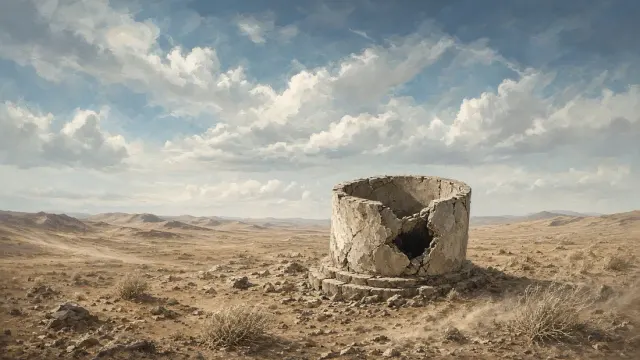
The repeated words “with thee” and “break in pieces” make this section sound like blow after blow. Nations, kingdoms, horses, riders, chariots, men, women, old, young, workers, flocks, captains, and rulers all enter the sequence. Yet the identity of the addressed “battle axe” is not supplied plainly enough to deserve an invented certainty. Interpreters have connected the weapon with Babylon, with the force raised against Babylon, or with Israel named just before. The Book of Jeremiah leaves the pronoun unnamed in the passage itself. What becomes unmistakable in the next lines is Babylon’s accountability for evil done in Zion. The empire is then called a “destroying mountain,” not because the city sits on a literal mountain, but because its power has towered destructively over others. That mountain is rolled down and burned, leaving no foundation stone for rebuilding the same structure.
Deep dive
The repeated "with thee" and "break in pieces" supply the rhythm of successive blows. Nations and kingdoms are followed by horses, chariots, families, generations, workers, and rulers. The list carries destruction out of a military abstraction and across the whole social order.
The identity of the "battle axe" is not named in the address. One reading takes it as Babylon, the instrument already called a hammer in chapter 50. Another takes it as the power raised to overthrow Babylon, often identified by interpreters with Cyrus and the Medo-Persian forces. A further reading connects it with Israel, named immediately before. The shifts of address and the tense of the Hebrew verbs have contributed to the disagreement. The King James future wording does not remove the unnamed pronoun.
What follows is less obscure: Babylon will receive an answer for the evil done in Zion. The "destroying mountain" is a figure for that overwhelming power, not a claim about Babylon's physical elevation. It is rolled down and burned, with no stone taken for a new foundation. The image denies the fallen power even the appearance of simply supplying the materials for its own reconstruction.
Words to trace: break, pieces, LORD, mountain, rider, stone
Verse-by-verse path
- Jeremiah 51:20
The “battle axe” is mappets, a shatterer, a war club, from the verb naphats, to break in pieces, which follows in the same verse. The noun and the verb are the same word. The word of God in 23:29 was a hammer that “breaketh the rock in pieces” with this same verb.
- Jeremiah 51:21
“The horse and his rider” is the phrase of the Song of the Sea, “the horse and his rider hath he thrown into the sea” (Exodus 15:1). The chariot and its driver follow. The drill of “break in pieces” is Israel’s oldest victory song put to new use.
- Jeremiah 51:22
The pairs, man and woman, old and young, young man and maid, are a way of saying everyone. Across verses 20 to 23 the verb “break in pieces” sounds nine times, one hammer stroke to each group, a chant built on repetition.
- Jeremiah 51:23
The shepherd with his flock and the ploughman with his yoke of oxen are the working countryside. “Captains and rulers” are pachot and seganim, both borrowed from Babylonian administrative titles, governors and prefects. The sequence runs from pasture to palace.
- Jeremiah 51:24
“In your sight” switches the address to the exiles, in the plural: they will watch the repayment. The measure is specific, “all their evil that they have done in Zion”, the burning of the city and the temple, which some of the listeners had witnessed.
- Jeremiah 51:25
“Destroying mountain” is har hammashchit, the same phrase the King James renders “mount of corruption” in 2 Kings 23:13, where Solomon’s shrines to foreign gods stood facing Jerusalem. Babylon’s temple tower was a man-made mountain of brick; God will make it a burnt-out cone.
- Jeremiah 51:26
Babylonian kings took pride in rebuilding temples on their old foundations; Nabonidus records digging for the foundation inscriptions of earlier kings. The verse denies Babylon even that: not a corner stone, not a foundation stone, will be reused.
Jeremiah 51:20-26
King James Version20Thou art my battle axe and weapons of war: for with thee will I break in pieces the nations, and with thee will I destroy kingdoms;
21And with thee will I break in pieces the horse and his rider; and with thee will I break in pieces the chariot and his rider;
22With thee also will I break in pieces man and woman; and with thee will I break in pieces old and young; and with thee will I break in pieces the young man and the maid;
23I will also break in pieces with thee the shepherd and his flock; and with thee will I break in pieces the husbandman and his yoke of oxen; and with thee will I break in pieces captains and rulers.
24And I will render unto Babylon and to all the inhabitants of Chaldea all their evil that they have done in Zion in your sight, saith the LORD.
25Behold, I am against thee, O destroying mountain, saith the LORD, which destroyest all the earth: and I will stretch out mine hand upon thee, and roll thee down from the rocks, and will make thee a burnt mountain.
26And they shall not take of thee a stone for a corner, nor a stone for foundations; but thou shalt be desolate for ever, saith the LORD.
Jeremiah 51:27-33
Messengers Running Through a Failing City
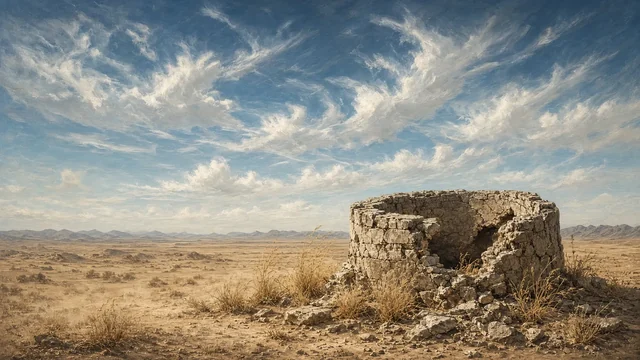
Outside Babylon, preparation is organized and named: Ararat, Minni, Ashchenaz, and the kings of the Medes are summoned, standards rise, trumpets sound, captains are appointed, and horses advance. Inside the city, the picture runs the other direction. Mighty men stop fighting, remain in their strongholds, and discover that the title “mighty” cannot make strength continue. The Book of Jeremiah then gives the fall to runners. One messenger meets another, each bringing the king another piece of bad news: the city is taken at one end, crossings are stopped, reeds burn, and soldiers are afraid. Royal authority is reduced to receiving reports about an outcome it can no longer reverse. The final image gathers the section into harvest language. Babylon is a threshing floor awaiting the appointed work, and “yet a little while” points to an approaching season rather than supplying a numerical timetable.
Deep dive
Ararat, Minni, Ashchenaz, and the Medes turn the assembling host into a named coalition. Standards, trumpet, captains, and horses belong to a coordinated preparation against the city. Inside Babylon, by contrast, the mighty remain in their strongholds and their strength fails. The reversal is not a shortage of impressive titles; it is the collapse of the activity those titles imply.
The running couriers give the fall a rapidly narrowing scale. The oracle has moved from nations and kingdoms to one messenger meeting another with news of the city's breach, blocked crossings, burned reeds, and frightened soldiers. The king is receiving information about an outcome that his office can no longer prevent.
The threshing floor returns to the agricultural imagery with which the chapter opened. Babylon is now the place prepared for the blow and the crop awaiting its appointed harvest. The phrase "yet a little while" belongs to the oracle's announcement of an approaching time; it is not a numerical interval from which a separate chronology can be calculated.
Words to trace: Babylon, land, nations, burned, LORD, meet
Verse-by-verse path
- Jeremiah 51:27
Ararat is Urartu, around Lake Van; Minni the Mannaeans south of Lake Urmia; Ashchenaz the Scythians, called Ishkuza in Assyrian texts and listed among Japheth’s descendants (Genesis 10:3). “Rough caterpillers” are bristly young locusts, with spines, massed and advancing.
- Jeremiah 51:28
“The land of his dominion” is singular, the realm of the Median king. By the early sixth century the Medes had brought Urartu and the Mannaeans into their orbit, so the list of verse 27 names Media’s own subject peoples: one coalition under one crown.
- Jeremiah 51:29
“Tremble and sorrow” uses a verb for writhing in labour. “Every purpose… shall be performed” is literally “shall stand”, the same verb as the challenge in 44:28, “whose words shall stand, mine, or theirs”. Babylon’s own plans are not mentioned.
- Jeremiah 51:30
“Her bars are broken” echoes the promise to Cyrus in Isaiah 45:2, “I will break in pieces the gates of brass, and cut in sunder the bars of iron.” “Forborn to fight” is a striking detail: soldiers sitting in their strongholds while the city goes up in flames around them.
- Jeremiah 51:31
A “post” is a runner, the royal courier (2 Chronicles 30:6, Esther 3:13). Runners coming from opposite directions meet on the way to the palace, each with the same news. “At one end” means the city is taken from its edge; Babylon was so vast that one quarter could fall while another had not heard.
- Jeremiah 51:32
“The passages” are the fords and ferry crossings of the river. “The reeds” translates agammim, marshes or reed beds; burning the reed thickets was a way to flush out anyone hiding. Every exit from the city is shut or on fire.
- Jeremiah 51:33
“It is time to thresh her” is literally “time to tread her”, the stamping that hardened a threshing floor before the harvest was brought in. Micah 4:12–13 pictures nations gathered “as the sheaves into the floor”. Babylon is being flattened ready for the grain.
Jeremiah 51:27-33
King James Version27Set ye up a standard in the land, blow the trumpet among the nations, prepare the nations against her, call together against her the kingdoms of Ararat, Minni, and Ashchenaz; appoint a captain against her; cause the horses to come up as the rough caterpillers.
28Prepare against her the nations with the kings of the Medes, the captains thereof, and all the rulers thereof, and all the land of his dominion.
29And the land shall tremble and sorrow: for every purpose of the LORD shall be performed against Babylon, to make the land of Babylon a desolation without an inhabitant.
30The mighty men of Babylon have forborn to fight, they have remained in their holds: their might hath failed; they became as women: they have burned her dwellingplaces; her bars are broken.
31One post shall run to meet another, and one messenger to meet another, to shew the king of Babylon that his city is taken at one end,
32And that the passages are stopped, and the reeds they have burned with fire, and the men of war are affrighted.
33For thus saith the LORD of hosts, the God of Israel; The daughter of Babylon is like a threshingfloor, it is time to thresh her: yet a little while, and the time of her harvest shall come.
Jeremiah 51:34-40
Zion Names What Was Done to Her
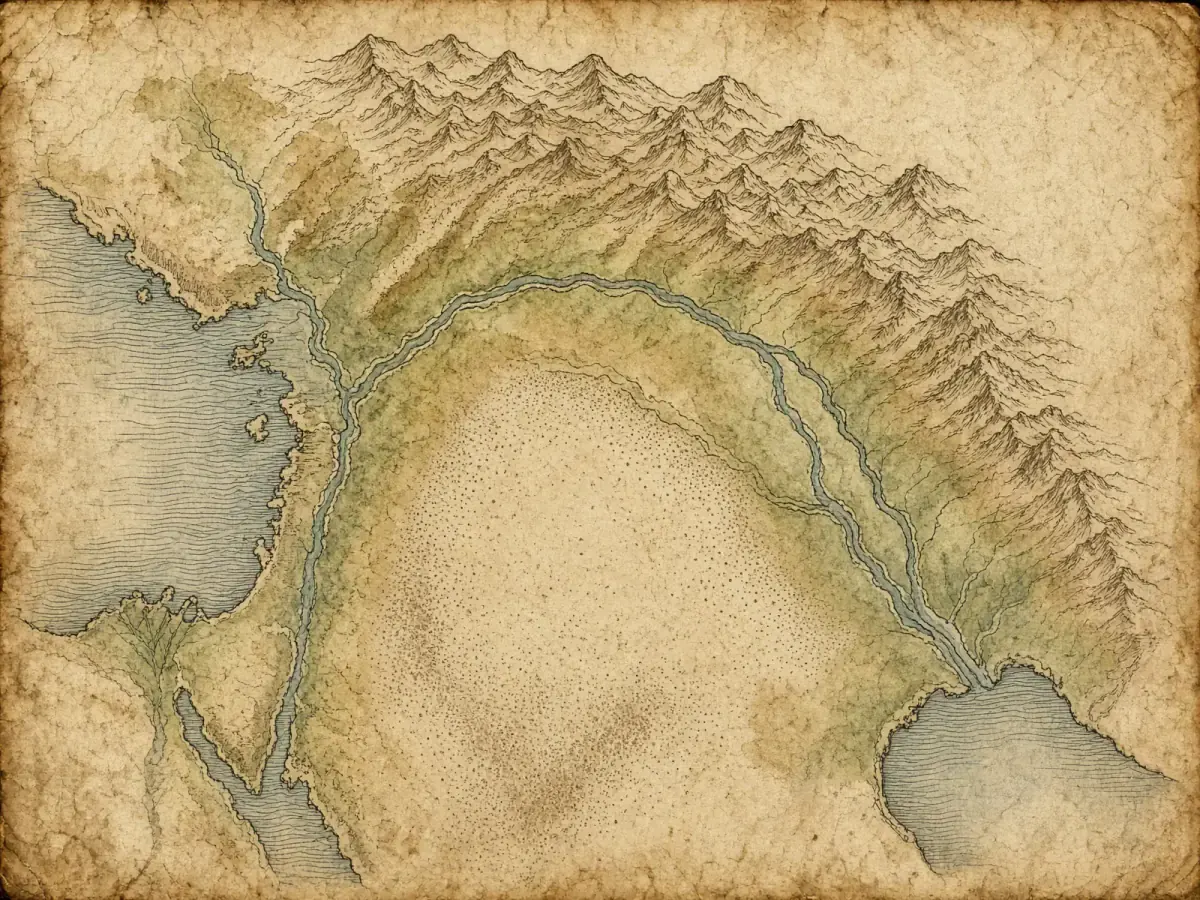
Jerusalem is finally allowed to speak the violence done to her in the first person. Nebuchadrezzar has devoured, crushed, emptied, swallowed, and cast her out. The images are bodily and predatory because the complaint comes from the side that has been consumed, not from an observer describing imperial success. Then Zion and Jerusalem name the violence and blood directly, and the response answers them directly: “I will plead thy cause.” The Book of Jeremiah uses the same legal language that appeared with the strong Redeemer in chapter 50, but here it stands immediately beside the injured city’s complaint. Babylon’s own animal imagery is then reversed. Its people roar like lions, but the judgment brings them down like lambs, rams, and goats to slaughter. Even the feast turns against them as drunkenness ends in a “perpetual sleep,” making the predator’s confidence collapse into helplessness.
Deep dive
The first-person complaint receives its identification in the next verse: the inhabitant of Zion and Jerusalem are speaking. Nebuchadnezzar is named rather than left as a symbolic predator without a historical referent. The empty vessel and the swallowing creature describe conquest from the position of the people whose substance has been taken.
The reply is explicitly responsive: "I will plead thy cause". It answers the complaint about violence and blood rather than introducing an unrelated reason for judgment. The same legal language used for the strong Redeemer in chapter 50 now stands directly beside the injured city's appeal.
Babylon's inhabitants roar like lions, but the final comparison makes them lambs, rams, and goats led to slaughter. Their apparent role as predators has reversed. The feast and drunkenness lead to a sleep from which they do not wake, an image of death rather than ordinary rest. These details belong to the oracle's depiction of judgment; the passage does not identify this feast with a named king's later banquet or supply a separate account of its guests.
Words to trace: Babylon, inhabitant, lions, LORD, sleep, astonishment
Verse-by-verse path
- Jeremiah 51:34
Now Zion speaks. “Swallowed me up like a dragon” uses tannin, a sea monster. “He hath cast me out” is literally “he hath rinsed me out”, like a bowl emptied and rinsed, matching “an empty vessel”. The Hebrew text wavers between “me” and “us” in these verbs.
- Jeremiah 51:35
“Be upon Babylon” is the formula of blood-guilt, as David said to the Amalekite, “Thy blood be upon thy head” (2 Samuel 1:16). “My flesh” may mean my kin. Zion and Jerusalem each bring a charge, the way a plaintiff states a case in court.
- Jeremiah 51:36
“Dry up her sea” may point to the great river or the lake and reservoir works around the city. Isaiah 44:27–28 sets side by side the God who says “to the deep, Be dry” and the one who says of Cyrus, “He is my shepherd”.
- Jeremiah 51:37
In 9:11 God said, “I will make Jerusalem heaps, and a den of dragons.” The same two words, heaps and dragons, jackals in the Hebrew, are now applied to Babylon. The sentence passed on Jerusalem is passed on the city that carried it out.
- Jeremiah 51:38
In 2:15 the young lions “roared upon” Israel and “yelled”, laying the land waste. The same verbs return: Babylon’s men roar and growl like young lions, but, as the next verses show, they are lions about to be fed a meal that kills them.
- Jeremiah 51:39
“In their heat” means inflamed with wine and appetite, as Hosea 7:4–7 describes drunken courtiers “hot as an oven”. “That they may rejoice” reads in the Greek “that they may be stupefied”. The “perpetual sleep” is death, a sleep with no morning.
- Jeremiah 51:40
Lambs, rams and he-goats are sacrificial animals, as in the great sacrifice at Bozrah in Isaiah 34:6, “the blood of lambs and goats… the fat of the kidneys of rams”. The lions of verse 38 end as sheep.
Jeremiah 51:34-40
King James Version34Nebuchadrezzar the king of Babylon hath devoured me, he hath crushed me, he hath made me an empty vessel, he hath swallowed me up like a dragon, he hath filled his belly with my delicates, he hath cast me out.
35The violence done to me and to my flesh be upon Babylon, shall the inhabitant of Zion say; and my blood upon the inhabitants of Chaldea, shall Jerusalem say.
36Therefore thus saith the LORD; Behold, I will plead thy cause, and take vengeance for thee; and I will dry up her sea, and make her springs dry.
37And Babylon shall become heaps, a dwellingplace for dragons, an astonishment, and an hissing, without an inhabitant.
38They shall roar together like lions: they shall yell as lions’ whelps.
39In their heat I will make their feasts, and I will make them drunken, that they may rejoice, and sleep a perpetual sleep, and not wake, saith the LORD.
40I will bring them down like lambs to the slaughter, like rams with he goats.
Jeremiah 51:41-44
The God Must Release What He Swallowed
“Sheshach” does not hide Babylon from the reader, because Babylon is named in the same breath. The alternate name, commonly explained through the Hebrew letter-pairing device called Atbash, sits beside the ordinary name while the oracle concentrates on reversal: the city once praised across the earth becomes an astonishment. The Book of Jeremiah then places flood and drought-like emptiness next to one another without needing them to describe the same weather. The sea overwhelming Babylon pictures irresistible defeat; the dry, deserted cities picture what remains when habitation is gone. The final image reaches into religion and plunder at once. Bel is punished and forced to bring out of his mouth what he has swallowed. That answers Nebuchadrezzar’s earlier swallowing of Zion. The empire and its god cannot permanently keep what conquest gathered, and even the nations that once flowed toward Babylon cease their movement.
Deep dive
Sheshach stands in parallel with Babylon in the same verse. It is commonly explained as an Atbash form of the Hebrew name Babel, made by pairing letters from opposite ends of the alphabet. The naming is not effective concealment here, because Babylon is named immediately alongside it. The emphasis rests on the celebrated city's reversal, not on withholding its identity.
The flood and the dry wilderness follow one another as images of ruin. They need not be combined into a single description of the city's weather. Overwhelming waters show defeat arriving without containment; the dry, empty land shows habitation gone.
Bel's mouth then answers the earlier image of Nebuchadnezzar swallowing Zion. What the imperial power consumed will not remain securely inside its god's possession. The nations stop flowing toward Bel, and the wall falls. Religious attraction, accumulated plunder, and physical protection are dismantled in the same closing movement. The oracle has not merely exchanged one military boast for another; it has challenged what Babylon claims the right to retain.
Words to trace: Babylon, land, nations, astonishment, become, cities
Verse-by-verse path
- Jeremiah 51:41
Sheshach appeared first in 25:26, where “the king of Sheshach shall drink after them”, the last to take the cup. It uses the same letter cipher as verse 1: B-B-L, Babel, becomes Sh-Sh-K. Here the code and the plain name stand side by side.
- Jeremiah 51:42
“The sea” is the invading army, roaring like the sea as in 6:23 and 50:42. A city built on rivers and canals, defended by water, is pictured going under water of another kind.
- Jeremiah 51:43
“A dry land, and a wilderness” uses tsiyyah and aravah, the words of 2:6 for the wilderness through which God led Israel out of Egypt, “a land of deserts… a land of drought”. The captor’s land becomes the desert of the exodus.
- Jeremiah 51:44
In Isaiah 2:2 “all nations shall flow unto” the mountain of the LORD’s house; the verb nahar is related to the word for river. Here the nations stop flowing to Bel. Bel, Marduk, is made to cough up what he swallowed: the plunder, the captives, the temple vessels.
Jeremiah 51:41-44
King James Version41How is Sheshach taken! and how is the praise of the whole earth surprised! how is Babylon become an astonishment among the nations!
42The sea is come up upon Babylon: she is covered with the multitude of the waves thereof.
43Her cities are a desolation, a dry land, and a wilderness, a land wherein no man dwelleth, neither doth any son of man pass thereby.
44And I will punish Bel in Babylon, and I will bring forth out of his mouth that which he hath swallowed up: and the nations shall not flow together any more unto him: yea, the wall of Babylon shall fall.
Jeremiah 51:45-53
Jerusalem Remembered from Far Away
Leaving Babylon is made difficult not only by danger but by rumor. One year brings alarming reports, another year brings more, and violence continues with ruler against ruler. The Book of Jeremiah recognizes a prolonged atmosphere in which repeated news could weaken the heart of people told to depart. Their orientation is therefore expressed through memory: “remember the LORD afar off, and let Jerusalem come into your mind.” Physical distance has not erased belonging. Then the exiles voice the shame of strangers entering the sanctuaries of the LORD’s house. The answer does not deny that humiliation or pretend the temple was untouched. It announces judgment on Babylon’s own graven images and wounded people across its land. Even an imagined ascent to heaven or the fortifying of the highest strength would not place the empire beyond the spoilers the LORD says will come from him.
Deep dive
The command to depart is accompanied by recognition of a prolonged field of alarming reports: one year, another year, violence, ruler against ruler. The oracle does not present the people as needing only a single dramatic signal. It addresses the danger that repeated news will exhaust their resolve or fix their attention inside the land they are told to leave.
The instruction to remember the LORD "afar off" and let Jerusalem come to mind joins physical distance with continued belonging. The next voice speaks of shame because strangers have entered the sanctuary. The answer does not deny that profanation. It announces judgment on Babylon's images, refusing the conclusion that the invader's religious power has thereby been established.
Revelation 18:4 takes up this summons to come out of Babylon, joining departure with refusal to share its sins and plagues. That later use develops the prophetic pattern; it does not remove the Judean exiles and their remembered temple from Jeremiah's immediate address. Here even Babylon's imagined ascent to heaven cannot put it beyond the announced attackers.
Words to trace: Babylon, LORD, land, fall, rumour, slain
Verse-by-verse path
- Jeremiah 51:45
The Greek translation lacks verses 45 to 48, one of its longest omissions in these chapters. The call “My people, go ye out” repeats the summons of verse 6 and 50:8, framing the oracle with the same command given three times.
- Jeremiah 51:46
“Ruler against ruler” fits Babylon after Nebuchadnezzar: his son Evil-merodach was murdered in 560 BC by Neriglissar, whose own son was deposed within months, and Nabonidus spent ten years away in Arabia. Whether the verse has these in view is an inference; it says only that rumours will come year after year.
- Jeremiah 51:47
Babylon gathered gods from other cities into itself. Cyrus’s cylinder inscription boasts that he sent the gods Nabonidus had brought into Babylon back to their own shrines. “Judgment upon the graven images” describes a capital full of idols collected from elsewhere.
- Jeremiah 51:48
Heaven and earth singing at Babylon’s fall is the picture of Isaiah 14:7–8, where at the fall of the king of Babylon “the whole earth is at rest… they break forth into singing: yea, the fir trees rejoice”. Creation, not only Israel, is glad to see the oppressor go.
- Jeremiah 51:49
The Hebrew is compact and can be read “Babylon must fall for the slain of Israel”, which many modern translations follow. Either way the balance is exact: Babylon made Israel’s slain fall, and at Babylon the slain of every land will fall.
- Jeremiah 51:50
Solomon’s prayer foresaw exiles praying “toward their land… and the city which thou hast chosen” (1 Kings 8:48), and Daniel prays with his windows open toward Jerusalem (Daniel 6:10). “Stand not still” means do not linger, and those addressed are survivors, “ye that have escaped the sword”.
- Jeremiah 51:51
Lamentations 1:10 makes the same complaint: “the heathen entered into her sanctuary, whom thou didst command that they should not enter into thy congregation.” “Sanctuaries” is plural, the holy places of the temple. The exiles’ shame is spoken in their own voice, in the first person plural.
- Jeremiah 51:52
“The days come… judgment upon her graven images” repeats the opening of verse 47 almost exactly. The two sentences stand on either side of the exiles’ memory and lament, so that their shame over the temple is enclosed by the promised judgment on Babylon’s gods.
- Jeremiah 51:53
Isaiah 14:13–14 gives the king of Babylon the boast, “I will ascend into heaven… I will be like the most High.” “Fortify the height of her strength” fits the city’s immense walls and temple tower. Neither height nor walls will keep God’s spoilers out.
Jeremiah 51:45-53
King James Version45My people, go ye out of the midst of her, and deliver ye every man his soul from the fierce anger of the LORD.
46And lest your heart faint, and ye fear for the rumour that shall be heard in the land; a rumour shall both come one year, and after that in another year shall come a rumour, and violence in the land, ruler against ruler.
47Therefore, behold, the days come, that I will do judgment upon the graven images of Babylon: and her whole land shall be confounded, and all her slain shall fall in the midst of her.
48Then the heaven and the earth, and all that is therein, shall sing for Babylon: for the spoilers shall come unto her from the north, saith the LORD.
49As Babylon hath caused the slain of Israel to fall, so at Babylon shall fall the slain of all the earth.
50Ye that have escaped the sword, go away, stand not still: remember the LORD afar off, and let Jerusalem come into your mind.
51We are confounded, because we have heard reproach: shame hath covered our faces: for strangers are come into the sanctuaries of the LORD’s house.
52Wherefore, behold, the days come, saith the LORD, that I will do judgment upon her graven images: and through all her land the wounded shall groan.
53Though Babylon should mount up to heaven, and though she should fortify the height of her strength, yet from me shall spoilers come unto her, saith the LORD.
Jeremiah 51:54-58
The Great Voice Falls Silent
Babylon’s “great voice” has sounded across nations, but now the sound coming from the city is a cry of destruction. The Book of Jeremiah turns volume itself into part of the reversal. The great voice is destroyed, bows are broken, and the ability to impose fear at a distance fails together with the weapons that supported it. Then every layer of leadership is drawn into the same drunken sleep: princes, wise men, captains, rulers, and mighty men. None is left standing outside the collapse as the one office strong enough to manage it. Only after naming all those human titles does the passage name “the King, whose name is the LORD of hosts.” Broad walls and high gates follow the rulers into ruin. Their scale records how much labor had been invested in security, which makes the closing weariness sharper: the work remains visible precisely where it proves unable to preserve the city.
Deep dive
The cry from Babylon announces the destruction of its "great voice". A power once heard across the nations now becomes the source of a different sound. The broken bows are the concrete counterpart to that change: the capacity to impose its voice is failing alongside the voice itself.
The drunken sleep returns, this time with princes, wise men, captains, rulers, and mighty men explicitly included. No layer of leadership is reserved as a secure observer of the collapse. The speaking title belongs instead to "the King", the LORD of hosts. Earthly offices are enumerated before that final naming of authority.
The broad walls and high gates complete the descent from impressive scale to wasted labor. What people worked to build is broken or burned, and weariness is left where strength had been invested. The declaration concerns the expenditure that cannot secure the city against this judgment. Its power comes from those named structures and workers, not from turning the sentence into a detached maxim about every human undertaking.
Words to trace: Babylon, LORD, broken, fire, hosts, mighty
Verse-by-verse path
- Jeremiah 51:54
The line answers 50:22, “A sound of battle is in the land, and of great destruction”, so the long oracle is bracketed by the same sound. “Great destruction”, shever gadol, is again the phrase Jeremiah first used of Judah’s ruin from the north (4:6).
- Jeremiah 51:55
“Her waves” are the attackers, crashing like the sea of verse 42 and roaring as in 50:42. The city’s “great voice”, the noise of a capital with its markets, festivals and processions, is silenced, while the enemy’s roar grows louder.
- Jeremiah 51:56
“The LORD God of recompences” is El gemulot, a title found only here, the God of repayments. “Shall surely requite” doubles the verb shallem, the root of shalom: to pay in full, to settle an account completely.
- Jeremiah 51:57
The drunken sleep of verse 39 returns, now naming the whole government: princes, wise men, governors, prefects, warriors. Job 14:12 describes death in the same words: “man lieth down, and riseth not… they shall not awake.” The King who pronounces it is the one who, in Psalm 121:4, “shall neither slumber nor sleep”.
- Jeremiah 51:58
Herodotus (1.178–179) describes Babylon’s walls as broad enough for a four-horse chariot to turn on top, with a hundred bronze gates. The last lines repeat Habakkuk 2:13, “the people shall labour in the very fire, and the people shall weary themselves for very vanity”.
Jeremiah 51:54-58
King James Version54A sound of a cry cometh from Babylon, and great destruction from the land of the Chaldeans:
55Because the LORD hath spoiled Babylon, and destroyed out of her the great voice; when her waves do roar like great waters, a noise of their voice is uttered:
56Because the spoiler is come upon her, even upon Babylon, and her mighty men are taken, every one of their bows is broken: for the LORD God of recompences shall surely requite.
57And I will make drunk her princes, and her wise men, her captains, and her rulers, and her mighty men: and they shall sleep a perpetual sleep, and not wake, saith the King, whose name is the LORD of hosts.
58Thus saith the LORD of hosts; The broad walls of Babylon shall be utterly broken, and her high gates shall be burned with fire; and the people shall labour in vain, and the folk in the fire, and they shall be weary.
Jeremiah 51:59-64
The Word Goes Under, but Not Into Silence
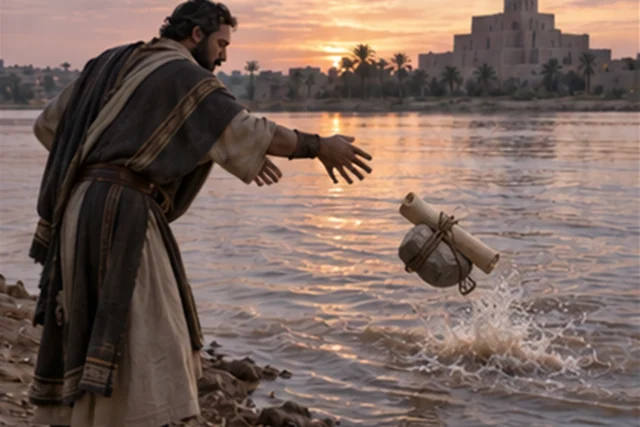
The oracle against Babylon ends not with another army but with a book, a stone, and a river. The date reaches back to Zedekiah’s fourth year, before Jerusalem’s fall, when Seraiah travels to Babylon carrying Jeremiah’s written words. He is to read them there and speak to the LORD about what has been announced against the place. Only after the reading is finished does the physical sign begin. A stone is bound to the scroll, and the weighted writing is cast into the Euphrates. The Book of Jeremiah makes the explanation inseparable from the act: Babylon will sink and not rise from the evil coming upon it. The scroll therefore disappears in service of its message, not in defeat of it. That creates a striking contrast with Jehoiakim’s burning of the earlier scroll, where destruction of the document was an attempt to dismiss the word rather than perform it.
Deep dive
The date returns to Zedekiah's fourth year, before Jerusalem's fall. The chapter's placement after accounts of that fall therefore does not make the commission a later journey. Seraiah is to carry the written declaration to Babylon, read it, and address the LORD concerning what has been spoken against the place. The sign is tied to a text and an explanation, not left as an unexplained object thrown into water.
Seraiah is to attach the stone only after finishing the reading, then cast the scroll into the Euphrates. In the instructed sign, the book sinks because it has been deliberately weighted. Its disappearance is to enact the stated fate of the empire, not retract the scroll's contents. The contrast with Jehoiakim's burning of the scroll in chapter 36 is exact enough to matter: there destruction of the document attempted to dismiss the word, while here the document's sinking serves the word.
Revelation 18:21 takes up the act in the image of a great stone thrown into the sea as a sign of Babylon's fall. Jeremiah closes this commission with "Thus far are the words of Jeremiah". The historical epilogue that follows will return to Jerusalem, not narrate Seraiah's later life or supply an eyewitness account of Babylon's eventual capture.
Words to trace: Babylon, Jeremiah, Seraiah, words, book, evil
Verse-by-verse path
- Jeremiah 51:59
Seraiah is Baruch’s brother: both are sons of Neriah son of Maaseiah (32:12). “A quiet prince” is sar menuchah, “officer of the resting place”, the quartermaster who arranged the king’s halts on a journey. Zedekiah’s fourth year, about 594 BC, is the year Hananiah broke the yoke from Jeremiah’s neck (28:1).
- Jeremiah 51:60
Jeremiah writes this scroll himself; no scribe is named, though Baruch took his dictation in chapter 36. “All these words” refers to the oracle of 50:1 to 51:58. The book that told the exiles to seek Babylon’s peace (29:7) also contained this sentence on Babylon.
- Jeremiah 51:61
“Shalt see” comes before “shalt read”: Seraiah is first to look at the city, then read the oracle in its presence. A sentence read aloud before its subject had legal weight, like a verdict pronounced in the hearing of the condemned.
- Jeremiah 51:62
Seraiah is to turn the oracle into a prayer, speaking it back to God: “O LORD, thou hast spoken”. “Neither man nor beast” is the formula of desolation used over Judah and promised to be reversed in 33:10–12. Now it falls on Babylon.
- Jeremiah 51:63
A scroll alone would float; the stone makes it sink. Jeremiah had once performed another sign at the Euphrates, burying a linen girdle there until it was ruined (13:1–7), a picture of Judah’s pride spoiled. Now the river is used against Babylon itself.
- Jeremiah 51:64
“And they shall be weary” repeats the last words of verse 58, as though marking where the oracle ended. “Thus far are the words of Jeremiah” is an editor’s note, like 48:47: the next chapter is an appendix drawn largely from 2 Kings 24 and 25, not Jeremiah’s own words.
Jeremiah 51:59-64
King James Version59The word which Jeremiah the prophet commanded Seraiah the son of Neriah, the son of Maaseiah, when he went with Zedekiah the king of Judah into Babylon in the fourth year of his reign. And this Seraiah was a quiet prince.
60So Jeremiah wrote in a book all the evil that should come upon Babylon, even all these words that are written against Babylon.
61And Jeremiah said to Seraiah, When thou comest to Babylon, and shalt see, and shalt read all these words;
62Then shalt thou say, O LORD, thou hast spoken against this place, to cut it off, that none shall remain in it, neither man nor beast, but that it shall be desolate for ever.
63And it shall be, when thou hast made an end of reading this book, that thou shalt bind a stone to it, and cast it into the midst of Euphrates:
64And thou shalt say, Thus shall Babylon sink, and shall not rise from the evil that I will bring upon her: and they shall be weary. Thus far are the words of Jeremiah.
Questions to keep in mind while reading
- Identify the historical crisis, covenant failure, warning, and promised hope.
- Distinguish the prophet’s immediate audience from later biblical connections.
- Do not turn present-day headlines into confident fulfillment claims without textual evidence.
Text first
Where readers differ
The chapter summary begins with what the passage says and how its parts fit together. It does not assume one denomination has already settled every question. Where a conclusion depends on a tradition, literary theory, or historical reconstruction, that dependence is named openly.
The KJV text is presented first. Interpretive conclusions are labeled, and differences are introduced only when they help a reader understand why serious communities do not always reach the same answer.
Comparative interpretive notes for this chapter are in preparation. Until reviewed notes are ready, this page separates the KJV text from summary and application without claiming that serious readers agree on every question.
Questions beneath the surface
- What account of God, human freedom, responsibility, and the good life emerges from Jeremiah 51?
- Which tension does the chapter refuse to resolve quickly?
- What changes when the chapter is read as part of the whole canon rather than as an isolated moral lesson?
- Where might a sincere reader confuse a familiar tradition with something the text states directly?
Questions for serious personal contemplation
These open-ended questions make room for tension, honest response, prayer, and conclusions that remain accountable to the chapter.
Observe without rushing
What part of Jeremiah 51 makes you stop, feel unsettled, or feel surprised, and why?
Which detail in the passage would be easiest to overlook? How does that detail change your understanding?
Where do you see tension between what happens and this focus: Jeremiah 51 develops its own movement around Babylon, LORD, land, break, pieces?
What important question does the passage leave open instead of resolving quickly?
Examine your inner life honestly
Which person, response, fear, or desire in the passage feels most like your own life right now?
What assumption about God, other people, or yourself does this text challenge?
Which part would you rather soften, avoid, or explain away too quickly? What might that reaction reveal?
If this Scripture could ask you one direct question, what do you think it would ask?
Respond with wisdom and courage
What do you need to remember, confess, grieve, thank God for, or trust after reading this passage?
How might another faithful person read this situation differently without ignoring the text?
What obedient response would be costly, uncomfortable, or slow, yet still faithful to Scripture?
What question will you carry into prayer this week, and which verses will you keep in front of you?
Music and video connected to the passage
Related media appears when its Scripture reference overlaps this study. Music and video can illuminate a theme while the biblical text remains the foundation.