The big picture
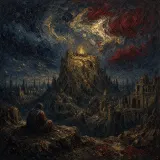
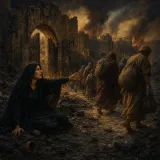
Lamentations 1 makes absence audible. Jerusalem is measured against what used to fill her: people, feasts, allies, children, leaders, food, and honor. Even the roads and gates seem to register what no longer arrives. Yet the city does not remain a distant object under inspection. Her own voice interrupts the description and repeatedly asks the Lord and the surrounding world to look. She acknowledges rebellion and the Lord's righteousness without treating that confession as a reason to minimize captivity, hunger, betrayal, or death. The chapter's controlling ache is the missing comforter. Former lovers fail, enemies rejoice, and no human relationship repairs what has collapsed. The final prayer therefore holds two claims together: Jerusalem's transgressions are real, and the wickedness of those who delight in her ruin is also brought before God.
In this chapter
- A Princess Reduced to Tribute Lamentations 1:1-6
Lamentations opens by making status itself part of the loss.
- Memory Makes the Loss Larger Lamentations 1:7-11
Memory enlarges Jerusalem's misery because it keeps former life present enough to compare.
- A Body Under Fire, Net, and Yoke Lamentations 1:12-15
Jerusalem refuses to let the passing world keep its distance.
- Confession Does Not Produce a Comforter Lamentations 1:16-19
The refrain of no comforter reaches beyond loneliness into institutional collapse.
- The Final Appeal Names the Enemies Too Lamentations 1:20-22
The chapter closes with Jerusalem still addressing the Lord, but nothing in the prayer resembles a tidy resolution.

Scripture beside the summary
Lamentations · King James Version · 22Lamentations 1:1-6
A Princess Reduced to Tribute
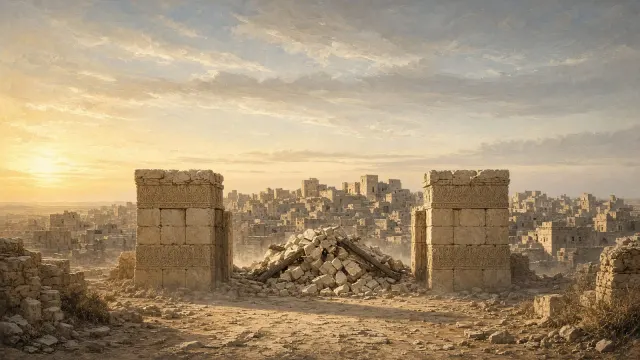
Lamentations opens by making status itself part of the loss. The city once crowded with people is now solitary, the woman once honored is compared to a widow, and the princess has become subject to tribute. These are not three decorative images for the same idea. Each removes a different form of security: company, social standing, and political independence. Then the emptiness spreads beyond the people. Roads mourn because the feast traffic has disappeared, gates stand unused, and priests sigh where public worship once gathered the city. Even the princes are reduced to hungry deer with no strength left for flight. Verse 5 names Jerusalem's transgressions as part of the explanation, but the poem does not let that statement swallow everything else. The same lines that acknowledge guilt keep the captive children in view. Lamentations begins with judgment and grief sharing the same page.
Deep dive
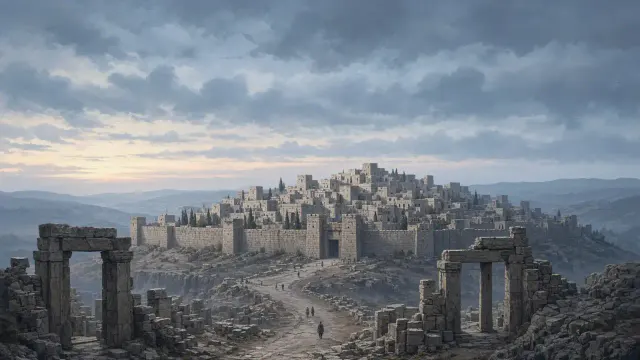
The Book of Lamentations begins with astonishment before it offers explanation. Jerusalem is not introduced as a location on a map but as a woman sitting alone. Three comparisons expose different dimensions of her loss: the crowded city is solitary, the honored woman resembles a widow, and the princess has become tributary. That last word makes the humiliation material. Former standing has given way to subjection and compulsory service. Her tears belong to a city whose relationships and public life have broken down together.
The personification spreads into the landscape. Roads mourn because nobody travels them to the feasts; gates stand empty; priests sigh instead of presiding over celebration. The princes become hungry deer, an image of depleted strength rather than royal command. Verse 5 also attributes the affliction to Jerusalem's many transgressions. That explanation does not replace the lament with a verdict and close the case. The same passage that acknowledges guilt follows the children into captivity. Moral explanation and attention to suffering remain on the page together.
Words to trace: become, gone, afflicted, captivity, enemies, Zion
Verse-by-verse path
- Lamentations 1:1
The first word, “How”, is the Hebrew ekah, and it gives the book its Hebrew name. The comparison is “as a widow”, not a widow: the husband is not dead, only absent. The word for “solitary” is the one Leviticus 13:46 uses of the leper who must live alone outside the camp.
- Lamentations 1:2
“Weepeth sore” doubles the verb in Hebrew, weeping she weeps. Her “lovers” are the allies Judah courted, Egypt above all, whom Jeremiah had mocked as lovers who would despise her (Jeremiah 4:30). The line that none comforts her returns four more times in the chapter, in verses 9, 16, 17 and 21.
- Lamentations 1:3
“Between the straits” means in the narrows, a hunting picture of quarry run down in a pass with no way out. “She findeth no rest” echoes the curse of Deuteronomy 28:65: among the nations “the sole of thy foot” would have no rest. The warning has become the description.
- Lamentations 1:4
Young women had their own part at the festivals, dancing at the vineyards of Shiloh (Judges 21:19–21) and in the promised return of Jeremiah 31:13. Their grief is named among the priests’ because the feasts they danced at no longer happen. Where Hebrew reads “afflicted”, the Greek Old Testament has them “led away”.
- Lamentations 1:5
“Her adversaries are the chief” is literally “have become the head”. Deuteronomy 28:13 promised Israel would be the head and not the tail if she obeyed, and 28:44 warned the stranger would become the head. The children go “before the enemy”, driven ahead of their captors like a flock.
- Lamentations 1:6
“Daughter of Zion” is a Hebrew way of personifying the city itself, Daughter Zion, not a daughter belonging to her. Princes running without strength before a pursuer recalls Zedekiah and his officers fleeing by night and being overtaken in the plains of Jericho (Jeremiah 52:7–8).
Lamentations 1:1-6
King James Version1How doth the city sit solitary, that was full of people! how is she become as a widow! she that was great among the nations, and princess among the provinces, how is she become tributary!
2She weepeth sore in the night, and her tears are on her cheeks: among all her lovers she hath none to comfort her: all her friends have dealt treacherously with her, they are become her enemies.
3Judah is gone into captivity because of affliction, and because of great servitude: she dwelleth among the heathen, she findeth no rest: all her persecutors overtook her between the straits.
4The ways of Zion do mourn, because none come to the solemn feasts: all her gates are desolate: her priests sigh, her virgins are afflicted, and she is in bitterness.
5Her adversaries are the chief, her enemies prosper; for the LORD hath afflicted her for the multitude of her transgressions: her children are gone into captivity before the enemy.
6And from the daughter of Zion all her beauty is departed: her princes are become like harts that find no pasture, and they are gone without strength before the pursuer.
Lamentations 1:7-11
Memory Makes the Loss Larger
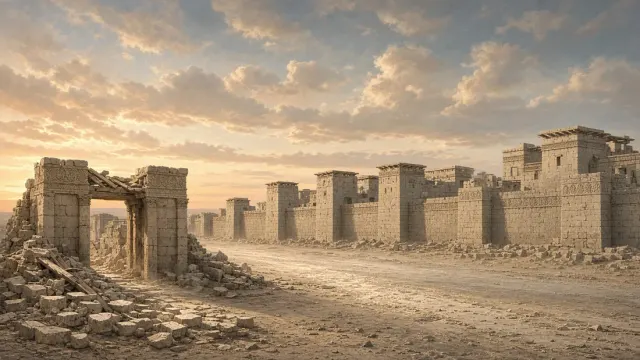
Memory enlarges Jerusalem's misery because it keeps former life present enough to compare. Pleasant things are not merely gone; they are remembered while enemies seize them and hungry people trade valuables for food. The movement is brutal in its simplicity: what once signaled prosperity is converted into the price of staying alive. The sanctuary's violation deepens that reversal, since outsiders enter a space whose access had been carefully bounded. Then the city interrupts the description. "O LORD, behold my affliction" changes her from the object being watched into a voice demanding recognition. That shift happens again when she asks the Lord to see how low she has become. The poem's alphabetic structure gives the lament formal order, but it does not pretend the collapse itself is orderly. The careful shape holds a city whose memories, possessions, worship, and hunger refuse to fit neatly inside it.
Deep dive
The repeated contrast between former and present life gives memory a painful double role. It preserves Jerusalem's identity, but it also inventories what is missing. Precious things that once marked prosperity become things the enemy seizes; eventually valuables are exchanged simply to obtain food. The movement is from honor to survival. The invasion of the sanctuary intensifies that reversal because the very space associated with regulated access has been entered by hostile outsiders.
In verse 9 the KJV's "wonderfully" describes the extraordinary extent of the collapse, not something admirable. More important than the unusual English is the sudden change of address: the city speaks directly to the Lord from inside a passage that has been describing her. The movement happens again in verse 11. Jerusalem refuses to remain only an object under observation. Her appeal asks for recognition, not an invented explanation of her private emotions. The Hebrew poem also has an alphabetic structure, with its successive stanzas following the letters of the alphabet. The carefully ordered form does not make the devastation orderly; it gives sustained shape to the effort to name it.
Words to trace: pleasant, affliction, days, enemy, hand, Jerusalem
Verse-by-verse path
- Lamentations 1:7
This stanza has four lines where its neighbours have three, as if memory will not fit the pattern. The word rendered “sabbaths” is rare and may mean her ceasing, her collapse; the King James connects it to the sabbath because the two share a root. Either way the enemy is laughing at her stopping.
- Lamentations 1:8
“Grievously sinned” is a doubled Hebrew phrase, literally sinned a sin. Exposure of nakedness was the public shaming of an unfaithful wife, used of Jerusalem again in Ezekiel 16:37. “Turneth backward” is the posture of someone who can no longer meet the eyes of those staring at her.
- Lamentations 1:9
“Her filthiness is in her skirts” pictures a menstrual stain showing on the hem of a garment, impurity that can no longer be hidden. Not remembering “her last end” means she never thought about where her conduct led, the same charge Isaiah 47:7 lays against proud Babylon.
- Lamentations 1:10
The law of Deuteronomy 23:3 barred Ammonites and Moabites from entering “the congregation of the LORD”. Now foreigners have walked past the congregation into the sanctuary itself. The “pleasant things” his hand spreads over are the temple treasures inventoried in Jeremiah 52:17–23.
- Lamentations 1:11
“Meat” in 1611 meant food of any kind, not flesh. “To relieve the soul” is literally to bring the breath back, to keep oneself alive. The word for “vile” means cheap, worthless, and it lands in the same verse where the people have sold their most precious things for a meal.
Lamentations 1:7-11
King James Version7Jerusalem remembered in the days of her affliction and of her miseries all her pleasant things that she had in the days of old, when her people fell into the hand of the enemy, and none did help her: the adversaries saw her, and did mock at her sabbaths.
8Jerusalem hath grievously sinned; therefore she is removed: all that honoured her despise her, because they have seen her nakedness: yea, she sigheth, and turneth backward.
9Her filthiness is in her skirts; she remembereth not her last end; therefore she came down wonderfully: she had no comforter. O LORD, behold my affliction: for the enemy hath magnified himself.
10The adversary hath spread out his hand upon all her pleasant things: for she hath seen that the heathen entered into her sanctuary, whom thou didst command that they should not enter into thy congregation.
11All her people sigh, they seek bread; they have given their pleasant things for meat to relieve the soul: see, O LORD, and consider; for I am become vile.
Lamentations 1:12-15
A Body Under Fire, Net, and Yoke
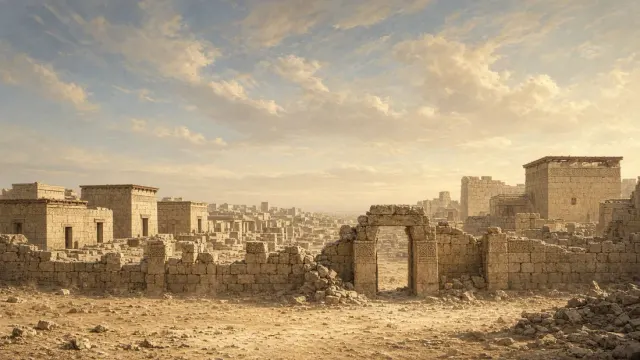
Jerusalem refuses to let the passing world keep its distance. "Is it nothing to you?" turns suffering into a demand to look, and the images that follow make simple observation impossible. Fire reaches the bones, a net stops movement, a yoke settles on the neck, and a winepress crushes. No single metaphor is asked to explain everything. The accumulation matters because each image exposes a different kind of helplessness. Most severe is the yoke made from Jerusalem's own transgressions. Guilt is not abstract here; it becomes weight fitted to the body. Even the language of assembly is reversed, since the gathering is no celebration but a force called against the city. Lamentations does not present these images for spectacle. They belong to Jerusalem's own appeal for a hearing, and their force comes from showing how completely judgment has entered bodily, civic, and communal life.

Deep dive
The appeal to passersby interrupts the possibility of distant observation. Jerusalem places her affliction before people who might otherwise continue along the road. She does not claim that an enemy has acted beyond God's reach. The fire, net, yoke, and winepress are all associated with the Lord's action. Each image catches a different kind of helplessness: fire penetrates, a net arrests movement, a yoke imposes weight, and a winepress crushes. The sequence gives suffering several forms without pretending that one metaphor can contain it.
The yoke is especially exacting because it is made from her transgressions. Guilt has become a burden fitted around her own neck, and the hands that fasten it are divine. In verse 15 even the language of assembly turns ominous: the gathering is directed against Jerusalem rather than toward celebration. The virgin daughter is placed beneath a winepress. The poem does not soften the force of that picture, but neither does it invite enjoyment of her humiliation. These are the city's words about the violence she has endured, spoken to obtain a hearing rather than to provide a spectacle.
Words to trace: LORD, sorrow, trodden, able, afflicted, anger
Verse-by-verse path
- Lamentations 1:12
The Hebrew of “Is it nothing to you” is two terse words, literally “not to you”, which some read as a wish: may it not come to you. Handel set the second half in Messiah as the sorrow of Christ. “The day of his fierce anger” speaks of the day of the LORD as a day already come.
- Lamentations 1:13
Fire shut up in the bones is how Jeremiah described the word he could not hold in (Jeremiah 20:9), one reason Jewish and Christian tradition assigned this book to him, though the book names no author. The Greek Old Testament opens it with a line saying Jeremiah sat weeping.
- Lamentations 1:14
Jeremiah once wore a yoke of wooden bars in the streets as a sign; Hananiah broke it, and Jeremiah answered that iron would replace wood (Jeremiah 27:2; 28:10–14). The word for “bound” occurs nowhere else in the Hebrew Bible. “Wreathed” means knotted or twisted together, the sins lashed into one harness.
- Lamentations 1:15
The King James prints “Lord” in lower case here and in verse 14, marking the Hebrew Adonai, master, rather than the divine name. Grapes were trodden underfoot in a stone vat and the juice ran red, which is why the winepress became a picture of bloodshed. “Virgin” is often read as a city never before taken.
Lamentations 1:12-15
King James Version12Is it nothing to you, all ye that pass by? behold, and see if there be any sorrow like unto my sorrow, which is done unto me, wherewith the LORD hath afflicted me in the day of his fierce anger.
13From above hath he sent fire into my bones, and it prevaileth against them: he hath spread a net for my feet, he hath turned me back: he hath made me desolate and faint all the day.
14The yoke of my transgressions is bound by his hand: they are wreathed, and come up upon my neck: he hath made my strength to fall, the Lord hath delivered me into their hands, from whom I am not able to rise up.
15The Lord hath trodden under foot all my mighty men in the midst of me: he hath called an assembly against me to crush my young men: the Lord hath trodden the virgin, the daughter of Judah, as in a winepress.
Lamentations 1:16-19
Confession Does Not Produce a Comforter
The refrain of no comforter reaches beyond loneliness into institutional collapse. Jerusalem weeps because the one who should relieve her is far away, stretches out her hands, and finds no rescuer. Then she says something the poem refuses to simplify: "The LORD is righteous; for I have rebelled against his commandment." Confession is explicit, but it does not silence the appeal for others to hear or make captivity less terrible. Former lovers deceive her. Young people are carried away. Priests and elders die while trying to find enough food to live. Relationships and offices that once suggested stability cannot supply even bread. Lamentations therefore keeps two uncomfortable truths together. Jerusalem does not declare herself innocent, and her admission of guilt does not make her suffering disposable. The absent comforter remains absent even after confession, which is why the chapter continues to speak rather than pretending the case is closed.

Deep dive
The return to tears in verse 16 is not redundant. The preceding images have specified the affliction; the lack of a comforter specifies its isolation. Children are desolate, hands are stretched out, and no rescuer arrives. Verse 17 briefly describes Zion from outside again before the city's own voice resumes. That alternation keeps the account from settling into a single, comfortable distance. Jerusalem is both publicly exposed and personally speaking.
Her acknowledgment that the Lord is righteous is explicit. She has rebelled against his commandment. Yet the next movement is still an appeal for the peoples to hear and see. Confession does not require the poem to deny the horror of captivity or to call hunger insignificant. The former lovers prove deceptive, and priests and elders die while seeking food to sustain themselves. Offices and relationships that once promised security cannot supply bread. The section therefore refuses two easy reductions: Jerusalem is not presented as guiltless, and her admission of guilt does not make her suffering unworthy of sustained attention.
Words to trace: LORD, relieve, adversaries, captivity, children, city
Verse-by-verse path
- Lamentations 1:16
The doubled “mine eye, mine eye” is in the standard Hebrew text, though some manuscripts and the Greek have the word once. “Relieve my soul” here, as in verses 11 and 19, is built on the verb of Psalm 23:3, “He restoreth my soul”. The restorer the psalm promised is the one now far off.
- Lamentations 1:17
Spreading the hands was the posture of prayer and of begging. “A menstruous woman” translates niddah, the impurity of Leviticus 15:19–24 that others avoided touching. The neighbours are not only hostile; they keep their distance as from something unclean. “Jacob” names the whole people by their ancestor.
- Lamentations 1:18
“Rebelled against his commandment” is literally rebelled against his mouth, the idiom used of Moses and Aaron at Meribah (Numbers 20:24). This is the stanza of the letter tsade, and the confession begins with the word tsaddiq, righteous. The alphabet itself hands Jerusalem her opening word.
- Lamentations 1:19
The verb for “deceived” is the one Joshua used of the Gibeonites who tricked Israel into a treaty (Joshua 9:22). “Gave up the ghost” is the King James idiom for breathing one’s last; ghost meant spirit or breath. The men who held the highest standing died foraging for scraps like everyone else.
Lamentations 1:16-19
King James Version16For these things I weep; mine eye, mine eye runneth down with water, because the comforter that should relieve my soul is far from me: my children are desolate, because the enemy prevailed.
17Zion spreadeth forth her hands, and there is none to comfort her: the LORD hath commanded concerning Jacob, that his adversaries should be round about him: Jerusalem is as a menstruous woman among them.
18The LORD is righteous; for I have rebelled against his commandment: hear, I pray you, all people, and behold my sorrow: my virgins and my young men are gone into captivity.
19I called for my lovers, but they deceived me: my priests and mine elders gave up the ghost in the city, while they sought their meat to relieve their souls.
Lamentations 1:20-22
The Final Appeal Names the Enemies Too
The chapter closes with Jerusalem still addressing the Lord, but nothing in the prayer resembles a tidy resolution. Distress is described from inside the body, while sword outside and death at home erase any safe direction. Jerusalem again admits grievous rebellion. At the same time, she names the enemies who have heard her sighs and taken pleasure in what has happened. That detail darkens the repeated theme of hearing. Jerusalem has spent the chapter asking to be seen and heard, yet her adversaries receive the same evidence and answer it with delight. Her final petition therefore asks that their wickedness also come before God. She does not erase her own transgressions in order to name theirs. Lamentations ends the chapter with judgment requested on both sides, no comforter newly arrived, no captives returned, and no divine reply supplied. What remains is a voice still praying through many sighs and a faint heart.

Deep dive
The chapter's final address turns inward and outward at once. Jerusalem describes bodily turmoil and acknowledges grievous rebellion, while the sword outside and death inside leave no safe direction. The distinction between street and house no longer separates danger from refuge. The repeated absence of a comforter reaches its sharpest form when the enemies hear of her trouble and welcome it. Hearing, which Jerusalem has been asking others to grant her, has produced delight rather than compassion among her adversaries.
Her request that their wickedness come before God is not a denial of her own. She asks for judgment on both sides, with the treatment she has received becoming the measure she names for them. Lamentations records that severe petition without reporting its fulfillment here. The chapter does not end with restored buildings, returning children, or a newly arrived comforter. It ends with many sighs and a failing heart. The persistence of address matters: the city still speaks to the Lord, but the poem does not supply a reply on his behalf.
Words to trace: heart, abroad, bereaveth, bowels, comfort, death
Verse-by-verse path
- Lamentations 1:20
“My bowels are troubled” is literally my insides are churning, like wine fermenting; the bowels were the seat of feeling. “Mine heart is turned within me” is exactly the phrase God speaks of himself in Hosea 11:8. Sword outside and death within echoes Deuteronomy 32:25: “The sword without, and terror within.”
- Lamentations 1:21
Among those glad at Jerusalem’s fall, Edom is named in 4:21 and in Psalm 137:7, which remembers them shouting “Rase it”. The Hebrew of the last line can be read as a completed fact or, as many translators take it, a prayer: bring the day. The King James makes it a confident future.
- Lamentations 1:22
The verb behind “do unto them” is the one used for gleaning a vine a second time, taking every last grape. Verse 12 used it for what was “done unto me”, so Jerusalem asks that her enemies be gleaned as she was. This is the stanza of tav, the last letter of the alphabet.
Lamentations 1:20-22
King James Version20Behold, O LORD; for I am in distress: my bowels are troubled; mine heart is turned within me; for I have grievously rebelled: abroad the sword bereaveth, at home there is as death.
21They have heard that I sigh: there is none to comfort me: all mine enemies have heard of my trouble; they are glad that thou hast done it: thou wilt bring the day that thou hast called, and they shall be like unto me.
22Let all their wickedness come before thee; and do unto them, as thou hast done unto me for all my transgressions: for my sighs are many, and my heart is faint.
Questions to keep in mind while reading
- Identify the historical crisis, covenant failure, warning, and promised hope.
- Distinguish the prophet’s immediate audience from later biblical connections.
- Do not turn present-day headlines into confident fulfillment claims without textual evidence.
Text first
Where readers differ
The chapter summary begins with what the passage says and how its parts fit together. It does not assume one denomination has already settled every question. Where a conclusion depends on a tradition, literary theory, or historical reconstruction, that dependence is named openly.
The KJV text is presented first. Interpretive conclusions are labeled, and differences are introduced only when they help a reader understand why serious communities do not always reach the same answer.
Comparative interpretive notes for this chapter are in preparation. Until reviewed notes are ready, this page separates the KJV text from summary and application without claiming that serious readers agree on every question.
Questions beneath the surface
- What account of God, human freedom, responsibility, and the good life emerges from Lamentations 1?
- Which tension does the chapter refuse to resolve quickly?
- What changes when the chapter is read as part of the whole canon rather than as an isolated moral lesson?
- Where might a sincere reader confuse a familiar tradition with something the text states directly?
Questions for serious personal contemplation
These open-ended questions make room for tension, honest response, prayer, and conclusions that remain accountable to the chapter.
Observe without rushing
What part of Lamentations 1 makes you stop, feel unsettled, or feel surprised, and why?
Which detail in the passage would be easiest to overlook? How does that detail change your understanding?
Where do you see tension between what happens and this focus: Jerusalem personified as a solitary grieving woman among empty streets and ruined gates?
What important question does the passage leave open instead of resolving quickly?
Examine your inner life honestly
Which person, response, fear, or desire in the passage feels most like your own life right now?
What assumption about God, other people, or yourself does this text challenge?
Which part would you rather soften, avoid, or explain away too quickly? What might that reaction reveal?
If this Scripture could ask you one direct question, what do you think it would ask?
Respond with wisdom and courage
What do you need to remember, confess, grieve, thank God for, or trust after reading this passage?
How might another faithful person read this situation differently without ignoring the text?
What obedient response would be costly, uncomfortable, or slow, yet still faithful to Scripture?
What question will you carry into prayer this week, and which verses will you keep in front of you?
Music and video connected to the passage
Related media appears when its Scripture reference overlaps this study. Music and video can illuminate a theme while the biblical text remains the foundation.