The big picture
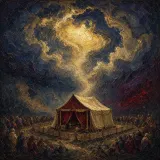
Numbers 9 combines a remembered deliverance with a travel schedule nobody can predict. Israel keeps the Passover in Sinai during the first month of the second year, before the census date that opened the book. Men barred by corpse defilement then ask why they must miss the feast, and Moses waits for a ruling rather than improvising. The answer provides a second-month Passover for those genuinely prevented by uncleanness or distant travel while preserving the full rites of the feast and distinguishing inability from deliberate refusal. The chapter then turns to the cloud over the tabernacle. It may remain overnight, several days, a month, or a year. Israel moves when it rises and stays when it remains. Resting in place and setting out are described with the same language of obedience, making the cloud rather than a fixed calendar the governor of the journey.
In this chapter
- The Anniversary Comes Before the Departure Numbers 9:1-5
The date places this Passover before the census of Numbers 1, confirming that the book is grouping material by subject as well as by sequence.
- The Excluded Men Ask to Be Included Numbers 9:6-8
The excluded men do not challenge the fact of their uncleanness.
- Another Date, Not a Lesser Passover Numbers 9:9-14
The second-month Passover changes the date, not the feast.
- Remaining in Camp Is Also Obedience Numbers 9:15-23
The cloud makes Israel's travel calendar impossible to print in advance.


Scripture beside the summary
Numbers · King James Version · 23Numbers 9:1-5
The Anniversary Comes Before the Departure
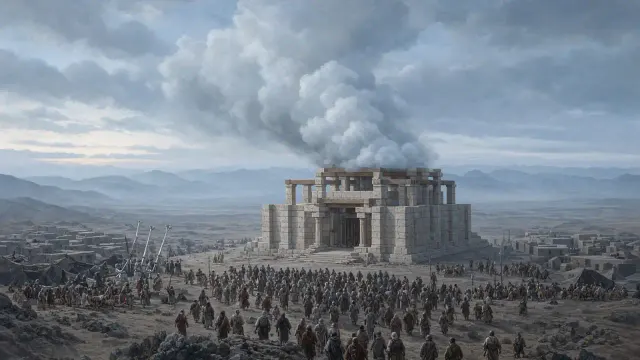
The date places this Passover before the census of Numbers 1, confirming that the book is grouping material by subject as well as by sequence. Israel is still in Sinai, one year removed from the first Passover and the departure from Egypt, and the feast is kept at its appointed time with its prescribed rites. The people are no longer eating in haste on the edge of escape. They are remembering deliverance from the other side of it, in the wilderness that followed. Numbers records their obedience cleanly before introducing any exceptional case. That order matters because the problem in the next verses is not general neglect. The congregation has kept the feast, and particular men have been prevented from joining it because of ritual defilement. The normal observance is therefore established first, giving the later provision the character of a genuine accommodation within the command rather than a replacement for the command itself.
Deep dive
The date again reaches behind the opening census, which took place in the second month. The Book of Numbers is completing the account of Israel’s preparation at Sinai rather than presenting every instruction in strict chronological sequence. The Passover recalls the departure from Egypt while the people are still camped in the wilderness, before their next great movement toward the land.
The repeated insistence on the appointed season and the prescribed rites connects this observance with the original command. Leaving Egypt has not made the feast obsolete; it has made remembrance of that deliverance possible from the other side of the journey. Verse 5 records obedience without qualification. The difficult case that follows does not arise because the entire congregation refuses the feast. It arises within an observance that has been carried out, when particular people find themselves unable to participate under its purity requirements.
Words to trace: keep, children, Israel, month, Moses, passover
Verse-by-verse path
- Numbers 9:1
This is the only Passover recorded between Egypt and Canaan. The next one is kept at Gilgal after the Jordan crossing (Joshua 5:10), because the generation born in the wilderness had not been circumcised (Joshua 5:5–7), and Exodus 12:48 barred the uncircumcised from eating it.
- Numbers 9:2
“Appointed season” is mo’ed, the word for Israel’s fixed feasts and the same word as in “tent of meeting” (ohel mo’ed). The feast has its date as the tent has its place.
- Numbers 9:3
“At even” is literally “between the two evenings”, a phrase later disputed: the rabbis took it as the afternoon, from the sun’s decline to sunset, while the Samaritans and others took it as the twilight between sunset and dark.
- Numbers 9:4
Pesach, passover, comes from the verb pasach used in Exodus 12:13 and 12:23, where the LORD passes over the doors marked with blood. Isaiah 31:5 uses it of protecting: “passing over he will preserve it.”
- Numbers 9:5
A Passover in the desert needed lambs. The people had come out of Egypt with “flocks, and herds, even very much cattle” (Exodus 12:38), and at Sinai they still had them.
Numbers 9:1-5
King James Version1And the LORD spake unto Moses in the wilderness of Sinai, in the first month of the second year after they were come out of the land of Egypt, saying,
2Let the children of Israel also keep the passover at his appointed season.
3In the fourteenth day of this month, at even, ye shall keep it in his appointed season: according to all the rites of it, and according to all the ceremonies thereof, shall ye keep it.
4And Moses spake unto the children of Israel, that they should keep the passover.
5And they kept the passover on the fourteenth day of the first month at even in the wilderness of Sinai: according to all that the LORD commanded Moses, so did the children of Israel.
Numbers 9:6-8
The Excluded Men Ask to Be Included
The excluded men do not challenge the fact of their uncleanness. They say plainly that they were defiled by a dead body and therefore could not keep the Passover on that day. Their question is about participation: why should this condition keep them from offering with the rest of Israel at the appointed season? Numbers gives no names, no identity for the dead person, and no hidden motive. The men bring the difficulty to Moses and Aaron as it stands. Moses' answer is one of the most restrained moments in the chapter. He does not stretch an old rule, dismiss the concern, or invent a compromise that sounds reasonable. He tells them to stand still while he hears what the LORD will command. The pause becomes part of the lawmaking process. An unanticipated case receives an explicit ruling, and Moses' authority is shown not by having an instant answer for everything but by refusing to manufacture one before it is given.
Deep dive
The men acknowledge the very condition that excludes them. They are not denying their defilement or demanding that the feast lose its boundaries. Their concern is that this condition prevents them from bringing the LORD’s offering with Israel at the appointed time. The passage supplies neither their names nor the identity of the deceased. Later proposals about whose body they had handled remain proposals, not details recorded here.
Moses does not answer by extending an existing rule on his own authority. He tells them to wait while he hears what the LORD commands about their case. The pause is part of the account’s substance: a new circumstance receives an explicit ruling rather than an improvised answer dressed as an old command. The question comes from people seeking participation, and the resulting instruction makes provision for that desire without treating the original purity concern as imaginary.
Words to trace: body, dead, defiled, LORD, Moses, Aaron
Verse-by-verse path
- Numbers 9:6
“The dead body of a man” is literally “the soul of a man”, nefesh adam. Numbers does not say who had died. The rabbis guessed they were the men carrying Joseph’s coffin (Exodus 13:19), or Mishael and Elzaphan, who carried out Nadab and Abihu (Leviticus 10:4).
- Numbers 9:7
“Wherefore are we kept back” is lamah niggara, “why should we be diminished?”. The daughters of Zelophehad use the same verb in 27:4: “Why should the name of our father be done away?” Both requests end in a new law.
- Numbers 9:8
This is one of four cases in the Torah where Moses has no answer and waits for a ruling: the blasphemer (Leviticus 24:12), the man gathering sticks on the sabbath (15:34), the daughters of Zelophehad (27:5), and these men.
Numbers 9:6-8
King James Version6And there were certain men, who were defiled by the dead body of a man, that they could not keep the passover on that day: and they came before Moses and before Aaron on that day:
7And those men said unto him, We are defiled by the dead body of a man: wherefore are we kept back, that we may not offer an offering of the LORD in his appointed season among the children of Israel?
8And Moses said unto them, Stand still, and I will hear what the LORD will command concerning you.
Numbers 9:9-14
Another Date, Not a Lesser Passover
The second-month Passover changes the date, not the feast. A person prevented by corpse defilement or a distant journey may keep it one month later, still eating with unleavened bread and bitter herbs, leaving none until morning, and breaking no bone. Numbers makes accommodation without turning the observance into a cut-down version for exceptional people. Just as important, the chapter distinguishes genuine inability from simple refusal. A clean man who is not away and still neglects the Passover bears guilt and is cut off. The law therefore refuses to treat obstruction and indifference as the same act. The resident stranger who chooses to keep the feast follows the same ordinance as the native-born Israelite. That equal rule belongs to this participation without pretending that every distinction in Israel's law has vanished. The provision is generous because it creates a real second opportunity, and exact because it preserves both the feast's form and the limits of the exception.

Deep dive
The additional observance falls on the fourteenth day of the second month. Its changed date does not make it an abbreviated version of the feast. Unleavened bread, bitter herbs, the prohibition on leftovers, and the instruction concerning unbroken bones remain in force. The provision changes when an obstructed person may participate, not what the Passover is.
The next distinction is sharp. A clean person who is not away on a journey and nevertheless refuses the feast bears sin and is to be cut off. An actual impediment and an avoidable refusal are not treated as the same case. Verse 14 then includes the resident stranger under the same Passover ordinance as the native-born Israelite. This is a statement about participation under the prescribed rule, not an announcement that every distinction elsewhere in Israel’s law has disappeared. The new provision is generous in its defined scope and exact about its terms.
Words to trace: keep, passover, LORD, journey, ordinance, stranger
Verse-by-verse path
- Numbers 9:9
The answer comes as a new speech. The formula is the same as for any law, but this one was prompted by a question from below.
- Numbers 9:10
“Or of your posterity” extends the ruling to future generations. In the Hebrew text the last letter of “afar off” carries a dot above it, one of the dotted words of the Torah, and the rabbis took it to mean that “afar” could be any distance beyond the sanctuary’s threshold.
- Numbers 9:11
The date falls six days before the camp moved off from Sinai (10:11). King Hezekiah later kept the Passover in the second month when the priests were not ready in time (2 Chronicles 30:2–3, 15), the one recorded use of this provision.
- Numbers 9:12
“Nor break any bone of it” repeats Exodus 12:46. John 19:36 applies it to the body of Jesus on the cross, whose legs were not broken: “A bone of him shall not be broken.”
- Numbers 9:13
“Forbeareth” is chadal, to leave off or refrain. The man is not prevented; he simply does not come. “Shall bear his sin” means he carries the guilt himself, with no offering to take it.
- Numbers 9:14
Exodus 12:48 required that a stranger be circumcised before eating the Passover. Here the phrase “one ordinance” is added, and will be repeated at 15:15–16: the rule for the foreign resident and the native is the same.
Numbers 9:9-14
King James Version9And the LORD spake unto Moses, saying,
10Speak unto the children of Israel, saying, If any man of you or of your posterity shall be unclean by reason of a dead body, or be in a journey afar off, yet he shall keep the passover unto the LORD.
11The fourteenth day of the second month at even they shall keep it, and eat it with unleavened bread and bitter herbs.
12They shall leave none of it unto the morning, nor break any bone of it: according to all the ordinances of the passover they shall keep it.
13But the man that is clean, and is not in a journey, and forbeareth to keep the passover, even the same soul shall be cut off from among his people: because he brought not the offering of the LORD in his appointed season, that man shall bear his sin.
14And if a stranger shall sojourn among you, and will keep the passover unto the LORD; according to the ordinance of the passover, and according to the manner thereof, so shall he do: ye shall have one ordinance, both for the stranger, and for him that was born in the land.
Numbers 9:15-23
Remaining in Camp Is Also Obedience
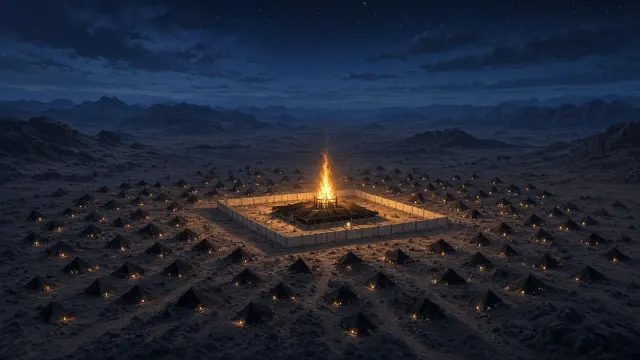
The cloud makes Israel's travel calendar impossible to print in advance. It covers the tabernacle by day, appears as fire by night, rises when the people are to move, and remains when they are to stay. Numbers repeats the possibilities until the point becomes unavoidable: the halt might last one night, a few days, many days, a month, or a year. Departure may come in daylight or darkness. The congregation cannot turn one successful pattern into a permanent timetable and call that guidance. More surprising is the language used for waiting. Remaining in camp is repeatedly described as keeping the LORD's charge just as traveling is done at his command. A long stay is not a failure to make progress. It is obedience when the cloud remains. The chapter ends by putting rest and movement under the same authority, establishing the standard of response immediately before the wilderness complaints begin to show what happens when Israel stops taking its direction from that center.

Deep dive
The account returns to the tabernacle’s erection and describes the cloud by day and the appearance of fire by night. The sign governs the whole camp through its relation to the sanctuary. When the cloud rises, Israel travels; where it rests, Israel pitches its tents. The repeated statements give staying the same language of command as moving. A long halt is not described as a failure of guidance.
The possible intervals grow deliberately varied: overnight, a few days, many days, a month, or a year. Departure may occur by day or by night. This is not a travel calendar that can be settled once and posted outside every tent. The next movement depends on the cloud rather than on a standard length of stay. The closing verse gathers rest, travel, keeping the charge, and the command conveyed through Moses into one description. Before the complaints begin, the book has established what ordered response looks like in both motion and stillness.
Words to trace: cloud, journeyed, LORD, tabernacle, commandment, abode
Verse-by-verse path
- Numbers 9:15
The verse steps back to the day of Exodus 40:34–38, when the cloud first covered the tent. “As it were the appearance of fire” is the phrase used of the glory on Sinai in Exodus 24:17, “like devouring fire”.
- Numbers 9:16
“Alway” is tamid, continually, the word for the continual burnt offering and the lamp kept always burning (Exodus 27:20). Cloud by day and fire by night ran without a break.
- Numbers 9:17
“Taken up” is the verb alah, to go up, the same verb used for the lamps in 8:2. The flames went up in the tent; the cloud went up from it, and the camp followed.
- Numbers 9:18
“At the commandment of the LORD” is literally “at the mouth of the LORD”. The phrase occurs seven times in verses 18–23, as though the paragraph were counting its own obedience.
- Numbers 9:19
The camp stayed at Sinai for about eleven months, from the third month of the first year (Exodus 19:1) to the twentieth day of the second month of the second year (10:11). The cloud had already shown that it could tarry long.
- Numbers 9:20
“A few days” is literally “days of number”, days few enough to count. The verse sets short stops beside long ones and treats both the same.
- Numbers 9:21
A one-night halt could end with a march at dawn, and the verse adds that the cloud could lift at night. The camp packed up in the dark if it had to, following the fire.
- Numbers 9:22
“Or a year” renders yamim, literally “days”, which in Hebrew idiom can mean a full year, as in Leviticus 25:29. Deuteronomy 1:46 later says the people stayed in Kadesh “many days”.
- Numbers 9:23
“By the hand of Moses” shows that the cloud’s movement reached the people through him; the trumpets of the next chapter give that signal. Psalm 105:39 remembers the arrangement: “He spread a cloud for a covering; and fire to give light in the night.”
Numbers 9:15-23
King James Version15And on the day that the tabernacle was reared up the cloud covered the tabernacle, namely, the tent of the testimony: and at even there was upon the tabernacle as it were the appearance of fire, until the morning.
16So it was alway: the cloud covered it by day, and the appearance of fire by night.
17And when the cloud was taken up from the tabernacle, then after that the children of Israel journeyed: and in the place where the cloud abode, there the children of Israel pitched their tents.
18At the commandment of the LORD the children of Israel journeyed, and at the commandment of the LORD they pitched: as long as the cloud abode upon the tabernacle they rested in their tents.
19And when the cloud tarried long upon the tabernacle many days, then the children of Israel kept the charge of the LORD, and journeyed not.
20And so it was, when the cloud was a few days upon the tabernacle; according to the commandment of the LORD they abode in their tents, and according to the commandment of the LORD they journeyed.
21And so it was, when the cloud abode from even unto the morning, and that the cloud was taken up in the morning, then they journeyed: whether it was by day or by night that the cloud was taken up, they journeyed.
22Or whether it were two days, or a month, or a year, that the cloud tarried upon the tabernacle, remaining thereon, the children of Israel abode in their tents, and journeyed not: but when it was taken up, they journeyed.
23At the commandment of the LORD they rested in the tents, and at the commandment of the LORD they journeyed: they kept the charge of the LORD, at the commandment of the LORD by the hand of Moses.
Questions to keep in mind while reading
- Identify the people addressed and the covenant setting.
- Distinguish rescue, worship, holiness, justice, and community responsibility.
- Read commands in their literary and covenant context before making a modern application.
Text first
Where readers differ
The chapter summary begins with what the passage says and how its parts fit together. It does not assume one denomination has already settled every question. Where a conclusion depends on a tradition, literary theory, or historical reconstruction, that dependence is named openly.
The KJV text is presented first. Interpretive conclusions are labeled, and differences are introduced only when they help a reader understand why serious communities do not always reach the same answer.
Comparative interpretive notes for this chapter are in preparation. Until reviewed notes are ready, this page separates the KJV text from summary and application without claiming that serious readers agree on every question.
Questions beneath the surface
- What account of God, human freedom, responsibility, and the good life emerges from Numbers 9?
- Which tension does the chapter refuse to resolve quickly?
- What changes when the chapter is read as part of the whole canon rather than as an isolated moral lesson?
- Where might a sincere reader confuse a familiar tradition with something the text states directly?
Questions for serious personal contemplation
These open-ended questions make room for tension, honest response, prayer, and conclusions that remain accountable to the chapter.
Observe without rushing
What part of Numbers 9 makes you stop, feel unsettled, or feel surprised, and why?
Which detail in the passage would be easiest to overlook? How does that detail change your understanding?
Where do you see tension between what happens and this focus: Numbers 9 develops its own movement around LORD, cloud, children, Israel, keep?
What important question does the passage leave open instead of resolving quickly?
Examine your inner life honestly
Which person, response, fear, or desire in the passage feels most like your own life right now?
What assumption about God, other people, or yourself does this text challenge?
Which part would you rather soften, avoid, or explain away too quickly? What might that reaction reveal?
If this Scripture could ask you one direct question, what do you think it would ask?
Respond with wisdom and courage
What do you need to remember, confess, grieve, thank God for, or trust after reading this passage?
How might another faithful person read this situation differently without ignoring the text?
What obedient response would be costly, uncomfortable, or slow, yet still faithful to Scripture?
What question will you carry into prayer this week, and which verses will you keep in front of you?
Music and video connected to the passage
Related media appears when its Scripture reference overlaps this study. Music and video can illuminate a theme while the biblical text remains the foundation.