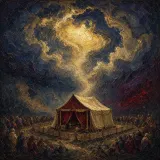
The big picture
The preparation at Sinai finally becomes motion. Two silver trumpets create distinct signals for assembly, leadership meetings, camp departures, war, and worship. On the twentieth day of the second month, the cloud rises and Judah leads the first ordered journey away from Sinai. The procession is arranged so Gershon and Merari can carry and erect the tabernacle before Kohath arrives with its holy furnishings, turning earlier job descriptions into coordinated movement. Moses also asks Hobab to accompany Israel as experienced eyes in the wilderness, placing practical human knowledge beside the guidance of the cloud without treating them as rivals. The chapter closes with the ark, the cloud, and Moses' words at departure and rest. Israel leaves Sinai not as a crowd improvising a route but as a camp whose sound, sequence, burdens, and prayers have all been given form.
In this chapter
- Different Signals Mean Different Actions Numbers 10:1-10
The two silver trumpets turn sound into organization.
- The Date Turns Preparation Into Movement Numbers 10:11-16
The date finally releases everything the earlier chapters prepared.
- The Tent Must Arrive Before Its Furnishings Numbers 10:17-28
The marching order reveals why the Levitical assignments had to be so specific.
- A Cloud Overhead and Experienced Eyes on the Ground Numbers 10:29-32
Moses invites Hobab to come with Israel and frames the invitation around both promise and practical usefulness.
- Movement and Rest Have Words Attached Numbers 10:33-36
The chapter ends with movement framed by presence.

Scripture beside the summary
Numbers · King James Version · 36Numbers 10:1-10
Different Signals Mean Different Actions
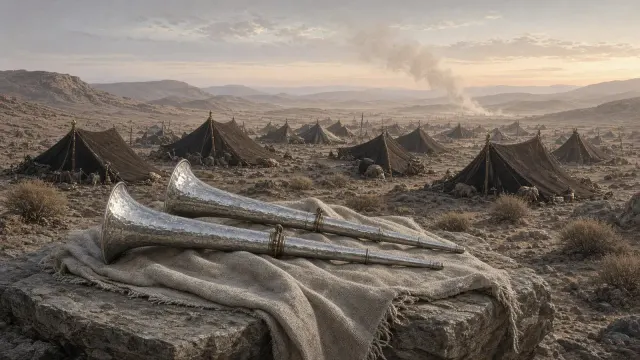
The two silver trumpets turn sound into organization. Both together summon the whole congregation, one calls the princes, and an alarm begins the movement of the camps. Numbers even distinguishes the ordinary gathering blast from the alarm so that not every loud signal means the same thing. The sons of Aaron are the authorized players, linking the practical communication system to priestly service. The instruments then reach beyond logistics. They sound in war, on days of gladness, at appointed feasts, at new months, and over offerings, becoming a memorial before the LORD as well as a way to move thousands of people. The chapter gives meanings for the calls but no surviving notation from which their exact melodies or rhythms can be reconstructed. Its interest is functional distinction. The same instrument can gather, warn, launch a march, or accompany worship because the signal, setting, and command determine what the sound means.

Deep dive
The instruments are made of silver, each of a whole piece. They are not described as animal horns. Their calls form a practical system: both trumpets gather the congregation, one gathers the princes, and an alarm signals departure by the divisions. A call to assemble is explicitly distinguished from the alarm. The passage identifies the meanings and authorized players without giving a musical notation or exact rhythm that can now be reconstructed.
The same instruments also belong to war, days of gladness, appointed observances, and the beginning of months. Their sound is associated with being remembered before the LORD and with offerings presented before him. The trumpets therefore connect the organized camp with its worship and its dependence in conflict. They are more than a solution to the difficulty of making one voice carry across many tents, but their sacred role does not erase the very practical distinctions between the signals.
Words to trace: blow, alarm, trumpets, camps, LORD, assembly
Verse-by-verse path
- Numbers 10:1
The last instruction given at Sinai before the camp moves. After nine chapters of arrangements, the book places a short law that is almost a manufacturing order exactly where standing still turns into marching.
- Numbers 10:2
“Of a whole piece” renders miqshah, hammered work, the term Exodus 25:18 and 25:31 use for the cherubim and the lampstand: beaten from one mass of metal, not cast or joined. These are chatsotserot, straight metal tubes, not the ram’s horn shofar. Josephus says each was a little under a cubit long.
- Numbers 10:3
“Blow” here is the plain blast, taqa, as distinct from the alarm of verse 5. The meeting point is fixed at the door of the tent of meeting, so the whole assembly converges on the one place every tent in the camp plan of chapter 2 already faces.
- Numbers 10:4
The princes are the twelve tribal leaders named in 1:5–16 and again at the dedication in chapter 7. “Thousands” is eleph, which can mean a thousand or a clan unit, a word that has carried much of the modern debate over how large the census totals are meant to be.
- Numbers 10:5
“Alarm” is teruah, a broken or quavering blast, the word Joshua 6:5 uses for the great shout at Jericho. The east camps are Judah, Issachar and Zebulun (2:3), the side facing the tent’s entrance, so the first alarm moves the division nearest the door.
- Numbers 10:6
Only east and south are given their signals. The Hebrew stops at two; the Greek Septuagint adds a third alarm for the west and a fourth for the north, supplying what it took to be missing. The closing clause turns from the list to the general rule.
- Numbers 10:7
The same instruments, a different pattern of sound. A gathering must never be mistaken for a departure, so the alarm is forbidden at assembly outright. The Mishnah’s rules for the new year still keep the long plain blast and the broken teruah as separate sounds.
- Numbers 10:8
The blowing stays in the priestly family rather than passing to heralds from each tribe. When Israel goes to war with Midian in 31:6, it is Phinehas the priest who goes out “with the holy instruments, and the trumpets to blow in his hand”.
- Numbers 10:9
Numbers looks past the wilderness here for the first time in this chapter: the war envisaged is fought “in your land” against an oppressor. “Be remembered” is zakar, the verb of Genesis 8:1 where God remembered Noah, remembrance that issues in rescue.
- Numbers 10:10
Three kinds of occasion are named: days of gladness, set feasts, and the new moons. The verse lists burnt offerings and peace offerings only. “Memorial” is zikkaron, from the same root as “remembered” in verse 9, so the war trumpet and the festival trumpet do the same work before God.
Numbers 10:1-10
King James Version1And the LORD spake unto Moses, saying,
2Make thee two trumpets of silver; of a whole piece shalt thou make them: that thou mayest use them for the calling of the assembly, and for the journeying of the camps.
3And when they shall blow with them, all the assembly shall assemble themselves to thee at the door of the tabernacle of the congregation.
4And if they blow but with one trumpet, then the princes, which are heads of the thousands of Israel, shall gather themselves unto thee.
5When ye blow an alarm, then the camps that lie on the east parts shall go forward.
6When ye blow an alarm the second time, then the camps that lie on the south side shall take their journey: they shall blow an alarm for their journeys.
7But when the congregation is to be gathered together, ye shall blow, but ye shall not sound an alarm.
8And the sons of Aaron, the priests, shall blow with the trumpets; and they shall be to you for an ordinance for ever throughout your generations.
9And if ye go to war in your land against the enemy that oppresseth you, then ye shall blow an alarm with the trumpets; and ye shall be remembered before the LORD your God, and ye shall be saved from your enemies.
10Also in the day of your gladness, and in your solemn days, and in the beginnings of your months, ye shall blow with the trumpets over your burnt offerings, and over the sacrifices of your peace offerings; that they may be to you for a memorial before your God: I am the LORD your God.
Numbers 10:11-16
The Date Turns Preparation Into Movement
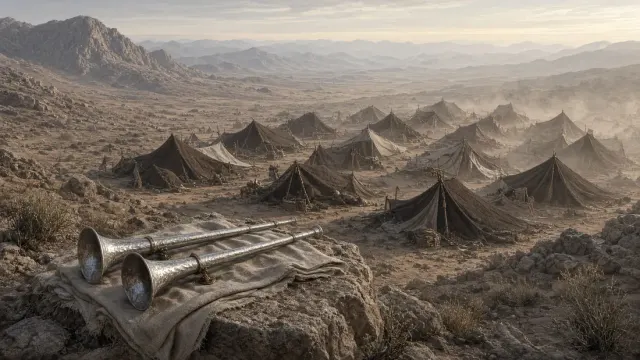
The date finally releases everything the earlier chapters prepared. On the twentieth day of the second month in the second year, the cloud lifts from the tabernacle, and Israel leaves Sinai toward Paran. The census, camp arrangement, leaders, standards, and rules for movement stop being diagrams and become an actual procession. Judah goes first under Nahshon, with Issachar and Zebulun under the same leaders already named in the earlier registers. Their names have now appeared in census, dedication, and movement, showing continuity rather than a succession of unrelated officeholders. Verse 13 calls this first departure obedience to the LORD's command through Moses. That detail matters because later chapters will contain movements that are not obedient simply because they are energetic. Here the cloud rises, the assigned division goes first, and the camp begins the journey exactly within the structure that Numbers has spent nine chapters establishing.
Deep dive
The twentieth day of the second month in the second year gives the departure a firm place beside the earlier dates. The census, the camp arrangement, the assignments, and the transport provisions now become visible movement. The book first gives the journey’s larger direction from Sinai toward Paran, then describes how the divisions set out. That broader announcement does not require every intervening event to have occurred on the first day.
Judah leads with Nahshon at the head of its host, followed by Issachar and Zebulun under the leaders already named. The familiar names are doing new work in the account: those associated with enrollment and dedication now direct marching divisions. Verse 13 describes this first departure as obedience to the LORD’s command through Moses. That initial obedience stands as part of the account, giving the later wilderness crises their contrast.
Words to trace: children, host, cloud, first, second, took
Verse-by-verse path
- Numbers 10:11
Nineteen days after the census began on the first of the second month (1:1), and less than a year after arriving at Sinai in the third month (Exodus 19:1). The tabernacle had stood since the first of the first month (Exodus 40:17); the late Passover of 9:11 fell six days before this.
- Numbers 10:12
“Took their journeys” is plural, stages, the word chapter 33 uses for the whole itinerary from Egypt. Paran is the broad wilderness south of Canaan and north of Sinai, but the camp does not formally pitch in it until 12:16, after Taberah, Kibroth-hattaavah and Hazeroth.
- Numbers 10:13
“First” may mean the first stage, or that this was the first time they marched in this order. “By the hand of Moses” is the book’s standing phrase for instruction passed through him: the cloud lifted, and the command reached the camps by a man.
- Numbers 10:14
Nahshon was Aaron’s brother-in-law, since Aaron married Elisheba the daughter of Amminadab (Exodus 6:23). He brought the first dedication gift in 7:12, and Ruth 4:20 puts him in the line that leads to David. Judah’s camp numbered 186,400 (2:9).
- Numbers 10:15
Nethaneel, “God has given”, brought the second gift in 7:18, a day after Nahshon. The order of march repeats the order of dedication exactly, so the twelve days of offerings in chapter 7 were already this procession in miniature.
- Numbers 10:16
Not the Reubenite Eliab, son of Pallu, whose sons Dathan and Abiram rebel in chapter 16 (26:8–9). Zebulun, Leah’s sixth and last son, marches third in the front division beside Issachar, its full brother.
Numbers 10:11-16
King James Version11And it came to pass on the twentieth day of the second month, in the second year, that the cloud was taken up from off the tabernacle of the testimony.
12And the children of Israel took their journeys out of the wilderness of Sinai; and the cloud rested in the wilderness of Paran.
13And they first took their journey according to the commandment of the LORD by the hand of Moses.
14In the first place went the standard of the camp of the children of Judah according to their armies: and over his host was Nahshon the son of Amminadab.
15And over the host of the tribe of the children of Issachar was Nethaneel the son of Zuar.
16And over the host of the tribe of the children of Zebulun was Eliab the son of Helon.
Numbers 10:17-28
The Tent Must Arrive Before Its Furnishings
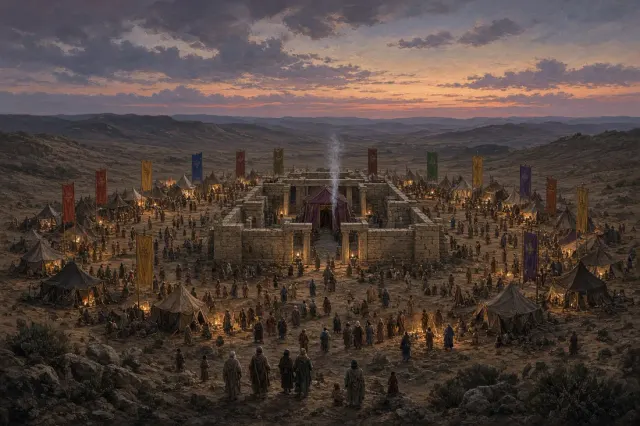
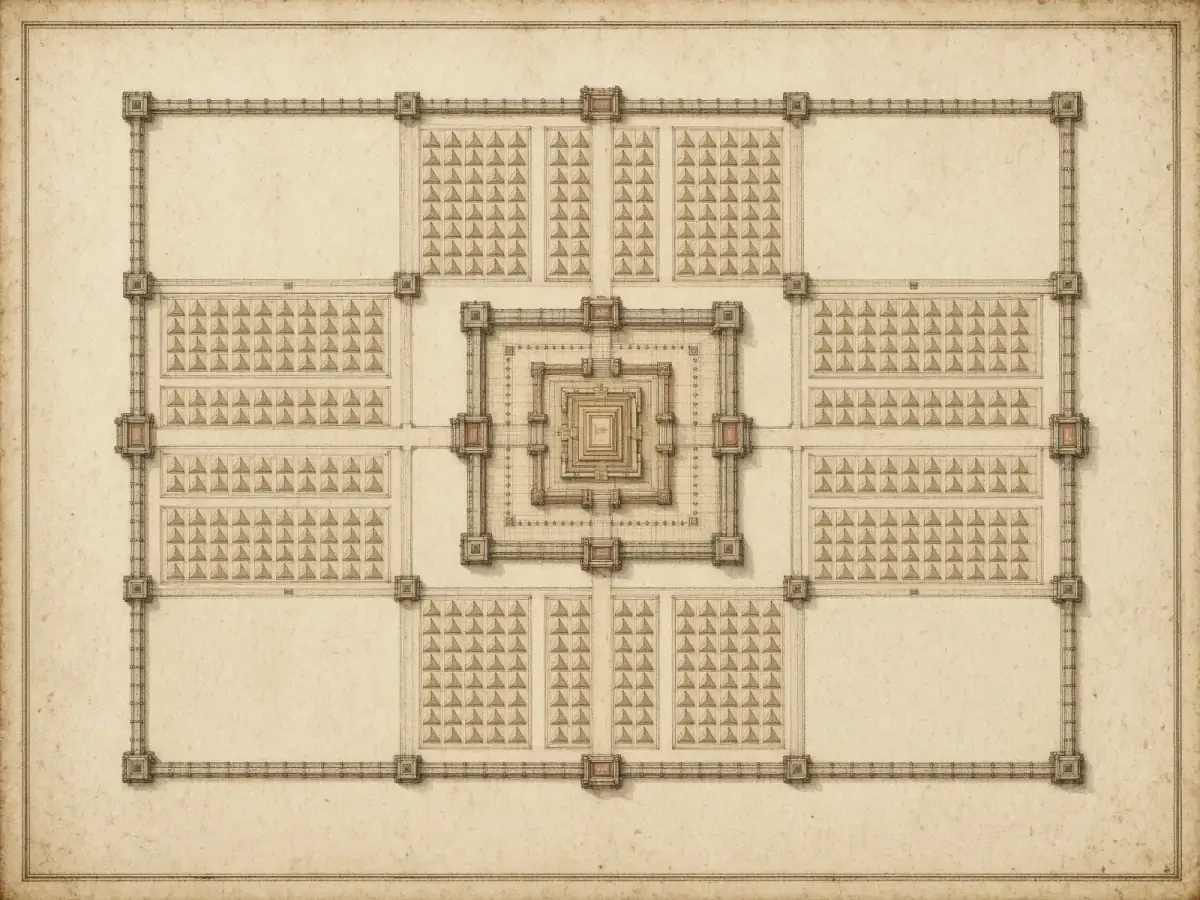
The marching order reveals why the Levitical assignments had to be so specific. Gershon and Merari leave after Judah with the tabernacle's coverings and framework. Reuben's division follows. Then Kohath comes with the holy furnishings, and verse 21 explains the timing: the first carriers are to have the tabernacle erected by the time the furnishings arrive. The sanctuary is not dismantled and rebuilt as one undifferentiated job. One family's work prepares the destination for another family's burden. Ephraim then follows, and Dan closes as the rear guard, completing the four-division procession. Numbers has moved from static camp positions to a sequence in which separate responsibilities interlock. Curtains must arrive before they can be hung, framework before sacred furniture can be housed, and the families carrying them must move at the right point in the larger column. Order here is not decorative symmetry. It is what makes a mobile sanctuary physically possible.
Deep dive
The order contains an excellent piece of practical coordination. Gershon and Merari leave with the tabernacle after Judah’s division; Reuben’s division follows; then come the Kohathites with the holy furnishings. Verse 21 explains the timing: the others set up the tabernacle before the Kohathites arrive. The coverings and framework do not trail behind the objects that need to be housed in them.
Ephraim’s division follows, and Dan closes the procession as the rear guard. The chapter thus expands the general arrangement in chapter 2 into the actual sequencing of work and movement. Transport is not a single undifferentiated task performed at one instant. The families have distinct burdens, different equipment, and a shared destination at which their work must fit together. The sequence makes their dependence on one another visible without interrupting the account for a separate explanation of efficient camp management.
Words to trace: children, host, forward, tribe, armies, camp
Verse-by-verse path
- Numbers 10:17
The first time the tabernacle is taken down on the march. Gershon carried the curtains and coverings and Merari the boards, bars, pillars and sockets (4:25–32), on the six wagons of chapter 7: two to Gershon, four to Merari, the heavier load given the most oxen.
- Numbers 10:18
Reuben, Jacob’s firstborn, heads only the second division; Judah has the front. Elizur means “my God is a rock”. Reuben’s camp lay on the south, so this is the division the second alarm of verse 6 sets moving.
- Numbers 10:19
Zurishaddai means “my rock is Shaddai”, the old divine title of Genesis 17:1. Simeon counted 59,300 at Sinai (1:23) and would fall to 22,200 at the second census (26:14), the steepest loss of any tribe.
- Numbers 10:20
The father is Deuel, as in 1:14 and 7:42, but Reuel in 2:14. The Hebrew letters d and r are nearly identical in shape, so one spelling is almost certainly a copyist’s slip; the Greek has Ragouel in every place.
- Numbers 10:21
“The sanctuary” here means the holy things, ark, table, lampstand and altars, which Kohath carried on their shoulders with no wagons at all (7:9). “Against they came” is 1611 English for “in readiness for their arrival”: against in its old sense of before, in time for.
- Numbers 10:22
Ephraim, Joseph’s younger son, heads the western division, as Jacob set Ephraim before Manasseh in Genesis 48:20. By 1 Chronicles 7:26–27, Elishama son of Ammihud was the grandfather of Joshua.
- Numbers 10:23
Gamaliel means “God is my reward”. Manasseh was the smallest tribe at Sinai with 32,200 (1:35) and would grow to 52,700 by the second census (26:34), the largest gain any tribe makes.
- Numbers 10:24
Benjamin, Rachel’s second son, marches with the two tribes of his brother Joseph, so the whole western division is Rachel’s descendants. Abidan means “my father is judge”; Gideoni shares its root with Gideon, “hewer”.
- Numbers 10:25
“Rereward” is the old spelling of rearward. The Hebrew is measef, the gatherer, the division that picks up stragglers and anything left behind. Dan was the largest tribe after Judah, 62,700 (1:39), and its camp 157,600 strong (2:31), numbers suited to the rear guard.
- Numbers 10:26
Asher was the son of Leah’s maid Zilpah. With Dan and Naphtali, the sons of Rachel’s maid Bilhah, the rear division brings together all three tribes it contains from Jacob’s two secondary wives.
- Numbers 10:27
The last name in the order of march. Ahira is hard to read; the plain sense, “my brother is evil” or “brother of evil”, is so strange that some take ra as a divine name. Naphtali closes the column as it closed the dedication on the twelfth day (7:78).
- Numbers 10:28
The summary line keeps the census vocabulary: “according to their armies”, tsivotam, hosts. The tribes do not wander off as families but march as the mustered companies of chapter 1.
Numbers 10:17-28
King James Version17And the tabernacle was taken down; and the sons of Gershon and the sons of Merari set forward, bearing the tabernacle.
18And the standard of the camp of Reuben set forward according to their armies: and over his host was Elizur the son of Shedeur.
19And over the host of the tribe of the children of Simeon was Shelumiel the son of Zurishaddai.
20And over the host of the tribe of the children of Gad was Eliasaph the son of Deuel.
21And the Kohathites set forward, bearing the sanctuary: and the other did set up the tabernacle against they came.
22And the standard of the camp of the children of Ephraim set forward according to their armies: and over his host was Elishama the son of Ammihud.
23And over the host of the tribe of the children of Manasseh was Gamaliel the son of Pedahzur.
24And over the host of the tribe of the children of Benjamin was Abidan the son of Gideoni.
25And the standard of the camp of the children of Dan set forward, which was the rereward of all the camps throughout their hosts: and over his host was Ahiezer the son of Ammishaddai.
26And over the host of the tribe of the children of Asher was Pagiel the son of Ocran.
27And over the host of the tribe of the children of Naphtali was Ahira the son of Enan.
28Thus were the journeyings of the children of Israel according to their armies, when they set forward.
Numbers 10:29-32
A Cloud Overhead and Experienced Eyes on the Ground
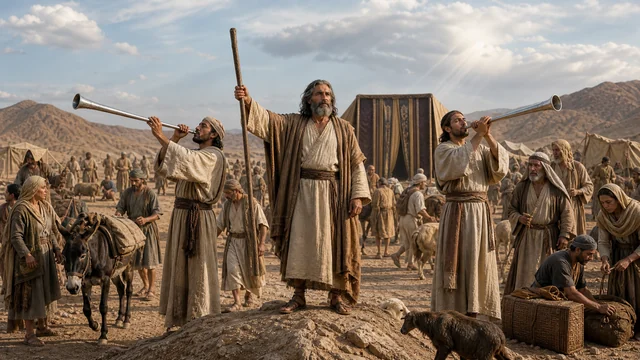
Moses invites Hobab to come with Israel and frames the invitation around both promise and practical usefulness. The destination is the place the LORD has said he will give, and Moses offers Hobab a share in the good promised to the people. Hobab initially refuses, preferring his own land and kindred. Moses' second appeal then gets specific: Hobab knows how to camp in the wilderness and can be "instead of eyes" for them. That line places experienced human observation beside the cloud without any hint that asking for help betrays divine guidance. Numbers does not force a choice between providence overhead and good judgment on the ground. It also stops before giving Hobab's final answer. Later readers may try to infer what he did, but these verses preserve only the refusal and the renewed appeal. The account honors his usefulness without inventing the decision that the conversation itself does not record.
Deep dive
Moses presents the journey in terms of a destination the LORD has promised, then asks Hobab to come. Hobab initially declines in favor of his own land and kindred. The second appeal becomes more specific: his knowledge of wilderness camping would make him "instead of eyes" for the company. Divine direction by the cloud and the usefulness of experienced human observation appear side by side, without a rebuke of Moses for seeking that help.
The invitation also joins usefulness with belonging. Moses does not merely ask for directions and dismiss Hobab when the route is clear; he offers participation in the good the LORD will do for Israel. Yet the exchange stops after this renewed appeal. No acceptance is recorded in these verses. The book moves back to the journey without supplying Hobab’s final answer, so a confident account of what he decided at this moment would go beyond the conversation actually preserved.
Words to trace: LORD, good, Moses, concerning, depart, encamp
Verse-by-verse path
- Numbers 10:29
Hobab is son of Raguel, the Reuel of Exodus 2:18, which leaves “father in law” uncertain: it may describe Raguel, or Hobab himself, as Judges 4:11 reads it. The Hebrew choten is any relative by marriage, not only a wife’s father.
- Numbers 10:30
Hobab’s refusal uses the words of Abram’s call in reverse. Abram was told to leave “thy country, and... thy kindred” (Genesis 12:1); Hobab will go back to “mine own land, and to my kindred”, the same word moledet in both.
- Numbers 10:31
“Instead of eyes” is how the Hebrew reads, a guide who sees water and pasture. The Greek Septuagint took it differently: “thou shalt be an elder among us”. Judges 1:16 finds the Kenites, descendants of Moses’ father-in-law, settled with Judah, which suggests the family did come.
- Numbers 10:32
The doubled “it shall be” is an insistence in the Hebrew as well. The offer is not a wage but a share: whatever good the LORD does Israel, Israel will do to Hobab, a stranger folded into the promise of verse 29.
Numbers 10:29-32
King James Version29And Moses said unto Hobab, the son of Raguel the Midianite, Moses’ father in law, We are journeying unto the place of which the LORD said, I will give it you: come thou with us, and we will do thee good: for the LORD hath spoken good concerning Israel.
30And he said unto him, I will not go; but I will depart to mine own land, and to my kindred.
31And he said, Leave us not, I pray thee; forasmuch as thou knowest how we are to encamp in the wilderness, and thou mayest be to us instead of eyes.
32And it shall be, if thou go with us, yea, it shall be, that what goodness the LORD shall do unto us, the same will we do unto thee.
Numbers 10:33-36
Movement and Rest Have Words Attached
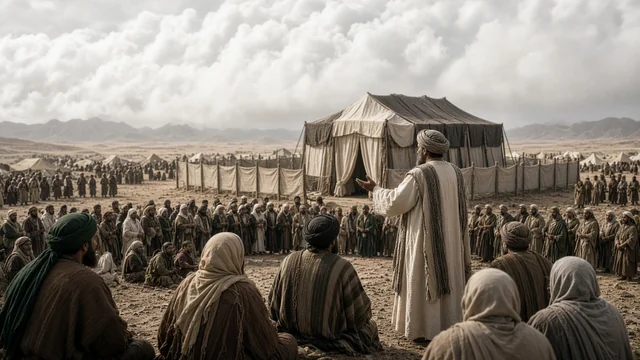
The chapter ends with movement framed by presence. Israel travels three days from the mount of the LORD, the ark goes before them to seek a resting place, and the cloud remains over them by day. The ark's described position has raised debate about whether it was physically at the front on this occasion or functioning as the leading sign within a more complex procession, because chapter 2 had emphasized the sanctuary's central place. Numbers does not provide a complete aerial diagram here. What it does provide is the ark's guiding role and Moses' words. At departure he asks the LORD to rise and scatter his enemies; at rest he asks the LORD to return to Israel's many thousands. Those sayings keep the ark from becoming a merely impressive object in the column. Movement and rest are both interpreted through the LORD's relation to his people, and that prayerful ending makes the complaint opening chapter 11 sound all the more abrupt.
Deep dive
The ark is described as going before the people to seek a resting place, while the cloud is over them. Its position raises a question alongside the central place assigned to the tabernacle in chapter 2. Ellicott takes a position physically ahead of the company as the natural reading, while allowing that this need not be its position on every journey. Barnes understands leadership rather than a place at the very front. The passage gives no complete diagram of the procession. Its description of the ark’s guiding role is clear even where the precise arrangement remains debated.
Moses’ two sayings correspond to departure and rest. When the ark moves, he calls for the LORD’s enemies to be scattered; when it rests, he addresses the LORD in relation to Israel’s many thousands. The language prevents the ark from becoming merely an impressive object at the front of a procession. The words concern the LORD’s presence, his enemies, and his people. The chapter ends with movement framed by address to God, immediately before the next chapter opens with speech that displeases him.
Words to trace: LORD, days, journey, camp, cloud, covenant
Verse-by-verse path
- Numbers 10:33
“The mount of the LORD” is the name Exodus 3:1 gives Horeb, where Moses met God at the bush, and the “three days’ journey” echoes the three days Moses asked Pharaoh for in Exodus 3:18. “To search out” is tur, the verb used for the spies in 13:2.
- Numbers 10:34
The cloud is “upon them”, overhead, a canopy as well as a sign. The Greek Septuagint places this verse after verses 35 and 36, a sign that the two sayings that follow were already felt to be an insertion into the account.
- Numbers 10:35
Hebrew scrolls set this verse and the next between two inverted letters nun, which the Talmud reads as marking them off as a book of their own. Psalm 68:1 opens with Moses’ cry almost word for word: “Let God arise, let his enemies be scattered.”
- Numbers 10:36
“Many thousands” is literally “ten thousands of thousands”. It reverses the blessing on Rebekah in Genesis 24:60, “thousands of millions”, thousands of ten thousands. The prayer asks the LORD to settle among Israel whenever the ark comes to rest.
Numbers 10:33-36
King James Version33And they departed from the mount of the LORD three days’ journey: and the ark of the covenant of the LORD went before them in the three days’ journey, to search out a resting place for them.
34And the cloud of the LORD was upon them by day, when they went out of the camp.
35And it came to pass, when the ark set forward, that Moses said, Rise up, LORD, and let thine enemies be scattered; and let them that hate thee flee before thee.
36And when it rested, he said, Return, O LORD, unto the many thousands of Israel.
Questions to keep in mind while reading
- Identify the people addressed and the covenant setting.
- Distinguish rescue, worship, holiness, justice, and community responsibility.
- Read commands in their literary and covenant context before making a modern application.
Text first
Where readers differ
The chapter summary begins with what the passage says and how its parts fit together. It does not assume one denomination has already settled every question. Where a conclusion depends on a tradition, literary theory, or historical reconstruction, that dependence is named openly.
The KJV text is presented first. Interpretive conclusions are labeled, and differences are introduced only when they help a reader understand why serious communities do not always reach the same answer.
Comparative interpretive notes for this chapter are in preparation. Until reviewed notes are ready, this page separates the KJV text from summary and application without claiming that serious readers agree on every question.
Questions beneath the surface
- What account of God, human freedom, responsibility, and the good life emerges from Numbers 10?
- Which tension does the chapter refuse to resolve quickly?
- What changes when the chapter is read as part of the whole canon rather than as an isolated moral lesson?
- Where might a sincere reader confuse a familiar tradition with something the text states directly?
Questions for serious personal contemplation
These open-ended questions make room for tension, honest response, prayer, and conclusions that remain accountable to the chapter.
Observe without rushing
What part of Numbers 10 makes you stop, feel unsettled, or feel surprised, and why?
Which detail in the passage would be easiest to overlook? How does that detail change your understanding?
Where do you see tension between what happens and this focus: Numbers 10 develops its own movement around children, host, LORD, blow, forward?
What important question does the passage leave open instead of resolving quickly?
Examine your inner life honestly
Which person, response, fear, or desire in the passage feels most like your own life right now?
What assumption about God, other people, or yourself does this text challenge?
Which part would you rather soften, avoid, or explain away too quickly? What might that reaction reveal?
If this Scripture could ask you one direct question, what do you think it would ask?
Respond with wisdom and courage
What do you need to remember, confess, grieve, thank God for, or trust after reading this passage?
How might another faithful person read this situation differently without ignoring the text?
What obedient response would be costly, uncomfortable, or slow, yet still faithful to Scripture?
What question will you carry into prayer this week, and which verses will you keep in front of you?
Music and video connected to the passage
Related media appears when its Scripture reference overlaps this study. Music and video can illuminate a theme while the biblical text remains the foundation.