The big picture
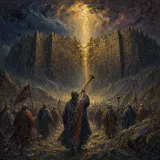
Jericho is tightly shut, but God speaks of the city as already given before Israel begins its strange seven-day procession. Priests, trumpets, the ark, armed men, a rear guard, controlled silence, and a timed shout make obedience more visible than conventional siegecraft. Before the wall falls, Joshua also defines what the victory will mean. The city is under a ban, Rahab's household is protected under the earlier oath, and precious metals belong to the LORD's treasury rather than to private soldiers. When the wall collapses, the account records both the severe destruction of Jericho and the deliberate rescue of Rahab and her family. The spies who once depended on her now bring her out. The city is burned, the reserved metals are deposited, and Joshua pronounces a curse on anyone who rebuilds Jericho. The chapter closes with Joshua's growing fame, while the warning about banned goods already points toward trouble inside Israel's own camp.
Central truth
Joshua 6 presents Jericho falling after Israel follows the LORD’s unusually specific seven-day procession, while the city’s devoted destruction, Rahab’s rescue, and Joshua’s rebuilding curse mark both judgment and remembered mercy.

The study notes have a page of their own
The movement by movement analysis, the words to trace, the verse by verse notes and where readers differ are written for someone studying alone. They are on the Deep Personal Reflections page for this chapter. This page is the lesson.
A chapter-specific teaching brief
These anchors come from this chapter itself. They help a teacher use the Level 1 overview, the Level 2 study, and the Scripture text as one lesson.
Open with the chapter’s first image
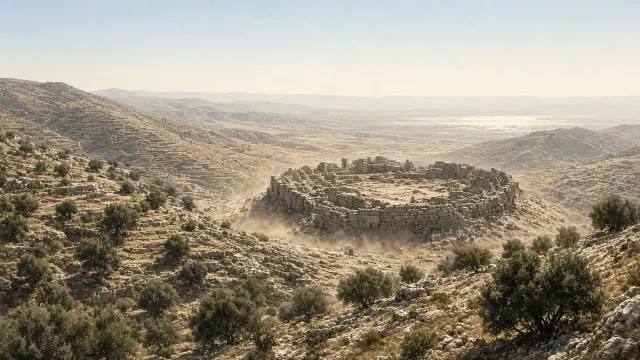
Joshua 6:1: “Now Jericho was straitly shut up because of the children of Israel: none went out, and none came in.”
Slow down at the turning point
Joshua 6:15: “And it came to pass on the seventh day, that they rose early about the dawning of the day, and compassed the city after the same manner seven times: only…”
Keep this word trail visible
city, LORD, priests, trumpets, Joshua, seven
What to explain, in order
Teach the passage in this order. Each step names the verses it rests on, so every point can be shown in the text before it is applied.
Joshua 6:1-5
Shut gates and strange orders
Begin with the city: "straitly shut up", so that "none went out, and none came in." Then read the LORD's promise in verse 2 in the past tense, "I have given", before any instructions. Explain the instructions in verses 3 to 5: once a day for six days, seven times on the seventh, rams' horns, a long blast, a shout. Teach this first because the order matters: the outcome is announced before the method, so Israel's obedience is not a way of earning the victory but a way of receiving it. The method also makes it impossible for anyone to claim the credit.
Joshua 6:6-14
Six days of walking in silence
Show the procession on the board: armed men, seven priests with trumpets, the ark, then the "rereward", the rear guard. Explain rereward. Read verse 10 and let the silence register: the only sound for six days is the trumpets before the ark. Ask what it would be like to walk round a fortified city under the watching eyes of its defenders, saying nothing, and to go back to camp each evening with nothing visibly changed. This step teaches patience and obedience without visible results, so give it time before the climax.
Joshua 6:15-21
The shout, the wall and the ban
Read the seventh day and the fall of the wall. Then slow down at 6:17, "the city shall be accursed, even it, and all that are therein, to the LORD". Explain the Hebrew herem: something devoted wholly to the LORD, either destroyed or given to the sanctuary, never kept as private profit. Read 6:21 as written, and do not soften or dramatise it. Say plainly that this is an act of judgment the LORD commanded at a particular moment in Israel's history, linked in Genesis 15:16 and Deuteronomy 9:4-5 to the wickedness of the land. It is never a pattern for anyone to follow today.
Joshua 6:22-25
A household brought out
Now turn to Rahab and do not let her be an afterthought; the chapter itself names her four times. The spies who swore the oath bring out her father, mother, brothers and all her kindred, and set them "without the camp of Israel". Then 6:25 says she "dwelleth in Israel even unto this day". Explain that the ban on Jericho was not an ethnic sentence; a Canaanite woman and her family who turned to the LORD were spared. Teach this here so that the class holds judgment and mercy in the same chapter, as the text does.
Joshua 6:26-27
A curse on rebuilding and a name spread abroad
Finish with Joshua's oath. Explain "adjured" as putting the people under a solemn oath. Read 1 Kings 16:34 so the class sees the curse remembered centuries later. Then read the last verse: "So the LORD was with Joshua; and his fame was noised throughout all the country." That fulfils 1:5 and 3:7. Teach this last because it closes the first great act in the land and prepares for chapter 7, which begins with a single word, "But", and the discovery that someone did not keep the ban.
Where learners get stuck
The misreadings this passage tends to produce, and how to answer each from the text.
"Jericho shows that God approves of killing whole peoples, so violence in his name can be right today."
Read what the text says and how narrowly it says it. The ban on Jericho is commanded by the LORD for this city at this moment (6:2, 17), tied elsewhere to the judgment of long wickedness (Genesis 15:16, Deuteronomy 9:4-5). Israel may not profit from it (6:18-19). Rahab's family, who turned to the LORD, are spared (6:25). Nothing in Joshua gives anyone today a licence for violence, and the New Testament says our warfare is "not against flesh and blood" (Ephesians 6:12). Christians have wrestled with this chapter for centuries, and a teacher can say so honestly.
"The walls fell because the people marched and shouted the right way."
The LORD says "I have given into thine hand Jericho" before any marching begins (6:2), and Joshua says "the LORD hath given you the city" before the wall falls (6:16). Hebrews 11:30 says "By faith the walls of Jericho fell down". The procession is obedience to an instruction, not a technique. Teachers should steer away from any lesson that turns the march into a formula for making obstacles fall.
"Rahab was only spared because she was useful to the spies."
The spies' oath in 2:12-14 was made because Rahab confessed the LORD as "God in heaven above, and in earth beneath" (2:11) and asked for mercy. In 6:25 she not only survives but "dwelleth in Israel even unto this day", and Matthew 1:5 places her in the line of David. Usefulness would have earned a reward and a departure; what she receives is a home among the LORD's people.
"The curse in verse 26 means God hates the city of Jericho forever."
The curse falls on the man "that riseth up and buildeth this city Jericho", that is, whoever refortifies it as a city (6:26). It is fulfilled in Hiel in 1 Kings 16:34. Later Scripture shows people living there: Elisha heals its water in 2 Kings 2:19-22, and Jesus heals blind Bartimaeus near Jericho and eats with Zacchaeus there (Mark 10:46, Luke 19:1-10). The curse is about a rebuilt fortress, not a place beyond mercy.
Learning objectives
- Describe the seven-day marching pattern accurately, distinguishing the first six days from the seventh.
- Identify the roles of armed men, seven priests, seven trumpets of rams’ horns, the ark, and the rereward in the procession.
- Explain what “accursed” and “devoted” action means in the chapter’s handling of Jericho’s people and goods.
- Trace Rahab’s rescue from the prior oath in Joshua 2 to its execution in Joshua 6:22–25.
- Explain why silver, gold, brass, and iron are treated differently from other goods in verses 18–19 and 24.
- Identify Joshua’s curse concerning anyone who rebuilds Jericho and distinguish it from the city’s later habitation.
Teacher preparation
- Read Joshua 2 before class and mark every promise made to Rahab.
- Chart the procession order from verses 6–9 and 13: armed men, priests with trumpets, ark, and rereward.
- Count the sevens: seven priests, seven trumpets, seven days, and seven circuits on the seventh day.
- Prepare to explain “accursed thing” in KJV usage as material placed under the ban or devoted to destruction or to the LORD.
- Read 1 Kings 16:34 so Joshua’s curse in verse 26 can be connected to its later fulfillment under Hiel without claiming that no one ever occupied the Jericho area in the meantime.
Evidence and interpretation checks
Explicit
Joshua 6:2 explicitly states that the LORD has given Jericho, its king, and its mighty men into Joshua’s hand, and verses 3–5 explicitly prescribe the unusual marching and trumpet pattern.
Scripture-supported
Rahab’s rescue in verses 22–25 is directly supported by the oath terms of Joshua 2:12–21, and Joshua’s rebuilding curse in verse 26 is later echoed in 1 Kings 16:34.
Strong inference
Because the city falls only after the prescribed sequence and shout, the account directs attention away from ordinary siege engineering and toward obedience to the LORD’s command.
Possible or traditional reading
The repeated number seven is often given broad symbolic explanations.
Limit
Joshua 6 does not explain the physical mechanics by which the wall falls or provide an archaeological description of every section of Jericho.
Discussion with answer guidance
1. How does the seventh day differ from the first six days?
What a good answer contains
On the first six days Israel goes round the city "once" and returns to camp (6:3, 14). On the seventh day they rise "about the dawning of the day" and go round "seven times" (6:15), and only on the seventh circuit does the long trumpet blast come and the shout. A good answer sees the pattern of sevens: seven priests, seven trumpets, seven days, seven circuits. It also notices that the change on the seventh day is the LORD's timing, not a sign that Israel's patience paid off.
Show teacher guidance
On days one through six Israel circles once each day.
2. Who is making noise during most of the procession, and who is specifically told to remain silent?
What a good answer contains
The priests blow the trumpets the whole time (6:8-9, 13). The people are told, "Ye shall not shout, nor make any noise with your voice, neither shall any word proceed out of your mouth, until the day I bid you shout" (6:10). A good answer sees the contrast: the sound around Jericho is the sound of worship, rams' horns before the ark, while the people walk in silence. The shout, when it comes in 6:16, is on Joshua's word. A weak answer says everyone marched noisily for seven days.
Show teacher guidance
The priests blow trumpets continually, while Joshua commands the people not to shout or let their voice be heard until the appointed moment in verse 10.
3. What is Israel warned not to take from Jericho, and what items are reserved for the LORD’s treasury?
What a good answer contains
They are to "keep yourselves from the accursed thing" (6:18), and "all the silver, and gold, and vessels of brass and iron, are consecrated unto the LORD: they shall come into the treasury of the LORD" (6:19). Explain "accursed" here as devoted, placed under the ban and given wholly to the LORD. A good answer sees that the ban is not plunder; Israel may not profit from Jericho. It also notes the warning that taking it would "make the camp of Israel a curse", which chapter 7 will show.
Show teacher guidance
Use verses 18–19: avoid the accursed or devoted thing; silver, gold, and vessels of brass and iron are consecrated to the LORD and go into the treasury.
4. How do the two spies identify the household they are responsible to rescue?
What a good answer contains
Joshua sends "the two men that had spied out the country" back to "the harlot's house" to bring out "the woman, and all that she hath, as ye sware unto her" (6:22). The men who made the oath keep it. A good answer links this to 2:12-21: the scarlet line and the house on the wall identify the household, and the spies know it. A weak answer forgets that the rescue depends on the same men who made the promise in chapter 2.
Show teacher guidance
Verse 22 sends the young men who had spied out the country back to Rahab’s house.
5. What does Joshua 6:25 say about Rahab after Jericho falls?
What a good answer contains
"Joshua saved Rahab the harlot alive, and her father's household, and all that she had; and she dwelleth in Israel even unto this day" (6:25). The reason follows: "because she hid the messengers". A good answer notices that she is brought "without the camp" first (6:23) and then lives within Israel, so she moves from outside to inside. It also notices that in the same chapter the city is destroyed and a Canaanite family is saved, so judgment and mercy stand side by side. A weak answer forgets her and remembers only the walls.
Show teacher guidance
The verse says Joshua saved Rahab, her father’s household, and all she had, and that she dwelt in Israel “even unto this day.” Keep that inclusion in view alongside the city’s judgment.
6. What exactly does Joshua curse in verse 26?
What a good answer contains
The man "that riseth up and buildeth this city Jericho" (6:26). The cost is his sons: "he shall lay the foundation thereof in his firstborn, and in his youngest son shall he set up the gates of it." It is a curse on refortifying Jericho as a city, which 1 Kings 16:34 records being fulfilled when Hiel of Bethel rebuilt it. A good answer explains the oath and its fulfilment. A weak answer assumes nobody could live in the area afterward, which the Bible does not say.
Show teacher guidance
The curse concerns the man who rises to build Jericho, with his firstborn and youngest tied to laying the foundation and setting up the gates.
Responsible application
Heart and habits
Compare the simplicity of the promised outcome in verse 2 with the odd patience of the seven-day instructions.
Relationships and community
Follow the community’s obligation to keep an oath made by two spies to Rahab.
Do not pocket Jericho
List what belongs to Israel, what belongs to the treasury, and what is under the ban.
Session plans
Two timings of the same lesson. The shorter keeps the reading, the central discussion and one response; the longer gives the confusions and the application their own time.
45 minutes
Given before the march
Read 6:1-5. Underline "I have given" in verse 2 and ask what difference it makes that it comes first.
Six days of silence
Read 6:6-14. Take questions one and two, and draw the procession on the board.
The wall and the ban
Read 6:15-21. Take question three. Explain herem calmly and work through the first confusion, about violence today.
Rahab brought out
Read 6:22-25. Take questions four and five, and the third confusion.
The curse and the fame
Read 6:26-27 and 1 Kings 16:34. Take question six briefly.
Close
Hand out the sheet, read 6:25 together, and pray for mercy to reach those far off.
90 minutes
Walls that fall
Ask the class what they remember about Jericho from childhood. Write the memories down, and ask which of them the text actually says.
Given before the march
Read 6:1-5 and take the second confusion, about technique. Read Hebrews 11:30.
Six days of silence
Read 6:6-14. Take questions one and two. Walk the procession round the room in silence if space allows.
The wall and the ban
Read 6:15-21. Take question three. Explain herem with Deuteronomy 7:1-6, 20:16-18 and Genesis 15:16. Work through the first confusion with care, leaving room for honest questions.
A household brought out
Read 6:22-25 and Matthew 1:5. Take questions four and five, and the third confusion.
The curse and the fame
Read 6:26-27, 1 Kings 16:34 and Luke 19:1-10. Take question six and the fourth confusion.
Application
Choose the do not pocket Jericho application and list what belongs to Israel, what to the treasury, and what is under the ban.
Close
Read the key verse together and pray for those in the room who carry questions about this chapter.
Adapting the lesson
Children
Walk round the room once a day for six days in a single session, quietly, with one child blowing a toy trumpet, then seven times and a big shout. Make the wall from cardboard boxes and let them fall. Keep the focus on God keeping his promise and on Rahab's family being rescued through the red cord. Do not describe the killing; say that God judged the city and saved Rahab, and let children's questions be answered simply and gently.
Youth
Expect hard questions about 6:21 and welcome them. Read the verse, then Deuteronomy 9:4-5 and Genesis 15:16, and be honest that Christians have struggled with this. Show that the ban was not about ethnicity, because Rahab's family was spared, and that it was not about loot. Make clear that nothing in this passage gives anyone the right to harm people in God's name today. Then let the silence of 6:10 speak to their habit of instant reaction.
Adults
Give the ban proper time. Present what the text says, the theological reasons Deuteronomy gives, and the questions the text raises, without forcing one explanation; some adults will have read critics who use this chapter against faith. Hold 6:21 and 6:25 together. Discuss the patience of six silent days in a culture that expects instant results, and the oath kept to Rahab when it would have been easy to forget.
One to one
Ask the person what they find hardest in the chapter, and let them answer before you teach. If it is the destruction, read 6:17-25 together and show how the text holds judgment and mercy side by side, and how Rahab is spared. If it is the long wait of the six days, talk about walking in obedience without visible results. Do not hurry to tidy every question; promise to keep reading together.
Song and video learning lab
A song or video may interpret, compress, or dramatize the text. Its value becomes clearer when its choices are compared with Scripture.
- Before the media: the exact passage and its central movement.
- During the media: the words, people, events, and emotions the artist emphasizes.
- After the media: what it clarifies, what it leaves out, and what belongs back in the biblical text.
Handout
One page for learners to take home. The print button prints this section alone.
Joshua 6:1–27
The passage in brief
The LORD tells Joshua that he has given Jericho into Israel's hand. For six days the army walks round the city once, with seven priests blowing rams' horns before the ark, while the people stay silent. On the seventh day they go round seven times, the priests blow a long blast, the people shout, and the wall falls. The city is devoted to the LORD in judgment, but Rahab and her family are brought out alive, as the spies promised, and she comes to live among Israel.
A verse to keep
And Joshua saved Rahab the harlot alive, and her father’s household, and all that she had; and she dwelleth in Israel even unto this day; because she hid the messengers, which Joshua sent to spy out Jericho.
Joshua 6:25 · King James Version
Questions to take home
What did the LORD say to Joshua before telling him how to take the city (6:2)?
Why were the people told to stay silent for six days (6:10)?
How did Israel keep the promise made to Rahab (6:22-25)?
This week
Keep one promise this week that would be easy to let slip, as Israel kept its oath to Rahab.
Music and video connected to the passage
Related media appears when its Scripture reference overlaps this study. Music and video can illuminate a theme while the biblical text remains the foundation.