
The big picture
Luke 23 repeatedly separates the legal sentence imposed on Jesus from the question of his guilt. Before Pilate, charges are translated into language suitable for Roman authority, including an accusation about tribute that Luke has already shown to distort Jesus' words. Pilate declares that he finds no fault and sends the Galilean to Herod, whose curiosity produces many questions, no miracle, mockery, and a return. Pilate then states innocence again and again, yet releases Barabbas, a man actually imprisoned for sedition and murder, while delivering Jesus to crucifixion. On the road, Simon carries the cross behind him and mourning women hear a warning about Jerusalem. At Calvary, Jesus prays for forgiveness while rulers, soldiers, and one criminal insist that true kingship should prove itself through self-rescue. Another criminal sees differently and asks to be remembered; he receives the promise of being with Jesus in paradise. Darkness, a torn veil, Jesus' final prayer to the Father, and a centurion's recognition follow. Joseph's dissenting council membership and the women's careful observation of the burial keep the chapter's responses varied to the end. The condemned king continues to give while those judging him repeatedly reveal what they cannot make the sentence prove.
Central truth
Luke 23 presents Jesus repeatedly declared undeserving of death yet condemned under pressure, extending mercy on the road and at the cross, dying with trust in the Father, and being buried in a known tomb while faithful witnesses observe where His body is laid.

The study notes have a page of their own
The movement by movement analysis, the words to trace, the verse by verse notes and where readers differ are written for someone studying alone. They are on the Deep Personal Reflections page for this chapter. This page is the lesson.
A chapter-specific teaching brief
These anchors come from this chapter itself. They help a teacher use the Level 1 overview, the Level 2 study, and the Scripture text as one lesson.
Open with the chapter’s first image
Luke 23:1: “And the whole multitude of them arose, and led him unto Pilate.”
Slow down at the turning point
Luke 23:28: “But Jesus turning unto them said, Daughters of Jerusalem, weep not for me, but weep for yourselves, and for your children.”
Keep this word trail visible
Jesus, Pilate, people, Herod, laid, chief
What to explain, in order
Teach the passage in this order. Each step names the verses it rests on, so every point can be shown in the text before it is applied.
Luke 23:1-12
Before Pilate and Herod
Begin with the charges and Pilate's first verdict. Explain that Pilate, as Roman governor, alone could order execution. When he hears Galilee, he sends Jesus to Herod Antipas, the ruler of Galilee, who is in Jerusalem for the feast. Herod hoped for a miracle; Jesus says nothing to him. Herod's soldiers mock him with a fine robe and send him back. Teach the irony of 23:12: two rivals become friends over the rejection of Jesus. Teach this first because it begins the record of innocence that runs through the whole chapter.
Luke 23:13-25
Three times innocent, and condemned
Pilate calls everyone together and declares that neither he nor Herod finds Jesus guilty. Explain chastise as flogging, a lesser punishment Pilate hoped would satisfy them. The crowd demands Barabbas, a man imprisoned for rebellion and murder, and cries crucify. Pilate tries a third time and then gives in. Teach the exchange plainly: the guilty man is released and the innocent one delivered. Luke does not explain it as a doctrine here, but the class can see the picture of substitution. Keep the focus on injustice, and do not blame any people group.
Luke 23:26-31
Simon and the daughters of Jerusalem
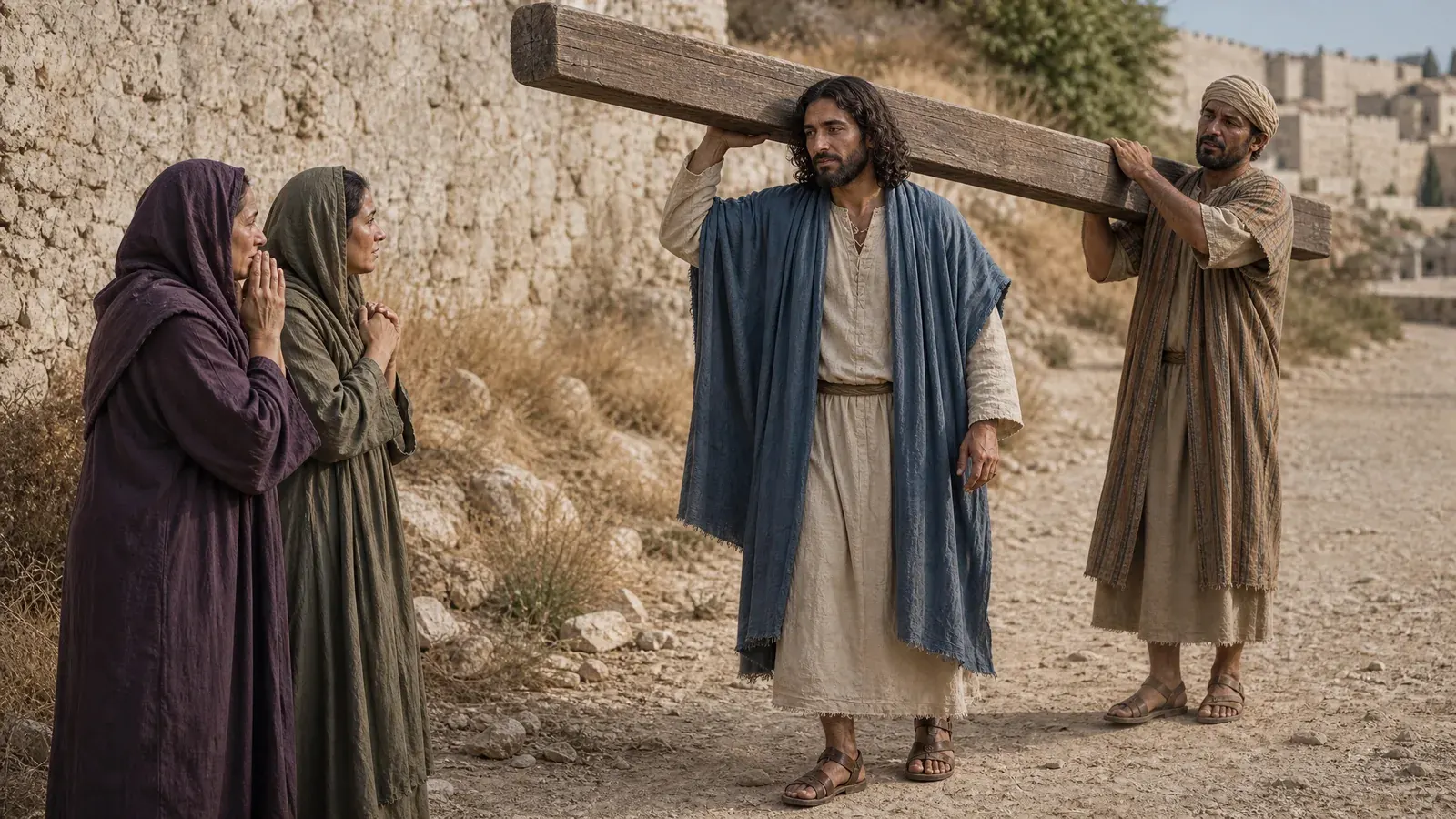
On the road to execution soldiers seize Simon of Cyrene, a man from North Africa coming in from the country, to carry the cross behind Jesus. Point out the phrase "after Jesus", the posture of a disciple in 9:23. Then a large crowd of women mourning. Teach Jesus' words to them as compassion and warning: the coming judgement on the city is worse than what they are watching. Explain the green and dry tree. Teach this step to show that even now Jesus is thinking of others, not himself.
Luke 23:32-38
Father, forgive them
Speak of the crucifixion simply and without graphic description: at the place called Calvary they crucified him between two criminals. Explain Calvary as the Latin name for the place of the skull. Put the weight on his first words: "Father, forgive them; for they know not what they do" (23:34). Note that some ancient manuscripts lack this sentence; many Bibles keep it. Then the mockery from rulers, soldiers and the inscription. Teach the repeated taunt, save thyself, and let the class see that he saves others precisely by not saving himself.
Luke 23:39-43
Remember me
Teach the two criminals as two responses to Jesus. One joins the mockery. The other fears God, admits his guilt, declares Jesus innocent, and asks to be remembered in his kingdom. Explain paradise as a Persian word for a garden, used for the place of the righteous with God. Jesus promises "To day". Teach this step as the gospel in miniature: a man with no time left to earn anything receives mercy by trusting the king beside him. Traditions discuss what this means for the state of the dead; keep to Jesus' promise.
Luke 23:44-49
Into thy hands
At noon darkness falls for three hours, and the temple curtain is torn. Then Jesus cries out with a loud voice and commits his spirit to the Father, words from Psalm 31:5 that Jewish children learned as a bedtime prayer. Teach his death as trust, not defeat. Then the centurion, a Roman officer, glorifies God and calls him righteous, the last of the witnesses to his innocence. The crowds beat their breasts in grief and go home, and the women watch. Handle this step with reverence and give the room a moment of silence.
Luke 23:50-56
Joseph, the tomb, and the women
Introduce Joseph of Arimathaea, a member of the council who had not agreed with its decision and who was waiting for the kingdom. He asks Pilate for the body, a costly and public act. Teach the details: wrapped in linen, laid in a new tomb cut in rock. Then the women, who follow, see the tomb and how the body is laid, prepare spices, and rest on the sabbath "according to the commandment". Teach this last because it sets the scene for chapter 24 and shows quiet faithfulness in the darkest hour.
Where learners get stuck
The misreadings this passage tends to produce, and how to answer each from the text.
"The Jews killed Jesus, so they are to blame."
Luke names particular people: "the chief priests and the rulers and the people" in that crowd (23:13), Herod, Pilate who "delivered Jesus to their will" (23:25), and Roman soldiers. Jesus, his disciples and the women who mourn him are also Jews (23:27). Jesus prays "Father, forgive them" (23:34), and Acts 4:27 includes Gentiles and Israel together. Christians have confessed that their own sins put Jesus on the cross. Teach this clearly and firmly: blaming the Jewish people has caused terrible harm and has no basis in this text.
"If Pilate thought Jesus was innocent, he was a good man."
Pilate declares Jesus innocent three times (23:4, 23:14, 23:22) and still "gave sentence that it should be as they required" (23:24). He knew the truth and acted against it because the crowd's voices "prevailed" (23:23). Luke shows that knowing what is right and doing what is popular are not the same. Teach this as a warning for any of us who hold authority, without demonising Pilate more than the text does.
"The criminal on the cross proves that how we live does not matter."
The criminal says "we indeed justly; for we receive the due reward of our deeds" (23:41), so he takes his life seriously and confesses it. He fears God (23:40) and asks Jesus for mercy (23:42). His case shows that no one is beyond grace, even at the end. It does not teach that repentance can safely be delayed, since the other criminal, with the same opportunity, mocked. Teach hope for the dying and urgency for the living.
"Jesus died because he was too weak to save himself."
The rulers and soldiers say "let him save himself" and "save thyself" (23:35, 23:37), but earlier Jesus said the Son of man "must suffer many things" (9:22) and prayed "not my will, but thine, be done" (22:42). At the end he commends his spirit to the Father with a loud voice (23:46). He chose not to save himself in order to save others. Teach his death as willing self giving, which is why the centurion glorified God.
Learning objectives
- Trace the accusations before Pilate and Herod and identify every declaration or indication that Jesus has not been found guilty of a capital offense.
- Explain the exchange involving Barabbas and the crowd’s repeated demand for crucifixion.
- Interpret Jesus’ words to the daughters of Jerusalem as a warning about coming judgment rather than a request for sentimental pity.
- Compare the two malefactors and explain Jesus’ promise to the one who turns to Him.
- Identify the signs surrounding Jesus’ death and the words attributed to Jesus, the centurion, and the watching crowd.
- Describe Joseph of Arimathaea’s actions and the women’s observation of the tomb, preparation of spices, and Sabbath rest.
Teacher preparation
- Prepare a simple Roman-trial sequence: council accusation, Pilate, Herod, return to Pilate, repeated declarations, crowd pressure, sentence.
- Read Isaiah 53:9, 12 and Psalm 31:5 before class.
- Prepare the textual note for Luke 23:34, 'Father, forgive them.' The verse is in the KJV but absent from some early manuscripts.
- Explain 'paradise' only as far as the promise requires: Jesus tells the repentant malefactor, 'To day shalt thou be with me in paradise.' Avoid building a complete geography of the afterlife from one sentence.
- Mark the women carefully.
Evidence and interpretation checks
Explicit
Luke 23:4, 14–15, and 22 explicitly record repeated judgments from Pilate that he finds no fault or no cause of death in Jesus, and Pilate also reports that Herod has found nothing worthy of death.
Scripture-supported
Luke 23:39–43 directly contrasts one criminal’s mockery with the other’s rebuke, acknowledgment of his own just condemnation, assertion that Jesus has done nothing amiss, request to be remembered, and Jesus’ promise of paradise that day.
Strong inference
The detailed burial sequence in verses 50–56 strongly supports continuity between the crucified body and the tomb visited in chapter 24: Joseph handles the body, women observe the placement, and they prepare to return after Sabbath.
Possible or traditional reading
Luke 23:34 and some other passion details have textual variants across ancient manuscripts.
Limit
Luke 23 does not name the two malefactors, does not specify the exact physical mechanism of the three-hour darkness, does not say the centurion converted in a later technical sense, and does not describe Joseph as one of the twelve.
Discussion with answer guidance
1. What charges are brought to Pilate in verse 2, and which one becomes the practical focus?
What a good answer contains
They say "We found this fellow perverting the nation, and forbidding to give tribute to Cæsar, saying that he himself is Christ a King" (23:2). A strong answer notices that the second charge is false, since in 20:25 Jesus told them to render to Caesar what is Caesar's, and that the third is the one Pilate takes up: "Art thou the King of the Jews?" (23:3). Jesus answers "Thou sayest it". The charge of kingship is what will be written over the cross (23:38). A weak answer lists the charges without seeing that they recast a religious claim as a political threat to Rome.
Show teacher guidance
The accusers allege perverting the nation, forbidding tribute to Caesar, and claiming to be Christ a King.
2. How many times does Luke make Pilate’s reluctance audible?
What a good answer contains
Three times. "I find no fault in this man" (23:4). After Herod: "I, having examined him before you, have found no fault in this man", adding that Herod found "nothing worthy of death" (23:14-15). And "the third time, Why, what evil hath he done? I have found no cause of death in him" (23:22). A good answer sees that Luke is building a legal record of innocence, and that Pilate still gives way: "the voices of them and of the chief priests prevailed" (23:23). Herod, the centurion and a criminal add their witness. A weak answer counts the statements without seeing the injustice they expose.
Show teacher guidance
Pilate says he finds no fault in verse 4, reports neither he nor Herod finds a capital cause in verses 14–15, and says a third time in verse 22 that he finds no cause of death.
3. Why does Jesus tell the daughters of Jerusalem to weep for themselves and their children?
What a good answer contains
"Daughters of Jerusalem, weep not for me, but weep for yourselves, and for your children" (23:28). He sees days coming when people will call the barren blessed and cry to the mountains "Fall on us" (23:29-30). Then "if they do these things in a green tree, what shall be done in the dry?" (23:31). Explain the proverb: if this happens to the innocent, living tree, how much worse for the dry wood ready to burn. A strong answer links this to the lament of 19:41-44. A weak answer reads Jesus as rejecting their sympathy; even on the road he is caring for them and warning them.
Show teacher guidance
He redirects grief toward coming days of severe judgment, using images of blessed barrenness and people calling on mountains and hills.
4. What separates the two crucified criminals in verses 39–43?
What a good answer contains
One "railed on him, saying, If thou be Christ, save thyself and us" (23:39). The other rebukes him: "Dost not thou fear God, seeing thou art in the same condemnation?", admits "we indeed justly; for we receive the due reward of our deeds: but this man hath done nothing amiss" (23:40-41), and asks "Lord, remember me when thou comest into thy kingdom" (23:42). Jesus answers "To day shalt thou be with me in paradise" (23:43). A good answer sees fear of God, confession, recognition of Jesus' innocence and kingship, and a plea for mercy. A weak answer misses that he has nothing to offer and is still received.
Show teacher guidance
One demands self-saving proof and mocks.
5. What happens at Jesus’ death in verses 44–49?
What a good answer contains
"there was a darkness over all the earth until the ninth hour", "the sun was darkened, and the veil of the temple was rent in the midst" (23:44-45). Jesus cries out "Father, into thy hands I commend my spirit" and dies (23:46), quoting Psalm 31:5. The centurion glorifies God: "Certainly this was a righteous man" (23:47). The crowd "smote their breasts, and returned" (23:48), and his acquaintances and the women from Galilee watch from afar (23:49). Explain the veil as the curtain before the holy place, and many read its tearing as access to God opened. A weak answer forgets the witnesses, which Luke carefully names.
Show teacher guidance
Darkness covers the land, the temple veil is torn, Jesus commits His spirit to the Father and dies, the centurion declares Him righteous, the crowd smites their breasts, and acquaintances and women watch from afar.
6. Why does Luke spend so much space on burial details?
What a good answer contains
Because the burial establishes that Jesus truly died and where his body lay. Joseph, "a good man, and a just" who had not agreed with the council (23:50-51), takes the body, wraps it "in linen", and lays it "in a sepulchre that was hewn in stone, wherein never man before was laid" (23:53). The women "beheld the sepulchre, and how his body was laid" (23:55), and then rest on the sabbath. A strong answer sees that these details answer later doubts in chapter 24: the women know the right tomb, and it held no other body. A weak answer treats the burial as an appendix to the cross.
Show teacher guidance
Joseph is named and characterized, a new rock-hewn tomb is identified, the body is laid there, the day is noted, and women see the tomb and placement before preparing spices.
Responsible application
Heart and habits
Compare the two criminals as two responses to the same visible Jesus under the same brutal circumstances.
Relationships and community
Use Pilate’s repeated verdicts and eventual sentence to examine how public pressure can overpower acknowledged judgment.
Stay with the witnesses
Pay attention to Joseph and the women after the public spectacle.
Session plans
Two timings of the same lesson. The shorter keeps the reading, the central discussion and one response; the longer gives the confusions and the application their own time.
45 minutes
The charges
Read 23:1-12 and ask question one.
No fault in him
Read 23:13-25. Ask question two and take confusions one and two.
On the road
Read 23:26-31 and ask question three.
The cross
Read 23:32-43. Ask question four and take confusion three.
His death and burial
Read 23:44-56. Ask questions five and six. Keep a moment of silence after 23:46.
Response and handout
Invite learners to pray the criminal's words in silence. Read the key verse together and give out the sheet.
90 minutes
Innocent or guilty
Ask the group what makes a trial unjust. Then read 23:1-12 and ask question one.
The verdicts
Read 23:13-25. Ask question two. Take confusions one and two carefully.
Simon and the women
Read 23:26-31 with 19:41-44. Ask question three.
Forgive them
Read 23:32-38 and Isaiah 53:12. Take confusion four.
Paradise
Read 23:39-43. Ask question four and take confusion three.
The death of Jesus
Read 23:44-49 and Psalm 31:5. Ask question five. Keep a full minute of silence.
The burial
Read 23:50-56 and ask question six.
Handout and prayer
Read the key verse together, point to the take-home line, and pray 23:42 and 23:46 slowly together.
Adapting the lesson
Children
Tell this part gently. Say that people who did not believe in Jesus asked the ruler to have him killed, even though he had done nothing wrong. Say that Jesus died on a cross, and that even then he forgave people and was kind to a man beside him. Do not describe nails, wounds or pain. Tell them that a kind man named Joseph put Jesus in a tomb, and that the next part of Luke has very good news.
Youth
Ask them to count how many times someone says Jesus is innocent. Then talk about Pilate giving in to the crowd and ask where they feel pressure to go along with something they know is wrong. Read 23:34 and 23:39-43 and talk about forgiveness and mercy. Treat the crucifixion honestly but without dwelling on violence, and watch for students who are grieving.
Adults
Give time to the legal record of innocence, the role of Herod, and the meaning of Barabbas' release. Read Isaiah 53 alongside. Address firmly the error of blaming the Jewish people. Spend time on the words from the cross in Luke: forgiveness, paradise, trust. Many adults will have watched someone die; let 23:46 speak of dying in trust, with pastoral care.
One to one
Read 23:39-43 together slowly. Ask which of the two criminals they relate to, or whether they feel like a bystander. If they carry guilt, tell them the second criminal brought nothing and was promised paradise. If they are facing death or grief, read 23:46 and pray it with them. Leave room for silence.
Song and video learning lab
A song or video may interpret, compress, or dramatize the text. Its value becomes clearer when its choices are compared with Scripture.
- Before the media: the exact passage and its central movement.
- During the media: the words, people, events, and emotions the artist emphasizes.
- After the media: what it clarifies, what it leaves out, and what belongs back in the biblical text.
Handout
One page for learners to take home. The print button prints this section alone.
Luke 23
The passage in brief
Jesus was taken to Pilate, the Roman governor, and to Herod. Both found him innocent, and Pilate said so three times, but the crowd demanded his death and Pilate gave in, releasing a murderer named Barabbas instead. Simon of Cyrene carried the cross. At Calvary Jesus was crucified between two criminals. He prayed for those who crucified him and promised paradise to the criminal who asked to be remembered. At noon darkness fell, and Jesus committed his spirit to the Father and died. Joseph of Arimathaea buried him in a new tomb, and the women saw where he was laid.
A verse to keep
And he said unto Jesus, Lord, remember me when thou comest into thy kingdom. And Jesus said unto him, Verily I say unto thee, To day shalt thou be with me in paradise.
Luke 23:42-43 · King James Version
Questions to take home
How many times did Pilate say Jesus was innocent (23:4, 23:14, 23:22)?
What did Jesus pray for the people who crucified him (23:34)?
What did Jesus promise the criminal who asked to be remembered (23:43)?
This week
Pray the words Lord, remember me each night this week, and thank Jesus for dying for you.
Music and video connected to the passage
Related media appears when its Scripture reference overlaps this study. Music and video can illuminate a theme while the biblical text remains the foundation.