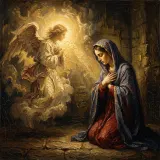
The big picture
The final chapter of the Book of Luke keeps separating what people can see from what they are able to understand. An empty tomb does not explain itself, remembered words do. Accurate reports do not automatically produce belief, and two travelers can rehearse the facts of Jesus' death while failing to see how suffering belongs to redemption. Jesus therefore opens the Scriptures before recognition settles the matter, then opens the gathered disciples' understanding after showing that “it is I myself.” The chapter refuses to choose between bodily presence and scriptural interpretation. Both are necessary to the witness Luke is preparing. That witness is then given a direction, repentance and remission of sins among all nations beginning at Jerusalem, and a limit, they must wait for power from on high. The Book of Luke closes with Jesus blessing as he departs and the disciples returning to Jerusalem with worship, praise, and great joy.
Central truth
Luke 24:1–35 moves the resurrection announcement from an empty tomb and remembered words to a long road where the risen Jesus is initially unrecognized, opens Moses and the prophets concerning Himself, and is finally known in the breaking of bread. Luke 24:36–53 closes the Gospel with the risen Jesus presenting bodily evidence, opening His disciples’ understanding of Scripture, commissioning repentance and remission of sins to all nations from Jerusalem, promising power from on high, and blessing them as He is carried up.

The study notes have a page of their own
The movement by movement analysis, the words to trace, the verse by verse notes and where readers differ are written for someone studying alone. They are on the Deep Personal Reflections page for this chapter. This page is the lesson.
A chapter-specific teaching brief
These anchors come from this chapter itself. They help a teacher use the Level 1 overview, the Level 2 study, and the Scripture text as one lesson.
Open with the chapter’s first image
Luke 24:1: “Now upon the first day of the week, very early in the morning, they came unto the sepulchre, bringing the spices which they had prepared, and certain…”
Slow down at the turning point
Luke 24:26: “Ought not Christ to have suffered these things, and to enter into his glory?”
Keep this word trail visible
Jerusalem, sepulchre, hands, Jesus, blessed, certain
What to explain, in order
Teach the passage in this order. Each step names the verses it rests on, so every point can be shown in the text before it is applied.
Luke 24:1–35
Luke 24:1-8
Why seek the living among the dead
Begin before dawn with the women who saw the burial (23:55) and come back with spices. The stone is rolled away, the body is gone, and two men in shining clothes appear. Teach the question "Why seek ye the living among the dead?" as the turning point of the whole Gospel. Then put the weight on remember: the angels do not give new information so much as send the women back to Jesus' own words. Teach this first because it shows that the resurrection is the fulfilment of what Jesus said, not a surprise outside his plan.
Luke 24:9-12
Idle tales and an empty tomb
The women tell the eleven and the others. Read the names in 24:10 and point out that Luke has prepared for them since 8:2-3. Then the apostles' response: nonsense, unbelief. Explain that in that culture women's testimony was often given less weight, so it is remarkable that the Gospels name women as the first witnesses. Then Peter runs, stoops, sees the linen clothes lying by themselves, and goes away wondering. Teach this step to show that the resurrection was not something the disciples wanted to believe or invented; they had to be persuaded.
Luke 24:13-24
Two on the road, eyes held
That same day two disciples walk to Emmaus, about seven miles, talking over everything. Jesus joins them, "But their eyes were holden that they should not know him". Explain holden as held back, prevented. Teach his question, their sad faces, and Cleopas' summary of the week, which is an accurate account of the facts without understanding. Put weight on "we trusted", the sound of disappointed hope. Teach this step slowly, because many learners know what it is to walk away from a place where hope seemed to die.
Luke 24:25-27
Beginning at Moses
Jesus rebukes their slow hearts and asks his question about the necessity of suffering before glory. Then he teaches them from Moses and all the prophets. Name some passages Jesus may have opened: Genesis 3:15, the Passover of Exodus 12, the servant of Isaiah 53, Psalm 22. Do not claim to know exactly which he used; Luke does not say. Teach this step as the key to reading the Old Testament: it speaks about Christ, and his suffering and glory are both written there. Encourage learners that the same Lord still opens the Scriptures.
Luke 24:28-35
Known in the breaking of bread
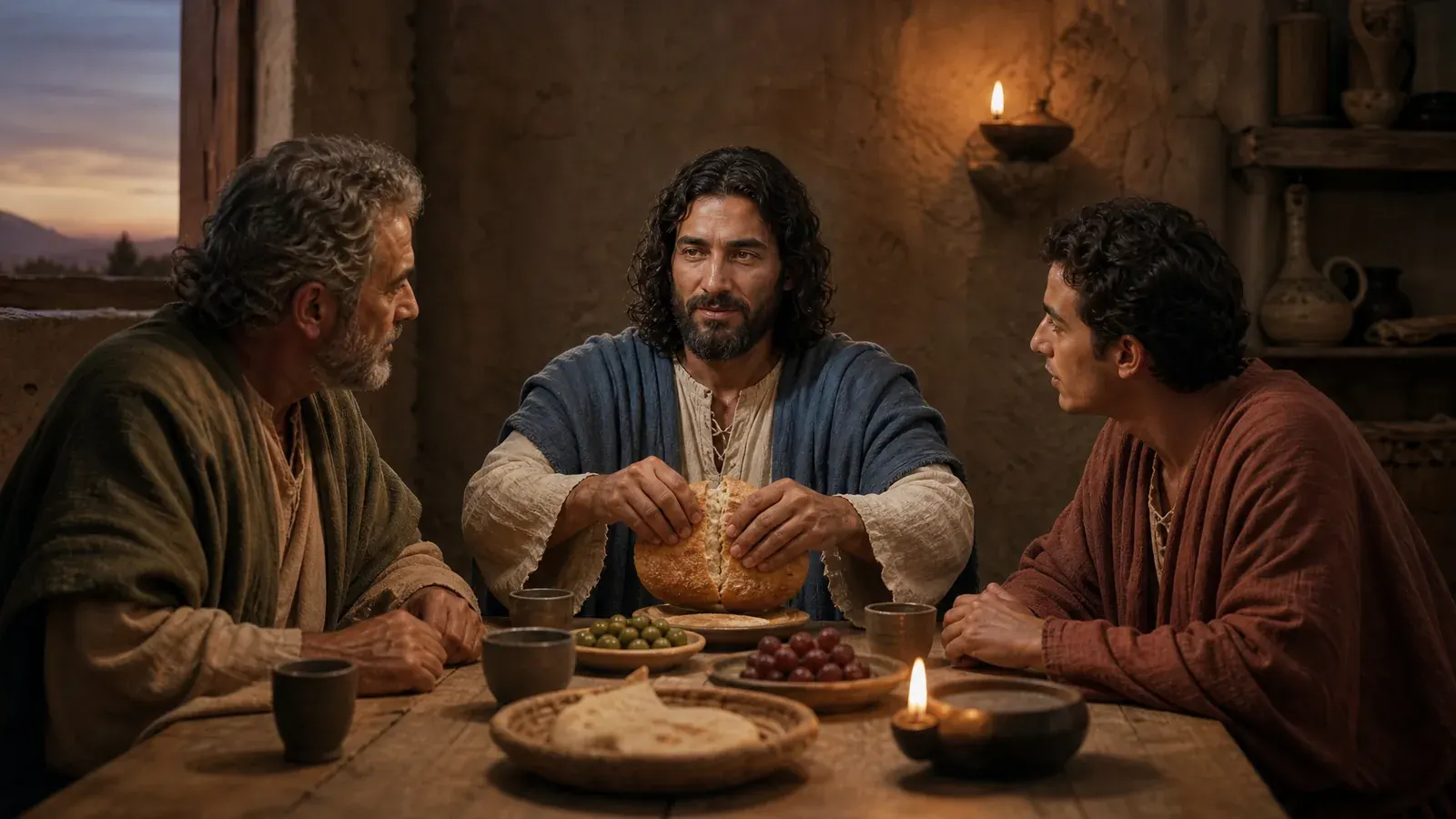
At the village Jesus acts as if he will go on, and they urge him to stay. Explain that hospitality to a stranger at nightfall was a sacred duty. At the meal the guest acts as host: he takes, blesses, breaks and gives. Their eyes are opened and he vanishes. Teach their reflection on burning hearts, their immediate return, and the news they hear in Jerusalem. Close on 24:35, "how he was known of them in breaking of bread". Teach this last because it joins the Scriptures and the shared meal as the places where the risen Lord is recognised.
Luke 24:36–53
Luke 24:36-37
Peace, and terror
Begin with the moment: while the Emmaus pair are still speaking, Jesus stands among them and says "Peace be unto you". Teach his greeting as the peace the angels announced at his birth (2:14), now given by the risen Lord himself. Then their terror. Explain that many people then believed in ghosts as the spirits of the dead, so the disciples reach for the explanation they have. Teach this short step first because the whole unit answers it: Jesus is not a spirit and not a memory but himself, alive in the body.
Luke 24:38-43
Hands, feet and a broiled fish
Teach the evidence in the order Jesus offers it: his questions about their troubled thoughts, his hands and feet, the invitation to touch, the statement about flesh and bones, and the meal of fish. Explain that the marks of crucifixion are still there, so the risen body is the same body, transformed. Pause on "believed not for joy", a mix of joy and disbelief that learners will recognise. Teach this step as Jesus' patience with doubters: he does not scold them for not believing; he gives them more reasons to believe.
Luke 24:44-45
The law, the prophets and the psalms
Now Jesus teaches. He reminds them that he told them all this before, and that everything written about him must be fulfilled. Explain the three divisions of the Hebrew Bible. Then the decisive act: he opened their understanding. Teach that understanding Scripture is a gift of the risen Christ, not only a matter of study. Connect to the road to Emmaus, where he did the same. Teach this step before the commission so the class sees that the mission is built on the Scriptures understood in the light of Jesus.
Luke 24:46-49
Witnesses to all nations
Teach the summary of the message in 24:46-47: Christ's suffering, his resurrection on the third day, repentance and forgiveness preached in his name to every nation, beginning at Jerusalem. Point out that the Gospel began with promises to Israel and ends with all nations, as Simeon foresaw in 2:32. Then the role of the disciples as witnesses and the command to wait for power from on high. Explain that Acts 1:8 picks up this promise. Teach this step as the commission that every learner who follows Jesus shares.
Luke 24:50-53
Blessing, ascension, joy
Jesus leads them out to Bethany, lifts his hands and blesses them, and while blessing them he is carried up into heaven. Explain lifted hands as the gesture of a priest blessing the people, as in Leviticus 9:22. Then their response: worship, great joy, the temple, continual praise. Show the shape of the whole Gospel: it opened in the temple with a priest struck silent and closes in the temple with disciples blessing God. Teach this last step so that learners leave the lesson with Jesus' blessing over them and joy as their response.
Where learners get stuck
The misreadings this passage tends to produce, and how to answer each from the text.
Luke 24:1–35
"The disciples expected Jesus to rise, so they imagined it."
The women came with spices for a corpse (24:1). The apostles called their report "idle tales" and "believed them not" (24:11). The Emmaus disciples said "we trusted", in the past tense (24:21). None of them expected a resurrection, though Jesus had foretold it (24:6-7). Their unbelief had to be overcome by evidence and by the risen Jesus himself. Teach that the Gospel's honesty about their doubts strengthens its witness.
"They did not recognise Jesus because his body was completely different."
Luke says "their eyes were holden that they should not know him" (24:16), and later "their eyes were opened, and they knew him" (24:31). The cause is placed in their eyes being held and then opened, not in Jesus being unrecognisable. In 24:39 Jesus says "it is I myself". Teach that recognising the risen Jesus is a gift God gives, through the Scriptures and the breaking of bread, and avoid speculating about the details of his resurrection body.
"The breaking of bread at Emmaus was the Lord's Supper."
Jesus' actions, "he took bread, and blessed it, and brake, and gave to them" (24:30), echo the Last Supper (22:19) and the feeding of the five thousand (9:16). Traditions read the Emmaus meal in different ways, some seeing the Supper in it and others an ordinary meal. Luke does not settle it. Teach what he does say, that Jesus "was known of them in breaking of bread" (24:35), and let learners make the connection their own churches make.
Luke 24:36–53
"Jesus rose only in a spiritual sense; his body stayed in the tomb."
Jesus says the opposite: "a spirit hath not flesh and bones, as ye see me have" (24:39). He shows his hands and feet (24:40) and eats fish before them (24:43). The tomb was empty (24:3). Luke takes care to show a bodily resurrection, the same body that was crucified, now alive and changed. Teach that Christian hope is resurrection of the body, not only the survival of the soul, and that this gives dignity to our bodies now.
"The Old Testament is about Israel, and only the New Testament is about Jesus."
Jesus says "all things must be fulfilled, which were written in the law of Moses, and in the prophets, and in the psalms, concerning me" (24:44), and on the Emmaus road he explained "in all the scriptures the things concerning himself" (24:27). The Old Testament is truly about Israel, and through Israel's history it points to Christ. Teach learners to read it as Jesus did, with patience and care, looking for him without forcing every verse.
"When Jesus ascended, he left us on our own."
Jesus promises "I send the promise of my Father upon you" (24:49), the Holy Spirit who comes at Pentecost (Acts 2:1-4). He goes up while blessing them (24:51), and they return "with great joy" (24:52), which is not the response of people abandoned. Acts 1:11 promises he will return. Teach the ascension as Jesus taking his place at the Father's right hand (22:69), from where he sends his Spirit and reigns.
Learning objectives
- Reconstruct the women’s arrival at the tomb and identify what they find missing and what the two men tell them to remember.
- Explain why remembering Jesus’ earlier words is central to the women’s response in verses 6–8.
- Describe the apostles’ initial reaction and Peter’s separate visit to the tomb.
- Trace the Emmaus conversation from disappointed expectations to Jesus’ rebuke and scriptural exposition.
- Identify what Cleopas and his companion had hoped concerning Jesus and what reports they have already heard.
- Explain the sequence by which the two disciples recognize Jesus at the meal and immediately return to Jerusalem.
- Identify the disciples’ initial fear and the evidence Jesus offers to establish that He is physically risen.
- Explain why Jesus eats before the disciples and how that action functions in the argument of verses 36–43.
- Trace the Law of Moses, Prophets, and Psalms language in verses 44–46 and explain what Jesus says had to be fulfilled.
- State the content, scope, starting point, and witnesses of the mission in verses 47–48.
- Explain the promise of the Father and the command to remain in Jerusalem until endued with power from on high.
- Describe the final blessing, ascension, worship, joy, and continuing temple praise without importing details from Acts before noting the connection.
Teacher preparation
- Re-read Luke 23:50–56 before class.
- Mark every memory and understanding verb in verses 1–12: remembered His words, told, seemed as idle tales, believed not, stooping, beholding, wondering.
- Prepare the geography at a modest level: Emmaus is said to be about threescore furlongs from Jerusalem in the KJV.
- Read Deuteronomy 18:15, Psalm 16, Psalm 22, Isaiah 53, and other common messianic texts only as preparation.
- Do not treat the breaking of bread automatically as a formal Communion service.
- Read Luke 24:1–35 immediately before teaching this unit.
- Prepare to explain the KJV phrase 'a spirit hath not flesh and bones' in verse 39.
- Note the food in verse 42: a piece of broiled fish and, in the KJV, honeycomb.
- Mark the three-part Scripture designation in verse 44: law of Moses, prophets, and psalms.
- Read Acts 1:1–12 after preparing Luke, not before.
Evidence and interpretation checks
Explicit
Luke 24:5–8 explicitly reports the angelic question, 'Why seek ye the living among the dead,' the declaration that Jesus is risen, the reminder of His Galilean prediction of crucifixion and third-day resurrection, and the women remembering His words. Luke 24:39–43 explicitly records Jesus showing hands and feet, inviting touch, distinguishing Himself from a spirit, and eating fish before them.
Scripture-supported
Luke 24:25–27 directly says Jesus rebukes the two for slowness to believe all the prophets spoke, identifies the necessity of Christ’s suffering before glory, and expounds in all the Scriptures the things concerning Himself. Luke 24:46–48 directly joins three claims: Christ must suffer and rise the third day, repentance and remission of sins must be preached in His name among all nations beginning at Jerusalem, and the disciples are witnesses of these things.
Strong inference
The fact that the travelers already know the tomb report yet remain despondent strongly indicates that raw information about an empty tomb has not yet become resurrection understanding for them. The closing movement from Jerusalem as the city that rejected and killed Jesus to Jerusalem as the starting point of worldwide proclamation strongly underscores grace and mission emerging from the very place of rejection.
Possible or traditional reading
Christian tradition commonly identifies the unnamed Emmaus companion as Cleopas’s wife, another male disciple, or someone else. Some manuscripts and translations differ in small details in Luke 24, including the honeycomb phrase in verse 42 and wording around the ascension.
Limit
Luke 24:1–35 does not name all the women in the opening verses until verse 10, does not list the exact Scriptures Jesus expounds on the road, and does not explain the mechanism by which the disciples’ eyes are held or later opened. Luke 24:36–53 does not give the date when the promised power will arrive, does not explain the physics of the ascension, and does not yet narrate the nations mission itself.
Discussion with answer guidance
1. What do the women expect to do at the tomb, and what immediately disrupts that expectation?
What a good answer contains
They come "very early in the morning" on the first day of the week, "bringing the spices which they had prepared" (24:1), expecting to finish anointing a dead body. Instead "they found the stone rolled away from the sepulchre" (24:2), and when they go in they "found not the body of the Lord Jesus" (24:3). A good answer sees that the women expected death, not resurrection; their faithfulness is real, but their plan is for a corpse. Notice that Luke calls him "the Lord Jesus" here. A weak answer says they came looking for a risen Jesus, which the spices rule out.
Show teacher guidance
They bring prepared spices, but find the stone rolled away and do not find the body of the Lord Jesus.
2. What are the women told to remember in verses 6–8?
What a good answer contains
The two men say "Why seek ye the living among the dead? He is not here, but is risen: remember how he spake unto you when he was yet in Galilee" (24:5-6). His words were "The Son of man must be delivered into the hands of sinful men, and be crucified, and the third day rise again" (24:7). Then "they remembered his words" (24:8). A strong answer connects this to 9:22 and 18:31-33, and notices that the women are treated as disciples who had heard his teaching. The resurrection is explained by what Jesus already said. A weak answer forgets the word must.
Show teacher guidance
Jesus had said in Galilee that the Son of man must be delivered into sinful hands, be crucified, and rise the third day.
3. How do the apostles receive the women’s report?
What a good answer contains
Luke says "their words seemed to them as idle tales, and they believed them not" (24:11). Explain idle tales as nonsense, foolish talk. A good answer notes that the women are named, Mary Magdalene, Joanna, Mary the mother of James and others (24:10), and that the apostles still dismiss them. Peter at least runs to the tomb and sees the linen clothes, "wondering in himself" (24:12). A strong answer sees that Luke does not hide the apostles' unbelief, which makes their later witness more striking. A weak answer blames only the women's testimony or skips Peter's visit.
Show teacher guidance
Verse 11 says the words seem to them as idle tales and they believe not.
4. What hopes do the Emmaus travelers confess in verse 21?
What a good answer contains
They say "we trusted that it had been he which should have redeemed Israel" (24:21). They describe Jesus as "a prophet mighty in deed and word before God and all the people" (24:19), and then his condemnation and crucifixion (24:20). A strong answer hears the past tense: we had hoped. Their hope was real but shaped by an expectation of national rescue that did not include a suffering Messiah. They also mention the women and the empty tomb but say "him they saw not" (24:24). A weak answer treats them as unbelievers; they are grieving followers whose hope has collapsed.
Show teacher guidance
They had trusted that Jesus was the One who should have redeemed Israel.
5. What does Jesus say they have failed to believe in verses 25–26?
What a good answer contains
"O fools, and slow of heart to believe all that the prophets have spoken" (24:25). Then "Ought not Christ to have suffered these things, and to enter into his glory?" (24:26). A good answer stresses the word all: they believed the parts of Scripture about glory but not the parts about suffering. Then "beginning at Moses and all the prophets, he expounded unto them in all the scriptures the things concerning himself" (24:27). Explain fools here as foolish, slow to understand, not as an insult. A weak answer misses that Jesus answers their grief with Scripture before he reveals himself.
Show teacher guidance
Not merely one prediction, but 'all that the prophets have spoken,' including the necessity that Christ suffer and then enter glory.
6. When do they recognize Jesus, and what do they do next?
What a good answer contains
At the table: "he took bread, and blessed it, and brake, and gave to them. And their eyes were opened, and they knew him; and he vanished out of their sight" (24:30-31). They say "Did not our heart burn within us, while he talked with us by the way, and while he opened to us the scriptures?" (24:32), rise "the same hour", return to Jerusalem, and tell the eleven, who greet them with "The Lord is risen indeed, and hath appeared to Simon" (24:34). A strong answer notes the actions echo 9:16 and 22:19. A weak answer forgets that they go back seven miles at night with the news.
Show teacher guidance
Their eyes are opened as He takes, blesses, breaks, and gives bread.
7. Why are the disciples terrified in verse 37 even after hearing resurrection reports?
What a good answer contains
Jesus "stood in the midst of them" and said "Peace be unto you" (24:36), and they "were terrified and affrighted, and supposed that they had seen a spirit" (24:37). A good answer notes that reports are not the same as presence: they have heard the women, Peter and the Emmaus pair, and still a sudden appearance in a closed gathering frightens them. A strong answer sees that their fear is a wrong conclusion about what kind of being stands before them, a ghost rather than a risen body, which Jesus corrects at once. A weak answer calls them faithless without noticing that Jesus answers their fear with patience.
Show teacher guidance
They suppose they have seen a spirit.
8. What evidence does Jesus present in verses 38–43?
What a good answer contains
Jesus asks "Why are ye troubled? and why do thoughts arise in your hearts?" (24:38), then "Behold my hands and my feet, that it is I myself: handle me, and see; for a spirit hath not flesh and bones, as ye see me have" (24:39). He shows them his hands and feet (24:40). While they "believed not for joy" he asks for food, and eats "a piece of a broiled fish" before them (24:41-43). A strong answer gathers sight, touch and eating, and notes that the wounds identify him as the one crucified. A weak answer misses the lovely phrase believed not for joy: it is too good to be true.
Show teacher guidance
He asks why thoughts arise, shows hands and feet, invites handling, distinguishes flesh and bones from a spirit, and eats before them.
9. What must be fulfilled according to verse 44?
What a good answer contains
Jesus says "all things must be fulfilled, which were written in the law of Moses, and in the prophets, and in the psalms, concerning me" (24:44). Explain that these are the three parts of the Hebrew Bible, so Jesus is saying the whole Old Testament points to him. Then "opened he their understanding, that they might understand the scriptures" (24:45). A good answer connects this to 24:27 on the Emmaus road and to Jesus' many predictions. A weak answer limits the fulfilment to a few proof texts, when Jesus speaks of all things in every part.
Show teacher guidance
All things written concerning Jesus in the law of Moses, prophets, and psalms.
10. What three movements summarize the mission in verses 46–48?
What a good answer contains
First, Christ suffers and rises: "thus it behoved Christ to suffer, and to rise from the dead the third day" (24:46). Second, the message goes out: "repentance and remission of sins should be preached in his name among all nations, beginning at Jerusalem" (24:47). Third, the disciples are the messengers: "ye are witnesses of these things" (24:48). A strong answer sees that the mission flows from the cross and resurrection and is defined as repentance and forgiveness. Explain behoved as was necessary. A weak answer turns the mission into a general programme and loses the centre, his name and forgiveness.
Show teacher guidance
Christ suffers and rises.
11. Why are the disciples told to remain in Jerusalem instead of beginning immediately?
What a good answer contains
Because they need power they do not yet have. "I send the promise of my Father upon you: but tarry ye in the city of Jerusalem, until ye be endued with power from on high" (24:49). Explain endued as clothed. A good answer connects the promise of the Father to the Holy Spirit, poured out at Pentecost in Acts 2, which the Book of Luke's second volume describes. The mission begins at Jerusalem (24:47), and the waiting is obedience, not idleness. A weak answer misses that the witnesses cannot do this work in their own strength.
Show teacher guidance
Jesus promises to send the promise of His Father and commands them to tarry until they are endued with power from on high.
12. How does Luke end the Gospel after Jesus is carried up?
What a good answer contains
"And they worshipped him, and returned to Jerusalem with great joy: And were continually in the temple, praising and blessing God" (24:52-53). Before that Jesus "lifted up his hands, and blessed them" and was "carried up into heaven" while blessing them (24:50-51). A strong answer notices that the Gospel began in the temple with Zacharias, who could not speak a blessing (1:22), and ends in the temple with disciples blessing God, and with Jesus blessing them like a priest. Also note the worship given to Jesus. A weak answer treats the ending as a farewell rather than the joyful launch of the mission.
Show teacher guidance
The disciples worship Him, return to Jerusalem with great joy, and remain continually in the temple praising and blessing God.
Responsible application
Heart and habits
Use the movement from remembered words to opened Scriptures to recognition.
Relationships and community
Notice the chain of witness: women to apostles, Peter to tomb, travelers with each other, Jesus with travelers, travelers back to the eleven.
Do not skip the long road
The risen Jesus could reveal Himself immediately, yet Luke gives substantial space to the scriptural conversation before recognition.
Begin at Jerusalem
Ask why the mission begins in the city associated with Jesus’ rejection and death.
Session plans
Two timings of the same lesson. The shorter keeps the reading, the central discussion and one response; the longer gives the confusions and the application their own time.
Luke 24:1–35
45 minutes
The empty tomb
Read 24:1-8. Ask questions one and two.
Idle tales
Read 24:9-12. Ask question three and take confusion one.
We had hoped
Read 24:13-24. Ask question four and take confusion two.
Moses and the prophets
Read 24:25-27 and ask question five.
Burning hearts
Read 24:28-35. Ask question six and take confusion three.
Handout
Read the key verse together, give out the sheet, and pray that the Lord would open the Scriptures to each learner.
90 minutes
Disappointed hopes
Ask the group to remember a time when something they hoped for seemed to end. Then read 24:1-8 and ask question one.
Remember his words
Read 24:6-8 with 9:22 and 18:31-33. Ask question two.
The women's witness
Read 24:9-12 and 8:1-3. Ask question three and take confusion one.
The road to Emmaus
Read 24:13-24. Ask question four and take confusion two.
Christ in all the Scriptures
Read 24:25-27, then Isaiah 53:3-6 and Psalm 22:1, 22:16-18 as samples. Ask question five.
At the table
Read 24:28-35, then 9:16 and 22:19. Ask question six and take confusion three.
Application
In pairs, learners name one way they could read the Old Testament this month looking for Christ.
Handout and prayer
Read the key verse together, point to the take-home line, and pray Abide with us together.
Luke 24:36–53
45 minutes
Peace be unto you
Read 24:36-37 and ask question one.
Handle me and see
Read 24:38-43. Ask question two and take confusion one.
Opened understanding
Read 24:44-45. Ask question three and take confusion two.
Witnesses
Read 24:46-49. Ask questions four and five.
Carried up
Read 24:50-53. Ask question six and take confusion three.
Handout and blessing
Read the key verse together, give out the sheet, and close by speaking a blessing over the group with lifted hands.
90 minutes
Too good to be true
Ask the group about news that seemed too good to believe. Then read 24:36-37 and ask question one.
The risen body
Read 24:38-43 and 1 Corinthians 15:3-8. Ask question two and take confusion one.
The whole Bible about him
Read 24:44-45. Ask question three and take confusion two. Let each learner name an Old Testament passage they see pointing to Christ.
The commission
Read 24:46-49 and Acts 1:8. Ask questions four and five.
Ascension and joy
Read 24:50-53, Leviticus 9:22 and Acts 1:9-11. Ask question six and take confusion three.
From temple to temple
Read 1:8-10 and 24:52-53 side by side. Discuss how the Gospel has travelled from silence to praise.
Application
In pairs, each learner names one person to whom they could be a witness of these things, and one way to do it.
Handout and blessing
Read the key verse together, point to the take-home line, and close with a spoken blessing.
Adapting the lesson
Luke 24:1–35
Children
Show an empty box with a cloth folded inside, and tell how the women found the tomb empty and angels said Jesus was alive. Then walk around the room with two children as the friends going to Emmaus, sad, and let a third child join them as Jesus. At a table, break a bread roll and say their eyes were opened and they knew it was Jesus. End with everyone saying The Lord is risen indeed.
Youth
Ask whether they have ever felt that God let them down, and read 24:21, we had hoped. Let them talk honestly. Then show how Jesus walked with the two disciples in their disappointment before showing himself. Discuss the women's testimony being dismissed and how the resurrection had to overcome real doubt. Encourage them that reading the Bible can make their hearts burn too.
Adults
Give time to the evidence of the empty tomb and the honesty about the disciples' unbelief. Explore 24:25-27 as a key to reading the Old Testament, with examples. Many adults have walked their own road to Emmaus after loss or disappointment; let 24:17 and 24:21 speak, and then the burning heart of 24:32. Respect differing views on the breaking of bread.
One to one
Read 24:13-32 together. Ask whether there is a hope in their life that feels as if it has died. Listen, as Jesus did when he asked what they were talking about. Then read 24:27 and 24:32 and offer to read a passage of Scripture with them regularly. Pray Abide with us, for it is toward evening, over them.
Luke 24:36–53
Children
Let the children pretend to be the disciples in a room when Jesus appears and says peace be unto you. Show how he let them touch his hands and how he ate some fish to prove he was really alive. Then lift your hands and bless them as Jesus did, and tell them he went up to heaven and his friends were full of joy. Keep the wounds mentioned simply as marks on his hands.
Youth
Ask what would convince them that someone had come back from the dead. Read 24:38-43 and list the evidence. Talk about being witnesses: what have they seen and heard of Jesus that they could tell a friend? Discuss the joy of 24:52 and why the disciples were not sad when he left. Encourage them that the same Spirit promised in 24:49 is given to believers today.
Adults
Give time to the bodily resurrection and its importance for Christian hope. Explore 24:44-47 as a summary of the Gospel and the key to reading the Old Testament. Discuss what it means to be a witness at work and in the family, without pressure. Show the shape of Luke from temple to temple, and let the closing joy and blessing shape the end of the course on Luke.
One to one
Read 24:36-43 together and ask what doubts they carry about the resurrection, or about Jesus being near. Listen. Tell them Jesus answered doubt with patience and evidence. Then read 24:50-53 and ask what difference his blessing makes to their week. End by praying a blessing over them, as Jesus blessed his disciples.
Song and video learning lab
A song or video may interpret, compress, or dramatize the text. Its value becomes clearer when its choices are compared with Scripture.
- Before the media: the exact passage and its central movement.
- During the media: the words, people, events, and emotions the artist emphasizes.
- After the media: what it clarifies, what it leaves out, and what belongs back in the biblical text.
Handout
One page for learners to take home. The print button prints this section alone.
Luke 24:1–35
The passage in brief
Early on the first day of the week, women came to Jesus' tomb with spices and found it empty. Two angels told them he had risen, as he had said, and they told the apostles, who did not believe them. That day two disciples walked to Emmaus, sad, and Jesus joined them, though they did not recognise him. He explained from Moses and the prophets that the Christ had to suffer and then enter his glory. When he broke bread with them, their eyes were opened, and they hurried back to Jerusalem to tell the others.
A verse to keep
And they said one to another, Did not our heart burn within us, while he talked with us by the way, and while he opened to us the scriptures?
Luke 24:32 · King James Version
Questions to take home
What did the angels ask the women at the tomb (24:5)?
What had the two disciples hoped Jesus would do (24:21)?
How did they finally recognise Jesus (24:30-31, 24:35)?
This week
Read one Old Testament passage this week and ask how it points to Jesus' suffering or glory.
Luke 24:36–53
The passage in brief
Jesus appeared to his disciples in Jerusalem and said, Peace be unto you. They were frightened and thought he was a spirit, but he showed them his hands and feet, invited them to touch him, and ate fish in front of them. He opened their minds to understand that the whole Old Testament spoke about him, and that he had to suffer and rise. He sent them to preach repentance and forgiveness to all nations and promised them power from on high. Then he blessed them and was carried up into heaven, and they returned to Jerusalem with great joy.
A verse to keep
And said unto them, Thus it is written, and thus it behoved Christ to suffer, and to rise from the dead the third day: And that repentance and remission of sins should be preached in his name among all nations, beginning at Jerusalem.
Luke 24:46-47 · King James Version
Questions to take home
How did Jesus show the disciples he was not a spirit (24:39-43)?
What did Jesus say must be preached to all nations (24:47)?
What did the disciples do after Jesus was carried up into heaven (24:52-53)?
This week
Tell one person this week, simply and in your own words, that Jesus is risen and what that means to you.
Music and video connected to the passage
Related media appears when its Scripture reference overlaps this study. Music and video can illuminate a theme while the biblical text remains the foundation.