
The big picture
The final teaching has ended, and the passion begins under the shadow of Passover. Jesus announces his crucifixion before the leaders describe their plan, holding his foreknowledge beside their responsibility. An unnamed woman pours costly ointment on him and is defended against the charge of waste; immediately afterward Judas asks what he will be paid to deliver Jesus. At the Passover table, betrayal is announced from within the twelve, then bread and cup receive their interpretation as body, blood, covenant, and remission of sins. Jesus predicts that all the disciples will scatter and that Peter will deny him three times, but he also promises a meeting in Galilee beyond the failure. In Gethsemane, sorrow is explicit and the cup is faced through repeated submission to the Father’s will. Arrest follows by a kiss, yet Jesus refuses the sword and says angelic rescue is available but not sought. Before the council he speaks of the Son of man at the right hand of power. Outside, Peter’s denials intensify until the cock crows and memory breaks his confidence into bitter tears.
Central truth
As betrayal approaches, Jesus receives an anointing for burial and interprets the Passover bread and cup through his body and blood, announcing forgiveness through his coming death and a future meal in his Father’s kingdom. Jesus submits his anguished prayer to the Father’s will, refuses armed rescue, and affirms his identity before the council while the disciples scatter and Peter’s promised loyalty collapses into three denials.

The study notes have a page of their own
The movement by movement analysis, the words to trace, the verse by verse notes and where readers differ are written for someone studying alone. They are on the Deep Personal Reflections page for this chapter. This page is the lesson.
A chapter-specific teaching brief
These anchors come from this chapter itself. They help a teacher use the Level 1 overview, the Level 2 study, and the Scripture text as one lesson.
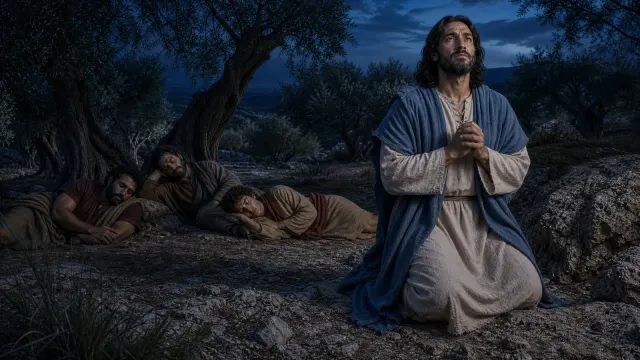
Open with the chapter’s first image
Matthew 26:1: “And it came to pass, when Jesus had finished all these sayings, he said unto his disciples,”
Slow down at the turning point
Matthew 26:38: “Then saith he unto them, My soul is exceeding sorrowful, even unto death: tarry ye here, and watch with me.”
Keep this word trail visible
Jesus, disciples, Peter, high, hand, betrayed
What to explain, in order
Teach the passage in this order. Each step names the verses it rests on, so every point can be shown in the text before it is applied.
Matthew 26:1–30
Matthew 26:1-5
Two days before Passover
Mark the transition: "when Jesus had finished all these sayings" closes the last of Matthew's five great discourses. Explain the Passover as the feast recalling Israel's rescue from Egypt, when the lamb's blood marked the houses spared. Jesus sets his death inside that feast. Then show the leaders' plot and their wish for secrecy. Explain "subtilty" as cunning. Teach this first so the class sees from the start that Jesus walks toward the cross knowingly, and that the plotters will end up acting on his schedule, not theirs.
Matthew 26:6-13
Ointment for his burial
Set the scene in Bethany, at the house of Simon the leper, perhaps a man Jesus had healed. Explain an alabaster box as a sealed flask of soft stone, often broken to pour out its contents, and the ointment as perfumed oil worth a great deal. The disciples' objection sounds righteous. Jesus' answer has three parts: her deed is good, the moment is unique, and it prepares his body for burial. Spend time on 26:13; she is the only person in Matthew promised a memorial wherever the gospel goes.
Matthew 26:14-16
Thirty pieces of silver
Teach this step briefly but do not skip it. The word "Then" ties Judas' visit to the anointing, setting a gift beyond price beside a betrayal for a modest sum. Explain thirty shekels of silver as the compensation for a slave in Exodus 21:32, and read Zechariah 11:12-13, which Matthew will quote in 27:9-10. Say what the text says and stop there: Judas sought the opportunity. Leave his motives where Matthew leaves them, and warn against both sympathy that excuses and contempt that forgets each disciple's question in 26:22.
Matthew 26:17-25
Is it I
Explain the feast of unleavened bread, which ran with Passover, and the preparations Jesus directs: "My time is at hand". At the meal he announces the betrayal. Have the class notice how each disciple turns inward with "Lord, is it I?" rather than accusing others. Explain dipping in the dish as sharing the common bowl, a sign of friendship, which makes the betrayal worse. Read the woe of 26:24 soberly: the Son of man goes "as it is written", and still the betrayer is responsible. Hold God's plan and human guilt together, as the verse does.
Matthew 26:26-30
Body, blood and a new cup
Read the words of institution slowly and let the class hear them before any explanation. Then show the Passover background: bread and cup at a meal remembering rescue. Jesus gives them new meaning in his own death. Explain covenant from Exodus 24:8 and Jeremiah 31:31-34, the new covenant of forgiven sins. Say plainly that Christian traditions understand the presence of Christ in this meal in different ways, and that all of them hear these words. Close with 26:29 and the hymn, so the meal ends in hope and worship.
Matthew 26:31–75
Matthew 26:31-35
Scattered sheep and a promise
Begin on the walk to the mount of Olives. Jesus says all will stumble, quotes Zechariah 13:7, and promises to go before them into Galilee. Explain "offended" again as made to stumble, the word of 13:21 and 24:10. Then Peter's double boast, and the prediction of three denials before the cock crows. Point out that "Likewise also said all the disciples". Teach this first because the whole passage is the unfolding of this short conversation: the promise that will hold, and the boasts that will not.
Matthew 26:36-46
Gethsemane
Explain Gethsemane as an olive grove, the name meaning an oil press. Jesus takes the same three who saw the transfiguration. Read his words of sorrow slowly; Matthew does not hide the anguish of the Son of God. Explain the cup from Isaiah 51:17 and Jeremiah 25:15 as the cup of God's wrath against sin, which helps the class grasp why he dreads it. Then the three prayers, each found the disciples asleep. Close on 26:45-46: the hour has come, and Jesus rises to meet it. He who prayed most is the one ready to go.
Matthew 26:47-56
The kiss and the sword
Judas arrives with a crowd armed with swords and clubs. Explain the kiss as an ordinary greeting between a disciple and his teacher, which is what makes it dreadful. Jesus calls him "Friend", the same word the vineyard owner used in 20:13 and the king in 22:12. Explain a legion as a Roman unit of several thousand soldiers, so twelve legions of angels is an overwhelming force. Jesus forbids the sword and submits so that Scripture is fulfilled. End on the sad line of 26:56: "Then all the disciples forsook him, and fled."
Matthew 26:57-68
Before Caiaphas
Explain that the council, the Sanhedrin, was the highest Jewish court in Jerusalem, led by the high priest. Matthew stresses that they sought false witness and could not get two to agree until a twisted version of Jesus' saying about the temple (compare John 2:19). Explain "adjure" as putting someone under oath. Teach Jesus' silence and then his answer, with Psalm 110 and Daniel 7 on the board. Speak of the abuse in 26:67-68 briefly and plainly, without dwelling on it, and note the irony: they mock him as a prophet while his prophecy about Peter is being fulfilled in the courtyard.
Matthew 26:69-75
Peter in the courtyard
Matthew cuts from Jesus inside to Peter outside, and the contrast is the point: Jesus confesses under oath, Peter denies under oath. Explain "bewrayeth" as gives away; Peter's Galilean accent betrays him. Explain "curse and to swear" as calling down curses on himself if he is lying, not ordinary bad language. Then the cock crows and Peter remembers. Read 26:75 in silence. Teach this last, and resist rushing to the restoration, because the passage ends with a man who loved Jesus weeping over what he has done.
Where learners get stuck
The misreadings this passage tends to produce, and how to answer each from the text.
Matthew 26:1–30
"Jesus said the poor will always be with us, so we do not need to worry about poverty."
Jesus echoes Deuteronomy 15:11, which says the poor will never cease out of the land and therefore commands "Thou shalt open thine hand wide unto thy brother". His point in 26:11 is that his presence is about to end, "but me ye have not always". The same Gospel ends its teaching with 25:35-40, where feeding the hungry is feeding him. Concern for the poor is not set aside here; the woman's devotion is defended.
"Judas had no choice, because the Scriptures said it would happen."
Jesus says both things in one verse: "The Son of man goeth as it is written of him: but woe unto that man by whom the Son of man is betrayed" (26:24). God's purpose does not cancel human responsibility. Judas asked for the money himself (26:15) and sought the opportunity (26:16). Teach the mystery honestly without dissolving either half.
"The disciples all knew Judas was the traitor at the table."
Matthew records that each one asked "Lord, is it I?" (26:22), which shows none was sure of himself, let alone of Judas. The sign of dipping in the dish (26:23) could fit anyone sharing the meal. Jesus' reply to Judas, "Thou hast said" (26:25), is direct, but Matthew does not say the others understood it. Do not supply details from other Gospels as if Matthew wrote them.
"The Lord's Supper is just a meal to remember a sad goodbye."
Jesus explains the cup as "my blood of the new testament, which is shed for many for the remission of sins" (26:28). That is covenant and forgiveness, not only memory. He also points forward to drinking it new "in my Father's kingdom" (26:29). Churches differ in how they understand the meal, but none of them reads it as only a farewell.
Matthew 26:31–75
"Jesus was afraid in Gethsemane, so he cannot really have been the Son of God."
Matthew shows the Son of God in full human anguish: "My soul is exceeding sorrowful, even unto death" (26:38). He prays to "my Father" (26:39), the language of the Son, and the cup he dreads is the judgement he is about to bear. His sorrow shows what the cross cost, and his "thy will be done" (26:42) is the obedience of the Son. Hebrews 5:7-8 speaks of this same prayer.
"Peter was a coward, and real Christians would never do what he did."
Peter followed when the others fled (26:58) and sat in the high priest's own courtyard, which took some courage. He failed under pressure, three times, after promising he would die first (26:35). Matthew records it so that no reader thinks himself above it; Jesus had warned "All ye shall be offended" (26:31). And Jesus had already promised to meet them in Galilee (26:32). Failure is not the end of discipleship in this Gospel.
"Jesus was arrested because he was too weak to stop it."
He says the opposite: "Thinkest thou that I cannot now pray to my Father, and he shall presently give me more than twelve legions of angels?" (26:53). He goes to meet Judas (26:46), tells his disciple to put away the sword, and explains that he is choosing the path the Scriptures describe (26:54, 26:56). His arrest is an act of obedience and love, not helplessness.
"Jesus' silence before the council means he had nothing to say for himself."
Matthew records that "Jesus held his peace" (26:63) before false witnesses, recalling the servant of Isaiah 53:7 who "opened not his mouth". When the high priest asks the true question under oath, Jesus answers clearly and claims the throne at the right hand of power (26:64). He is silent before lies and speaks when the question is who he is.
Learning objectives
- Compare Jesus’ announced death with the leaders’ plan.
- Explain why Jesus defends the woman’s anointing.
- Identify the terms Judas accepts for betrayal.
- Distinguish the disciples’ questions from knowledge of the betrayer.
- Explain the meaning Jesus gives the bread and cup.
- Identify the future hope expressed before the departure to Olivet.
- Identify the scattering prediction and the promise of reunion.
- Trace Jesus’ repeated prayer without erasing its anguish.
- Explain the warning about willingness and human weakness.
- Describe why Jesus refuses the sword at his arrest.
- Identify the claim Jesus makes before Caiaphas.
- Trace the escalation and conclusion of Peter’s denials.
Teacher preparation
- Distinguish the Bethany anointing, betrayal agreement, and Passover meal in Matthew 26:1–30.
- Retain the unnamed woman and the anointing of Jesus’ head in 26:7; label other-Gospel comparisons separately.
- Gloss sat at meat as dining, remission as forgiveness, and new testament in 26:28 as covenant language.
- Read Exodus 12:1–14; 24:8 and Jeremiah 31:31–34 for Passover, covenant blood, and forgiveness.
- Prepare respectful discussion across church traditions; keep classroom illustration distinct from administering a sacrament.
- Map Matthew 26:31–75: departure, Gethsemane prayer and arrest, Caiaphas’s questioning, and Peter’s courtyard denials.
- Compare Zechariah 13:7, Psalm 110:1, and Daniel 7:13–14 with the scattering and authority sayings.
- Gloss offended as falling away, adjure as solemnly charge under oath, and bewrayeth as reveals.
- Keep Matthew 26:51’s swordsman and servant unnamed; label the ear’s healing as another Gospel’s detail.
- Plan restrained reading without reenactment, graphic description, or requests for personal accounts of betrayal.
Evidence and interpretation checks
Explicit
Locate the burial interpretation, thirty silver pieces, and bread-and-cup sayings in Matthew 26:12, 15, and 26–29. Locate Jesus’ sorrow, submitted prayer, refusal of the sword, and Peter’s bitter weeping in Matthew 26:37–42, 52–54, and 75.
Scripture-supported
Read Matthew 26:11 alongside Deuteronomy 15:11; the continuing presence of poverty accompanies a command for openhanded help, not permission for neglect. Read Matthew 26:31 with Zechariah 13:7; the scattering is explicitly framed through Scripture, not reported as an unforeseen interruption.
Strong inference
Compare Matthew 26:6–16; infer a deliberate contrast between costly honour given to Jesus and money sought for handing him over. Compare Matthew 26:33–35 with 40–41 and 69–75; infer that confident intentions are insufficient when they ignore the warning to watch and pray.
Possible or traditional reading
Present differing understandings of Christ’s presence in the bread and cup at Matthew 26:26–28 as theological interpretations; do not claim the passage states every later sacramental explanation. Read the cup in Matthew 26:39 through judgment-cup passages such as Isaiah 51:17 as a scriptural interpretation; distinguish this connection from an exhaustive explanation supplied in the prayer.
Limit
State that Matthew 26:6–30 does not name the woman, identify the hymn, or report the departure of Judas during this meal. State that Matthew 26:31–75 does not name the swordsman, catalogue every trial procedure, or describe Peter’s eventual restoration within this passage.
Discussion with answer guidance
1. What tension appears between Jesus’ announcement and the leaders’ discussion of timing?
What a good answer contains
Jesus speaks first and plainly: "after two days is the feast of the passover, and the Son of man is betrayed to be crucified" (26:2). Meanwhile the leaders meet at Caiaphas' palace to take him "by subtilty, and kill him", and they decide "Not on the feast day, lest there be an uproar among the people" (26:4-5). A good answer sees the irony: they plan to avoid the feast, and Jesus has already said it will be at the feast. Matthew shows who is in control of the timing without giving a full timetable. A weak answer makes the leaders the authors of events.
Show teacher guidance
Read 26:1–5: Jesus connects Passover with his crucifixion, while the leaders seek secrecy and fear an uproar. Keep both statements without supplying a detailed chronology Matthew does not explain.
2. Why does Jesus call the woman’s action good rather than wasteful?
What a good answer contains
The disciples call the ointment a waste that "might have been sold for much, and given to the poor" (26:8-9). Jesus answers "she hath wrought a good work upon me" (26:10), and explains: "she did it for my burial" (26:12). She has seen what the disciples refuse to see, that he is going to die. A good answer also reads 26:11 within the moment: the poor are always there to be served, and Jesus himself is about to go. It is not permission to neglect the poor, as Deuteronomy 15:11, the verse Jesus echoes, commands generosity.
Show teacher guidance
Compare the disciples’ objection in 26:8–9 with Jesus’ burial interpretation in 26:10–13. His approaching death makes the moment particular; verse 11 must not become a general excuse to ignore poverty.
3. What does Judas arrange, and what does the passage leave unexplained about him?
What a good answer contains
Judas goes to the chief priests and asks "What will ye give me, and I will deliver him unto you?" They agree on "thirty pieces of silver", and he looks for an opportunity (26:15-16). Matthew places this right after the anointing, setting a costly gift against a cheap sale. A good answer reports what Judas does and notes that the price echoes Zechariah 11:12 and Exodus 21:32, the price of a slave. A weak answer supplies a hidden motive, such as forcing Jesus to fight, that Matthew never states.
Show teacher guidance
Identify thirty pieces of silver and his search for an opportunity in 26:14–16. Do not invent a hidden attempt to force Jesus into action or claim a complete account of Judas’s motives.
4. What do the disciples’ sorrowful questions show when betrayal is announced?
What a good answer contains
Each disciple asks "Lord, is it I?" (26:22), "exceeding sorrowful". None of them points at another; each fears the traitor might be himself. Jesus answers that it is one who dips in the dish with him (26:23), which at a shared meal could be any of them, and he speaks a heavy woe on the betrayer (26:24). Judas asks "Master, is it I?", and Jesus answers "Thou hast said" (26:25). A good answer notices that the others call him Lord and Judas calls him Master. A weak answer adds a scene of Judas leaving that Matthew does not record here.
Show teacher guidance
Read 26:20–25: each asks about himself, and Judas receives a direct reply. Do not portray the others as already possessing a fully explained identification or import an unreported exit.
5. What explanation does Jesus attach to the bread and the cup?
What a good answer contains
Over the bread: "Take, eat; this is my body" (26:26). Over the cup: "this is my blood of the new testament, which is shed for many for the remission of sins" (26:28). Jesus interprets his coming death as a covenant sacrifice that brings forgiveness. A good answer explains "testament" as covenant, recalls Exodus 24:8 where Moses sprinkled "the blood of the covenant", and notes that "for many" echoes 20:28. It mentions that Christians understand how Christ is present in the meal differently, and leaves that to each tradition.
Show teacher guidance
Use 26:26–28: his body and the blood of the new testament shed for many for remission of sins. Keep forgiveness and self-giving central; this is more than a farewell toast.
6. What remains ahead when Jesus speaks of drinking anew in the Father’s kingdom?
What a good answer contains
Jesus says "I will not drink henceforth of this fruit of the vine, until that day when I drink it new with you in my Father's kingdom" (26:29). His death is near, but he speaks of a future meal with these same disciples, including those who will soon run. The meal ends as "they had sung an hymn" (26:30), and they go out to the mount of Olives. A good answer holds the shadow and the promise together. It may mention that Passover meals closed with psalms, likely from Psalms 113 to 118, without claiming Matthew names which.
Show teacher guidance
Read 26:29–30: approaching death is not his last word about fellowship. Retain the future promise, the sung hymn, and the departure without claiming Matthew identifies which psalm they sang.
7. What does Jesus promise immediately after predicting that the disciples will scatter?
What a good answer contains
Jesus quotes Zechariah 13:7, "I will smite the shepherd, and the sheep of the flock shall be scattered abroad" (26:31), and in the next breath says "But after I am risen again, I will go before you into Galilee" (26:32). The promise of reunion is spoken before any of them fails. A good answer notices that Jesus knows the worst about them and still plans to meet them, and that the angel repeats this promise in 28:7. A weak answer hears only the prediction of scattering and loses the shepherd going on ahead of his sheep.
Show teacher guidance
Read 26:31–32: after rising, he will go before them into Galilee. Do not let Peter’s later failure erase a promise made before it; keep prediction and promised reunion together.
8. How does Jesus’ repeated prayer hold distress and submission together?
What a good answer contains
His sorrow is real: "My soul is exceeding sorrowful, even unto death" (26:38), and he falls on his face. His request is real: "O my Father, if it be possible, let this cup pass from me" (26:39). His submission is real: "nevertheless not as I will, but as thou wilt". The second prayer moves further, "if this cup may not pass away from me, except I drink it, thy will be done" (26:42), and the third uses "the same words" (26:44). A good answer sees that honest anguish and full obedience live in the same prayer, and that repeating it is wrestling, not empty words.
Show teacher guidance
Compare 26:38–44: genuine sorrow, the request about the cup, and acceptance of the Father’s will remain present. Repeating the prayer does not make it empty repetition or cancel its submission.
9. Why is the statement about a willing spirit not an excuse for sleeping?
What a good answer contains
Jesus speaks the line as the reason to pray, not as permission to sleep: "Watch and pray, that ye enter not into temptation: the spirit indeed is willing, but the flesh is weak" (26:41). The disciples meant every word of 26:35, and still could not stay awake one hour (26:40). Their weakness is exactly why they need to watch and pray. A good answer names dependence on God as the lesson, after the boasting of 26:33-35. It also treats tiredness with compassion; Matthew says "their eyes were heavy" (26:43), and Jesus does not mock them.
Show teacher guidance
Read 26:40–41: recognition of weakness supports the command to watch and pray. Avoid mocking exhausted people; the lesson concerns dependence rather than confidence that good intentions are enough.
10. Does refusing the sword mean Jesus claims he has no available help?
What a good answer contains
No. Jesus says he could ask his Father, "and he shall presently give me more than twelve legions of angels" (26:53). He has help available and does not use it, because "how then shall the scriptures be fulfilled, that thus it must be?" (26:54). He also rebukes the sword: "all they that take the sword shall perish with the sword" (26:52). A good answer sees that his arrest is a choice, not a defeat, and that he refuses violence in his own defence. It does not imply the arresting crowd was in the right; Jesus exposes their secrecy in 26:55.
Show teacher guidance
Use 26:51–56: he speaks of the Father’s angelic help but refuses rescue that would contradict Scripture’s fulfillment. Keep voluntary submission distinct from lack of authority or approval of the attackers.
11. What does Jesus say when Caiaphas asks whether he is the Christ, the Son of God?
What a good answer contains
Jesus has kept silent until the high priest puts him under oath "by the living God" (26:63). Then he answers "Thou hast said", an affirmation, and adds "Hereafter shall ye see the Son of man sitting on the right hand of power, and coming in the clouds of heaven" (26:64). That joins Psalm 110:1 and Daniel 7:13. A good answer sees that the prisoner tells his judges they will see him enthroned, and that the council calls it blasphemy (26:65) because they reject the claim. A weak answer treats "Thou hast said" as a refusal to answer.
Show teacher guidance
Expect his affirmation and the Son of man seated at power’s right hand, coming in heaven’s clouds (26:64). Compare Psalm 110:1 and Daniel 7:13–14; distinguish Jesus’ claim from the council’s charge of blasphemy.
12. How do Peter’s denials intensify before the cock crows?
What a good answer contains
First Peter says "I know not what thou sayest" (26:70), a vague evasion. Then "he denied with an oath, I do not know the man" (26:72). Finally "began he to curse and to swear, saying, I know not the man" (26:74), and the cock crows. Each challenge comes from a lower-ranking person, a damsel, a maid, bystanders, and each answer is stronger. Then Peter remembers Jesus' word: "And he went out, and wept bitterly" (26:75). A good answer ends there, in grief, and lets the restoration wait for chapter 28.
Show teacher guidance
Trace 26:69–75 from denial to oath to cursing and swearing, followed by remembered words and bitter weeping. Do not invent reconciliation here or confuse the passage’s sorrow with its final resolution.
Responsible application
Heart and habits
Ask a fictional reader to distinguish concern for the poor from dismissing the woman Jesus defends.
Relationships and community
Plan reverent discussion of the bread and cup in an imaginary group with differing interpretations.
Read the death through Jesus’ words
Invite an explanation of why forgiveness and the kingdom promise belong in a lesson on this meal, not only betrayal.
Promise before failure
Connect Matthew 26:32 with Peter’s collapse and the later Galilean meeting.
Session plans
Two timings of the same lesson. The shorter keeps the reading, the central discussion and one response; the longer gives the confusions and the application their own time.
Matthew 26:1–30
45 minutes
Two timetables
Read 26:1-5 and take question one. Mark on the board who said when, and when it actually happened.
The anointing
Read 26:6-13. Take question two and confusion one.
The price
Read 26:14-16 with Zechariah 11:12. Take question three and confusion two.
Is it I
Read 26:17-25. Take question four and confusion three. Ask learners why each disciple asked about himself.
Bread and cup
Read 26:26-30 slowly. Take questions five and six and confusion four, respecting the traditions in the room.
Handout and hymn
Read the key verse and close by singing or reading a hymn, as the disciples did.
90 minutes
Opening
Ask what the most valuable gift anyone could give would be. Then read 26:7.
Passover and plot
Read Exodus 12:21-27 and then 26:1-5. Take question one.
The woman's good work
Read 26:6-13 with Deuteronomy 15:11. Take question two and confusion one. Ask what the woman understood that the disciples missed.
Judas' bargain
Read 26:14-16, Exodus 21:32 and Zechariah 11:12-13. Take question three and confusion two.
At the table
Read 26:17-25. Take question four and confusion three. Give a minute of silence for each to ask Lord, is it I.
The new covenant
Read 26:26-30 with Exodus 24:8 and Jeremiah 31:31-34. Take questions five and six and confusion four.
Application
In pairs, take the application on reading the death through Jesus' words and write one sentence on what the cup promises.
Handout and hymn
Read the key verse together and end with a hymn.
Matthew 26:31–75
45 minutes
The prediction
Read 26:31-35. Take question one. Underline the promise of verse 32 on the handout.
Gethsemane
Read 26:36-46. Take questions two and three and confusion one.
The arrest
Read 26:47-56. Take question four and confusion three.
Before Caiaphas
Read 26:57-68 without dwelling on the abuse. Take question five and confusion four.
The denials
Read 26:69-75. Take question six and confusion two. Leave a moment of silence after verse 75.
Handout and prayer
Read the key verse and pray it together.
90 minutes
Opening
Ask the group about a promise they made and could not keep. Do not ask for details. Read 26:33-35.
The shepherd struck
Read 26:31-35 with Zechariah 13:7 and 28:7. Take question one.
Not as I will
Read 26:36-46 with Isaiah 51:17 and Hebrews 5:7-8. Take questions two and three and confusion one. Pray quietly for a minute as a group.
The kiss and the sword
Read 26:47-56. Take question four and confusion three. Discuss what 26:52 says about violence in Jesus' name.
The council
Read 26:57-68 with Psalm 110:1, Daniel 7:13-14 and Isaiah 53:7. Take question five and confusion four.
Peter's denial
Read 26:69-75. Take question six and confusion two. Draw the three steps of denial.
Application
Use the application on promise before failure, reading 28:7 and 28:16 aloud.
Handout and prayer
Read the key verse together and pray for any who are carrying failure.
Adapting the lesson
Matthew 26:1–30
Children
Bring a small bottle of scented oil and let the children smell it while you tell how a woman poured something precious on Jesus to show her love. Explain that Jesus shared a special meal with his friends and gave them bread and a cup to remember that he would give his life for them. Leave out the details of the betrayal price; say a friend turned against him.
Youth
Ask what is worth spending everything on, and let them weigh the disciples' objection fairly before reading Jesus' answer. Discuss the question Lord, is it I as a model of honest self-examination rather than pointing at others. On the Supper, explain what their own church does and why, and treat other traditions with respect.
Adults
Give time to the Old Testament background: Passover in Exodus 12, the covenant blood of Exodus 24:8, the new covenant of Jeremiah 31 and the price in Zechariah 11. Discuss how the meal is understood in the traditions present, without debate for its own sake. Ask what extravagant devotion would look like for them, and where they might hear the disciples' complaint of waste.
One to one
Ask which person at Bethany or at the table they most relate to: the woman, the indignant disciples, the sorrowful eleven or Judas. If they fear they have betrayed Jesus, read 26:28 and the remission of sins. If they are preparing for the Lord's Supper, read 26:26-29 together slowly and pray before they next receive it.
Matthew 26:31–75
Children
Tell how Jesus went to a garden to pray because he was very sad, and that he told God, I will do what you want. Show that his friends fell asleep. Say some men took Jesus away, and that Jesus did not want anyone to fight. Leave out the spitting and hitting. Tell of Peter saying he did not know Jesus and then crying, and say Jesus still loved Peter.
Youth
Start with Peter's boast and ask whether they have ever been sure they would stand firm and then folded. Use Gethsemane to show that honest prayer can say I do not want this and still say thy will be done. Discuss the sword: what does 26:52 say about using force for Jesus. Treat the denials as a mirror, not a joke about Peter.
Adults
Read the Old Testament texts that frame the night: Zechariah 13:7, Isaiah 51:17, Psalm 110:1, Daniel 7:13 and Isaiah 53:7. Give time to Gethsemane as a school of prayer under pressure, especially for those facing illness or loss. Contrast Jesus' confession and Peter's denial in the same hour, and ask where adult believers are tempted to say I know not the man.
One to one
If the person is facing something they dread, read 26:39 together and let them pray their own version of it. If they carry the memory of a failure, read 26:75 and then 26:32, the promise given before the fall. Ask what watching and praying would look like for them this week, and pray with them.
Song and video learning lab
A song or video may interpret, compress, or dramatize the text. Its value becomes clearer when its choices are compared with Scripture.
- Before the media: the exact passage and its central movement.
- During the media: the words, people, events, and emotions the artist emphasizes.
- After the media: what it clarifies, what it leaves out, and what belongs back in the biblical text.
Handout
One page for learners to take home. The print button prints this section alone.
Matthew 26:1–30
The passage in brief
Two days before Passover, Jesus says he will be handed over to be crucified, while the leaders plot to arrest him quietly. In Bethany a woman pours costly ointment on his head; the disciples call it waste, but Jesus says she has prepared him for burial. Judas agrees to betray him for thirty pieces of silver. At the Passover meal Jesus says one of the twelve will betray him, and then gives them bread and a cup as his body and his blood of the covenant, shed for the forgiveness of sins.
A verse to keep
For this is my blood of the new testament, which is shed for many for the remission of sins.
Matthew 26:28 · King James Version
Questions to take home
Why did Jesus say the woman's gift was a good work in 26:10-12?
What did each disciple ask in 26:22 when Jesus spoke of betrayal?
What does Jesus say his blood is shed for in 26:28?
This week
Before you next share the Lord's Supper, read Matthew 26:26-29 and thank Jesus for the forgiveness he promised.
Matthew 26:31–75
The passage in brief
On the way to the Mount of Olives, Jesus says all his disciples will fall away and Peter will deny him three times, but promises to meet them in Galilee after he rises. In Gethsemane he prays in deep sorrow, Not as I will, but as you will, while the disciples sleep. Judas betrays him with a kiss; Jesus forbids the sword and the disciples flee. Before the high priest he says he is the Christ and will be seen at the right hand of power. In the courtyard Peter denies him three times and weeps bitterly.
A verse to keep
And he went a little further, and fell on his face, and prayed, saying, O my Father, if it be possible, let this cup pass from me: nevertheless not as I will, but as thou wilt.
Matthew 26:39 · King James Version
Questions to take home
What does Jesus promise in 26:32, before the disciples fail?
What does Jesus pray three times in Gethsemane, according to 26:39-44?
What did Peter do when he remembered Jesus' words in 26:75?
This week
When you face something hard this week, pray the words of 26:39 in your own words.
Music and video connected to the passage
Related media appears when its Scripture reference overlaps this study. Music and video can illuminate a theme while the biblical text remains the foundation.
 The Cup in the GardenMatthew 26:36-56Listen to related music →
 Before the Cock CrowMatthew 26:47-75; Mark 14:43-72; Luke 22:47-62; John 18:1-27Listen to related music →
 Thy Will Be DoneMatthew 26:36-46; Mark 14:32-42; Luke 22:39-46Listen to related music →
 This Do in RemembranceMatthew 26:17-35; Mark 14:12-31; Luke 22:7-38; John 13-17Listen to related music →