The big picture
Two full years pass before Pharaoh's dreams cause the cupbearer to remember Joseph. Brought from prison, Joseph interprets the dreams and proposes a practical response. At thirty he receives authority to prepare Egypt for famine.
In this chapter
- A Warning of Abundance and Famine Genesis 41:1-32
Pharaoh dreams of healthy and wasted cattle, then full and thin ears of grain.
- Wisdom Becomes Administration Genesis 41:33-45
Joseph proposes appointed oversight and collection during the abundant years.
- Preparation for a Wider Need Genesis 41:46-57
Joseph stores grain, fathers Manasseh and Ephraim, and remembers affliction as well as fruitfulness in their names.
Scripture beside the summary
Genesis · King James Version · 57Genesis 41:1-32
A Warning of Abundance and Famine
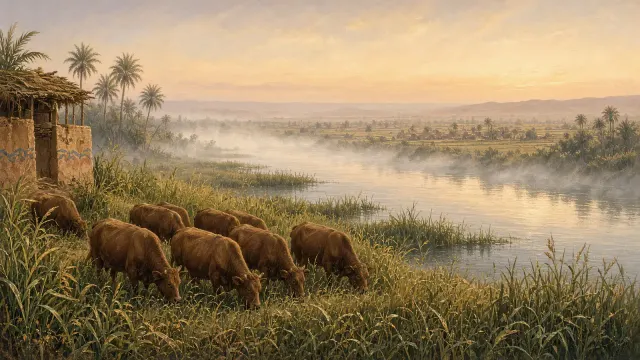
Pharaoh dreams of healthy and wasted cattle, then full and thin ears of grain. Joseph denies that interpretation originates in himself and credits God. The paired dreams announce seven abundant years followed by seven severe years, with repetition emphasizing the event's certainty and urgency.

Deep dive
The opening interval belongs to Joseph's waiting as much as to Pharaoh's dreaming: "two full years" have passed since the butler's restoration. The account then moves without warning from the forgotten prisoner to the king beside the river in a dream. Cattle emerge in two groups, but ordinary feeding becomes impossible consumption when the lean animals swallow the fat. In the second dream, ears of grain perform the same impossible act. Both images make weakness consume strength without using the normal means by which either animals or crops grow.
Pharaoh wakes after each dream, yet waking does not settle the disturbance. Morning brings the resources of the court into the matter: magicians and wise men are summoned, hear the dreams, and fail to interpret them for him. The contrast is not between a king with advisers and a king without them. It is between the full availability of his advisers and the absence of the particular understanding he needs. An unanswered question at the top of Egypt will reach a man at the bottom of its prison system.
The butler's recollection is attached to an admission of faults. He recounts the imprisonment and the two interpretations, carefully explaining that each officer received a different outcome. His recommendation rests on fulfilment, not on a general impression that Joseph was impressive. Yet his description keeps Joseph's low position visible: young, Hebrew, and a servant. Nothing in that introduction naturally resembles the office Joseph will hold by the end of the chapter.
The summons is urgent. Joseph is brought out, shaved, and given a change of clothing before appearing. Clothing has already marked his favour at home and served as evidence in two deceptions; now a change of raiment marks his entry into the royal presence. Pharaoh presents him as a man able to understand dreams. Joseph's first answer interrupts that attribution: "It is not in me." He names God as the source of Pharaoh's answer. The correction comes before he hears the dreams, so it is not a qualification added after a successful performance.
Pharaoh's retelling adds a feature that deserves attention. After the thin cattle eat the fat ones, they remain just as ill favoured. Consumption leaves no visible benefit. Joseph's interpretation answers that detail: the famine will be so severe that the preceding abundance will no longer be apparent. The issue is not only that lean years follow good years. It is that the later shortage can swallow the practical memory of what the earlier years supplied.
Joseph repeatedly insists that the dream is one. Two sets of images do not announce two unrelated disasters or fourteen years of famine. Cattle and grain express the same sequence, while the doubling establishes that God has fixed the matter and will bring it about soon. The explanation is specific to these dreams, not a universal key assigning seven years to every seven objects in a dream. The king has been shown what is coming before it arrives. That advance knowledge makes the years of plenty a period of responsibility rather than merely a pleasant prelude.
Words to trace: seven, kine, Pharaoh, ears, favoured, river, dream, dreamed, interpret, Joseph, captain, years
Verse-by-verse path
- Genesis 41:1
“Two full years” is literally “two years of days”, time counted out day by day. “The river” is ye’or, a word borrowed from Egyptian and used in the Old Testament almost only for the Nile. The king’s dream begins at the source of all Egypt’s wealth.
- Genesis 41:2
Cattle standing in the Nile to escape heat and flies were a common sight, so cows walking up out of the water is a natural picture. “Meadow” is achu, another Egyptian loanword, the reed grass of the riverbank; Job 8:11 uses it for the “flag” that cannot grow without water.
- Genesis 41:3
“Ill favoured” is ra’ot mar’eh, “evil of appearance”, the exact reverse of the phrase that described Joseph in 39:6 and his mother Rachel in 29:17. For a moment the two herds stand together on the bank before anything happens.
- Genesis 41:4
Cattle do not eat cattle, and the grotesque detail is what makes the dream unforgettable. The first dream ends abruptly, in two words in Hebrew, vayyiqats Par’oh: “So Pharaoh awoke”.
- Genesis 41:5
Seven ears on one stalk describes a branched wheat grown in Egypt, which carries several heads on a single stem. “Rank” is the KJV’s word for vigorous and well grown, with no bad smell in it; the Hebrew beri’ot is the same word as the “fat” cows.
- Genesis 41:6
The east wind, qadim, is the hot, dry wind off the desert, what Egyptians now call the khamsin, which can scorch a crop in days. An east wind brings the locusts on Egypt in Exodus 10:13. “Blasted” means scorched.
- Genesis 41:7
“Devoured” is bala, to swallow whole, the verb used when the earth swallows Korah (Numbers 16:30). “Behold, it was a dream” is the moment of waking; Solomon wakes at Gibeon with the same words (1 Kings 3:15).
- Genesis 41:8
“His spirit was troubled” uses pa’am, to beat like a pulse, the phrase used of Nebuchadnezzar’s restless nights in Daniel 2:1. The “magicians” are chartummim, probably from an Egyptian title for the chief lector priests, the scholars of sacred texts. They reappear against Moses in Exodus 7:11.
- Genesis 41:9
“My faults” is plural, “my sins”, and the butler leaves them unnamed: the offence that put him in prison, the two years of forgetting, or both. A courtier who once angered this king chooses his words carefully before reopening the matter.
- Genesis 41:10
The butler speaks of Pharaoh in the third person to his face, “Pharaoh was wroth with his servants”, the manner of court speech. He reminds the king of his own anger before asking to be believed.
- Genesis 41:11
He stresses that the two dreams came “in one night”, a detail that makes the account striking and that matches Pharaoh’s own two dreams, also dreamed in a single night.
- Genesis 41:12
The butler never gives Joseph’s name. He calls him na’ar, a lad, the word used of Joseph at seventeen in 37:2, although Joseph is now nearly thirty. “Young”, “Hebrew” and “servant” each lower him one step further.
- Genesis 41:13
Read literally, the Hebrew credits the interpreter with the outcome: “me he restored to mine office, and him he hanged.” Rashi took “he” as Pharaoh, understood from the context. Either way, the butler’s report makes the word and the event the same thing.
- Genesis 41:14
“Hastily” is “they made him run”. Egyptians of rank were clean-shaven, and Hebrews wore beards, so shaving was the price of entry to the court. Joseph is changed into the look of the country before he says a word.
- Genesis 41:15
Pharaoh’s phrase is literally “thou hearest a dream to interpret it”, as though hearing were all it took. The king repeats the report he has had, a compliment that sets a trap: if the answer then fails, it fails as Joseph’s own.
- Genesis 41:16
“It is not in me” is one word in Hebrew, bil’adai, “apart from me”. “An answer of peace” is shalom Pharaoh, Pharaoh’s welfare. Joseph promises that God will speak to the king’s good before he has heard what the dream is.
- Genesis 41:17
Genesis gives the dream twice, once as Pharaoh saw it and once as he tells it. In the telling he stands “upon the bank”, literally “upon the lip” of the river. The small differences between the two versions are the first thing a careful listener would hear.
- Genesis 41:18
Pharaoh reverses the order of the adjectives: the cows are now “fatfleshed and well favoured” where verse 2 had “well favoured and fatfleshed”. The king remembers the flesh first.
- Genesis 41:19
Pharaoh adds his own reaction, absent from verse 3: “such as I never saw in all the land of Egypt for badness.” He also calls them dallot, poor, a word normally used of poor people, not animals.
- Genesis 41:20
“The first seven” is a word Pharaoh adds. He is already sorting the dream into before and after, the order Joseph’s interpretation will give it.
- Genesis 41:21
“When they had eaten them up” is literally “when they had come into their inward parts”. Pharaoh describes what the dream showed and he found hardest to bear: food going in and leaving no trace.
- Genesis 41:22
Pharaoh does not say he slept again, as verse 5 did. He runs the two dreams together, “I saw in my dream”, as a single telling. Joseph will say that they are indeed one. The ears are now “full”, where verse 5 said “rank”.
- Genesis 41:23
Pharaoh adds “withered”, tsenumot, a word that appears nowhere else in the Old Testament; its sense is guessed from the context as hard or shrivelled. The retelling is harsher than the dream as first reported.
- Genesis 41:24
Pharaoh admits to a foreign slave that his own experts failed. “Declare” is higgid, to tell or make known, and it is the verb Joseph picks up at once in the next verse.
- Genesis 41:25
What the magicians could not “declare” in verse 24, God “hath shewed”, and the verb is the same, higgid. Joseph’s first sentence on the dreams answers the court’s failure with its own word.
- Genesis 41:26
Seven lean years were a known terror in the ancient world. An Egyptian inscription on Sehel Island, the Famine Stela, tells of seven years of low Nile floods under an early king, and seven years of famine appear in the Gilgamesh epic.
- Genesis 41:27
Joseph calls the thin ears “empty”, reqot. It is the word used of the pit into which his brothers threw him: “the pit was empty” (37:24). The emptiness he knew is now the one he explains.
- Genesis 41:28
Joseph repeats verse 25 with a different verb. There God “told”; here he “sheweth”, lets Pharaoh see. The interpretation is framed between the two statements, so the king hears twice that the source is God.
- Genesis 41:29
The plenty is limited to “all the land of Egypt”, while the famine that follows will reach “all lands” (verse 54). Egypt’s name is repeated almost every sentence in this part of the speech.
- Genesis 41:30
“Forgotten” is nashach, the verb of the butler’s forgetting in 40:23 and of Manasseh’s name in verse 51. The good years will be forgotten the way Joseph was.
- Genesis 41:31
“Grievous” is kaved, heavy. The same word described the famine that drove Abram down to Egypt in 12:10: “the famine was grievous in the land.” The family’s history with Egypt keeps beginning with hunger.
- Genesis 41:32
“Established” is nakon, made firm and settled, and “shortly” is literally “God hastens to do it”. Joseph’s reading carries its own deadline: the matter is fixed and near, so there is no time to spare in the plan that follows.
Genesis 41:1-32
King James Version1And it came to pass at the end of two full years, that Pharaoh dreamed: and, behold, he stood by the river.
2And, behold, there came up out of the river seven well favoured kine and fatfleshed; and they fed in a meadow.
3And, behold, seven other kine came up after them out of the river, ill favoured and leanfleshed; and stood by the other kine upon the brink of the river.
4And the ill favoured and leanfleshed kine did eat up the seven well favoured and fat kine. So Pharaoh awoke.
5And he slept and dreamed the second time: and, behold, seven ears of corn came up upon one stalk, rank and good.
6And, behold, seven thin ears and blasted with the east wind sprung up after them.
7And the seven thin ears devoured the seven rank and full ears. And Pharaoh awoke, and, behold, it was a dream.
8And it came to pass in the morning that his spirit was troubled; and he sent and called for all the magicians of Egypt, and all the wise men thereof: and Pharaoh told them his dream; but there was none that could interpret them unto Pharaoh.
9Then spake the chief butler unto Pharaoh, saying, I do remember my faults this day:
10Pharaoh was wroth with his servants, and put me in ward in the captain of the guard’s house, both me and the chief baker:
11And we dreamed a dream in one night, I and he; we dreamed each man according to the interpretation of his dream.
12And there was there with us a young man, an Hebrew, servant to the captain of the guard; and we told him, and he interpreted to us our dreams; to each man according to his dream he did interpret.
13And it came to pass, as he interpreted to us, so it was; me he restored unto mine office, and him he hanged.
14Then Pharaoh sent and called Joseph, and they brought him hastily out of the dungeon: and he shaved himself, and changed his raiment, and came in unto Pharaoh.
15And Pharaoh said unto Joseph, I have dreamed a dream, and there is none that can interpret it: and I have heard say of thee, that thou canst understand a dream to interpret it.
16And Joseph answered Pharaoh, saying, It is not in me: God shall give Pharaoh an answer of peace.
17And Pharaoh said unto Joseph, In my dream, behold, I stood upon the bank of the river:
18And, behold, there came up out of the river seven kine, fatfleshed and well favoured; and they fed in a meadow:
19And, behold, seven other kine came up after them, poor and very ill favoured and leanfleshed, such as I never saw in all the land of Egypt for badness:
20And the lean and the ill favoured kine did eat up the first seven fat kine:
21And when they had eaten them up, it could not be known that they had eaten them; but they were still ill favoured, as at the beginning. So I awoke.
22And I saw in my dream, and, behold, seven ears came up in one stalk, full and good:
23And, behold, seven ears, withered, thin, and blasted with the east wind, sprung up after them:
24And the thin ears devoured the seven good ears: and I told this unto the magicians; but there was none that could declare it to me.
25And Joseph said unto Pharaoh, The dream of Pharaoh is one: God hath shewed Pharaoh what he is about to do.
26The seven good kine are seven years; and the seven good ears are seven years: the dream is one.
27And the seven thin and ill favoured kine that came up after them are seven years; and the seven empty ears blasted with the east wind shall be seven years of famine.
28This is the thing which I have spoken unto Pharaoh: What God is about to do he sheweth unto Pharaoh.
29Behold, there come seven years of great plenty throughout all the land of Egypt:
30And there shall arise after them seven years of famine; and all the plenty shall be forgotten in the land of Egypt; and the famine shall consume the land;
31And the plenty shall not be known in the land by reason of that famine following; for it shall be very grievous.
32And for that the dream was doubled unto Pharaoh twice; it is because the thing is established by God, and God will shortly bring it to pass.
Genesis 41:33-45
Wisdom Becomes Administration
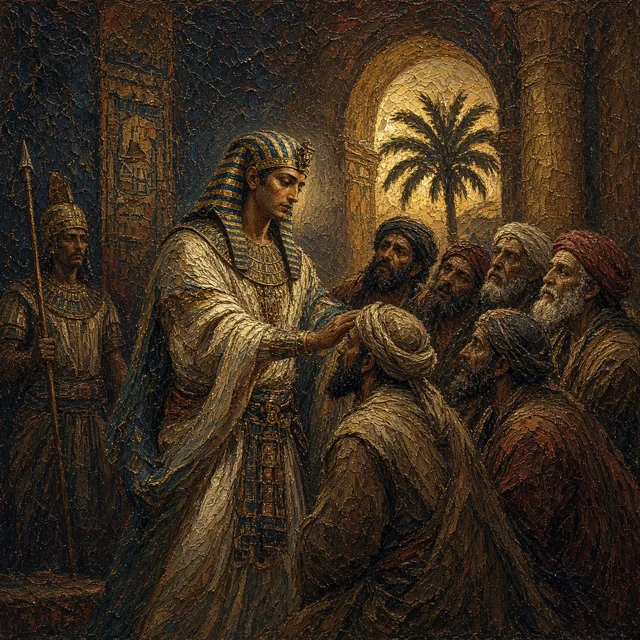
Joseph proposes appointed oversight and collection during the abundant years. Pharaoh recognizes his discernment and gives him authority, a signet, fine linen, a gold chain and a chariot. The narrative names his Egyptian wife, Asenath, and her father Potipherah, priest of On.
Deep dive
The words "Now therefore" mark the turn from explanation to action. Joseph does not stop after telling Pharaoh what the images mean. He proposes a discerning administrator, subordinate officers, collection of a fifth during the good years, and storage under royal authority. The plan is concrete enough to be administered. It identifies people, timing, proportion, places of storage, and the purpose of the reserve.
The proposal also treats the two periods as one planning problem. Egypt cannot arrange seven years of plenty to last indefinitely, but it can carry some of their yield forward into the years that follow. Food is to be kept in cities rather than simply admired in the fields. Joseph's stated objective is that the land not perish through famine. The certainty he has assigned to the approaching shortage does not make preparation pointless. In his explanation, the warning is useful precisely because the abundance comes first and offers something that can be stored.
Joseph has described the sort of man needed without explicitly requesting the appointment. Pharaoh answers that description by turning to the man who has just given it. His reasoning follows Joseph's own attribution: because God has shown him these things, Pharaoh recognizes his discernment and wisdom. The royal decision converts demonstrated understanding into responsibility over the king's house and people. The throne remains Pharaoh's, a boundary stated alongside the exceptional authority being granted.
The appointment becomes visible through objects and movement. The ring passes from Pharaoh's hand to Joseph's, linen clothes him, a gold chain encircles his neck, and the second chariot carries him before people commanded to bow. Earlier Joseph's clothing was removed by brothers and left behind during flight. This clothing is publicly bestowed. The Egyptian name and marriage to Asenath further establish his position in the country. Genesis records the institutional change without saying that Joseph has exchanged the God he just named for the religious identity of his father-in-law.
Words to trace: land, Egypt, food, Pharaoh, years, famine, Joseph, hand, eyes
Verse-by-verse path
- Genesis 41:33
“Discreet and wise” is navon vechakam, the pair God gives Solomon in 1 Kings 3:12, “a wise and an understanding heart”. “Look out” is the verb to see: let Pharaoh see a man. Joseph describes the post without naming anyone for it.
- Genesis 41:34
“Take up the fifth part” is one verb in Hebrew, chimmesh, “let him fifth the land”, a tax of twenty per cent, double a tithe. The fifth becomes a permanent law of Egyptian land in 47:26.
- Genesis 41:35
“Corn” in the KJV means grain of any kind, here bar, threshed grain. Maize was unknown in the ancient world. “Under the hand of Pharaoh” puts the stores under royal control, and models of granaries have been found in Egyptian tombs.
- Genesis 41:36
“For store” is piqqadon, a deposit held in trust, the word used in Leviticus 6:2 of goods “delivered him to keep”. “That the land perish not” uses karat, to be cut off, the word of covenant penalties.
- Genesis 41:37
No one in the court objects to handing a fifth of the country’s harvest to the crown. The plan is “good in the eyes” of the king and of the servants who had just failed him.
- Genesis 41:38
This is the first time in the Bible that a person is said to have the Spirit of God in him. The next is Bezalel the craftsman (Exodus 31:3). Nebuchadnezzar will say of Daniel, “in whom is the spirit of the holy gods” (Daniel 4:8), the same judgment from another foreign king.
- Genesis 41:39
The chapter uses a third verb for revelation here: God “hath shewed”, hodia, made known. Pharaoh accepts Joseph’s account of the source and turns it into a qualification for office.
- Genesis 41:40
“According unto thy word shall all my people be ruled” is literally “upon thy mouth shall all my people kiss”. Rashi took it to mean they would be fed or provided for at his command; others read it as submission, as in Psalm 2:12, “Kiss the Son.”
- Genesis 41:41
“See, I have set thee” is literally “I have given thee”, spoken as done. It is the second of three speeches that begin “And Pharaoh said unto Joseph” (verses 39, 41 and 44), and together they read like a formal installation.
- Genesis 41:42
The ring was the royal seal, used to sign in the king’s name. Fine linen is shesh, an Egyptian word, the cloth of priests and nobles. Egyptian kings rewarded officials with heavy gold collars, and tomb reliefs show the ceremony; Daniel receives a chain of gold in the same way (Daniel 5:29).
- Genesis 41:43
The cry “Bow the knee” renders abrek, a word found nowhere else. The KJV follows the old Jewish reading, from berek, knee. Others take it as an Egyptian command, “Attention!”, or the Akkadian title abarakku, chief steward. The second chariot put Joseph directly behind the king in any procession.
- Genesis 41:44
“I am Pharaoh” works like an oath on the king’s own name. “Lift up his hand or foot” is an idiom for any movement at all: no one in Egypt stirs without Joseph’s leave.
- Genesis 41:45
Zaphnath-paaneah is probably Egyptian for “the god speaks and he lives”; Onkelos rendered it “revealer of hidden things”. Asenath means “belonging to Neith”, a goddess. Poti-pherah is the fuller form of Potiphar’s name, and On is Heliopolis, the city of the sun god.
Genesis 41:33-45
King James Version33Now therefore let Pharaoh look out a man discreet and wise, and set him over the land of Egypt.
34Let Pharaoh do this, and let him appoint officers over the land, and take up the fifth part of the land of Egypt in the seven plenteous years.
35And let them gather all the food of those good years that come, and lay up corn under the hand of Pharaoh, and let them keep food in the cities.
36And that food shall be for store to the land against the seven years of famine, which shall be in the land of Egypt; that the land perish not through the famine.
37And the thing was good in the eyes of Pharaoh, and in the eyes of all his servants.
38And Pharaoh said unto his servants, Can we find such a one as this is, a man in whom the Spirit of God is?
39And Pharaoh said unto Joseph, Forasmuch as God hath shewed thee all this, there is none so discreet and wise as thou art:
40Thou shalt be over my house, and according unto thy word shall all my people be ruled: only in the throne will I be greater than thou.
41And Pharaoh said unto Joseph, See, I have set thee over all the land of Egypt.
42And Pharaoh took off his ring from his hand, and put it upon Joseph’s hand, and arrayed him in vestures of fine linen, and put a gold chain about his neck;
43And he made him to ride in the second chariot which he had; and they cried before him, Bow the knee: and he made him ruler over all the land of Egypt.
44And Pharaoh said unto Joseph, I am Pharaoh, and without thee shall no man lift up his hand or foot in all the land of Egypt.
45And Pharaoh called Joseph’s name Zaphnath-paaneah; and he gave him to wife Asenath the daughter of Poti-pherah priest of On. And Joseph went out over all the land of Egypt.
Genesis 41:46-57
Preparation for a Wider Need
Joseph stores grain, fathers Manasseh and Ephraim, and remembers affliction as well as fruitfulness in their names. Famine eventually reaches beyond Egypt, and people come to buy grain. The administrative task will bring his brothers back into the account.
Deep dive
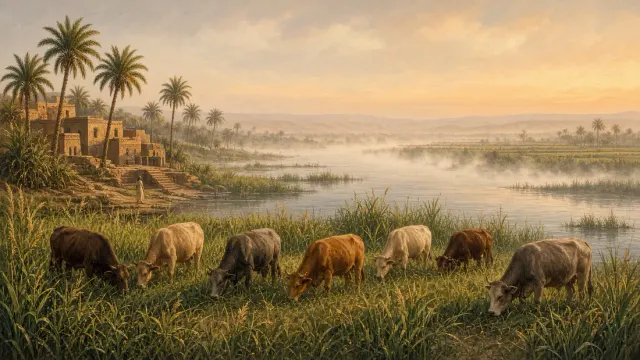
Joseph is thirty when he stands before Pharaoh. Genesis 37 introduced him at seventeen, so the ages place thirteen years between those points. The text does not assign all thirteen to prison; they include his earlier service in Potiphar's house. The following years of abundance produce grain beyond continued numbering. That description brings the promise of plenty into the work of collection: the successful interpretation now requires the sustained work of filling stores.
The sons' names give access to Joseph's own account of his circumstances. Manasseh is associated with forgetting toil and his father's house, while Ephraim is associated with fruitfulness. Yet Egypt remains "the land of my affliction" in the explanation of the second name. The two descriptions coexist. The references to forgetting cannot mean literal loss of family memory, since Joseph will recognize his brothers and repeatedly ask after his father. His language marks a changed experience of past trouble, not proof that the family has vanished from his knowledge. Abundance is real without becoming an instruction to rename his earlier suffering.
The end of abundance is stated as firmly as its arrival. Seven years are completed, and the next period begins according to Joseph's interpretation. The statement that Egypt has bread is followed by Egyptians crying out for bread. There is no contradiction requiring an invented second famine: stored food exists, but hungry people need access to it. Pharaoh directs them to Joseph, and Joseph opens the storehouses and sells.
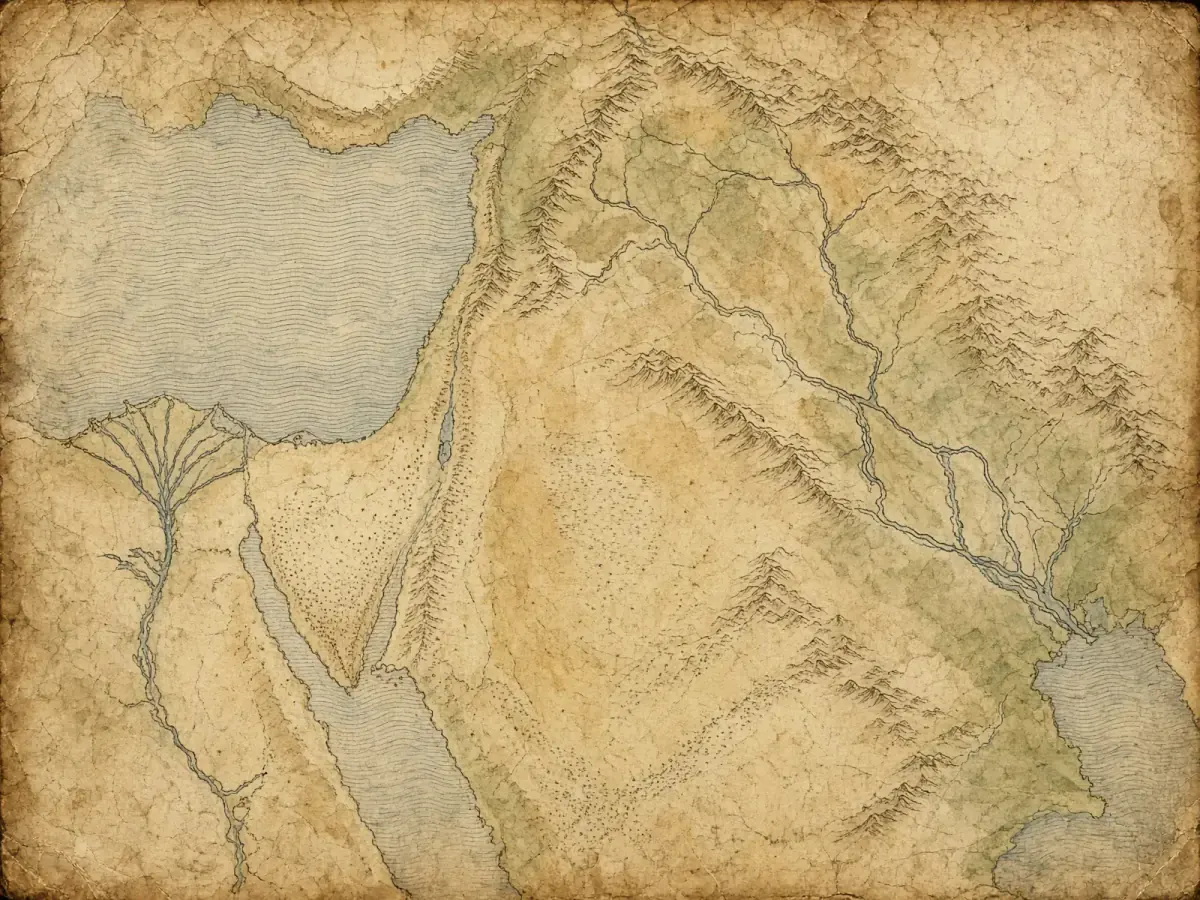
The closing movement widens from Egypt to the countries coming to buy. Joseph's administrative position is now the meeting point between the famine and the people trying to survive it. The chapter's expansive language emphasizes the reach of the shortage and the draw of Egypt's reserves; it does not provide a map of every affected region. One of those regions will be Canaan. The final verse has already created the conditions under which the brothers who sent Joseph away must travel toward the man they no longer expect to meet.
Words to trace: Joseph, years, Egypt, food, land, gathered, famine, bread, dearth
Verse-by-verse path
- Genesis 41:46
“Stood before” is the phrase for entering a king’s service (1 Kings 10:8). David was thirty when he began to reign (2 Samuel 5:4), and Levites began their service at thirty (Numbers 4:3). The verse repeats that Joseph “went out”, this time to walk the whole country.
- Genesis 41:47
“By handfuls” is liqmatsim, probably meaning in heaps, each seed yielding a fistful. The earth itself is the subject of the verse: the land does the producing, and Joseph’s part comes in the next.
- Genesis 41:48
Each city stored the grain of its own surrounding fields, which saved the labour of hauling it. The descendants of the man who filled Egypt’s granaries will later be forced to build “treasure cities”, store cities, for another Pharaoh (Exodus 1:11).
- Genesis 41:49
“As the sand of the sea” is the language of the promise to Jacob’s line: “I will make thy seed as the sand of the sea, which cannot be numbered for multitude” (32:12). Egyptian scribes counted grain with great care, so for them to stop counting is a large claim.
- Genesis 41:50
The Talmud drew a rule from “before the years of famine came”: that couples should abstain during famine (Ta’anit 11a). Asenath is given her full descent again, as the daughter of the priest of On, each time she is mentioned.
- Genesis 41:51
Joseph has an Egyptian name, an Egyptian wife and an Egyptian office, and he gives his sons Hebrew names. Manasseh sounds like nashani, “he made me forget”. “Toil” is amal, trouble or hardship, the word Job uses of his misery (Job 5:7).
- Genesis 41:52
Ephraim has a dual ending, “doubly fruitful”. It picks up the command God gave Jacob at Bethel, “be fruitful and multiply” (35:11). Ephraim will later be the name of the whole northern kingdom, as in Hosea.
- Genesis 41:53
Seven years pass in one sentence. Nothing is recorded of them except the gathering and the two births. Genesis spends its words on the dreams and on the famine, not on the good times between.
- Genesis 41:54
Egypt’s harvests depend on the Nile flood, fed by rains far to the south; Canaan depends on its own rain. For both to fail at once, the rains had to fail across the whole region, which the verse states as a plain fact. The KJV uses “dearth” and “famine” for the same Hebrew word.
- Genesis 41:55
“What he saith to you, do” is echoed in Mary’s words at Cana, “Whatsoever he saith unto you, do it” (John 2:5), which closely follow the Greek of this verse. Pharaoh hands the people over to Joseph with a single command.
- Genesis 41:56
The Hebrew says Joseph “opened all that was in them”; the KJV supplies “storehouses”. He sold, and did not give: shavar is a verb used for dealing in grain, and the selling will lead to the Egyptians’ money, cattle and land passing to Pharaoh in 47:13–20.
- Genesis 41:57
“All countries” is literally “all the earth”, a sweeping phrase. God promised Abraham that in him all families of the earth would be blessed (12:3), and here the earth comes to one of Abraham’s descendants for bread; the link is an inference, not stated in the verse.
Genesis 41:46-57
King James Version46And Joseph was thirty years old when he stood before Pharaoh king of Egypt. And Joseph went out from the presence of Pharaoh, and went throughout all the land of Egypt.
47And in the seven plenteous years the earth brought forth by handfuls.
48And he gathered up all the food of the seven years, which were in the land of Egypt, and laid up the food in the cities: the food of the field, which was round about every city, laid he up in the same.
49And Joseph gathered corn as the sand of the sea, very much, until he left numbering; for it was without number.
50And unto Joseph were born two sons before the years of famine came, which Asenath the daughter of Poti-pherah priest of On bare unto him.
51And Joseph called the name of the firstborn Manasseh: For God, said he, hath made me forget all my toil, and all my father’s house.
52And the name of the second called he Ephraim: For God hath caused me to be fruitful in the land of my affliction.
53And the seven years of plenteousness, that was in the land of Egypt, were ended.
54And the seven years of dearth began to come, according as Joseph had said: and the dearth was in all lands; but in all the land of Egypt there was bread.
55And when all the land of Egypt was famished, the people cried to Pharaoh for bread: and Pharaoh said unto all the Egyptians, Go unto Joseph; what he saith to you, do.
56And the famine was over all the face of the earth: and Joseph opened all the storehouses, and sold unto the Egyptians; and the famine waxed sore in the land of Egypt.
57And all countries came into Egypt to Joseph for to buy corn; because that the famine was so sore in all lands.
Questions to keep in mind while reading
- Track who acts, who speaks, who is affected, and what changes.
- Notice repeated promises, failures, rescues, and consequences.
- Do not assume the account approves every action that is reported.
Text first
Where readers differ
The chapter summary begins with what the passage says and how its parts fit together. It does not assume one denomination has already settled every question. Where a conclusion depends on a tradition, literary theory, or historical reconstruction, that dependence is named openly.
The KJV text is presented first. Interpretive conclusions are labeled, and differences are introduced only when they help a reader understand why serious communities do not always reach the same answer.
Can we identify Joseph's Pharaoh?
Genesis names Joseph's Egyptian office, wife, father-in-law and age when he enters service, but it does not name the king or dynasty. Proposed identifications depend on larger chronological reconstructions and remain debated. Egyptian artifacts can illuminate practices without identifying the biblical participants.
Likewise, Joseph's storage and land policy should be evaluated as a narrated response to famine, with both preserved life and concentrated power visible. It is not automatically a timeless economic blueprint.
Genesis 41:14,42-46 · Genesis 47:13-26
Questions beneath the surface
- What account of God, human freedom, responsibility, and the good life emerges from Genesis 41?
- Which tension does the chapter refuse to resolve quickly, especially around wisdom, provision, providence?
- What changes when the chapter is read as part of the whole canon rather than as an isolated moral lesson?
- Where might a sincere reader confuse a familiar tradition with something the text states directly?
Questions for serious personal contemplation
These open-ended questions make room for tension, honest response, prayer, and conclusions that remain accountable to the chapter.
Observe without rushing
What part of Genesis 41 makes you stop, feel unsettled, or feel surprised, and why?
Which detail in the passage would be easiest to overlook? How does that detail change your understanding?
Where do you see tension between what happens and this focus: From prison to responsibility?
What important question does the passage leave open instead of resolving quickly?
Examine your inner life honestly
Which person, response, fear, or desire in the passage feels most like your own life right now?
What assumption about God, other people, or yourself does this text challenge?
Which part would you rather soften, avoid, or explain away too quickly? What might that reaction reveal?
If this Scripture could ask you one direct question, what do you think it would ask?
Respond with wisdom and courage
What do you need to remember, confess, grieve, thank God for, or trust after reading this passage?
How might another faithful person read this situation differently without ignoring the text?
What obedient response would be costly, uncomfortable, or slow, yet still faithful to Scripture?
What question will you carry into prayer this week, and which verses will you keep in front of you?
Music and video connected to the passage
Related media appears when its Scripture reference overlaps this study. Music and video can illuminate a theme while the biblical text remains the foundation.