The big picture
Leviticus 27 closes the book with valuation, redemption, and the limits of changing one's mind after something has been set apart. Persons under a singular vow receive fixed assessments by age and sex, with a priestly adjustment for someone too poor to pay the schedule. Sacrificial animals cannot simply be exchanged, while unclean animals and houses may be redeemed by adding a fifth to their valuation. Dedicated fields remain tied to the Jubilee calendar, and ancestral holdings differ from purchased fields because one person's vow cannot erase another family's right of return. Firstborn animals already belong to the LORD and therefore cannot be repackaged as new voluntary gifts. Devoted things form a more severe, irrevocable category, while produce tithes and livestock tithes follow different redemption rules. The book ends on a practical point with theological weight: a promise, a portion, or the tenth animal must retain the status already assigned to it.
In this chapter
- A Vow Involving a Person Receives an Assessment Leviticus 27:1-8
A vow involving a person is turned into an assessed amount rather than an instruction to sacrifice that person.
- An Attempted Exchange Can Leave Two Animals Holy Leviticus 27:9-15
A sacrificial animal becomes difficult to retrieve the moment it is given, and Leviticus blocks the most obvious strategy for doing so.
- A Field’s Calendar Remains Attached to Its Dedication Leviticus 27:16-25
A dedicated field carries the Jubilee calendar with it into the sanctuary's accounting.
- Already Owed and Irrevocably Devoted Are Separate Categories Leviticus 27:26-29
Leviticus separates what is already owed from what can still be voluntarily dedicated.
- The Tenth Animal Is Counted, Not Selected for Convenience Leviticus 27:30-34
The closing tithe rules make counting more important than preference.
Scripture beside the summary
Leviticus · King James Version · 34Leviticus 27:1-8
A Vow Involving a Person Receives an Assessment
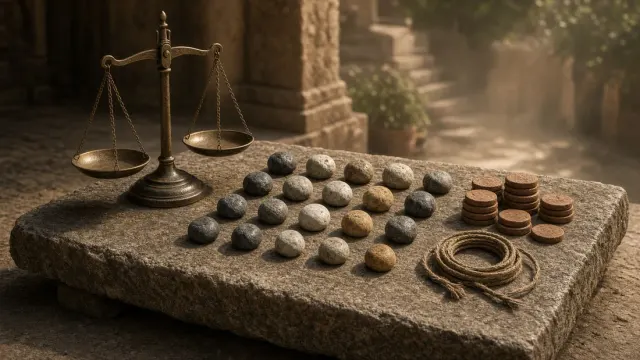
A vow involving a person is turned into an assessed amount rather than an instruction to sacrifice that person. Leviticus gives a schedule in sanctuary shekels that varies by age and sex, and the inequalities in that schedule are real. The verses do not say the numbers are a complete measure of human worth, but they also do not provide a reason that makes the differences disappear. Explanations based on labor value or economic capacity may be proposed, yet those rationales are not stated here. What the passage does explain is how poverty affects the procedure. A person unable to afford the prescribed valuation is not simply rejected or forced under the full schedule. He is presented before the priest, who sets the amount according to the ability of the one who made the vow. Leviticus therefore combines fixed assessment with a defined exception for limited means, keeping both the structure and the accommodation inside the stated rule.
Deep dive
The opening concern is a "singular vow", followed by the assessment attached to persons. This is not an instruction to sacrifice the people named in the schedule. The procedure concerns an amount associated with the vow, expressed in silver according to the sanctuary standard. Different ages and the distinction between male and female produce different prescribed sums.
The differences are real. The text does not say that the schedule is an exhaustive measure of a person’s intrinsic worth, but neither does it offer an explicit explanation that removes the unequal assessments. Their possible relationship to economic capacity or customary service value is an interpretation, not a reason supplied in these verses. A careful reading can describe what the amounts do without inventing the rationale behind every ratio.
Verse 8 then makes the person who vowed and cannot afford the assessment a separate case. The priest must value according to that person’s ability. The schedule is therefore not administered as though limited means were irrelevant. As in the offering laws, the book gives poverty a stated place in the procedure rather than leaving it to an unrecorded private exception.
Words to trace: estimation, shekels, years, female, male, five
Verse-by-verse path
- Leviticus 27:1
The book’s last speech formula. Leviticus opened with the LORD calling from the tent of meeting (1:1) and closes, after the climax of chapter 26, with an appendix on money and promises.
- Leviticus 27:2
“Singular vow” translates a phrase meaning to make a vow extraordinary or wonderful, from pala, the root of “wonders”. A person could vow himself or a dependant to the LORD; since Israel offered no human sacrifice and not all could serve at the sanctuary, the vow was paid in silver.
- Leviticus 27:3
Fifty shekels was a very large sum. Deuteronomy 22:29 sets the same fifty as the penalty for seizing a virgin, and David pays fifty shekels for Araunah’s threshing floor and oxen in 2 Samuel 24:24. The sanctuary shekel was a fixed standard weight, not whatever a local market used.
- Leviticus 27:4
Thirty shekels is the value set on a slave gored by an ox in Exodus 21:32, and the sum Zechariah is paid in scorn (Zechariah 11:12), which Matthew 26:15 sees again in the price paid to Judas.
- Leviticus 27:5
Twenty shekels for a youth is the price at which Joseph’s brothers sold him at seventeen, in Genesis 37:28. The band of five to twenty covers those not yet counted among the fighting men of Numbers 1.
- Leviticus 27:6
Infants under a month are left out entirely, as they are from the census of the Levites in Numbers 3:15; a month was the age at which a child was reckoned to have survived. Five shekels is also the redemption price of a firstborn son (Numbers 3:47, 18:16).
- Leviticus 27:7
After sixty the male value falls to less than a third, while the female value falls only by a third. Whatever the reasoning behind the numbers, it is not stated, and the gap between the sexes narrows sharply in old age.
- Leviticus 27:8
The person is literally “made to stand” before the priest, and “value” is the same verb as “estimation” throughout. The priest’s valuation is tied to what the vower’s own hand can reach, the phrase used of the poor man’s offering in 5:7 and 14:22.
Leviticus 27:1-8
King James Version1And the LORD spake unto Moses, saying,
2Speak unto the children of Israel, and say unto them, When a man shall make a singular vow, the persons shall be for the LORD by thy estimation.
3And thy estimation shall be of the male from twenty years old even unto sixty years old, even thy estimation shall be fifty shekels of silver, after the shekel of the sanctuary.
4And if it be a female, then thy estimation shall be thirty shekels.
5And if it be from five years old even unto twenty years old, then thy estimation shall be of the male twenty shekels, and for the female ten shekels.
6And if it be from a month old even unto five years old, then thy estimation shall be of the male five shekels of silver, and for the female thy estimation shall be three shekels of silver.
7And if it be from sixty years old and above; if it be a male, then thy estimation shall be fifteen shekels, and for the female ten shekels.
8But if he be poorer than thy estimation, then he shall present himself before the priest, and the priest shall value him; according to his ability that vowed shall the priest value him.
Leviticus 27:9-15
An Attempted Exchange Can Leave Two Animals Holy
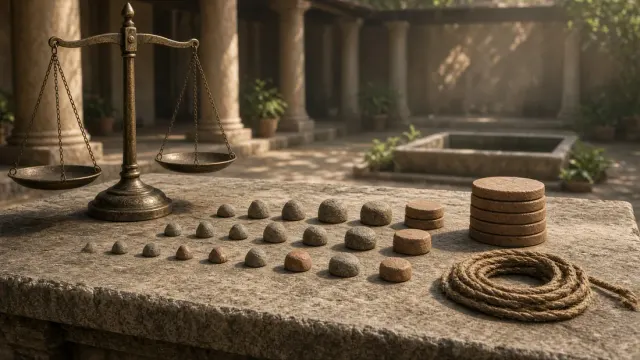
A sacrificial animal becomes difficult to retrieve the moment it is given, and Leviticus blocks the most obvious strategy for doing so. The donor may not exchange a good animal for a bad one or a bad one for a good one. If an exchange is attempted, both animals become holy, so the effort to revise the gift actually enlarges it. An unclean animal is different because it is not eligible for sacrifice. The priest values it, and the owner may redeem it by paying that amount plus a fifth. A dedicated house follows a similar valuation and redemption procedure. These cases show that holiness does not require every dedicated thing to be burned or removed permanently from ordinary use, but neither can a donor reverse the dedication merely because circumstances or preferences have changed. Where redemption is allowed, it has a measured cost; where substitution is forbidden, changing one's mind cannot rewrite the original commitment.
Deep dive
An animal eligible for sacrifice becomes holy when it is given. The prohibition on exchange works in both directions, good for bad and bad for good. The giver is not allowed to reopen the dedication simply by describing the proposed alteration as an improvement. If an exchange is attempted, both animals become holy. The attempted revision has enlarged the gift instead of recovering it.
An unclean animal follows a different procedure because it is not eligible for the altar. The priest assesses it, and the owner can redeem it by adding a fifth to that valuation. A house dedicated to the LORD is likewise assessed according to its condition, with the same added fifth if the giver takes it back.
These distinctions show that holiness does not require every dedicated object to be burned or permanently removed from all ordinary use. Some gifts are represented through valuation and redemption, but the return has a defined cost. The donor’s changed intention does not, by itself, undo the status established by the earlier commitment.
Words to trace: beast, priest, good, LORD, holy, change
Verse-by-verse path
- Leviticus 27:9
The moment the animal is given, it is holy: the dedication is complete in the vow itself, before the animal ever reaches the altar.
- Leviticus 27:10
Two verbs, “alter” and “change”, close off every loophole, and “a good for a bad” is forbidden alongside “a bad for a good”. Even an upgrade is refused, because the right to reopen the vow is itself what is denied.
- Leviticus 27:11
An unclean beast, a donkey or a camel, could be vowed but could never be sacrificed. Presenting it before the priest turns it into a price, since the animal itself has nowhere to go at the altar.
- Leviticus 27:12
“Good or bad” is the Hebrew merism for the whole range of quality. The address shifts pointedly to the priest in the second person: “as thou valuest it, who art the priest, so shall it be.” His figure is final.
- Leviticus 27:13
The added fifth, twenty percent, is the same surcharge that repays holy things eaten in error (5:16) and goods taken by fraud (6:5). Buying back what was given costs more than never giving it.
- Leviticus 27:14
“Sanctify” is qadash in its causative form, to make holy. A house given to the sanctuary would in practice be sold or let by the priests, and the silver used for the sanctuary.
- Leviticus 27:15
“It shall be his” is the whole goal of the verse: the house comes back entire, provided the vower pays the valuation plus the fifth, 120 percent of the priest’s figure.
Leviticus 27:9-15
King James Version9And if it be a beast, whereof men bring an offering unto the LORD, all that any man giveth of such unto the LORD shall be holy.
10He shall not alter it, nor change it, a good for a bad, or a bad for a good: and if he shall at all change beast for beast, then it and the exchange thereof shall be holy.
11And if it be any unclean beast, of which they do not offer a sacrifice unto the LORD, then he shall present the beast before the priest:
12And the priest shall value it, whether it be good or bad: as thou valuest it, who art the priest, so shall it be.
13But if he will at all redeem it, then he shall add a fifth part thereof unto thy estimation.
14And when a man shall sanctify his house to be holy unto the LORD, then the priest shall estimate it, whether it be good or bad: as the priest shall estimate it, so shall it stand.
15And if he that sanctified it will redeem his house, then he shall add the fifth part of the money of thy estimation unto it, and it shall be his.
Leviticus 27:16-25
A Field’s Calendar Remains Attached to Its Dedication
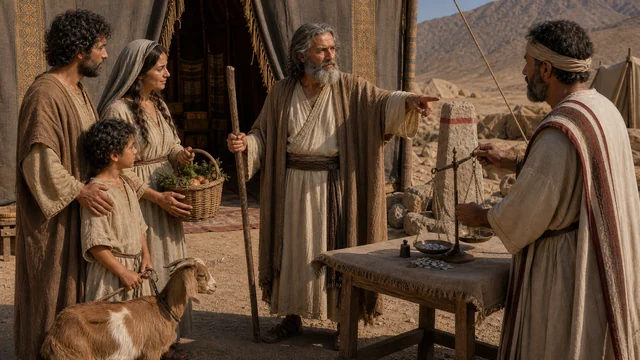
A dedicated field carries the Jubilee calendar with it into the sanctuary's accounting. Its valuation begins with productive capacity and then changes according to how many years remain before Jubilee. A field dedicated late in the cycle cannot be valued as though the full period still remains. If the person who dedicated an ancestral field redeems it, an additional fifth is required. If the specified redemption does not occur and the field reaches the irreversible outcome described, it becomes holy to the LORD and passes to the priest at Jubilee. A purchased field is different because the giver never owned the ancestral right behind it. Its value can be dedicated for the remaining years, but the land itself must return at Jubilee to the family from whom it was bought. The rule is exact: devotion can reach what a person truly controls, but it cannot permanently consume someone else's future right of return. The sanctuary shekel gives the entire calculation a common standard.
Deep dive
The valuation of an ancestral field begins with the amount of seed associated with it and then accounts for the years remaining until Jubilee. A field dedicated later in the cycle cannot be treated as though it carries the same remaining period as one dedicated at the beginning. The chapter brings the calendar of chapter 25 into the sanctuary’s accounting.
Redemption by the person who dedicated the field requires the assessed amount plus a fifth. Where the field is not redeemed, or is sold under the case described, the text assigns an irreversible outcome: at Jubilee it becomes holy to the LORD as devoted land and belongs to the priest. The general return of ancestral land therefore has this particular consecration-related qualification.
A field that the giver purchased, rather than held as ancestral possession, is different. Its assessed value is paid for the period until Jubilee, but the field itself returns to the original holder at that time. A person cannot dedicate away someone else’s eventual right of return. The sanctuary shekel then supplies the common measurement for the assessments, preventing the entire arrangement from depending on shifting private standards.
Words to trace: field, estimation, jubile, LORD, possession, sanctify
Verse-by-verse path
- Leviticus 27:16
A field is valued by what it takes to sow rather than by its area. A homer was a donkey load, the Hebrew word being related to hamor, donkey, perhaps some two hundred litres of seed. Fifty shekels per homer is reckoned across a full fifty years of jubilee.
- Leviticus 27:17
Dedicated from the jubilee year itself, the field is worth the full estimation, because the sanctuary receives every harvest until the next jubilee.
- Leviticus 27:18
Each year gone reduces the price, roughly a shekel a year on the fifty year scale. The calculation is the same as for the sale of land in 25:15–16: what is dedicated is really the harvests left before the land goes home.
- Leviticus 27:19
“Assured to him” is literally “it shall rise to him”, the field standing up again as his own. The vower is the one family member who pays the extra fifth; the kinsman redeemer of chapter 25 does not appear here.
- Leviticus 27:20
The two cases are failure to redeem, or selling the dedicated field to someone else as though it were still his. The Hebrew grammar leaves it unclear whether the second means the owner or the priest sells it; the Jewish sages disagreed about it.
- Leviticus 27:21
“Devoted” is cherem, the most severe category of all, anticipated here and defined in verse 28. A field that would have gone home at the jubilee instead goes to the priests. Numbers 18:14 later confirms that everything devoted in Israel belongs to Aaron.
- Leviticus 27:22
A bought field is only a lease on harvests until the jubilee, since the land always belongs to its ancestral family (25:23). So what the buyer can dedicate is only what he has.
- Leviticus 27:23
“In that day” matters: the price for a purchased field is paid at once, in a single sum, not left open as with an ancestral field. There is no option to redeem later and no added fifth.
- Leviticus 27:24
The phrase piles up to make the point unmissable: the field returns to the seller, “even to him to whom the possession of the land did belong”. The vow of a buyer cannot cancel the claim of the family that holds it by inheritance.
- Leviticus 27:25
A gerah was the smallest unit of weight, literally a grain or bean. Fixing the shekel at twenty gerahs, as Exodus 30:13 and Numbers 3:47 also do, ties every price in the chapter to a single measure.
Leviticus 27:16-25
King James Version16And if a man shall sanctify unto the LORD some part of a field of his possession, then thy estimation shall be according to the seed thereof: an homer of barley seed shall be valued at fifty shekels of silver.
17If he sanctify his field from the year of jubile, according to thy estimation it shall stand.
18But if he sanctify his field after the jubile, then the priest shall reckon unto him the money according to the years that remain, even unto the year of the jubile, and it shall be abated from thy estimation.
19And if he that sanctified the field will in any wise redeem it, then he shall add the fifth part of the money of thy estimation unto it, and it shall be assured to him.
20And if he will not redeem the field, or if he have sold the field to another man, it shall not be redeemed any more.
21But the field, when it goeth out in the jubile, shall be holy unto the LORD, as a field devoted; the possession thereof shall be the priest’s.
22And if a man sanctify unto the LORD a field which he hath bought, which is not of the fields of his possession;
23Then the priest shall reckon unto him the worth of thy estimation, even unto the year of the jubile: and he shall give thine estimation in that day, as a holy thing unto the LORD.
24In the year of the jubile the field shall return unto him of whom it was bought, even to him to whom the possession of the land did belong.
25And all thy estimations shall be according to the shekel of the sanctuary: twenty gerahs shall be the shekel.
Leviticus 27:26-29
Already Owed and Irrevocably Devoted Are Separate Categories
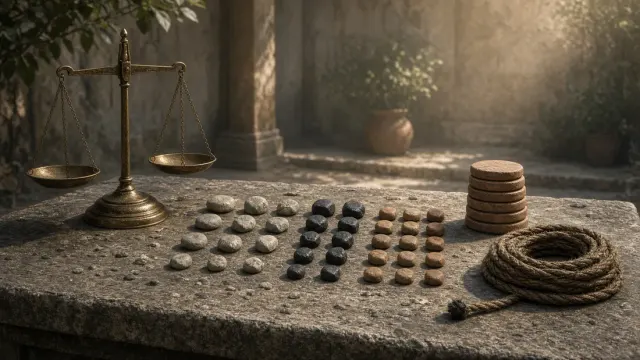
Leviticus separates what is already owed from what can still be voluntarily dedicated. A firstborn ox or sheep already belongs to the LORD, so the owner cannot present it as though he were creating a new gift. An unclean firstborn follows a valuation and redemption procedure, but the principle remains that an existing obligation cannot be relabeled as fresh generosity. The section then turns to the stricter category rendered "devoted." These things cannot be sold or redeemed, and the final human clause states death for the person under the specified devotion. The precise scope of that human case is disputed, and the passage does not identify every authority, circumstance, or legal ground that could produce it. That uncertainty must not be solved by making the clause say ordinary lifelong service, but neither does the text authorize a reader to kill someone merely because of a private vow. Leviticus has moved from redeemable assessments to an expressly irrevocable category, and the distinction is the point.
Deep dive
A firstborn ox or sheep cannot become a new voluntary dedication because it already belongs to the LORD. The distinction is between giving something still at one’s disposal and relabeling an existing obligation as a fresh gift. The unclean-animal case instead involves valuation, redemption with an added fifth, or sale.
The Hebrew cherem, translated here through "devoted", marks an irrevocable setting apart or ban. Brown–Driver–Briggs distinguishes uses involving sacred dedication from those involving destruction. Verse 28 includes persons, animals, and ancestral fields among things that cannot be sold or redeemed. Verse 29 then explicitly states death for the person under the devotion it describes.
The scope of that human case is disputed. Matthew Poole and other commentators understand people already placed under a judicial or divinely commanded sentence, whose lives cannot be ransomed; other readings connect it more directly with the irrevocable human devotion mentioned in verse 28. The clause does not identify the authority or grounds for each possible case. Its wording cannot be reduced to ordinary lifelong service, but neither does it state that every personal vow authorizes killing someone. The chapter has distinguished this severe category from the redeemable assessments with which it began.
Words to trace: devoted, redeemed, beast, estimation, firstling, LORD
Verse-by-verse path
- Leviticus 27:26
“Firstling” is bekhor, and the firstborn of ox and sheep had belonged to the LORD since Exodus 13:2 and 13:12. To vow one would be to give God what was already his; the clause “it is the LORD’s” ends the discussion.
- Leviticus 27:27
Exodus 13:13 prescribed that a firstborn donkey be redeemed with a lamb or have its neck broken. This verse sets another route: money at the valuation plus a fifth, or sale by the sanctuary.
- Leviticus 27:28
Cherem is a setting apart so complete that it cannot be bought back, and “most holy” is the rank of the showbread and the sin offering. The word appears in the conquest accounts, at Jericho (Joshua 6:17–18) and in Achan’s theft of devoted things.
- Leviticus 27:29
The verse is disputed. One reading takes it of people already under a sentence of death, whom no vow price could ransom; another links it to the ban in war, as with Agag in 1 Samuel 15. Either way it closes off redemption, and it gives no private person power over another’s life.
Leviticus 27:26-29
King James Version26Only the firstling of the beasts, which should be the LORD’s firstling, no man shall sanctify it; whether it be ox, or sheep: it is the LORD’s.
27And if it be of an unclean beast, then he shall redeem it according to thine estimation, and shall add a fifth part of it thereto: or if it be not redeemed, then it shall be sold according to thy estimation.
28Notwithstanding no devoted thing, that a man shall devote unto the LORD of all that he hath, both of man and beast, and of the field of his possession, shall be sold or redeemed: every devoted thing is most holy unto the LORD.
29None devoted, which shall be devoted of men, shall be redeemed; but shall surely be put to death.
Leviticus 27:30-34
The Tenth Animal Is Counted, Not Selected for Convenience
The closing tithe rules make counting more important than preference. Produce tithes belong to the LORD, yet their redemption is permitted if the owner adds a fifth. Livestock tithes work differently. Animals pass under the rod, and every tenth one becomes holy without the owner first inspecting whether it is especially good or inconveniently poor. The procedure therefore prevents selective generosity. A person cannot manipulate the sequence to substitute a preferred animal, and if an exchange is attempted, both the counted animal and its replacement become holy with no redemption allowed. This is not the same standard as choosing an unblemished animal for a voluntary burnt offering because the tithe arises through number rather than selection. The book ends at Sinai with these exact handling rules for promises and portions already owed. Leviticus closes not with abstraction but with the practical question of whether a person will let the tenth animal remain the tenth animal once it has passed under the rod.
Deep dive
The tithe of seed and fruit belongs to the LORD. Its redemption requires the added fifth, continuing the distinction between acknowledging an obligation and retrieving what has been set apart. The animal tithe is regulated differently: the tenth animal passing under the rod is holy.
The owner must not inspect the sequence in order to substitute a preferred good or bad animal for the one counted. This is not the same procedure as selecting an unblemished animal for a voluntary burnt offering. The tithe arises through the count. Attempted exchange again leaves both animals holy, and redemption is expressly excluded.
The final verse returns to Moses, Israel, and Sinai. Leviticus has moved from the call out of the tabernacle through offerings, priesthood, purity, holy conduct, sacred time, land, and covenant consequences. It closes with the exact handling of promises and portions already owed. The ending is practical without being trivial: even a vow, a field assessment, and the tenth animal must retain the meaning assigned to them rather than becoming whatever their owner later prefers.
Words to trace: change, holy, LORD, land, tithe, both
Verse-by-verse path
- Leviticus 27:30
The earliest tithes in Scripture are Abram’s to Melchizedek (Genesis 14:20) and Jacob’s vow at Bethel (Genesis 28:22). Here the tenth is not a gift offered but a portion that “is the LORD’s” before it is given.
- Leviticus 27:31
A produce tithe could be bought back, again with a fifth added, which was practical for a farmer far from the sanctuary. Deuteronomy 14:24–26 gives another route: sell it at home and spend the silver at the sanctuary.
- Leviticus 27:32
The shepherd counted his flock by making them pass one at a time under his staff at a gate or fold, as Jeremiah 33:13 and Ezekiel 20:37 picture. Every tenth animal through the gate was marked; the Mishnah remembers it being daubed with red.
- Leviticus 27:33
“Search” is the verb for a priest inspecting leprosy in chapter 13, to examine closely. The owner is barred from inspecting the tenth animal at all, since chance, not choice, decides which one belongs to the LORD.
- Leviticus 27:34
The last verse of the book returns to mount Sinai, where Exodus 19 left the people and where Numbers 1:1 will open, still in the wilderness of Sinai. Leviticus has not moved an inch geographically; every law in it was given at the mountain.
Leviticus 27:30-34
King James Version30And all the tithe of the land, whether of the seed of the land, or of the fruit of the tree, is the LORD’s: it is holy unto the LORD.
31And if a man will at all redeem ought of his tithes, he shall add thereto the fifth part thereof.
32And concerning the tithe of the herd, or of the flock, even of whatsoever passeth under the rod, the tenth shall be holy unto the LORD.
33He shall not search whether it be good or bad, neither shall he change it: and if he change it at all, then both it and the change thereof shall be holy; it shall not be redeemed.
34These are the commandments, which the LORD commanded Moses for the children of Israel in mount Sinai.
Questions to keep in mind while reading
- Identify the people addressed and the covenant setting.
- Distinguish rescue, worship, holiness, justice, and community responsibility.
- Read commands in their literary and covenant context before making a modern application.
Text first
Where readers differ
The chapter summary begins with what the passage says and how its parts fit together. It does not assume one denomination has already settled every question. Where a conclusion depends on a tradition, literary theory, or historical reconstruction, that dependence is named openly.
The KJV text is presented first. Interpretive conclusions are labeled, and differences are introduced only when they help a reader understand why serious communities do not always reach the same answer.
Comparative interpretive notes for this chapter are in preparation. Until reviewed notes are ready, this page separates the KJV text from summary and application without claiming that serious readers agree on every question.
Questions beneath the surface
- What account of God, human freedom, responsibility, and the good life emerges from Leviticus 27?
- Which tension does the chapter refuse to resolve quickly?
- What changes when the chapter is read as part of the whole canon rather than as an isolated moral lesson?
- Where might a sincere reader confuse a familiar tradition with something the text states directly?
Questions for serious personal contemplation
These open-ended questions make room for tension, honest response, prayer, and conclusions that remain accountable to the chapter.
Observe without rushing
What part of Leviticus 27 makes you stop, feel unsettled, or feel surprised, and why?
Which detail in the passage would be easiest to overlook? How does that detail change your understanding?
Where do you see tension between what happens and this focus: Leviticus 27 develops its own movement around estimation, LORD, field, priest, holy?
What important question does the passage leave open instead of resolving quickly?
Examine your inner life honestly
Which person, response, fear, or desire in the passage feels most like your own life right now?
What assumption about God, other people, or yourself does this text challenge?
Which part would you rather soften, avoid, or explain away too quickly? What might that reaction reveal?
If this Scripture could ask you one direct question, what do you think it would ask?
Respond with wisdom and courage
What do you need to remember, confess, grieve, thank God for, or trust after reading this passage?
How might another faithful person read this situation differently without ignoring the text?
What obedient response would be costly, uncomfortable, or slow, yet still faithful to Scripture?
What question will you carry into prayer this week, and which verses will you keep in front of you?
Music and video connected to the passage
Related media appears when its Scripture reference overlaps this study. Music and video can illuminate a theme while the biblical text remains the foundation.