
The big picture
The chapter opens with a wedding invitation refused by people who either ignore it or attack the servants carrying it. The hall is then filled from the highways with both bad and good, yet the king’s inspection makes clear that a widened invitation has not abolished judgment. A series of public challenges follows. The tribute question tries to force Jesus into a political trap, but the coin’s image becomes the starting point for distinguishing Caesar’s claim from the larger claim of God. The Sadducees build a resurrection puzzle out of seven marriages, and Jesus rejects the assumption that risen life must reproduce present arrangements unchanged. A lawyer asks for the great commandment and receives two joined answers: love of God and love of neighbour, on which the law and prophets hang. Finally, Jesus turns questioner and asks how David can call his own descendant Lord. The familiar title Son of David remains true, but no longer sufficient by itself to account for the authority described in Psalm 110.
In this chapter
- The Hall Fills, but the King Still Enters Matthew 22:1-14
The wedding hall fills only after the first invitations fail, but the Book of Matthew will not let abundance of guests be mistaken for absence of judgment.
- The Coin Answers Before the Trap Can Close Matthew 22:15-22
The trap is introduced before the question.
- Seven Husbands Do Not Define the Resurrection Matthew 22:23-33
The Sadducees build their question so resurrection will look absurd before Jesus ever answers.
- Two Commandments Carry the Whole Structure Matthew 22:34-40
The lawyer asks for one great commandment, and Jesus answers with two that refuse to be separated.
- David Calls His Own Descendant Lord Matthew 22:41-46
After answering everyone else, Jesus asks the question that leaves the room silent.
Scripture beside the summary
Matthew · King James Version · 46Matthew 22:1-14
The Hall Fills, but the King Still Enters
The wedding hall fills only after the first invitations fail, but the Book of Matthew will not let abundance of guests be mistaken for absence of judgment. Some invited people simply return to farm and business, while others abuse and kill the king’s servants. Indifference and violence differ, yet both reject the summons. The king then sends servants into the highways, where they gather “both bad and good,” so the room is filled by invitation rather than by a prior résumé of worthiness. Then the king himself enters. One man has no wedding garment and no answer when questioned. The passage never explains the garment with a single symbolic key, and it does not say the king routinely provided clothing at the door. What matters is the interruption of an easy conclusion. The invitation has widened dramatically, but the king still inspects the guests. Grace has brought people in from the roads; that welcome has not made the king indifferent to the fitness of those who now stand within his feast.
Deep dive
The first invited guests respond in different ways. Some return to farm and business; others abuse and kill the servants. Indifference and violence are not identical acts, but both reject the king’s invitation. The destruction of the murderers and their city gives the refusal a consequence far beyond a missed dinner. The royal feast for the son carries the weight of judgment.
The servants then gather people from the highways, both bad and good. The hall fills because the invitation reaches beyond the original circle, not because everyone gathered arrives with an established record of worthiness. Yet the king’s entrance introduces another distinction. Being inside the hall is not the end of the examination.
The wedding garment has been interpreted as righteousness, a fitting response to grace, or the transformed conduct appropriate to the kingdom. Matthew does not decode it with one explicit equivalent. Nor does he say that this king routinely supplies garments at the door, a detail sometimes asserted as though it were in the passage. What the account supplies is the guest’s inability to answer and the severity of exclusion. A widened invitation has not made the king’s judgment disappear.
Words to trace: servants, wedding, king, bidden, marriage, garment
Verse-by-verse path
- Matthew 22:1
Nobody has asked a question; “answered” in the Hebrew idiom means he took up speaking, in response to the plot of 21:46. This is the third parable in a row aimed at the same listeners, after the two sons and the tenants, and the third to involve a father and a son.
- Matthew 22:2
A wedding feast in that world could run for seven days, as Samson’s did (Judges 14:12). A king marrying off his heir was a state occasion, the setting of Psalm 45, the royal wedding psalm. To refuse was to refuse the king, not a host.
- Matthew 22:3
Guests were invited ahead, then summoned when the meal was ready, as Haman was first invited and then fetched by the king’s chamberlains (Esther 5:8; 6:14). “Would not come” is imperfect in Greek: they kept being unwilling. The first refusal is to the summons, not the invitation.
- Matthew 22:4
“Dinner” is ariston, the midday meal that opened a feast day. “Fatlings” are animals fattened on grain. Meat once killed had to be eaten, so “all things are ready” is urgent. Wisdom’s feast in Proverbs 9:2–3 is set the same way: her beasts killed, her maidens sent out to call.
- Matthew 22:5
“Made light of it” is ameleo, to be careless about, to not bother. Luke’s guests offer excuses (Luke 14:18–20); Matthew’s give none and simply go, one to his own field, one to his trading. “Merchandise” is emporia, business, used nowhere else in the New Testament.
- Matthew 22:6
“Entreated” was 1611 English for treated; “spitefully” translates hybrizo, to outrage or insult, the root of hubris. Killing messengers over a dinner invitation makes no sense as an ordinary account of a feast, which is a sign that the parable has become the tenants of 21:35 again.
- Matthew 22:7
Many read the burned city as an allusion to Rome’s destruction of Jerusalem in AD 70; others note that sending troops against a rebellious city was stock language for judgment in the prophets. Either way, the parable’s realism bends: a war is fought while the dinner waits.
- Matthew 22:8
“Worthy” is axios, the word used when the twelve were sent out: find who is worthy in each town, and if the house be worthy, let your peace come on it (10:11–13). “Not worthy of me” was said three times in 10:37–38. Worthiness in Matthew is shown by the welcome given.
- Matthew 22:9
“Highways” is literally the outlets of the roads, the points where city streets run out into the country roads. Travellers, beggars and day labourers gathered there, like the idle men in the marketplace of 20:3.
- Matthew 22:10
“Both bad and good”, and the bad come first. The gathering is like the dragnet of 13:47–48, which takes in every kind and sorts them afterwards. The oldest manuscripts read that the bridechamber, nymphon, was filled, not the wedding.
- Matthew 22:11
Zephaniah 1:7–8 gave the image already: the LORD has prepared a sacrifice and bidden his guests, and on that day he will punish “all such as are clothed with strange apparel”. The Talmud tells a later parable of a king’s banquet where the wise came dressed and the foolish came in their work clothes (Shabbat 153a).
- Matthew 22:12
“Speechless” is phimoo, to muzzle, the verb used in verse 34 when Jesus “put the Sadducees to silence”. The king asks a direct question that allows an answer; the man has none. Being addressed as “Friend” in this book is never good news.
- Matthew 22:13
The binders are diakonoi, table servants, not the douloi who carried the invitations. “Outer darkness” is a phrase only Matthew uses (8:12; 22:13; 25:30); at a night feast it meant the dark outside the lamplit hall. Weeping and gnashing of teeth is his refrain too, six times in the book.
- Matthew 22:14
The saying is a pun. “Called” is kletoi, from the same verb as “bidden” (kekelemenoi), which has run through the whole parable; “chosen” is eklektoi. Second Esdras has a near relative: “There be many created, but few shall be saved” (2 Esdras 8:3).
Matthew 22:1-14
King James Version1And Jesus answered and spake unto them again by parables, and said,
2The kingdom of heaven is like unto a certain king, which made a marriage for his son,
3And sent forth his servants to call them that were bidden to the wedding: and they would not come.
4Again, he sent forth other servants, saying, Tell them which are bidden, Behold, I have prepared my dinner: my oxen and my fatlings are killed, and all things are ready: come unto the marriage.
5But they made light of it, and went their ways, one to his farm, another to his merchandise:
6And the remnant took his servants, and entreated them spitefully, and slew them.
7But when the king heard thereof, he was wroth: and he sent forth his armies, and destroyed those murderers, and burned up their city.
8Then saith he to his servants, The wedding is ready, but they which were bidden were not worthy.
9Go ye therefore into the highways, and as many as ye shall find, bid to the marriage.
10So those servants went out into the highways, and gathered together all as many as they found, both bad and good: and the wedding was furnished with guests.
11And when the king came in to see the guests, he saw there a man which had not on a wedding garment:
12And he saith unto him, Friend, how camest thou in hither not having a wedding garment? And he was speechless.
13Then said the king to the servants, Bind him hand and foot, and take him away, and cast him into outer darkness; there shall be weeping and gnashing of teeth.
14For many are called, but few are chosen.
Matthew 22:15-22
The Coin Answers Before the Trap Can Close
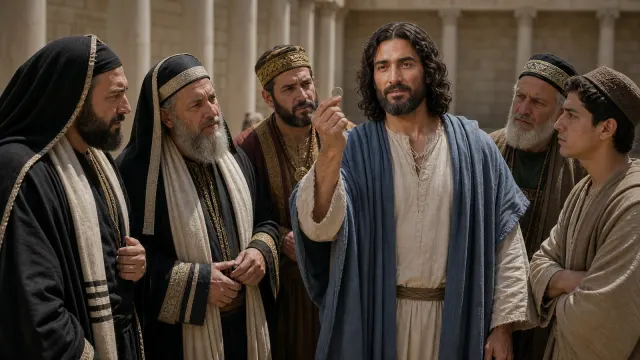
The trap is introduced before the question. Pharisees and Herodians approach with flattery about Jesus’ truthfulness and independence, hoping to make those very qualities work against him when they ask about tribute to Caesar. The Book of Matthew then puts a coin in the middle of the argument. Its image and superscription are visible facts, and Jesus makes the challengers name them. “Caesar’s” gives him the first half of his answer, but not the last. The things belonging to Caesar may be rendered to Caesar, while the things belonging to God must be rendered to God. The second claim prevents the first from becoming total. The saying is not a complete modern political theory, and it does not grant government unlimited ownership of human allegiance. Instead, it breaks the false choice the questioners tried to impose. A coin may bear Caesar’s mark without making Caesar the measure of everything owed. The men who hoped to entangle Jesus marvel and leave, their carefully prepared binary unable to contain the larger obligation he has named.
Deep dive
The flattering introduction praises Jesus for precisely the independence the speakers hope to exploit. Matthew states that they are trying to entangle him in his talk. The question about paying tribute is therefore not presented as a disinterested request for instruction, even though it raises a genuine issue of obligation.
Jesus asks for the tribute coin, and they produce it. Its image and inscription give the conversation something visible to examine. His answer acknowledges what belongs to Caesar while immediately naming what belongs to God. The second obligation is not an afterthought that can be discarded once the first has been settled.
The saying does not provide a full modern theory of government, nor does it grant Caesar unlimited possession of human allegiance. It resists the attempted reduction to a single answer on the challengers’ terms. The coin can bear Caesar’s mark without making Caesar the final measure of everything owed. Their astonishment and departure close the encounter. The sought-for entanglement has instead exposed the inadequacy of the choice they tried to impose.
Words to trace: sar’s, tribute, Caesar, carest, counsel, disciples
Verse-by-verse path
- Matthew 22:15
“Entangle” is pagideuo, to snare, from pagis, a bird trap; this is its only use in the New Testament. “Took counsel” is the phrase used when Pharisees first plotted to destroy him after a sabbath healing (12:14), and it returns four times in the passion (27:1, 7; 28:12).
- Matthew 22:16
The Pharisees send their students, not themselves. The Herodians, backers of Herod’s dynasty and so of the Roman arrangement, appear only here in Matthew. “Regardest not the person of men” renders a Hebrew idiom, to lift the face, meaning to show partiality (Leviticus 19:15; Deuteronomy 1:17).
- Matthew 22:17
“Tribute” is kensos, the census tax paid straight to Rome since AD 6, when Judea became a Roman province. That year Judas the Galilean led a revolt against it (Acts 5:37), and Josephus counts his movement among the roots of the war with Rome. Either answer was dangerous.
- Matthew 22:18
“Tempt” is peirazo, to test, the verb of the devil in the wilderness, who is simply called “the tempter” (4:3). “Hypocrites” is the word for stage actors, apt for men who have just performed deference in verse 16.
- Matthew 22:19
The coin is the denarius, and Jesus has to ask for one; his questioners produce it in the temple courts. The commonest denarius in Judea then was Tiberius’s, the coin traditionally called the tribute penny.
- Matthew 22:20
The Tiberius denarius read in abbreviated Latin, “Tiberius Caesar, son of the divine Augustus, Augustus”, and on the reverse “Pontifex Maximus”, high priest. The image claimed divine descent and priesthood for the emperor. Jesus asks them to read it aloud.
- Matthew 22:21
Their question in verse 17 used “give”; Jesus answers with apodote, give back, return what is owed. Many readers, from Tertullian on, have heard Genesis 1:27 behind the answer: the coin bears Caesar’s eikon, image, and man bears God’s. That is an inference; the text leaves it for the hearer.
- Matthew 22:22
The three rounds of questioning each end in a reaction: they marvelled here, the crowd was astonished in verse 33, and in verse 46 no one could answer. Leaving him and going their way is the posture of men who came for a quotation and got none.
Matthew 22:15-22
King James Version15Then went the Pharisees, and took counsel how they might entangle him in his talk.
16And they sent out unto him their disciples with the Herodians, saying, Master, we know that thou art true, and teachest the way of God in truth, neither carest thou for any man: for thou regardest not the person of men.
17Tell us therefore, What thinkest thou? Is it lawful to give tribute unto Caesar, or not?
18But Jesus perceived their wickedness, and said, Why tempt ye me, ye hypocrites?
19Shew me the tribute money. And they brought unto him a penny.
20And he saith unto them, Whose is this image and superscription?
21They say unto him, Cæsar’s. Then saith he unto them, Render therefore unto Cæsar the things which are Cæsar’s; and unto God the things that are God’s.
22When they had heard these words, they marvelled, and left him, and went their way.
Matthew 22:23-33
Seven Husbands Do Not Define the Resurrection
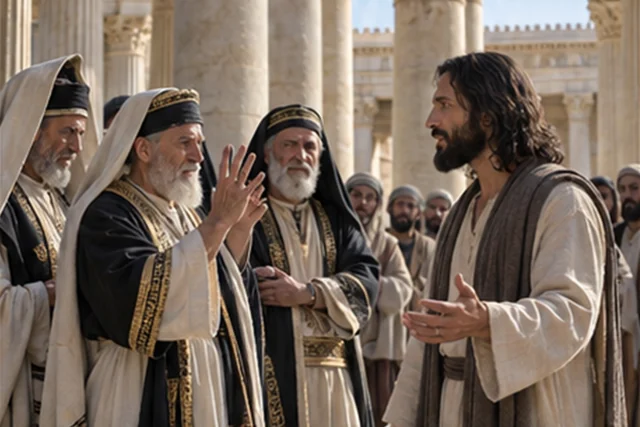
The Sadducees build their question so resurrection will look absurd before Jesus ever answers. Seven brothers successively marry the same woman under the duty to raise offspring for a deceased brother, and the challengers ask whose wife she will be when the dead rise. The Book of Matthew identifies their denial of resurrection at the outset, so this is not simply a bereavement question. The imagined contradiction depends on one assumption: resurrected life must reproduce present marriage arrangements unchanged. Jesus rejects the premise. In the resurrection people do not marry or give in marriage, and being “as the angels” refers to that condition rather than to humans turning into angels. He then argues from God’s self-identification with Abraham, Isaac, and Jacob. The point is deeper than an English grammar trick over a supplied verb. The living God continues to bind his name to the patriarchs. Death cannot be the final account of people whom God still names in relation to himself. The Sadducees’ puzzle is answered by a life larger than the structure they assumed it had to preserve.
Deep dive
Matthew identifies the Sadducees as denying resurrection before presenting their case. The sequence of seven brothers is an argument designed to make resurrection appear unworkable, not a pastoral question from a grieving widow. It assumes that the risen life must reproduce the marriage arrangements of the present life without alteration.
Jesus rejects that assumption. The comparison with angels concerns the absence of marrying and being given in marriage; it does not say that human beings become angels. Resurrection is not merely the resumption of present social arrangements with death temporarily removed. The Sadducees’ imagined contradiction depends on limiting God’s power to the form of life they already know.
Jesus then appeals to God’s self-identification in Exodus 3:6. Abraham, Isaac, and Jacob remain the persons to whom God binds his name. The argument should not be reduced to an English present-tense trick, as though the whole point rests on one supplied verb. It concerns the living God’s continuing relation to the patriarchs and the inadequacy of death as the final account of that relation.
Words to trace: resurrection, wife, brother, dead, marry, seven
Verse-by-verse path
- Matthew 22:23
Matthew compresses the week: this is “the same day”. Josephus says the Sadducees held that the soul perishes with the body and rejected rewards after death, and Acts 23:8 adds that they denied angels and spirits as well. They were largely the priestly aristocracy.
- Matthew 22:24
The law of levirate marriage is Deuteronomy 25:5–6; “levir” is Latin for brother in law. Their wording blends it with Genesis 38:8, where Judah tells Onan to “raise up seed to thy brother”. The verb for marrying the widow, epigambreuo, is a technical term for marrying as next of kin.
- Matthew 22:25
“With us” sets the case as if it happened in their own circle. A widely known account lay close at hand: in Tobit, Sarah had been given to seven husbands, each killed on the wedding night (Tobit 3:8). The Sadducees may have borrowed its shape.
- Matthew 22:26
“Likewise” disposes of five weddings and five funerals in one word. The Talmud later held that a woman widowed twice or three times should not be married again, fearing she brought death (Yevamot 64b). The Sadducees’ case is built to press the law beyond any real family.
- Matthew 22:27
“Last of all” is the phrase of 21:37, where the owner sends his son last of all. The levirate law existed to give the dead man an heir, and seven times it has produced none. Their example quietly shows the law failing at its own purpose.
- Matthew 22:28
“They all had her” is the language of possession, and “whose wife” asks only which of seven owners wins the claim. The woman herself is never given a name or a view. The question assumes the risen life must settle a property dispute.
- Matthew 22:29
“Err” is planao, to wander off course, the verb used of the sheep “gone astray” in 18:12. Jesus names two failures, and his answer takes them in reverse: the power of God in verse 30, then the Scriptures in verses 31–32.
- Matthew 22:30
Acts 23:8 says the Sadducees denied angels too, so the comparison is made with beings they would not grant. First Enoch 15:6–7 gives a Jewish rationale current at the time: angels do not marry because they do not die, and marriage exists for those who must have children.
- Matthew 22:31
“Spoken unto you by God”: Jesus treats the words at the burning bush as addressed to the men in front of him, not only to Moses long ago. This is the third “have ye not read” in these Jerusalem debates (21:16, 42).
- Matthew 22:32
Jesus argues from Exodus 3:6, in the five books of Moses whose authority the Sadducees gave the highest place. Fourth Maccabees makes a similar point about the martyrs: those who die for God live unto God, as do Abraham, Isaac and Jacob (4 Maccabees 16:25).
- Matthew 22:33
“Astonished at his doctrine” is the phrase with which the crowds received the Sermon on the Mount (7:28). “Doctrine” in 1611 means teaching. The crowds hear his first long teaching and his last public debates with the same astonishment.
Matthew 22:23-33
King James Version23The same day came to him the Sadducees, which say that there is no resurrection, and asked him,
24Saying, Master, Moses said, If a man die, having no children, his brother shall marry his wife, and raise up seed unto his brother.
25Now there were with us seven brethren: and the first, when he had married a wife, deceased, and, having no issue, left his wife unto his brother:
26Likewise the second also, and the third, unto the seventh.
27And last of all the woman died also.
28Therefore in the resurrection whose wife shall she be of the seven? for they all had her.
29Jesus answered and said unto them, Ye do err, not knowing the scriptures, nor the power of God.
30For in the resurrection they neither marry, nor are given in marriage, but are as the angels of God in heaven.
31But as touching the resurrection of the dead, have ye not read that which was spoken unto you by God, saying,
32I am the God of Abraham, and the God of Isaac, and the God of Jacob? God is not the God of the dead, but of the living.
33And when the multitude heard this, they were astonished at his doctrine.
Matthew 22:34-40
Two Commandments Carry the Whole Structure
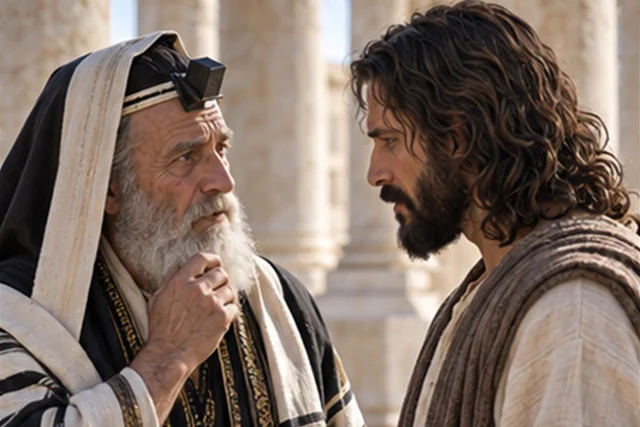
The lawyer asks for one great commandment, and Jesus answers with two that refuse to be separated. Love for God reaches heart, soul, and mind, language of whole-person allegiance rather than a technical diagram of three independent human compartments. Then the Book of Matthew sets love of neighbour beside it: “the second is like unto it.” The second command does not compete with the first or reduce devotion to God. It reveals that devotion to God cannot be described as though other people were irrelevant. Love of neighbour “as thyself” likewise does not require the passage to become a separate theory of self-esteem before concern for another can begin. The final image is architectural. The law and prophets “hang” on these commands. Jesus is not throwing away the rest of Scripture or replacing every concrete duty with an undefined feeling called love. He is naming the structure that holds the whole together. The answer is compressed, but not thin. It makes worship and human obligation meet in two sentences that cannot safely be pulled apart.
Deep dive
The lawyer asks for the great commandment, but Jesus answers with a first and a second that belongs beside it. Deuteronomy 6:5 supplies the total claim of love for God; Leviticus 19:18 supplies love for the neighbour. The second is not presented as a rival that diminishes the first. It is like it, and the answer refuses to let devotion to God be described without reference to another person.
The language of heart, soul, and mind expresses undivided allegiance rather than a technical division of the human person into three independently measured compartments. Similarly, loving the neighbour as oneself establishes a relation of concern; this exchange does not develop a separate programme of self-esteem before neighbour-love can begin.
The final image gives the two commandments structural importance. The law and prophets hang on them. Jesus has not said that the rest of Scripture is worthless or that love means freedom from every concrete command. He identifies the orientation that gives the whole its coherence. The answer compresses the law without draining it of its demands.
Words to trace: commandment, love, asked, commandments, first, gathered
Verse-by-verse path
- Matthew 22:34
“Were gathered together” is the phrase of Psalm 2:2 in the Greek Old Testament, where the rulers are gathered together against the LORD and his anointed. The early church read that psalm over the passion in exactly this way (Acts 4:25–27).
- Matthew 22:35
A “lawyer” is a Torah expert, a scribe; the word appears only here in Matthew. In Mark the scribe is friendly and Jesus tells him he is not far from the kingdom (Mark 12:28–34). Matthew makes the question another test.
- Matthew 22:36
The rabbis later counted 613 commandments in the Torah, 248 positive and 365 negative (Babylonian Talmud Makkot 23b), and weighed which were heavy and which light. Hillel was remembered for summing up the law to a would be convert standing on one foot (Shabbat 31a).
- Matthew 22:37
Deuteronomy 6:5, the opening command of the Shema, recited morning and evening. The Hebrew reads heart, soul and might; Matthew’s wording has heart, soul and mind, dianoia. “Might” has become “mind”, a whole person claim in the vocabulary of Greek speakers.
- Matthew 22:38
Jesus has answered the question asked, and could stop here. “First” and “great” are both given: first in order, greatest in weight. Everything in the next verse is more than the lawyer requested.
- Matthew 22:39
This is the third time Matthew quotes Leviticus 19:18 (5:43; 19:19). In Leviticus the neighbour is first “the children of thy people”, but the same chapter extends the command to the stranger: “thou shalt love him as thyself” (Leviticus 19:34). “Like unto it” is homoia, of the same kind.
- Matthew 22:40
“Hang” is kremannymi, to hang from a peg or hinge. The Mishnah uses a similar picture of laws that are like “mountains hanging by a hair”, many rulings from few verses (Hagigah 1:8). “The law and the prophets” echoes 7:12, where the golden rule is said to be the law and the prophets.
Matthew 22:34-40
King James Version34But when the Pharisees had heard that he had put the Sadducees to silence, they were gathered together.
35Then one of them, which was a lawyer, asked him a question, tempting him, and saying,
36Master, which is the great commandment in the law?
37Jesus said unto him, Thou shalt love the Lord thy God with all thy heart, and with all thy soul, and with all thy mind.
38This is the first and great commandment.
39And the second is like unto it, Thou shalt love thy neighbour as thyself.
40On these two commandments hang all the law and the prophets.
Matthew 22:41-46
David Calls His Own Descendant Lord
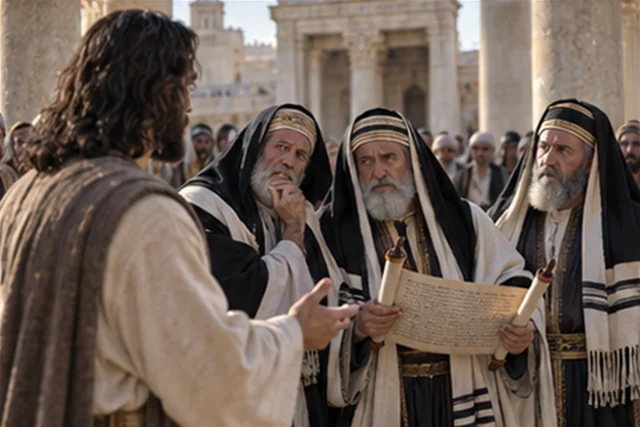
After answering everyone else, Jesus asks the question that leaves the room silent. The expected answer comes quickly: the Christ is the Son of David. The Book of Matthew has used that title from its opening line and repeatedly placed it on the lips of people seeking mercy, so Jesus is not rejecting Davidic descent. He is pressing it further with Psalm 110. If David in the Spirit calls the coming figure “my Lord,” then ancestry alone cannot explain the relation. A descendant stands within David’s line; the one seated at God’s right hand with enemies beneath his feet bears authority David acknowledges above himself. The tension is not solved by discarding either side. The Christ is David’s son, yet he is more than a descendant whose significance is exhausted by genealogy. No one can answer Jesus’ question, and the public attempts to interrogate him cease. The psalm will return in the high priest’s court when Jesus speaks of the Son of man at the right hand of power, where this unresolved authority will become part of the charge against him.
Deep dive
The answer “The son of David” fits a title Matthew has used from the opening line. Jesus does not reject that descent. He asks whether it is sufficient to account for the language of Psalm 110:1, where David, speaking in the Spirit, calls the figure at God’s right hand his Lord.
The tension lies between descent and superior authority. A descendant belongs within David’s line, yet the psalm describes someone whom David acknowledges above himself. The right hand and the enemies made a footstool speak of divinely granted rule, taking the discussion beyond a simple identification by ancestry.
Matthew’s conclusion is decisive: no one can answer, and the public attempts to question Jesus cease. The silence differs from an absence of scriptural material. The material has been quoted directly before them. Their familiar answer requires a larger understanding than they have supplied. Later, in Matthew 26:64, Jesus will return to the right hand of power when questioned under oath, and the implication left unresolved here will become central to the charge against him.
Words to trace: LORD, David, call, able, answer, asked
Verse-by-verse path
- Matthew 22:41
In Mark the question is put to the crowd in the temple (Mark 12:35). Matthew addresses it to the Pharisees while they are still assembled from verse 34. For the first time in the week, Jesus is the one asking.
- Matthew 22:42
“What think ye?” once more, Matthew’s formula for inviting judgment. The expected answer is the standard one: the Psalms of Solomon, a century before, pray God to raise up their king, “the son of David” (Psalms of Solomon 17:21).
- Matthew 22:43
“In spirit” means speaking as a prophet, moved by the Spirit, as David claimed in his last words: “The Spirit of the LORD spake by me” (2 Samuel 23:2). Both sides accept the psalm as David’s, as its heading says, and the argument depends on that.
- Matthew 22:44
The King James prints the divine name as LORD in capitals and the second title as Lord: in Hebrew, YHWH says to adoni, my lord. Psalm 110:1 is quoted or echoed in the New Testament more than any other Old Testament verse. Conquerors set their feet on the necks of defeated kings (Joshua 10:24).
- Matthew 22:45
In that world a father did not call his son “lord”; the son honoured the father. The whole argument turns on the possessive: David’s “my Lord”. It is a question, and Jesus leaves it one.
- Matthew 22:46
Mark puts “no man after that durst ask him any question” after the scribe’s question (Mark 12:34); Matthew moves it to the end of the whole series. From here there is no more interrogation, and chapter 23 is Jesus speaking unanswered.
Matthew 22:41-46
King James Version41While the Pharisees were gathered together, Jesus asked them,
42Saying, What think ye of Christ? whose son is he? They say unto him, The Son of David.
43He saith unto them, How then doth David in spirit call him Lord, saying,
44The LORD said unto my Lord, Sit thou on my right hand, till I make thine enemies thy footstool?
45If David then call him Lord, how is he his son?
46And no man was able to answer him a word, neither durst any man from that day forth ask him any more questions.
Questions to keep in mind while reading
- Watch what Jesus says and does, and how people respond.
- Trace kingdom, discipleship, opposition, cross, and resurrection in the evangelist’s own sequence.
- Let later doctrine clarify the scene without erasing its immediate setting.
Text first
Where readers differ
The chapter summary begins with what the passage says and how its parts fit together. It does not assume one denomination has already settled every question. Where a conclusion depends on a tradition, literary theory, or historical reconstruction, that dependence is named openly.
The KJV text is presented first. Interpretive conclusions are labeled, and differences are introduced only when they help a reader understand why serious communities do not always reach the same answer.
Comparative interpretive notes for this chapter are in preparation. Until reviewed notes are ready, this page separates the KJV text from summary and application without claiming that serious readers agree on every question.
Questions beneath the surface
- What account of God, human freedom, responsibility, and the good life emerges from Matthew 22?
- Which tension does the chapter refuse to resolve quickly?
- What changes when the chapter is read as part of the whole canon rather than as an isolated moral lesson?
- Where might a sincere reader confuse a familiar tradition with something the text states directly?
Questions for serious personal contemplation
These open-ended questions make room for tension, honest response, prayer, and conclusions that remain accountable to the chapter.
Observe without rushing
What part of Matthew 22 makes you stop, feel unsettled, or feel surprised, and why?
Which detail in the passage would be easiest to overlook? How does that detail change your understanding?
Where do you see tension between what happens and this focus: Matthew 22 develops its own movement around servants, Jesus, LORD, wedding, king?
What important question does the passage leave open instead of resolving quickly?
Examine your inner life honestly
Which person, response, fear, or desire in the passage feels most like your own life right now?
What assumption about God, other people, or yourself does this text challenge?
Which part would you rather soften, avoid, or explain away too quickly? What might that reaction reveal?
If this Scripture could ask you one direct question, what do you think it would ask?
Respond with wisdom and courage
What do you need to remember, confess, grieve, thank God for, or trust after reading this passage?
How might another faithful person read this situation differently without ignoring the text?
What obedient response would be costly, uncomfortable, or slow, yet still faithful to Scripture?
What question will you carry into prayer this week, and which verses will you keep in front of you?
Music and video connected to the passage
Related media appears when its Scripture reference overlaps this study. Music and video can illuminate a theme while the biblical text remains the foundation.
 Before the Cock CrowMatthew 26:47-75; Mark 14:43-72; Luke 22:47-62; John 18:1-27Listen to related music →
 A House of PrayerMatthew 21:12-23:39; Mark 11:12-12:44; Luke 19:45-21:4Listen to related music →
 Behold the ManMatthew 27:1-31; Mark 15:1-20; Luke 22:63-23:25; John 18:28-19:16Listen to related music →
 Thy Will Be DoneMatthew 26:36-46; Mark 14:32-42; Luke 22:39-46Listen to related music →