The big picture
Jacob receives a public mourning and burial in Canaan. Afterward the brothers fear Joseph will retaliate now that their father is dead. Joseph again names both their evil intention and God's preserving purpose, then dies with a promise still ahead.
Central truth
Joseph refuses revenge, provides for his brothers, and dies requiring his bones to accompany Israel's future departure from Egypt because he trusts God's promise.

The study notes have a page of their own
The movement by movement analysis, the words to trace, the verse by verse notes and where readers differ are written for someone studying alone. They are on the Deep Personal Reflections page for this chapter. This page is the lesson.
A chapter-specific teaching brief
These anchors come from this chapter itself. They help a teacher use the Level 1 overview, the Level 2 study, and the Scripture text as one lesson.
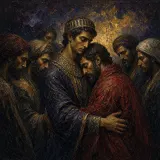
Open with the chapter’s first image
Genesis 50:1: “And Joseph fell upon his father’s face, and wept upon him, and kissed him.”
Slow down at the turning point
Genesis 50:19: “And Joseph said unto them, Fear not: for am I in the place of God?”
Keep this word trail visible
Joseph, father, land, brethren, bury, days
What to explain, in order
Teach the passage in this order. Each step names the verses it rests on, so every point can be shown in the text before it is applied.
Genesis 50:1-3
Grief first
Open with Joseph falling on his father's face, weeping and kissing him (50:1). Let the grief stand before any theology. Then the embalming. Explain that Egyptian physicians did this, that it took forty days, and that Egypt mourned seventy days, a sign of great honour. Do not add the two numbers; the forty may fall within the seventy. Teach this first because the chapter begins with a son's loss, and learners who have lost a parent should hear that Genesis honours tears.
Genesis 50:4-14
Carry Jacob home, then return
Read Joseph's request to Pharaoh, the great company of Egyptian officials, and the mourning at the threshing floor of Atad. Explain that the Canaanites named the place Abel-mizraim, meaning mourning of Egypt. Then the burial at Machpelah, exactly as Jacob had charged in 49:29-32, and the return to Egypt. Place this step here because it fulfils Jacob's oath and shows the family still bound to the promised land, yet still living outside it.
Genesis 50:15-18
Fear after the funeral
Read 50:15 and stress how natural the fear is. Then the message attributed to Jacob, which Genesis neither confirms nor denies. Point out that this is the clearest request for forgiveness in the whole account: they name "the trespass", "their sin" and the "evil". Then Joseph weeps, and the brothers come and fall before him, saying "Behold, we be thy servants" (50:18). Note that this fulfils the dreams of chapter 37 one last time, and Joseph does not take pleasure in it.
Genesis 50:19-21
Evil remains evil, good preserves life
Read Joseph's answer slowly. Explain "am I in the place of God?" as a refusal to sit in judgment where God has already acted. Then 50:20 clause by clause, with two columns on the board: what you intended and what God intended. Then 50:21, practical provision and kind words. Make this the centre of the lesson. It is the Bible's clearest statement in Genesis that God's purposes can work through human evil without approving it.
Genesis 50:22-26
A coffin with a future journey
Read the last verses. Joseph lives to see his great-grandchildren on his knees, a picture of blessing. Then his last words, twice saying "God will surely visit you". Explain "visit" as God coming to act on behalf of his people. Then the oath about his bones, and the coffin in Egypt. Close by reading Hebrews 11:22, which calls this an act of faith. Genesis ends not with arrival but with a promise still waiting, and that is how the Book of Exodus begins.
Where learners get stuck
The misreadings this passage tends to produce, and how to answer each from the text.
"Genesis 50:20 means that evil things are really good."
Joseph says "ye thought evil against me" and does not take it back. God "meant it unto good", which means God worked his good purpose through and in spite of their evil, not that the evil became good. Teach both halves every time. For anyone who has suffered at another's hands, it matters that the Bible calls evil evil.
"Joseph forgave them, so everyone must forgive and trust those who hurt them straight away."
Joseph's forgiveness came after many years, after the brothers' repeated confession and changed lives, and from a position of safety. It took the form of provision, not of putting himself back under their power. Forgiveness is commanded in Scripture, but it does not require restored trust or contact with someone dangerous. Never use this chapter to pressure a victim of abuse.
"The brothers made up Jacob's message to save themselves."
That is one possible reading, and some interpreters hold it. But Genesis does not say so. It records the message as their report (50:16-17) and gives no verdict. Jacob may have spoken words we were not told about. Let learners hold the question open and focus on Joseph's response, which is the same either way.
"Genesis ends sadly, with Joseph dead in a coffin."
Genesis ends with a death and with a promise. Joseph twice says "God will surely visit you" (50:24-25) and gives orders that assume the exodus will happen. Exodus 13:19 shows Moses carrying the bones, and Joshua 24:32 their burial. The ending is a hopeful pause, the first book of the Bible leaving God's people waiting on his word.
Learning objectives
- Distinguish Jacob's embalming, mourning, burial, and the return to Egypt.
- Explain why the brothers fear Joseph after their father's death.
- Separate their reported message from an independently recorded command of Jacob.
- Distinguish evil human intention from God's life-preserving purpose.
- Identify the concrete care accompanying Joseph's reassurance.
- Explain how Joseph's burial instructions orient the ending toward a future departure.
Teacher preparation
- Read Genesis 47:29–31 and 49:29–33; connect the funeral journey to Jacob's sworn burial arrangements.
- Distinguish forty embalming days, seventy Egyptian mourning days, and seven days at Atad; do not automatically add the first two.
- Prepare an Egypt–Canaan–Egypt movement chart; leave the precise route beyond Jordan unsettled.
- Read 50:16–17 as the brothers' reported message; Genesis independently confirms neither its genuineness nor its fabrication.
- Read Exodus 13:19, Joshua 24:32, and Hebrews 11:22; distinguish the later journey of Joseph's bones from events completed in Genesis.
Evidence and interpretation checks
Explicit
Identify the brothers' fear in Genesis 50:15, Joseph's distinction between intentions in 50:20, and his promised nourishment in 50:21.
Scripture-supported
Compare Genesis 50:24–25 with Exodus 13:19 and Joshua 24:32; later passages explicitly describe the carrying and burial of Joseph's bones.
Strong inference
Infer sustained commitment from Genesis 50:21: Joseph promises provision for the brothers and children, not merely less angry speech.
Possible or traditional reading
Present the view that the brothers invent Jacob's dying command as a possible reading of Genesis 50:16–17; their report is recorded, but its origin is not independently settled.
Limit
State that Genesis 50:20 does not make evil morally good; 50:26 leaves Joseph's coffin in Egypt without describing Israel's departure.
Discussion with answer guidance
1. Why does the funeral party return to Egypt after burying Jacob in Canaan?
What a good answer contains
Because this is a funeral, not the exodus. Joseph asks leave to "bury my father, and I will come again" (50:5), and the families stay behind: "only their little ones, and their flocks, and their herds, they left in the land of Goshen" (50:8). After the burial, "Joseph returned into Egypt" (50:14). A good answer sees that the promise of return to Canaan is honoured in Jacob's body but not yet fulfilled for the people. That waits for Exodus.
Show teacher guidance
Read 50:5,8,13–14: Joseph promises return; dependents and flocks remain. This burial journey is not the exodus.
2. What changes in the brothers' expectations when Jacob dies?
What a good answer contains
With their father gone, they fear his protection has gone too: "Joseph will peradventure hate us, and will certainly requite us all the evil which we did unto him" (50:15). A good answer notices that Joseph has given no sign of this; the fear comes from their own guilt. Seventeen years after the reconciliation of chapter 45, they still cannot quite believe they are forgiven. A weak answer assumes Joseph had been waiting for revenge.
Show teacher guidance
Use 50:15: they fear revenge now that their father is gone. Distinguish their suspicion from a threat Joseph actually makes.
3. What can the class establish about the message attributed to Jacob?
What a good answer contains
Only what it says. The brothers send word: "Thy father did command before he died, saying" (50:16), with a request to forgive "the trespass of thy brethren, and their sin; for they did unto thee evil" (50:17). Genesis records no such command from Jacob earlier, nor does it say the message was invented. A good answer accepts the content and holds back on its origin. It also notes the brothers now call themselves "the servants of the God of thy father".
Show teacher guidance
Read 50:16–17 as reported speech. Accept its stated content; resist claiming certainty about a prior command that Genesis has not independently recorded.
4. How does Joseph distinguish their intention from God's intention?
What a good answer contains
"But as for you, ye thought evil against me; but God meant it unto good, to bring to pass, as it is this day, to save much people alive" (50:20). Two subjects, two intentions, one set of events. A good answer reads it clause by clause and keeps "ye thought evil" as fully true as "God meant it unto good". The outcome, many lives saved, is the evidence of God's purpose. A weak answer turns the verse into a claim that it was all for the best.
Show teacher guidance
Read 50:20 clause by clause: they intended evil, God intended good, and the stated outcome is many lives preserved. Keep the wrong named.
5. What does Joseph offer after saying he is not in God's place?
What a good answer contains
"Now therefore fear ye not: I will nourish you, and your little ones. And he comforted them, and spake kindly unto them" (50:21). Before this, "am I in the place of God?" (50:19) means judgment belongs to God, not to him. A good answer gathers the practical commitments: provision for the brothers and their children, comfort, kind words. Joseph's forgiveness is shown in continued care, not only in a statement about providence.
Show teacher guidance
Read 50:19–21: reassurance, nourishment for the brothers and their children, comfort, and kind speech. Do not reduce his response to a theory about providence.
6. Why does a coffin in Egypt not function as a declaration that Egypt is the final home?
What a good answer contains
Because Joseph has already pointed beyond it. "God will surely visit you, and bring you out of this land unto the land which he sware to Abraham, to Isaac, and to Jacob" (50:24), and he makes them swear, "ye shall carry up my bones from hence" (50:25). The coffin in 50:26 is in Egypt, but it is waiting to travel. A good answer connects this with Exodus 13:19 and Joshua 24:32, where the bones are carried and buried at Shechem.
Show teacher guidance
Read 50:24–26: promised divine visitation and an oath about carrying his bones precede the coffin. The final location is present fact, not final destiny.
Responsible application
Heart and habits
Ask learners to rewrite an excuse that uses a beneficial outcome to erase culpability, preserving both intentions from 50:20.
Relationships and community
Draft a fictional response that rejects retaliation while naming wrongdoing and offering appropriate practical care; do not require resumed unsafe contact.
Leave instructions beyond a lifetime
Use Joseph's oath to discuss preserving an unfinished communal commitment for later generations without claiming premature fulfillment.
Session plans
Two timings of the same lesson. The shorter keeps the reading, the central discussion and one response; the longer gives the confusions and the application their own time.
45 minutes
Tears before theology
Read 50:1-3. Acknowledge the grief and explain the embalming and mourning.
The funeral journey
Read 50:4-14. Ask question one.
Fear after the funeral
Read 50:15-18. Ask questions two and three. Take confusion three.
Ye thought evil, God meant it unto good
Read 50:19-21. Draw the two columns. Ask questions four and five. Take confusions one and two with care.
Carry up my bones
Read 50:22-26. Ask question six and take confusion four.
Handout and prayer
Read the key verse together, point to the take-home line, and pray.
90 minutes
Loss and mourning
Read 49:33 and 50:1-3. Allow a moment of silence for anyone grieving.
Carry me home
Read 50:4-14 with 47:29-31 and 49:29-32. Ask question one and trace the movement Egypt, Canaan, Egypt.
The old fear
Read 50:15-18. Ask questions two and three and take confusion three.
Two intentions
Read 50:19-21. Fill the two columns. Ask questions four and five and take confusion one. Read 45:5-8 beside it.
Forgiveness and safety
Take confusion two carefully. Distinguish forgiveness, trust and reconciliation. Give a safeguarding contact if appropriate.
The bones and the promise
Read 50:22-26, then Exodus 13:19, Joshua 24:32 and Hebrews 11:22. Ask question six and take confusion four.
Application
In pairs, rewrite an excuse that uses a good outcome to erase blame, keeping both clauses of 50:20.
Handout and prayer
Read the key verse together, point to the take-home line, and pray.
Adapting the lesson
Children
Explain gently that Jacob died and Joseph was very sad, and that they took Jacob to be buried where his family lay. Then tell how the brothers were scared and Joseph said, do not be afraid, I will look after you. Show a suitcase picture for Joseph's bones going home one day. Do not ask children about deaths in their families.
Youth
Compare refusing revenge with pretending harm never happened. Read 50:20 and ask them to name both intentions. Make clear that forgiveness does not mean going back to someone who is still dangerous. Trace Joseph's bones into Exodus and Joshua to show how the promise carried on.
Adults
Discuss lasting guilt, the slow work of reconciliation, the relationship between providence and responsibility, and commitments that outlast a life. Avoid turning 50:20 into a quick answer for every sufferer. Give space to the brothers' fear and Joseph's tears.
One to one
Read 50:15-21 together. Ask whether the person identifies more with the brothers, afraid of a past wrong, or with Joseph, wronged and deciding how to respond. Let them answer without pressure. If they have been harmed, do not urge forgiveness on a timetable; let 50:20 assure them that God calls evil evil.
Song and video learning lab
A song or video may interpret, compress, or dramatize the text. Its value becomes clearer when its choices are compared with Scripture.
- Before the media: the exact passage and its central movement.
- During the media: the words, people, events, and emotions the artist emphasizes.
- After the media: what it clarifies, what it leaves out, and what belongs back in the biblical text.
Handout
One page for learners to take home. The print button prints this section alone.
Genesis 50:1-26
The passage in brief
In Genesis 50 Jacob dies, and Joseph weeps over him. The Egyptians mourn seventy days, and Joseph and his brothers carry Jacob to Canaan and bury him in the cave of Machpelah. Back in Egypt, the brothers fear Joseph will now take revenge. Joseph weeps and tells them: you meant evil against me, but God meant it for good, to save many lives. He promises to care for them and their children. Before he dies, Joseph makes them promise to carry his bones to the promised land.
A verse to keep
But as for you, ye thought evil against me; but God meant it unto good, to bring to pass, as it is this day, to save much people alive.
Genesis 50:20 · King James Version
Questions to take home
What were the brothers afraid of in 50:15?
What two intentions does Joseph name in 50:20?
Why did Joseph ask for his bones to be carried out of Egypt?
This week
Name one hard thing in your life this week, call it what it is, and ask God to bring good from it.
Music and video connected to the passage
Related media appears when its Scripture reference overlaps this study. Music and video can illuminate a theme while the biblical text remains the foundation.