The big picture
Joshua 24 gathers Israel at Shechem and stretches the final covenant scene across the whole history that brought the people there. The review begins before Abraham's call, when the ancestral household served other gods, then traces what the LORD took, gave, sent, delivered, and provided. That repeated divine action is the setting for "choose you this day." The choice is not presented as an isolated slogan about personal decision. It follows cities not built by Israel and vineyards not planted by Israel, and it concerns which god will receive the service of a people already living inside those gifts. Joshua then refuses to let the people's first answer close the meeting. God's holiness and jealousy, the danger of strange gods still among them, and the covenant consequences of forsaking him turn an enthusiastic pledge into a witnessed obligation. Joshua records the words, sets up a stone at Shechem, and sends everyone back to his inheritance. The book ends with Joshua, Joseph's bones, and Eleazar buried inside the land, joining recent leadership, an ancient promise, and priestly service in one final geography of fulfilment.
Central truth
Joshua 23–24 closes the book by grounding Israel’s future in the LORD’s completed acts, warning of covenant judgment for apostasy, and renewing commitment at Shechem with written testimony and a witness stone.


The study notes have a page of their own
The movement by movement analysis, the words to trace, the verse by verse notes and where readers differ are written for someone studying alone. They are on the Deep Personal Reflections page for this chapter. This page is the lesson.
A chapter-specific teaching brief
These anchors come from this chapter itself. They help a teacher use the Level 1 overview, the Level 2 study, and the Scripture text as one lesson.
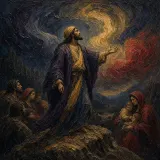
Open with the chapter’s first image
Joshua 24:1: “And Joshua gathered all the tribes of Israel to Shechem, and called for the elders of Israel, and for their heads, and for their judges, and for their…”
Slow down at the turning point
Joshua 24:14: “Now therefore fear the LORD, and serve him in sincerity and in truth: and put away the gods which your fathers served on the other side of the flood, and…”
Keep this word trail visible
LORD, Joshua, serve, people, Israel, Egypt
What to explain, in order
Teach the passage in this order. Each step names the verses it rests on, so every point can be shown in the text before it is applied.
Joshua 23:1-5
An old man remembers
Begin with Joshua's age and his gathering of the leaders. Point out the phrase "a long time after", so the class knows years have passed since the wars. Read his first words, "I am old and stricken in age", and his reminder of what they have seen. Note that he speaks of nations that still remain and promises the LORD will expel them. Teach this first because the farewell starts with memory: before Joshua warns, he reminds them who has fought for them, and that their future rests on the same God.
Joshua 23:6-13
Courage to keep the book
Read 23:6 beside 1:7-8 and let the class hear the same words at the end of Joshua's life that he heard at the start: be very courageous to keep the book, turn not to right or left. Then read the warnings: do not mention the gods of the nations, do not intermarry with them, cleave to the LORD. Explain that the concern is religious, not ethnic; Rahab and the Gibeonites show that foreigners could join Israel. Teach the warnings in their covenant setting, as Deuteronomy 7 framed them, and avoid any modern application to ethnicity or nationality.
Joshua 23:14-16
Not one thing has failed, both ways
Read 23:14 slowly and let the class hear Joshua's confession: "not one thing hath failed". Then read 23:15-16, the warning that the same faithfulness applies to judgment. Explain that the God who kept every good promise will also keep his word about the consequences of turning away. Teach this as the hinge of chapter 23. Note that Israel's later history, ending in exile in 2 Kings 17 and 25, shows the warning was not empty. Keep the tone serious but not frightening, as Joshua's own tone is fatherly.
Joshua 24:1-13
The LORD tells Israel its history
Move to Shechem and the great assembly. Explain that Shechem is where Abraham first built an altar in the land (Genesis 12:6-7), so the place itself recalls the beginning. Then read 24:2-13 as the LORD's own speech, and count the "I"s. Point out that it begins with idolatry, Terah serving other gods, and ends with gifts, cities and vineyards they did not make. Explain "the hornet" in 24:12 as a picture of the panic the LORD sent ahead. Teach the history before the choice, because the choice is a response to grace.
Joshua 24:14-18
Choose you this day
Read 24:14-15 and set it in context. Joshua tells them to fear the LORD, serve him in sincerity and truth, and put away the old gods. Then the choice: if serving the LORD seems evil, choose whom to serve, the gods of the past or the gods of the land. End with Joshua's own commitment. Then read the people's answer in 24:16-18, which retells the history in their own words. Teach this so the class sees that the famous verse is part of a covenant renewal, not a slogan.
Joshua 24:19-28
You cannot, unless you put away
Read Joshua's startling reply in 24:19. Explain that he is not denying grace but refusing a cheap pledge: the LORD is holy and jealous and will not tolerate divided loyalty. Follow the exchange: the people insist, become witnesses against themselves, and are told to put away the strange gods "which are among you", which implies they still have them. Then show the covenant written and the stone set up as a witness. Teach this as the climax of the book: Joshua makes the people count the cost.
Joshua 24:29-33
Three graves and a generation
Finish with the three burials. Joshua, now called "the servant of the LORD" as Moses was in 1:1, dies at a hundred and ten. Joseph's bones, carried from Egypt as he asked in Genesis 50:25 and Exodus 13:19, rest at Shechem. Eleazar is buried. Read 24:31 and its quiet warning: Israel served the LORD as long as the elders who had seen his works lived. Teach this last because it opens into the Book of Judges and asks every teacher what the next generation will remember.
Where learners get stuck
The misreadings this passage tends to produce, and how to answer each from the text.
"Choose you this day means faith is just a personal decision anyone can make easily."
The choice in 24:15 comes after the LORD's long account of what he has done (24:2-13), and it is a covenant response to grace. Joshua then says "Ye cannot serve the LORD" (24:19) to make the people see the cost. They must put away other gods (24:23). The verse calls for a real, costly commitment, not a casual preference. Different traditions describe the relation between God's grace and human choice differently, and the passage holds both together without settling the debate.
"Joshua told the people they could not serve God, so he was discouraging them."
Joshua's words are "Ye cannot serve the LORD: for he is an holy God; he is a jealous God" (24:19). He is warning them not to make a pledge they will not keep, because the LORD will not share their loyalty with idols. When they insist, he accepts them as witnesses (24:22) and tells them to "put away" the strange gods (24:23). His aim is a pledge that lasts. The result is a covenant (24:25).
"The warnings about not mixing with the nations mean God wants people of different ethnicities to keep apart."
The concern in 23:7 and 23:12 is the gods of the nations: "neither make mention of the name of their gods". The Book of Joshua itself shows Rahab, a Canaanite, living in Israel (6:25), and the Gibeonites serving at the altar (9:27). The danger was being drawn into idolatry, as Solomon later was (1 Kings 11:1-4). These verses cannot be used to support racial or national separation today.
"Israel served God faithfully after Joshua, so everything was fine."
Verse 31 says "Israel served the LORD all the days of Joshua, and all the days of the elders that overlived Joshua". That is a limit, not a guarantee. Judges 2:10 says "there arose another generation after them, which knew not the LORD". The book ends with faithfulness tied to memory, and the people's need to put away strange gods (24:23) shows the danger was already present. Teachers should leave the class with the question of passing faith on.
Learning objectives
- Distinguish Joshua’s leader farewell in chapter 23 from the all-tribes assembly at Shechem in chapter 24.
- Identify the repeated warnings against joining the remaining nations or serving their gods.
- Explain how Joshua 23 places fulfilled good promises and threatened covenant judgment side by side.
- Trace the first-person divine history in Joshua 24:2–13 from Abraham’s ancestors through the land gift.
- Interpret Joshua’s challenge to choose whom to serve together with his later statement, “Ye cannot serve the LORD,” rather than treating either line as a detached slogan.
- Identify the closing memorials: written words, witness stone, Joseph’s bones, and Eleazar’s burial.
Teacher preparation
- Read Deuteronomy 7, 28, and 30 so Joshua’s warnings about nations, gods, blessing, and destruction remain in Moses’ covenant vocabulary.
- Locate Shechem between Mount Ebal and Mount Gerizim.
- Mark the LORD’s first-person verbs in Joshua 24:2–13, where divine action is placed before Israel’s response.
- Prepare to explain Joshua 24:15 and 24:19 together.
- Read Genesis 50:24–26 and Exodus 13:19.
Evidence and interpretation checks
Explicit
Joshua 23:14 says not one good thing promised by the LORD has failed, while 23:15–16 warns that covenant transgression will bring the threatened evil.
Scripture-supported
Joseph’s burial in Joshua 24:32 fulfills the concern of Genesis 50:25 and Exodus 13:19, where Joseph makes Israel swear to carry his bones up from Egypt and Moses takes them during the exodus.
Strong inference
Joshua’s “Ye cannot serve the LORD” challenges shallow confidence by grounding service in the LORD’s holiness and jealousy.
Possible or traditional reading
Joshua 24:2 says Terah and the fathers beyond the flood served other gods.
Limit
The witness stone is said to have “heard” the LORD’s words in Joshua’s rhetorical declaration, but the passage does not teach that the stone is literally conscious.
Discussion with answer guidance
1. What reason does Joshua give in 23:3 for confidence about Israel’s past victories?
What a good answer contains
Joshua says "ye have seen all that the LORD your God hath done unto all these nations because of you; for the LORD your God is he that hath fought for you" (23:3). A good answer sees that Joshua points to what they have seen with their own eyes, and credits every victory to the LORD, not to himself or the army. Verse 10 repeats it: "One man of you shall chase a thousand: for the LORD your God, he it is that fighteth for you". A weak answer gives Joshua or Israel the credit.
Show teacher guidance
Joshua says the people saw what the LORD did, “for the LORD your God is he that hath fought for you.”
2. What two opposite outcomes are placed side by side in Joshua 23:14–16?
What a good answer contains
In 23:14, "not one thing hath failed of all the good things which the LORD your God spake concerning you". In 23:15-16, "so shall the LORD bring upon you all evil things", if they serve other gods. A good answer sees that the same faithfulness that kept the good promises will keep the warnings; God's word is reliable both ways. A weak answer reads the warning as a change in God's character rather than as the same covenant faithfulness applied to unfaithfulness.
Show teacher guidance
All the good things promised have come to pass, and the same covenant framework warns that evil things and removal from the land will follow transgression and other-god worship.
3. In Joshua 24:2–13, who is the repeated actor behind Israel’s history?
What a good answer contains
The LORD himself, speaking in the first person: "I took your father Abraham" (24:3), "I gave unto Isaac Jacob and Esau" (24:4), "I sent Moses also and Aaron, and I plagued Egypt" (24:5), "I brought you" (24:8), "I delivered you" (24:10), "I sent the hornet" (24:12), "I have given you a land" (24:13). A good answer counts the verbs and sees that Israel's history is told as God's acts. Verse 13 drives it home: cities they did not build, vineyards they did not plant.
Show teacher guidance
The LORD speaks in first person and repeatedly says what he took, gave, sent, brought, plagued, delivered, and provided.
4. What three service options are named in Joshua 24:15?
What a good answer contains
The options are the gods of two places and the LORD: "whether the gods which your fathers served that were on the other side of the flood, or the gods of the Amorites, in whose land ye dwell: but as for me and my house, we will serve the LORD" (24:15). Explain "the flood" here as the river Euphrates. A good answer sees that the choice is not between faith and no faith, but between the LORD and the gods of the past or of the present culture. It also notices that the verse begins "if it seem evil unto you to serve the LORD".
Show teacher guidance
The gods served by the fathers beyond the flood, the gods of the Amorites in the land, and the LORD whom Joshua and his house will serve.
5. Why does Joshua answer the people’s pledge with “Ye cannot serve the LORD” in verse 19?
What a good answer contains
Because their answer was too easy. Joshua says, "Ye cannot serve the LORD: for he is an holy God; he is a jealous God" (24:19), and warns that if they forsake the LORD, "he will turn and do you hurt" (24:20). He presses until they say "Nay; but we will serve the LORD" (24:21), accept being witnesses against themselves (24:22), and are told to put away "the strange gods which are among you" (24:23). A good answer sees that Joshua forces the pledge to cost something. A weak answer thinks Joshua is discouraging them.
Show teacher guidance
Read the rest of the verse and verses 20–23.
6. What four closing memorial or burial details appear after the covenant exchange?
What a good answer contains
Joshua "wrote these words in the book of the law of God, and took a great stone, and set it up there under an oak" (24:26). Joshua dies at a hundred and ten and is buried at Timnath-serah (24:29-30). Joseph's bones, "which the children of Israel brought up out of Egypt, buried they in Shechem" (24:32), fulfilling Genesis 50:25. Eleazar is buried in a hill belonging to Phinehas (24:33). A good answer sees that the book ends with promises kept and a generation passing, and notes verse 31: Israel served the LORD as long as those who remembered lived.
Show teacher guidance
Joshua writes the words, sets a great stone, Joseph’s bones are buried at Shechem, and Eleazar is buried in Phinehas’s hill.
Responsible application
Heart and habits
Make two columns from chapter 23: “what the LORD has done” and “what Israel must guard against.” Discuss why gratitude for fulfilled promises and warning against future unfaithfulness belong in the same farewell.
Relationships and community
Examine the public covenant assembly with leaders, written words, and a witness stone.
Do not turn verse 15 into wall decor
Read Joshua 24:15 through verse 24 before interpreting “choose you this day.” Identify how Joshua keeps pressing after the people answer correctly, forcing the choice to include the removal of rival gods.
Session plans
Two timings of the same lesson. The shorter keeps the reading, the central discussion and one response; the longer gives the confusions and the application their own time.
45 minutes
An old man remembers
Read 23:1-5 and 23:14. Take questions one and two.
The LORD tells the history
Read 24:1-13. Take question three. Count the first-person verbs with the class.
Choose you this day
Read 24:14-18. Take question four and the first confusion.
You cannot
Read 24:19-28. Take question five and the second confusion.
Three graves
Read 24:29-33. Take question six and the fourth confusion.
Close
Hand out the sheet, read 24:15 together, and pray.
90 minutes
Last words
Ask the class what someone might say if they knew it was their last chance to speak to their family. Then read 23:2.
An old man remembers
Read 23:1-13. Take question one and the third confusion.
Both ways
Read 23:14-16. Take question two.
The LORD tells the history
Read 24:1-13 and Genesis 12:6-7. Take question three. Count the verbs.
Choose you this day
Read 24:14-18. Take question four and the first confusion.
You cannot serve the LORD
Read 24:19-28. Take question five and the second confusion.
Three graves and a generation
Read 24:29-33, Genesis 50:25 and Judges 2:10. Take question six and the fourth confusion.
Close
Complete the do not turn verse 15 into wall decor application from the plan, read the key verse together and pray.
Adapting the lesson
Children
Make a big paper stone and stand it up at the front. Read 24:15 together and practise saying "as for me and my house, we will serve the LORD". Retell the history of 24:2-13 with simple pictures, Abraham, Egypt, the sea, the river, the walls, and ask after each one who did it, with the answer "God did". End by asking what they will tell their own children one day.
Youth
Ask what gods people serve today without calling them gods. Read 24:14-15 and talk about the gods of the fathers and the gods of the land around them. Then read 24:19 and ask why Joshua would say "Ye cannot". Let them consider whether their faith is their own or borrowed, and read 24:31 to ask what happens when a generation forgets.
Adults
Give time to the shape of the covenant: history, choice, warning, witness, stone. Discuss the tension between God's faithfulness and Israel's responsibility. Read Judges 2:10 and ask how the group is passing on faith to the next generation. Treat 23:12 carefully and make clear it concerns idolatry, not ethnicity.
One to one
Read 24:14-24 together and ask the person what would need to be put away for them to serve the LORD wholeheartedly. Do not press for a confession. If they are a parent or grandparent, read 24:31 and ask what they hope the next generation will remember. Pray together using Joshua's words in 24:15.
Song and video learning lab
A song or video may interpret, compress, or dramatize the text. Its value becomes clearer when its choices are compared with Scripture.
- Before the media: the exact passage and its central movement.
- During the media: the words, people, events, and emotions the artist emphasizes.
- After the media: what it clarifies, what it leaves out, and what belongs back in the biblical text.
Handout
One page for learners to take home. The print button prints this section alone.
Joshua 23:1–24:33
The passage in brief
Joshua, now old, gathers Israel's leaders and reminds them that the LORD fought for them and that not one of his promises failed. He warns them that turning to other gods will bring judgment. At Shechem he tells the whole history of what God did, from Abraham to the land, and calls the people to choose whom they will serve. They promise to serve the LORD, and Joshua makes a covenant with them and sets up a great stone as a witness. Then Joshua dies.
A verse to keep
And if it seem evil unto you to serve the LORD, choose you this day whom ye will serve; whether the gods which your fathers served that were on the other side of the flood, or the gods of the Amorites, in whose land ye dwell: but as for me and my house, we will serve the LORD.
Joshua 24:15 · King James Version
Questions to take home
What did Joshua say about God's promises in 23:14?
Who is the main actor in Israel's history in 24:2-13?
Why did Joshua say "Ye cannot serve the LORD" (24:19-23)?
This week
Put away one thing this week that competes with God in your heart, and tell someone your decision.
Music and video connected to the passage
Related media appears when its Scripture reference overlaps this study. Music and video can illuminate a theme while the biblical text remains the foundation.