
The big picture
The public challenge at Jerusalem's wall becomes a private and prophetic response. Hezekiah tears his clothes, enters the LORD's house, and asks Isaiah to pray for the remnant. A second Assyrian message escalates the claim by warning the king that his God may deceive him. Hezekiah carries the letter into the temple, spreads it before the LORD, and prays without denying Assyria's actual victories. Isaiah's answer reframes those victories: the conqueror is powerful, but not the author of his own reach. The promise to Jerusalem is precise, including renewed cultivation and an Assyrian assault that will not enter the city. The angel of the LORD then strikes the camp. Sennacherib returns to Nineveh and later dies in his own god's house, ending the boast very differently from how it began.
In this chapter
- No Strength to Bring Forth 2 Kings 19:1-7
Hezekiah does not answer Rabshakeh with a louder speech of his own.
- Now the Accusation Is That God Deceives 2 Kings 19:8-13
The first reassurance does not stop the campaign map from moving.
- The Threatening Document Changes Rooms 2 Kings 19:14-19
The threatening letter changes rooms.
- The Conqueror Is Not the Author of His Own Reach 2 Kings 19:20-28
Isaiah's answer does not deny Sennacherib's achievements.
- Roots Downward, Fruit Upward 2 Kings 19:29-34
The sign of Jerusalem's deliverance begins in damaged fields.
- The Great Speech Ends Outside the City 2 Kings 19:35-37
After chapters of speeches, the decisive blow is almost abrupt.

Scripture beside the summary
2 Kings · King James Version · 372 Kings 19:1-7
No Strength to Bring Forth
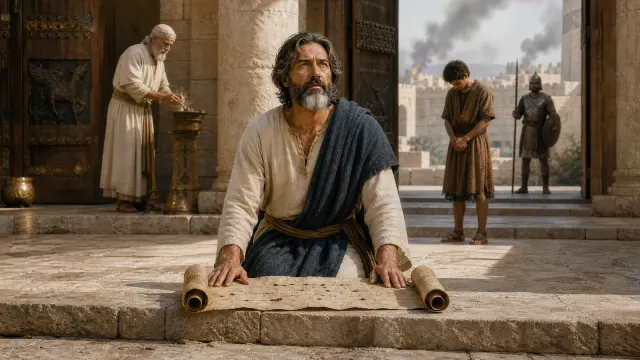
Hezekiah does not answer Rabshakeh with a louder speech of his own. He tears his clothes, puts on sackcloth, goes into the LORD's house, and sends men in the same posture of mourning to Isaiah. His phrase about children reaching birth without strength to bring forth captures a crisis at the point where something must happen but human capacity has run out. The request is for “the remnant that are left,” which admits the damage already done across Judah. Isaiah's first answer is aimed directly at the words that have created the crisis. The Assyrian servants have reproached the LORD, and their king will hear a report, return to his own land, and die there. The promise arrives before the chapter describes how any of that happens. Its first work is to set the direction of the outcome against the direction announced by Assyria.
Deep dive
Hezekiah's actions continue the officials' torn clothing rather than dismissing their alarm. He enters the LORD's house while his representatives go to Isaiah. The two movements connect royal prayer and prophetic inquiry without making the prophet's presence a substitute for the king's own approach to the LORD.
The image of children reaching birth without strength to bring them forth names a crisis at the point where delay threatens life. It does not describe an actual group of women in the city; it gives language to the kingdom's inability to complete its own deliverance. The request is for the "remnant that are left," acknowledging that Judah has already suffered losses. This is not an untouched kingdom merely imagining danger.
Isaiah's initial answer concentrates on the words Hezekiah has heard. The Assyrian servants have reproached the LORD, and their master will be turned back and killed in his own land. The answer does not yet describe the night's destruction of the camp. It establishes the direction of the outcome before the next message arrives to challenge it.
Words to trace: king, LORD, Hezekiah, Isaiah, words, Assyria
Verse-by-verse path
- 2 Kings 19:1
Hezekiah does what his officials did (18:37) and more: the clothes are torn, then covered with sackcloth, the coarse goat hair cloth of mourning and penitence. Going into the house of the LORD is his first move, before any council of war.
- 2 Kings 19:2
This is the first appearance of Isaiah in the Book of 2 Kings, the only one of the writing prophets named in the book apart from Jonah (14:25). Sending the elders of the priests along with the two senior officials makes it a delegation of the whole state.
- 2 Kings 19:3
“Rebuke” is tokechah, chastisement, and “blasphemy” is ne'atsah, contempt: the day is one of punishment from the LORD and scorn from Assyria at once. The birth image is a proverb; Hosea 13:13 uses a child stuck in the womb for a people unable to turn.
- 2 Kings 19:4
“The living God” sets the LORD against the dead gods Rabshakeh had listed. Hezekiah says “the LORD thy God”, twice, speaking of Isaiah's God rather than his own, which may express humility or a sense that his standing before the LORD is compromised.
- 2 Kings 19:5
A short narrative hinge, repeated nearly word for word in Isaiah 37:5. Its effect is to slow the pace, so that the prophet's reply is heard as the answer to the formal request just made.
- 2 Kings 19:6
The word for the Assyrian “servants” here is ne'arim, lads or boys, not the ordinary word for officials. Isaiah belittles the great king's great officers as his errand boys.
- 2 Kings 19:7
“Blast” is ruach, spirit or wind: the LORD will put a spirit in him. The three steps, rumour, return, death by the sword in his own land, map the rest of the chapter, and the last one is fulfilled only in verse 37.
2 Kings 19:1-7
King James Version1And it came to pass, when king Hezekiah heard it, that he rent his clothes, and covered himself with sackcloth, and went into the house of the LORD.
2And he sent Eliakim, which was over the household, and Shebna the scribe, and the elders of the priests, covered with sackcloth, to Isaiah the prophet the son of Amoz.
3And they said unto him, Thus saith Hezekiah, This day is a day of trouble, and of rebuke, and blasphemy: for the children are come to the birth, and there is not strength to bring forth.
4It may be the LORD thy God will hear all the words of Rab-shakeh, whom the king of Assyria his master hath sent to reproach the living God; and will reprove the words which the LORD thy God hath heard: wherefore lift up thy prayer for the remnant that are left.
5So the servants of king Hezekiah came to Isaiah.
6And Isaiah said unto them, Thus shall ye say to your master, Thus saith the LORD, Be not afraid of the words which thou hast heard, with which the servants of the king of Assyria have blasphemed me.
7Behold, I will send a blast upon him, and he shall hear a rumour, and shall return to his own land; and I will cause him to fall by the sword in his own land.
2 Kings 19:8-13
Now the Accusation Is That God Deceives
The first reassurance does not stop the campaign map from moving. Rabshakeh finds Sennacherib at Libnah, news arrives about Tirhakah, and another message is sent to Jerusalem. This time the accusation escalates from “Hezekiah deceives you” to “let not thy God...deceive thee.” The question is no longer whether Judah's king has enough horses, clever enough advisers, or a useful alliance. The reliability of the LORD is made the target. Assyria's evidence is its own record of conquest, and the names of destroyed places are meant to make Jerusalem's future feel already decided. The coming prayer will not deny that record. That is what gives the dispute its shape. The argument is over what Assyrian success proves, and whether the God addressed by Hezekiah can simply be placed in the same category as the gods already burned.
Deep dive
The Assyrian campaign is still moving. Rabshakeh finds his master at Libnah rather than Lachish, and the report of Tirhakah's advance enters the account. The book does not allow the first prophetic assurance to freeze every other army in place. Hezekiah hears another threat amid continuing military developments.
The wording escalates the earlier charge. In chapter 18, Rabshakeh repeatedly warned that Hezekiah was deceiving the people; the new message warns Hezekiah against being deceived by his God. The issue is no longer confined to the king's capacity to defend Jerusalem. The LORD's reliability is directly challenged.
The list of conquered places supplies evidence intended to make future conquest appear inevitable. Those past defeats are not invented away by the prayer that follows. Hezekiah will acknowledge that Assyria has destroyed nations and burned their gods. The dispute turns on the conclusion drawn from those facts: whether the LORD is simply another object that can be overcome and thrown into the same fire.
Words to trace: king, Assyria, delivered, Hezekiah, Arpad, children
Verse-by-verse path
- 2 Kings 19:8
Libnah lay in the Shephelah, north of Lachish. The Assyrian relief of Lachish's siege, found in Sennacherib's palace at Nineveh and now in the British Museum, shows the city that he had just left, in grim detail.
- 2 Kings 19:9
Tirhakah (Taharqa) was a Kushite prince of Egypt's twenty fifth dynasty, not yet king in 701 BC but crowned by the time Kings was written; the title may be given proleptically. Ethiopia translates Cush, the Nile kingdom south of Egypt.
- 2 Kings 19:10
Rabshakeh had told the people not to let Hezekiah deceive them (18:29); now the letter says not to let God deceive Hezekiah. The same verb climbs one level higher, from king to God.
- 2 Kings 19:11
“Destroying them utterly” uses charam, the verb for placing under the ban, the total destruction Israel was once commanded to carry out in Canaan. The Assyrian claims the vocabulary of holy war for himself.
- 2 Kings 19:12
Gozan, Haran and Rezeph were cities in upper Mesopotamia and Syria absorbed by Assyria generations earlier. Haran is where Abraham's family lived (Genesis 11:31), so the list reaches, unwittingly, back to Israel's own ancestral town.
- 2 Kings 19:13
The letter names kings, not gods as in 18:34: where is the king of Hamath? The rulers are gone along with their deities. The list makes Hezekiah the next name on a roster of vanished monarchs.
2 Kings 19:8-13
King James Version8So Rab-shakeh returned, and found the king of Assyria warring against Libnah: for he had heard that he was departed from Lachish.
9And when he heard say of Tirhakah king of Ethiopia, Behold, he is come out to fight against thee: he sent messengers again unto Hezekiah, saying,
10Thus shall ye speak to Hezekiah king of Judah, saying, Let not thy God in whom thou trustest deceive thee, saying, Jerusalem shall not be delivered into the hand of the king of Assyria.
11Behold, thou hast heard what the kings of Assyria have done to all lands, by destroying them utterly: and shalt thou be delivered?
12Have the gods of the nations delivered them which my fathers have destroyed; as Gozan, and Haran, and Rezeph, and the children of Eden which were in Thelasar?
13Where is the king of Hamath, and the king of Arpad, and the king of the city of Sepharvaim, of Hena, and Ivah?
2 Kings 19:14-19
The Threatening Document Changes Rooms
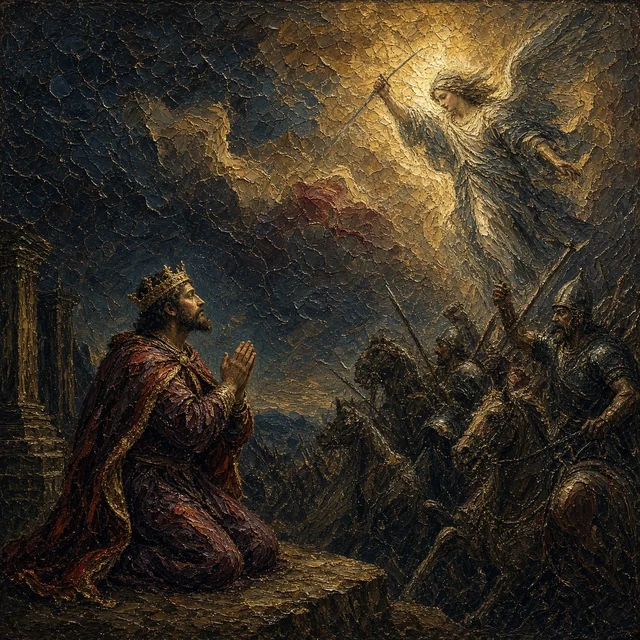
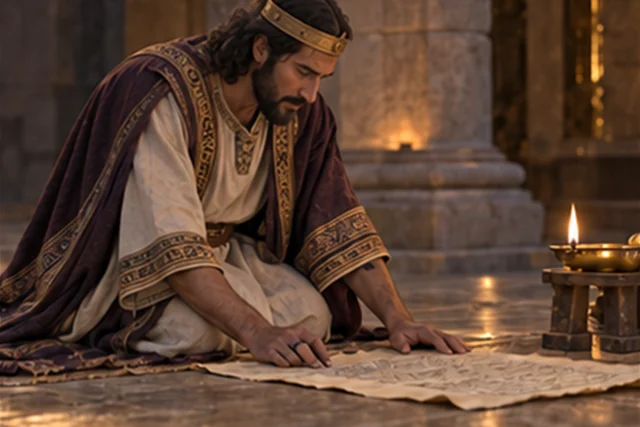
The threatening letter changes rooms. Hezekiah reads it, carries it into the LORD's house, and spreads it out before the LORD. The gesture does not reveal information to God. It relocates the challenge into the place where Hezekiah will answer it through prayer. He names the LORD as the God of Israel who dwells between the cherubim, then immediately widens the confession: God alone rules the kingdoms and made heaven and earth. The temple does not shrink him into a local deity. Hezekiah also refuses to pray by pretending Assyria's record is fake. The nations were destroyed and their gods were burned. His distinction is that those gods were wood and stone, made by human hands. The requested deliverance therefore concerns more than survival. It concerns the claim in Sennacherib's letter about who the LORD is.
Deep dive
The letter moves from the messengers' hands to the king's eyes and then into the temple. Spreading it before the LORD does not imply that its contents were previously hidden from God. The physical action places the written threat before the one it has challenged. The prayer's appeals to hear and see match the document and the insulting words it carries.
Hezekiah begins with the God of Israel enthroned between the cherubim, then immediately names him as God of all earthly kingdoms and maker of heaven and earth. The temple location does not confine the God addressed to one local territory. This directly answers the Assyrian habit of lining up a god beside each conquered city.
The acknowledgment of Assyria's record is equally important. Hezekiah does not deny that nations have fallen or that their gods have burned. He distinguishes the wood and stone made by human hands from the living God addressed in prayer. The requested deliverance is therefore joined to recognition beyond Jerusalem: the kingdoms are to know who the LORD is. Survival is urgently sought, but the meaning of survival extends to the claim made in the letter.
Words to trace: LORD, earth, Hezekiah, destroyed, gods, hand
Verse-by-verse path
- 2 Kings 19:14
The Hebrew says “letters”, plural, though “it” follows in the singular, as if a set of tablets or sheets made one message. Spreading it before the LORD is a physical act unparalleled elsewhere in the Old Testament.
- 2 Kings 19:15
The cherubim were the golden figures over the ark in the most holy place (1 Kings 6:23–28). Hezekiah addresses the God enthroned in that small room as maker of heaven and earth and ruler of all kingdoms, including Assyria.
- 2 Kings 19:16
Ear and eye, hear and see: the prayer asks the LORD to use the senses the idols of Psalm 115:5–6 do not have. The Hebrew has “which he hath sent”, meaning the letter or the messenger, not Sennacherib sending himself.
- 2 Kings 19:17
“Of a truth” concedes the Assyrian point without argument. The prayer admits the facts of 18:33–35 and 19:11–13 before disputing what they prove.
- 2 Kings 19:18
Assyrian kings did carry off and sometimes destroy the statues of conquered gods, and the reliefs show soldiers bearing idols away. Wood and stone, the work of men's hands, is Deuteronomy's own description of idols (Deuteronomy 4:28).
- 2 Kings 19:19
The request ends not with Judah's safety but with knowledge among the nations, as Solomon's prayer at the temple's dedication did (1 Kings 8:43, 60). “Even thou only” matches the “thou alone” of verse 15, enclosing the prayer.
2 Kings 19:14-19
King James Version14And Hezekiah received the letter of the hand of the messengers, and read it: and Hezekiah went up into the house of the LORD, and spread it before the LORD.
15And Hezekiah prayed before the LORD, and said, O LORD God of Israel, which dwellest between the cherubims, thou art the God, even thou alone, of all the kingdoms of the earth; thou hast made heaven and earth.
16LORD, bow down thine ear, and hear: open, LORD, thine eyes, and see: and hear the words of Sennacherib, which hath sent him to reproach the living God.
17Of a truth, LORD, the kings of Assyria have destroyed the nations and their lands,
18And have cast their gods into the fire: for they were no gods, but the work of men’s hands, wood and stone: therefore they have destroyed them.
19Now therefore, O LORD our God, I beseech thee, save thou us out of his hand, that all the kingdoms of the earth may know that thou art the LORD God, even thou only.
2 Kings 19:20-28
The Conqueror Is Not the Author of His Own Reach
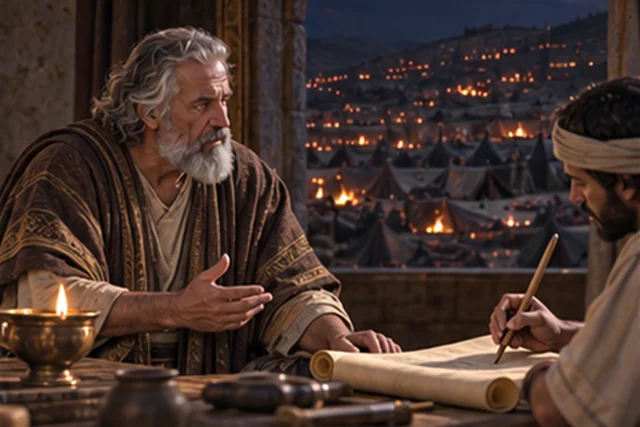
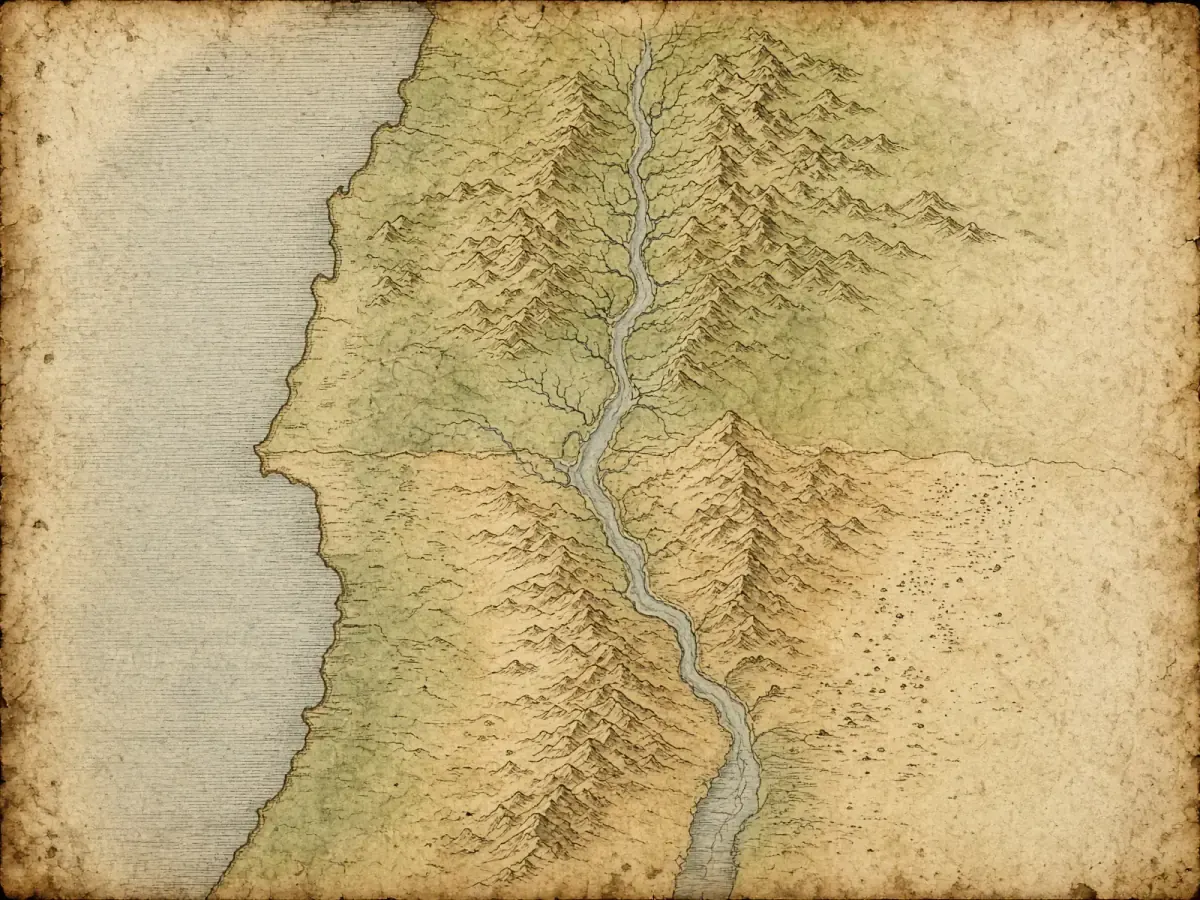
Isaiah's answer does not deny Sennacherib's achievements. It denies his authorship of them. The Assyrian boast piles up chariots, mountain heights, felled trees, strange waters, and rivers supposedly dried beneath his feet, a ruler narrating conquest as if power begins with himself. The LORD's response reaches behind that self-description: what Assyria has done has occurred within a purpose older than the campaign. Then the language changes from what the king claims to what the LORD knows. His dwelling, his movements, and his rage are all known. The man who speaks as if he directs the map is pictured with a hook in his nose and a bridle in his lips. The same route that brought him toward Jerusalem becomes the route of return. The conqueror is not denied strength; he is denied the final say over where that strength goes.
Deep dive
The daughter of Zion laughs and shakes her head within the prophetic oracle. This is a poetic reversal of Assyria's intimidation, not a report that the besieged inhabitants have begun laughing at soldiers outside the wall. The city described as vulnerable receives a voice of defiance because the LORD answers the reproach directed against him.
The Assyrian boast piles up conquered heights, felled trees, unfamiliar waters, and rivers overcome by the king's own movement. The answer does not simply deny that cities have been reduced to heaps. It denies that the Assyrian ruler is the ultimate source of the power he claims. What he presents as self-originating achievement has occurred within a purpose older than his campaign.
The shift from boasting to being known is decisive. The LORD knows his dwelling, his movements, and his rage. The hook and bridle then turn the ruler who directs armies into one who is himself directed. The route of conquest becomes the route of return. The imagery assigns him no independent power to decide that Jerusalem must be the next city on his list.
Words to trace: LORD, daughter, grass, Israel, rage, reproached
Verse-by-verse path
- 2 Kings 19:20
This time Isaiah is not consulted; he sends word unprompted. “I have heard” answers directly to Hezekiah's “hear” in verse 16.
- 2 Kings 19:21
The oracle is a taunt song in poetic lines. Daughter Zion is Jerusalem personified as a young woman, and “virgin” here means unconquered. Shaking the head behind a departing enemy is a gesture of mockery, as in Psalm 22:7.
- 2 Kings 19:22
“The Holy One of Israel” is Isaiah's signature title for God, used some twenty five times in the book of Isaiah and only here in Kings. Lifting the eyes on high is arrogance: Sennacherib has looked upward at the one he should have feared.
- 2 Kings 19:23
The boast imitates Assyrian royal inscriptions, which do describe kings crossing mountains with chariots and felling cedars of Lebanon for their palaces. “Carmel” here is not the mountain but the word for a fruitful garden land.
- 2 Kings 19:24
Digging wells in hostile ground, then drying up rivers under his soles, is a claim to master deserts and waters alike. “Besieged places” translates matsor, which is also a poetic name for Egypt (Micah 7:12), so most modern versions read the rivers of Egypt, the Nile's channels.
- 2 Kings 19:25
The LORD takes over the verb “done” and “formed”, yatsar, the potter's word from Genesis 2:7. Assyria's conquests were planned long ago, the same claim Isaiah 10:5–15 makes in its picture of the axe boasting against the one who swings it.
- 2 Kings 19:26
Grass on flat mud roofs sprouts quickly in the rain and withers before it can grow, a picture also used in Psalm 129:6. The weakness of the conquered was part of the LORD's purpose, not a proof of Assyrian greatness.
- 2 Kings 19:27
Abode, going out, coming in: the full span of a life, the same pairing Psalm 121:8 uses of the LORD's protection. Here it is used of surveillance: nothing the king does escapes notice.
- 2 Kings 19:28
Assyrian reliefs show captive kings led by ropes through hooks in their lips or noses, and Esarhaddon had himself depicted leading two kings this way. The LORD turns Assyria's own humiliation of captives back on its king.
2 Kings 19:20-28
King James Version20Then Isaiah the son of Amoz sent to Hezekiah, saying, Thus saith the LORD God of Israel, That which thou hast prayed to me against Sennacherib king of Assyria I have heard.
21This is the word that the LORD hath spoken concerning him; The virgin the daughter of Zion hath despised thee, and laughed thee to scorn; the daughter of Jerusalem hath shaken her head at thee.
22Whom hast thou reproached and blasphemed? and against whom hast thou exalted thy voice, and lifted up thine eyes on high? even against the Holy One of Israel.
23By thy messengers thou hast reproached the Lord, and hast said, With the multitude of my chariots I am come up to the height of the mountains, to the sides of Lebanon, and will cut down the tall cedar trees thereof, and the choice fir trees thereof: and I will enter into the lodgings of his borders, and into the forest of his Carmel.
24I have digged and drunk strange waters, and with the sole of my feet have I dried up all the rivers of besieged places.
25Hast thou not heard long ago how I have done it, and of ancient times that I have formed it? now have I brought it to pass, that thou shouldest be to lay waste fenced cities into ruinous heaps.
26Therefore their inhabitants were of small power, they were dismayed and confounded; they were as the grass of the field, and as the green herb, as the grass on the housetops, and as corn blasted before it be grown up.
27But I know thy abode, and thy going out, and thy coming in, and thy rage against me.
28Because thy rage against me and thy tumult is come up into mine ears, therefore I will put my hook in thy nose, and my bridle in thy lips, and I will turn thee back by the way by which thou camest.
2 Kings 19:29-34
Roots Downward, Fruit Upward
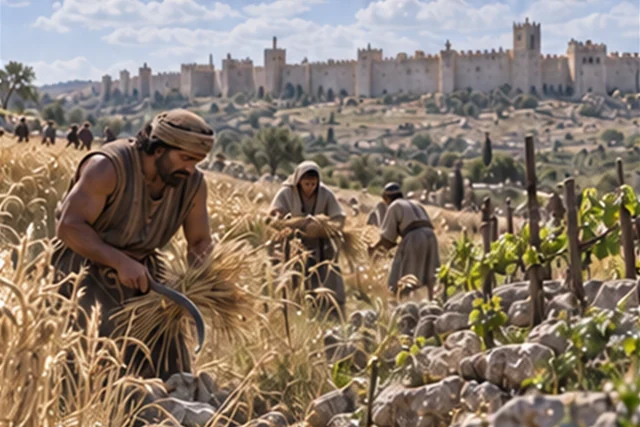
The sign of Jerusalem's deliverance begins in damaged fields. For two years the people eat what grows without ordinary planting, and only in the third do sowing, reaping, vineyards, and fruit return in their usual form. That sequence takes the devastation seriously. Rescue does not magically make every agricultural loss disappear. The remnant is then pictured taking “root downward” and bearing “fruit upward,” a compact answer to the threat of uprooting and deportation. Rabshakeh had offered vineyards in another land; the oracle describes life resuming from the people who remain here. The military promise is equally specific. Sennacherib will not enter the city, shoot an arrow into it, approach with shield, or build a siege bank. This is a promise about this assault, grounded in the LORD's purpose and David, not a claim that Jerusalem can never fall under any future judgment.
Deep dive
The sign reaches into fields rather than beginning with a display above the walls. Volunteer growth will feed the people before ordinary sowing, reaping, and vineyard work resume. This takes the damage to agriculture seriously. Deliverance is not described as an instant return to a landscape that has suffered nothing.
The remnant's future is then pictured as roots going down and fruit coming up. The direction answers the threat of uprooting through deportation. Rabshakeh offered vineyards in another land; the oracle describes renewed life emerging from the surviving people here. The remnant language remains important: restoration is promised to those left after real loss.
The military assurance is unusually specific. The Assyrian king will not enter the city, shoot an arrow there, approach it with shield, or build a siege bank against it. The grounds named are the LORD's own sake and David's sake, not a general rule that Jerusalem can never be captured. The later fall in chapter 25 makes that distinction indispensable. This promise concerns this threatened assault and this deliverance; it does not erase every subsequent prophetic warning against the city.
Words to trace: city, LORD, year, remnant, sake, arrow
Verse-by-verse path
- 2 Kings 19:29
The sign is addressed to Hezekiah and it is agricultural. With fields ravaged in the campaign, the people will eat aftergrowth, sapiach, grain that sprouts from seed fallen at harvest, and then shachis, what sprouts from that. Sowing resumes only in the third year.
- 2 Kings 19:30
The image of roots and fruit reverses the uprooting threat of deportation and answers Rabshakeh's offer of another land in 18:32. Amos 2:9 uses the same pair in reverse, of the Amorite destroyed from fruit above to roots beneath.
- 2 Kings 19:31
The line “the zeal of the LORD of hosts shall do this” appears word for word in Isaiah 9:7, where it closes the promise of the child born to rule on David's throne. The remnant is the work of divine passion, not of Judah's strategy.
- 2 Kings 19:32
The list descends from entering the city, to shooting an arrow, to bringing a shield, to piling a siege ramp, each a stage of an Assyrian siege shown on the Lachish reliefs. Not even the first stage will happen at Jerusalem.
- 2 Kings 19:33
“By the way that he came” repeats the bridle image of verse 28 in plain prose. The promise is repeated at both ends of the verse, “shall not come into this city”, as a seal.
- 2 Kings 19:34
“For mine own sake, and for my servant David's sake” was the reason given for sparing Jerusalem under Solomon's son (1 Kings 11:13). The city's safety rests on the LORD's name and his promise to David, not on Hezekiah's merit.
2 Kings 19:29-34
King James Version29And this shall be a sign unto thee, Ye shall eat this year such things as grow of themselves, and in the second year that which springeth of the same; and in the third year sow ye, and reap, and plant vineyards, and eat the fruits thereof.
30And the remnant that is escaped of the house of Judah shall yet again take root downward, and bear fruit upward.
31For out of Jerusalem shall go forth a remnant, and they that escape out of mount Zion: the zeal of the LORD of hosts shall do this.
32Therefore thus saith the LORD concerning the king of Assyria, He shall not come into this city, nor shoot an arrow there, nor come before it with shield, nor cast a bank against it.
33By the way that he came, by the same shall he return, and shall not come into this city, saith the LORD.
34For I will defend this city, to save it, for mine own sake, and for my servant David’s sake.
2 Kings 19:35-37
The Great Speech Ends Outside the City
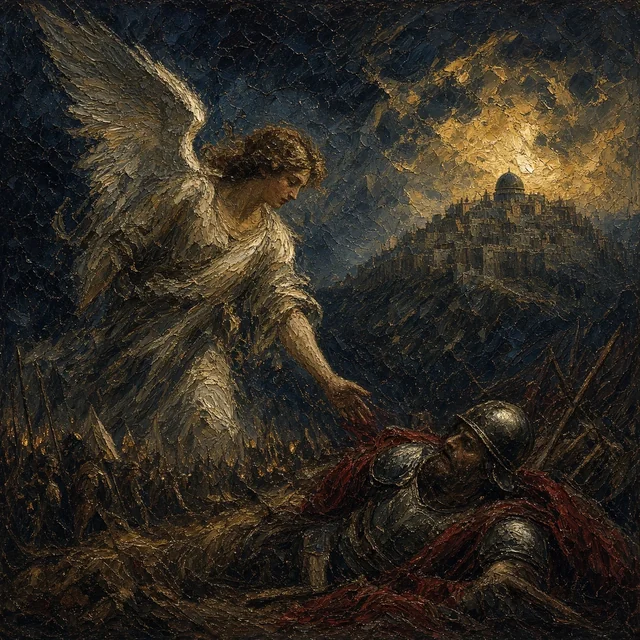
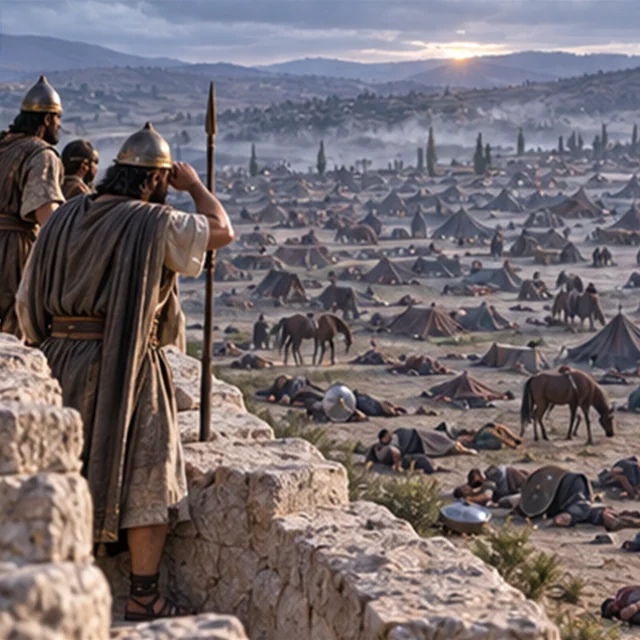
After chapters of speeches, the decisive blow is almost abrupt. The angel of the LORD strikes the Assyrian camp, and morning reveals one hundred eighty-five thousand dead. The Book of 2 Kings names the agent and the result but does not fill the gap with a battle by Judah, a disease diagnosis, or another natural mechanism. Sennacherib leaves, returns to Nineveh, and fulfills the direction Isaiah had announced. His later death carries a final irony the book does not need to explain aloud. The ruler who asked which god could deliver any land is struck by his own sons while worshiping in the house of Nisroch his god. The text compresses the interval and does not say the assassination happened immediately after the campaign. What it selects is the place, the family relationship, and the reversal. Jerusalem stands; his own household kills him.
Deep dive
After the extended speeches, the defeat is described with startling brevity. The angel of the LORD strikes a hundred and eighty-five thousand in the Assyrian camp, and morning reveals the dead. The book identifies the agent and the result but does not diagnose a plague, describe a battle by Judah's army, or supply a natural mechanism. Those explanations would be additions to this account, not details recovered from its wording.
Sennacherib leaves and returns to Nineveh. The repetition of departure and return answers the prophetic promise and reverses his announced intention to enter Jerusalem. His death is then reported while he worships in the house of Nisroch. The ruler whose message asked which god could deliver a people is not protected from his own sons inside his god's sanctuary.
The account compresses his return and eventual death without stating that the killing occurs immediately after the campaign. The location, the sword, and the family relationship are its selected details. Hezekiah's threatened house remains standing; Sennacherib's own household supplies his killers. The closing accession of Esarhaddon records Assyria's continuation without restoring the claim its previous king made over Jerusalem.
Words to trace: smote, Adrammelech, angel, Armenia, arose, Assyria
Verse-by-verse path
- 2 Kings 19:35
“That night” ties the blow to the night after the promise. The Book of 2 Kings does not say where the camp lay, and it need not have been under Jerusalem's walls. Herodotus preserves an Egyptian tradition that mice overran Sennacherib's army and gnawed its bowstrings, which some read as a memory of plague.
- 2 Kings 19:36
Three verbs, departed, went, returned, hurry him home. Sennacherib's annals boast of trapping Hezekiah but never claim to have taken Jerusalem, an unusual silence in records that list every conquest.
- 2 Kings 19:37
Sennacherib was murdered in 681 BC, twenty years after this campaign; Babylonian and Assyrian sources confirm a son killed him. Nisroch is otherwise unknown and may be a garbled name for Nusku or Marduk. Armenia translates Ararat, the land of Urartu, where Noah's ark came to rest.
2 Kings 19:35-37
King James Version35And it came to pass that night, that the angel of the LORD went out, and smote in the camp of the Assyrians an hundred fourscore and five thousand: and when they arose early in the morning, behold, they were all dead corpses.
36So Sennacherib king of Assyria departed, and went and returned, and dwelt at Nineveh.
37And it came to pass, as he was worshipping in the house of Nisroch his god, that Adrammelech and Sharezer his sons smote him with the sword: and they escaped into the land of Armenia. And Esar-haddon his son reigned in his stead.
Questions to keep in mind while reading
- Track who acts, who speaks, who is affected, and what changes.
- Notice repeated promises, failures, rescues, and consequences.
- Do not assume the account approves every action that is reported.
Text first
Where readers differ
The chapter summary begins with what the passage says and how its parts fit together. It does not assume one denomination has already settled every question. Where a conclusion depends on a tradition, literary theory, or historical reconstruction, that dependence is named openly.
The KJV text is presented first. Interpretive conclusions are labeled, and differences are introduced only when they help a reader understand why serious communities do not always reach the same answer.
Comparative interpretive notes for this chapter are in preparation. Until reviewed notes are ready, this page separates the KJV text from summary and application without claiming that serious readers agree on every question.
Questions beneath the surface
- What account of God, human freedom, responsibility, and the good life emerges from 2 Kings 19?
- Which tension does the chapter refuse to resolve quickly?
- What changes when the chapter is read as part of the whole canon rather than as an isolated moral lesson?
- Where might a sincere reader confuse a familiar tradition with something the text states directly?
Questions for serious personal contemplation
These open-ended questions make room for tension, honest response, prayer, and conclusions that remain accountable to the chapter.
Observe without rushing
What part of 2 Kings 19 makes you stop, feel unsettled, or feel surprised, and why?
Which detail in the passage would be easiest to overlook? How does that detail change your understanding?
Where do you see tension between what happens and this focus: 2 Kings 19 develops its own movement around LORD, king, Assyria, Hezekiah, city?
What important question does the passage leave open instead of resolving quickly?
Examine your inner life honestly
Which person, response, fear, or desire in the passage feels most like your own life right now?
What assumption about God, other people, or yourself does this text challenge?
Which part would you rather soften, avoid, or explain away too quickly? What might that reaction reveal?
If this Scripture could ask you one direct question, what do you think it would ask?
Respond with wisdom and courage
What do you need to remember, confess, grieve, thank God for, or trust after reading this passage?
How might another faithful person read this situation differently without ignoring the text?
What obedient response would be costly, uncomfortable, or slow, yet still faithful to Scripture?
What question will you carry into prayer this week, and which verses will you keep in front of you?
Music and video connected to the passage
Related media appears when its Scripture reference overlaps this study. Music and video can illuminate a theme while the biblical text remains the foundation.
 The Angel Smote the Camp2 Kings 18:1-19:37Listen to related music →
 Hezekiah and Sennacherib2 Kings 18-19Listen to related music →
 2 Kings, Fire in the Whirlwind2 Kings 1:1-25:30Listen to related music →The Angel in the Night2 Kings 18-19; Isaiah 36-37Listen to related music →Hezekiah and Sennacherib2 Kings 18–19Watch a related video →