
The big picture
The Book of Acts, chapter 15, turns the Gentile mission into a question the whole church must answer: must Gentile believers be circumcised and keep Moses' law in order to be saved? The debate is serious, lengthy, and resolved through testimony, Scripture, and a shared judgment. Peter points to God's prior gift of the Spirit, James finds the Gentiles already present in the prophetic promise, and the resulting letter explicitly rejects an unauthorized burden. Antioch receives that decision with joy and further encouragement. Yet the chapter refuses to end with institutional harmony. Paul and Barnabas sharply disagree over John Mark and separate. The Book of Acts can place doctrinal agreement and personal rupture in the same chapter without pretending that either one cancels the other.
In this chapter
- A Condition Added at the Door Acts 15:1-5
The dispute begins with a condition placed at the door of salvation: unless Gentile believers are circumcised after Moses' manner, they cannot be saved.
- Peter Reverses the Expected Comparison Acts 15:6-11
Peter's contribution comes after "much disputing," so the Book of Acts does not pretend the answer appeared without argument.
- James Finds the Gentiles Already Named in the Promise Acts 15:12-21
The room first hears what God has done among the Gentiles through Barnabas and Paul, then James sets that testimony beside the prophets.
- The Letter Removes a Burden It Did Not Authorize Acts 15:22-29
The letter does something more precise than settle a theological question in the abstract.
- A Letter Becomes Encouragement in a Gathered Church Acts 15:30-35
At Antioch, the letter is not delivered quietly to a few leaders and filed away.
- Agreement Over the Gentiles Does Not Prevent a Painful Separation Acts 15:36-41
The proposal is simple and pastoral: revisit the brethren in every city and see how they are doing.
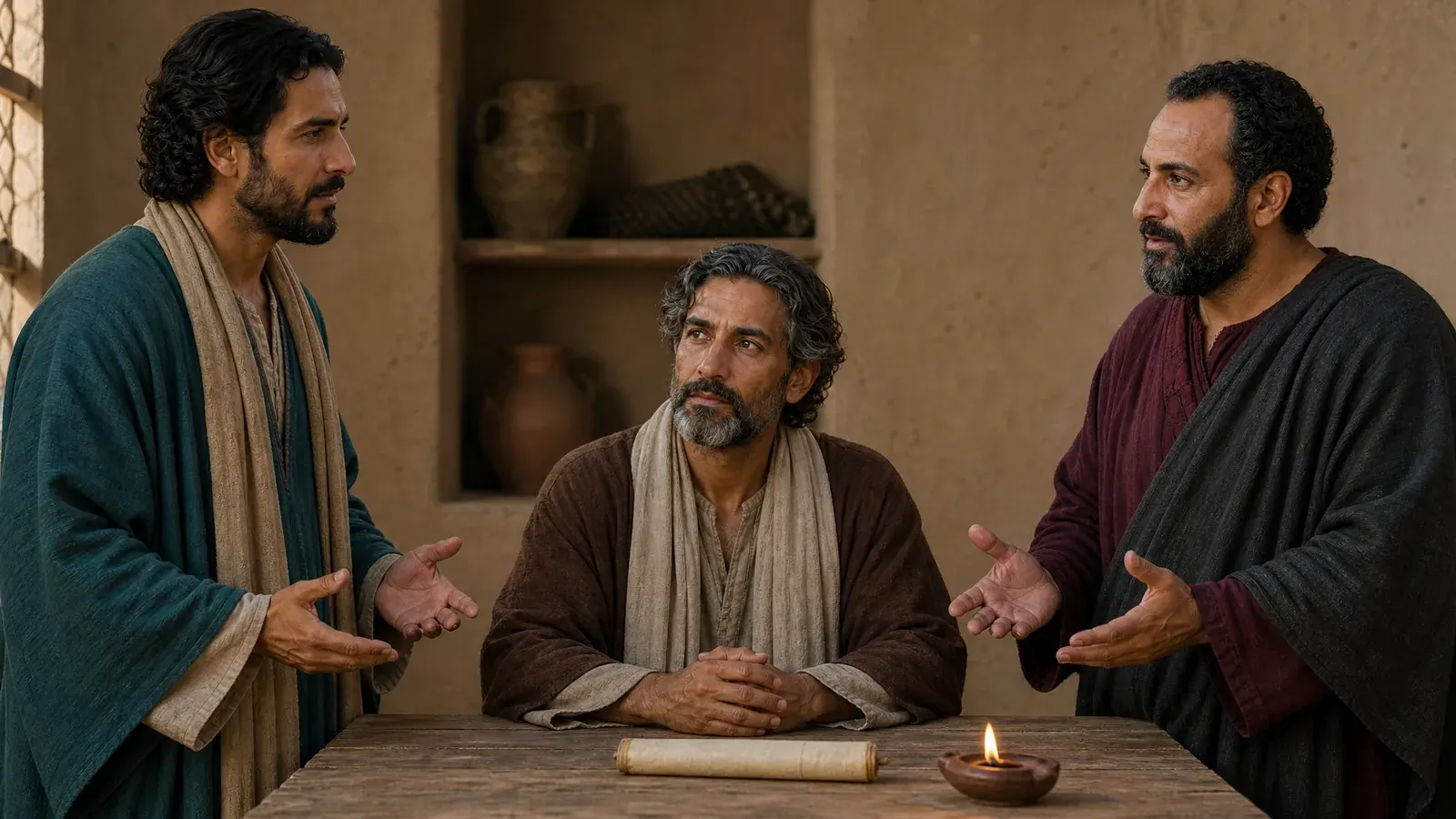

Scripture beside the summary
Acts · King James Version · 41Acts 15:1-5
A Condition Added at the Door
The dispute begins with a condition placed at the door of salvation: unless Gentile believers are circumcised after Moses' manner, they cannot be saved. That claim reaches far beyond preference or custom, because it changes the terms on which the people welcomed throughout the recent mission may understand themselves to belong. Paul and Barnabas therefore answer with serious disputation, and the question is carried to Jerusalem rather than left as a local quarrel. Along the way, news of Gentile conversion produces joy, and Jerusalem receives the delegation and hears what God has done. The disagreement remains real even inside that welcome. Believers associated with the Pharisees insist on circumcision and law keeping. The Book of Acts identifies them as believers, which makes the tension internal to the church. The issue is not whether Gentiles have shown interest, but what their reception means for the community as a whole.
Deep dive
The opening claim is absolute: without circumcision according to Moses, these Gentiles cannot be saved. That is more than advice about a useful custom. It changes the terms on which the people welcomed in the preceding chapters may understand themselves to belong. Paul and Barnabas dispute it vigorously because the question reaches the meaning of their entire mission.
As the delegation travels, accounts of Gentile conversion produce great joy among the brethren. Jerusalem likewise receives the visitors and hears what God has done with them. The welcome does not mean the issue is already settled. Believers associated with the Pharisees rise to require circumcision and obedience to Moses' law. Acts identifies them as believers, making this an argument within the emerging church rather than simply an attack from outside it.
The movement to Jerusalem gives the dispute a setting where its implications can be addressed together. It does not erase the evidence already accumulated in Antioch, Cyprus, and the Gentile households. What those events mean for the whole community is precisely what now has to be stated.
Words to trace: certain, apostles, Barnabas, brethren, church, elders
Verse-by-verse path
- Acts 15:1
Paul writes of “certain” who “came from James” to Antioch and caused Peter to withdraw from Gentile tables (Galatians 2:12); whether they are these men is uncertain, and James disowns their message in verse 24. “After the manner of Moses” is a telling phrase, since circumcision began with Abraham (Genesis 17) and was only later written into Moses’ law (Leviticus 12:3).
- Acts 15:2
“Dissension” is stasis, a word for civil strife, used of Barabbas’s “insurrection” (Luke 23:19). “Certain other of them” is left unnamed; if this is the visit of Galatians 2:1–3, one of them was Titus, an uncircumcised Greek whom Paul brought as a living test case. That identification is debated.
- Acts 15:3
“Brought on their way” is propempo, to send someone off with provisions and escort, a standard courtesy among early churches (Romans 15:24, 3 John 6). The route runs through Phoenicia and Samaria, where the scattered believers of 8:4 and 11:19 had planted churches, and Samaritans, once outsiders themselves, rejoice at news of Gentiles.
- Acts 15:4
This is Paul’s third visit to Jerusalem in Acts, after 9:26 and the famine relief of 11:30. “Received” is paradechomai, to welcome. Three groups are named, the church, the apostles and the elders, and all three will share in the final decision (verse 22).
- Acts 15:5
“Sect” is hairesis, a school or party, a neutral word here; Acts applies it to the Sadducees (5:17) and, on opponents’ lips, to the Christians themselves (24:5). Paul was a Pharisee by training (23:6, Philippians 3:5), so he knows exactly how these believers read Moses.
Acts 15:1-5
King James Version1And certain men which came down from Judæa taught the brethren, and said, Except ye be circumcised after the manner of Moses, ye cannot be saved.
2When therefore Paul and Barnabas had no small dissension and disputation with them, they determined that Paul and Barnabas, and certain other of them, should go up to Jerusalem unto the apostles and elders about this question.
3And being brought on their way by the church, they passed through Phenice and Samaria, declaring the conversion of the Gentiles: and they caused great joy unto all the brethren.
4And when they were come to Jerusalem, they were received of the church, and of the apostles and elders, and they declared all things that God had done with them.
5But there rose up certain of the sect of the Pharisees which believed, saying, That it was needful to circumcise them, and to command them to keep the law of Moses.
Acts 15:6-11
Peter Reverses the Expected Comparison
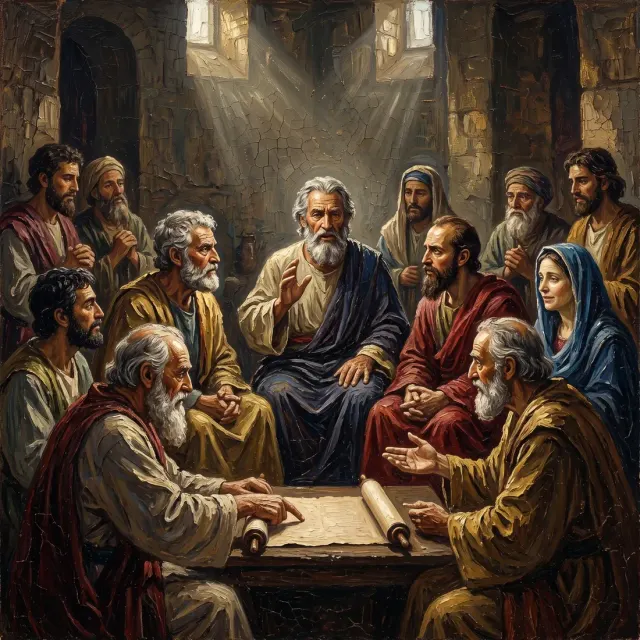
Peter's contribution comes after "much disputing," so the Book of Acts does not pretend the answer appeared without argument. He reaches back to the Gentile household already received through his own preaching and centers the case on God's action. The heart-knowing God gave the Holy Ghost to the Gentiles, purified their hearts by faith, and made no distinction before the condition now being proposed was added. Peter therefore asks why anyone would place a yoke on disciples after God has already borne witness to their reception. His final sentence reverses the expected comparison. He does not merely say that Gentiles may be saved in the same way Jews are. He says, "through the grace of the Lord Jesus Christ we shall be saved, even as they." The Gentile case becomes a display of the grace on which Peter's own people also depend, not a tolerated exception to a different rule.
Deep dive
Much disputing precedes Peter's speech. The result is not presented as an answer so obvious that serious disagreement never arose. Peter brings the case of Cornelius into the discussion because God, who knows hearts, gave the Gentiles the Holy Ghost without first requiring the condition now being proposed.
The absence of a distinction is attached to God's action in purifying hearts by faith. Peter's argument therefore concerns more than permission to socialize. The people themselves have been received by God. To put the contested yoke upon them would test God by adding a requirement after that reception has already been publicly demonstrated.
The conclusion contains a small but decisive reversal. Peter does not merely say that Gentiles can be saved in the same manner as Jews. He says that his own people will be saved through the grace of the Lord Jesus in the same manner as they. The Gentile case is no longer a tolerated exception requiring explanation; it displays the grace upon which Peter also depends. His language about the unbearable yoke does not turn the law into a mistake. It denies that bearing it supplies the basis of salvation.
Words to trace: believe, hearts, able, apostles, bare, bear
Verse-by-verse path
- Acts 15:6
The gathering is traditionally called the Council of Jerusalem and usually dated to about AD 48 or 49, the first of the church’s many councils, though the text uses no such title. “Consider of this matter” is literally “to see about this word”: the question is treated as a word, a matter to be examined.
- Acts 15:7
“A good while ago” is literally “from ancient days”, though Cornelius’s baptism was perhaps ten years earlier; the phrase stresses that the question was settled long before this meeting. “God made choice among us” puts the choice of Peter as the first to preach to Gentiles in God’s hands, not his own.
- Acts 15:8
“Which knoweth the hearts” is one Greek word, kardiognostes, heart-knower. It appears only twice in the Bible: here, and in the prayer of 1:24 when the apostles asked the heart-knowing Lord to choose Judas’s replacement. The God who chose Matthias by his knowledge of hearts has judged the Gentiles’ hearts too.
- Acts 15:9
“Purifying” is katharizo, the verb of the rooftop voice: “What God hath cleansed, that call not thou common” (10:15). In the vision the word applied to foods; Peter now applies it to hearts. Cleanness, the whole matter in dispute, is located where the ritual law could not reach.
- Acts 15:10
To “tempt” God is to put him to the test, as Israel did at Massah (Exodus 17:2), and Deuteronomy 6:16 forbids it. Jewish teachers spoke of taking up “the yoke of the kingdom” and “the yoke of the Torah” as an honour. Peter uses the image for a burden that experience showed no one had carried, and Paul calls it “the yoke of bondage” (Galatians 5:1).
- Acts 15:11
These are Peter’s last recorded words in the Book of Acts; after this chapter he does not appear again. “We believe” is emphatic, a statement of what the apostles hold. He speaks of “the grace of the Lord Jesus”, a phrase Paul uses to close several letters, and which here carries the whole argument.
Acts 15:6-11
King James Version6And the apostles and elders came together for to consider of this matter.
7And when there had been much disputing, Peter rose up, and said unto them, Men and brethren, ye know how that a good while ago God made choice among us, that the Gentiles by my mouth should hear the word of the gospel, and believe.
8And God, which knoweth the hearts, bare them witness, giving them the Holy Ghost, even as he did unto us;
9And put no difference between us and them, purifying their hearts by faith.
10Now therefore why tempt ye God, to put a yoke upon the neck of the disciples, which neither our fathers nor we were able to bear?
11But we believe that through the grace of the Lord Jesus Christ we shall be saved, even as they.
Acts 15:12-21
James Finds the Gentiles Already Named in the Promise
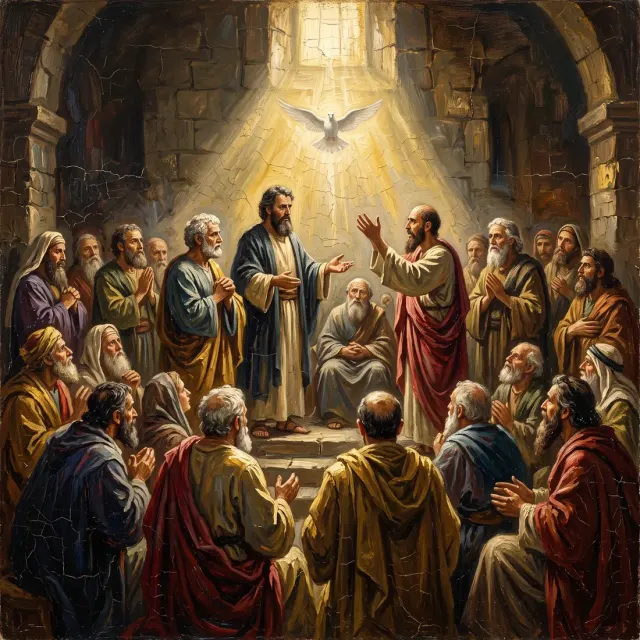
The room first hears what God has done among the Gentiles through Barnabas and Paul, then James sets that testimony beside the prophets. His use of Amos places Gentile inclusion inside the promise rather than treating it as an emergency Scripture never anticipated. The Book of Acts lets experience and text meet without turning either into a rival authority. James's conclusion is therefore not to trouble Gentiles who are turning to God, while asking them to abstain from idol pollution, fornication, what is strangled, and blood. The exact rationale for grouping those four matters has remained debated, and the passage does not spell out every later implication. What it does make clear is the direction of the decision: the Gentiles are not to be burdened with the opening demand for circumcision and full law keeping. Moses is already read throughout the cities, so the decision is made in a world where Jewish practice is very much present.
Deep dive
The assembly becomes silent for Barnabas and Paul. Their signs and wonders are described as God's work among the Gentiles, giving the discussion concrete events rather than only rival theories. James then places that testimony alongside the prophets. His use of Amos 9:11–12 joins the restoration associated with David to peoples beyond Israel who bear God's name.
The Gentiles do not appear in the quotation as an unanticipated problem the Scriptures failed to foresee. Their inclusion belongs within the promise James is interpreting. His judgment is consequently not to trouble those turning to God, while asking them to abstain from idol pollution, fornication, what is strangled, and blood.
The requirements have been read chiefly as safeguards for fellowship between Jewish and Gentile believers, or as enduring obligations associated with holiness and separation from pagan worship. The precise rationale for grouping all four together remains debated. James's reference to Moses being read in every city shows that Gentile reception must be addressed in a world where Jewish communities and their practices are already present. It does not explicitly say that these four requirements are the first installment of an eventual obligation to keep the whole law.
Words to trace: Gentiles, build, Lord, name, abstain, agree
Verse-by-verse path
- Acts 15:12
“Kept silence” is sigao: the arguing stops. In Jerusalem the names revert to “Barnabas and Paul”, Barnabas first, as in the letter of verse 25; he is the man the church there had known and trusted since 4:36. “Miracles and wonders” are the signs and wonders credited to Moses in Egypt (7:36).
- Acts 15:13
This is James the Lord’s brother, whom later tradition called James the Just; Hegesippus, quoted by Eusebius, says his knees grew hard as a camel’s from prayer in the temple. His reputation for keeping the Law is the reason his voice could carry the Pharisee believers. “Answered” means he responds to all that has been said.
- Acts 15:14
“Simeon” is the Hebrew form of Peter’s name, used of him only here and in 2 Peter 1:1, a Jerusalem touch in James’s speech. “A people for his name” uses laos, the word the Scriptures reserve for Israel, now for a people drawn “out of” the nations, as Deuteronomy 14:2 spoke of Israel chosen “out of all the nations”.
- Acts 15:15
“Agree” is sumphoneo, to sound together, the root of symphony: the prophets’ words and the events at Caesarea are in harmony. James says “the prophets” though he quotes only Amos, as if Amos spoke for the others; the Twelve circulated together on one scroll.
- Acts 15:16
Amos 9:11 is quoted from the Septuagint. The “tabernacle of David” is a skene, a booth or hut: Amos pictures the royal house as a collapsed shelter. “After this I will return” is not in Amos and may echo Jeremiah 12:15. The Dead Sea Scrolls also quote this verse to describe the community God would rebuild.
- Acts 15:17
The Greek and Hebrew of Amos differ strikingly at this point. The Hebrew of Amos 9:12 reads “that they may possess the remnant of Edom”; the Septuagint reads “that the residue of men may seek”. Edom and adam, man, share the same consonants, and “possess” and “seek” differ by one letter, so the Greek translators read a promise of conquest as a promise of seeking.
- Acts 15:18
The oldest manuscripts have a shorter line, closer to “says the Lord, who makes these things known from of old”, echoing Isaiah 45:21. The King James follows a later text that expands it into a statement about God’s knowledge of his works. In either form, the Gentile inclusion is presented as long intended, not improvised.
- Acts 15:19
“My sentence is” translates a single Greek verb, krino, “I judge”; whether James speaks as the meeting’s president delivering a ruling or as one voice offering a verdict is debated. “Trouble” is parenochleo, to add difficulties or harass, found only here in the New Testament.
- Acts 15:20
The four items resemble the rules Leviticus 17–18 laid on “the stranger that sojourneth among you”: no sacrifice to other gods, no eating blood, no meat of an animal not drained, no forbidden unions. The Western text drops “things strangled” and adds the negative Golden Rule, turning the list toward ethics; this is an early rewriting.
- Acts 15:21
Josephus claims that Moses ordered the Law read publicly every week so that none would be ignorant of it (Against Apion 2.175), and Philo describes synagogues on the Sabbath as schools of the Law. “Of old time” stresses that the synagogue presence is generations old. James sets the letter inside that long-established reading.
Acts 15:12-21
King James Version12Then all the multitude kept silence, and gave audience to Barnabas and Paul, declaring what miracles and wonders God had wrought among the Gentiles by them.
13And after they had held their peace, James answered, saying, Men and brethren, hearken unto me:
14Simeon hath declared how God at the first did visit the Gentiles, to take out of them a people for his name.
15And to this agree the words of the prophets; as it is written,
16After this I will return, and will build again the tabernacle of David, which is fallen down; and I will build again the ruins thereof, and I will set it up:
17That the residue of men might seek after the Lord, and all the Gentiles, upon whom my name is called, saith the Lord, who doeth all these things.
18Known unto God are all his works from the beginning of the world.
19Wherefore my sentence is, that we trouble not them, which from among the Gentiles are turned to God:
20But that we write unto them, that they abstain from pollutions of idols, and from fornication, and from things strangled, and from blood.
21For Moses of old time hath in every city them that preach him, being read in the synagogues every sabbath day.
Acts 15:22-29
The Letter Removes a Burden It Did Not Authorize
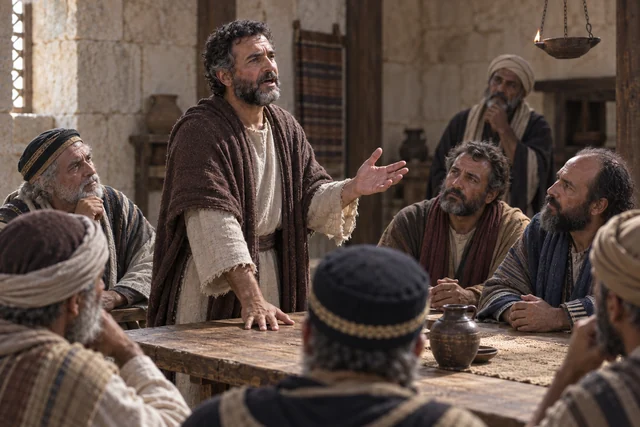
The letter does something more precise than settle a theological question in the abstract. It tells unsettled Gentile believers that the men who troubled them came from Jerusalem but did not carry Jerusalem's authorization. Geographic origin is separated from authority. The whole church joins the apostles and elders in sending Judas and Silas with Barnabas and Paul, so the decision travels through recognized people as well as through writing. The letter also honors the missionaries as men who have risked their lives for Jesus' name, which leaves little room for treating them as barely tolerated troublemakers. Its central phrase, "the Holy Ghost, and to us," places the judgment under divine guidance without erasing the debate that preceded it. Most importantly, the decision is defined by restraint: no greater burden is to be laid on the recipients than the necessary matters named. The limits of the decision are part of the decision itself.

Deep dive
The letter distinguishes the teachers' geographic origin from their authority. They came from Jerusalem's community, but the community had given them no such commandment. This matters because an unchallenged claim to represent the center could have made the Gentile churches think the mission's welcome had been withdrawn.
Judas and Silas accompany Barnabas and Paul so that the decision arrives through recognized witnesses as well as writing. The letter also honors Barnabas and Paul as men who have risked their lives for the name of Jesus. The contested missionaries are not sent back as barely tolerated outsiders; the receiving churches are given explicit grounds to trust them.
The phrase "the Holy Ghost, and to us" places the shared judgment under divine guidance without suppressing the preceding debate, testimony, and interpretation. The four abstentions follow a refusal to lay a greater burden on the recipients. The letter does not repeat the opening claim that circumcision is necessary for salvation, nor replace it with an equally sweeping demand to adopt the whole law. Its form makes the limits of the decision part of the decision.
Words to trace: brethren, send, Antioch, apostles, Barnabas, chosen
Verse-by-verse path
- Acts 15:22
“Pleased it” is dokeo, “it seemed good”, the formula of official decrees, and Luke uses it of himself in his Gospel’s preface (Luke 1:3). Judas Barsabas may be a brother of Joseph Barsabas, the candidate in 1:23. Silas is the Silvanus of Paul’s letters (1 Thessalonians 1:1) and, like Paul, a Roman citizen (16:37).
- Acts 15:23
“Greeting” is chairein, the standard opening of a Greek letter. In the New Testament it opens only three letters: this one, the letter of the tribune Claudius Lysias (23:26), and the Letter of James (1:1), whose author is the James who shaped this decision. Cilicia, Paul’s home province, is named though Acts has recorded no church founding there.
- Acts 15:24
“Troubled” is tarasso, the word Paul uses of the agitators in Galatia, “there be some that trouble you” (Galatians 1:7). “Subverting” is anaskeuazo, to pack up baggage, used of dismantling or plundering a place, found only here in the New Testament. The words “Ye must be circumcised, and keep the law” are missing from the oldest manuscripts.
- Acts 15:25
“Beloved”, agapetos, is used only here in the whole Book of Acts, and it is given to the two missionaries whose methods were in question. The letter names them in Jerusalem order, Barnabas before Paul. “Being assembled with one accord” presents the decision as unanimous, whatever argument preceded it.
- Acts 15:26
“Hazarded” is paradidomi, to hand over, the verb used when Jesus was “delivered” to be crucified; it can also mean to devote. The recent stoning at Lystra (14:19) gives the phrase its weight. The full title, “our Lord Jesus Christ”, marks whose name the risk was taken for.
- Acts 15:27
Letters in the ancient world were often carried by trusted bearers who could confirm and expand them in person, as Tychicus was sent to tell the Colossians Paul’s news (Colossians 4:7–8). “By mouth” means by word of mouth: two men from Jerusalem vouch for the paper, and no one can claim it was forged or twisted.
- Acts 15:28
“Burden” is baros, weight, and the risen Jesus uses the same phrase to Thyatira, “I will put upon you none other burden” (Revelation 2:24), in a letter that condemns eating things sacrificed to idols and fornication (2:20). “Necessary” is epanankes, of necessity, a stiff official word found only here in the New Testament.
- Acts 15:29
The list is reordered from verse 20, and “pollutions of idols” becomes the specific eidolothuta, “meats offered to idols”, the very term Paul discusses at length with the Corinthians (1 Corinthians 8–10). “Fare ye well” is errosthe, literally “be strong”, the normal closing of a Greek letter.
Acts 15:22-29
King James Version22Then pleased it the apostles and elders, with the whole church, to send chosen men of their own company to Antioch with Paul and Barnabas; namely, Judas surnamed Barsabas, and Silas, chief men among the brethren:
23And they wrote letters by them after this manner; The apostles and elders and brethren send greeting unto the brethren which are of the Gentiles in Antioch and Syria and Cilicia:
24Forasmuch as we have heard, that certain which went out from us have troubled you with words, subverting your souls, saying, Ye must be circumcised, and keep the law: to whom we gave no such commandment:
25It seemed good unto us, being assembled with one accord, to send chosen men unto you with our beloved Barnabas and Paul,
26Men that have hazarded their lives for the name of our Lord Jesus Christ.
27We have sent therefore Judas and Silas, who shall also tell you the same things by mouth.
28For it seemed good to the Holy Ghost, and to us, to lay upon you no greater burden than these necessary things;
29That ye abstain from meats offered to idols, and from blood, and from things strangled, and from fornication: from which if ye keep yourselves, ye shall do well. Fare ye well.
Acts 15:30-35
A Letter Becomes Encouragement in a Gathered Church
At Antioch, the letter is not delivered quietly to a few leaders and filed away. The gathered multitude hears it, and the Book of Acts records joy because the decision brings consolation to people whose standing had been unsettled. Judas and Silas then do more than authenticate the document. As prophets, they speak at length, exhort the brethren, and strengthen them. A settled controversy has not ended the church's need for teaching or encouragement. The KJV notice that Silas remains also prepares for the partnership soon to follow, while Paul and Barnabas continue teaching and preaching with "many others also." That phrase matters because it keeps Antioch from becoming a platform occupied only by famous missionaries. The church that commissioned earlier work remains a community where numerous people carry the word. The formal decision has restored clarity, but the chapter shows that clarity must still be lived within ordinary gathered fellowship.
Deep dive
The letter is delivered to the gathered multitude rather than left as a private reassurance for Paul and Barnabas. The people whose standing has been unsettled hear the answer together. Their rejoicing is attached to the consolation the letter brings, giving the resolution a human consequence without inventing reactions the text does not describe.
Judas and Silas do more than authenticate a document. As prophets they exhort the brethren at length and strengthen them. The written decision has settled a disputed requirement, but instruction and encouragement continue. Agreement is not treated as the end of the community's need to learn.
The KJV includes the notice that Silas chooses to remain, preparing for his later partnership with Paul. Paul and Barnabas also continue teaching and preaching with many others. That final phrase keeps Antioch from shrinking into a platform occupied by two famous workers. The church that sent the mission is again shown as a place where numerous people share the work of the word.
Words to trace: Antioch, brethren, Silas, abide, apostles, Barnabas
Verse-by-verse path
- Acts 15:30
“Dismissed” is apoluo, released, the verb used of the Antioch church sending Paul and Barnabas off in 13:3. “The multitude” is plethos, used in Acts as a term for the whole assembled congregation, as when the Twelve called “the multitude of the disciples” to choose the seven (6:2).
- Acts 15:31
“Read” means read aloud to the gathering, as Paul expected his own letters to be read to whole churches (Colossians 4:16, 1 Thessalonians 5:27). “Consolation” is paraklesis, which also means exhortation or encouragement; the letter both comforts and urges.
- Acts 15:32
Paul describes the prophet’s task as speaking “to edification, and exhortation, and comfort” (1 Corinthians 14:3), and that is what Judas and Silas do here. “Prophets also themselves” places them alongside the prophets and teachers of Antioch (13:1). “With many words” suggests long sessions, not a greeting at the door.
- Acts 15:33
“Let go in peace” is the formal farewell with a blessing, the Hebrew shalom. The oldest manuscripts read that they returned “to those that had sent them” rather than “unto the apostles”. Either way, their mission as delegates was complete.
- Acts 15:34
The oldest Greek manuscripts lack the whole verse. It seems to have been added to explain how Silas can be in Antioch in verse 40 after being sent home in verse 33; Codex Bezae adds further that Judas went on alone. Without it, Paul may simply have sent for Silas from Jerusalem.
- Acts 15:35
“Teaching and preaching” pairs didasko and euangelizomai, instruction for the church and announcement for outsiders. Paul’s letter to the Galatians mentions a time in Antioch when “even Barnabas” was carried away into separating from Gentile believers (Galatians 2:13); if that happened in this period, it may shadow what follows.
Acts 15:30-35
King James Version30So when they were dismissed, they came to Antioch: and when they had gathered the multitude together, they delivered the epistle:
31Which when they had read, they rejoiced for the consolation.
32And Judas and Silas, being prophets also themselves, exhorted the brethren with many words, and confirmed them.
33And after they had tarried there a space, they were let go in peace from the brethren unto the apostles.
34Notwithstanding it pleased Silas to abide there still.
35Paul also and Barnabas continued in Antioch, teaching and preaching the word of the Lord, with many others also.
Acts 15:36-41
Agreement Over the Gentiles Does Not Prevent a Painful Separation
The proposal is simple and pastoral: revisit the brethren in every city and see how they are doing. The disagreement that follows is therefore not about whether the churches matter, but about whether John Mark should accompany the return after leaving the earlier work in Pamphylia. Barnabas is determined to take him; Paul judges the previous departure a sufficient reason not to. The Book of Acts calls the contention sharp and does not award either man an uncomplicated moral victory. Nor does it reveal a secret motive that turns the quarrel into a disguised divine command. The result is separation: Barnabas sails with Mark to Cyprus, while Paul chooses Silas and travels through Syria and Cilicia strengthening churches. Both journeys continue useful work, but usefulness does not make the rupture painless or retrospectively necessary. The Book of Acts lets a chapter about major public agreement end with two trusted coworkers unable to continue together.
Deep dive
The proposal begins with care for the churches already formed. Paul wants to see how the brethren are doing, so the dispute does not arise from competing ideas about whether those people matter. It concerns whether Mark should accompany the visit after leaving the earlier work in Pamphylia.
Acts gives the substance of both positions: Barnabas intends to take Mark, while Paul considers his earlier departure a reason not to take him. The contention becomes sharp enough that the two separate. The account does not award one of them an unqualified moral victory, supply hidden motives, or announce that the disagreement was a divine command disguised as a quarrel.
Barnabas sails to Cyprus with Mark; Paul leaves with Silas and strengthens the churches through Syria and Cilicia. Both journeys continue work already established, but that fact does not make the rupture painless or retrospectively necessary. The later request for Mark in 2 Timothy 4:11 shows that Paul's assessment of his usefulness was not permanently fixed at this moment. Acts itself leaves the separation here, without staging a reconciliation it does not recount.
Words to trace: Barnabas, departed, Paul, brethren, Mark, asunder
Verse-by-verse path
- Acts 15:36
“Visit” is episkeptomai, the verb of God visiting his people (Luke 1:68, 7:16), which James also used in verse 14: “God at the first did visit the Gentiles.” “See how they do” is pastoral and plain. Paul is now the one who proposes the journey.
- Acts 15:37
“Determined” is boulomai, to wish or be minded, a softer word than the English suggests. Barnabas had been the one to take Saul by the hand when the Jerusalem disciples were afraid of him (9:27); he is consistent in giving a second chance to a man others doubted.
- Acts 15:38
“Thought not good” is axioo, to judge worthy: Paul did not consider it right. “Departed” is aphistemi, to withdraw or fall away, the verb Jesus used for those who “in time of temptation fall away” (Luke 8:13). Paul’s choice of word shows how seriously he took the desertion at Perga.
- Acts 15:39
“Contention” is paroxusmos, the root of paroxysm, which Hebrews 10:24 uses in a good sense, to “provoke unto love”. This is Barnabas’s last appearance in Acts. Paul later mentions him without bitterness (1 Corinthians 9:6), and Mark is with Paul again in Colossians 4:10.
- Acts 15:40
Only Paul and Silas are said to be “recommended … unto the grace of God”, the phrase used when Antioch sent out the first mission (14:26); nothing is said of Barnabas’s send-off, and some infer the church backed Paul. Silas was a Jerusalem delegate and a Roman citizen, well placed to carry the council’s letter to Paul’s churches (16:4).
- Acts 15:41
Syria and Cilicia were two of the regions named in the letter’s address (verse 23), so Paul delivers the decision where it was meant to go. His route runs overland and westward through the Cilician Gates to Derbe (16:1), the reverse of the road not taken at the end of the first journey.
Acts 15:36-41
King James Version36And some days after Paul said unto Barnabas, Let us go again and visit our brethren in every city where we have preached the word of the Lord, and see how they do.
37And Barnabas determined to take with them John, whose surname was Mark.
38But Paul thought not good to take him with them, who departed from them from Pamphylia, and went not with them to the work.
39And the contention was so sharp between them, that they departed asunder one from the other: and so Barnabas took Mark, and sailed unto Cyprus;
40And Paul chose Silas, and departed, being recommended by the brethren unto the grace of God.
41And he went through Syria and Cilicia, confirming the churches.
Questions to keep in mind while reading
- Track who acts, who speaks, who is affected, and what changes.
- Notice repeated promises, failures, rescues, and consequences.
- Do not assume the account approves every action that is reported.
Text first
Where readers differ
The chapter summary begins with what the passage says and how its parts fit together. It does not assume one denomination has already settled every question. Where a conclusion depends on a tradition, literary theory, or historical reconstruction, that dependence is named openly.
The KJV text is presented first. Interpretive conclusions are labeled, and differences are introduced only when they help a reader understand why serious communities do not always reach the same answer.
Comparative interpretive notes for this chapter are in preparation. Until reviewed notes are ready, this page separates the KJV text from summary and application without claiming that serious readers agree on every question.
Questions beneath the surface
- What account of God, human freedom, responsibility, and the good life emerges from Acts 15?
- Which tension does the chapter refuse to resolve quickly?
- What changes when the chapter is read as part of the whole canon rather than as an isolated moral lesson?
- Where might a sincere reader confuse a familiar tradition with something the text states directly?
Questions for serious personal contemplation
These open-ended questions make room for tension, honest response, prayer, and conclusions that remain accountable to the chapter.
Observe without rushing
What part of Acts 15 makes you stop, feel unsettled, or feel surprised, and why?
Which detail in the passage would be easiest to overlook? How does that detail change your understanding?
Where do you see tension between what happens and this focus: Apostles and elders debating Gentile inclusion in Jerusalem, listening to testimony, and composing the letter?
What important question does the passage leave open instead of resolving quickly?
Examine your inner life honestly
Which person, response, fear, or desire in the passage feels most like your own life right now?
What assumption about God, other people, or yourself does this text challenge?
Which part would you rather soften, avoid, or explain away too quickly? What might that reaction reveal?
If this Scripture could ask you one direct question, what do you think it would ask?
Respond with wisdom and courage
What do you need to remember, confess, grieve, thank God for, or trust after reading this passage?
How might another faithful person read this situation differently without ignoring the text?
What obedient response would be costly, uncomfortable, or slow, yet still faithful to Scripture?
What question will you carry into prayer this week, and which verses will you keep in front of you?
Music and video connected to the passage
Related media appears when its Scripture reference overlaps this study. Music and video can illuminate a theme while the biblical text remains the foundation.