
The big picture
Deuteronomy 21 keeps finding people who might otherwise disappear inside someone else’s power: an unidentified victim in a field, a captive woman in a conqueror’s house, a firstborn son of the less-loved wife, a son under a grave parental accusation, and even the body of a condemned man. The chapter does not make their situations equal, nor does it remove the severity of its own legal world. Instead, each case receives a boundary that another person’s preference cannot simply erase. A city must answer for blood shed nearby even when the killer is unknown. Desire must wait while a captive mourns. A father’s affection cannot rewrite birth order. Parents bring a rebellious son to public judgment rather than exercising private capital power. An executed body must come down before night. The common thread is not softness. It is the insistence that exposed lives remain governed by stated obligations rather than by whoever presently holds the advantage.
In this chapter
- An Unsolved Death Is Not an Ownerless Problem Deuteronomy 21:1-9
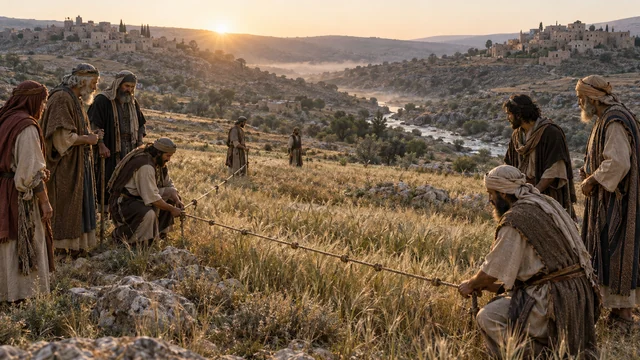
A body lies in a field, no killer is known, and Deuteronomy’s first response is to measure.
- The Captive Woman Is Allowed to Mourn Deuteronomy 21:10-14
The captive woman enters the law through the captor’s desire, but that desire does not control the calendar.
- Affection Cannot Rearrange the Birth Order Deuteronomy 21:15-17
A father may prefer one wife and dislike another, but Deuteronomy will not let those affections change which son was born first.
- A Parental Charge Must Leave the Household Deuteronomy 21:18-21
The son in this law is described cumulatively: stubborn and rebellious, refusing father and mother, unmoved by correction, and publicly charged as a glutton and drunkard.
- Even the Condemned Body Cannot Remain Overnight Deuteronomy 21:22-23
Even after execution, Deuteronomy puts a clock on public exposure.


Scripture beside the summary
Deuteronomy · King James Version · 23Deuteronomy 21:1-9
An Unsolved Death Is Not an Ownerless Problem
A body lies in a field, no killer is known, and Deuteronomy’s first response is to measure. The nearest city becomes responsible to act, not because its elders have been proved guilty, but because an unidentified death is not allowed to become nobody’s problem. Their declaration is precise: their hands did not shed the blood and their eyes did not see it. Innocence from the murder itself does not equal permission to ignore the blood nearby. The unused heifer and uncultivated valley mark the rite off from ordinary agricultural work, while priests stand present and the elders wash their hands over the animal. The prayer asks mercy for the redeemed people and removal of innocent blood from Israel. The procedure does not solve the crime by inventing a culprit. It gives an unsolved killing public recognition before the LORD and refuses to let uncertainty turn into communal indifference.

Deep dive
The first response to the body is measurement. Distance identifies which community must act, not which community has been proved to contain the murderer. That distinction is essential: the elders confess neither that they killed the man nor that they witnessed his death. They nevertheless cannot treat the absence of a suspect as the disappearance of a responsibility. Someone has died in the land, and the death must be publicly acknowledged before the LORD.
The unused heifer and uncultivated valley set the rite apart from ordinary agricultural work. In the KJV, ground that is not "eared" is ground that has not been ploughed. This is not described as a regular altar sacrifice; the animal's neck is broken in the valley, and the elders wash their hands over it. Their declaration of innocence is joined to a plea for the redeemed people. The closing command still requires innocent blood to be put away. Ritual acknowledgment does not convert an unidentified murder into an event that no longer matters.
Words to trace: LORD, slain, blood, city, elders, heifer
Verse-by-verse path
- Deuteronomy 21:1
“Slain” is chalal, one pierced, the word for a victim of violence rather than of illness or age. The first murder in Scripture also happened in a field, where Cain rose up against Abel (Genesis 4:8), and it too had no witness but the ground.
- Deuteronomy 21:2
“Thy elders and thy judges” are officials from beyond the local town. The Mishnah (Sotah 9:1) says members of the great court came out from Jerusalem, three of them or, in Rabbi Judah’s view, five, to take the measurements themselves.
- Deuteronomy 21:3
The heifer that has never borne a yoke matches the red heifer of Numbers 19:2, “upon which never came yoke”, and the untried cows that drew the ark back from the Philistines (1 Samuel 6:7). An animal never put to use is set apart for a single act.
- Deuteronomy 21:4
“A rough valley” is nachal eitan, most likely a wadi with a stream that never dries. Amos 5:24 uses the same pair: “let judgment run down as waters, and righteousness as a mighty stream.” Breaking the neck is arafah, the fate of an unredeemed firstling ass (Exodus 13:13).
- Deuteronomy 21:5
The priests say nothing in the rite as written, but the verse repeats the court language of 17:8 and 19:17, “every controversy and every stroke”. The ceremony is framed as a hearing with no defendant, held before those appointed to judge.
- Deuteronomy 21:6
Pilate’s gesture draws on this: he “took water, and washed his hands before the multitude, saying, I am innocent of the blood of this just person” (Matthew 27:24). Psalm 26:6 uses the image too: “I will wash mine hands in innocency.”
- Deuteronomy 21:7
The Mishnah (Sotah 9:6) asks why elders would need to deny murder, and answers that they mean: he did not come to us and we sent him away without food, we did not see him and let him go without escort. Innocence is read as having cared for the stranger on the road.
- Deuteronomy 21:8
“Be merciful” is kapper, to cover or atone, the root of Yom Kippur. The Mishnah (Sotah 9:6) divides the words: the elders speak 21:7, the priests pray this line, and “the blood shall be forgiven them” is not spoken by any of them but announced from heaven.
- Deuteronomy 21:9
The rite had an end. The Mishnah (Sotah 9:9) records that when murderers multiplied, the ceremony of the heifer was abolished, because it was designed for a death that was rare and unexplained, not for killing that had become ordinary.
Deuteronomy 21:1-9
King James Version1If one be found slain in the land which the LORD thy God giveth thee to possess it, lying in the field, and it be not known who hath slain him:
2Then thy elders and thy judges shall come forth, and they shall measure unto the cities which are round about him that is slain:
3And it shall be, that the city which is next unto the slain man, even the elders of that city shall take an heifer, which hath not been wrought with, and which hath not drawn in the yoke;
4And the elders of that city shall bring down the heifer unto a rough valley, which is neither eared nor sown, and shall strike off the heifer’s neck there in the valley:
5And the priests the sons of Levi shall come near; for them the LORD thy God hath chosen to minister unto him, and to bless in the name of the LORD; and by their word shall every controversy and every stroke be tried:
6And all the elders of that city, that are next unto the slain man, shall wash their hands over the heifer that is beheaded in the valley:
7And they shall answer and say, Our hands have not shed this blood, neither have our eyes seen it.
8Be merciful, O LORD, unto thy people Israel, whom thou hast redeemed, and lay not innocent blood unto thy people of Israel’s charge. And the blood shall be forgiven them.
9So shalt thou put away the guilt of innocent blood from among you, when thou shalt do that which is right in the sight of the LORD.
Deuteronomy 21:10-14
The Captive Woman Is Allowed to Mourn
The captive woman enters the law through the captor’s desire, but that desire does not control the calendar. She is brought into the house, changes the signs of her former condition, and receives a full month to mourn her father and mother before the marriage is completed. The text does not call the situation romantic or tell us what she feels toward the man who captured her. What it does name is bereavement, and it makes room for that grief inside a situation created by war. The shaving of the head and treatment of the nails have been explained in different ways, but the law itself is clearer about the end of the relationship. If the man no longer delights in her, he must let her go. He cannot sell her or turn her into merchandise. His change of desire does not become permanent ownership over her future.

Deep dive
The provision begins with the man's desire, but it immediately interrupts his timetable. The woman changes her clothing and mourns her father and mother for a full month. The account does not describe her feelings toward her captor or present the marriage as a romance. Her bereavement is the circumstance the law names and makes room for. War has not made her previous family a matter too inconvenient to acknowledge.
The shaving and treatment of the nails have been understood as mourning, a transition of status, or an alteration of the appearance that attracted the captor. The text gives the actions without explaining each one's symbolism. It is clearer about what happens if the man ceases to want her: he cannot recover a purchase price by selling her or treat her as merchandise. The reason refers to his having humbled her. These are constraints within a coercive situation, not a statement that captivity supplied consent. The final freedom also means that his change of desire does not give him unlimited rights over what becomes of her.
Words to trace: house, wife, beautiful, bewail, captive, captives
Verse-by-verse path
- Deuteronomy 21:10
“Taken them captive” is a cognate phrase, shavita shivyo, literally captured its captivity. The same idiom appears in Psalm 68:18, “thou hast led captivity captive”, which Paul quotes of Christ’s ascension in Ephesians 4:8.
- Deuteronomy 21:11
“A beautiful woman” is yefat to’ar, beautiful of form, the phrase used of Rachel (Genesis 29:17) and Esther (Esther 2:7). “Hast a desire” is chashaq, the verb 7:7 and 10:15 use of God setting his love on Israel. Here it is a soldier’s wanting.
- Deuteronomy 21:12
“Pare her nails” is literally do her nails, and the rabbis disagreed about what that meant. Rabbi Eliezer said cut them; Rabbi Akiva said let them grow, to make her less attractive to her captor (Yevamot 48a). The text gives the act without its purpose.
- Deuteronomy 21:13
A full month is literally a month of days. It matches the thirty days Israel mourned for Aaron (Numbers 20:29) and for Moses (34:8), the period for the greatest losses. “The raiment of her captivity” is the clothing she wore when taken.
- Deuteronomy 21:14
“Humbled” is innah, the verb used when Shechem took Dinah (Genesis 34:2) and Amnon forced Tamar (2 Samuel 13:14). “Make merchandise” is a rare verb that recurs in 24:7, of kidnapping someone in order to sell him.
Deuteronomy 21:10-14
King James Version10When thou goest forth to war against thine enemies, and the LORD thy God hath delivered them into thine hands, and thou hast taken them captive,
11And seest among the captives a beautiful woman, and hast a desire unto her, that thou wouldest have her to thy wife;
12Then thou shalt bring her home to thine house; and she shall shave her head, and pare her nails;
13And she shall put the raiment of her captivity from off her, and shall remain in thine house, and bewail her father and her mother a full month: and after that thou shalt go in unto her, and be her husband, and she shall be thy wife.
14And it shall be, if thou have no delight in her, then thou shalt let her go whither she will; but thou shalt not sell her at all for money, thou shalt not make merchandise of her, because thou hast humbled her.
Deuteronomy 21:15-17
Affection Cannot Rearrange the Birth Order
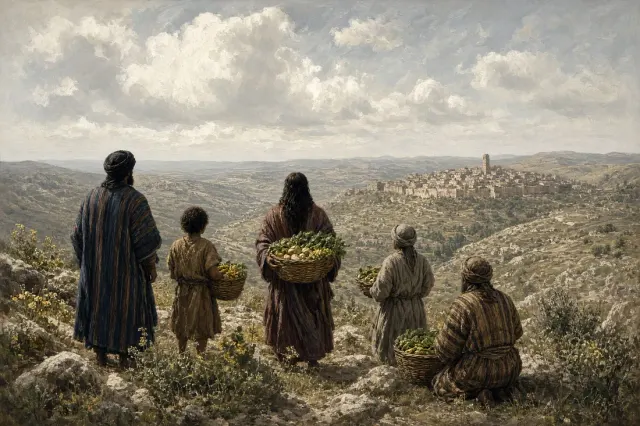
A father may prefer one wife and dislike another, but Deuteronomy will not let those affections change which son was born first. The case is written around precisely the temptation that favoritism creates: the son of the loved wife could be promoted over the actual firstborn because the father wishes the family order matched his emotions. The law blocks that move. The firstborn son of the unfavoured wife receives the double portion because the right follows his birth position, not his mother’s standing in her husband’s heart. The chapter does not stop to praise the plural marriage that produces the conflict. It regulates the particular injustice possible within it. That focus is important. Household affection can be real and unequal, yet legal rights are not permitted to rise and fall with every shift of preference. The father may love differently; he may not inherit differently on that basis.
Deep dive
The law does not begin with a harmonious household and merely explain arithmetic. It names the unequal affection that might tempt a father to rewrite an inheritance. The contrast between the loved and hated wives concerns their standing in his affections; the legal question is whether their sons' rights rise and fall with that preference. Moses answers by distinguishing the father's feelings from the firstborn son's position.
The double portion is not the whole estate. It is the firstborn's larger share among the brothers, grounded here in his being the beginning of his father's strength. A later-born son cannot be made firstborn simply because his mother is preferred. The chapter regulates an existing plural marriage without pausing to commend that arrangement. Its close attention falls on the particular injury that favouritism could cause: a son losing an established right because his father wishes another household relationship had produced him first.
Words to trace: firstborn, hated, beloved, acknowledge, beginning, born
Verse-by-verse path
- Deuteronomy 21:15
“Beloved” and “hated” describe favour, not open hostility. Genesis 29:31 uses the very word: “when the LORD saw that Leah was hated”. Jacob’s household, with Rachel loved and Leah not, is the case this law describes.
- Deuteronomy 21:16
Jacob did give the favoured wife’s son the firstborn’s portion: Joseph received it through Ephraim and Manasseh. 1 Chronicles 5:1-2 explains why it was lawful: Reuben forfeited it by defiling his father’s bed, not because Leah was less loved.
- Deuteronomy 21:17
“A double portion” is pi shenayim, literally a mouth of two, two shares. Elisha asks Elijah for “a double portion of thy spirit” (2 Kings 2:9), the heir’s share. “The beginning of his strength” is Jacob’s phrase over Reuben (Genesis 49:3).
Deuteronomy 21:15-17
King James Version15If a man have two wives, one beloved, and another hated, and they have born him children, both the beloved and the hated; and if the firstborn son be hers that was hated:
16Then it shall be, when he maketh his sons to inherit that which he hath, that he may not make the son of the beloved firstborn before the son of the hated, which is indeed the firstborn:
17But he shall acknowledge the son of the hated for the firstborn, by giving him a double portion of all that he hath: for he is the beginning of his strength; the right of the firstborn is his.
Deuteronomy 21:18-21
A Parental Charge Must Leave the Household
The son in this law is described cumulatively: stubborn and rebellious, refusing father and mother, unmoved by correction, and publicly charged as a glutton and drunkard. That is not the portrait of a small child receiving a capital sentence for one bad afternoon. Just as important, the parents do not carry out the punishment themselves. Father and mother take the case to the elders at the gate and state the charge before public authority. The men of the city then execute the prescribed penalty. None of those procedural limits makes the death sentence mild, and the text gives no record here of how frequently such a law was applied. But the location of authority matters. Parental power is serious without becoming private power of life and death. A household accusation this grave must leave the household, be spoken publicly, and enter the community’s legal order before the stated punishment can follow.
Deep dive
The description is cumulative: refusal to listen, resistance to correction, and the public charge of gluttony and drunkenness. It is not a scene in which a momentary disagreement immediately gives an angry parent power of life and death. Father and mother act together and take the case to the gate, where the elders hear the accusation. The son's precise age is not given, although the charges are not a description of a small child's ordinary disobedience.
Those procedural distinctions do not make the final penalty less severe. The men of the city stone the son, and the passage gives the removal of evil and the hearing of Israel as its concluding purposes. Parental authority is therefore neither unlimited private power nor merely a preference the community need never consider. This law places a grave household accusation before public authority and then assigns a punishment that belongs to this covenant's legal setting. The text does not supply an example of the provision being carried out or a count of how often such cases occurred.
Words to trace: city, voice, elders, father, mother, obey
Verse-by-verse path
- Deuteronomy 21:18
“Stubborn and rebellious” is sorer umoreh. Psalm 78:8 applies the pair to the whole wilderness generation, “a stubborn and rebellious generation”, and Jeremiah 5:23 to Judah. “Chastened” is yasar, the father’s discipline of 8:5.
- Deuteronomy 21:19
Both parents must act, and the Mishnah (Sanhedrin 8:4) holds that if either refuses, there is no case. The rabbis narrowed the law so tightly that the Talmud concludes: there never was a stubborn and rebellious son and never will be; the law exists to be studied (Sanhedrin 71a).
- Deuteronomy 21:20
“Glutton” and “drunkard” are zolel and sove, the pair of Proverbs 23:20-21: “the drunkard and the glutton shall come to poverty”. Jesus’ critics hurled the same charge at him: “a man gluttonous, and a winebibber” (Matthew 11:19).
- Deuteronomy 21:21
The Mishnah (Sanhedrin 8:5) says the rebellious son is judged on account of his end: better he die innocent now than guilty later. That is the rabbis’ explanation of a law they did everything to confine. The deterrent formula closes the case as in 13:11.
Deuteronomy 21:18-21
King James Version18If a man have a stubborn and rebellious son, which will not obey the voice of his father, or the voice of his mother, and that, when they have chastened him, will not hearken unto them:
19Then shall his father and his mother lay hold on him, and bring him out unto the elders of his city, and unto the gate of his place;
20And they shall say unto the elders of his city, This our son is stubborn and rebellious, he will not obey our voice; he is a glutton, and a drunkard.
21And all the men of his city shall stone him with stones, that he die: so shalt thou put evil away from among you; and all Israel shall hear, and fear.
Deuteronomy 21:22-23
Even the Condemned Body Cannot Remain Overnight
Even after execution, Deuteronomy puts a clock on public exposure. The person has already been put to death when the body is hung on a tree, so these verses are not themselves a description of Roman crucifixion. The law concerns what happens to the condemned body afterward. It may be displayed, but it may not remain there overnight. Burial must take place the same day because the hanged person is associated with a curse and the land must not be defiled. The community’s right to execute under its law does not become a right to display the corpse indefinitely. Galatians later takes up the phrase about one hanged on a tree when speaking of Christ bearing the curse. That later use draws on the association established here, while Deuteronomy’s own demand remains concrete: judgment has occurred, but the body still has a burial deadline.

Deep dive
The order of the actions matters: the person is put to death and then hung on a tree. The passage is not itself a description of Roman crucifixion or an explanation of every possible method of execution. It concerns the public exposure of the condemned body and imposes a definite limit on that exposure. The severity of the sentence does not authorize an indefinite display.
The reason joins the hanged person's curse to the holiness of the land. Burial must occur that day, so the community's enforcement of judgment does not become a continuing source of defilement. Galatians 3:13 later takes up the phrase about being cursed when hung on a tree to explain Christ's bearing of the curse. Paul's use depends on the association established here, while applying it to a later death with a different immediate judicial setting. Deuteronomy's own final concern remains precise: the land is an inheritance from God, and even a condemned corpse must not be left upon it without limit.
Words to trace: death, tree, accursed, body, bury, committed
Verse-by-verse path
- Deuteronomy 21:22
Joshua hanged the king of Ai and the five kings of the south on trees after killing them, and took the bodies down at sunset (Joshua 8:29, 10:26-27). Rizpah’s long vigil over Saul’s sons left hanging on the hill (2 Samuel 21:10) shows what happened when the limit was ignored.
- Deuteronomy 21:23
The Mishnah (Sanhedrin 6:4) reads “accursed of God” as an insult to God, because a human being bears his image: like twin brothers, one a king and one a hanged robber, whom passers-by mistake for the king. John 19:31 has the bodies taken down before the sabbath.
Deuteronomy 21:22-23
King James Version22And if a man have committed a sin worthy of death, and he be to be put to death, and thou hang him on a tree:
23His body shall not remain all night upon the tree, but thou shalt in any wise bury him that day; (for he that is hanged is accursed of God;) that thy land be not defiled, which the LORD thy God giveth thee for an inheritance.
Questions to keep in mind while reading
- Identify the people addressed and the covenant setting.
- Distinguish rescue, worship, holiness, justice, and community responsibility.
- Read commands in their literary and covenant context before making a modern application.
Text first
Where readers differ
The chapter summary begins with what the passage says and how its parts fit together. It does not assume one denomination has already settled every question. Where a conclusion depends on a tradition, literary theory, or historical reconstruction, that dependence is named openly.
The KJV text is presented first. Interpretive conclusions are labeled, and differences are introduced only when they help a reader understand why serious communities do not always reach the same answer.
Comparative interpretive notes for this chapter are in preparation. Until reviewed notes are ready, this page separates the KJV text from summary and application without claiming that serious readers agree on every question.
Questions beneath the surface
- What account of God, human freedom, responsibility, and the good life emerges from Deuteronomy 21?
- Which tension does the chapter refuse to resolve quickly?
- What changes when the chapter is read as part of the whole canon rather than as an isolated moral lesson?
- Where might a sincere reader confuse a familiar tradition with something the text states directly?
Questions for serious personal contemplation
These open-ended questions make room for tension, honest response, prayer, and conclusions that remain accountable to the chapter.
Observe without rushing
What part of Deuteronomy 21 makes you stop, feel unsettled, or feel surprised, and why?
Which detail in the passage would be easiest to overlook? How does that detail change your understanding?
Where do you see tension between what happens and this focus: Deuteronomy 21 develops its own movement around city, LORD, elders, firstborn, hated?
What important question does the passage leave open instead of resolving quickly?
Examine your inner life honestly
Which person, response, fear, or desire in the passage feels most like your own life right now?
What assumption about God, other people, or yourself does this text challenge?
Which part would you rather soften, avoid, or explain away too quickly? What might that reaction reveal?
If this Scripture could ask you one direct question, what do you think it would ask?
Respond with wisdom and courage
What do you need to remember, confess, grieve, thank God for, or trust after reading this passage?
How might another faithful person read this situation differently without ignoring the text?
What obedient response would be costly, uncomfortable, or slow, yet still faithful to Scripture?
What question will you carry into prayer this week, and which verses will you keep in front of you?
Music and video connected to the passage
Related media appears when its Scripture reference overlaps this study. Music and video can illuminate a theme while the biblical text remains the foundation.