The big picture
Arrest does not begin with Jesus being surprised or overpowered. The Book of John places knowledge and initiative in his hands even as the ropes close around them. He steps forward, identifies himself, protects the disciples, and refuses Peter's sword because the cup before him comes from the Father. The chapter then alternates between Jesus' open witness and Peter's denial, making the contrast sharper without supplying private motives for either man. Religious questioning yields violence when Jesus asks for witnesses, while the movement to Pilate shifts the case into Roman categories of kingship and power. Jesus' kingdom is not sourced from this world, so its servants do not preserve it by force. Pilate says he finds no fault, yet turns innocence into an option within a release custom. The chapter closes with Barabbas preferred and the declared innocent man still bound.
In this chapter
- He Steps Forward Before They Take Him John 18:1-11
The arresting party arrives with weapons, lights, and Judas' knowledge of a place Jesus regularly used with his disciples.
- Bound Inside, Followed at a Distance of Allegiance John 18:12-18
Binding follows a scene in which Jesus has already stepped forward and secured the disciples' release, so the ropes do not erase the agency just displayed.
- A Public Teacher Asks for Witnesses John 18:19-24
Asked about his disciples and teaching, Jesus points away from secret conspiracy and toward public witness.
- A Familiar Face Makes the Denial More Specific John 18:25-27
The Book of John returns to Peter at the coal fire and places his examination beside Jesus' interrogation.
- The Threshold Is Guarded While the Death Is Pursued John 18:28-32
The threshold of Pilate's judgment hall carries one of the chapter's sharpest juxtapositions.
- The Kingdom's Source Changes the Terms of the Hearing John 18:33-38
Pilate asks about kingship in the terms that matter to Roman authority, but Jesus first asks where the charge came from.
- An Innocent Man Becomes an Option in a Release Offer John 18:39-40
Pilate has just said that he finds no fault, yet he does not release Jesus on the strength of that conclusion.
Scripture beside the summary
John · King James Version · 40John 18:1-11
He Steps Forward Before They Take Him
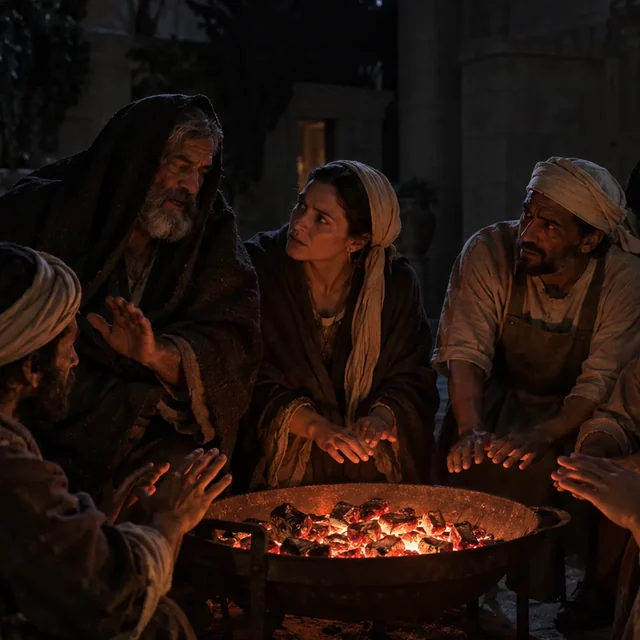
The arresting party arrives with weapons, lights, and Judas' knowledge of a place Jesus regularly used with his disciples. The betrayal therefore turns familiarity gained through companionship into practical advantage. Yet the Book of John immediately refuses to let that advantage define the scene. Jesus knows what is coming and walks forward to ask whom they seek. His identification sends the group backward to the ground, an action the account reports without explaining its mechanism. He then repeats the question and directs that the disciples be allowed to leave, linking their preservation to his earlier words about losing none given to him. Peter's sword cuts a named servant, Malchus, making the violence particular rather than symbolic. Jesus orders the weapon away and speaks of the Father's cup. The one being seized is still determining what kind of action will govern his arrest, and it will not be Peter's attempt at armed rescue.
Deep dive
The crossing of Cedron and entrance into a garden begin the movement out of the farewell prayer. Judas knows the place because Jesus has often met there with the disciples. Familiarity acquired within companionship becomes useful to betrayal. The lanterns, torches, and weapons belong to the arresting party, but John immediately places the encounter under Jesus' knowledge: he knows what is coming and goes forward to meet them. The account does not name this garden Gethsemane or repeat every detail found in the other Gospels.
His identification is followed by the party's retreat and fall to the ground. John reports the action without explaining its mechanics. The effect within the scene is unmistakable: these are not captors who seize an unsuspecting man before he can respond. Jesus again identifies the person they seek and directs that the disciples be allowed to go. John connects their preservation with his earlier words about losing none of those given to him.
Peter's sword then attempts a kind of protection Jesus has not requested. The servant is named Malchus, making the injury particular rather than a generalized clash. Jesus orders the sword put away and speaks of the cup the Father has given him. He is not rejecting the reality of human violence; he is refusing Peter's attempt to determine the mission through it. The shepherd's claim to lay down his life has become the governing action of the arrest.
Words to trace: Jesus, disciples, Judas, seek, betrayed, Nazareth
Verse-by-verse path
- John 18:1
The Cedron, or Kidron, is a winter torrent, dry most of the year, in the valley east of the temple. David crossed it fleeing Absalom while his own counsellor Ahithophel went over to the enemy (2 Samuel 15:23, 31), a parallel many readers have heard. Only the Book of John calls the place a garden, and the tomb will be in a garden too (19:41).
- John 18:2
Luke says Jesus spent his nights of that week on the Mount of Olives “as he was wont” (Luke 21:37; 22:39). Habit made him easy to find. The Book of John again tags Judas with his deed, “which betrayed him”, as it has since 6:71.
- John 18:3
“Band” is speira, the technical word for a Roman cohort, and “captain” in verse 12 is a chiliarch, a tribune. Whether Roman troops really joined temple police is debated. At Passover the moon was full, yet they came with lanterns and torches to find the light of the world.
- John 18:4
“Whom seek ye?” echoes Jesus’ first words in the Book of John, “What seek ye?” (1:38), spoken to two men who wanted to follow him. The risen Jesus will ask Mary Magdalene nearly the same question, “whom seekest thou?” (20:15).
- John 18:5
“I am he” is in Greek simply ego eimi, “I am”; the King James sets the added “he” in italics. “Jesus of Nazareth” is the title Pilate will nail above the cross (19:19). This is also the last time the Book of John names Judas: standing with the arresting party.
- John 18:6
Readers have long heard the Psalms here: “When the wicked... came upon me to eat up my flesh, they stumbled and fell” (Psalm 27:2), and “then shall mine enemies turn back” (Psalm 56:9). The reaction is triggered by the words, and the Book of John repeats them so that no one misses it.
- John 18:7
The same question, the same answer, word for word. The armed party has nothing further to say, and still nobody lays a hand on him. The repetition slows the scene so that the next move, the arrest, happens only when Jesus has set its terms.
- John 18:8
In Mark 14:50 the disciples forsake him and flee. The Book of John frames the same departure as a release granted on Jesus’ word: “let these go their way.” The good shepherd of 10:11-12 is the one who does not run when the wolf comes.
- John 18:9
The formula “that the saying might be fulfilled” is the one the Book of John uses for Scripture, and here it is applied to Jesus’ own words from the night before (17:12; compare 6:39). His sayings are given the standing of prophecy within hours of being spoken.
- John 18:10
Only the Book of John names the swordsman as Peter and the servant as Malchus, a name found among Nabataeans and built on the Semitic word for king. The word for ear is a diminutive, possibly the lobe. Luke alone adds that Jesus healed it (Luke 22:51).
- John 18:11
The Book of John has no prayer of agony in the garden, but this line shows it knows the cup of Mark 14:36, “take away this cup”. In the prophets the cup is the cup of the LORD’s fury (Isaiah 51:17; Jeremiah 25:15), and Jesus asks a question that expects the answer yes.
John 18:1-11
King James Version1When Jesus had spoken these words, he went forth with his disciples over the brook Cedron, where was a garden, into the which he entered, and his disciples.
2And Judas also, which betrayed him, knew the place: for Jesus ofttimes resorted thither with his disciples.
3Judas then, having received a band of men and officers from the chief priests and Pharisees, cometh thither with lanterns and torches and weapons.
4Jesus therefore, knowing all things that should come upon him, went forth, and said unto them, Whom seek ye?
5They answered him, Jesus of Nazareth. Jesus saith unto them, I am he. And Judas also, which betrayed him, stood with them.
6As soon then as he had said unto them, I am he, they went backward, and fell to the ground.
7Then asked he them again, Whom seek ye? And they said, Jesus of Nazareth.
8Jesus answered, I have told you that I am he: if therefore ye seek me, let these go their way:
9That the saying might be fulfilled, which he spake, Of them which thou gavest me have I lost none.
10Then Simon Peter having a sword drew it, and smote the high priest’s servant, and cut off his right ear. The servant’s name was Malchus.
11Then said Jesus unto Peter, Put up thy sword into the sheath: the cup which my Father hath given me, shall I not drink it?
John 18:12-18
Bound Inside, Followed at a Distance of Allegiance
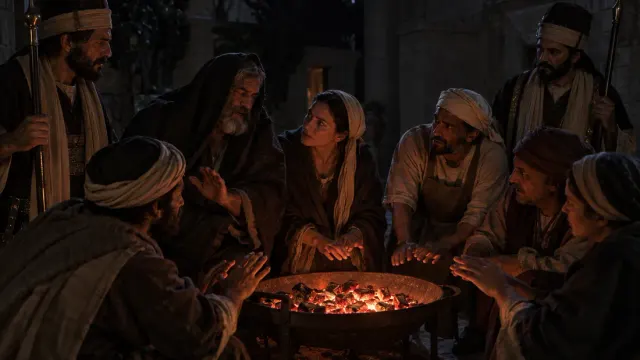
Binding follows a scene in which Jesus has already stepped forward and secured the disciples' release, so the ropes do not erase the agency just displayed. He is taken into a specific network of authority associated with Annas and Caiaphas, and the Book of John recalls Caiaphas' earlier counsel that one man should die for the people. The logic supporting the proceeding therefore predates the questioning. Peter, meanwhile, enters the courtyard through the help of another disciple whose identity the passage leaves unstated. The first denial comes not before a formal tribunal but from the woman keeping the door. Peter says, "I am not," then remains by a coal fire among servants and officers. The scene is almost painfully ordinary. Jesus has identified himself before an armed party; Peter declines to identify his relation to Jesus in a doorway conversation. The Book of John lets the spoken contrast carry the weight without inventing Peter's private thoughts.
Deep dive
Binding follows the scene in which Jesus has identified himself and secured the disciples' release. The ropes do not erase the agency John has just displayed. The mention of Annas and his relationship to Caiaphas places the hearing within a specific circle of authority, and John recalls Caiaphas' earlier proposal that one man should die for the people. The idea that will justify the proceedings has already been voiced before the questioning begins.
The other disciple knows the high priest and gains access to the courtyard, then assists Peter's entry. John does not identify this disciple by name in the passage. Treating the identification as certain would supply a detail the account leaves unstated. What matters here is the unequal access that brings Peter to the door and into the setting of the denial.
The first challenge comes from the woman keeping that door, not from a formal tribunal. Peter denies being one of Jesus' disciples and then stands warming himself with the servants and officers. The cold and the fire give the scene an ordinary physical setting without explaining his private thoughts. The contrast is already present in the spoken answers: Jesus has identified himself before the armed party, while Peter has declined to identify his own relation to him.
Words to trace: Peter, high, priest, disciple, door, Jesus
Verse-by-verse path
- John 18:12
A chiliarch commanded a thousand men in theory; the same rank belongs to Claudius Lysias, who arrests Paul in Acts 21:31. The binding is the first physical restraint put on Jesus in the Book of John, and he will be sent on “bound” in verse 24.
- John 18:13
Annas had been high priest from about AD 6 to 15, until the Roman prefect Valerius Gratus deposed him; five of his sons and his son-in-law Caiaphas held the office after him. Luke can still name “Annas and Caiaphas” together as high priests (Luke 3:2). “That same year” means that fateful year.
- John 18:14
In 1990 a family tomb was found south of Jerusalem holding an ornate ossuary inscribed “Joseph son of Caiaphas”, widely identified as this high priest’s, whose full name Josephus gives as Joseph Caiaphas. The Book of John reintroduces him by the one sentence it wants remembered.
- John 18:15
“Palace” renders aule, which is the open courtyard of a large house, not a royal building; the setting is the high priest’s residence. “Known unto the high priest” uses gnostos, an acquaintance, possibly someone with standing in the household. The disciple gets in with Jesus; Peter does not.
- John 18:16
The doorkeeper is a woman, a household slave in charge of the gate, like Rhoda who answers Peter’s knock at Mary’s house in Acts 12:13. The other disciple has to speak on Peter’s behalf to get him inside, the very place where he will be questioned.
- John 18:17
The girl frames her question with the Greek particle that expects a no: “You aren’t one of this man’s disciples too, are you?” It is almost an invitation to deny. “Also” suggests she knows the other disciple’s connection. Peter’s “I am not”, ouk eimi, inverts Jesus’ “I am” of verse 5.
- John 18:18
A “fire of coals” is an anthrakia, a charcoal fire, a word used only here and in 21:9, where the risen Jesus has a charcoal fire on the shore before asking Peter three times whether he loves him. Jerusalem stands about 750 metres up, and spring nights are cold.
John 18:12-18
King James Version12Then the band and the captain and officers of the Jews took Jesus, and bound him,
13And led him away to Annas first; for he was father in law to Caiaphas, which was the high priest that same year.
14Now Caiaphas was he, which gave counsel to the Jews, that it was expedient that one man should die for the people.
15And Simon Peter followed Jesus, and so did another disciple: that disciple was known unto the high priest, and went in with Jesus into the palace of the high priest.
16But Peter stood at the door without. Then went out that other disciple, which was known unto the high priest, and spake unto her that kept the door, and brought in Peter.
17Then saith the damsel that kept the door unto Peter, Art not thou also one of this man’s disciples? He saith, I am not.
18And the servants and officers stood there, who had made a fire of coals; for it was cold: and they warmed themselves: and Peter stood with them, and warmed himself.
John 18:19-24
A Public Teacher Asks for Witnesses
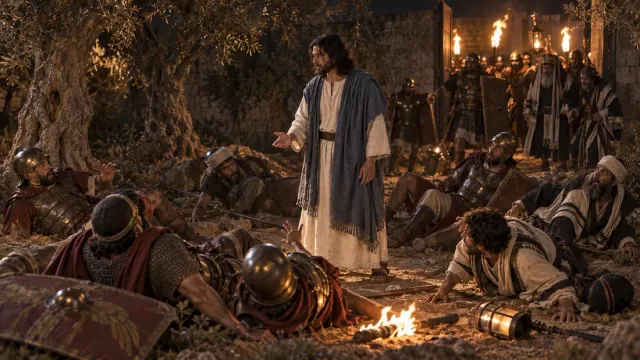
Asked about his disciples and teaching, Jesus points away from secret conspiracy and toward public witness. He has spoken in synagogues and in the temple, places where hearers can be found, so the proper route is to ask those who heard him. The Book of John has made testimony a governing question from its opening chapters, and the hearing now exposes what happens when evidence is requested but force answers instead. An officer strikes Jesus and objects to the manner of his response. Jesus does not answer violence with a counterblow. He asks for the evil in his words to be demonstrated, or, if he spoke well, for the blow to be explained. The account needs no invented catalogue of procedural violations. The substitution of a slap for testimony is enough. Even the precise sequencing around Annas and Caiaphas remains somewhat uncertain, but the central contrast does not: the bound prisoner asks for evidence and receives violence instead of proof.
Deep dive
The questioning concerns both Jesus' teaching and the people associated with him. His answer directs attention to the public settings in which he has spoken: synagogue and temple. Saying that he has spoken openly does not mean he has never taught disciples privately; the preceding chapters consist of such instruction. The point is that his doctrine is not a hidden conspiracy whose content can be discovered only by extracting an admission from him.
Jesus asks that those who heard be questioned. This returns the hearing to testimony, the very subject that has structured so many of John's earlier disputes. The officer's response is a blow accompanied by an objection to the manner of his answer. Jesus then distinguishes proving evil speech from striking someone who has spoken well. The account exposes the substitution of force for an answer without needing an invented catalogue of violated legal procedures.
Verse 24 presents a sequencing question. The KJV's "had sent" can describe an earlier transfer to Caiaphas, while other readings take the verse as Annas sending Jesus onward after this examination. The passage is therefore read with some uncertainty about which high priest presides over the preceding exchange. What remains clear is that the bound prisoner calls for evidence and receives violence instead of a demonstrated fault.
Words to trace: Jesus, high, priest, evil, always, Annas
Verse-by-verse path
- John 18:19
The questions come in a telling order, first about his disciples and then about his teaching, as though the size of the following mattered before its content. That is an inference, but a movement of followers was what worried the council in 11:48.
- John 18:20
“Openly” is parresia, the word the Jerusalem crowd used in 7:26 when they marvelled that he spoke boldly in the temple. “In secret have I said nothing” echoes the LORD in Isaiah 45:19, “I have not spoken in secret”, which the Greek Old Testament renders with nearly the same words.
- John 18:21
Some of those who heard him are close at hand. The temple officers once sent to arrest him came back empty-handed saying “Never man spake like this man” (7:46). The men standing around Jesus now belong to the same service.
- John 18:22
The blow, rhapisma, is a slap with the open hand or a rod. The Greek of Isaiah 50:6 uses the same word, “I gave my cheeks to blows”. Striking a prisoner during questioning was a way of charging him with insolence toward the office.
- John 18:23
Augustine noticed that Jesus, who taught turning the other cheek (Matthew 5:39), does not do so here but protests, and concluded that the command concerns the readiness of the heart, not silent compliance. “Bear witness” brings the word of testimony, so frequent in the Book of John, into the hearing room.
- John 18:24
Some copies add “therefore” to make the sending follow the hearing, and the ancient Sinaitic Syriac moves this verse to follow verse 13, putting the whole exchange before Caiaphas. Jesus is still “bound”, so he answered the questions tied.
John 18:19-24
King James Version19The high priest then asked Jesus of his disciples, and of his doctrine.
20Jesus answered him, I spake openly to the world; I ever taught in the synagogue, and in the temple, whither the Jews always resort; and in secret have I said nothing.
21Why askest thou me? ask them which heard me, what I have said unto them: behold, they know what I said.
22And when he had thus spoken, one of the officers which stood by struck Jesus with the palm of his hand, saying, Answerest thou the high priest so?
23Jesus answered him, If I have spoken evil, bear witness of the evil: but if well, why smitest thou me?
24Now Annas had sent him bound unto Caiaphas the high priest.
John 18:25-27
A Familiar Face Makes the Denial More Specific
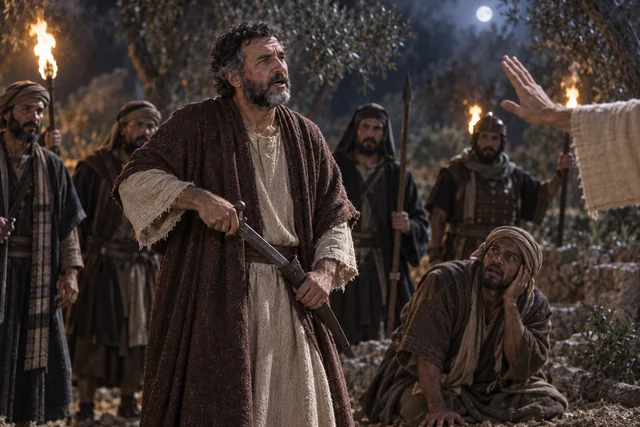
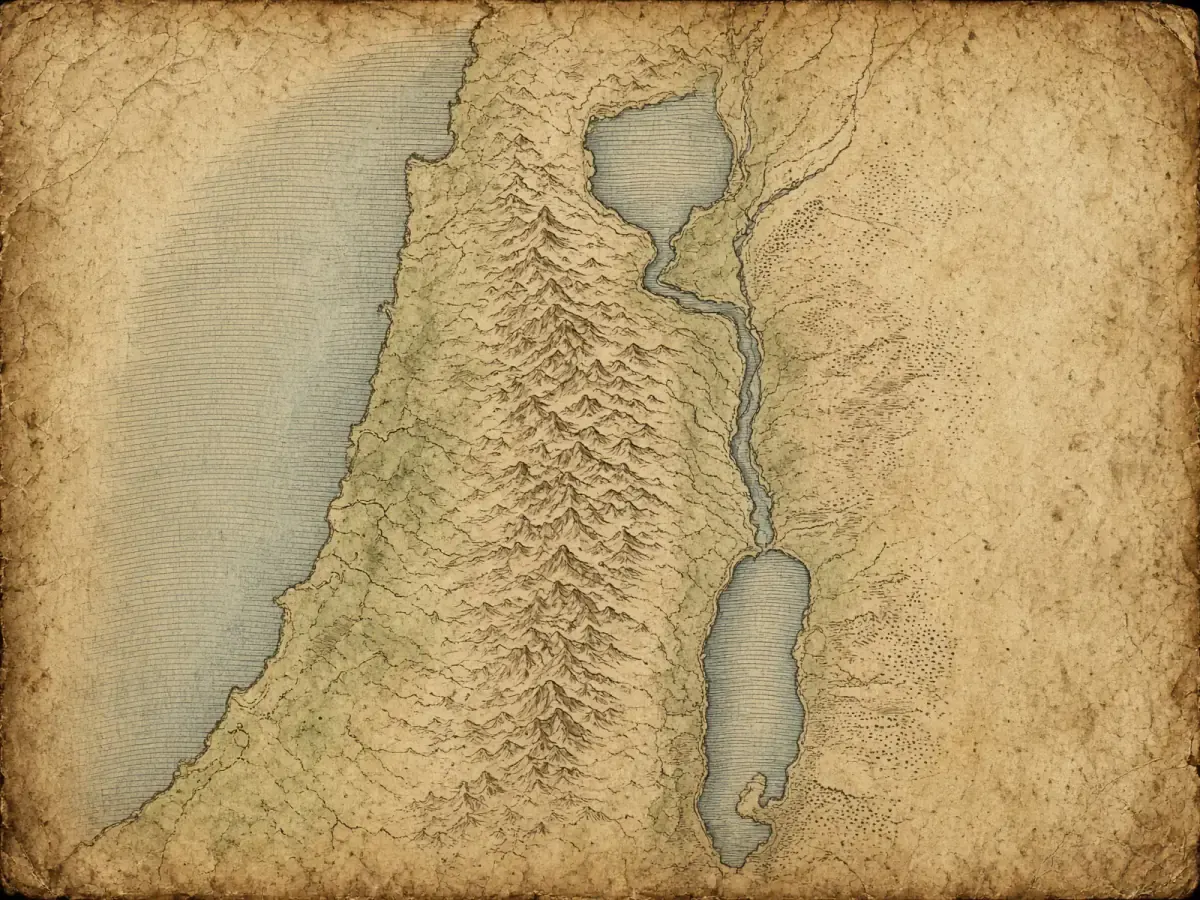
The Book of John returns to Peter at the coal fire and places his examination beside Jesus' interrogation. Jesus has spoken openly under official questioning; Peter is asked whether he belongs to him and denies it. The final challenge is more specific because it comes from a relative of Malchus, the servant whose ear Peter cut in the garden. The man claims to have seen Peter there, joining the earlier attempt at bold defense directly to the pressure now falling on him. Peter denies again, and the cock immediately crows. The Book of John records no explanatory speech and no psychological diagnosis. The sound is enough because Jesus had already supplied the interpretation in chapter 13. Peter promised to lay down his life and heard that he would deny three times before morning. The prediction has now become event. The account still refuses to make that failure Peter's last word, leaving his future unresolved until the final chapter.
Deep dive
John returns to Peter at the fire after the account of Jesus' interrogation. The arrangement puts the two examinations beside one another. Jesus has spoken openly under official questioning; Peter denies association under questions from those nearby. The second denial is followed by a more dangerous identification from someone connected with the garden. A relative of Malchus says he saw Peter there, linking the attempted sword defense directly with the pressure now placed upon him.
Peter's third denial and the cock's crow are recorded with exceptional economy. The account does not add a speech explaining why he failed. It allows the sound to recall Jesus' words in chapter 13, which had contradicted Peter's promise to lay down his life. The earlier prediction has now acquired the exact sequence Peter believed he could prevent.
John does not narrate Peter's tears or a departure into the night at this point, although other Gospel accounts contain additional details. The focus remains on the fulfilled word and the contrast between Jesus' witness and Peter's denial. The chapter then moves forward without settling Peter's future. That unfinished relation matters: the final chapter will return to him, not as a man whose failure was imaginary, but as one whose place must be addressed after it.
Words to trace: Peter, denied, cock, crew, disciples, garden
Verse-by-verse path
- John 18:25
“He denied” is the verb of Jesus’ prediction in 13:38, “till thou hast denied me thrice”. It also inverts John the Baptist, who “confessed, and denied not” and then said “I am not the Christ” (1:20). The Baptist’s “I am not” was true; Peter’s is not.
- John 18:26
The first two questions expected the answer no. This one is phrased in Greek to expect yes: “Did I not see thee in the garden?” Only the Book of John knows that the questioner is Malchus’ relative, a detail from someone familiar with the high priest’s household, like the disciple of verse 15.
- John 18:27
The Romans called the third watch of the night, midnight to three, gallicinium, cockcrow, and Mark 13:35 names “the cockcrowing” among the watches. A few have suggested a trumpet signal ending that watch, but most take it as a bird. “Immediately” fixes the moment exactly.
John 18:25-27
King James Version25And Simon Peter stood and warmed himself. They said therefore unto him, Art not thou also one of his disciples? He denied it, and said, I am not.
26One of the servants of the high priest, being his kinsman whose ear Peter cut off, saith, Did not I see thee in the garden with him?
27Peter then denied again: and immediately the cock crew.
John 18:28-32
The Threshold Is Guarded While the Death Is Pursued
The threshold of Pilate's judgment hall carries one of the chapter's sharpest juxtapositions. Jesus' accusers avoid entering because of defilement concerns connected with eating the Passover, while simultaneously pressing a case intended to end in death. The Book of John aims that irony at the conduct in this proceeding, not at Jewish worship as such. Pilate asks for an accusation, and the first answer effectively asks him to trust the delivery itself as proof that Jesus is a wrongdoer. When he points them back toward their own law, the issue of execution surfaces. Their stated inability to put a man to death moves the case under Roman authority and toward the kind of death Jesus had already foretold. Administrative procedure therefore becomes part of the Gospel's larger pattern of fulfillment. The doorway does more than separate inside from outside. It is where ritual concern, accusation, imperial jurisdiction, and the manner of the coming death meet.
Deep dive
The accusers remain outside so that they may eat the Passover, and Pilate comes out to them. John places ritual caution beside the effort to obtain Jesus' death. The irony concerns these actions in this proceeding, not the worth of Jewish observance in general. The Gospel has repeatedly presented Jewish worship, Scripture, and believers without treating them as one undifferentiated opposition.
Pilate asks for an accusation, but the first answer appeals to the fact that Jesus has been brought to him: they would not have delivered him if he were not a wrongdoer. That response attempts to substitute the accusers' decision for a stated charge. When Pilate directs them toward their own law, their answer concerns inability to put anyone to death. The exchange reveals the desired outcome before the later discussion of kingship supplies the accusation in terms Pilate must consider.
John interprets the transfer in relation to Jesus' words about the manner of his death. The movement into Roman authority is therefore not merely administrative background. It brings the account toward the lifting up already explained in John 12:32–33. Questions about how the Passover timing fits the other Gospels remain relevant and are addressed with the preparation-day notice in chapter 19; they need not erase the immediate contrast enacted at this doorway.
Words to trace: death, hall, Jesus, judgment, Pilate, accusation
Verse-by-verse path
- John 18:28
The “hall of judgment” is the praetorium, the governor’s headquarters, either Herod’s palace on the western hill or the Antonia fortress beside the temple. “Early”, proi, is the last watch of the night, before six; Roman officials did business at first light.
- John 18:29
Pilate enters the Book of John without introduction, as though every reader knows him. From here to 19:16 he goes out to the accusers and in to Jesus again and again, some seven scenes in all, shuttling between a prisoner inside and accusers who will not cross the threshold.
- John 18:30
“Malefactor” is kakopoios, an evildoer. Jesus had just challenged the officer, “If I have spoken evil, bear witness of the evil” (verse 23), and no evil was named. Now the accusers call him an evildoer and still name nothing, asking Pilate to take their word for it.
- John 18:31
Roman governors reserved the death sentence to themselves. Yet stoning did happen: Stephen dies in Acts 7, and Josephus says the high priest Ananus had James the brother of Jesus stoned in AD 62, in a gap between governors, and was deposed for it.
- John 18:32
“Signifying what death he should die” repeats 12:33 word for word, and in 21:19 the same phrase is used of Peter’s death. A Jewish execution would have meant stoning; a Roman one means being lifted up on a cross.
John 18:28-32
King James Version28Then led they Jesus from Caiaphas unto the hall of judgment: and it was early; and they themselves went not into the judgment hall, lest they should be defiled; but that they might eat the passover.
29Pilate then went out unto them, and said, What accusation bring ye against this man?
30They answered and said unto him, If he were not a malefactor, we would not have delivered him up unto thee.
31Then said Pilate unto them, Take ye him, and judge him according to your law. The Jews therefore said unto him, It is not lawful for us to put any man to death:
32That the saying of Jesus might be fulfilled, which he spake, signifying what death he should die.
John 18:33-38
The Kingdom's Source Changes the Terms of the Hearing
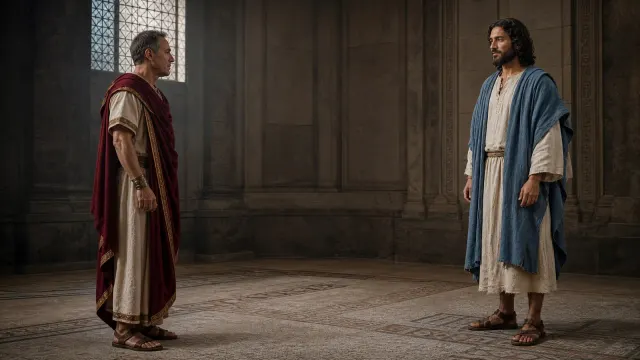
Pilate asks about kingship in the terms that matter to Roman authority, but Jesus first asks where the charge came from. That question exposes accusation before accepting its categories. His answer then distinguishes the kingdom's source from the world's political order. "Not of this world" does not mean irrelevant to this world; Jesus explains the difference through means. If his kingdom operated from this world's source, servants would fight to prevent his delivery. Peter's sword has already provided the immediate contrast. The Book of John therefore presents kingship without coercive self-preservation. Jesus connects his birth and coming into the world with bearing witness to truth, and the person "of the truth" hears his voice. Pilate responds, "What is truth?" then goes outside. The Book of John does not tell us whether the tone is cynical, weary, or philosophical. What matters is the action that follows: the question remains unexplored while Pilate publicly declares that he finds no fault in Jesus.
Deep dive
Inside the judgment hall, Pilate's question takes up the royal claim. Jesus first asks whether it comes from Pilate's own inquiry or from others' report, exposing the source of the accusation before answering its terms. Pilate distances himself from the dispute and asks what Jesus has done. The answer concerns a kingdom, but not one whose origin and means belong to this world.
The phrase "not of this world" is not the same as saying that the kingdom has no consequences within the world. Jesus explains it through the conduct of his servants: a kingdom operating on those terms would produce a fight to prevent his delivery. Peter's sword has already supplied the scene's immediate contrast, and Jesus has already refused it. Kingship is affirmed without accepting the model of coercive preservation Pilate's question assumes.
Jesus connects his birth and coming into the world with bearing witness to truth. The person who belongs to truth hears his voice, recalling the shepherd discourse within a very different setting. Pilate's question about truth is followed by his return outside; John does not specify whether his tone is cynical, impatient, or philosophically searching. The action leaves the answer unexplored while he announces that he finds no fault. The judgment already spoken does not bring the prisoner freedom.
Words to trace: Jesus, Pilate, Jews, king, kingdom, truth
Verse-by-verse path
- John 18:33
Pilate’s first words to Jesus are the same question in all four Gospels. The Greek puts “thou” first, with emphasis: “You? The king of the Jews?” The prisoner in front of him does not look like a king.
- John 18:34
“Of thyself” is aph’ heautou, the phrase the Book of John used of Caiaphas in 11:51: “this spake he not of himself”. Jesus asks Pilate the question that decides whether a speaker is a source or a mouthpiece.
- John 18:35
“Am I a Jew?” is framed to expect a scornful no. “Thine own nation”, ethnos, picks up the word the council used when it feared the Romans would “take away both our place and nation” (11:48). The nation has now handed its man to the Romans.
- John 18:36
“Servants” translates hyperetai, the same word the Book of John has used for the chief priests’ “officers” in verses 3, 12, 18 and 22. The high priest’s attendants came armed; Jesus says his own would have fought too, if his kingdom worked that way.
- John 18:37
“Thou sayest that I am a king” is a guarded reply, neither denial nor bare assent, and some read it “You say it, because I am a king.” “To this end was I born” is the only place the Book of John mentions Jesus’ birth.
- John 18:38
Francis Bacon opened his essay “Of Truth” in 1625 with “What is truth? said jesting Pilate, and would not stay for an answer”, one reading of the tone among several. “Fault” is aitia, a legal ground for a charge. This is the first of three such verdicts (19:4, 19:6).
John 18:33-38
King James Version33Then Pilate entered into the judgment hall again, and called Jesus, and said unto him, Art thou the King of the Jews?
34Jesus answered him, Sayest thou this thing of thyself, or did others tell it thee of me?
35Pilate answered, Am I a Jew? Thine own nation and the chief priests have delivered thee unto me: what hast thou done?
36Jesus answered, My kingdom is not of this world: if my kingdom were of this world, then would my servants fight, that I should not be delivered to the Jews: but now is my kingdom not from hence.
37Pilate therefore said unto him, Art thou a king then? Jesus answered, Thou sayest that I am a king. To this end was I born, and for this cause came I into the world, that I should bear witness unto the truth. Every one that is of the truth heareth my voice.
38Pilate saith unto him, What is truth? And when he had said this, he went out again unto the Jews, and saith unto them, I find in him no fault at all.
John 18:39-40
An Innocent Man Becomes an Option in a Release Offer
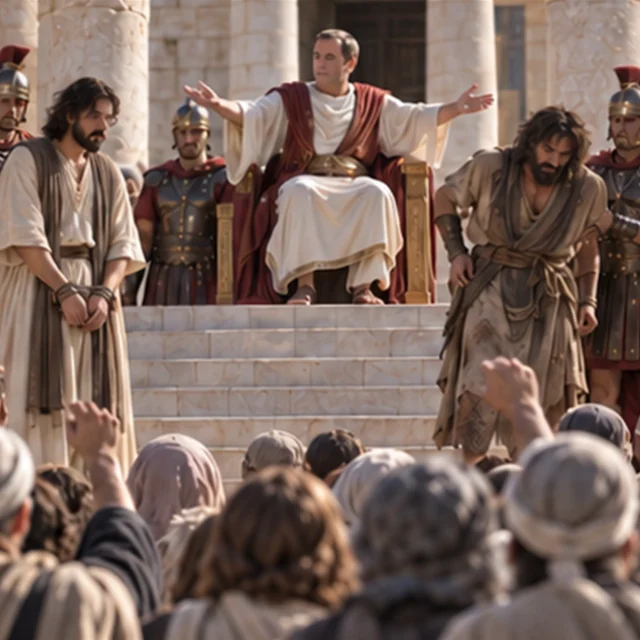
Pilate has just said that he finds no fault, yet he does not release Jesus on the strength of that conclusion. Instead, innocence is placed into a customary Passover choice as though an acquitted man still needs popular preference to go free. That order gives the release offer its sting. The title "King of the Jews" stays attached to Jesus while the crowd demands Barabbas. The Book of John identifies Barabbas only as a robber here and resists expanding him with details supplied elsewhere. The contrast is sufficient without embellishment. Responsibility also keeps slipping between speakers without dissolving. Pilate voices innocence but does not act on it. The accusers want death before fully shaping the charge in Roman terms. Jesus, whose authority is supposedly under examination, has given the most coherent account of his purpose. The chapter ends with the wrong prisoner requested, preparing for the next chapter's mockery, scourging, and crucifixion.
Deep dive
Pilate's offer follows his declaration that he finds no fault in Jesus. That order makes the proposed release more troubling than a simple attempt to be generous. A man pronounced without fault is now presented as one candidate in a discretionary choice, as though release required the audience's preference rather than the finding already announced. The title "King of the Jews" remains central to the offer and to the rejection it receives.
John identifies Barabbas briefly as a robber and does not supply the fuller account of his activities found elsewhere. The brevity sharpens the contrast without requiring an embellished portrait of the chosen prisoner. The reply demands this other man rather than Jesus, and the chapter stops at that preference.
The exchange also continues the pattern of responsibility passing from one speaker to another without the decisive act matching the spoken claim. Pilate says no fault, yet does not release on that basis. The accusers seek death while resisting an ordinary statement of charge. Jesus, the one whose authority is being tested, has given the most consistent account of his purpose. The next chapter will turn the failure to act on innocence into scourging, mock royalty, and crucifixion.
Words to trace: Barabbas, release, cried, custom, Jews, King
Verse-by-verse path
- John 18:39
No Passover release custom is known outside the Gospels. The Mishnah does allow the Passover lamb to be slaughtered for someone promised release from prison (Pesahim 8:6), which some cite as a trace of the practice. Pilate uses the royal title, probably with a sneer.
- John 18:40
Barabbas means “son of the father” in Aramaic, and some manuscripts of Matthew 27:16-17 call him Jesus Barabbas. “Robber” is lestes, the word Josephus uses for insurgent bandits and the word of 10:1, the thief and robber who climbs into the fold another way.
John 18:39-40
King James Version39But ye have a custom, that I should release unto you one at the passover: will ye therefore that I release unto you the King of the Jews?
40Then cried they all again, saying, Not this man, but Barabbas. Now Barabbas was a robber.
Questions to keep in mind while reading
- Watch what Jesus says and does, and how people respond.
- Trace kingdom, discipleship, opposition, cross, and resurrection in the evangelist’s own sequence.
- Let later doctrine clarify the scene without erasing its immediate setting.
Text first
Where readers differ
The chapter summary begins with what the passage says and how its parts fit together. It does not assume one denomination has already settled every question. Where a conclusion depends on a tradition, literary theory, or historical reconstruction, that dependence is named openly.
The KJV text is presented first. Interpretive conclusions are labeled, and differences are introduced only when they help a reader understand why serious communities do not always reach the same answer.
Comparative interpretive notes for this chapter are in preparation. Until reviewed notes are ready, this page separates the KJV text from summary and application without claiming that serious readers agree on every question.
Questions beneath the surface
- What account of God, human freedom, responsibility, and the good life emerges from John 18?
- Which tension does the chapter refuse to resolve quickly?
- What changes when the chapter is read as part of the whole canon rather than as an isolated moral lesson?
- Where might a sincere reader confuse a familiar tradition with something the text states directly?
Questions for serious personal contemplation
These open-ended questions make room for tension, honest response, prayer, and conclusions that remain accountable to the chapter.
Observe without rushing
What part of John 18 makes you stop, feel unsettled, or feel surprised, and why?
Which detail in the passage would be easiest to overlook? How does that detail change your understanding?
Where do you see tension between what happens and this focus: Jesus meeting the arresting party in the garden, Peter’s sword, hearings before Annas and Pilate, and Peter’s denial?
What important question does the passage leave open instead of resolving quickly?
Examine your inner life honestly
Which person, response, fear, or desire in the passage feels most like your own life right now?
What assumption about God, other people, or yourself does this text challenge?
Which part would you rather soften, avoid, or explain away too quickly? What might that reaction reveal?
If this Scripture could ask you one direct question, what do you think it would ask?
Respond with wisdom and courage
What do you need to remember, confess, grieve, thank God for, or trust after reading this passage?
How might another faithful person read this situation differently without ignoring the text?
What obedient response would be costly, uncomfortable, or slow, yet still faithful to Scripture?
What question will you carry into prayer this week, and which verses will you keep in front of you?
Music and video connected to the passage
Related media appears when its Scripture reference overlaps this study. Music and video can illuminate a theme while the biblical text remains the foundation.