The big picture
The Book of John makes the crucifixion chapter a collision between declared innocence and actual punishment. Pilate repeatedly says he finds no fault, yet Jesus is scourged, mocked, displayed, and finally delivered under pressure tied to Caesar. The title above the cross keeps the kingship question public in three languages, even after the chief priests ask Pilate to reduce it to a mere claim. Around the execution, the account moves between Scripture and concrete human detail: garments are divided, Jesus provides for his mother, thirst is spoken, and death is witnessed through the pierced side and unbroken legs. "It is finished" names the completion of the Father's work rather than simply the stopping of suffering. Joseph and Nicodemus then handle the body according to Jewish burial practice and place it in a new nearby tomb. The chapter ends not in abstraction but with a known body in a known grave.
In this chapter
- The Declaration of Innocence Stands Beside the Scourging John 19:1-7
Scourging comes after the release exchange and before any newly demonstrated offense.
- Authority from Above Does Not Remove Responsibility Below John 19:8-16
The charge about the Son of God makes Pilate more afraid, but the Book of John does not fill that fear with an invented private theory.
- The Disputed Title Stays Above the Cross John 19:17-22
The crucifixion itself is described with remarkable brevity.
- Possessions Are Divided; a Household Is Entrusted John 19:23-27
At the foot of the cross, soldiers calculate clothing while Jesus attends to a human obligation that death has not made irrelevant.
- Finished Describes the Work, Not Merely the Suffering John 19:28-30
The Book of John begins the final movement with Jesus knowing that all things are now accomplished, so his thirst belongs inside completion rather than interrupting it.
- The Body Is Dead, and the Witness Insists Upon It John 19:31-37
The urgency to remove the bodies before the high Sabbath creates a practical examination of death.
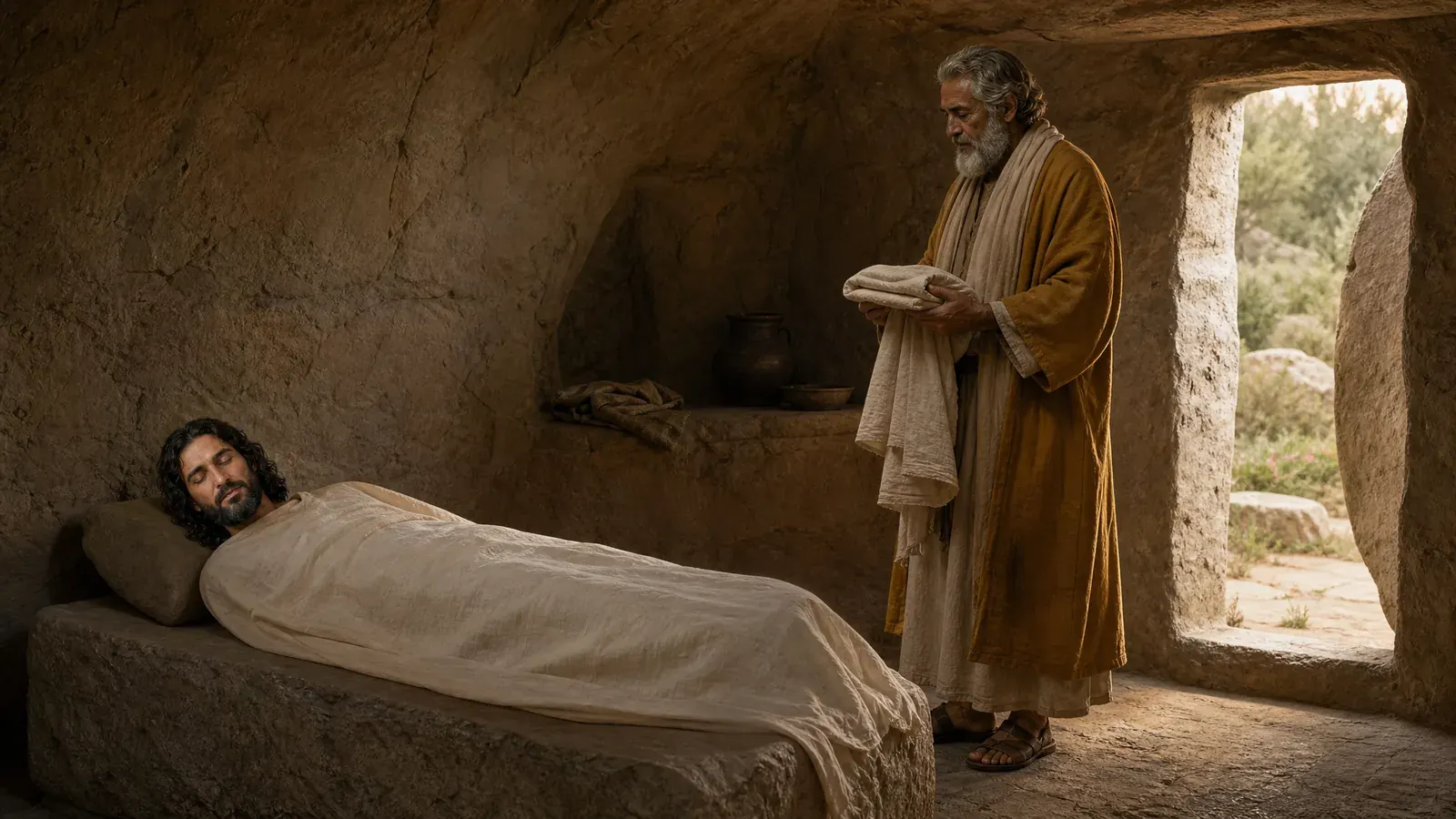
- Hidden Association Becomes the Work of Burial John 19:38-42
Two men previously associated with caution now perform the public work of burial.

Scripture beside the summary
John · King James Version · 42John 19:1-7
The Declaration of Innocence Stands Beside the Scourging
Scourging comes after the release exchange and before any newly demonstrated offense. That placement matters because Pilate's declaration of no fault stands beside punishment rather than preventing it. The soldiers add a crown of thorns, purple robe, mock greeting, and blows, turning kingship into a theater of humiliation. Yet the Book of John has spent too long on Jesus' identity for the scene to remain only mockery. The title being ridiculed is exactly the title the Gospel continues forcing into view. Pilate presents the injured Jesus and repeats that he finds no fault. The chief priests and officers answer with demands for crucifixion, and The Book of John names those speakers carefully rather than assigning the cry indiscriminately to every Jew. The appeal to law then names Jesus' claim to be the Son of God. The trial has not drifted away from the public ministry. Its old disputes have been concentrated around a wounded man whose claims are now treated as grounds for death.
Deep dive
The scourging follows the release exchange of the previous chapter, not a newly demonstrated offense. John keeps Pilate's repeated finding of no fault beside actions that injure the man so described. The crown of thorns, purple robe, royal greeting, and blows form a mock enthronement. Their immediate purpose is humiliation, but within the Gospel they also sustain the kingship question Pilate has been unable to settle. The claim being ridiculed is the claim the account continues to place before the audience.
Pilate brings Jesus out with another statement of innocence. The presentation exposes a body already subjected to punishment, making it impossible to treat the finding as though it had protected him. The cry for crucifixion comes from the chief priests and officers named in the scene. Precision about those speakers matters; John does not attribute the words to every Jew or to every person in Jerusalem.
The appeal to law then names the claim to be God's Son as grounds for death. That charge reaches back through the disputes about the Father's works and the unity of Father and Son. The trial is not becoming a wholly different account from the public ministry. It is concentrating its contested claims around the bound and wounded person who made them. John gives the suffering its weight through these actions and exchanges without adding a speculative inventory of wounds.
Words to trace: Pilate, crucify, crown, fault, find, Jesus
Verse-by-verse path
- John 19:1
In Mark and Matthew the scourging follows the sentence as the prelude to crucifixion. The Book of John sets it in the middle of the trial, where it looks like the lighter beating Luke has Pilate propose, “I will therefore chastise him, and release him” (Luke 23:16), used here as an attempt to satisfy the crowd.
- John 19:2
“Platted” is plaited, woven. The thorns were likely whatever thorny scrub grew nearby, and some suggest the spikes stood outward like the radiate crowns on imperial coins, though that is an inference. Mark says purple and Matthew scarlet; a soldier’s red cloak would serve for either.
- John 19:3
“Hail, King of the Jews!” parodies the salute Ave, Caesar. Several manuscripts add “and they came to him”, and the verbs are imperfects, so the picture is of soldiers stepping up one after another to salute and strike. The blows are the same open-handed slaps as in 18:22.
- John 19:4
Luke also counts three declarations of innocence by Pilate (Luke 23:4, 14, 22). Here the flogged prisoner is paraded as though his condition were proof: a beaten man is plainly no rebel king, so surely the accusers are satisfied.
- John 19:5
In the Latin Vulgate this is Ecce homo, the title of paintings by Titian, Correggio and Caravaggio, among many. Some hear Zechariah 6:12, “Behold the man whose name is The BRANCH”, a royal text; the Book of John does not flag it, so that remains an inference.
- John 19:6
The Greek cry is the verb alone, twice, with no object: “Crucify, crucify!” Pilate’s reply is a taunt, not a permission, since in 18:31 they have already told him they may not put a man to death. His own “no fault” is now said for the third time.
- John 19:7
The law meant is Leviticus 24:16, death for blaspheming the name of the LORD. “Made himself the Son of God” recalls the charges of 5:18, “making himself equal with God”, and 10:33, “thou, being a man, makest thyself God.” The political accusation has been dropped for the religious one.
John 19:1-7
King James Version1Then Pilate therefore took Jesus, and scourged him.
2And the soldiers platted a crown of thorns, and put it on his head, and they put on him a purple robe,
3And said, Hail, King of the Jews! and they smote him with their hands.
4Pilate therefore went forth again, and saith unto them, Behold, I bring him forth to you, that ye may know that I find no fault in him.
5Then came Jesus forth, wearing the crown of thorns, and the purple robe. And Pilate saith unto them, Behold the man!
6When the chief priests therefore and officers saw him, they cried out, saying, Crucify him, crucify him. Pilate saith unto them, Take ye him, and crucify him: for I find no fault in him.
7The Jews answered him, We have a law, and by our law he ought to die, because he made himself the Son of God.
John 19:8-16
Authority from Above Does Not Remove Responsibility Below
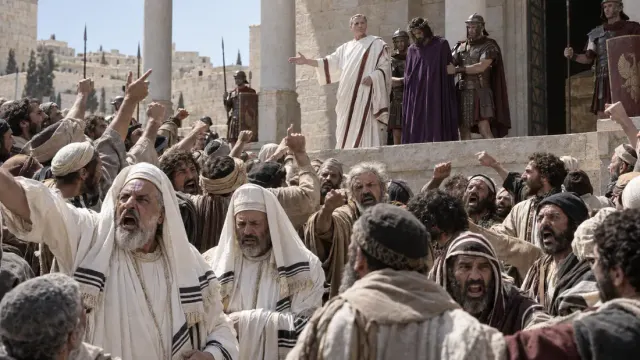
The charge about the Son of God makes Pilate more afraid, but the Book of John does not fill that fear with an invented private theory. His question, "Whence art thou?", returns to the Gospel's long argument about Jesus' origin. When Jesus remains silent, Pilate appeals to his own power to release or crucify. The answer places that authority under what is "given thee from above," yet it does not remove responsibility. Jesus can speak of another's greater sin only because Pilate's use of granted power still carries guilt. The pressure then shifts to Caesar. Pilate's attempt to release Jesus bends under the suggestion that freeing a rival king marks disloyalty to Rome. He brings Jesus out, presents him again as king, and finally delivers him to be crucified. The scene exposes a hard truth about authority: receiving power from above does not make every exercise of that power innocent below.
Deep dive
John explicitly records Pilate becoming more afraid when he hears the charge concerning God's Son. It does not explain that fear through an invented pagan legend or private diagnosis. His question returns to origin, the matter that has repeatedly divided hearers throughout the Gospel. Jesus' silence prompts Pilate to appeal to his power to release or crucify. The answer places that authority under what is given from above. It does not declare Pilate blameless: the reference to another's greater sin presupposes responsibility rather than abolishing it.
The subsequent pressure concerns loyalty to Caesar. Pilate brings Jesus out, sits in the judgment seat, and again presents him as king. The chief priests answer that Caesar is their only king. John names the speakers and lets their profession stand beside their rejection of the person the Gospel identifies as Israel's King. Pilate then delivers Jesus to be crucified. An acknowledgment of authority's higher source has not prevented its culpable exercise.
The time notice presents genuine difficulties for comparison with the other Gospels. Some interpreters take "preparation of the passover" as the eve of the Passover meal; others understand the Friday within the festival week. John places this presentation about the sixth hour, while Mark 15:25 places crucifixion at the third. Different reckonings and approximate time designations have been proposed, but no reconstruction is established by these verses alone. The contrasting discussions in Gill and Ellicott on John 19:14 illustrate the unresolved questions. John's own emphasis remains the convergence of Passover, judgment, and the king's delivery.
Words to trace: Jesus, Pilate, king, crucify, power, cried
Verse-by-verse path
- John 19:8
“The more afraid” implies earlier fear, though none has been mentioned; the Greek comparative can also simply mean “very afraid”. Either way this is the only feeling the Book of John ascribes to Pilate.
- John 19:9
Silence before accusers is the servant’s posture in Isaiah 53:7, “as a sheep before her shearers is dumb”, and Mark 15:5 records the same silence before Pilate. In the Book of John it is striking because Jesus has answered Pilate readily until now.
- John 19:10
The Greek puts “me” first: “To me you will not speak?” Power is exousia, lawful authority, and a Roman prefect held the right of the sword. Pilate names release second, after crucifixion, as if listing his options in order of likelihood.
- John 19:11
“From above” is anothen, the word of 3:3 and 3:31, “born from above” and “he that cometh from above”. Who is “he that delivered me” is debated: Caiaphas, who handed him to Pilate, or Judas, who is repeatedly called the one who delivered him. The singular points to one man.
- John 19:12
The threat had teeth. Pilate’s patron at Rome is often thought to have been Sejanus, who fell in AD 31, after which many of his associates were purged. “Speaketh against” is antilegei, to oppose, the language of maiestas, treason against the emperor.
- John 19:13
Gabbatha is Aramaic, probably meaning a height or ridge, so it is a second name, not a translation of the Greek Lithostrotos, Pavement. “Sat down” can also be read transitively, that Pilate seated Jesus on the judgment seat, as the Gospel of Peter and Justin Martyr tell it; most take Pilate as the one seated.
- John 19:14
“Preparation”, paraskeue, became the ordinary Greek word for Friday and remains so in modern Greek. “Behold your King!” is Pilate’s third “behold” in this scene, after “Behold, I bring him forth” and “Behold the man”.
- John 19:15
“Away with him” is aron, literally “lift him up” or “take him off”. Israel’s own confession was that the LORD was king; Gideon refused a crown for that reason (Judges 8:23), and asking Samuel for a king was a rejection of God (1 Samuel 8:7). The chief priests now name Caesar.
- John 19:16
The Greek says Pilate handed him over “to them”, though Roman soldiers carry out the sentence (verse 23). “Delivered”, paradidomi, is the verb used of Judas throughout, so the handing over now passes from Judas to the priests, from the priests to Pilate, and from Pilate to the executioners.
John 19:8-16
King James Version8When Pilate therefore heard that saying, he was the more afraid;
9And went again into the judgment hall, and saith unto Jesus, Whence art thou? But Jesus gave him no answer.
10Then saith Pilate unto him, Speakest thou not unto me? knowest thou not that I have power to crucify thee, and have power to release thee?
11Jesus answered, Thou couldest have no power at all against me, except it were given thee from above: therefore he that delivered me unto thee hath the greater sin.
12And from thenceforth Pilate sought to release him: but the Jews cried out, saying, If thou let this man go, thou art not Cæsar’s friend: whosoever maketh himself a king speaketh against Cæsar.
13When Pilate therefore heard that saying, he brought Jesus forth, and sat down in the judgment seat in a place that is called the Pavement, but in the Hebrew, Gabbatha.
14And it was the preparation of the passover, and about the sixth hour: and he saith unto the Jews, Behold your King!
15But they cried out, Away with him, away with him, crucify him. Pilate saith unto them, Shall I crucify your King? The chief priests answered, We have no king but Cæsar.
16Then delivered he him therefore unto them to be crucified. And they took Jesus, and led him away.
John 19:17-22
The Disputed Title Stays Above the Cross
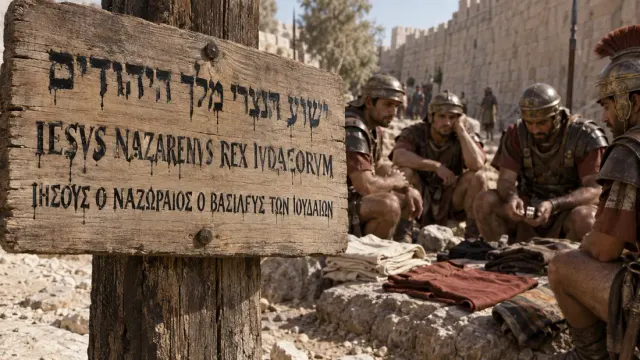
The crucifixion itself is described with remarkable brevity. Jesus carries the cross to Golgotha, is placed between two others, and the Book of John gives much of the scene's interpretive weight to the title over him. Pilate writes "JESUS OF NAZARETH THE KING OF THE JEWS" in Hebrew, Greek, and Latin, making the disputed identity visible near the city across languages. The chief priests do not ask him to remove the kingship language entirely. They ask that it be reduced to something Jesus merely claimed about himself. Pilate, who yielded when the prisoner's life was at stake, suddenly becomes immovable over a sentence: "What I have written I have written." The Book of John offers no psychological explanation for the change. The effect is enough. The execution intended to disgrace Jesus leaves his royal designation publicly fixed above him, and the lifting up announced earlier has now become literal and visible.
Deep dive
John follows Jesus bearing his cross to the place whose name is translated as the place of a skull. The crucifixion itself is recorded with striking brevity. Its weight is carried not by elaborate physical description but by the identity of the one placed between two others and by the written declaration above him. Pilate names Jesus of Nazareth and identifies him as King of the Jews, keeping both the disputed hometown and disputed kingship in view.
The location near the city and the inscription in Hebrew, Greek, and Latin make the title publicly accessible across languages. John does not say that every observer receives it as a confession of truth. Its force is that the execution's official notice states the claim the chief priests want reduced to something Jesus merely said about himself.
Pilate refuses their revision. The man who yielded over the prisoner's life now proves inflexible over the wording of the notice. John records that contrast without supplying a private explanation for his stubbornness. Within the Gospel, the result is that the royal designation remains over the crucified Jesus. The earlier lifting-up language has reached its visible form: the manner of death intended to expose and disgrace him is also the place where his kingship is written where others can read it.
Words to trace: JEWS, JESUS, KING, Pilate, place, written
Verse-by-verse path
- John 19:17
The condemned usually carried the crossbeam, the patibulum, not the whole cross. The Book of John leaves out Simon of Cyrene and says Jesus carried it “for himself”. Early writers such as Melito of Sardis compared Isaac carrying the wood up Moriah (Genesis 22:6). Golgotha is Aramaic for skull; the Latin calvaria gives “Calvary”.
- John 19:18
The Book of John does not call the two others thieves or criminals, only “two other”. “Jesus in the midst” places him at the centre of the row, the position of honour between attendants, which may be deliberate irony; Luke instead cites Isaiah 53:12, “numbered with the transgressors” (Luke 22:37).
- John 19:19
“Title” is titlos, from the Latin titulus, the placard stating a condemned man’s crime, sometimes carried before him or hung round his neck. The four Gospels word it differently, and the Book of John’s version is the longest, the only one with “of Nazareth”.
- John 19:20
Hebrew here probably means Aramaic, the spoken tongue of Judea; Latin was the language of the government and Greek of trade across the eastern empire. Manuscripts differ over the order of the three. The city was crowded with Passover pilgrims, so “many of the Jews” read it.
- John 19:21
“Chief priests of the Jews” is a phrase found nowhere else in the New Testament, and it sets the priests of the Jews against the King of the Jews in a single sentence. They ask for three words to be added: “he said, I am.”
- John 19:22
Pilate answers with two Greek perfects, gegrapha, gegrapha: what I have written stands written. The same perfect, gegraptai, “it is written”, is the formula for quoting Scripture. The Roman governor unknowingly speaks like a scribe of Scripture.
John 19:17-22
King James Version17And he bearing his cross went forth into a place called the place of a skull, which is called in the Hebrew Golgotha:
18Where they crucified him, and two other with him, on either side one, and Jesus in the midst.
19And Pilate wrote a title, and put it on the cross. And the writing was, JESUS OF NAZARETH THE KING OF THE JEWS.
20This title then read many of the Jews: for the place where Jesus was crucified was nigh to the city: and it was written in Hebrew, and Greek, and Latin.
21Then said the chief priests of the Jews to Pilate, Write not, The King of the Jews; but that he said, I am King of the Jews.
22Pilate answered, What I have written I have written.
John 19:23-27
Possessions Are Divided; a Household Is Entrusted
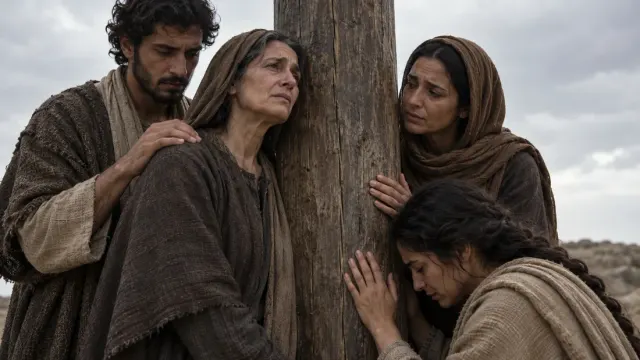
At the foot of the cross, soldiers calculate clothing while Jesus attends to a human obligation that death has not made irrelevant. The garments are divided and the seamless coat assigned by lot, actions the Book of John explicitly connects with Psalm 22. Scripture is fulfilled through ordinary decisions made by men who are not performing a religious ceremony. Nearby stand Jesus' mother and the women named in the account, along with the beloved disciple. Jesus speaks to his mother and to that disciple in terms of a new relation of care: "Woman, behold thy son" and "Behold thy mother." The address recalls Cana, where his hour had not yet come. Now, at the hour itself, he makes provision. The Book of John does not invent a family dispute to explain the scene. The stated act is already striking enough. While others divide what can be taken from him, Jesus gives responsibility for someone he loves into another's hands.
Deep dive
The soldiers divide the garments and cast lots for the seamless coat. John explicitly connects their decisions with Psalm 22:18. The fulfillment occurs through ordinary acts of possession by people attending an execution, not through a ceremony they consciously perform to honor Scripture. The contrast between their concern with clothing and the suffering man from whom it has been taken is contained in the placement of the scene.
Near the cross stand Jesus' mother and the women John names. The beloved disciple is present as well. Jesus speaks to his mother and then to the disciple, establishing responsibility in the language of son and mother. The address "Woman" returns to the form used at Cana, where his hour had not yet come. At this hour, the relationship is addressed again through an action of provision.
The disciple receives her into his own care from that hour. John does not explain the absence or intentions of every other family member, and the scene need not be filled with an invented family dispute. Its stated action is sufficient: while others divide what can be taken from Jesus, he entrusts someone he loves to another disciple. The completion of his mission does not make this particular human obligation beneath notice. The Gospel holds the world's salvation and a mother's care within the same crucifixion account.
Words to trace: mother, disciple, Jesus, coat, lots, Mary
Verse-by-verse path
- John 19:23
Four soldiers made a quaternion, the squad the Book of Acts mentions when Peter is guarded by “four quaternions” (Acts 12:4). The coat, chiton, was the tunic worn next to the skin. Josephus says the high priest’s robe was woven in one piece without a seam, and some see a priestly hint here; the text does not say so.
- John 19:24
The Greek links the two halves of the scene with men... de, “on the one hand... on the other”: “These things therefore the soldiers did” and, in the next verse, “now there stood” the women. The soldiers gamble at one side of the cross while the women stand at the other.
- John 19:25
It is unclear whether three women or four stand here. If “his mother’s sister” is someone other than “Mary the wife of Cleophas”, she may be Salome of Mark 15:40, and there are four; two sisters both named Mary seems unlikely. Hegesippus, in the second century, called Clopas the brother of Joseph.
- John 19:26
Neither Jesus’ mother nor “the disciple whom he loved” is ever named in the Book of John. The two unnamed figures closest to him are joined here into one household. Addressing his mother as “Woman” was respectful in Greek, the same address used for Mary Magdalene in 20:15.
- John 19:27
“From that hour” uses the Book of John’s word for the hour of Jesus’ glory, as if the new household were part of it. Later tradition places Mary with John at Ephesus, and a house there is still shown to pilgrims; the text says only that the disciple took her home.
John 19:23-27
King James Version23Then the soldiers, when they had crucified Jesus, took his garments, and made four parts, to every soldier a part; and also his coat: now the coat was without seam, woven from the top throughout.
24They said therefore among themselves, Let us not rend it, but cast lots for it, whose it shall be: that the scripture might be fulfilled, which saith, They parted my raiment among them, and for my vesture they did cast lots. These things therefore the soldiers did.
25Now there stood by the cross of Jesus his mother, and his mother’s sister, Mary the wife of Cleophas, and Mary Magdalene.
26When Jesus therefore saw his mother, and the disciple standing by, whom he loved, he saith unto his mother, Woman, behold thy son!
27Then saith he to the disciple, Behold thy mother! And from that hour that disciple took her unto his own home.
John 19:28-30
Finished Describes the Work, Not Merely the Suffering
The Book of John begins the final movement with Jesus knowing that all things are now accomplished, so his thirst belongs inside completion rather than interrupting it. The physical need is real. The one who spoke of living water is not insulated from a drying mouth at the cross. Sour wine is brought to him, and Scripture's pattern remains present without turning the suffering into theater. Then comes the sentence that has been gathering force across the Gospel: "It is finished." The word points to accomplishment. Jesus had spoken of doing the Father's work in chapter 4 and of finishing it in prayer in chapter 17. What ends here is not merely endurance of pain but the mission he has repeatedly described as given by the Father. He bows his head and gives up his spirit. The phrasing preserves agency at death while the next section will insist just as strongly that the death itself is physically real.
Deep dive
The account begins this movement with Jesus' knowledge that all things are now accomplished. His expression of thirst then gives the suffering body its own brief voice. The one who spoke of living water is not exempt from bodily need at the cross. John places the request within Scripture's fulfillment, and the sour wine recalls Psalm 69:21. The detail is not a claim that the need is theatrical. A genuine physical thirst and a scripturally patterned mission occupy the same act.
The declaration "It is finished" translates a form of the Greek teleo, meaning to bring to completion or accomplish (Strong's Greek 5055). The word does not, by itself, require a specialized translation such as a receipt marked paid in full. Its meaning here is established by the work Jesus has repeatedly said the Father gave him to finish, from the conversation beside the well in John 4:34 to the prayer in John 17:4. The mission, not simply endurance of pain, is the subject of completion.
Jesus then bows his head and gives up his spirit. The phrasing preserves his agency at the moment of death without making the death unreal. The next section will insist upon its physical reality. John has not described a failed attempt to escape execution followed by a religious reinterpretation. The completed work is announced from within the death toward which Jesus has knowingly moved.
Words to trace: vinegar, Jesus, accomplished, bowed, filled, finished
Verse-by-verse path
- John 19:28
“Accomplished” and “It is finished” in verse 30 are the same Greek word, tetelestai, bracketing the cry of thirst. Instead of the usual verb for fulfilment, the Book of John uses teleioo here, “that the scripture might be perfected”, found only in this place with Scripture as its subject.
- John 19:29
Hyssop is a small bushy plant with thin stems, which seems too flimsy to lift a wet sponge; one late manuscript reads hysso, a javelin, and some modern scholars follow it. But hyssop dipped in blood marked the doorposts at the first Passover (Exodus 12:22), and the Book of John may intend exactly that echo.
- John 19:30
“Bowed his head” is the phrase Jesus used when he said the Son of man “hath not where to lay his head” (Matthew 8:20). “Gave up the ghost” is paredoken to pneuma, he handed over the spirit, with paradidomi, the verb for handing over that ran through the betrayal and trial. Now he does the handing over.
John 19:28-30
King James Version28After this, Jesus knowing that all things were now accomplished, that the scripture might be fulfilled, saith, I thirst.
29Now there was set a vessel full of vinegar: and they filled a spunge with vinegar, and put it upon hyssop, and put it to his mouth.
30When Jesus therefore had received the vinegar, he said, It is finished: and he bowed his head, and gave up the ghost.
John 19:31-37
The Body Is Dead, and the Witness Insists Upon It
The urgency to remove the bodies before the high Sabbath creates a practical examination of death. Soldiers break the legs of the two others, but when they reach Jesus they find him already dead and do not break his. One soldier pierces his side, and blood and water come out. At that point the Book of John interrupts the sequence to insist on eyewitness testimony: the one who saw it bears record so that others may believe. The physical observation is not disposable scenery beneath a theological claim. At the same time, The Book of John does not offer an anatomical diagnosis, and modern speculation should not pretend the text supplies one. Scripture is then brought alongside the observed body. The unbroken bones recall Passover and Psalm language; the pierced figure recalls Zechariah. Fulfillment does not float above the corpse. It is attached to what happened to this body, seen by a witness who insists that Jesus was dead.
Deep dive
The preparation day and the coming high Sabbath make removal of the bodies urgent. The soldiers break the legs of the two others but find Jesus already dead and do not break his. The distinction matters to the scriptural interpretation, but it first establishes the condition they encounter. The account does not leave Jesus' death as an uncertain impression formed only by grieving followers.
The spear thrust produces blood and water, and John interrupts the sequence to insist upon the truth of the witness who saw it. The stated purpose is belief. The physical observation is therefore part of the testimony, not a disposable detail beneath the theological meaning. At the same time, the passage does not identify an anatomical cause for the fluids or provide enough information for a confident modern diagnosis. Its claim is what was seen, not a reconstructed medical mechanism.
The unbroken bones resonate with the Passover requirement in Exodus 12:46 and with Psalm 34:20; the pierced figure is explicitly connected with Zechariah 12:10. These references do distinct work. The first places the untouched bones within Scripture's pattern, while the second directs attention toward the one pierced. The hostile actions have not taken the death outside the Gospel's account of fulfillment. The body bears both the reality of what happened and the scriptural significance John asks the testimony to establish.
Words to trace: legs, brake, broken, pierced, record, sabbath
Verse-by-verse path
- John 19:31
Deuteronomy 21:22-23 forbade leaving a hanged man’s body on the tree overnight. The Sabbath was “an high day” because in this chronology it coincided with the first day of Passover. Breaking the legs, crurifragium, hastened death by taking away the victim’s ability to push up and breathe.
- John 19:32
In 1968 an ossuary at Giv’at ha-Mivtar in Jerusalem held the heel bone of a man named Yehohanan with an iron nail still through it, the only skeletal evidence of crucifixion from this period. Early reports said his shins were broken; later examination doubted that.
- John 19:33
Mark says Pilate “marvelled if he were already dead” and checked with the centurion before releasing the body (Mark 15:44). Crucified men often lingered for a day or more, so a death within a few hours was unusual enough for both accounts to remark on it.
- John 19:34
“Pierced” is nysso, to prod or stab. The Latin Vulgate follows a reading “opened his side”, and Augustine saw the church’s sacraments flowing from the side of the sleeping Christ, as Eve was drawn from the side of the sleeping Adam. Later legend named the soldier Longinus.
- John 19:35
“He knoweth” is ekeinos oiden, “that one knows”. It may mean the eyewitness himself, or it may point to another who vouches for him, Christ or God; commentators divide. A similar note of attestation closes the book in 21:24.
- John 19:36
The first words spoken about Jesus in the Book of John were “Behold the Lamb of God” (1:29). Numbers 9:12 repeats the Passover rule of unbroken bones beside Exodus 12:46. The first title and this last detail meet at the cross.
- John 19:37
The Book of John follows the Hebrew of Zechariah 12:10, “look upon me whom they have pierced”. The Greek Old Testament had misread the Hebrew verb and says “because they danced in mockery”. Revelation 1:7 uses the same Hebrew-based wording as here.
John 19:31-37
King James Version31The Jews therefore, because it was the preparation, that the bodies should not remain upon the cross on the sabbath day, (for that sabbath day was an high day,) besought Pilate that their legs might be broken, and that they might be taken away.
32Then came the soldiers, and brake the legs of the first, and of the other which was crucified with him.
33But when they came to Jesus, and saw that he was dead already, they brake not his legs:
34But one of the soldiers with a spear pierced his side, and forthwith came there out blood and water.
35And he that saw it bare record, and his record is true: and he knoweth that he saith true, that ye might believe.
36For these things were done, that the scripture should be fulfilled, A bone of him shall not be broken.
37And again another scripture saith, They shall look on him whom they pierced.
John 19:38-42
Hidden Association Becomes the Work of Burial
Two men previously associated with caution now perform the public work of burial. Joseph of Arimathaea is identified as a disciple who had been secret for fear, yet he asks Pilate for the body. Nicodemus, remembered from his nighttime visit, arrives with a large quantity of myrrh and aloes. The Book of John lets the change appear in action rather than inventing speeches of newfound courage. Together they wrap Jesus in linen with the spices according to Jewish burial practice. That description is important after chapters of conflict with particular Jewish authorities: Jewish custom here is the means by which Jesus' body is honored. The tomb is new, nearby, and unused, with proximity and preparation day explaining the choice. The Book of John ends the chapter with a body physically prepared and placed in a specific grave. The resurrection will not be a way of ignoring this ending. It will have to answer it.
Deep dive
Joseph is identified as a disciple whose association had been secret because of fear. Now he asks Pilate for the body and receives permission to take it. Nicodemus arrives with myrrh and aloes, and John deliberately recalls his earlier nighttime visit. The man who first came with questions in chapter 3 now participates in the physical care of the dead Jesus. The account reports this change in action without inventing a speech of public confession for either man.
The quantity of spices is large, and the body is wrapped with them in linen according to the Jewish manner of burial. That explicit description matters after the conflicts with named authorities: Jewish practice here is the means of honoring Jesus, not merely the background against which opponents act. The two men provide actual burial rather than leaving the crucified body as an abstraction about fulfilled prophecy.
The garden tomb is new and has held no previous occupant. Its proximity and the preparation day explain its use. John closes with the location of the body, making the next chapter's discovery a question about this particular burial rather than an unspecified missing corpse. The work has been declared finished, yet the account pauses at the physical facts of burial: a prepared body laid where no one has lain before. The resurrection will not bypass that ending. It will answer it.
Words to trace: Jesus, body, Jews, garden, laid, Pilate
Verse-by-verse path
- John 19:38
Arimathaea is probably Ramathaim-zophim, the hometown of Samuel (1 Samuel 1:1), north-west of Jerusalem. Mark calls Joseph an “honourable counsellor”, a member of the council (Mark 15:43). He fits exactly the rulers of 12:42 who believed but would not confess for fear of the Pharisees.
- John 19:39
A Roman pound, litra, was about 327 grams, so a hundred pounds is roughly 32 kilograms of spice, an amount fit for a king. When King Asa was buried he was laid “in the bed which was filled with sweet odours and divers kinds of spices” (2 Chronicles 16:14).
- John 19:40
“Linen clothes” are othonia, strips or sheets, and the same word describes what Peter finds lying in the empty tomb (20:5-7). “Wound” is deo, to bind, the verb used when Jesus himself was bound (18:12) and of Lazarus coming out “bound hand and foot” (11:44).
- John 19:41
The site beneath the Church of the Holy Sepulchre was an old quarry outside the walls of the time, and rock-cut tombs of the period survive there. A tomb “wherein was never man yet laid” matches the colt “whereon yet never man sat” (Luke 19:30): things unused, set apart for a king.
- John 19:42
The burial is presented as a matter of haste: the tomb was near and the Sabbath at hand. That may explain Mary Magdalene’s assumption in 20:15 that someone has moved the body: “tell me where thou hast laid him.” “Nigh” is the same word used of the place of crucifixion in verse 20.
John 19:38-42
King James Version38And after this Joseph of Arimathaea, being a disciple of Jesus, but secretly for fear of the Jews, besought Pilate that he might take away the body of Jesus: and Pilate gave him leave. He came therefore, and took the body of Jesus.
39And there came also Nicodemus, which at the first came to Jesus by night, and brought a mixture of myrrh and aloes, about an hundred pound weight.
40Then took they the body of Jesus, and wound it in linen clothes with the spices, as the manner of the Jews is to bury.
41Now in the place where he was crucified there was a garden; and in the garden a new sepulchre, wherein was never man yet laid.
42There laid they Jesus therefore because of the Jews’ preparation day; for the sepulchre was nigh at hand.
Questions to keep in mind while reading
- Watch what Jesus says and does, and how people respond.
- Trace kingdom, discipleship, opposition, cross, and resurrection in the evangelist’s own sequence.
- Let later doctrine clarify the scene without erasing its immediate setting.
Text first
Where readers differ
The chapter summary begins with what the passage says and how its parts fit together. It does not assume one denomination has already settled every question. Where a conclusion depends on a tradition, literary theory, or historical reconstruction, that dependence is named openly.
The KJV text is presented first. Interpretive conclusions are labeled, and differences are introduced only when they help a reader understand why serious communities do not always reach the same answer.
Comparative interpretive notes for this chapter are in preparation. Until reviewed notes are ready, this page separates the KJV text from summary and application without claiming that serious readers agree on every question.
Questions beneath the surface
- What account of God, human freedom, responsibility, and the good life emerges from John 19?
- Which tension does the chapter refuse to resolve quickly?
- What changes when the chapter is read as part of the whole canon rather than as an isolated moral lesson?
- Where might a sincere reader confuse a familiar tradition with something the text states directly?
Questions for serious personal contemplation
These open-ended questions make room for tension, honest response, prayer, and conclusions that remain accountable to the chapter.
Observe without rushing
What part of John 19 makes you stop, feel unsettled, or feel surprised, and why?
Which detail in the passage would be easiest to overlook? How does that detail change your understanding?
Where do you see tension between what happens and this focus: Jesus sentenced, crucified, entrusting his mother, dying, pierced, and placed in the garden tomb?
What important question does the passage leave open instead of resolving quickly?
Examine your inner life honestly
Which person, response, fear, or desire in the passage feels most like your own life right now?
What assumption about God, other people, or yourself does this text challenge?
Which part would you rather soften, avoid, or explain away too quickly? What might that reaction reveal?
If this Scripture could ask you one direct question, what do you think it would ask?
Respond with wisdom and courage
What do you need to remember, confess, grieve, thank God for, or trust after reading this passage?
How might another faithful person read this situation differently without ignoring the text?
What obedient response would be costly, uncomfortable, or slow, yet still faithful to Scripture?
What question will you carry into prayer this week, and which verses will you keep in front of you?
Music and video connected to the passage
Related media appears when its Scripture reference overlaps this study. Music and video can illuminate a theme while the biblical text remains the foundation.