The big picture
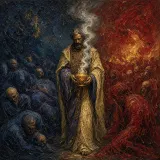
Numbers 16 takes a challenge to priestly and Mosaic authority and refuses to leave it as a contest of personalities. Korah's Levite grievance, the Reubenite accusations of Dathan and Abiram, and the support of 250 recognized leaders are brought before the LORD's choice. The judgments are distinct and terrible: the earth opens beneath the rebel households, fire consumes the incense offerers, and their censers are hammered into a permanent covering for the altar. Yet the next morning the congregation accuses Moses and Aaron of killing the LORD's people, and another plague begins. The chapter's final image answers the accusation in an unexpected way. Aaron, whose office has just been contested, runs into the stricken assembly with authorized incense and stands "between the dead and the living." The same priestly service challenged as illegitimate becomes the means of atonement. Numbers therefore ends the crisis not with Aaron enjoying vindication, but with the priest in the middle of danger, serving the people who had opposed him.
In this chapter
- The Congregation’s Holiness Does Not Settle Every Appointment Numbers 16:1-11
Korah's challenge is formidable because it gathers real status around a claim that sounds partly familiar.
- Egypt Is Now Called the Land of Milk and Honey Numbers 16:12-15
Dathan and Abiram refuse even to come when Moses summons them, and their answer turns Israel's geography upside down.
- The Men Accused of Self-Exaltation Intercede for the Assembly Numbers 16:16-24
The incense test reaches the tabernacle with 250 censers, Korah's gathered congregation, Moses, Aaron, and the glory of the LORD all in one scene.
- The Earth Opens, and the Fire Is a Separate Judgment Numbers 16:25-35
Moses goes to Dathan and Abiram after they refused to come to him, and the test he announces is deliberately public.
- The Censers Outlast Their Unauthorized Use Numbers 16:36-40
The censers survive the men who carried them, and that survival becomes part of the judgment's memory.
- The Next Morning Brings Another Accusation Numbers 16:41-45
The morning after the earth and fire, the congregation has not accepted the meaning of what it saw.
- Aaron Runs Toward the People Who Accuse Him Numbers 16:46-50
Aaron's final act in the chapter gives the priesthood its most forceful definition.


Scripture beside the summary
Numbers · King James Version · 50Numbers 16:1-11
The Congregation’s Holiness Does Not Settle Every Appointment
Korah's challenge is formidable because it gathers real status around a claim that sounds partly familiar. He is a Kohathite Levite, Dathan and Abiram are Reubenites, and 250 more supporters are "princes of the assembly, famous in the congregation." They argue that the congregation is holy and that the LORD is among them, truths Numbers has not denied. The dispute lies in the conclusion: if the whole congregation is holy, why should Moses and Aaron hold distinctive appointments? Moses answers by refusing to settle the issue through a stronger speech or a larger following. The LORD will show whom he has chosen to draw near. For Korah, the question becomes especially exact. He has already been brought near for Levitical service, yet he seeks the priesthood also. Numbers does not oppose holiness to appointment. It insists that the holiness of the congregation does not erase the boundaries within its service, and the censers will test the particular boundary Korah is crossing.

Deep dive
The coalition brings different positions together. Korah belongs to Kohath within Levi, while Dathan, Abiram, and On are identified with Reuben. The 250 supporters are recognized figures, not an anonymous collection of outsiders. On is named at the opening and then disappears from the account; the chapter gives no explanation for his absence from the later events. The size and standing of the group make the challenge public and substantial.
Their argument begins from the congregation’s holiness and the LORD’s presence among it. Those themes have already been affirmed in the book. The disputed inference is that such holiness makes the particular appointments of Moses and Aaron illegitimate. Moses answers by placing the matter before the LORD’s choice of who may draw near. The charge that they take too much upon themselves returns in his reply to the sons of Levi.
His specific question to Korah concerns the priesthood. Levitical service has already brought Korah near for work on behalf of the congregation; the demand reaches beyond that gift to another office. The distinction between Levites and priests, developed carefully in chapters 3–8, is now the precise boundary under attack. The incense test will make the question one of authorized approach, not merely the ability to gather a larger following.
Words to trace: LORD, congregation, sons, Korah, Levi, Moses
Verse-by-verse path
- Numbers 16:1
“Took men” is literally “Korah took”, with no object, and the KJV supplies “men”; some read it as “Korah took it upon himself”. Izhar was Amram’s brother (Exodus 6:18), so Korah was a first cousin of Moses and Aaron.
- Numbers 16:2
“Famous in the congregation” is literally “called ones of the assembly”, men summoned to council, close to the title given the tribal leaders in 1:16. “Men of renown” is anshey shem, “men of name”, the phrase Genesis 6:4 uses for the mighty men of old.
- Numbers 16:3
“Ye take too much upon you” is two words, rav lakhem, “enough of you” or “too much for you”. The claim that all are holy has an echo only a few verses back: 15:40 had just commanded Israel to “be holy unto your God”.
- Numbers 16:4
Moses falls on his face before he says a word. No audience is given for the gesture; it comes between the charge and the answer, and the answer is not his own verdict but a test.
- Numbers 16:5
“To morrow” is literally “morning”, boqer: the test is set for daybreak, with a night between. Moses answers in the vocabulary of priesthood: who are “his”, who is “holy”, and whom he will cause to “come near”, qarav, the verb of priestly approach.
- Numbers 16:6
“This do” is abrupt, two words in Hebrew. The censers are machtot, flat fire pans for carrying live coals, not the swinging censers of later worship; each man is to bring his own.
- Numbers 16:7
Moses throws their slogan back at them: “ye take too much upon you, ye sons of Levi.” The man the LORD chooses “shall be holy”, holiness as something conferred by choice, where verse 3 had claimed it by right for everyone.
- Numbers 16:8
“Hear, I pray you” is shimu na. Addressing Korah as “ye sons of Levi” widens the charge: he is spoken to as the head of a Levite faction, not as one man with a grievance.
- Numbers 16:9
“Seemeth it but a small thing” is literally “is it too little for you”, the phrase Dathan and Abiram hurl back in verse 13. The verse gathers the Levites’ charter from 3:6–8 and 8:14–19: separated, brought near, set to serve the tent and stand before the people.
- Numbers 16:10
The sentence turns on gam, “also”. The Levites had been “wholly given” to Aaron to serve him (3:9); Korah now asks for Aaron’s place as well as his own.
- Numbers 16:11
“Gathered together against the LORD” is noadim, the word of 14:35, “gathered together against me”. “What is Aaron” echoes Moses and Aaron in Exodus 16:7: “what are we, that ye murmur against us?” The complaint passes through the priest to God.
Numbers 16:1-11
King James Version1Now Korah, the son of Izhar, the son of Kohath, the son of Levi, and Dathan and Abiram, the sons of Eliab, and On, the son of Peleth, sons of Reuben, took men:
2And they rose up before Moses, with certain of the children of Israel, two hundred and fifty princes of the assembly, famous in the congregation, men of renown:
3And they gathered themselves together against Moses and against Aaron, and said unto them, Ye take too much upon you, seeing all the congregation are holy, every one of them, and the LORD is among them: wherefore then lift ye up yourselves above the congregation of the LORD?
4And when Moses heard it, he fell upon his face:
5And he spake unto Korah and unto all his company, saying, Even to morrow the LORD will shew who are his, and who is holy; and will cause him to come near unto him: even him whom he hath chosen will he cause to come near unto him.
6This do; Take you censers, Korah, and all his company;
7And put fire therein, and put incense in them before the LORD to morrow: and it shall be that the man whom the LORD doth choose, he shall be holy: ye take too much upon you, ye sons of Levi.
8And Moses said unto Korah, Hear, I pray you, ye sons of Levi:
9Seemeth it but a small thing unto you, that the God of Israel hath separated you from the congregation of Israel, to bring you near to himself to do the service of the tabernacle of the LORD, and to stand before the congregation to minister unto them?
10And he hath brought thee near to him, and all thy brethren the sons of Levi with thee: and seek ye the priesthood also?
11For which cause both thou and all thy company are gathered together against the LORD: and what is Aaron, that ye murmur against him?
Numbers 16:12-15
Egypt Is Now Called the Land of Milk and Honey
Dathan and Abiram refuse even to come when Moses summons them, and their answer turns Israel's geography upside down. Egypt, the land of bondage, is now called "a land that floweth with milk and honey," while Moses is accused of failing to provide the fields and vineyards of the promised destination. The phrase once attached to hope has been transferred backward to the place Israel left. Their accusation also treats the wilderness deaths as Moses' project of domination, passing over the congregation's own refusal to enter the land in Numbers 14. Moses answers in anger, but his defense is concrete rather than limitless: he has not taken even one donkey from them, and he has not hurt one of them. Numbers records that denial without turning it into a claim that every decision Moses has ever made is beyond question. The exchange exposes a rebellion built partly by retelling the recent past until Egypt becomes abundance and the consequences of refusal become evidence against the leader.

Deep dive
Their refusal to come up frames the speech at both ends. In between, they apply the language of milk and honey to the land Moses brought them out of: Egypt. This is a more complete reversal than the remembered menu of chapter 11. The description associated with the promised destination has been transferred to the place of bondage, while the actual destination is treated as evidence against Moses because fields and vineyards have not yet been received.
The charge of failed entry also passes over the congregation’s refusal in chapter 14. Their speech assigns the wilderness outcome to Moses’ exercise of power, not to the rejection that the book has just described. Moses responds with anger and an appeal concerning their offering, adding a concrete denial of exploitation: he has taken no donkey and harmed none of them. The account records that defense rather than filling it out with a general claim that every act of his leadership has been beyond criticism.
Words to trace: floweth, honey, land, milk, Moses, Abiram
Verse-by-verse path
- Numbers 16:12
“Come up” is alah, the verb used for going up to a court or a superior, and the verb of going up into the land that the people had refused in 13:31. The refusal is spoken before the charge, and again at the end of verse 14.
- Numbers 16:13
“Is it a small thing” answers verse 9 with the same Hebrew. “Make thyself altogether a prince” doubles a verb from sar, prince, the word of Exodus 2:14, where a Hebrew in Egypt first said to Moses, “Who made thee a prince and a judge over us?”
- Numbers 16:14
“Put out the eyes” is literally “bore out the eyes”, what was done to captives such as Samson (Judges 16:21) and Zedekiah (2 Kings 25:7), or else an idiom for blinding people to the facts. “These men” may be the speakers themselves, avoiding the words “our eyes”.
- Numbers 16:15
“Respect not thou their offering” uses the verb shaah of Genesis 4:4–5, where the LORD “had respect” to Abel’s offering and not Cain’s. “One ass” anticipates Samuel’s farewell in 1 Samuel 12:3: “whose ass have I taken?”
Numbers 16:12-15
King James Version12And Moses sent to call Dathan and Abiram, the sons of Eliab: which said, We will not come up:
13Is it a small thing that thou hast brought us up out of a land that floweth with milk and honey, to kill us in the wilderness, except thou make thyself altogether a prince over us?
14Moreover thou hast not brought us into a land that floweth with milk and honey, or given us inheritance of fields and vineyards: wilt thou put out the eyes of these men? we will not come up.
15And Moses was very wroth, and said unto the LORD, Respect not thou their offering: I have not taken one ass from them, neither have I hurt one of them.
Numbers 16:16-24
The Men Accused of Self-Exaltation Intercede for the Assembly
The incense test reaches the tabernacle with 250 censers, Korah's gathered congregation, Moses, Aaron, and the glory of the LORD all in one scene. The men accused of lifting themselves above Israel are then told to separate from the assembly so that it may be consumed, and their response is not relief. Moses and Aaron fall on their faces and plead. Their question, "shall one man sin, and wilt thou be wroth with all the congregation?", asks that the body not be destroyed as one undifferentiated mass. It does not pretend that the wider assembly has played no part, since Korah has just gathered it against them. The answer is separation of another kind: the congregation is told to move away from the dwellings of Korah, Dathan, and Abiram. Numbers places intercession at the center of a conflict about authority. Moses and Aaron do not receive threatened destruction of their opponents as a convenient solution. They use their access to plead for the people gathered against them.

Deep dive
Each claimant brings a censer with fire and incense, and Aaron is included in the test. Korah also gathers the congregation at the tabernacle entrance, bringing the wider assembly into the confrontation. The appearance of the LORD’s glory shifts the question from what the assembled men claim about themselves to the judgment announced in the divine presence.
When Moses and Aaron are told to separate from the congregation, they fall on their faces and plead against a judgment on everyone for the sin of one. The appeal does not deny the wider involvement that the preceding verse records. It asks that the whole body not be consumed as an undifferentiated mass. The answer directs the congregation away from the dwelling of Korah, Dathan, and Abiram. Moses and Aaron have again taken the position of intercessors for people gathered against them, rather than treating threatened destruction as a convenient way to remove opposition.
Words to trace: congregation, LORD, Aaron, censer, Moses, Korah
Verse-by-verse path
- Numbers 16:16
Moses names three parties in one breath, “thou, and they, and Aaron”, and Aaron comes last, one claimant among the rest. The test is to happen in the open, “before the LORD”, with the appointed priest on the same footing as his challengers.
- Numbers 16:17
The number is given exactly, two hundred and fifty, and then Korah and Aaron each with his own pan: two hundred and fifty-two pans of fire at the door of the tent. The repeated “every man his censer” makes each one individually answerable.
- Numbers 16:18
The rivals stand “with Moses and Aaron” at the same threshold, holding identical vessels. When Deuteronomy 11:6 recalls this day it names only Dathan and Abiram, and Psalm 106:17 does the same.
- Numbers 16:19
“Gathered” is the verb of assembly, qahal, the verb used in Exodus 32:1 when the people gathered to Aaron to demand the calf. The glory appears “unto all the congregation”: the whole people, not only the contestants, see it.
- Numbers 16:20
The LORD speaks to Moses and Aaron together, while Aaron still stands with his censer as one of the two hundred and fifty-two. The appointed priest is addressed before any sign has vindicated him.
- Numbers 16:21
“In a moment” is kerega, an instant, the blink of an eye. “Separate yourselves” is hibbadlu, the verb of Genesis 1:4, where God “divided the light from the darkness”. The offer of 14:12 returns, now with Aaron included in the call to stand apart.
- Numbers 16:22
“The God of the spirits of all flesh” is a title found only here and in 27:16, where Moses uses it again to ask for a leader to follow him. The title appeals to God as the one who gives every life breath and so knows each one apart.
- Numbers 16:23
A shorter speech, to Moses alone. The LORD does not answer the question of verse 22 in words; the next command answers it by opening a way out.
- Numbers 16:24
“Tabernacle” here is mishkan, the word usually kept for the LORD’s own dwelling, used of Korah’s tent: a rival dwelling in the camp. “Get you up” means move away, withdraw from its surroundings.
Numbers 16:16-24
King James Version16And Moses said unto Korah, Be thou and all thy company before the LORD, thou, and they, and Aaron, to morrow:
17And take every man his censer, and put incense in them, and bring ye before the LORD every man his censer, two hundred and fifty censers; thou also, and Aaron, each of you his censer.
18And they took every man his censer, and put fire in them, and laid incense thereon, and stood in the door of the tabernacle of the congregation with Moses and Aaron.
19And Korah gathered all the congregation against them unto the door of the tabernacle of the congregation: and the glory of the LORD appeared unto all the congregation.
20And the LORD spake unto Moses and unto Aaron, saying,
21Separate yourselves from among this congregation, that I may consume them in a moment.
22And they fell upon their faces, and said, O God, the God of the spirits of all flesh, shall one man sin, and wilt thou be wroth with all the congregation?
23And the LORD spake unto Moses, saying,
24Speak unto the congregation, saying, Get you up from about the tabernacle of Korah, Dathan, and Abiram.
Numbers 16:25-35
The Earth Opens, and the Fire Is a Separate Judgment
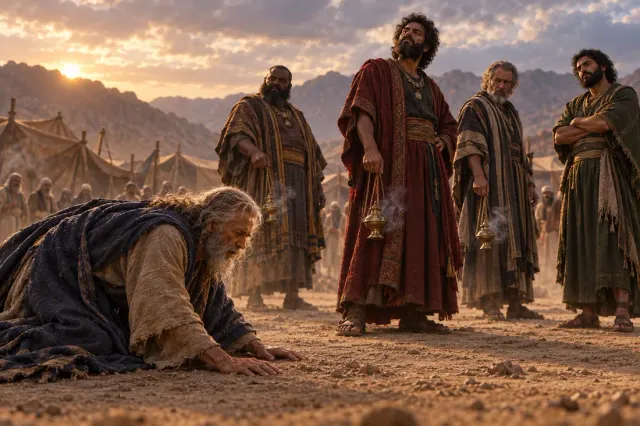
Moses goes to Dathan and Abiram after they refused to come to him, and the test he announces is deliberately public. If the rebels die an ordinary death, his claimed commission has not been established. If the earth opens immediately and takes them alive into the pit, Israel will know that the LORD sent him. The ground splits as he finishes speaking, swallowing the households and possessions described at the tents, while those nearby flee at the sound. Then Numbers records a second judgment: fire from the LORD consumes the 250 men who offered incense. The chapter does not blur the two events together. It also does not supply private speeches or individual verdicts for every wife or child present in the households. Later, Numbers 26 makes another needed distinction by saying explicitly that Korah's children did not die. The severity remains intact, but so does the book's precision. "All that appertained" cannot be used to erase the later survival the same book deliberately records.

Deep dive
Moses goes to Dathan and Abiram after they refuse to come to him. The congregation is warned away, and the families appear at their tent entrances, including wives, sons, and little children. Their presence belongs to the severity of the account and cannot be edited out. At the same time, the passage does not supply individual speeches or judgments about the personal responsibility of every member of those households.
The announced sign concerns Moses’ commission. An ordinary death would not establish his claim; the earth opening immediately after his words would distinguish the event from the common course of life. The KJV’s "quick" means alive here, as the following verse makes explicit, not merely that the fall happens rapidly. The earth closes, the people around flee, and then a separate statement records fire consuming the 250 incense offerers. The account distinguishes the forms of judgment rather than collapsing them into a single event.
Numbers 26:9–11 later recalls the earth swallowing Korah with Dathan and Abiram, but explicitly preserves Korah’s children from the deaths. That later qualification matters when reading the comprehensive language about households and possessions here. The event destroys the rebellious company described, but the book itself does not permit the claim that every descendant of Korah died. Its later census keeps that survival on record.
Words to trace: LORD, earth, Abiram, Dathan, appertained, congregation
Verse-by-verse path
- Numbers 16:25
Moses rises from his face and goes himself to the men who would not come to him in verse 12. The elders who follow are presumably the seventy of chapter 11, now at his side as witnesses.
- Numbers 16:26
“Wicked” is reshaim, the guilty party in a lawsuit: “these guilty men”. “Touch nothing of theirs” treats their goods as contagious, as the devoted things of Jericho were, which Achan took to his cost (Joshua 7:1).
- Numbers 16:27
Only Dathan and Abiram come out to their tent doors; Korah is not said to be there. Whether he died in the earth or in the fire is not stated, and readers have disagreed, since 26:10 speaks of the earth swallowing him together with the fire.
- Numbers 16:28
“Of mine own mind” is literally “from my own heart”, answering the charge of verse 13 that he acted to make himself a prince. “All these works” takes in his whole leadership since Egypt, not only this day.
- Numbers 16:29
“The common death of all men” and “the visitation of all men” are two phrases for dying as anyone dies and meeting the fate appointed to every life. Moses stakes his commission on the one outcome that could not happen by ordinary means.
- Numbers 16:30
“Make a new thing” is literally “create a creation”, yivra beriah, with bara, the verb of Genesis 1:1, which the Old Testament uses of God alone. “The pit” is Sheol, the realm of the dead, here to be entered living.
- Numbers 16:31
“Clave asunder” is baqa, the verb of Exodus 14:21, where “the waters were divided” at the sea. The timing is exact: the ground splits as he finishes speaking.
- Numbers 16:32
“The earth opened her mouth” recalls Genesis 4:11, where the ground “opened her mouth” to receive Abel’s blood. “Their houses” means households, bayit, the families and all they had.
- Numbers 16:33
Psalm 55:15 uses this event as a curse on enemies: “let them go down quick into hell.” “Perished from among the congregation” is avad, lost from the community’s number, removed from the count.
- Numbers 16:34
“At the cry of them” is literally “at their voice”, the sound of the swallowed or of the ground itself. The fear is plain and physical: people run from the edge of a pit still open in their camp.
- Numbers 16:35
The words echo Leviticus 10:2, where “there went out fire from the LORD, and devoured” Nadab and Abihu for offering strange fire. The two hundred and fifty die with incense in their hands, as Aaron’s two sons did.
Numbers 16:25-35
King James Version25And Moses rose up and went unto Dathan and Abiram; and the elders of Israel followed him.
26And he spake unto the congregation, saying, Depart, I pray you, from the tents of these wicked men, and touch nothing of theirs, lest ye be consumed in all their sins.
27So they gat up from the tabernacle of Korah, Dathan, and Abiram, on every side: and Dathan and Abiram came out, and stood in the door of their tents, and their wives, and their sons, and their little children.
28And Moses said, Hereby ye shall know that the LORD hath sent me to do all these works; for I have not done them of mine own mind.
29If these men die the common death of all men, or if they be visited after the visitation of all men; then the LORD hath not sent me.
30But if the LORD make a new thing, and the earth open her mouth, and swallow them up, with all that appertain unto them, and they go down quick into the pit; then ye shall understand that these men have provoked the LORD.
31And it came to pass, as he had made an end of speaking all these words, that the ground clave asunder that was under them:
32And the earth opened her mouth, and swallowed them up, and their houses, and all the men that appertained unto Korah, and all their goods.
33They, and all that appertained to them, went down alive into the pit, and the earth closed upon them: and they perished from among the congregation.
34And all Israel that were round about them fled at the cry of them: for they said, Lest the earth swallow us up also.
35And there came out a fire from the LORD, and consumed the two hundred and fifty men that offered incense.
Numbers 16:36-40
The Censers Outlast Their Unauthorized Use
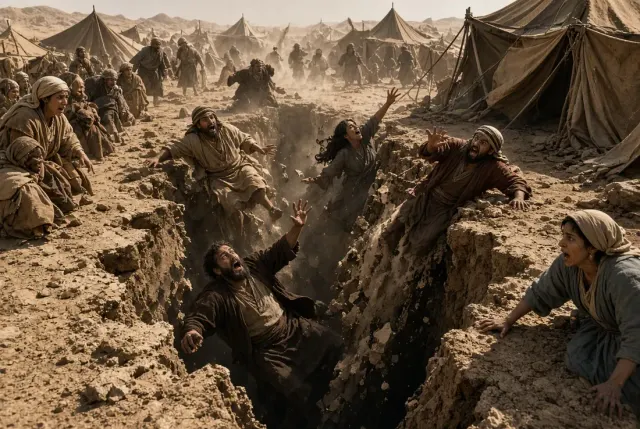
The censers survive the men who carried them, and that survival becomes part of the judgment's memory. Eleazar is told to remove them from the burning because, however unauthorized their users were, the censers have been presented before the LORD and are now hallowed. Sacred contact has not retroactively made the offerers rightful priests. Instead, the objects themselves must now be handled by the appointed priestly line. Hammered into broad plates for the altar, they become a visible memorial that "no stranger, which is not of the seed of Aaron," may come near to offer incense. The boundary is exact. Korah was a Levite, not an outsider to Israel and not a man without sanctuary service, yet Levitical nearness did not make priestly incense his office. Numbers leaves the metal at the altar so the disputed line remains visible. What was used to cross the boundary is remade into a sign that remembers where the boundary stands.
Deep dive
The censers are not discarded as ordinary scrap. Because they have been presented before the LORD, they are described as hallowed even though the men who used them have died. That distinction is striking: the sacred status of an object does not establish the authorization of the person who offers it. The very implements of the attempted approach now require priestly handling.
Eleazar, Aaron’s son, oversees their conversion into broad plates for the altar. The result remains at the place associated with the dispute as a visible memorial. Verse 40 defines the prohibited outsider in this setting as someone not descended from Aaron. A Levite such as Korah can therefore be unauthorized for this particular act without being a foreigner or excluded from all sanctuary service. The warning is exact about the boundary at issue. The altar’s added metal remembers an attempted crossing of that boundary, not a ban on every form of participation by the congregation.
Words to trace: LORD, censers, Aaron, altar, broad, children
Verse-by-verse path
- Numbers 16:36
The Hebrew Bible begins chapter 17 here; the KJV follows the Greek and Latin in running chapter 16 on to fifty verses. So 16:36–50 in English Bibles is 17:1–15 in Hebrew, and the Hebrew chapter 17 ends at verse 28.
- Numbers 16:37
“Scatter thou the fire yonder” means fling the coals far off, not onto the altar. Eleazar does the work rather than Aaron, since the high priest must not come near the dead (Leviticus 21:11).
- Numbers 16:38
“Sinners against their own souls” means they sinned at the cost of their lives. “Broad plates” are beaten sheets, plating for the bronze altar of Exodus 27:1–2. “A sign” is ot, the word used for the rainbow in Genesis 9:13.
- Numbers 16:39
“Brasen” means bronze: the pans were bronze, and so was the altar they now cover (Exodus 27:2). “They that were burnt” is all the verse calls the dead; they are not named again.
- Numbers 16:40
“Stranger” here is zar, an outsider to the priesthood, not the ger, the resident foreigner, of chapter 15. In this sense a Levite of Kohath could be a zar at the incense altar. “As the LORD said to him” most likely refers to Eleazar, told through Moses.
Numbers 16:36-40
King James Version36And the LORD spake unto Moses, saying,
37Speak unto Eleazar the son of Aaron the priest, that he take up the censers out of the burning, and scatter thou the fire yonder; for they are hallowed.
38The censers of these sinners against their own souls, let them make them broad plates for a covering of the altar: for they offered them before the LORD, therefore they are hallowed: and they shall be a sign unto the children of Israel.
39And Eleazar the priest took the brasen censers, wherewith they that were burnt had offered; and they were made broad plates for a covering of the altar:
40To be a memorial unto the children of Israel, that no stranger, which is not of the seed of Aaron, come near to offer incense before the LORD; that he be not as Korah, and as his company: as the LORD said to him by the hand of Moses.
Numbers 16:41-45
The Next Morning Brings Another Accusation
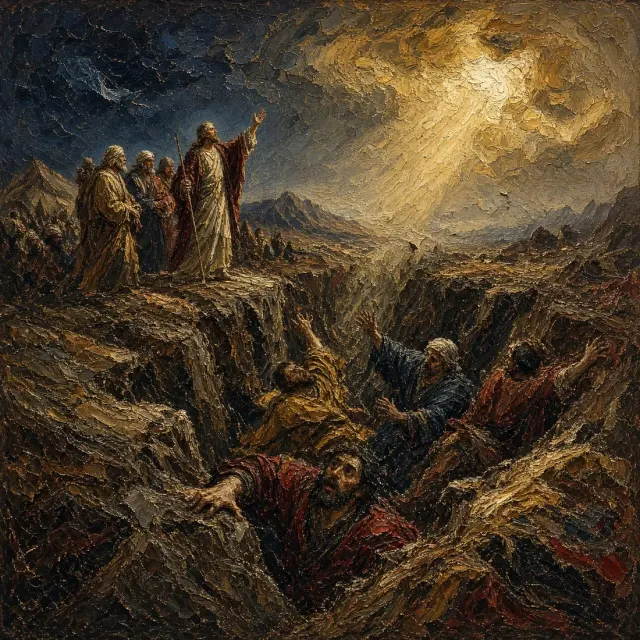
The morning after the earth and fire, the congregation has not accepted the meaning of what it saw. Instead it accuses Moses and Aaron: "Ye have killed the people of the LORD." Numbers lets that charge stand in direct tension with the preceding account, which attributed the judgments to the LORD. The people's interpretation does not rewrite what the chapter has already said. Their timing makes the conflict more unsettling. A spectacular sign has occurred, but sight has not produced settled understanding. As the congregation gathers again, the cloud covers the tabernacle and the glory of the LORD appears once more. Destruction is again announced, and Moses and Aaron again fall on their faces. The repetition shows that the first confrontation solved the question of divine appointment without automatically solving the congregation's resistance to that answer. Numbers does not assume that extraordinary evidence ends argument. The visible judgment can be remembered, named differently, and resisted on the very next day.
Deep dive
The timing is almost the most arresting detail: the complaint comes on the next day. The visible judgment has not produced a settled agreement about what happened. The congregation identifies those who died as the LORD’s people and accuses Moses and Aaron of killing them. Numbers records that accusation after attributing the earth’s opening and the consuming fire to the divine judgment; the people’s interpretation is not allowed to replace the preceding account.
The scene returns to the tabernacle, the cloud, and the appearance of glory. Moses and Aaron again fall on their faces when destruction is announced. The repetition intensifies the crisis rather than treating the first confrontation as a completed problem. A sign can establish the appointed priesthood within the account while the congregation continues to resist its meaning. The book does not assume that seeing a judgment automatically ends the conflict over how that judgment is understood.
Words to trace: congregation, Moses, Aaron, LORD, tabernacle, appeared
Verse-by-verse path
- Numbers 16:41
“The people of the LORD” is am YHWH, the phrase Moses used in 11:29: “would God that all the LORD’s people were prophets!” The murmuring is lun, the verb of 14:2, back on the very next morning.
- Numbers 16:42
The crowd turns toward the tent and sees the cloud cover it, as it first covered the tabernacle on the day it was raised (9:15). The appearance interrupts the gathering before it can act.
- Numbers 16:43
Moses and Aaron move toward the tent, “before” it, while the crowd moves against them. The two brothers go to the place of the glory, the only refuge the chapter offers them.
- Numbers 16:44
The LORD speaks to Moses alone, though the command in the next verse is plural and takes in Aaron. It is the last divine speech of the chapter.
- Numbers 16:45
“Get you up” is heromu, “lift yourselves away”, a different verb from the “separate” of verse 21, and “as in a moment” repeats that verse. The brothers fall on their faces a second time in two days.
Numbers 16:41-45
King James Version41But on the morrow all the congregation of the children of Israel murmured against Moses and against Aaron, saying, Ye have killed the people of the LORD.
42And it came to pass, when the congregation was gathered against Moses and against Aaron, that they looked toward the tabernacle of the congregation: and, behold, the cloud covered it, and the glory of the LORD appeared.
43And Moses and Aaron came before the tabernacle of the congregation.
44And the LORD spake unto Moses, saying,
45Get you up from among this congregation, that I may consume them as in a moment. And they fell upon their faces.
Numbers 16:46-50
Aaron Runs Toward the People Who Accuse Him
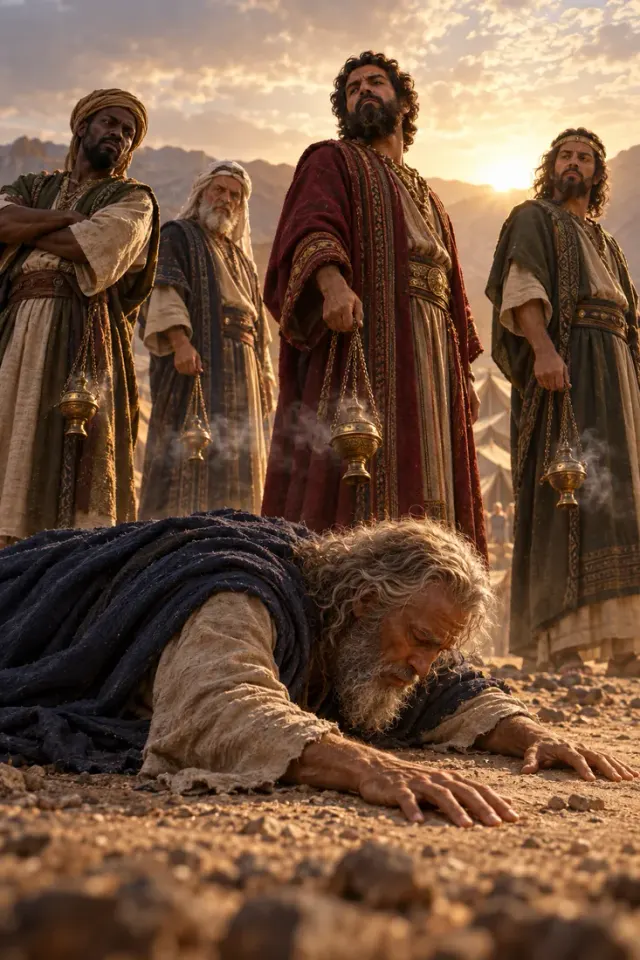
Aaron's final act in the chapter gives the priesthood its most forceful definition. Moses tells him to take fire from the altar, add incense, and move quickly into the congregation because the plague has begun. Aaron does not retreat from the people who have just accused him of killing the LORD's people. He runs toward them. The incense that marked unauthorized rivalry earlier in the chapter now appears as authorized service, with the source of the fire, the priest, and the purpose of atonement all specified. Then Aaron stands "between the dead and the living," and the plague is stayed. Numbers records 14,700 deaths in addition to those connected with Korah, so the ending does not soften the disaster. It does, however, expose the difference between seizing an office and serving through it. Aaron's vindication is not a throne at a distance. It is a place at the edge of death, using the contested priesthood on behalf of the very congregation that opposed him.
Deep dive
The same priestly act that stood at the center of the challenge now appears in rescue. Aaron takes fire from the altar, adds incense, and runs into the congregation at Moses’ command. The account specifies the source of the fire, the authorized priest, and the purpose of atonement. Incense is not operating here as an interchangeable substance whose use has the same consequence regardless of the person or command involved.
The spatial description carries the force of the ending. Aaron stands "between the dead and the living," and the plague stops. The priest whose office has been contested is not merely vindicated at a safe distance. He is placed in the midst of the people, at the boundary of the deaths, performing the service that the earlier appointments said would protect the congregation from wrath.
The recorded loss is 14,700, explicitly additional to those who died in the matter of Korah. The cessation does not undo those deaths, and the final return to Moses is not a victory celebration. It closes a chapter in which the protection associated with the priesthood has become visible under terrible conditions. The difference between an office seized in rivalry and service performed on behalf of the congregation has been demonstrated through the chapter’s own repeated use of incense.
Words to trace: plague, Aaron, congregation, Moses, atonement, begun
Verse-by-verse path
- Numbers 16:46
“Wrath” is qetsef, anger breaking out, pictured as having “gone out” like a messenger. Incense was burned on the golden altar inside the holy place; here it is carried out into the camp, among the people.
- Numbers 16:47
By the reckoning of 33:39, which makes Aaron 123 at his death in the fortieth year, he was now in his eighties, and he runs. He goes “into the midst”, the centre of the crowd that had accused him.
- Numbers 16:48
“Stayed” is atsar, held back or restrained, the verb used of the plague at Baal-peor in 25:8 and of David’s plague in 2 Samuel 24:25. The priest with a censer becomes a line the plague cannot cross.
- Numbers 16:49
Fourteen thousand seven hundred, counted apart from Korah’s company. With the two hundred and fifty and the households, the dead of these two days far outnumber the three thousand who fell after the calf (Exodus 32:28).
- Numbers 16:50
Aaron returns to the door of the tent, where the censer test began in verse 18. “The plague was stayed” is repeated from verse 48 as the chapter’s last words.
Numbers 16:46-50
King James Version46And Moses said unto Aaron, Take a censer, and put fire therein from off the altar, and put on incense, and go quickly unto the congregation, and make an atonement for them: for there is wrath gone out from the LORD; the plague is begun.
47And Aaron took as Moses commanded, and ran into the midst of the congregation; and, behold, the plague was begun among the people: and he put on incense, and made an atonement for the people.
48And he stood between the dead and the living; and the plague was stayed.
49Now they that died in the plague were fourteen thousand and seven hundred, beside them that died about the matter of Korah.
50And Aaron returned unto Moses unto the door of the tabernacle of the congregation: and the plague was stayed.
Questions to keep in mind while reading
- Identify the people addressed and the covenant setting.
- Distinguish rescue, worship, holiness, justice, and community responsibility.
- Read commands in their literary and covenant context before making a modern application.
Text first
Where readers differ
The chapter summary begins with what the passage says and how its parts fit together. It does not assume one denomination has already settled every question. Where a conclusion depends on a tradition, literary theory, or historical reconstruction, that dependence is named openly.
The KJV text is presented first. Interpretive conclusions are labeled, and differences are introduced only when they help a reader understand why serious communities do not always reach the same answer.
Comparative interpretive notes for this chapter are in preparation. Until reviewed notes are ready, this page separates the KJV text from summary and application without claiming that serious readers agree on every question.
Questions beneath the surface
- What account of God, human freedom, responsibility, and the good life emerges from Numbers 16?
- Which tension does the chapter refuse to resolve quickly?
- What changes when the chapter is read as part of the whole canon rather than as an isolated moral lesson?
- Where might a sincere reader confuse a familiar tradition with something the text states directly?
Questions for serious personal contemplation
These open-ended questions make room for tension, honest response, prayer, and conclusions that remain accountable to the chapter.
Observe without rushing
What part of Numbers 16 makes you stop, feel unsettled, or feel surprised, and why?
Which detail in the passage would be easiest to overlook? How does that detail change your understanding?
Where do you see tension between what happens and this focus: Korah’s assembly challenging Moses and Aaron before judgment divides the congregation?
What important question does the passage leave open instead of resolving quickly?
Examine your inner life honestly
Which person, response, fear, or desire in the passage feels most like your own life right now?
What assumption about God, other people, or yourself does this text challenge?
Which part would you rather soften, avoid, or explain away too quickly? What might that reaction reveal?
If this Scripture could ask you one direct question, what do you think it would ask?
Respond with wisdom and courage
What do you need to remember, confess, grieve, thank God for, or trust after reading this passage?
How might another faithful person read this situation differently without ignoring the text?
What obedient response would be costly, uncomfortable, or slow, yet still faithful to Scripture?
What question will you carry into prayer this week, and which verses will you keep in front of you?
Music and video connected to the passage
Related media appears when its Scripture reference overlaps this study. Music and video can illuminate a theme while the biblical text remains the foundation.