The big picture
The Book of 2 Kings 4 keeps moving from large prophetic claims into rooms, kitchens, fields, debts, and meals. A widow facing the loss of her sons discovers that the little oil left in her house can fill every borrowed vessel and leave enough to pay what she owes. A Shunammite woman builds Elisha a room without asking for reward, receives the promise of a son she never requested, and later carries that dead child back to the bed prepared for the prophet. Her protest forces the original promise back into view, while Elisha's prayer and persistent presence precede the child's restoration. The chapter then turns from one household to a hungry prophetic community: unfamiliar gourds make the common pot dangerous, and twenty barley loaves appear absurdly small for a hundred men. By the end, threatened bodies have repeatedly been preserved through ordinary objects that remain ordinary. Oil, a bed, meal, and barley loaves matter, but the chapter keeps attaching the decisive result to the LORD's word.
Central truth
The Lord’s word through Elisha heals Jericho’s water, confronts contempt, supplies a thirsty army, and rescues a widow’s household from debt. The Lord gives the Shunammite a son and restores him after death, while Elisha receives her grief and depends on prayer rather than automatic power. Through Elisha, the Lord preserves a prophetic community’s food and restores a borrowed tool, while Naaman’s intervening healing exposes the difference between receiving and exploiting grace.

The study notes have a page of their own
The movement by movement analysis, the words to trace, the verse by verse notes and where readers differ are written for someone studying alone. They are on the Deep Personal Reflections page for this chapter. This page is the lesson.
A chapter-specific teaching brief
These anchors come from this chapter itself. They help a teacher use the Level 1 overview, the Level 2 study, and the Scripture text as one lesson.
Open with the chapter’s first image
2 Kings 4:1: “Now there cried a certain woman of the wives of the sons of the prophets unto Elisha, saying, Thy servant my husband is dead; and thou knowest that thy…”
Slow down at the turning point
2 Kings 4:23: “And he said, Wherefore wilt thou go to him to day? it is neither new moon, nor sabbath. And she said, It shall be well.”
Keep this word trail visible
child, LORD, Gehazi, Elisha, servant, sons
What to explain, in order
Teach the passage in this order. Each step names the verses it rests on, so every point can be shown in the text before it is applied.
2 Kings 2:19–4:7
2 Kings 2:19-22
A spring healed by a word
Start at Jericho, where Elisha is staying after Elijah's departure. The men of the city say "the situation of this city is pleasant, as my lord seeth: but the water is naught, and the ground barren". Explain "naught" as bad, harmful. Jericho was the city Joshua cursed (Joshua 6:26), and now the first public act of Elisha's ministry is healing there. Read 2:21 carefully: the LORD speaks in the first person, "I have healed". Teach this first because it sets the pattern for the unit: a need, a simple sign, a word from the LORD, and a lasting result.
2 Kings 2:23-25
Contempt on the road to Bethel
Read these verses plainly and at an even pace. Bethel was the site of Jeroboam's calf (1 Kings 12:29), so the prophet of the LORD is going up to the centre of Israel's false worship. Explain that the Hebrew behind "little children" can describe boys or young men, and that the translators chose a phrase the text does not define further. Name what is reported: mockery of the LORD's prophet, a curse in the LORD's name, and the bears. Do not add a death toll, ages or motives. Place it here because it is the second side of the word that healed Jericho: the same word is not to be despised.
2 Kings 3:1-12
A campaign without water
Introduce Jehoram of Israel with the assessment of 3:2-3: better than his parents, since "he put away the image of Baal that his father had made", and still bound to Jeroboam's calves. Moab rebels, and three kings march round through Edom, "a compass of seven days' journey", which means a long circuit. Explain "fetched a compass" as travelled round. Then show the two responses to thirst side by side, despair from Israel's king and a request for a prophet from Judah's. A servant remembers Elisha "which poured water on the hands of Elijah", meaning his attendant.
2 Kings 3:13-25
Ditches filled at the morning offering
Elisha's welcome to Jehoram is cold: he would not even look at him "were it not that I regard the presence of Jehoshaphat the king of Judah" (3:14). Then a minstrel plays and the word comes: dig ditches, see no wind or rain, and the valley will fill. Explain that "this is but a light thing in the sight of the LORD" means it costs him nothing. Note that the water comes at the time of the morning offering, linking the gift to worship. Then read the misreading of red water and the rout. The instructions of 3:19 are harsh war practice; state them and move on.
2 Kings 3:26-27
An ending no one expects
Read 3:27 aloud and then wait. The king of Moab sacrifices his eldest son on the wall, there is great indignation against Israel, and the allies go home. Tell the class honestly that readers have long debated whose indignation is meant, whether Moab's fury, Israel's own horror, or divine displeasure, and that the verse does not settle it. What is clear is that the campaign does not end in a clean triumph. Teach it as part of the unit because it keeps learners from turning the water miracle into a promise that the LORD's people always win.
2 Kings 4:1-7
A widow, a creditor and borrowed jars
End with a household. The widow of one of the prophets says her husband "did fear the LORD" and that "the creditor is come to take unto him my two sons to be bondmen". Explain from Leviticus 25:39-43 that debt servitude was regulated in Israel, but here it means losing her sons. Elisha's questions come first, "What shall I do for thee? tell me, what hast thou in the house?", and she has only "a pot of oil". Then the neighbours' empty vessels, the shut door, the pouring, and the oil that stays when the jars run out. Teach this last as the warmest picture of the word working inside a single home.
2 Kings 4:8–37
2 Kings 4:8-10
A woman of standing makes room
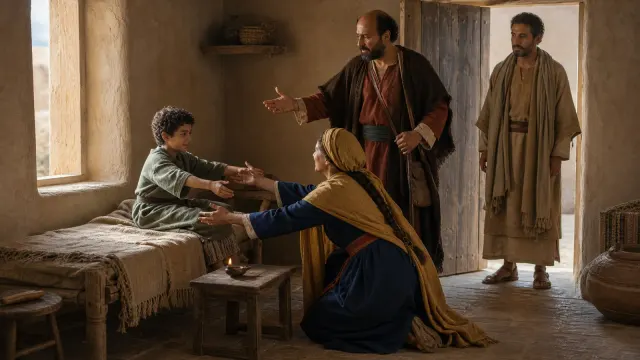
Introduce the Shunammite as "a great woman", which means a woman of means and standing in Shunem, not a tall one. She feeds the prophet, then speaks to her husband: "I perceive that this is an holy man of God, which passeth by us continually." Read the furnishing list slowly, bed, table, stool, candlestick, because it is a picture of thoughtful hospitality. Teach this first because her generosity comes before any promise. The class must meet her as a giver before it meets her as a mother, or the later grief will be read as the loss of a reward.
2 Kings 4:11-17
An offer refused, a gift unasked
Elisha asks what can be done for her and offers a word to the king or the captain of the host. Her answer, "I dwell among mine own people", means she is content and secure among her kin. It is Gehazi who notices, "Verily she hath no child, and her husband is old." Explain "according to the time of life" as at this time next year. Her reply to the promise is not doubt for its own sake but fear of hope: do not lie to me. Make sure the class hears that line, because the whole account turns on it.
2 Kings 4:18-24
My head, my head
Read 4:18-20 quietly and without dramatising. The boy goes out to his father among the reapers, cries "My head, my head", is carried home, "sat on her knees till noon, and then died". Pause there. Then show what she does: lays him on the prophet's bed, shuts the door, asks for an ass and a servant, and sets out. Explain that the husband's question about new moon and sabbath shows that people went to prophets on holy days. Her "It shall be well" is the brief answer of someone who will not speak of it until she reaches the one who promised.
2 Kings 4:25-30
Grief at the prophet's feet
At Carmel, Elisha sends Gehazi with three questions and gets "It is well". Then she reaches Elisha and catches his feet. Read 4:27 and point out that the LORD has hidden the matter from Elisha; the prophet does not know everything. Read her two questions in 4:28 and let them stand. Then the staff is sent, and she swears the same oath Elisha once swore to Elijah: she will not leave him. Teach this step carefully, because it shows that bringing raw grief to God's servant is not faithlessness.
2 Kings 4:31-37
The staff fails, the prayer is heard
Gehazi arrives first and the staff does nothing. Elisha comes, finds the child dead on his bed, shuts the door on the two of them and prays. Describe 4:34-35 simply: he lies on the child, mouth to mouth, eyes to eyes, hands to hands; the child grows warm; Elisha walks to and fro and stretches out again; the child sneezes seven times and opens his eyes. Do not turn this into a technique. Compare 1 Kings 17:17-24, where Elijah did much the same. End on 4:37, the mother at his feet again, taking up her son.
2 Kings 4:38–6:7
2 Kings 4:38-41
Death in the pot, and meal
Set the scene first: Gilgal, "a dearth in the land", and the sons of the prophets sitting before Elisha as students before a teacher. Explain "dearth" as famine and "seethe pottage" as boil a stew. In a famine people gather what grows wild, and one man brings back wild gourds no one recognises. Then the cry and the remedy: Elisha throws in meal, and "there was no harm in the pot". Teach this first because it shows the prophet caring for his community in the ordinary business of a shared meal, and it pairs naturally with the healed water of 2:21.
2 Kings 4:42-44
Twenty loaves for a hundred
A man from Baal-shalisha brings "bread of the firstfruits, twenty loaves of barley, and full ears of corn in the husk thereof". Explain that firstfruits were normally brought to the LORD and his servants; here they go to feed the hungry company. Barley loaves were small, coarse bread. The servant's objection is reasonable, and the LORD's word answers it in advance. Place this step here because it moves from removing harm to supplying enough, and because learners will recognise the shape from John 6:9-13, where barley loaves and leftovers appear again.
2 Kings 5:1-19
A Syrian healed in Israel's river
This unit includes chapter 5, but the next unit studies Naaman closely, so give it one step here and keep it brief. Read 5:1 for who Naaman is and 5:14-16 for what happens: he dips seven times in the Jordan, his flesh comes again "like unto the flesh of a little child", and he confesses that there is no God in all the earth but in Israel. Elisha will not be paid. Teach it at this point because it widens the circle: the same God who feeds the prophets heals an enemy commander, and Jesus will point to this in Luke 4:27.
2 Kings 5:20-27
The servant who ran after the gifts
Again, keep this short and leave the detail for the next unit. Gehazi decides his master has let Naaman off too lightly, runs after him, invents a request for two visiting prophets, and hides the silver and clothing at the tower. Elisha asks where he has been, and he lies. The leprosy of Naaman then clings to him. Teach it here as the contrast to everything else in the unit: the prophets receive what they need as gifts, and the one who grasps at more than he needs loses far more.
2 Kings 6:1-7
The iron that swam
Finish with the building project. The prophets say "the place where we dwell with thee is too strait for us", meaning too cramped. Explain that they go to the Jordan to cut beams and that Elisha comes because one asks him to. Read the loss in 6:5 and the man's cry. Then the miracle, in Elisha's own sequence: where fell it, a stick cast in, the iron floating, and the command to take it up. End here because it is the smallest miracle in the book and that is its point: the LORD cares about a borrowed tool and a worried worker.
Where learners get stuck
The misreadings this passage tends to produce, and how to answer each from the text.
2 Kings 2:19–4:7
"God cursed the boys because they made fun of a bald man."
The mockery is aimed at the LORD's prophet on the road to Bethel, the centre of Israel's calf worship, and "Go up" may echo the departure of Elijah just reported. Elisha curses them "in the name of the LORD" (2:24). The Book of 2 Kings presents this as contempt for the LORD's word meeting judgement, not as a quarrel about appearance. Still, the passage is hard and should be read with restraint: do not make up ages or a body count, and do not make it entertaining.
"Salt cures bad water, so this is a natural remedy."
The text gives the salt no healing power of its own. Elisha speaks for the LORD, "I have healed these waters" (2:21), and the healing lasts "unto this day" according to his word (2:22). The new cruse and the salt are a sign at the spring, much as the meal is in 4:41. A small handful of salt would make a spring saltier, not sweeter. Keep the emphasis where the verse puts it, on the LORD who speaks.
"The water looked red because it was blood, so God turned the water into blood."
Read 3:22 exactly: "the sun shone upon the water, and the Moabites saw the water on the other side as red as blood". The water was water; the morning light made it look red to the watching army. Moab's conclusion in 3:23 is their mistake, and the defeat follows from it. Teach learners to separate what a person in the account says from what the Book of 2 Kings says happened.
"If the widow had borrowed more jars, she would have got more oil, so she lacked faith."
Elisha told her "borrow not a few" (4:3), and she did borrow, shut the door and pour. The oil stopped when there was "not a vessel more" (4:6). The text never criticises her, and the result is enough: the debt is paid and the family lives "of the rest" (4:7). Do not lay a lesson about weak faith on a widow the passage treats with nothing but care.
2 Kings 4:8–37
"She was kind to Elisha so that God would give her a son."
The text runs the other way. She gives food and a room (4:8-10), and when Elisha asks what can be done, she asks for nothing: "I dwell among mine own people" (4:13). Gehazi raises her childlessness, and the promise is a gift she did not seek. Her later words, "Did I desire a son of my lord?" (4:28), say so directly. Teach her hospitality as freely given, and the son as grace, not payment.
"She should not have been so upset; she should have trusted God quietly."
Elisha does not say that. He says, "Let her alone; for her soul is vexed within her" (4:27), and defends her against Gehazi. Her bitter questions in 4:28 are heard and answered. The Book of 2 Kings gives honest grief a place at the prophet's feet. Be careful with this pastorally: a bereaved learner should leave the lesson knowing that bringing sorrow to God is not a lack of faith.
"Elisha's staff had the power to raise the dead."
Read 4:31: Gehazi lays the staff on the child's face "but there was neither voice, nor hearing". Elisha then goes in, shuts the door, and "prayed unto the LORD" (4:33). The restoration comes after prayer, and the LORD is the one who gives life. Whatever Elisha intended by sending the staff, the text records that it did nothing, and that is the detail to keep.
"God will always bring back a child who dies, if we pray enough."
This account records one restoration, as 1 Kings 17 records another. It does not promise that every child will be raised in this life, and many faithful parents have prayed and buried their children. Do not let the lesson suggest otherwise. What the passage does show is a God who hears a grieving mother and a prophet who does not push her away. Hold out that, and the hope of resurrection, without promising more than the text says.
2 Kings 4:38–6:7
"The prophets were testing God by eating something poisonous."
The text says the opposite: the gourds went into the pot because "they knew them not" (4:39). It was an honest mistake in a famine, discovered while eating. Elisha's response is to remedy it with meal so that "there was no harm in the pot" (4:41). Do not let this passage be used to encourage anyone to take risks with dangerous substances as a show of faith; it teaches care for people who made a mistake.
"Elisha's flour had some special ingredient that cured the poison."
Meal is ordinary ground grain, and the text gives it no hidden property. As with the salt of 2:20-22, the sign is simple and the result is the LORD's doing through his prophet. If anything, ordinary flour stirred into a pot shows how little the remedy depends on the material. Keep learners from building a natural explanation or a recipe on the verse.
"Gehazi was only taking what Naaman wanted to give."
Naaman did want to give it, but Elisha had refused it publicly with an oath, "As the LORD liveth, before whom I stand, I will receive none" (5:16). Gehazi had to lie to get the gifts (5:22), hide them (5:24) and lie again to his master (5:25). Elisha's question in 5:26, "Is it a time to receive money", shows that the refusal was part of the message to a foreigner: the LORD's healing cannot be bought.
"The axe head floating shows that God will fix any mistake we make if we ask."
The passage records one restored tool for one anxious man and shows the LORD's care for small things. It does not promise that every loss will be undone. Notice too that the man had to show the place and reach out his own hand (6:6-7). Teach care and confidence in prayer, and keep it honest: God is not a guarantee against all consequences.
Learning objectives
- Identify who heals Jericho’s water.
- Describe the Bethel judgment without embellishment.
- Contrast Jehoram’s alarm with Jehoshaphat’s inquiry.
- Explain the Moabites’ mistaken reading of water.
- Trace the widow’s oil from provision to repayment.
- Separate recorded outcomes from unanswered moral questions.
- Describe the Shunammite’s practical hospitality.
- Explain her response to the promised son.
- Trace her journey from death to appeal.
- Identify the limit of Elisha’s knowledge.
- Contrast the staff’s failure with Elisha’s prayer.
- Distinguish this restoration from a universal promise.
- Identify the danger in the cooking pot.
- Compare twenty loaves with one hundred diners.
- Explain the significance of leftover food.
- Place Naaman’s healing within the wider passage.
- Identify why the lost axe head matters.
- Distinguish divine provision from magical objects.
Teacher preparation
- Read the entire unit, including the Moab campaign between the water and oil accounts.
- Explain naught as bad, cruse as a vessel, and fetched a compass as journeyed round.
- Prepare to address 2:23–24 without asserting precise ages or that all forty-two died.
- Flag the sacrifice and unexplained indignation in 3:27; avoid graphic elaboration.
- Read Leviticus 25:39–43 before discussing the threatened debt-servitude in 4:1.
- Read 4:8–37 without stopping at the birth; the later grief changes the weight of her earlier words.
- Explain great woman as a woman of standing or means, not a description of height.
- Locate Shunem and Carmel without calculating an unsupported journey time.
- Mark the closed doors in 4:21 and 4:33 and the repeated refusal to leave in 4:30.
- Prepare a non-disclosure route for bereaved learners; do not ask anyone to discuss a child’s death.
- Read 4:38–6:7 in full, including chapter 5; reserve its detailed character study for the separate Naaman unit.
- Explain dearth as famine, seethe as boil, and strait as cramped.
- Keep barley loaves distinct from modern sandwich loaves; do not invent their size.
- Prepare a safe tool photograph rather than an axe demonstration beside water.
- Mark each ordinary resource: meal, bread, water, clothing, wood, and borrowed iron.
Evidence and interpretation checks
Explicit
Attribute the water’s healing to the Lord’s declaration in 2:21; follow 4:7 through selling oil, paying debt, and living on the remainder. Read 4:20, 27, 33–37: the child dies, Elisha admits the Lord has withheld the matter, he prays, and the mother receives her living son. Read 4:41–44 and 6:5–7: the food becomes harmless, a hundred eat with leftovers, and the borrower retrieves the iron.
Scripture-supported
Compare the army’s water in 3:17–20 with the widow’s oil in 4:3–7: both provisions follow particular prophetic instructions. Compare 4:16–17 with 4:28; the mother’s protest returns to the promise she had feared accepting, rather than introducing an unrelated complaint. Link 4:44 and 5:14 through their emphasis on fulfillment according to the prophetic word; neither scene credits the material used as independent power.
Strong inference
Infer from 4:1, 7 that the provision protects the household’s livelihood and freedom; do not reduce the account to accumulating wealth. Infer from 4:27–30 that the woman insists on reaching Elisha personally; do not treat her brief replies to others as full descriptions of her emotions. Infer the borrower’s concern for another person’s property from his immediate explanation in 6:5; do not assign a price or replacement debt.
Possible or traditional reading
Present the suggestion that 'Go up' in 2:23 mocks Elijah’s departure in 2:11 as possible, not an explanation supplied by the book. Present 'It is well' in 4:26 as often read as confidence in God; acknowledge that the account also shows restraint and urgent grief. Present the stick in 6:6 as sometimes given a symbolic Christian reading; identify that as a later interpretation, not the explanation supplied here.
Limit
Acknowledge that 3:27 does not identify the source of the great indignation; do not claim it proves acceptance of Moab’s sacrifice. State that 4:33–37 neither diagnoses the child’s illness nor explains a reproducible healing procedure or guarantees every bereaved parent this outcome. Acknowledge that 4:39–41 does not identify the plant or describe a detoxification recipe; 6:6 gives no physical mechanism for floating iron.
Discussion with answer guidance
1. Why does Elisha announce healing while casting salt into the spring?
What a good answer contains
Because the healing is the LORD's, and Elisha says so before anything happens: "Thus saith the LORD, I have healed these waters; there shall not be from thence any more death or barren land" (2:21). The salt in a new cruse is a sign carried out at the spring, and 2:22 credits the result to the word, "according to the saying of Elisha which he spake". A good answer puts the word first and the salt second. A weak answer turns the account into a method for purifying water that anyone could copy.
Show teacher guidance
Locate the Lord’s claim in 2:21–22; correct suggestions that the passage teaches a repeatable water-treatment technique.
2. What does the Book of 2 Kings actually report about the bears?
What a good answer contains
Only what 2:23-24 say. A group from Bethel mocks him, "Go up, thou bald head", he turns, looks at them, and "cursed them in the name of the LORD", and two she bears come out of the wood and tear forty-two of them. The text does not give their ages, their exact number, or say how many died. A good answer reports those facts soberly and notes that the curse is in the LORD's name. A weak answer either sensationalises the scene or invents details to make it comfortable.
Show teacher guidance
Stay with 2:23–24: mocking, a curse in the Lord’s name, and forty-two torn; do not supply ages, motives, or a death count.
3. How do the two kings respond differently when water runs out?
What a good answer contains
Jehoram of Israel despairs and blames the LORD: the LORD "hath called these three kings together, to deliver them into the hand of Moab" (3:10, repeated in 3:13). Jehoshaphat of Judah asks a question instead: "Is there not here a prophet of the LORD, that we may enquire of the LORD by him?" (3:11), and says, "The word of the LORD is with him" (3:12). The same thirst produces complaint in one and inquiry in the other. A good answer sees the contrast; a weak one treats both kings alike.
Show teacher guidance
Compare Jehoram’s conclusion in 3:10 with Jehoshaphat’s request in 3:11–12; both face the same shortage.
4. How does water become an advantage against Moab?
What a good answer contains
The LORD promises water without wind or rain (3:17), and in the morning "when the meat offering was offered" it comes "by the way of Edom" (3:20). When the Moabites rise early, "the sun shone upon the water, and the Moabites saw the water on the other side as red as blood" (3:22). They conclude, "This is blood: the kings are surely slain", and run to plunder the camp (3:23), where they are routed. A good answer traces both the gift of water and the misreading. A weak answer credits a clever ambush the text does not describe.
Show teacher guidance
Trace 3:20–24: the water arrives, sunlight makes it appear red, and Moab wrongly concludes the allies have killed one another.
5. Why should the lesson not end the campaign at its apparent victory?
What a good answer contains
Because the chapter does not end there. Cornered at Kir-haraseth, the king of Moab "took his eldest son that should have reigned in his stead, and offered him for a burnt offering upon the wall. And there was great indignation against Israel: and they departed from him, and returned to their own land" (3:27). A good answer includes the horror and the withdrawal, and admits that the text does not say whose indignation it was. A weak answer either stops at victory or claims certainty about an unexplained verse.
Show teacher guidance
Read 3:26–27; include the terrible sacrifice and Israel’s withdrawal while refusing an explanation the verses do not provide.
6. What happens after the widow finishes pouring?
What a good answer contains
The oil stops when the vessels run out: "There is not a vessel more. And the oil stayed" (4:6). Then she goes to the man of God, and he tells her, "Go, sell the oil, and pay thy debt, and live thou and thy children of the rest" (4:7). The miracle ends in a debt paid, two sons kept from being taken as bondmen, and a living for the household. A good answer follows it into that practical end. A weak answer promises oil without limit or scolds her for not borrowing more jars.
Show teacher guidance
Follow 4:6–7 into repayment and livelihood. Correct any answer that promises endless oil or treats insufficient jars as an explicit accusation of weak faith.
7. What does the woman provide before anyone offers her a reward?
What a good answer contains
Food and then a room, all before any reward is mentioned. She "constrained him to eat bread" (4:8), so that whenever he passed he turned in. Then she proposes "a little chamber" on the wall with "a bed, and a table, and a stool, and a candlestick" (4:10). Elisha's offer comes only afterwards, as thanks: "thou hast been careful for us with all this care; what is to be done for thee?" (4:13). A good answer lists the gifts in order. A weak answer imagines she was hoping to earn a son, which the text excludes.
Show teacher guidance
List food and the furnished room in 4:8–10. Correct the idea that she negotiates hospitality in exchange for a son.
8. Why does 'Do not lie' return with such force in her later appeal?
What a good answer contains
Because the promise she did not ask for becomes the ground of her grief. When Elisha says "thou shalt embrace a son", she answers, "do not lie unto thine handmaid" (4:16). When the son dies, she says, "Did I desire a son of my lord? did I not say, Do not deceive me?" (4:28). A good answer hears her saying: you gave me this unasked, and now it is taken. A weak answer reads her words as ungrateful, rather than as the honest anguish of someone who was afraid to hope.
Show teacher guidance
Connect 4:16 with 4:28: an unsolicited promise becomes the ground of her anguished question after the child dies.
9. What does she do with her son before leaving for Carmel?
What a good answer contains
She carries him up, "laid him on the bed of the man of God, and shut the door upon him, and went out" (4:21). Then she asks her husband for a young man and an ass to go to the man of God, tells him "It shall be well" without explaining (4:22-23), and tells the servant not to slacken the pace (4:24). A good answer notices her resolve and her refusal to accept the death as final. A weak answer invents a ritual or a secret plan that the verses do not describe.
Show teacher guidance
Follow 4:20–24: she lays him on Elisha’s bed, closes the door, requests transport, and urges haste; avoid guessing a hidden ritual.
10. How does Elisha respond when Gehazi tries to move her away?
What a good answer contains
He protects her: "Let her alone; for her soul is vexed within her: and the LORD hath hid it from me, and hath not told me" (4:27). Gehazi sees a woman clutching his master's feet and moves to push her away; Elisha sees her grief and admits he does not know its cause. A good answer catches both the protection and the confession of not knowing. A weak answer has Elisha rebuke her for bringing her sorrow to him, which reverses the verse.
Show teacher guidance
Read 4:27. Expect protection of her access and an admission of limited knowledge, not a rebuke for bringing visible grief.
11. Why is Gehazi’s report about the staff essential?
What a good answer contains
Because it shows that the staff, laid on the boy's face, does nothing: "there was neither voice, nor hearing", and Gehazi reports, "The child is not awaked" (4:31). Elisha must come himself, shut the door, and pray: he "shut the door upon them twain, and prayed unto the LORD" (4:33). Only then does the child's flesh grow warm. A good answer sees that the power was never in the stick. A weak answer skips 4:31 and makes the staff a holy tool.
Show teacher guidance
Use 4:29–33: the staff does not awaken the child; Elisha enters and prays. Resist assigning automatic power to the object.
12. How does the ending answer the mother’s appeal?
What a good answer contains
At Carmel she "caught him by the feet" in anguish (4:27); at the end she "fell at his feet, and bowed herself to the ground, and took up her son, and went out" (4:37). The same posture at his feet now carries thanks instead of grief, and Elisha's words "Take up thy son" (4:36) answer her question of 4:28. A good answer holds both scenes. A weak answer hurries to the happy ending and forgets that the grief was real and was not rebuked.
Show teacher guidance
Compare her grasping Elisha’s feet in 4:27 with her bowing and receiving her son in 4:36–37; retain both grief and restoration.
13. Why does the Book of 2 Kings mention that the gourds were unknown?
What a good answer contains
Because the danger was hidden, not chosen. One man "found a wild vine, and gathered thereof wild gourds his lap full, and came and shred them into the pot of pottage: for they knew them not" (4:39). The company eats in good faith and then cries, "O thou man of God, there is death in the pot" (4:40). A good answer notes the famine that made people gather wild food, and the innocent mistake. A weak answer turns it into a test of faith in which the prophets eat poison on purpose.
Show teacher guidance
Use 4:39–40: the gatherer introduces an unrecognized danger. Correct any claim that the company deliberately eats poison to demonstrate faith.
14. What objection does the servant raise about the twenty loaves?
What a good answer contains
The servant counts and protests: "What, should I set this before an hundred men?" (4:43). Twenty barley loaves and some fresh ears of grain against a hundred hungry men is plainly not enough. A good answer keeps the shortfall in view before the promise, because the objection is honest arithmetic. Elisha does not dispute the numbers; he repeats the command and gives the reason, "for thus saith the LORD, They shall eat, and shall leave thereof". A weak answer mocks the servant.
Show teacher guidance
Find the hundred men in 4:43; keep the numerical mismatch visible before reading the promise of enough and more.
15. Why include the leftovers rather than merely say everyone ate?
What a good answer contains
Because the LORD's word named two things, eating and leaving some over, and both happen: "they did eat, and left thereof, according to the word of the LORD" (4:44). The leftovers are the proof that the word was kept exactly. A good answer links the promise of 4:43 to the result of 4:44, and may note that the Gospels record the same pattern in the feeding of the five thousand. A weak answer reduces the leftovers to a lesson about not wasting food.
Show teacher guidance
Connect 4:43 and 4:44: the remaining food fulfills the particular word spoken, not a general lesson about portion control.
16. How does Naaman’s chapter interrupt any idea that help is for insiders only?
What a good answer contains
It puts a foreign army commander at the centre. Naaman serves the king of Syria, Israel's enemy, and 5:1 says "by him the LORD had given deliverance unto Syria". He is healed and Elisha refuses his gifts: "I will receive none" (5:16). Then Gehazi runs after the gifts and comes back a leper (5:20-27). A good answer sees grace given across the border, and the insider ruined by greed. A weak answer passes over chapter 5 as though the unit were only about the prophets' meals and tools.
Show teacher guidance
Use 5:1, 14–16: a Syrian commander is healed and payment refused; contrast Gehazi’s acquisition in 5:20–27.
17. Why is 'it was borrowed' the cry that explains the fallen iron?
What a good answer contains
Because the iron was not his to lose. He cries out "for it was borrowed" (6:5), and his alarm is for the owner as much as for himself; an iron axe head was costly. A good answer sees the honesty and responsibility in the cry, and the LORD's care for a small, practical loss. A weak answer invents who owned it, what it cost, or what penalty he faced, none of which the Book of 2 Kings says.
Show teacher guidance
Read 6:1–5: cooperative building uses someone else’s tool. Accept concern about responsibility, but not invented information about ownership or cost.
18. What part remains for the borrower after the iron rises?
What a good answer contains
He has to reach for it. Elisha asks "Where fell it?", throws in a stick, "and the iron did swim" (6:6); then he says, "Take it up to thee. And he put out his hand, and took it" (6:7). The man did not make the iron float, but he showed the place and then took up what was restored. A good answer keeps both: God acts, and the man responds. A weak answer gives him credit for the miracle or forgets that he had to act at all.
Show teacher guidance
Notice the command and his reaching hand in 6:7; distinguish receiving the restored tool from producing the miracle.
Responsible application
Heart and habits
Compare the kings’ crisis language in 3:10–12; draft a measured inquiry for a fictional leader facing uncertainty.
Relationships and community
Use 4:1–7 to identify practical needs a community could address for a fictional indebted household, without promising miraculous repayment.
Honesty at difficult verses
Have learners distinguish an observation, a proposed explanation, and an unanswered question about 2:23–24 or 3:27.
Hospitality without bargaining
Design modest, practical hospitality from the bed, table, stool, and lamp in 4:10; attach no promised reward to it.
Care without a price tag
Compare Elisha’s refusal in 5:16 with Gehazi’s scheme; evaluate a fictional demand for payment in exchange for promised spiritual help.
Session plans
Two timings of the same lesson. The shorter keeps the reading, the central discussion and one response; the longer gives the confusions and the application their own time.
2 Kings 2:19–4:7
45 minutes
The bad water
Read 2:19-22 and ask question one. Put the word of 2:21 on the board in large letters.
The road to Bethel
Read 2:23-25 calmly. Ask question two and take confusion one. Keep to what the verses say.
Three kings and no water
Read 3:4-20. Ask questions three and four, and correct confusion three from 3:22.
The wall
Read 3:26-27 aloud. Ask question five and leave the unanswered part of the verse unanswered.
The widow's jars
Read 4:1-7. Ask question six, then take confusion four. Draw the jars on the board as they fill.
Handout
Read the key verse together and give out the sheet. Close in prayer for households in debt.
90 minutes
Opening
Ask what it would mean for a whole town to have bad water. Read 2:19-20.
The word that heals
Read 2:21-22. Ask question one and take confusion two. Compare Joshua 6:26 with this healing at Jericho.
The word not to be mocked
Read 2:23-25. Explain Bethel's place in 1 Kings 12:28-29. Ask question two and take confusion one with care.
The thirsty campaign
Read 3:1-14. Ask question three. Chart Israel, Judah and Edom on the board and mark each king's response.
Water at the offering
Read 3:15-25. Ask question four and take confusion three. Note the timing at the morning offering in 3:20.
The hard ending
Read 3:26-27. Ask question five. Let the group name the different readings of the indignation without choosing one.
Borrowed vessels
Read 4:1-7 and Leviticus 25:39-43. Ask question six, then take confusion four. Discuss how a community can carry a widow's need.
Response and handout
Ask each learner to name one empty vessel they could bring to God in prayer. Read the key verse and close.
2 Kings 4:8–37
45 minutes
The prophet's room
Read 4:8-10. Ask question one and sketch the little chamber with its four items.
The promise
Read 4:11-17. Ask the first half of question two, and take confusion one.
The day in the field
Read 4:18-24 quietly. Ask question three. Do not ask anyone to share a loss.
At Carmel
Read 4:25-30. Ask question four and finish question two with 4:28. Take confusion two.
The closed door
Read 4:31-37. Ask questions five and six. Take confusion three from 4:31 and confusion four with care.
Handout
Read the key verse and give out the sheet. Close with a prayer for those who grieve.
90 minutes
Opening
Ask what makes a guest room welcoming. Read 4:8-10 and list what the woman provides.
Generosity first
Ask question one. Take confusion one, noting that she asks for nothing in 4:13.
The promise and the fear
Read 4:11-17. Discuss question two's first part: why would someone say do not lie to me when offered good news.
The field and the bed
Read 4:18-24. Ask question three. Leave silence after 4:20.
At the prophet's feet
Read 4:25-30. Ask question four and the rest of question two. Give confusion two time and gentleness.
The staff and the prayer
Read 4:31-37. Ask questions five and six. Take confusion three, then read 1 Kings 17:17-24 alongside.
Hope with honesty
Take confusion four. Read 1 Thessalonians 4:13-14 and talk about grieving with hope without promising every outcome.
Response and handout
Invite a written, private prayer. Read the key verse together and close.
2 Kings 4:38–6:7
45 minutes
Famine at Gilgal
Read 4:38-41. Ask question one and take confusion one.
Loaves and leftovers
Read 4:42-44. Ask questions two and three. Draw twenty loaves and a hundred places on the board.
The Syrian and the servant
Read 5:1, 5:14-16 and 5:25-27. Ask question four and take confusion three.
The borrowed axe head
Read 6:1-7. Ask questions five and six, then take confusion four.
The thread
Ask what the four accounts share: an ordinary need, a word, and the LORD's care.
Handout
Read the key verse together and hand out the sheet. Close in prayer.
90 minutes
Ordinary needs
Ask the group to list ordinary needs in their week: food, tools, a place to live. Keep the list visible.
The pot
Read 4:38-41. Ask question one and take confusions one and two. Compare 2:19-22.
The loaves
Read 4:42-44 and then John 6:5-13. Ask questions two and three. Note the barley loaves and the leftovers in both.
Naaman and Gehazi
Read 5:1-16 and 5:20-27 quickly. Ask question four and take confusion three. Mention Luke 4:27.
The axe head
Read 6:1-7. Ask questions five and six. Take confusion four.
Back to the list
Return to the opening list. Which of these do learners bring to God, and which do they think too small.
Response and handout
Each learner writes one small need to pray about this week. Read the key verse and close.
Adapting the lesson
2 Kings 2:19–4:7
Children
Use water and jars. Pour from a small jug into several cups and talk about the widow who had only a little oil and borrowed jars from her neighbours. Let children count the jars as they fill. Mention that Elisha also made a bad spring good. Leave out the bears and the sacrifice on the wall with young children; with older children say only that people who mocked God's prophet were punished, without detail.
Youth
Read 2:23-24 in the actual wording and set it beside a dramatic retelling from a cartoon or a sermon illustration. Ask which details are added. Then do the same for the red water. Let them practise not adding what the text omits in either direction. Close on the widow, and ask what borrowing empty jars from neighbours would have cost her in pride.
Adults
Give time to the Moab campaign, which most adults have never studied: the two kings' responses, the cold welcome Elisha gives Jehoram, and the unexplained ending in 3:27. Let the group hold an unresolved verse without forcing it. Then discuss debt and the threat to the widow's sons; some in the room may carry debt, so keep examples fictional and do not ask anyone about their finances.
One to one
Read 4:1-7 first, slowly. Ask what they have in the house, in the widow's sense: what small thing they already have that God might use. If debt or loss is pressing on them, let Elisha's two questions in 4:2 be the shape of your conversation, and offer practical help if you can give it. Bring in the other accounts only if they ask.
2 Kings 4:8–37
Children
Build the little room with a box: a bed, a table, a chair and a lamp. Talk about the kind woman who made space for God's prophet. Tell the rest simply: her boy became very sick and died, she went quickly to Elisha, Elisha prayed, and God gave the boy back. Do not act out the death. Some children will have lost someone; let them say so if they want, and never press.
Youth
Read 4:26-28 and ask what the difference is between saying it is well and being well. Let them notice that she says it to Gehazi but tells Elisha the truth. Talk about masks people wear in grief. Then read 4:31 and ask why the staff failed. Keep any discussion of death general, and offer a written option for anyone who does not want to speak aloud.
Adults
Give the most time to 4:27-28 and to how the passage treats grief: protected, heard and answered. Discuss honestly that not every prayer for a sick child is answered with healing, and that the passage does not claim it will be. Some adults will have buried children or prayed for children who were not given; speak with that in mind and do not offer spiritual explanations of anyone's loss.
One to one
Read the chapter together and ask where they would stand in it: with the woman offering a room, with her waiting for a promise, or with her at the prophet's feet. If they are grieving, stay with 4:27, let her soul alone, and do not hurry to the end. Let them know that her bitter questions were not rebuked. Pray with them, and promise nothing the text does not promise.
2 Kings 4:38–6:7
Children
Set out twenty paper loaves and a hundred dots for people, and let children see that it does not look like enough. Then tell how everyone ate and some was left over. Use a picture of an axe, not a real one, and tell how the borrowed iron floated. Mention Naaman only briefly: a sick soldier from another country whom God healed. Keep the focus on God caring for ordinary needs.
Youth
Start with the borrowed axe head: ask about a time they borrowed and broke something, using a made-up example if they prefer. Then read 4:43 and talk about honest doubt, the servant doing the maths. Bring in Gehazi as the person who grabbed more when he already had enough, and ask what made his choice so serious when the other accounts are about need.
Adults
Look at the community of prophets as a picture of shared life: common meals, shared bread, cramped housing, a building project, borrowed tools. Discuss how a church today carries the needs of its members. Then use Naaman and Gehazi to talk about money and ministry: what it means that Elisha would not be paid. Keep examples general and avoid naming particular ministries or people.
One to one
Ask which of the four accounts is closest to their life this week: a hidden danger, not enough, a gift abused, or something borrowed and lost. Read that one together and stay with it. If they think their needs too small to pray about, read 6:5-7 twice. Help them name one ordinary need and pray about it with them.
Song and video learning lab
A song or video may interpret, compress, or dramatize the text. Its value becomes clearer when its choices are compared with Scripture.
- Before the media: the exact passage and its central movement.
- During the media: the words, people, events, and emotions the artist emphasizes.
- After the media: what it clarifies, what it leaves out, and what belongs back in the biblical text.
Handout
One page for learners to take home. The print button prints this section alone.
2 Kings 2:19–4:7
The passage in brief
Elisha heals the bad water of Jericho by the LORD's word. On the road to Bethel a group mocks him and is judged by two bears after he curses them in the LORD's name. Then three kings run out of water in the wilderness; Judah's king asks for a prophet, and the LORD fills a valley with water and gives Moab into their hands, though the war ends in horror on the wall. Last, a widow about to lose her sons pours a little oil into borrowed jars and has enough to pay her debt and live.
A verse to keep
Then she came and told the man of God. And he said, Go, sell the oil, and pay thy debt, and live thou and thy children of the rest.
2 Kings 4:7 · King James Version
Questions to take home
Who does 2:21 say healed the waters of Jericho?
How did the king of Israel and the king of Judah respond differently when there was no water?
What did the widow have in the house, and what did God do with it?
This week
Bring one need you have kept to yourself to someone who can pray with you this week, and tell them what you already have.
2 Kings 4:8–37
The passage in brief
A woman of Shunem feeds Elisha and makes a small room for him in her house. When he asks what he can do for her, she asks for nothing, but he promises her a son, and the boy is born. Years later the boy dies in her lap. She lays him on the prophet's bed and rides to Elisha, falls at his feet and pours out her grief. His servant's staff does nothing, but Elisha shuts the door, prays to the LORD, and the child comes back to life.
A verse to keep
He went in therefore, and shut the door upon them twain, and prayed unto the LORD.
2 Kings 4:33 · King James Version
Questions to take home
What did the woman give Elisha before he promised her anything?
What did Elisha say when Gehazi tried to push her away, and what does it teach about bringing sorrow to God?
Why do you think the staff did nothing, and what did Elisha do instead?
This week
Make room this week for someone in God's work, a meal or a welcome, without expecting anything back.
2 Kings 4:38–6:7
The passage in brief
During a famine the prophets at Gilgal cook a stew with wild gourds no one knew were harmful; Elisha adds meal and the stew is safe. A man brings twenty barley loaves, and by the LORD's word they feed a hundred men with some left over. A Syrian commander, Naaman, is healed in the Jordan, but Elisha's servant Gehazi lies to get his gifts and is struck with Naaman's leprosy. Then a prophet loses a borrowed axe head in the river, and the LORD makes the iron float.
A verse to keep
And his servitor said, What, should I set this before an hundred men? He said again, Give the people, that they may eat: for thus saith the LORD, They shall eat, and shall leave thereof. So he set it before them, and they did eat, and left thereof, according to the word of the LORD.
2 Kings 4:43-44 · King James Version
Questions to take home
What was the servant's objection about the twenty loaves, and how did the LORD's word answer it?
Why was the man so worried about the axe head?
What small need would you not normally think to pray about?
This week
Pray this week about one ordinary need you usually handle alone, and look for God's care in it.
Music and video connected to the passage
Related media appears when its Scripture reference overlaps this study. Music and video can illuminate a theme while the biblical text remains the foundation.