The big picture
Deuteronomy 32 turns the covenant witness into poetry and gives Israel images difficult to forget. The LORD is named first as the Rock, perfect in work and just in all his ways, so the people's later corruption cannot be blamed on a defect in the one who formed them. The song remembers desert care, eaglelike protection, abundant food, and the striking claim that Jacob is the LORD's own portion. Then abundance twists into betrayal: Jeshurun grows fat and kicks, forgetting the Rock who gave life and rescue. Judgment answers that broken allegiance with equally vivid images of fire, hunger, venom, sword, and terror, yet even the threatened devastation is restrained where enemy boasting would deny the LORD's hand. The song moves finally toward vindication, mercy, and a summons to the nations to rejoice. After all that poetry, Moses makes the purpose plain. These words are not empty. They are to be set in the heart, taught to children, and treated as life.
Central truth
Moses' song calls heaven and earth to witness how the Lord's faithfully sustained people forsake their Rock, bringing judgment that exposes false gods while leaving vengeance, rescue, and the people's future in the Lord's hands. The Lord directs Moses to view the land and die outside it because of his failure at Meribah, preserving both the promise to Israel and the stated consequence for a leader who did not sanctify him before the people.

The study notes have a page of their own
The movement by movement analysis, the words to trace, the verse by verse notes and where readers differ are written for someone studying alone. They are on the Deep Personal Reflections page for this chapter. This page is the lesson.
A chapter-specific teaching brief
These anchors come from this chapter itself. They help a teacher use the Level 1 overview, the Level 2 study, and the Scripture text as one lesson.
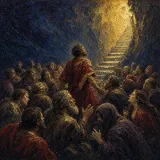
Open with the chapter’s first image
Deuteronomy 32:1: “Give ear, O ye heavens, and I will speak; and hear, O earth, the words of my mouth.”
Slow down at the turning point
Deuteronomy 32:30: “How should one chase a thousand, and two put ten thousand to flight, except their Rock had sold them, and the LORD had shut them up?”
Keep this word trail visible
people, Rock, children, LORD, land, Israel
What to explain, in order
Teach the passage in this order. Each step names the verses it rests on, so every point can be shown in the text before it is applied.
Deuteronomy 31:30–32:47
Deuteronomy 31:30-32:6
Heaven and earth, and the Rock
Begin with the setting: Moses speaks the song to the whole congregation. Explain that the song is a covenant lawsuit, calling witnesses (32:1) and laying out the case. Then read 32:2 slowly as a picture of good teaching. Introduce "the Rock", the song's main name for God, which appears again and again, and explain it as a picture of stability and shelter. Then the charge of 32:5-6. Teach this first because the whole song is a contrast between this Rock and the people's response.
Deuteronomy 32:7-14
Ask your elders what he did
Read 32:7 as an invitation to remember: ask your father and your elders. Then the history in images. 32:8 has a well-known textual difference; some ancient copies read "the sons of God" rather than "the children of Israel", and translations differ. Mention it briefly. Then the desert, the apple of his eye, the eagle stirring her nest and carrying her young, and the rich food of 32:13-14. Keep the eagle picture to what the verse says; popular embellishments go beyond it.
Deuteronomy 32:15-25
Jeshurun grew fat and kicked
This is the turn. Read 32:15-18: a well-fed animal kicking at its owner. Explain "devils" in 32:17 as demons or false spirits behind the idols, and "Of the Rock that begat thee thou art unmindful" (32:18) as forgetting a parent. Then the LORD's response in 32:19-25: hidden face, jealousy answered with jealousy, and judgements of hunger, plague and sword. Read these soberly. Paul quotes 32:21 in Romans 10:19, and readers differ on how he applies it to the Gentiles.
Deuteronomy 32:26-35
Why the enemy does not win
Show the surprising restraint of 32:26-27: God holds back so the enemy will not boast. Then 32:28-33: the song mocks the enemies' rock and vine as poisonous. 32:35, "To me belongeth vengeance, and recompence", places judgement with God alone. Paul quotes it in Romans 12:19 to forbid personal revenge. Teach this step to show that judgement in the song is never handed to human beings to carry out on their own.
Deuteronomy 32:36-43
I kill and I make alive
The song turns to rescue. When Israel's power is gone, the LORD "shall judge his people, and repent himself for his servants" (32:36). He mocks the idols and declares himself the only God who wounds and heals (32:39). The warrior images of 32:40-42 are vivid; read them as poetry of divine justice, not a call to human violence. End on 32:43: the nations are invited to rejoice with his people, and he "will be merciful unto his land, and to his people". Paul quotes this in Romans 15:10.
Deuteronomy 32:44-47
It is your life
Close with Moses and Joshua speaking the song together and Moses' final appeal. Point out that Joshua, called Hoshea here, stands beside Moses as the song is taught. Read 32:46-47 and make the connection to 6:6-7: words set on the heart and taught to children. Teach this last because it turns the song back into a call to obey.
Deuteronomy 32:48–52
Deuteronomy 32:48
That selfsame day
Begin by reading 32:45-47 and then 32:48 straight after it. Moses has just told the people the words of the law are their life; the same day the LORD tells him to prepare to die. Explain "selfsame" as the very same. Do not dramatise Moses' feelings, which the text does not describe. Teach this first so learners see that this short passage is the hinge between the song and the blessing.
Deuteronomy 32:49-50
Up to Nebo, and gathered to his people
Locate Nebo on a simple map: east of the Jordan, opposite Jericho, in the Abarim range. Explain "behold" as to look with care and take in. Then the phrase "be gathered unto thy people", a common Old Testament expression for death, used also of Abraham and Aaron. It speaks of joining those who went before, but it is not a burial map; Moses and Aaron die on different mountains.
Deuteronomy 32:51
The reason given
Read Numbers 20:1-13 for the background. At Meribah the people complained for water; Moses was told to speak to the rock and instead struck it twice, saying "must we fetch you water out of this rock?" (Numbers 20:10). Explain "sanctified me not" as failing to honour God as holy in front of the people. Readers have explained Moses' failure in different ways; let the text's own phrase lead, and keep his long faithfulness in view.
Deuteronomy 32:52
Yet thou shalt see
End with the two clauses of 32:52. The judgement holds, but the LORD gives Moses the sight of the land. Point forward to 34:1-4, where he sees it from Pisgah, and to the transfiguration in Matthew 17:3, where Moses appears with Jesus; Christians have long seen in that scene a further grace, while the passage itself does not speak of it. Let the class leave with both severity and kindness.
Where learners get stuck
The misreadings this passage tends to produce, and how to answer each from the text.
Deuteronomy 31:30–32:47
"The song is only about judgement, so it is a hopeless ending."
The song moves from charge to judgement to rescue. The LORD "shall judge his people, and repent himself for his servants" (32:36), declares that he heals (32:39), and ends "and will be merciful unto his land, and to his people" (32:43). The warnings are real, but the last word is mercy. Read through to 32:43 every time you teach it.
"One shall chase a thousand means believers are always unbeatable."
32:30 explains Israel's defeat, not its strength: one enemy chased a thousand Israelites "except their Rock had sold them". The verse shows what happens when God gives his people over. Joshua 23:10 uses similar words of Israel's victories, but this verse should not be turned into a slogan about human power.
"If God says vengeance is his, then he is a vengeful God we should fear."
"To me belongeth vengeance" (32:35) means justice belongs to God and not to us. It frees the wronged from carrying revenge, which is why Paul uses it in Romans 12:19 to say "avenge not yourselves". The same God declares that he heals (32:39) and is merciful (32:43). Help learners see God's justice as a comfort for the oppressed.
"The eagle verse tells us exactly how eagles teach their young to fly."
32:11 gives a picture: the eagle stirs the nest, hovers over its young, spreads its wings, takes them and carries them. It does not describe flight lessons in detail, and some popular illustrations add things the verse does not say. Keep the point the song makes: the LORD alone led Israel with that kind of protective care (32:12).
Deuteronomy 32:48–52
"God was too harsh; one mistake cost Moses everything."
The text calls it trespass and a failure to sanctify God before the whole people (32:51), a public act by the nation's leader. Yet Moses is not cast off: he sees the land (32:52), is called "the servant of the LORD" at his death (34:5), and is honoured as unmatched (34:10). Hold the seriousness of leadership and the grace given together.
"Moses was kept out because he was too old to go on."
34:7 says the opposite: "his eye was not dim, nor his natural force abated". The reason the LORD gives is Meribah (32:51). Moses' words in 31:2, "I can no more go out and come in", speak of his role ending at God's word, not of physical weakness.
"If a leader suffers, it must be because of some hidden sin."
This passage states one reason for one man's boundary. It gives no licence to speculate about why any person today suffers or loses something. Jesus refuses that reasoning in John 9:1-3. Keep the class from turning Moses' case into a rule for diagnosing others.
Learning objectives
- Explain why heaven and earth are addressed as listeners.
- Trace the contrast between the faithful Rock and corrupt children.
- Identify the movement from wilderness care to prosperous forgetfulness.
- Explain the concern about enemy boasting in 32:27.
- Distinguish the Lord's exclusive power from the helplessness of false gods.
- Describe the responsibility attached to teaching the song's words.
- Locate the commanded ascent in relation to Moab and Jericho.
- Identify the people to whom the land is being given.
- Explain the comparison between Moses' death and Aaron's.
- Name the reason the Lord gives for Moses' exclusion.
- Distinguish permission to see from permission to enter.
- Separate the passage's stated judgment from claims it does not make.
Teacher preparation
- Read Deuteronomy 31:19–22, 30 and 32:1–47; remember that the song has already been assigned the role of witness.
- Explain 'Jeshurun' as a poetic designation for Israel and identify Hoshea in 32:44 as Joshua by comparing Numbers 13:16.
- Mark each use of rock or Rock; check whose supposed protection is being described before treating every occurrence identically.
- Explain that 'repent himself for his servants' in 32:36 describes relenting or compassion, not the Lord confessing wrongdoing.
- Summarize judgment non-graphically; never turn growing fat in 32:15 into a joke about human bodies.
- Read Deuteronomy 32:48–52 immediately after 32:45–47; note the same-day transition from teaching about life to instructions concerning Moses' death.
- Read Numbers 20:1–13 for Meribah and 20:22–29 for Aaron's death on Mount Hor.
- Distinguish the location of Meribah in the wilderness of Zin from the separate Sinai wilderness name; do not collapse every water incident into one event.
- Prepare a simple east-of-Jordan orientation using Abarim, Nebo, Moab, and Jericho as the passage gives them.
- Plan to discuss death and accountability without asking learners to recount a bereavement or identify a punished person.
Evidence and interpretation checks
Explicit
Read Deuteronomy 32:4–6: the Rock's perfect work and justice stand against the people's corrupt response to the Father who made them. Read Deuteronomy 32:49, 52: Moses is commanded to view Canaan, but explicitly forbidden to enter it.
Scripture-supported
Compare Deuteronomy 32:15–18 with 8:12–14. Both connect abundance with the danger of forgetting the giver, not with a claim that food itself is evil. Compare Deuteronomy 32:51 with Numbers 20:12. Both identify failure to sanctify the Lord before Israel as the reason for exclusion.
Strong inference
Infer from Deuteronomy 31:21 and 32:46 that memorable words serve intergenerational accountability; the song is designed to outlive its first teacher. Infer from Deuteronomy 32:49–52 that the leader's consequence does not revoke the people's promised inheritance; the land is still described as the Lord's gift to Israel.
Possible or traditional reading
Treat elaborate traditional explanations of eagle parenting cautiously. Deuteronomy 32:11 gives stirring, hovering, spreading wings, and carrying, but does not describe every behavior used in popular illustrations. Treat 'gathered unto thy people' in Deuteronomy 32:50 as a death-related expression, not a precise burial map; Moses and Aaron are assigned different mountains.
Limit
State that Deuteronomy 32:30 is not a general promise that two believers possess a mathematically multiplied power; the verse explains defeat through the Rock's giving people over. State that Deuteronomy 32:48–52 does not explain Moses' private emotions, authorize speculation about a present sufferer's guilt, or pronounce his eternal destiny.
Discussion with answer guidance
1. Why begin a covenant witness with rain and dew?
What a good answer contains
Because the song is both gift and witness. Moses calls the heavens and the earth to listen (32:1), as he said he would in 31:28, and then describes his teaching as gentle water: "My doctrine shall drop as the rain, my speech shall distil as the dew, as the small rain upon the tender herb" (32:2). A strong answer keeps both: the words are nourishment for those who receive them and testimony against those who refuse. A weak answer chooses one and loses the other.
Show teacher guidance
Read 32:1–3 alongside 31:19. Hold together the nourishing teaching image and the serious testimony; do not force a choice between beauty and warning.
2. What makes the people's response so jarring beside the description of the Rock?
What a good answer contains
The Rock is described in five lines of faithfulness: "He is the Rock, his work is perfect: for all his ways are judgment: a God of truth and without iniquity, just and right is he" (32:4). Then: "They have corrupted themselves", and "they are a perverse and crooked generation" (32:5), and "Do ye thus requite the LORD, O foolish people and unwise? is not he thy father that hath bought thee?" (32:6). A good answer sees the contrast between a perfect giver and an ungrateful child. A weak answer reduces it to people making mistakes.
Show teacher guidance
Compare 32:4–6. Identify the contrast between faithful justice and corrupt repayment, rather than merely saying people make mistakes.
3. What happens between being carried and kicking against the giver?
What a good answer contains
The LORD found Israel "in a desert land", "kept him as the apple of his eye" (32:10), carried him like an eagle carrying her young (32:11), and fed him with honey from the rock and the finest food (32:13-14). Then: "But Jeshurun waxed fat, and kicked", and "then he forsook God which made him, and lightly esteemed the Rock of his salvation" (32:15). A strong answer keeps the order: rescue, care, abundance, then forgetting. Explain Jeshurun as a poetic name for Israel, meaning upright, used here with irony.
Show teacher guidance
Trace 32:10–18 from protection through rich provision to forsaking and forgetting. Keep the sequence visible.
4. Why does the song mention what an enemy might claim?
What a good answer contains
Because God's restraint protects his own name. He would have scattered them, "Were it not that I feared the wrath of the enemy", lest the adversaries "should say, Our hand is high, and the LORD hath not done all this" (32:27). A good answer sees that the enemy would misread Israel's fall as their own victory and as proof the LORD is powerless. 32:30-31 confirms it: Israel's defeat came because "their Rock had sold them". A weak answer misses the enemy's boast entirely.
Show teacher guidance
Read 32:26–27. Identify the imagined boast that the enemy's own hand accomplished everything and that the Lord had no part.
5. What answer is expected when the Lord asks where the other gods are?
What a good answer contains
None: the other gods cannot answer. "Where are their gods, their rock in whom they trusted", and the taunt "let them rise up and help you" (32:37-38) expects silence. Then the LORD speaks: "See now that I, even I, am he, and there is no god with me: I kill, and I make alive; I wound, and I heal: neither is there any that can deliver out of my hand" (32:39). A strong answer sees that the judgement exposes the idols and leaves the LORD alone as the one who can also heal. A weak answer hears only the threat.
Show teacher guidance
Read 32:37–39. Contrast their inability to help with the Lord's declaration that none can deliver from his hand.
6. Why does Moses call these words 'your life' rather than merely a memorable performance?
What a good answer contains
Because the words are the condition of their life in the land. "Set your hearts unto all the words which I testify among you this day, which ye shall command your children to observe to do" (32:46), "For it is not a vain thing for you; because it is your life" (32:47). Explain "vain" as empty. A good answer connects setting the heart, teaching the children, doing the words and prolonging days. A weak answer treats the song as a performance to admire and forget.
Show teacher guidance
Read 32:45–47. Connect setting the heart, teaching children, doing the law, and life in the land.
7. What makes 'that selfsame day' in 32:48 weighty?
What a good answer contains
Because the same day Moses tells the people that the words are "your life" and that through them "ye shall prolong your days in the land" (32:47), the LORD tells him to go up and die. "And the LORD spake unto Moses that selfsame day" (32:48). A strong answer feels the weight: the man who has just urged long life in the land on others is told his own life ends outside it. A weak answer passes over the timing as a scheduling detail.
Show teacher guidance
Look back to 32:45–47. Moses has just urged Israel to receive words that are their life; he must now prepare for his own death.
8. Where must Moses go, and what is he to do there?
What a good answer contains
"Get thee up into this mountain Abarim, unto mount Nebo, which is in the land of Moab, that is over against Jericho; and behold the land of Canaan" (32:49). A good answer names the place, Nebo in the Abarim range opposite Jericho, and the action, to behold. It also distinguishes the viewpoint from the destination: Moses sees across the Jordan but is not to cross. A weak answer blurs Nebo into the promised land itself.
Show teacher guidance
Use 32:49: ascend Nebo in Moab opposite Jericho and behold Canaan. Distinguish the viewpoint from the destination he cannot enter.
9. Whose inheritance remains secure in the command?
What a good answer contains
Israel's. The land is "the land of Canaan, which I give unto the children of Israel for a possession" (32:49), and 32:52 repeats it: "the land which I give the children of Israel". A strong answer sees that Moses' exclusion does not change the promise to the people at all; the gift still stands in the same sentence that sends him up the mountain. A weak answer thinks the people's future is in doubt because their leader is not going with them.
Show teacher guidance
Read 32:49. The land is being given to Israel; do not confuse Moses' exclusion with withdrawal of the national promise.
10. Why bring Aaron into these instructions?
What a good answer contains
Because Aaron's death is the pattern for Moses' own. Moses is to "die in the mount whither thou goest up, and be gathered unto thy people; as Aaron thy brother died in mount Hor" (32:50), and 32:51 joins them: "ye trespassed against me". Numbers 20:22-29 records Aaron's death on Hor. A good answer sees the brothers shared the failure at Meribah and share its consequence, though on different mountains. A weak answer forgets that Aaron is named because of Meribah.
Show teacher guidance
Read 32:50 and Numbers 20:22–29. Identify the parallel death and the shared responsibility connected with Meribah, not identical burial locations.
11. What reason does the Lord state for the boundary?
What a good answer contains
"Because ye trespassed against me among the children of Israel at the waters of Meribah-Kadesh, in the wilderness of Zin; because ye sanctified me not in the midst of the children of Israel" (32:51). A strong answer names both the trespass and the failure to honour God as holy before the people, as in Numbers 20:12. It does not substitute old age, which 34:7 rules out, or place all the blame on the people, though Moses elsewhere says "for your sakes" (1:37).
Show teacher guidance
Read 32:51 closely. Use trespass and failure to sanctify him; do not substitute age alone or blame the people exclusively.
12. What does the final 'yet' allow without overturning the judgment?
What a good answer contains
"Yet thou shalt see the land before thee; but thou shalt not go thither" (32:52). The "yet" grants something real: Moses will see with his own eyes the land promised to his fathers. The "but" keeps the boundary. A good answer holds both clauses and sees mercy within judgement, without letting the mercy cancel the judgement or the judgement erase the mercy. A weak answer reads only one half of the verse.
Show teacher guidance
Read 32:52. Moses may see the land but not enter; retain both clauses rather than allowing either to swallow the other.
Responsible application
Heart and habits
Ask learners to annotate an imagined prosperity speech with the missing giver named in 32:15–18; require no disclosure about their own finances.
Relationships and community
Draft a teaching note for the next generation that includes provision, betrayal, and responsibility rather than only the pleasant lines.
Songs that carry meaning
Evaluate a fictional lesson refrain that preserves the song's imagery but removes its warning; explain what its listeners would no longer learn.
A promise beyond one lifetime
Ask groups to distinguish what continues for Israel from what ends for Moses, using 32:49–52 alone.
Session plans
Two timings of the same lesson. The shorter keeps the reading, the central discussion and one response; the longer gives the confusions and the application their own time.
Deuteronomy 31:30–32:47
45 minutes
Rain and dew
Read 32:1-3 aloud. Take question one.
The Rock and the child
Read 32:4-6. Take question two.
Carried, then kicking
Read 32:10-18. Take question three and confusion four.
The enemy's boast
Read 32:26-31. Take question four and confusion two.
Where are their gods
Read 32:35-43 and 32:46-47. Take questions five and six, and confusion one.
Handout
Read the key verse together, point to the take-home line, and close with 32:43.
90 minutes
Songs that remember
Ask the class what song they remember from childhood and why. Read 31:19-22 and 31:30.
Witnesses and a lawsuit
Read 32:1-6. Take questions one and two. Explain the Rock.
The history in pictures
Read 32:7-14. Take confusion four. Mention the textual note on 32:8.
Fat and forgetful
Read 32:15-25. Take question three. Read 8:12-14 beside 32:15.
Restraint and vengeance
Read 32:26-35. Take question four and confusions two and three. Read Romans 12:17-21.
I wound and I heal
Read 32:36-43. Take question five and confusion one. Read Romans 15:8-10.
Your life
Read 32:44-47 and take question six.
Application
Have the class write a short verse of their own, in the shape of 32:7, about something God has done for their parents or elders.
Handout and prayer
Read the key verse together and pray 32:3, ascribing greatness to God.
Deuteronomy 32:48–52
45 minutes
That selfsame day
Read 32:45-48. Take question one.
Up to Nebo
Read 32:49-50 with a simple map. Take questions two and three.
Meribah
Read Numbers 20:1-13 and then 32:51. Take questions four and five, and confusion two.
Yet thou shalt see
Read 32:52. Take question six and confusion one.
Care with suffering
Take confusion three and talk gently about not judging others' losses.
Handout
Read the key verse together and point to the take-home line.
90 minutes
The view from a mountain
Show a picture of the view from Nebo, or describe it. Ask what it would feel like to see a place you cannot reach.
That selfsame day
Read 32:44-48. Take question one.
Nebo and Hor
Read 32:49-50 and Numbers 20:22-29. Take questions two, three and four.
The waters of Meribah
Read Numbers 20:1-13 slowly, then 32:51 and Numbers 20:12. Take question five and confusion two.
See, but not enter
Read 32:52 and 34:1-4. Take question six and confusion one.
Leaders and suffering
Take confusion three. Read John 9:1-3.
Application
Ask learners to name something they have been allowed to see begun but may not see finished, and to pray for those who will carry it on.
Handout and prayer
Read the key verse together and pray for leaders who carry responsibility before others.
Adapting the lesson
Deuteronomy 31:30–32:47
Children
Bring water in a spray bottle and mist a plant while reading 32:2: God's words are like gentle rain. Build a nest from cloth and use a toy bird to show 32:11, the eagle carrying her young. Keep the judgement verses out. Teach the children to say "He is the Rock" and to stand firm on the floor while they say it.
Youth
Ask what happens to gratitude when life gets easy, then read 32:15. Talk about Jeshurun kicking the one who fed him. Use 32:35 and Romans 12:19 to discuss revenge and online conflict. Point out that the song was meant to be sung and remembered; ask which worship songs carry truth for them, and which only carry feeling.
Adults
Discuss the structure of the song as a covenant lawsuit. Look at its use in the New Testament, Romans 10:19, 12:19, 15:10 and Hebrews 1:6 in some readings. Mention the textual issue at 32:8. Discuss the danger of comfort in 32:15 for established churches. Give time to 32:39 and how God's wounding and healing are held together.
One to one
Read 32:10-12 and ask whether they have known God carrying them. If they are in a season of forgetfulness, read 32:15-18 gently. If they have been wronged, read 32:35 and 32:43 and talk about leaving vengeance with God. Close with 32:47: these words are your life.
Deuteronomy 32:48–52
Children
Climb a pretend mountain with the children, standing on a chair or step, and look across the room to a "land" made of cloth. Explain that God let Moses see the land he had promised, even though Moses could not go in. Keep Meribah simple: Moses did not do what God said in front of everyone. Emphasise that God still loved Moses and called him his servant.
Youth
Ask whether they have ever worked hard for something and then not been part of the finish. Read 32:48-52. Discuss what it means to honour God as holy in front of others, especially for those who lead teams, clubs or younger children. Keep the conversation on responsibility rather than fear.
Adults
Discuss leadership and public example. Read Numbers 20 and 32:51 and ask why the failure was treated so seriously. Note the different ways readers explain the sin at Meribah. Discuss passing on work one will not finish, and how to bless those who will carry it forward. Keep grace visible through 32:52 and 34:10.
One to one
Ask whether they are facing an ending they did not choose. Read 32:52 slowly and talk about the "yet" in it. If they carry regret for a failure, read 34:5 and 34:10: Moses' failure is not the last word about him. Pray with them for peace about what they will not finish.
Song and video learning lab
A song or video may interpret, compress, or dramatize the text. Its value becomes clearer when its choices are compared with Scripture.
- Before the media: the exact passage and its central movement.
- During the media: the words, people, events, and emotions the artist emphasizes.
- After the media: what it clarifies, what it leaves out, and what belongs back in the biblical text.
Handout
One page for learners to take home. The print button prints this section alone.
Deuteronomy 31:30–32:47
The passage in brief
Moses teaches Israel a song. It calls heaven and earth to listen and praises the LORD as the Rock whose ways are perfect. It remembers how God found Israel in the desert, cared for them like an eagle with her young, and fed them richly, but they grew fat and turned to other gods. God will judge them, yet he will not let their enemies boast, and in the end he will show mercy. Moses tells the people these words are their life.
A verse to keep
He is the Rock, his work is perfect: for all his ways are judgment: a God of truth and without iniquity, just and right is he.
Deuteronomy 32:4 · King James Version
Questions to take home
What does 32:4 say about the Rock?
What happened after Jeshurun "waxed fat" in 32:15?
Why does Moses say these words are "your life" in 32:47?
This week
When life feels comfortable this week, stop once a day and thank the Rock who carried you.
Deuteronomy 32:48–52
The passage in brief
On the same day that Moses finishes his song, the LORD tells him to climb Mount Nebo, across the Jordan from Jericho, and look at the land of Canaan that God is giving to Israel. Moses will die there, as his brother Aaron died on Mount Hor, because at the waters of Meribah they did not honour God as holy in front of the people. God lets Moses see the land, but he will not enter it.
A verse to keep
Yet thou shalt see the land before thee; but thou shalt not go thither unto the land which I give the children of Israel.
Deuteronomy 32:52 · King James Version
Questions to take home
Where does God tell Moses to go in 32:49, and what will he see?
What reason does 32:51 give for Moses not entering the land?
What does God still give Moses in 32:52?
This week
Pray this week for someone who will carry on work you began, and tell them you are glad they will.
Music and video connected to the passage
Related media appears when its Scripture reference overlaps this study. Music and video can illuminate a theme while the biblical text remains the foundation.