The big picture
The queen of Sheba arrives to test Solomon, and the chapter gives her more than a glittering court to inspect. She brings hard questions, speaks what is in her heart, receives answers, and then studies the whole arrangement around the king: table, servants, clothing, attendants, and access to the house of the LORD. Her verdict is that the report she heard was smaller than the reality, but her praise ultimately turns toward God's purpose in setting Solomon on the throne to do judgment and justice for Israel. Gifts move both ways before the account widens into an extraordinary inventory of yearly gold, shields, throne, vessels, ships, horses, and tribute. Yet the gift behind the visible gifts is still wisdom God placed in Solomon's heart. The reign reaches its richest description and then ends in three restrained verses: forty years, burial, succession.
In this chapter
- A Reputation That Turns Out to Be an Understatement 2 Chronicles 9:1-8
The queen of Sheba comes to test a reputation, not merely to admire a palace.
- Gifts Move in Both Directions 2 Chronicles 9:9-12
The visit closes with gifts moving in both directions.
- Silver Scarcely Makes the Inventory 2 Chronicles 9:13-21
The chapter now turns Solomon's wealth into a room full of visible objects.
- The Gift Behind the Gifts 2 Chronicles 9:22-28
After the gold, the account returns to the gift that cannot be weighed.
- Forty Years, Then a Name in the Succession 2 Chronicles 9:29-31
Solomon's magnificent reign ends with almost no magnificence in the telling.
Scripture beside the summary
2 Chronicles · King James Version · 312 Chronicles 9:1-8
A Reputation That Turns Out to Be an Understatement
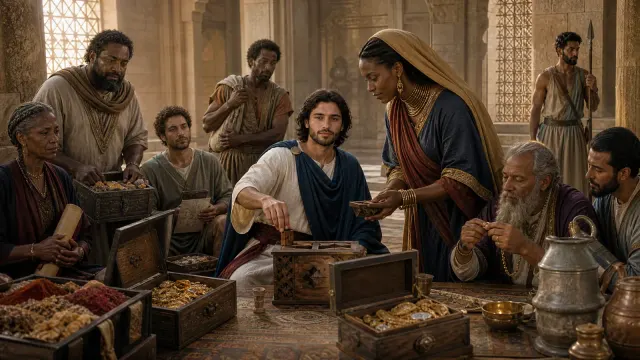
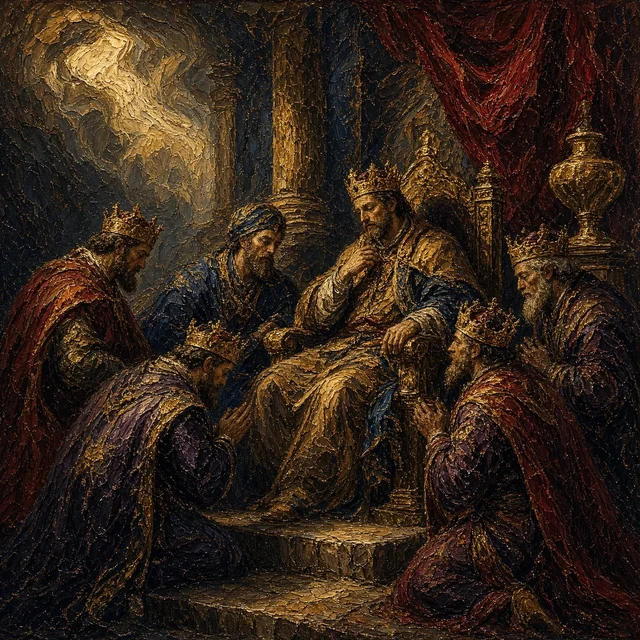
The queen of Sheba comes to test a reputation, not merely to admire a palace. She brings hard questions, speaks to Solomon about all that is in her heart, and finds nothing he cannot answer. Only after that intellectual exchange does she examine the ordered life around him: table, servants, ministers, clothing, cupbearers, and his ascent to the house of the LORD. Her reaction is that the reports reaching her country did not exaggerate Solomon. They understated him. Yet the section's most important turn is where her praise finally lands. She blesses the LORD and connects Solomon's throne with God's love for Israel, judgment, and justice. The visitor is overwhelmed by wisdom made visible in administration, but the account does not let the king become a self-made wonder. His position is interpreted through the people he is meant to govern well.
Deep dive
The queen does more than inspect a display of expensive objects. She brings difficult questions, speaks what is in her heart, and receives answers. Only then does the account move through the house, the table, the servants, their clothing, and Solomon's ascent to the house of the LORD. Wisdom is being examined both in speech and in the ordering of a court. The visitor who came with questions encounters an entire establishment shaped by the king's rule.
Her report reverses the usual problem with an impressive reputation: this one has been undersold. The expression about having no more spirit describes her being overwhelmed by what she sees; it does not require an invented account of fainting. More important is where her praise lands. She calls Solomon's throne God's throne and connects his appointment with justice, judgment, and God's love for Israel. The splendour serves a stated royal responsibility. In Matthew 12:42, Jesus recalls her journey to hear Solomon's wisdom when identifying the greater claim of his own presence. The later reference takes her serious pursuit of wisdom, not her fascination with gold, as its point of comparison.
Words to trace: Solomon, wisdom, king, LORD, told, apparel
Verse-by-verse path
- 2 Chronicles 9:1
Sheba is most often identified with Saba in southwest Arabia, modern Yemen, a kingdom grown rich on the frankincense trade, some twelve hundred miles from Jerusalem by caravan. “Hard questions” are chidot, riddles, the word for Samson’s riddle at his wedding (Judges 14:12). “Prove” means test.
- 2 Chronicles 9:2
“Told her all her questions” means answered them all. Proverbs 25:2 names the royal skill on display: “It is the glory of God to conceal a thing: but the honour of kings is to search out a matter.”
- 2 Chronicles 9:3
She “had seen the wisdom”: the verb treats wisdom as something visible, laid out in what the king has built. The house here is probably the palace, since the way up to the temple is listed separately in the next verse.
- 2 Chronicles 9:4
“His ascent” is aliyyato, the way he went up to the temple. The parallel in 1 Kings 10:5 has olato, which can also mean “his burnt offering”, and older versions read it that way. “The sitting of his servants” is the seating order at the royal table.
- 2 Chronicles 9:5
“Thine acts” is literally “thy words”, devarim, so the report was of Solomon’s sayings as well as his deeds. “A true report” is emet, truth, the word that stands behind “amen”.
- 2 Chronicles 9:6
The Hebrew is a little sharper than Kings: “the half of the greatness of thy wisdom”. The queen had already heard enough to make the long journey, and says she disbelieved even that until she saw it.
- 2 Chronicles 9:7
“Happy” is ashrei, the word that opens Psalm 1. The Greek of 1 Kings 10:8 reads “happy are thy wives” in place of “thy men”, the two Hebrew words differing by a single letter.
- 2 Chronicles 9:8
“Judgment and justice” is the pair the book used of David’s own rule in 1 Chronicles 18:14. The foreign queen names as Solomon’s purpose what Chronicles had already said of his father, and she calls the throne God’s where 1 Kings 10:9 has “the throne of Israel”.
2 Chronicles 9:1-8
King James Version1And when the queen of Sheba heard of the fame of Solomon, she came to prove Solomon with hard questions at Jerusalem, with a very great company, and camels that bare spices, and gold in abundance, and precious stones: and when she was come to Solomon, she communed with him of all that was in her heart.
2And Solomon told her all her questions: and there was nothing hid from Solomon which he told her not.
3And when the queen of Sheba had seen the wisdom of Solomon, and the house that he had built,
4And the meat of his table, and the sitting of his servants, and the attendance of his ministers, and their apparel; his cupbearers also, and their apparel; and his ascent by which he went up into the house of the LORD; there was no more spirit in her.
5And she said to the king, It was a true report which I heard in mine own land of thine acts, and of thy wisdom:
6Howbeit I believed not their words, until I came, and mine eyes had seen it: and, behold, the one half of the greatness of thy wisdom was not told me: for thou exceedest the fame that I heard.
7Happy are thy men, and happy are these thy servants, which stand continually before thee, and hear thy wisdom.
8Blessed be the LORD thy God, which delighted in thee to set thee on his throne, to be king for the LORD thy God: because thy God loved Israel, to establish them for ever, therefore made he thee king over them, to do judgment and justice.
2 Chronicles 9:9-12
Gifts Move in Both Directions
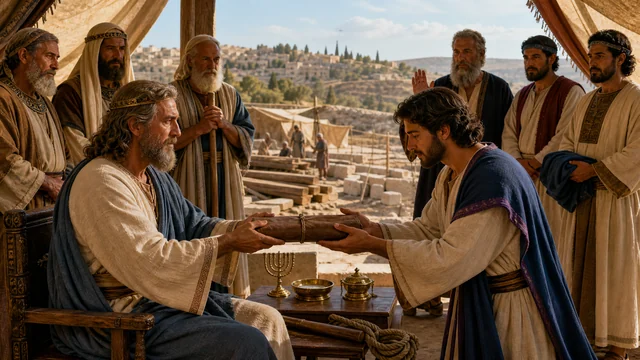
The visit closes with gifts moving in both directions. The queen brings gold, precious stones, and an extraordinary quantity of spices, while the products arriving through Huram and Solomon's trading partnership include algum wood and more precious stones. That wood does not simply disappear into storage. It becomes architectural work in the temple and palace and instruments for singers, so foreign trade reaches both building and music. Solomon, in turn, gives the queen what she desires and asks beyond what she had brought him. The exchange is generous without needing a romance invented around it. The Book of 2 Chronicles gives no such private account. She remains a royal visitor who tested wisdom, inspected the court, pronounced her judgment, exchanged costly gifts, and returned to her own land with her servants. That is already more than enough significance for the visit.
Deep dive
Gold, spices, and precious stones appear in the queen's gift, but the spices receive the special distinction: nothing comparable is brought afterward. The account then briefly turns to the servants of Huram and Solomon and their supplies of algum wood and precious stones. Foreign contributions do not simply disappear into a royal strongroom. The wood becomes features of both the temple and the palace, as well as instruments for the singers. Trade reaches architecture and music.
Solomon's response includes what the queen asks and desires, beyond what she has brought to him. The account gives no inventory of her requests and no private explanation of their relationship. It records her departure with her servants to her own land. That restraint matters. A visit rich enough in questions, observation, praise, and reciprocal gifts does not need an added romance to make it significant. The queen remains a royal visitor whose independent examination has produced a public judgment about Solomon's wisdom.
Words to trace: king, gave, servants, Solomon, algum, gold
Verse-by-verse path
- 2 Chronicles 9:9
A hundred and twenty talents is the same sum Hiram once sent Solomon (1 Kings 9:14). Sheba became a byword for this trade: Isaiah 60:6 sees them come “from Sheba” bringing gold and incense, and Psalm 72:15 prays for “the gold of Sheba” to be given to the king.
- 2 Chronicles 9:10
Here Chronicles agrees with 1 Kings 10:11 that algum came by sea from Ophir along with the gold, where in 2:8 Solomon had asked for algum from Lebanon. Both may be true of different shipments, or the name may cover more than one wood.
- 2 Chronicles 9:11
“Terraces” is mesillot, raised paths or stairways; 1 Kings 10:12 has a different word, often rendered “pillars” or “supports”, and neither is certain. Wood for harps is chosen for its sound, so the algum was valued for music as well as for building.
- 2 Chronicles 9:12
“All her desire” is left unspecified. Later Ethiopian tradition built a dynasty on this visit, claiming a son born to the queen and Solomon, but nothing in Chronicles or Kings supports it. She simply “turned”, and went home with her retinue.
2 Chronicles 9:9-12
King James Version9And she gave the king an hundred and twenty talents of gold, and of spices great abundance, and precious stones: neither was there any such spice as the queen of Sheba gave king Solomon.
10And the servants also of Huram, and the servants of Solomon, which brought gold from Ophir, brought algum trees and precious stones.
11And the king made of the algum trees terraces to the house of the LORD, and to the king’s palace, and harps and psalteries for singers: and there were none such seen before in the land of Judah.
12And king Solomon gave to the queen of Sheba all her desire, whatsoever she asked, beside that which she had brought unto the king. So she turned, and went away to her own land, she and her servants.
2 Chronicles 9:13-21
Silver Scarcely Makes the Inventory
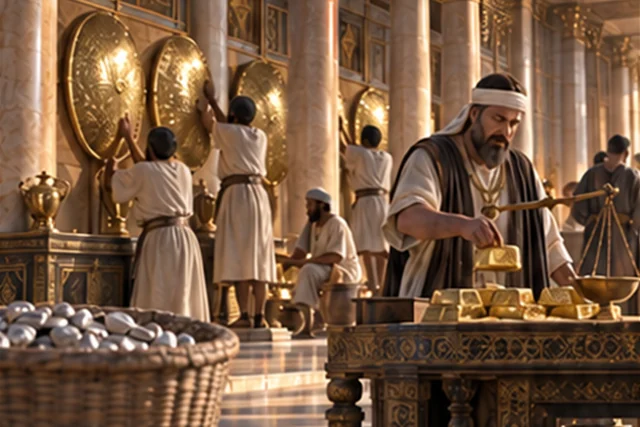
The chapter now turns Solomon's wealth into a room full of visible objects. The annual gold figure comes first, before additional revenue from merchants and rulers is even added. Shields of beaten gold fill the house of the forest of Lebanon, an ivory throne is overlaid with gold, lions flank the seat and steps, and even the drinking vessels make silver look ordinary by comparison. The number 666 appears here as an income figure, and this passage supplies no hidden judgment that needs to be imported into it. The throne's details stage royal magnificence quite deliberately, while the ships extend that magnificence outward through ivory, apes, and peacocks. No secret code is needed for the inventory to work. The point is already loud enough: Solomon's court possesses a reach, luxury, and visual scale the account regards as exceptional.
Deep dive
The annual weight of gold is specified before additional revenue from merchants, rulers, and governors is mentioned. The figure of 666 belongs here to an account of income. This passage does not supply an interpretation of it as a hidden judgment on Solomon. The objects that follow turn that income into something visible: large and small shields, an ivory throne overlaid with gold, lions beside the seats and steps, and drinking vessels fit for this particular court. Silver has not vanished; it has simply lost its claim to being impressive.
The throne receives a carefully staged description. Steps, footstool, supports, and lions direct attention toward the seated king, and the account says that no other kingdom had its like. The ships bring a different kind of distinction, extending the inventory beyond metals to ivory, apes, and peacocks. These details display the reach of Solomon's wealth and connections. They are not accompanied by an explanation of secret meanings for each animal or architectural feature. The abundance is already doing its work without an additional code.
Words to trace: gold, Solomon, king, beaten, silver, throne
Verse-by-verse path
- 2 Chronicles 9:13
Six hundred and sixty-six talents is the figure of 1 Kings 10:14, about twenty-three tons of gold a year. The law of the king in Deuteronomy 17:17 had said, “neither shall he greatly multiply to himself silver and gold.”
- 2 Chronicles 9:14
“Chapmen” is an old word for travelling traders. “Governors” is pachot, the administrative title later held by Nehemiah and Zerubbabel under Persia, a word from the Chronicler’s own era set into Solomon’s reign.
- 2 Chronicles 9:15
A target was the large shield that covered the whole body, from the old word “targe”. These did not last: Shishak of Egypt carried them off in Rehoboam’s fifth year, and Rehoboam replaced them with bronze (12:9–10).
- 2 Chronicles 9:16
The house of the forest of Lebanon was a hall a hundred cubits long with four rows of cedar pillars (1 Kings 7:2), named for the forest of columns inside it. Isaiah 22:8 calls it the armoury, “the armour of the house of the forest”.
- 2 Chronicles 9:17
The throne was probably inlaid with ivory panels rather than carved from it. Ivory furniture became a mark of later northern luxury: Ahab built an “ivory house” (1 Kings 22:39), and Amos condemns those who lie “upon beds of ivory” (Amos 6:4).
- 2 Chronicles 9:18
Only Chronicles has the golden footstool fastened to the throne; 1 Kings 10:19 instead says the top of the throne was round behind. The “stays” are armrests, and the lions stood beside them.
- 2 Chronicles 9:19
Two lions by the arms and twelve on the steps make fourteen. The twelve are often taken as one for each tribe of Israel, and the lion was Judah’s emblem from Jacob’s blessing (Genesis 49:9), though the text makes no such link itself.
- 2 Chronicles 9:20
The golden vessels did not survive the dynasty: Nebuchadnezzar “cut in pieces all the vessels of gold which Solomon king of Israel had made” (2 Kings 24:13). “Accounted of” means valued.
- 2 Chronicles 9:21
Kings speaks of “a navy of Tharshish”, a class of large sea-going ship; Chronicles reads Tarshish as a destination, though Tarshish usually lay in the far west (Jonah 1:3) and these ships sailed from the Red Sea. The words for apes and peacocks may be loanwords from Indian languages.
2 Chronicles 9:13-21
King James Version13Now the weight of gold that came to Solomon in one year was six hundred and threescore and six talents of gold;
14Beside that which chapmen and merchants brought. And all the kings of Arabia and governors of the country brought gold and silver to Solomon.
15And king Solomon made two hundred targets of beaten gold: six hundred shekels of beaten gold went to one target.
16And three hundred shields made he of beaten gold: three hundred shekels of gold went to one shield. And the king put them in the house of the forest of Lebanon.
17Moreover the king made a great throne of ivory, and overlaid it with pure gold.
18And there were six steps to the throne, with a footstool of gold, which were fastened to the throne, and stays on each side of the sitting place, and two lions standing by the stays:
19And twelve lions stood there on the one side and on the other upon the six steps. There was not the like made in any kingdom.
20And all the drinking vessels of king Solomon were of gold, and all the vessels of the house of the forest of Lebanon were of pure gold: none were of silver; it was not any thing accounted of in the days of Solomon.
21For the king’s ships went to Tarshish with the servants of Huram: every three years once came the ships of Tarshish bringing gold, and silver, ivory, and apes, and peacocks.
2 Chronicles 9:22-28
The Gift Behind the Gifts
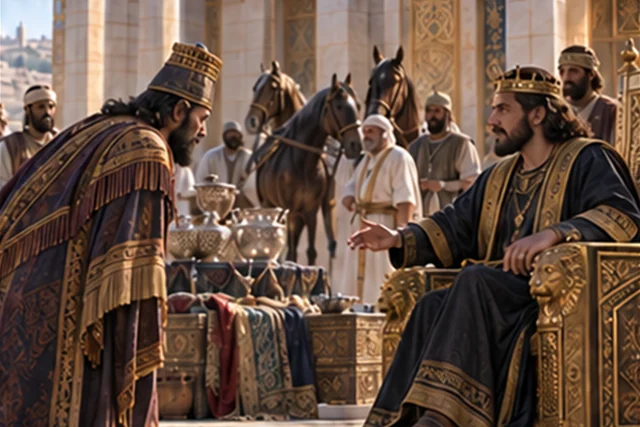
After the gold, the account returns to the gift that cannot be weighed. Kings seek Solomon because they want to hear "his wisdom, that God had put in his heart." That clause keeps the source of his reputation from becoming a celebration of self-creation. Visitors bring silver, gold, clothing, armour, spices, horses, and mules, but God is the one said to have given the understanding drawing them to Jerusalem. The section then gathers military resources, territory, horses, chariot centres, silver, and cedar into one final picture of royal reach. It is the broadest display of Solomon's strength in the chapter. Yet the next reign will introduce the voice of people who remember heavy service under this prosperous system. That later complaint does not cancel the present wealth. It simply prevents the court's abundance from becoming the only description available for Solomon's kingdom.
Deep dive
After so much gold, the explanation for the royal visits returns to something that cannot be weighed: the wisdom God has put in Solomon's heart. The distinction between the gifts is important. God gives wisdom; visitors bring silver, gold, garments, armour, spices, horses, and mules in response to the reputation that wisdom has created. The chapter does not describe Solomon as a self-created marvel. Its language directs the source of his exceptional understanding beyond him.
The closing inventory of horses, chariots, garrisons, tribute, and territorial reach gathers several kinds of royal strength into one view. The comparison of silver with stones and cedar with common trees is a statement of extraordinary abundance, not a claim that their material properties have changed. This is the reign at its widest and richest. The next chapter will allow another voice to describe life under it: the people who speak of heavy service and a grievous yoke. Their complaint does not make the present inventory unreal, but it prevents abundance at court from becoming the only available description of the reign.
Words to trace: Solomon, horses, king, kings, earth, Egypt
Verse-by-verse path
- 2 Chronicles 9:22
The promise at Gibeon was riches and honour “such as none of the kings have had” (1:12). The verse reports it kept, with riches and wisdom now named together.
- 2 Chronicles 9:23
“Sought the presence” is literally “sought the face of Solomon”, the same idiom God used in 7:14, “seek my face”. The kings of the earth come to Solomon’s face as Israel is told to come to God’s.
- 2 Chronicles 9:24
“Harness” in 1611 meant armour and weapons, the Hebrew neshek. “A rate year by year” marks these presents as an annual obligation, tribute brought on a schedule rather than gifts brought once.
- 2 Chronicles 9:25
First Kings 4:26 gives forty thousand stalls; Chronicles has four thousand, which fits the fourteen hundred chariots of 1:14 far better, two or three horses to each chariot. A copyist’s extra zero in Kings is the usual explanation.
- 2 Chronicles 9:26
“The river” is the Euphrates. He “reigned over all the kings”, which means overlordship of vassal kings who kept their own thrones, not direct rule; the Philistine cities, for instance, still had kings of their own.
- 2 Chronicles 9:27
The line repeats 1:15, but the gold has dropped out. At the start of the reign silver and gold were as common as stones; in this closing summary only silver is mentioned.
- 2 Chronicles 9:28
Chronicles adds “and out of all lands” to the horse trade. First Kings follows its equivalent summary with Solomon’s foreign wives and his turning to their gods (1 Kings 11:1–8), none of which appears in Chronicles.
2 Chronicles 9:22-28
King James Version22And king Solomon passed all the kings of the earth in riches and wisdom.
23And all the kings of the earth sought the presence of Solomon, to hear his wisdom, that God had put in his heart.
24And they brought every man his present, vessels of silver, and vessels of gold, and raiment, harness, and spices, horses, and mules, a rate year by year.
25And Solomon had four thousand stalls for horses and chariots, and twelve thousand horsemen; whom he bestowed in the chariot cities, and with the king at Jerusalem.
26And he reigned over all the kings from the river even unto the land of the Philistines, and to the border of Egypt.
27And the king made silver in Jerusalem as stones, and cedar trees made he as the sycomore trees that are in the low plains in abundance.
28And they brought unto Solomon horses out of Egypt, and out of all lands.
2 Chronicles 9:29-31
Forty Years, Then a Name in the Succession
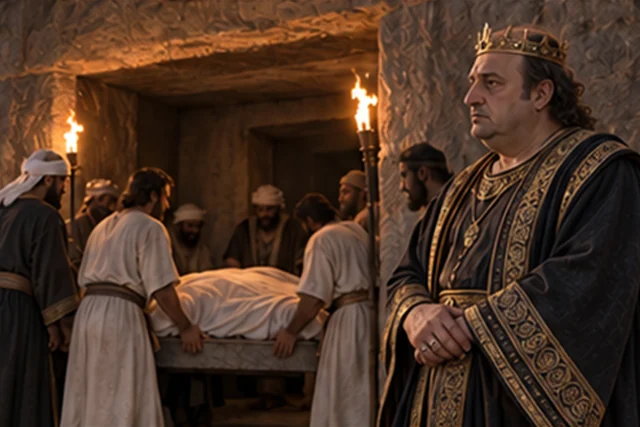
Solomon's magnificent reign ends with almost no magnificence in the telling. The Book of 2 Chronicles points beyond itself to records associated with Nathan, Ahijah, and Iddo, making clear that the chapters just read are not an exhaustive biography. Then comes the simple boundary no throne can remove: Solomon reigns forty years, dies, is buried in David's city, and is succeeded by Rehoboam. The gold shields, throne lions, ships, horses, and treasure receive pages of description. Death receives a sentence. That contrast gives the ending unusual force. Rehoboam inherits the office, but wisdom is not listed among the objects that pass automatically from father to son. The dynasty continues, while the quality of the next reign remains open. Heredity can place a man on the throne. The next chapter will show what he does once he is there.
Deep dive
The reference to Nathan, Ahijah, and Iddo places Solomon's acts within named prophetic records. It also makes clear that the chapter has not attempted an exhaustive biography. The extravagant inventory can therefore close in three restrained verses. Solomon reigns forty years, is buried in David's city, and is succeeded by his son. Gold receives considerable description; death receives none of its ornament.
Rehoboam enters the account through succession rather than through an assessment of his wisdom. That difference leaves the next chapter with a real question to settle through events, not through heredity. The throne can pass from father to son. The discernment that Solomon requested at Gibeon has not been listed among the objects transferred with it. The reign ends with continuity of the royal house, while the quality of the next king's rule remains to be shown.
Words to trace: Solomon, reigned, acts, Ahijah, book, buried
Verse-by-verse path
- 2 Chronicles 9:29
Ahijah the Shilonite is the prophet who tore his new garment into twelve pieces and gave ten to Jeroboam (1 Kings 11:29–31), announcing the division of the kingdom. Iddo is cited again for the reigns of Rehoboam and Abijah (12:15; 13:22).
- 2 Chronicles 9:30
Solomon is the last king to reign “in Jerusalem over all Israel”. The next chapter begins with the northern tribes gathering at Shechem to make his son’s kingship conditional, and the united kingdom does not outlive the reign.
- 2 Chronicles 9:31
“Slept with his fathers” is the idiom for a death in peace. Kings gives Solomon an unhappy close, with his heart turned and adversaries raised up against him (1 Kings 11:9–25); Chronicles records none of it. Rehoboam’s mother was Naamah, an Ammonite (12:13).
2 Chronicles 9:29-31
King James Version29Now the rest of the acts of Solomon, first and last, are they not written in the book of Nathan the prophet, and in the prophecy of Ahijah the Shilonite, and in the visions of Iddo the seer against Jeroboam the son of Nebat?
30And Solomon reigned in Jerusalem over all Israel forty years.
31And Solomon slept with his fathers, and he was buried in the city of David his father: and Rehoboam his son reigned in his stead.
Questions to keep in mind while reading
- Track who acts, who speaks, who is affected, and what changes.
- Notice repeated promises, failures, rescues, and consequences.
- Do not assume the account approves every action that is reported.
Text first
Where readers differ
The chapter summary begins with what the passage says and how its parts fit together. It does not assume one denomination has already settled every question. Where a conclusion depends on a tradition, literary theory, or historical reconstruction, that dependence is named openly.
The KJV text is presented first. Interpretive conclusions are labeled, and differences are introduced only when they help a reader understand why serious communities do not always reach the same answer.
Comparative interpretive notes for this chapter are in preparation. Until reviewed notes are ready, this page separates the KJV text from summary and application without claiming that serious readers agree on every question.
Questions beneath the surface
- What account of God, human freedom, responsibility, and the good life emerges from 2 Chronicles 9?
- Which tension does the chapter refuse to resolve quickly?
- What changes when the chapter is read as part of the whole canon rather than as an isolated moral lesson?
- Where might a sincere reader confuse a familiar tradition with something the text states directly?
Questions for serious personal contemplation
These open-ended questions make room for tension, honest response, prayer, and conclusions that remain accountable to the chapter.
Observe without rushing
What part of 2 Chronicles 9 makes you stop, feel unsettled, or feel surprised, and why?
Which detail in the passage would be easiest to overlook? How does that detail change your understanding?
Where do you see tension between what happens and this focus: 2 Chronicles 9 develops its own movement around Solomon, gold, king, servants, wisdom?
What important question does the passage leave open instead of resolving quickly?
Examine your inner life honestly
Which person, response, fear, or desire in the passage feels most like your own life right now?
What assumption about God, other people, or yourself does this text challenge?
Which part would you rather soften, avoid, or explain away too quickly? What might that reaction reveal?
If this Scripture could ask you one direct question, what do you think it would ask?
Respond with wisdom and courage
What do you need to remember, confess, grieve, thank God for, or trust after reading this passage?
How might another faithful person read this situation differently without ignoring the text?
What obedient response would be costly, uncomfortable, or slow, yet still faithful to Scripture?
What question will you carry into prayer this week, and which verses will you keep in front of you?
Music and video connected to the passage
Related media appears when its Scripture reference overlaps this study. Music and video can illuminate a theme while the biblical text remains the foundation.