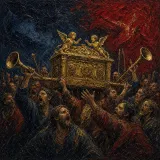
The big picture
Rest from surrounding enemies gives David time to notice an uncomfortable contrast: he lives in cedar while the ark remains under curtains. Nathan initially approves the king's desire to build, but that same night the word of the LORD redirects both men. The LORD has not been waiting through Israel's long past for someone to provide him a cedar residence. He recounts bringing Israel from Egypt, traveling with the people, taking David from the sheepcote, preserving him, and making his name. Then the meaning of "house" turns. David wants to build a structure for the LORD; the LORD promises to build David a dynasty. A future son will construct the sanctuary, receive a father-son relationship, face discipline if he sins, and remain within a mercy distinguished from Saul's removal. The promise stretches beyond one reign. David responds by sitting before the LORD, calling himself servant, remembering Israel's redemption, and asking that the word already spoken be established. The prayer grows out of promise rather than negotiation.
In this chapter
- A Reasonable Proposal Is Not Yet a Revelation 2 Samuel 7:1-3
The chapter begins with rest, cedar, and a reasonable comparison.
- The God Who Has Traveled with His People 2 Samuel 7:4-7
The LORD's answer reaches back past David's palace, past his reign, and back to the exodus.
- The Meaning of House Changes Under David's Feet 2 Samuel 7:8-11
The speech retells David's career from the sheepcote upward.
- A Son, a Throne, and a Promise Beyond One Reign 2 Samuel 7:12-17
The promise moves beyond David's lifetime to a son from his own body.
- The King Sits Down as a Servant 2 Samuel 7:18-24
David's response is physically quiet.
- The Promise Supplies the Language of the Prayer 2 Samuel 7:25-29
David finally asks for exactly what the LORD has already said.
Scripture beside the summary
2 Samuel · King James Version · 292 Samuel 7:1-3
A Reasonable Proposal Is Not Yet a Revelation
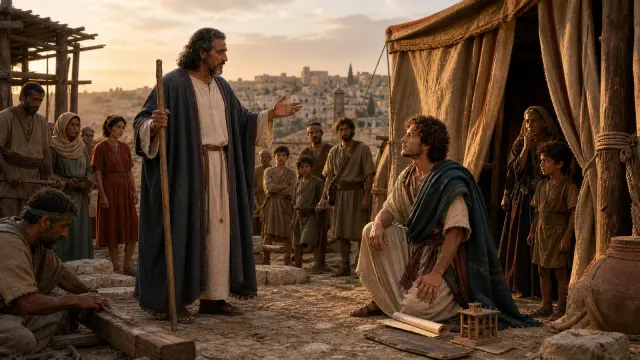
The chapter begins with rest, cedar, and a reasonable comparison. David lives in a finished house while the ark remains behind curtains, and he proposes to change the imbalance. Nathan's first answer is equally reasonable: proceed, because the LORD is with you. The Book of 2 Samuel does not mock either man for that judgment. Instead, it carefully lets the initial approval stand before recording the word that comes to Nathan at night. That sequence matters. Prophetic office does not make Nathan's first instinct identical with final revelation, and David's sincere desire does not make his chosen project automatically appointed. The king approaches as a giver who wants to build. The answer will remind him that he is first a receiver. By allowing a good intention to be redirected without turning it into a wicked intention, the chapter creates room for a larger promise than David had imagined. The cedar house is not condemned. It simply turns out not to be the center of what the LORD intends to say.
Deep dive
The chapter opens in a settled setting: David occupies his house, and the LORD has given him rest from surrounding enemies. The contrast he notices is material and immediate. The king lives in cedar; the ark remains within curtains. His concern is not presented as a cynical device for increasing his reputation. It is a serious proposal arising from the arrangement already visible at the end of chapter 6. Yet a serious proposal can still receive an answer different from the one expected.
Nathan initially tells David to proceed because the LORD is with him. The next section carefully distinguishes that response from the word Nathan receives that night. A prophet's presence in the room does not make every initial judgment the final divine instruction. The Book of 2 Samuel allows Nathan's first answer to stand before recording its correction. The result gives the promise that follows its surprising shape: David approaches as the intended giver, but the LORD will speak as the one who has already given and will give again.
Words to trace: king, house, LORD, Nathan, cedar, curtains
Verse-by-verse path
- 2 Samuel 7:1
Deuteronomy 12:10–11 had linked the two things: when the LORD gives Israel “rest from all your enemies round about”, then there will be a place he chooses for his name. David has the rest, so he thinks of the place. “Sat in his house” can also mean dwelt, settled at last.
- 2 Samuel 7:2
Nathan appears here for the first time, and he will be the prophet who confronts David over Bath-sheba (12:1). “Curtains” is the word for the tent hangings of Exodus 26. The cedar house is the one Hiram’s craftsmen built (5:11).
- 2 Samuel 7:3
Nathan’s answer sounds like Samuel’s to the young Saul: “do as occasion serve thee; for God is with thee” (1 Samuel 10:7). It is courtly and sincere, and it is spoken before anyone has asked the LORD.
2 Samuel 7:1-3
King James Version1And it came to pass, when the king sat in his house, and the LORD had given him rest round about from all his enemies;
2That the king said unto Nathan the prophet, See now, I dwell in an house of cedar, but the ark of God dwelleth within curtains.
3And Nathan said to the king, Go, do all that is in thine heart; for the LORD is with thee.
2 Samuel 7:4-7
The God Who Has Traveled with His People
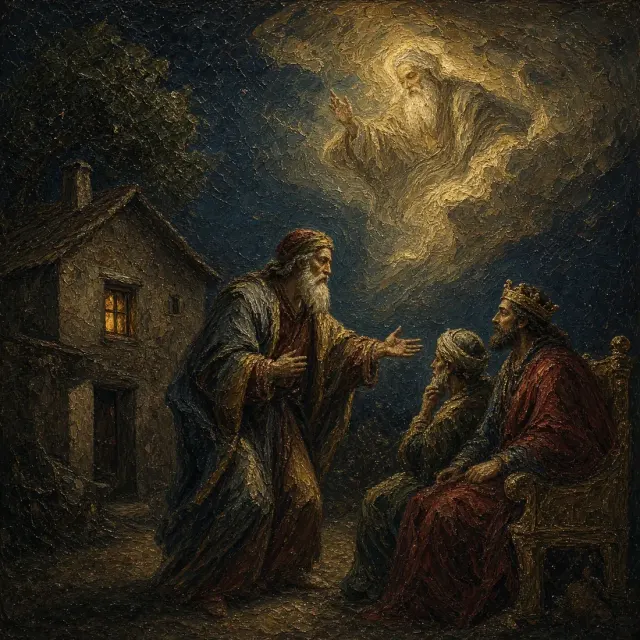
The LORD's answer reaches back past David's palace, past his reign, and back to the exodus. He has traveled with Israel in tent and tabernacle and never demanded a cedar house from the leaders appointed to feed the people. The point is not that a temple would be wrong. The same speech will assign its construction to David's son. The sharper point is that divine presence has never depended on Israel first providing sufficiently impressive architecture. The LORD brought the people out, walked with them, and dealt with their shepherds before any king could compare his own building with a sanctuary. David is addressed as "my servant," placing royal initiative inside that older relationship. The temple will eventually have its place, but it cannot be imagined as the thing that first makes the LORD available to Israel. David's proposal is redirected, not ridiculed, and the long memory of a God who traveled with his people becomes the answer to the immediate embarrassment of curtains beside cedar.
Deep dive
The answer begins by addressing David as the LORD's servant. Royal initiative is placed within an older relationship of service. The LORD recalls bringing Israel from Egypt and moving with the people in a tent and tabernacle. His presence has not waited for a settled court, expensive timber, or a king sufficiently successful to provide suitable accommodation. The recollection makes Israel's long history of divine companionship more significant than the contrast between two present buildings.
The speech does not condemn the future temple. Verse 13 will expressly assign its construction to David's son. The point here is that the LORD has not been pressing Israel's shepherds for a cedar house, nor has a lack of one prevented him from acting. David's proposal is redirected rather than mocked. The temple will enter the promise in its appointed place, but it cannot enter as the thing that first enables the LORD to dwell with, protect, or establish his people.
Words to trace: Israel, house, build, children, LORD, walked
Verse-by-verse path
- 2 Samuel 7:4
The word comes “that night”, the same way Samuel heard the LORD in the dark at Shiloh (1 Samuel 3) and heard the rejection of Saul the night before he confronted him (1 Samuel 15:16). Nathan’s daytime yes lasts only until night.
- 2 Samuel 7:5
The LORD calls David “my servant”, a title that sets him beside Moses. The message comes as a question; the Chronicles version turns it into a flat statement, “Thou shalt not build me an house” (1 Chronicles 17:4). The question lets David hear the oddness of his own offer.
- 2 Samuel 7:6
“Walked” is a form of the verb meaning to go about, to move to and fro. A tent, ohel, and a tabernacle, mishkan, are the two words for the portable sanctuary of the wilderness. The LORD describes himself as a traveller who has never asked to settle.
- 2 Samuel 7:7
“Any of the tribes” reads strangely, since tribes were not commanded to shepherd Israel. The parallel in 1 Chronicles 17:6 has “judges”, and the two Hebrew words differ by one letter. The judges fits the next clause, “whom I commanded to feed my people”.
2 Samuel 7:4-7
King James Version4And it came to pass that night, that the word of the LORD came unto Nathan, saying,
5Go and tell my servant David, Thus saith the LORD, Shalt thou build me an house for me to dwell in?
6Whereas I have not dwelt in any house since the time that I brought up the children of Israel out of Egypt, even to this day, but have walked in a tent and in a tabernacle.
7In all the places wherein I have walked with all the children of Israel spake I a word with any of the tribes of Israel, whom I commanded to feed my people Israel, saying, Why build ye not me an house of cedar?
2 Samuel 7:8-11
The Meaning of House Changes Under David's Feet
The speech retells David's career from the sheepcote upward. The LORD took him, was with him, cut off enemies, and made his name. Those statements do not erase David's battles or courage. They relocate his achievements within a relationship that began before he had the ability to build anything for God. Israel's future security then occupies the middle of the promise. The people will be planted and given rest from affliction, so David's dynasty is not framed as a private family prize detached from those he governs. Then comes the turn on the word "house." David has been thinking in cedar and walls; the LORD announces that he will make David a house in the sense of a household and royal line. The reversal is simple enough to fit in one ordinary word and large enough to change the chapter. David wanted to construct something that might outlast him. He is instead promised a future that no royal building project could manufacture.
Deep dive
The speech begins with the sheepcote, not the palace. David's rise is traced through the LORD's taking, accompanying, defeating enemies, and making a name for him. Royal achievement is retold through gifts and acts that precede David's offer to build. This does not remove David from his battles; it places those battles inside a relationship he did not create. The man proposing a permanent dwelling has himself been brought from an entirely different dwelling and occupation.
Israel's security occupies the center of the promise. The people will be planted, will dwell in their place, and will no longer be afflicted as before. The dynasty is not described as a private family prize detached from the nation. The language of rest links David's present circumstances with a wider future. Even while speaking to the king, the LORD keeps the people within the purpose of his kingship.
Then the word "house" turns. Hebrew bayith can mean a building, a household, or a dynasty, senses distinguished in the Brown–Driver–Briggs lexicon. David had spoken of constructing a building; the LORD now promises to establish David's family line. The same ordinary word carries the chapter's extraordinary reversal. David has not secured a contract to perform a service that puts God in his debt. He has received a promise about a future he cannot build with cedar.
Words to trace: Israel, people, enemies, LORD, name, place
Verse-by-verse path
- 2 Samuel 7:8
“Sheepcote” is a pasture, and “from following the sheep” is literally “from behind the flock”. Amos uses the same image of his own call (Amos 7:15). “Ruler” is nagid again, the designated leader. The message now opens with the full title “the LORD of hosts”.
- 2 Samuel 7:9
“Made thee a great name” echoes the promise to Abraham, “I will make thy name great” (Genesis 12:2). The Hebrew can also be read as future, “I will make”, which would move the great name into promise rather than record.
- 2 Samuel 7:10
“Plant them” recalls the song at the Red Sea: “thou shalt bring them in, and plant them in the mountain of thine inheritance” (Exodus 15:17). “Children of wickedness” is the phrase “sons of injustice”, the same one David used of Abner’s killers (3:34).
- 2 Samuel 7:11
The unsettled centuries of the judges are named as the “beforetime” of verse 10. Then the speech changes person, from “I” to “the LORD telleth thee”, as if the prophet were stepping forward to deliver the central line himself.
2 Samuel 7:8-11
King James Version8Now therefore so shalt thou say unto my servant David, Thus saith the LORD of hosts, I took thee from the sheepcote, from following the sheep, to be ruler over my people, over Israel:
9And I was with thee whithersoever thou wentest, and have cut off all thine enemies out of thy sight, and have made thee a great name, like unto the name of the great men that are in the earth.
10Moreover I will appoint a place for my people Israel, and will plant them, that they may dwell in a place of their own, and move no more; neither shall the children of wickedness afflict them any more, as beforetime,
11And as since the time that I commanded judges to be over my people Israel, and have caused thee to rest from all thine enemies. Also the LORD telleth thee that he will make thee an house.
2 Samuel 7:12-17
A Son, a Throne, and a Promise Beyond One Reign
The promise moves beyond David's lifetime to a son from his own body. That son will build the house for the LORD's name, while the LORD establishes his kingdom and speaks of him in father-son terms. Solomon is the immediate historical figure who will build the temple, but the language of an enduring throne reaches beyond the span of any one mortal reign. The promise also includes discipline. If the son commits iniquity, chastening will come through human means. Mercy, however, will not be removed as it was from Saul. That contrast gives the dynasty continuity without turning its kings into men beyond accountability. Later Scripture applies the father-son language and Davidic throne to Christ, yet the clause about a sinful royal son should not be flattened into a claim that every element has the same immediate referent. Nathan delivers assurance and discipline together. The house will endure by promised mercy, not because every occupant of the throne will govern without failure.
Deep dive
The promise moves beyond David's death to offspring from his own body. The son who builds the house has an immediate historical referent in Solomon, whose temple work is recorded in 1 Kings 5–8. The speech distinguishes two houses: the sanctuary built by the son and the royal house established by the LORD. The son receives a throne and a father-son relationship, but he does not become exempt from accountability. The stated possibility of iniquity brings correction within the promise itself.
The comparison with Saul gives that correction its boundary. The LORD may chasten David's offspring, but his mercy will not be removed as it was from Saul. This is neither permission to sin nor a prediction that every Davidic ruler will govern well. It makes a distinction between judgment upon a king and the abandonment of the pledged house. The language of an enduring throne exceeds what any single mortal reign can accomplish, and the later failures of the dynasty do not disappear merely because the promise is generous.
Later Scripture returns directly to this language. Hebrews 1:5 applies the father-son declaration to Christ, and Luke 1:32–33 identifies Jesus with David's throne and an unending reign. That reception extends the promise without requiring every clause about the immediate royal offspring to describe Jesus in the same way. In particular, the provision for a son's iniquity should not become a claim that Christ sins. Nathan delivers the whole revelation, including both its assurance and its discipline.
Words to trace: kingdom, established, house, throne, bowels, build
Verse-by-verse path
- 2 Samuel 7:12
“Sleep with thy fathers” becomes the standard death notice for the kings of Judah and Israel, and this is its first use for a king. “Proceed out of thy bowels” repeats the promise to Abram: “he that shall come forth out of thine own bowels shall be thine heir” (Genesis 15:4).
- 2 Samuel 7:13
“An house for my name” is Deuteronomy’s language for the sanctuary, the place where the LORD makes his name dwell. The son builds a house; the LORD makes the throne stable “for ever”, and that phrase will recur again and again through the chapter.
- 2 Samuel 7:14
The father and son language was the language of royal adoption; Psalm 2:7 uses it at a coronation. “The rod of men” means correction through human agents. Psalm 89:30–34 turns this verse into verse at length, adding that the LORD will not break his covenant.
- 2 Samuel 7:15
“Mercy” is chesed, covenant loyalty. The contrast with Saul is blunt: from him it was taken away. “Before thee” means that Saul was removed to make room for David, a fact David has never been allowed to boast of.
- 2 Samuel 7:16
“Established” is ne’eman, from the root that gives “amen”: made sure, faithful. The LORD promised Eli a “sure house” for a faithful priest (1 Samuel 2:35), and Samuel was “established” as a prophet (1 Samuel 3:20). The same word now secures David’s line.
- 2 Samuel 7:17
“Vision” is chizzayon, a revelation received at night. Nathan passes on everything, word for word, including the clause about the son’s iniquity. He will be back with harder words in chapter 12.
2 Samuel 7:12-17
King James Version12And when thy days be fulfilled, and thou shalt sleep with thy fathers, I will set up thy seed after thee, which shall proceed out of thy bowels, and I will establish his kingdom.
13He shall build an house for my name, and I will stablish the throne of his kingdom for ever.
14I will be his father, and he shall be my son. If he commit iniquity, I will chasten him with the rod of men, and with the stripes of the children of men:
15But my mercy shall not depart away from him, as I took it from Saul, whom I put away before thee.
16And thine house and thy kingdom shall be established for ever before thee: thy throne shall be established for ever.
17According to all these words, and according to all this vision, so did Nathan speak unto David.
2 Samuel 7:18-24
The King Sits Down as a Servant
David's response is physically quiet. He goes in and sits before the LORD. The king who began with a building proposal now has nothing to construct in the scene; he has a word to receive. "Who am I" becomes the opening register of a prayer that repeatedly calls David the LORD's servant and marvels at the future promised to his house. He does not treat the dynasty as evidence that his family has become the center of divine purpose. His prayer widens to Israel, the people redeemed from Egypt and established as the LORD's own. The God who promises David a house is the same God who made a people for himself. That connection keeps the dynasty attached to the nation it is meant to serve. David's wonder is therefore both personal and historical. He looks at how far his own house has been carried, then reaches back to Israel's redemption before asking for anything further. The promise enlarges his horizon rather than narrowing it.
Deep dive
David goes in and sits before the LORD. The stillness fits the reversal: the king who began with a building project now responds to something spoken over him. His questions concern his own smallness and the reach of what has been promised, not the practical procurement of materials. Repeated references to himself as a servant give the prayer its register. He does not discard his kingship; he receives its future as something dependent on the LORD's knowledge, word, and purpose.
The prayer refuses to keep the promise inside a family portrait. David turns to the incomparable LORD and the people redeemed from Egypt. The God who establishes his house is the God who made Israel his own people. This is why the dynasty cannot be interpreted only as inherited privilege. Its place is within that larger bond. David's gratitude names the giver's greatness and Israel's singular redemption before asking for the fulfillment of what his own household has received.
Words to trace: LORD, people, David, house, Israel, servant
Verse-by-verse path
- 2 Samuel 7:18
David goes in to the tent where the ark stands and sits, which is not the ordinary posture for prayer in Scripture. He addresses “Lord GOD”, Adonai YHWH, a form found seven times in this prayer and rarely elsewhere in Samuel. “Who am I” is what Moses said at the bush (Exodus 3:11).
- 2 Samuel 7:19
“The manner of man” renders torat ha’adam, literally “the law of man”, one of the hardest phrases in the chapter. It may mean “is this the way men deal with one another?” or, as some read it, “this is instruction for all humanity”.
- 2 Samuel 7:20
David speaks of himself in the third person, “what can David say more”, as a servant might before a master. “Knowest” is the verb for intimate, chosen knowledge. He has nothing to add because he has already been fully known.
- 2 Samuel 7:21
“For thy word’s sake” is “for thy servant’s sake” in 1 Chronicles 17:19. “According to thine own heart” echoes Samuel’s words that the LORD had sought “a man after his own heart” (1 Samuel 13:14): the heart in question is God’s.
- 2 Samuel 7:22
“None like thee, neither is there any God beside thee” recalls Hannah’s song, “there is none beside thee” (1 Samuel 2:2), the prayer that opened the books of Samuel. The claim rests on hearing: “all that we have heard with our ears”, the handed-down account of the exodus.
- 2 Samuel 7:23
The Hebrew stumbles here, with a plural verb for God “went” and a shift of pronouns from “you” to “thy people”. First Chronicles 17:21 smooths it and adds “by driving out nations”. David is marvelling at Israel’s uniqueness rather than composing a tidy sentence.
- 2 Samuel 7:24
“Confirmed” is kun again, the verb of establishing, now used for the people rather than the throne. “Thou… art become their God” is the covenant formula of Exodus 6:7, spoken back to the LORD as a completed fact.
2 Samuel 7:18-24
King James Version18Then went king David in, and sat before the LORD, and he said, Who am I, O Lord GOD? and what is my house, that thou hast brought me hitherto?
19And this was yet a small thing in thy sight, O Lord GOD; but thou hast spoken also of thy servant’s house for a great while to come. And is this the manner of man, O Lord GOD?
20And what can David say more unto thee? for thou, Lord GOD, knowest thy servant.
21For thy word’s sake, and according to thine own heart, hast thou done all these great things, to make thy servant know them.
22Wherefore thou art great, O LORD God: for there is none like thee, neither is there any God beside thee, according to all that we have heard with our ears.
23And what one nation in the earth is like thy people, even like Israel, whom God went to redeem for a people to himself, and to make him a name, and to do for you great things and terrible, for thy land, before thy people, which thou redeemedst to thee from Egypt, from the nations and their gods?
24For thou hast confirmed to thyself thy people Israel to be a people unto thee for ever: and thou, LORD, art become their God.
2 Samuel 7:25-29
The Promise Supplies the Language of the Prayer
David finally asks for exactly what the LORD has already said. "Do as thou hast said" is the heart of the petition. He does not bargain for additional territory, immunity, or privilege beyond the announced promise. The revelation that the LORD will build him a house becomes the reason he has "found in his heart" to pray. The sequence is important: divine word first, human request second. David's confidence does not come from discovering the right formula to pressure God but from the reliability of what has been spoken. He also keeps the LORD's name and his own house in their proper order. The desired establishment of the dynasty is tied to the magnifying of the LORD of hosts as God over Israel. The chapter that began with David comparing his building to the ark's tent ends with David asking that his family remain blessed "before thee." Cedar has disappeared from the prayer. The lasting thing is the promise under which the house must live.
Deep dive
David's request is not an attempt to enlarge the offer by bargaining. He asks that the word already spoken concerning his servant and his house be established. The announced future becomes the ground for prayer in the present. He explicitly connects his courage to pray with the LORD's revelation that he will build him a house. The king has found words to ask because God has first supplied words to trust.
The desired result is the magnifying of the LORD's name and the continuance of David's house before him. Both remain together to the end. This is not a prayer for a dynasty free to exist on its own terms once divine support has been secured. The final request locates the household under blessing and before the LORD. A chapter that began with David comparing buildings closes with David asking that his family live within a promise.
Words to trace: servant, house, LORD, concerning, hosts, Israel
Verse-by-verse path
- 2 Samuel 7:25
“Establish” here is qum, to raise up, the verb the LORD used for setting up David’s seed (verse 12). David asks for nothing new; he hands the promise back in its own words, “do as thou hast said”.
- 2 Samuel 7:26
“Magnified” is from the same root as “great” in verses 9 and 22. The LORD promised to make David’s name great, and David answers by asking that the LORD’s name be made great. The title he uses, “God over Israel”, puts the king under a higher king.
- 2 Samuel 7:27
“Hast revealed” is literally “hast uncovered the ear of thy servant”, the idiom used when the LORD told Samuel about Saul (1 Samuel 9:15). “Found in his heart” means found the courage; the prayer exists because the promise came first.
- 2 Samuel 7:28
“Thou art that God” is emphatic, thou art the God, and “thy words be true” uses emet, reliability. “This goodness” is tovah, a word that can also mean a covenant benefit, the good promised between parties bound by oath.
- 2 Samuel 7:29
The root for blessing appears three times in one verse, and “for ever” closes the prayer, as it has recurred through the whole chapter. “Let it please thee” means be willing. The last words rest the house on what God has spoken, not on what David can build.
2 Samuel 7:25-29
King James Version25And now, O LORD God, the word that thou hast spoken concerning thy servant, and concerning his house, establish it for ever, and do as thou hast said.
26And let thy name be magnified for ever, saying, The LORD of hosts is the God over Israel: and let the house of thy servant David be established before thee.
27For thou, O LORD of hosts, God of Israel, hast revealed to thy servant, saying, I will build thee an house: therefore hath thy servant found in his heart to pray this prayer unto thee.
28And now, O Lord GOD, thou art that God, and thy words be true, and thou hast promised this goodness unto thy servant:
29Therefore now let it please thee to bless the house of thy servant, that it may continue for ever before thee: for thou, O Lord GOD, hast spoken it: and with thy blessing let the house of thy servant be blessed for ever.
Questions to keep in mind while reading
- Track who acts, who speaks, who is affected, and what changes.
- Notice repeated promises, failures, rescues, and consequences.
- Do not assume the account approves every action that is reported.
Text first
Where readers differ
The chapter summary begins with what the passage says and how its parts fit together. It does not assume one denomination has already settled every question. Where a conclusion depends on a tradition, literary theory, or historical reconstruction, that dependence is named openly.
The KJV text is presented first. Interpretive conclusions are labeled, and differences are introduced only when they help a reader understand why serious communities do not always reach the same answer.
Comparative interpretive notes for this chapter are in preparation. Until reviewed notes are ready, this page separates the KJV text from summary and application without claiming that serious readers agree on every question.
Questions beneath the surface
- What account of God, human freedom, responsibility, and the good life emerges from 2 Samuel 7?
- Which tension does the chapter refuse to resolve quickly?
- What changes when the chapter is read as part of the whole canon rather than as an isolated moral lesson?
- Where might a sincere reader confuse a familiar tradition with something the text states directly?
Questions for serious personal contemplation
These open-ended questions make room for tension, honest response, prayer, and conclusions that remain accountable to the chapter.
Observe without rushing
What part of 2 Samuel 7 makes you stop, feel unsettled, or feel surprised, and why?
Which detail in the passage would be easiest to overlook? How does that detail change your understanding?
Where do you see tension between what happens and this focus: David seated before the Lord after Nathan delivers the covenant promise?
What important question does the passage leave open instead of resolving quickly?
Examine your inner life honestly
Which person, response, fear, or desire in the passage feels most like your own life right now?
What assumption about God, other people, or yourself does this text challenge?
Which part would you rather soften, avoid, or explain away too quickly? What might that reaction reveal?
If this Scripture could ask you one direct question, what do you think it would ask?
Respond with wisdom and courage
What do you need to remember, confess, grieve, thank God for, or trust after reading this passage?
How might another faithful person read this situation differently without ignoring the text?
What obedient response would be costly, uncomfortable, or slow, yet still faithful to Scripture?
What question will you carry into prayer this week, and which verses will you keep in front of you?
Music and video connected to the passage
Related media appears when its Scripture reference overlaps this study. Music and video can illuminate a theme while the biblical text remains the foundation.