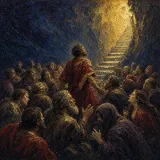
The big picture
Deuteronomy 31 is a chapter about succession, but it refuses to pretend that replacing Moses solves Israel's deeper problem. Joshua is publicly commissioned, and the repeated assurance is that the LORD goes before the people and will not fail them. At the same time, Moses writes the law, places it in the care of priests and elders, orders its public reading, and prepares a song that will remain in Israel's mouth after his death. The chapter is building witnesses that outlive a leader. Its most unsettling feature is the forecast of future betrayal inside the very ceremony of transition. Israel will enter the land, prosper, and turn aside. That prediction does not cancel Joshua's commission or make teaching pointless. It makes them more urgent. Leadership, written law, public hearing, remembered song, heaven, and earth all converge around one problem: how covenant words will continue to speak when Moses no longer can.
In this chapter
- Moses Does Not Cross, but the LORD Goes Before the People Deuteronomy 31:1-8
Moses' departure is made public before Joshua's authority is emphasized, but the passage carefully keeps the LORD at the center of both.
- The Stored Law Must Become an Audible Law Deuteronomy 31:9-13
A written law can be preserved and still become functionally silent, so Moses joins custody to public hearing.
- The Commissioning Scene Includes an Unwelcome Forecast Deuteronomy 31:14-18
The commissioning scene carries an uncomfortable double message.
- The Song Is Appointed to Testify, Not Merely to Decorate Deuteronomy 31:19-23
The song is not commissioned as decoration for a solemn moment.
- The Book Stands Beside the Ark as a Witness Deuteronomy 31:24-30
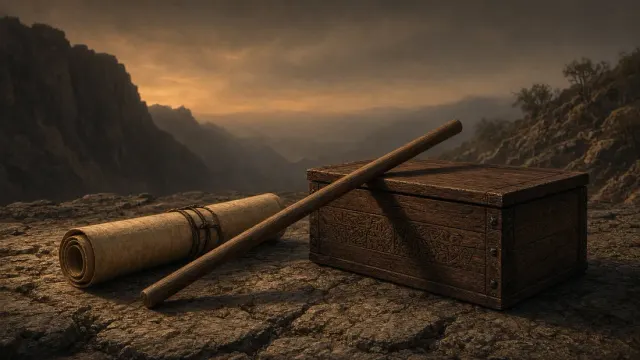
When Moses finishes writing the law, the book is placed beside the ark with a stated purpose: it will remain there “for a witness.” Its honored location matters, but the text is not being stored merely as a sacred object.


Scripture beside the summary
Deuteronomy · King James Version · 30Deuteronomy 31:1-8
Moses Does Not Cross, but the LORD Goes Before the People
Moses' departure is made public before Joshua's authority is emphasized, but the passage carefully keeps the LORD at the center of both. Moses names his age, his inability to continue “go out and come in,” and the divine prohibition against crossing Jordan. Read beside the later statement that his eye was not dim and his strength had not failed, this is more than a picture of physical collapse. His active leadership has reached its appointed boundary. Joshua will cross, but even his name is framed by a stronger repeated subject: the LORD goes before Israel. The earlier victories over Sihon and Og become precedent for confidence, not trophies proving that Moses himself was indispensable. Then Joshua is called forward “in the sight of all Israel.” Succession is not left to rumor or private arrangement. Courage is spoken first to the people and then to the new leader, and both receive the same ground for it: divine presence rather than the personality of the man at the front.

Deep dive
Moses names his age and says that he can no longer go out and come in. Read beside the undimmed sight and unabated strength reported in 34:7, that expression need not be reduced to a description of physical collapse. It also concerns the ending of his active leadership, and he immediately names the LORD's refusal to let him cross the Jordan. The boundary is given by divine command as well as by the approaching end of his life.
The repeated subject in the reassurance is the LORD: he goes before Israel, and he will act as he did against Sihon and Og. Joshua is then named as the human leader who crosses. The succession changes the person leading the company without changing the source of the promised victory. Moses addresses Joshua in the sight of all Israel, making the transfer public rather than leaving the people to infer a successor after his death. Courage is enjoined first upon the people and then upon Joshua, with the same assurance that the LORD will not fail them.
Words to trace: LORD, courage, fail, fear, forsake, good
Verse-by-verse path
- Deuteronomy 31:1
The Hebrew says Moses “went”, vayyelekh, which names this section in the Jewish reading cycle. The Greek Old Testament and a Dead Sea Scroll of Deuteronomy read “finished speaking” instead, a difference of two letters swapped, which fits the context well: the speeches are done.
- Deuteronomy 31:2
Genesis 6:3 had set the limit of a man’s days at a hundred and twenty years. Stephen later divided Moses’ life into three forties: Egypt, Midian, and the wilderness (Acts 7:23, 30, 36). “This day” suggests a birthday, and Jewish tradition holds that he died on the day he was born.
- Deuteronomy 31:3
The verse sets God and Joshua side by side with the same verb and the same emphatic pronoun: “he will go over before thee... Joshua, he shall go over before thee”. The human leader walks where the divine leader has already gone.
- Deuteronomy 31:4
Og is usually called king of Bashan, but here both are “kings of the Amorites”, as in 3:8. The news of these two victories reached Jericho: Rahab names Sihon and Og to the spies as the reason her city’s heart melted (Joshua 2:10).
- Deuteronomy 31:5
“According unto all the commandments” refers back to the instructions of 7:2 and 20:16–17 about the nations of the land. The verse changes from singular to plural, from “thee” to “your face” and “ye”, addressing the tribes as a crowd.
- Deuteronomy 31:6
“Be strong and of a good courage” is plural here, spoken to all Israel; Joshua 1 repeats it four times. “Fail thee” is rapha, to let go slack, to drop one’s hands from someone. Hebrews 13:5 quotes the promise: “I will never leave thee, nor forsake thee.”
- Deuteronomy 31:7
The same charge as verse 6, now in the singular, to one man, and “in the sight of all Israel”. “Cause them to inherit” is the causative of nachal: Joshua is to be the one who shares out the land, which is exactly the work of Joshua 13–21.
- Deuteronomy 31:8
“Dismayed” is chatat, to be shattered or broken in spirit. God repeats the pairing to Joshua in almost the same words: “be not afraid, neither be thou dismayed” (Joshua 1:9). “He will be with thee” is expanded there into “as I was with Moses, so I will be with thee” (1:5).
Deuteronomy 31:1-8
King James Version1And Moses went and spake these words unto all Israel.
2And he said unto them, I am an hundred and twenty years old this day; I can no more go out and come in: also the LORD hath said unto me, Thou shalt not go over this Jordan.
3The LORD thy God, he will go over before thee, and he will destroy these nations from before thee, and thou shalt possess them: and Joshua, he shall go over before thee, as the LORD hath said.
4And the LORD shall do unto them as he did to Sihon and to Og, kings of the Amorites, and unto the land of them, whom he destroyed.
5And the LORD shall give them up before your face, that ye may do unto them according unto all the commandments which I have commanded you.
6Be strong and of a good courage, fear not, nor be afraid of them: for the LORD thy God, he it is that doth go with thee; he will not fail thee, nor forsake thee.
7And Moses called unto Joshua, and said unto him in the sight of all Israel, Be strong and of a good courage: for thou must go with this people unto the land which the LORD hath sworn unto their fathers to give them; and thou shalt cause them to inherit it.
8And the LORD, he it is that doth go before thee; he will be with thee, he will not fail thee, neither forsake thee: fear not, neither be dismayed.
Deuteronomy 31:9-13
The Stored Law Must Become an Audible Law
A written law can be preserved and still become functionally silent, so Moses joins custody to public hearing. Priests and elders receive the text, but every seven years the words must come back into the air before assembled Israel. The audience is deliberately broad: men, women, children, and the stranger within the gates. The public reading therefore prevents official possession from becoming private ownership. The year of release and Feast of Tabernacles provide a recurring national occasion, not the only time anyone may hear the law. Deuteronomy has already placed teaching inside ordinary household life. This gathering does something different by bringing scattered households beneath the same audible words. The most revealing line concerns children “which have not known any thing.” Their inexperience is not grounds for exclusion until they are older or better prepared. It is the reason to bring them near. Hearing leads to learning, fear of the LORD, and doing, so preservation serves formation rather than mere archival survival.

Deep dive
Custody and hearing are deliberately joined. Priests and elders receive the written law, but its destination is not permanent silence in official keeping. The recurring assembly turns the preserved words back into speech before the whole people. Men, women, children, and the resident stranger are expressly included in the audience.
The year of release and the Feast of Tabernacles supply the appointed occasion. This does not mean the law may be heard only once in seven years; Deuteronomy elsewhere requires its teaching in ordinary household life. The public reading has its own function, gathering people who live in different households and places under the same spoken words. Verse 13 especially names children who have not known. Their lack of experience is a reason to bring them within hearing, not a reason to leave them outside until they already understand. The sequence is hearing, learning, fearing the LORD, and doing. Preservation of the text serves that continuing formation of the people.
Words to trace: LORD, Israel, children, fear, hear, learn
Verse-by-verse path
- Deuteronomy 31:9
Exodus 24:4 already said “Moses wrote all the words of the LORD”; here he writes “this law”, the book the reader holds. Numbers 4:15 assigned the carrying of holy things to the Kohathite Levites, but on great occasions priests carried the ark, as they will at the Jordan (Joshua 3:6).
- Deuteronomy 31:10
The year of release was every seventh year, when debts were cancelled (15:1–2), and Tabernacles fell in autumn at the end of harvest. The Mishnah (Sotah 7:8) describes King Agrippa reading the law at this assembly and weeping at 17:15, “thou mayest not set a stranger over thee”.
- Deuteronomy 31:11
“Appear before the LORD” echoes 16:16, where all males appear three times a year. “In their hearing” is literally “in their ears”. When Ezra read the law at the Feast of Tabernacles after the exile, he read “from the morning until midday” (Nehemiah 8:3).
- Deuteronomy 31:12
“Gather” is haqhel, and the assembly came to be called hakhel from this verb. The Talmud (Chagigah 3a) asked why small children should be brought, since they cannot follow, and answered: to give a reward to those who bring them.
- Deuteronomy 31:13
“Which have not known any thing” are the children born after the wilderness, who never saw the wonders. The Book of Judges will record exactly this gap: “there arose another generation after them, which knew not the LORD” (Judges 2:10).
Deuteronomy 31:9-13
King James Version9And Moses wrote this law, and delivered it unto the priests the sons of Levi, which bare the ark of the covenant of the LORD, and unto all the elders of Israel.
10And Moses commanded them, saying, At the end of every seven years, in the solemnity of the year of release, in the feast of tabernacles,
11When all Israel is come to appear before the LORD thy God in the place which he shall choose, thou shalt read this law before all Israel in their hearing.
12Gather the people together, men, and women, and children, and thy stranger that is within thy gates, that they may hear, and that they may learn, and fear the LORD your God, and observe to do all the words of this law:
13And that their children, which have not known any thing, may hear, and learn to fear the LORD your God, as long as ye live in the land whither ye go over Jordan to possess it.
Deuteronomy 31:14-18
The Commissioning Scene Includes an Unwelcome Forecast
The commissioning scene carries an uncomfortable double message. The pillar of cloud makes the LORD's presence visible at the tabernacle, yet the words spoken there look beyond Joshua's appointment to Israel's future abandonment of the covenant. Moses will “sleep with thy fathers,” and the people will rise to pursue other gods. The contrast is almost brutal in its economy: one leader lies down, and the nation rises in the wrong direction. Earlier in the chapter the LORD promised not to fail or forsake the people in the commanded crossing. Here, after they forsake him, he says he will hide his face. The differing circumstances keep those statements from collapsing into contradiction or into a blanket guarantee without covenant consequence. Even Israel's later question, whether calamity has come because God is not among them, falls short of the full diagnosis. They notice the absence. The LORD names the preceding breach. The scene distinguishes experiencing consequence from accurately confessing the allegiance that produced it.
Deep dive
The pillar of cloud places this charge within a visible manifestation of the LORD's presence. Yet the words spoken there are not confined to Joshua's successful entrance into the land. Moses will lie down with his fathers, and the people will rise to pursue other gods. That contrast of lying down and rising gives the prediction a sharp turn: his death will not be followed simply by the orderly continuation of everything he has taught.
The promise not to forsake Israel earlier in the chapter stands beside the announcement here that God will forsake and hide his face after Israel forsakes him. The difference in stated circumstances matters. An assurance of presence for the commanded crossing is not presented as permission to abandon the covenant without consequence. The people will recognize that God is not among them, but their reported words do not yet include the explicit acknowledgment of turning to other gods that God supplies. The passage distinguishes noticing divine absence from fully naming the breach that preceded it.
Words to trace: tabernacle, evils, LORD, Moses, cloud, congregation
Verse-by-verse path
- Deuteronomy 31:14
“Tabernacle of the congregation” is the tent of meeting, which Deuteronomy mentions only here, in verses 14 and 15. “Present yourselves” is hityatsvu, from the same root as the “ye stand” of 29:10: take up your station.
- Deuteronomy 31:15
The pillar standing at the tent door recalls Exodus 33:9–10, where it came down whenever Moses entered, and Numbers 12:5, where it came down to rebuke Miriam and Aaron. This is the last time the Pentateuch shows the pillar.
- Deuteronomy 31:16
The rabbis listed this among a handful of verses whose grammar can be divided two ways (Yoma 52a): “rise up” might belong to Moses, “thou shalt sleep with thy fathers, and rise up”. The Talmud (Sanhedrin 90b) cites that reading as a hint of the resurrection.
- Deuteronomy 31:17
“Hide my face”, hester panim, became a theological term in Judaism for times when God seems absent. The Psalms use it in complaint: “How long wilt thou hide thy face from me?” (Psalm 13:1). “Devoured” is literally “to be eaten”, the language of beasts and fire.
- Deuteronomy 31:18
“Surely hide” is a doubled verb, haster astir. The Talmud (Chullin 139b), asking where Esther is hinted in the Torah, answered with this verse, hearing her name in astir. The Book of Esther never names God, and the rabbis read it as a history of the hidden face.
Deuteronomy 31:14-18
King James Version14And the LORD said unto Moses, Behold, thy days approach that thou must die: call Joshua, and present yourselves in the tabernacle of the congregation, that I may give him a charge. And Moses and Joshua went, and presented themselves in the tabernacle of the congregation.
15And the LORD appeared in the tabernacle in a pillar of a cloud: and the pillar of the cloud stood over the door of the tabernacle.
16And the LORD said unto Moses, Behold, thou shalt sleep with thy fathers; and this people will rise up, and go a whoring after the gods of the strangers of the land, whither they go to be among them, and will forsake me, and break my covenant which I have made with them.
17Then my anger shall be kindled against them in that day, and I will forsake them, and I will hide my face from them, and they shall be devoured, and many evils and troubles shall befall them; so that they will say in that day, Are not these evils come upon us, because our God is not among us?
18And I will surely hide my face in that day for all the evils which they shall have wrought, in that they are turned unto other gods.
Deuteronomy 31:19-23
The Song Is Appointed to Testify, Not Merely to Decorate
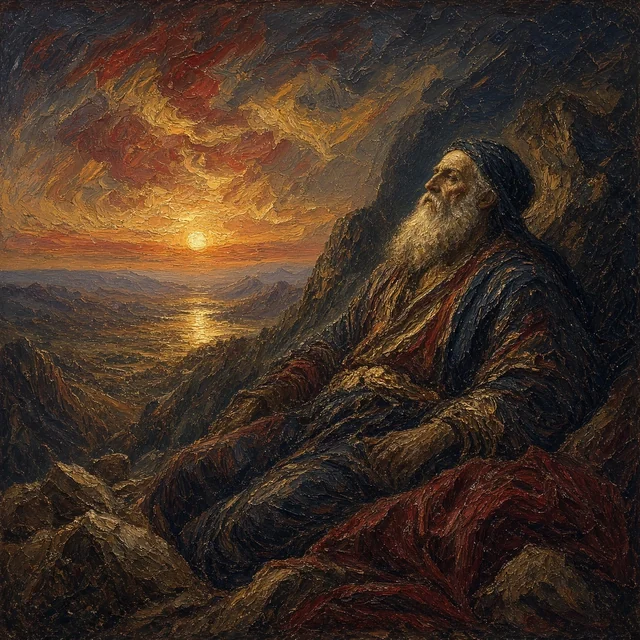
The song is not commissioned as decoration for a solemn moment. It is given a legal and memorial job: “that this song may be a witness.” Moses is to write it, teach it, and put it in Israel's mouth so that descendants can carry words they did not hear him compose. That makes music a form of durable testimony. The predicted setting of apostasy is also important. Israel does not turn aside because the land failed to provide. The people eat, become full, and grow fat before turning to other gods. Abundance becomes the setting in which forgetfulness ripens. The LORD says the people's disposition is already known before they enter the land, so the song is not an emergency measure devised after the collapse. Moses writes it immediately. Joshua's charge then returns at the end of the section, still accompanied by “I will be with thee.” The forecast of later betrayal does not invalidate the present commission. It makes the witness and the leadership necessary at the same time.
Deep dive
The instruction to put the song in Israel's mouth gives it a durable human location. A written witness can be kept; a taught song can also be repeated by descendants who never heard Moses speak. Its purpose is not described merely as making the covenant occasion more memorable or beautiful. When trouble comes, the retained words will testify that the people were warned.
Abundance is the predicted setting of the betrayal. The people eat, become full, and grow fat, then turn toward other gods. The next chapter will give that sequence its memorable poetic form. God also says that the disposition is already known before entry into the land, so the provision is not an improvised response after failure becomes obvious. Moses writes and teaches the song the same day. Joshua's commission then returns, with the assurance of divine presence in bringing Israel into the land. The forecast of later disloyalty does not cancel the immediate work of teaching or the real responsibility of the successor.
Words to trace: children, Israel, song, land, sware, mouths
Verse-by-verse path
- Deuteronomy 31:19
“Write ye” is plural; Moses and Joshua write together, and 32:44 says the two of them spoke the song to the people. A song is harder to lose than a scroll. It lives in memory, and “put it in their mouths” makes it something sung.
- Deuteronomy 31:20
Hosea 13:6 describes the same sequence as history: “According to their pasture, so were they filled; they were filled, and their heart was exalted; therefore have they forgotten me.” “Provoke” is niatsuni, to spurn or treat with contempt.
- Deuteronomy 31:21
“Imagination” is yetser, the word of Genesis 6:5 and 8:21, “the imagination of man’s heart is evil from his youth”. Rabbinic Judaism made it a technical term, the yetzer hara, the evil inclination. God knows it “even now”, before the land is entered.
- Deuteronomy 31:22
The song was written and taught on the same day. In 32:44 Moses “spake all the words of this song in the ears of the people, he, and Hoshea the son of Nun”, using Joshua’s original name (Numbers 13:16).
- Deuteronomy 31:23
The subject is unnamed, but “the land which I sware” can only be God’s words. The Greek Old Testament makes Moses the speaker and adjusts the pronouns, reading “which the LORD sware” and “he shall be with thee”. The Hebrew has God give the charge directly.
Deuteronomy 31:19-23
King James Version19Now therefore write ye this song for you, and teach it the children of Israel: put it in their mouths, that this song may be a witness for me against the children of Israel.
20For when I shall have brought them into the land which I sware unto their fathers, that floweth with milk and honey; and they shall have eaten and filled themselves, and waxen fat; then will they turn unto other gods, and serve them, and provoke me, and break my covenant.
21And it shall come to pass, when many evils and troubles are befallen them, that this song shall testify against them as a witness; for it shall not be forgotten out of the mouths of their seed: for I know their imagination which they go about, even now, before I have brought them into the land which I sware.
22Moses therefore wrote this song the same day, and taught it the children of Israel.
23And he gave Joshua the son of Nun a charge, and said, Be strong and of a good courage: for thou shalt bring the children of Israel into the land which I sware unto them: and I will be with thee.
Deuteronomy 31:24-30
The Book Stands Beside the Ark as a Witness
When Moses finishes writing the law, the book is placed beside the ark with a stated purpose: it will remain there “for a witness.” Its honored location matters, but the text is not being stored merely as a sacred object. It is positioned to continue speaking after Moses cannot. That point gathers the whole chapter. Moses has already watched Israel's rebellion during his lifetime and expects worse after his death, so he surrounds the future with witnesses that do not depend on his physical presence. The written law, the ark bearing Levites, assembled elders and officers, heaven and earth, and the taught song all converge. None is a replacement Moses in miniature. Together they ensure that later corruption cannot be explained by claiming there was no testimony. The closing line then carries the reader directly into chapter 32 as Moses speaks the song “in the ears” of the congregation. What will later live in memory first enters through public hearing. The transition is therefore part of one continuous act of witness.

Deep dive
The book's proximity to the ark gives it an honoured place, but the stated function is not merely honour. It is there as a witness against the people. The KJV locates it "in the side of the ark," commonly understood as beside it; the passage does not specify a compartment or describe the book as one of the tablets within. The important point is its continuing presence under the care of the ark-bearing Levites.
Moses' expectation of later corruption is grounded in the rebellion he has already witnessed while alive. He does not describe his own continued presence as the sole thing that has ever kept Israel obedient. Written law, assembled leaders, heaven and earth, and the taught song now converge as witnesses that outlast his leadership. The closing verse introduces the recitation that follows in chapter 32. The words are brought into the congregation's ears before they are left in its memory, making the transition from one chapter to the next part of a single act of public testimony.
Words to trace: LORD, Moses, words, book, commanded, covenant
Verse-by-verse path
- Deuteronomy 31:24
“Until they were finished” is ad tummam, a completion formula. The book is described as finished, written to its end. Who wrote the account of Moses’ death in chapter 34 was debated in the Talmud (Bava Batra 15a); one view gives the last eight verses to Joshua.
- Deuteronomy 31:25
In verse 9 the carriers were “the priests the sons of Levi”; here simply “the Levites”. Deuteronomy uses the terms loosely, as 10:8 had set the whole tribe of Levi apart “to bear the ark of the covenant of the LORD”.
- Deuteronomy 31:26
The Talmud (Bava Batra 14b) records a dispute over what “in the side of” means: one rabbi placed the scroll inside the ark with the tablets, another on a ledge fixed outside it. The ark held the tablets of the covenant (10:5); the book is placed alongside them.
- Deuteronomy 31:27
“Stiff neck” is the phrase God used of Israel at the golden calf (Exodus 32:9; Deuteronomy 9:6). “How much more after my death” is an argument from lesser to greater, which the rabbis counted among the ten such arguments in the Torah (Genesis Rabbah 92:7).
- Deuteronomy 31:28
The officers are the shoterim, the officials who will carry Joshua’s orders through the camp in Joshua 1:10 and 3:2. Heaven and earth are called for the third time in the book (4:26; 30:19), and the song itself will open by addressing them (32:1).
- Deuteronomy 31:29
“Utterly corrupt yourselves” is a doubled verb from shachat, the word God used at the golden calf: “thy people... have corrupted themselves” (9:12; Exodus 32:7). “The latter days” is the phrase of 4:30. “The work of your hands” means idols.
- Deuteronomy 31:30
“Until they were ended” repeats the completion formula of verse 24. “In the ears” leads straight into the song, which opens “Give ear, O ye heavens” (32:1). The book of the law is finished; now it is set to music.
Deuteronomy 31:24-30
King James Version24And it came to pass, when Moses had made an end of writing the words of this law in a book, until they were finished,
25That Moses commanded the Levites, which bare the ark of the covenant of the LORD, saying,
26Take this book of the law, and put it in the side of the ark of the covenant of the LORD your God, that it may be there for a witness against thee.
27For I know thy rebellion, and thy stiff neck: behold, while I am yet alive with you this day, ye have been rebellious against the LORD; and how much more after my death?
28Gather unto me all the elders of your tribes, and your officers, that I may speak these words in their ears, and call heaven and earth to record against them.
29For I know that after my death ye will utterly corrupt yourselves, and turn aside from the way which I have commanded you; and evil will befall you in the latter days; because ye will do evil in the sight of the LORD, to provoke him to anger through the work of your hands.
30And Moses spake in the ears of all the congregation of Israel the words of this song, until they were ended.
Questions to keep in mind while reading
- Identify the people addressed and the covenant setting.
- Distinguish rescue, worship, holiness, justice, and community responsibility.
- Read commands in their literary and covenant context before making a modern application.
Text first
Where readers differ
The chapter summary begins with what the passage says and how its parts fit together. It does not assume one denomination has already settled every question. Where a conclusion depends on a tradition, literary theory, or historical reconstruction, that dependence is named openly.
The KJV text is presented first. Interpretive conclusions are labeled, and differences are introduced only when they help a reader understand why serious communities do not always reach the same answer.
Comparative interpretive notes for this chapter are in preparation. Until reviewed notes are ready, this page separates the KJV text from summary and application without claiming that serious readers agree on every question.
Questions beneath the surface
- What account of God, human freedom, responsibility, and the good life emerges from Deuteronomy 31?
- Which tension does the chapter refuse to resolve quickly?
- What changes when the chapter is read as part of the whole canon rather than as an isolated moral lesson?
- Where might a sincere reader confuse a familiar tradition with something the text states directly?
Questions for serious personal contemplation
These open-ended questions make room for tension, honest response, prayer, and conclusions that remain accountable to the chapter.
Observe without rushing
What part of Deuteronomy 31 makes you stop, feel unsettled, or feel surprised, and why?
Which detail in the passage would be easiest to overlook? How does that detail change your understanding?
Where do you see tension between what happens and this focus: Moses commissioning Joshua and giving the written law to the priests for public reading?
What important question does the passage leave open instead of resolving quickly?
Examine your inner life honestly
Which person, response, fear, or desire in the passage feels most like your own life right now?
What assumption about God, other people, or yourself does this text challenge?
Which part would you rather soften, avoid, or explain away too quickly? What might that reaction reveal?
If this Scripture could ask you one direct question, what do you think it would ask?
Respond with wisdom and courage
What do you need to remember, confess, grieve, thank God for, or trust after reading this passage?
How might another faithful person read this situation differently without ignoring the text?
What obedient response would be costly, uncomfortable, or slow, yet still faithful to Scripture?
What question will you carry into prayer this week, and which verses will you keep in front of you?
Music and video connected to the passage
Related media appears when its Scripture reference overlaps this study. Music and video can illuminate a theme while the biblical text remains the foundation.