The big picture
Exodus 12 gives Israel's departure a form that can outlive the generation leaving Egypt. The calendar is reset, households select and share an unblemished animal, blood marks the doorway, and the meal is eaten dressed for travel. Before the chapter reports the midnight judgment, it already gives future Israel an annual memorial, seven days of unleavened bread, holy assemblies, and answers for children who will ask what the observance means. At midnight the firstborn die throughout Egypt, and Pharaoh finally orders Israel out with the families and animals he had tried to keep. The people leave in haste with unleavened dough, valuables, livestock, and a mixed multitude. The chapter then looks backward over the long sojourn and forward into Passover participation, defining a guarded covenant meal that also gives a way for committed outsiders to enter its observance.
In this chapter
- A New Year Begins Before Freedom Arrives Exodus 12:1-6
Israel's new calendar begins before Israel is actually free.
- Blood on the Doorway, a Meal Inside Exodus 12:7-13
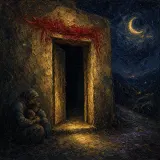
The doorway becomes the visible boundary of the household's refuge.
- The Emergency Meal Becomes an Enduring Observance Exodus 12:14-20
Before the night has even happened, Exodus tells Israel how to remember it afterward.
- The Doorway Becomes Something Children Will Ask About Exodus 12:21-28
Moses now gives Israel's elders the household instructions in concrete form.
- Midnight Reaches the Palace and the Dungeon Exodus 12:29-32
At midnight, the final warning becomes household grief across Egypt.
- The People Leave with Dough on Their Shoulders Exodus 12:33-39
Egypt's urgency now drives the departure.
- Four Hundred and Thirty Years, and One Appointed Night Exodus 12:40-42
Exodus stretches the camera from one urgent night to centuries of sojourning.
- A Guarded Meal with a Way for Outsiders to Enter Exodus 12:43-51
The final Passover instructions guard the meal without making foreign birth an absolute barrier.

Scripture beside the summary
Exodus · King James Version · 51Exodus 12:1-6
A New Year Begins Before Freedom Arrives
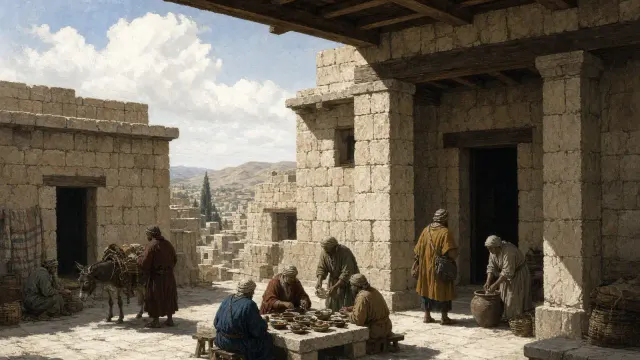
Israel's new calendar begins before Israel is actually free. While the people are still in Egypt, the month of departure is named as the beginning of their year, making the coming release a reference point for communal time. The instructions then move into ordinary households. Each household selects an unblemished male animal from the sheep or goats, while a household too small to consume one shares with a nearby neighbor according to the number of people eating. The practical detail matters because the rite is communal without being wasteful or detached from actual families. Selection on the tenth day and killing on the fourteenth also mean that this night is prepared for rather than improvised. Before Pharaoh has ordered anyone out, Israel is already organizing home, food, and calendar around an act of deliverance the people have not yet seen completed.
Deep dive
The first change is to time itself. While Moses and Aaron are still in Egypt, this month is designated the beginning of Israel's year. The instruction treats the coming release as the event around which communal time will be organized. Pharaoh still occupies his throne, but he no longer determines the calendar that matters to the people he has enslaved. The command looks beyond tonight's survival to years the people have not yet lived.
The congregation acts through households. A small household is to share with its nearest neighbor, and the number participating is measured by how much each person can eat. That practical detail matters: the rite is not designed to produce identical private displays regardless of need. It joins neighboring households around a portion they can actually consume. Israel is addressed as a whole assembly without requiring everyone to gather at a single doorway.
The animal is male, unblemished, and in its first year; it may come from either the sheep or the goats. The familiar word "lamb" should not hide that express allowance. It is selected on the tenth day and killed on the fourteenth, so preparation precedes the night of haste. Nothing here describes the household's emotional attachment during those days. The significance stated by Exodus lies in the animal's condition, the appointed time, and the whole congregation's participation. There is not yet a tabernacle or an Aaronic priesthood directing the rite. Its first setting is the home.
Words to trace: lamb, month, house, congregation, first, Israel
Verse-by-verse path
- Exodus 12:1
“In the land of Egypt” is pointed: this is the only statute of Israel’s law given in Egypt rather than in the wilderness. Jewish commentators long noted that the first commandment addressed to Israel as a people comes while they are still enslaved, and it is about time.
- Exodus 12:2
The month is later called Abib (13:4), meaning “fresh ears of grain”, and after the exile Nisan. The Hebrew year had also a civil beginning in the autumn, which is why the Jewish New Year falls in Tishri, the seventh month counted from this one. Two new years run side by side.
- Exodus 12:3
“Congregation”, edah, is used of Israel here for the first time, a gathered and organised community. “Lamb” is seh, which covers a young sheep or a young goat, as verse 5 makes clear. Selection on the tenth day gave four days to watch the animal.
- Exodus 12:4
“According to his eating” means by how much each person can eat. Jewish practice later set a minimum of ten people for a lamb, and Josephus reports groups of ten to twenty. The instruction is practical: no family is too small to keep it, and no lamb is wasted.
- Exodus 12:5
“Without blemish” is tamim, whole or complete, the word used of Noah (“perfect”, Genesis 6:9) and required of all later sacrifices. “Of the first year” is literally “a son of a year”, a yearling. 1 Peter 1:19 calls Christ “a lamb without blemish and without spot”.
- Exodus 12:6
“Keep it up” means keep it under watch. “In the evening” is literally “between the two evenings”, an old phrase that later tradition took as between noon and sunset, or between sunset and dark. The whole assembly kills it, but each household kills its own.
Exodus 12:1-6
King James Version1And the LORD spake unto Moses and Aaron in the land of Egypt, saying,
2This month shall be unto you the beginning of months: it shall be the first month of the year to you.
3Speak ye unto all the congregation of Israel, saying, In the tenth day of this month they shall take to them every man a lamb, according to the house of their fathers, a lamb for an house:
4And if the household be too little for the lamb, let him and his neighbour next unto his house take it according to the number of the souls; every man according to his eating shall make your count for the lamb.
5Your lamb shall be without blemish, a male of the first year: ye shall take it out from the sheep, or from the goats:
6And ye shall keep it up until the fourteenth day of the same month: and the whole assembly of the congregation of Israel shall kill it in the evening.
Exodus 12:7-13
Blood on the Doorway, a Meal Inside
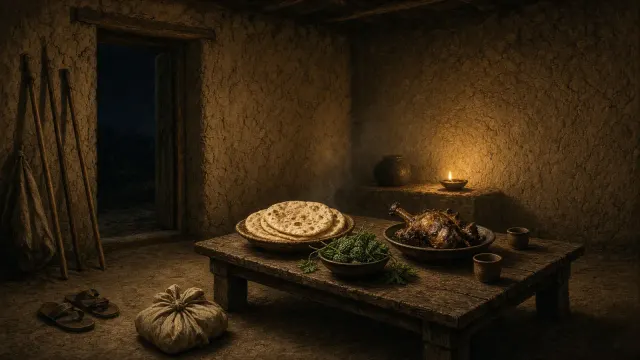
The doorway becomes the visible boundary of the household's refuge. Blood is placed on the side posts and upper post, while inside the family eats roasted meat with unleavened bread and bitter herbs. Nothing is casual about the meal: preparation, leftovers, clothing, shoes, and staff are all shaped by readiness to leave. The people are to eat in haste, already dressed for a departure Pharaoh has not yet authorized. The blood is not presented as an independent magical substance. It is a sign appointed by the LORD and given meaning by his promise to pass over the marked houses when judgment strikes Egypt's firstborn. The scene therefore joins food, protection, judgment, and movement in one domestic space. Israel waits inside while the decisive action belongs to the LORD moving through Egypt beyond the door.
Deep dive
The instructions arrange the house into a boundary and a gathering place. Blood marks the upper and side posts of the doorway; the household eats the animal inside. The meal includes unleavened bread and bitter herbs, with the meat roasted rather than boiled. What remains by morning must be burned. These are not casual menu suggestions, and the food is not being prepared as a store for ordinary use afterward. The meal belongs to this appointed night.
The clothing adds another layer. Girded garments, shoes, and a staff make this a meal eaten by people ready to travel, not a settled household preparing for bed. Their readiness is commanded before Pharaoh orders them away. The name "the LORD's passover" identifies whose act gives the meal its meaning. Israel is preparing to depart, but the decisive movement first belongs to the LORD, who passes through Egypt in judgment.
Protection is attached to the sign God has appointed and promised to recognize. The passage does not present ancestry alone as an automatic substitute for the instructions, nor blood as an independent magical substance. The LORD declares what the sign will mean and promises that the destructive plague will not enter those marked houses. Judgment against Egypt's gods is explicit in verse 12, but Exodus does not assign every earlier plague to one particular deity. The broad claim is stronger than a speculative matching chart: Egypt's divine powers will not shield the land from the LORD's action.
Words to trace: Egypt, blood, fire, land, houses, morning
Verse-by-verse path
- Exodus 12:7
The side posts are mezuzot, the word that later names the small case fixed to Jewish doorposts under Deuteronomy 6:9. The “upper door post” is the lintel, mashqof, a word found only in this chapter. The blood goes on the frame, the part of the house every person must pass through.
- Exodus 12:8
“Bitter herbs” is merorim, from the word for bitter, marar, the same verb as 1:14, “they made their lives bitter”. The meal eats the bondage. Unleavened bread, matsot, is flat bread baked without yeast, quick to make.
- Exodus 12:9
“Sodden” means boiled, the old past participle of seethe. The animal is roasted whole, head, legs and “purtenance”, the inner parts. Boiling was the ordinary way to cook sacrificial meat (1 Samuel 2:13–15), so roasting over open fire sets this meal apart and suits people with no time to wait.
- Exodus 12:10
Nothing may be kept for the next day. The meal cannot be stored or turned into leftovers; it belongs wholly to this night. Burning what remains prevents any part of the sacred animal from becoming common food.
- Exodus 12:11
“Loins girded” means the long robe tucked into the belt for walking or running. Shoes indoors were unusual, and the staff in hand ready for the road. “In haste” is chippazon, the alarm of flight, used again in Deuteronomy 16:3. “Passover” is pesach, named here for the first time.
- Exodus 12:12
“Pass through” is avar, a different verb from “pass over” in verse 13. “Against all the gods of Egypt I will execute judgment” is the only time Exodus says outright that the plagues target Egypt’s gods. Numbers 33:4 repeats it. Egyptian kings were considered divine and their firstborn heirs were gods-in-waiting.
- Exodus 12:13
“Pass over” is pasach, which may mean to leap over, or to hover protectively, as in Isaiah 31:5, where the LORD will “pass over” and preserve Jerusalem like birds flying. The blood is a sign “to you”, for Israel’s assurance, though God is the one who sees it.
Exodus 12:7-13
King James Version7And they shall take of the blood, and strike it on the two side posts and on the upper door post of the houses, wherein they shall eat it.
8And they shall eat the flesh in that night, roast with fire, and unleavened bread; and with bitter herbs they shall eat it.
9Eat not of it raw, nor sodden at all with water, but roast with fire; his head with his legs, and with the purtenance thereof.
10And ye shall let nothing of it remain until the morning; and that which remaineth of it until the morning ye shall burn with fire.
11And thus shall ye eat it; with your loins girded, your shoes on your feet, and your staff in your hand; and ye shall eat it in haste: it is the LORD’s passover.
12For I will pass through the land of Egypt this night, and will smite all the firstborn in the land of Egypt, both man and beast; and against all the gods of Egypt I will execute judgment: I am the LORD.
13And the blood shall be to you for a token upon the houses where ye are: and when I see the blood, I will pass over you, and the plague shall not be upon you to destroy you, when I smite the land of Egypt.
Exodus 12:14-20
The Emergency Meal Becomes an Enduring Observance
Before the night has even happened, Exodus tells Israel how to remember it afterward. The day is to become a memorial feast through generations, and the unleavened bread expands from one urgent meal into a seven-day observance. Leaven is removed from the houses, the first and seventh days are marked by holy assemblies, and ordinary work stops except for preparing what people need to eat. The seriousness of belonging appears in the warning that one who eats leaven during the appointed period will be cut off from Israel, whether native-born or resident stranger. Exodus does not explain the exact mechanism of that penalty here, nor does it turn leaven into a universal symbol in every context. Its immediate purpose is historical and communal. A future household will enact, in food and time, the departure its ancestors were still awaiting when these instructions were first given.
Deep dive
The chapter moves into instructions for future generations before it reports the departure itself. This is deliberate pacing. The night is not to survive only in the recollections of those old enough to remember Egypt. It is given a repeated form that later households will practice. The seven-day observance extends the memory beyond a single meal, and the first and seventh days are marked by holy assemblies and freedom from ordinary work, with food preparation expressly allowed.
The removal of leaven reaches through the houses and applies to both the resident stranger and the native-born. The warning that an offender will be "cut off" makes participation a serious matter of belonging, not merely a preference for one kind of bread. The precise mechanism of that penalty is not specified here. Equally, the passage does not pause to declare that leaven always symbolizes moral corruption wherever it appears in Scripture. In Exodus, its immediate connection is to this feast and the remembered departure.
A later book does make a deliberate moral use of these details. In 1 Corinthians 5:7–8, Paul identifies Christ with the sacrificed Passover and uses the removal of leaven to address evil within the Corinthian congregation. That connection earns its place because Paul explicitly turns to this observance. It should not erase the first setting: Israel is being taught how to keep a historical act of deliverance present in communal time. The feast is already being prescribed while the people who will observe it are still living under Egyptian rule.
Words to trace: bread, first, unleavened, feast, leavened, month
Verse-by-verse path
- Exodus 12:14
“Memorial” is zikkaron, a reminder. “Feast” is chag, the pilgrimage word, and “ordinance for ever” makes it a permanent statute. The order of the verses is striking: the festival is instituted before the event it remembers has taken place.
- Exodus 12:15
“Leaven” is se’or, the old fermented dough kept back from the previous batch to start the next, which is why it must be cleared out entirely: it is a chain that runs from year to year. “Cut off” is karat, and whether it means exile or death at God’s hand is debated.
- Exodus 12:16
“Holy convocation” is miqra qodesh, a sacred gathering, literally “a holy calling”. The only work permitted is preparing food, a rule that distinguishes these festival days from the Sabbath, when cooking was forbidden (16:23).
- Exodus 12:17
“Observe the feast of unleavened bread” is in Hebrew simply “guard the unleavened bread”, and the rabbis read it literally as well: watch the dough so it cannot rise. This is the first time the feast of the seven days is named apart from the Passover lamb itself.
- Exodus 12:18
The dates are exact: the fourteenth at evening to the twenty-first at evening, seven days. Hebrew days begin at evening, which is why the phrasing runs from even to even, a count also found in Genesis 1, “the evening and the morning”.
- Exodus 12:19
“No leaven found” gave rise to the later practice of searching the house for crumbs by lamplight on the night before Passover. The rule includes the stranger, ger, a resident alien: the household law binds anyone living in an Israelite home.
- Exodus 12:20
The shortest statement of the rule, placed last as a summary. “All your habitations” extends the observance wherever Israel lives, which makes it portable, a festival not tied to a single sanctuary as long as the household keeps it.
Exodus 12:14-20
King James Version14And this day shall be unto you for a memorial; and ye shall keep it a feast to the LORD throughout your generations; ye shall keep it a feast by an ordinance for ever.
15Seven days shall ye eat unleavened bread; even the first day ye shall put away leaven out of your houses: for whosoever eateth leavened bread from the first day until the seventh day, that soul shall be cut off from Israel.
16And in the first day there shall be an holy convocation, and in the seventh day there shall be an holy convocation to you; no manner of work shall be done in them, save that which every man must eat, that only may be done of you.
17And ye shall observe the feast of unleavened bread; for in this selfsame day have I brought your armies out of the land of Egypt: therefore shall ye observe this day in your generations by an ordinance for ever.
18In the first month, on the fourteenth day of the month at even, ye shall eat unleavened bread, until the one and twentieth day of the month at even.
19Seven days shall there be no leaven found in your houses: for whosoever eateth that which is leavened, even that soul shall be cut off from the congregation of Israel, whether he be a stranger, or born in the land.
20Ye shall eat nothing leavened; in all your habitations shall ye eat unleavened bread.
Exodus 12:21-28
The Doorway Becomes Something Children Will Ask About
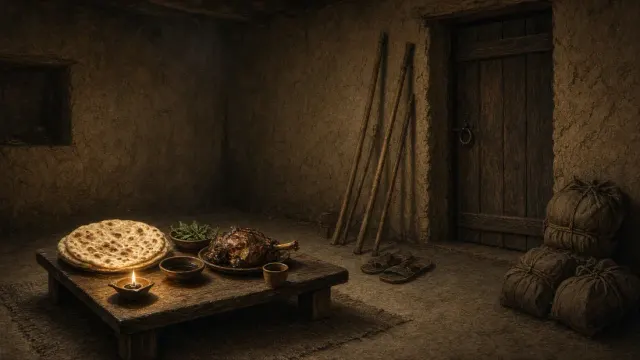
Moses now gives Israel's elders the household instructions in concrete form. Hyssop applies the blood to the lintel and side posts, and no one is to leave the marked house before morning. That restriction keeps the family inside the refuge rather than turning the night into something to observe from the street. The instructions immediately look ahead to the promised land and to children who will ask, "What mean ye by this service?" Their question is built into the ritual rather than treated as a distraction from it. The required answer names both judgment and deliverance: Egypt was struck, and Israel's houses were passed over. The people bow and worship, then do as they are commanded. Pharaoh is still outside the scene trying to control departure, while Israel's homes prepare for release on terms already given by the LORD.
Deep dive
The instruction now travels from the LORD through Moses to the elders and families. Hyssop is used to apply the blood, and the household is told to remain inside until morning. This adds an important boundary to the earlier command: marking the door is not followed by wandering outside to watch events unfold. The refuge is the house whose doorway bears the appointed sign. Exodus describes the LORD as preventing "the destroyer" from entering, without supplying a personal name, appearance, or separate biography for that figure.
The explanation then leaps ahead to the promised land. Children who never experienced Egypt will encounter a practiced observance and ask what it means. Their question is not an interruption to the ceremony. It is part of the future the instructions themselves anticipate. The answer names both aspects of the night: Egyptian households were struck, and Israel's households were delivered. Memory is not reduced to a cheerful account of travel while the judgment that made the departure possible disappears.
The people bow and worship before carrying out the commands. That response resembles their worship when they first heard that God had seen their affliction in Exodus 4:31, but the present scene gives their response a concrete form in the household preparations. The repeated statement that they did as commanded closes the instruction with action rather than another negotiation. Outside, Pharaoh has repeatedly argued over who may go. Inside these homes, the people prepare for the departure on the terms already given.
Words to trace: LORD, blood, children, houses, Israel, bason
Verse-by-verse path
- Exodus 12:21
“Draw out” probably means select from the flock, or go and bring. Moses passes on the instruction to the elders, who pass it to families, the same chain of authority as in 3:16. “Kill the passover” names the lamb itself as “the passover”.
- Exodus 12:22
Hyssop was a small, bushy aromatic plant, probably a kind of marjoram, whose hairy stems hold liquid well. It is used again in the cleansing of lepers (Leviticus 14:4) and David’s “purge me with hyssop” (Psalm 51:7). A sponge on hyssop was lifted to Jesus on the cross (John 19:29).
- Exodus 12:23
“The destroyer” is ha-mashchit, the same word used of the angel who strikes Jerusalem in 2 Samuel 24:16. Hebrews 11:28 speaks of “he that destroyed the firstborn”. The LORD passes over the door and does not permit the destroyer to go in, which places even the destroyer under his command.
- Exodus 12:24
The verb shifts between plural and singular: “ye shall observe” and “to thee and to thy sons”. The ordinance addresses the whole people and each father at once. “For ever” is le’olam, as long as there are generations to keep it.
- Exodus 12:25
“Service” is avodah again, the word for the slave labour of chapter 1. The bondage of avodah in Egypt becomes the avodah of worship in the land. The law is given for a future Israel settled in Canaan, not yet reached.
- Exodus 12:26
This is the first of four places in the Law where a child’s question is anticipated (13:14, Deuteronomy 6:20 and here, with 13:8 answering an unasked one). The Passover Haggadah builds its “four sons” on these texts, with this one said to be spoken by the wicked son, because he says “you”, not “us”.
- Exodus 12:27
The answer holds “houses” twice: God passed over the houses and delivered our houses. The people respond by bowing their heads, the same gesture as in 4:31 when they first believed. They have not yet seen the deliverance, only been told of it.
- Exodus 12:28
“Went away, and did” is simple obedience. Israel acts without being able to see what is coming. The phrase “so did they” echoes the obedience of Moses and Aaron in 7:6.
Exodus 12:21-28
King James Version21Then Moses called for all the elders of Israel, and said unto them, Draw out and take you a lamb according to your families, and kill the passover.
22And ye shall take a bunch of hyssop, and dip it in the blood that is in the bason, and strike the lintel and the two side posts with the blood that is in the bason; and none of you shall go out at the door of his house until the morning.
23For the LORD will pass through to smite the Egyptians; and when he seeth the blood upon the lintel, and on the two side posts, the LORD will pass over the door, and will not suffer the destroyer to come in unto your houses to smite you.
24And ye shall observe this thing for an ordinance to thee and to thy sons for ever.
25And it shall come to pass, when ye be come to the land which the LORD will give you, according as he hath promised, that ye shall keep this service.
26And it shall come to pass, when your children shall say unto you, What mean ye by this service?
27That ye shall say, It is the sacrifice of the LORD’s passover, who passed over the houses of the children of Israel in Egypt, when he smote the Egyptians, and delivered our houses. And the people bowed the head and worshipped.
28And the children of Israel went away, and did as the LORD had commanded Moses and Aaron, so did they.
Exodus 12:29-32
Midnight Reaches the Palace and the Dungeon
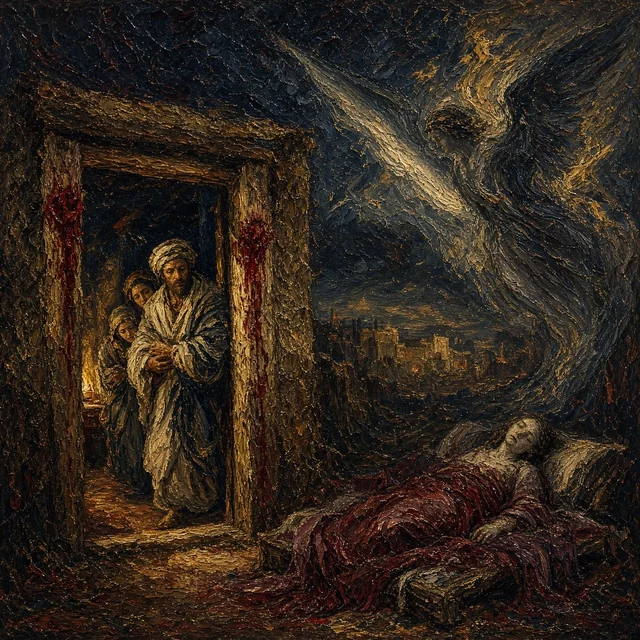
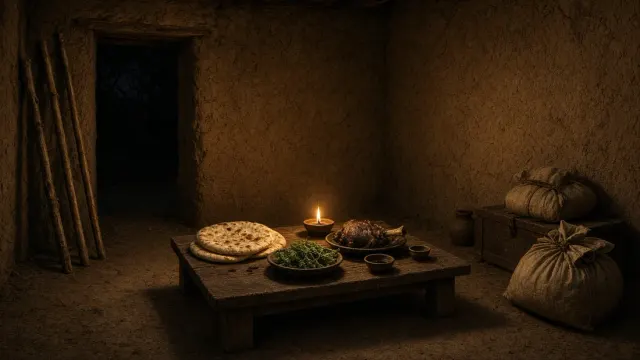
At midnight, the final warning becomes household grief across Egypt. The range runs from Pharaoh's firstborn to the firstborn of the captive in the dungeon, with firstborn animals included as well. "Firstborn" names a family position, not a category limited to babies, and the breadth of the judgment is what produces the great cry throughout the land. Pharaoh rises at night and finally issues the command he had resisted in every earlier form. Israel is to get out, serve the LORD, and take the flocks and herds too. "As ye have said" quietly reverses his previous conditions one by one. Even his request, "bless me also," places the ruler in a new posture toward the men he once dismissed and threatened. Exodus records the surrender without confusing it with a lasting transformation of Pharaoh's character.
Deep dive
The fulfillment preserves the breadth of the warning while changing its lower endpoint from the maidservant at the mill to the captive in the dungeon. The judgment reaches the throne and those confined far beneath its privileges. "Firstborn" is a place within a family, not a synonym for infant; the passage does not restrict the deaths to babies. Nor does it suggest that every bereaved household had equal responsibility for Pharaoh's decisions. Its account is severe precisely because the loss reaches across the land rather than remaining inside the royal household.
Pharaoh rises at night, along with his servants and the Egyptians. The national cry interrupts the king's control of events in a way his earlier private withdrawals did not. The commands he now issues reverse the conditions he had previously imposed: Israel may go, serve the LORD, and take the flocks and herds. The repeated qualification "as ye have said" points back to demands he had refused. The departure is no longer being trimmed to fit his terms.
His added request, "bless me also," places the king in the position of asking something from the men he had dismissed and threatened. Exodus records the request without treating it as proof of a lasting conversion. The account also does not linger over the deaths for spectacle. It states the loss, the cry, and the resulting command to leave. The gravity is in the scale of the bereavement and in the fact that Pharaoh's surrender comes only now.
Words to trace: firstborn, Egypt, LORD, night, Pharaoh, Aaron
Verse-by-verse path
- Exodus 12:29
“Captive that was in the dungeon” is literally “in the house of the pit”, a prison cell, the same word Joseph used for his prison in Genesis 40:15. The range in 11:5 was throne to mill; here it is throne to dungeon, reaching even lower.
- Exodus 12:30
“Not a house where there was not one dead” is a double negative, total in Hebrew. The cry that Moses foretold in 11:6 comes to pass word for word. Pharaoh rises “in the night”, the man who banished Moses from his face now awake and summoning him.
- Exodus 12:31
He called for Moses and Aaron by night, after vowing not to see Moses’ face again (10:28). “As ye have said” cancels every condition he tried to set: distance, persons, livestock. “Serve the LORD” is spoken in Pharaoh’s own mouth.
- Exodus 12:32
“Bless me also” is the last request of a defeated king. In Genesis 47:7 Jacob blessed an earlier Pharaoh; now Pharaoh asks a blessing of Israel’s leaders. “As ye have said” is repeated, and the conditions of 10:24 are withdrawn.
Exodus 12:29-32
King James Version29And it came to pass, that at midnight the LORD smote all the firstborn in the land of Egypt, from the firstborn of Pharaoh that sat on his throne unto the firstborn of the captive that was in the dungeon; and all the firstborn of cattle.
30And Pharaoh rose up in the night, he, and all his servants, and all the Egyptians; and there was a great cry in Egypt; for there was not a house where there was not one dead.
31And he called for Moses and Aaron by night, and said, Rise up, and get you forth from among my people, both ye and the children of Israel; and go, serve the LORD, as ye have said.
32Also take your flocks and your herds, as ye have said, and be gone; and bless me also.
Exodus 12:33-39
The People Leave with Dough on Their Shoulders
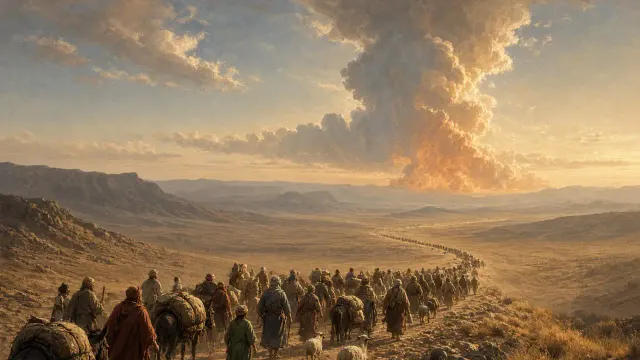
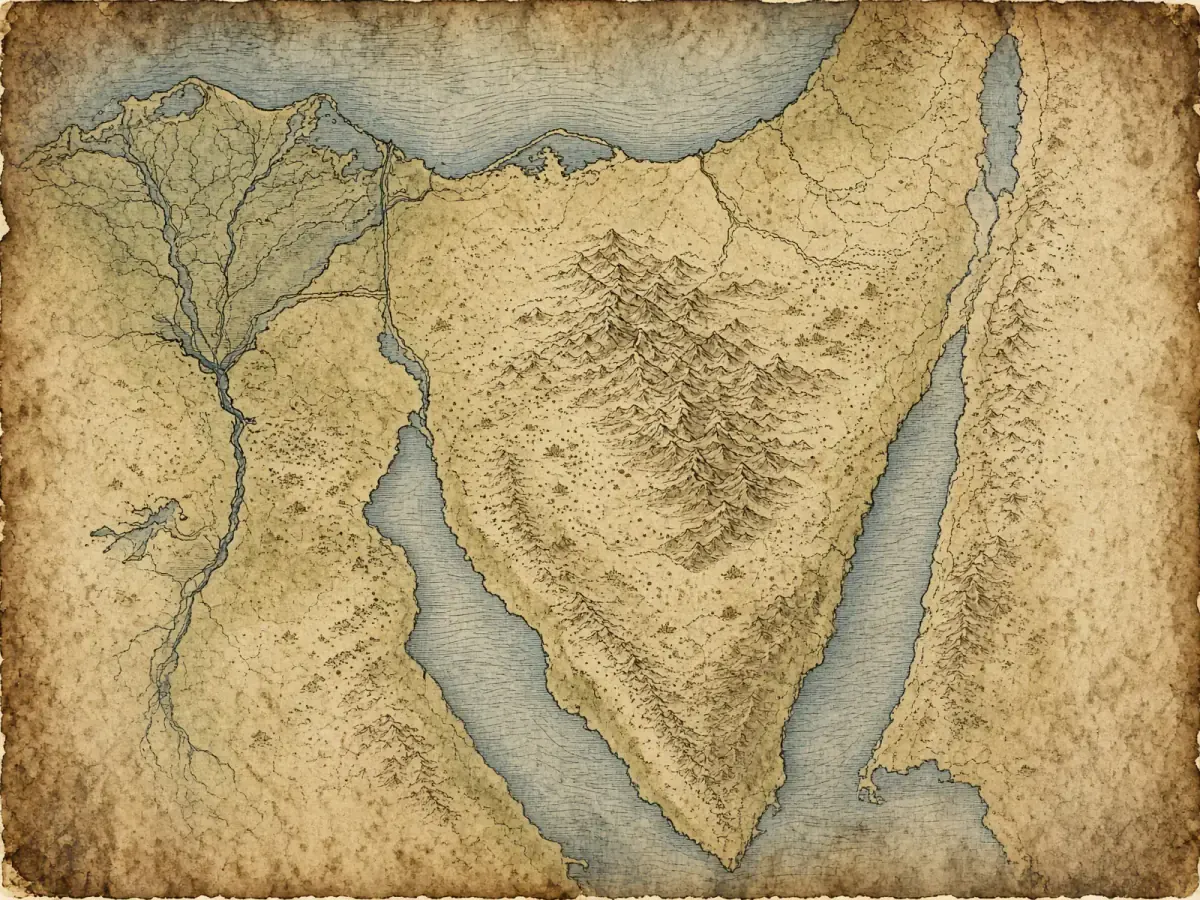
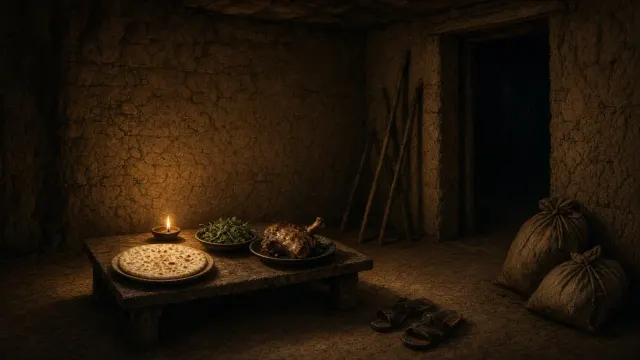
Egypt's urgency now drives the departure. The people who had been prevented from leaving are pressed to go so quickly that their dough has not risen, and kneading troughs are carried bundled in clothing on their shoulders. The scene is national in scale but filled with household objects. Israel also asks for silver, gold, and clothing, receiving what had been promised earlier and leaving with what Exodus calls the spoil of Egypt, though no armed looting of houses is described. About six hundred thousand men travel on foot, besides children, along with a mixed multitude and abundant livestock. The company is therefore broader than a single neat ethnic or demographic line. The unleavened cakes are finally explained both ritually and practically: the people were thrust out before ordinary food preparation could be completed. Memory and haste meet in the same bread.
Deep dive
The urgency now comes from Egypt. Those who were forced to meet an unchanged brick quota are being pressed to leave before their bread can rise. Their kneading troughs, once invaded by frogs in Exodus 8:3, become part of the household equipment carried out on their shoulders. The detail keeps the departure tangible. This is not an abstract nation changing its legal status. People are moving with food still unfinished and domestic objects bundled into their clothing.
Silver, gold, and clothing fulfill the earlier promise that they would not leave empty-handed. Exodus attributes the Egyptians' willingness to the favor given by the LORD and then describes the result as spoiling Egypt. The language resembles the taking of a victor's spoil, although no Israelite assault on Egyptian houses is described. The transfer happens through the requests already commanded, not through a newly introduced episode of armed looting.
The number given is about six hundred thousand men on foot, besides children; it is not a stated total for every traveler. The "mixed multitude" further prevents the departing company from being pictured as a population with only one background. Exodus does not identify every group's ancestry or explain each person's motive for joining. It also includes abundant livestock, resolving the argument over the animals. The unleavened cakes are then explained by the haste of expulsion. The prescribed observance and the practical conditions of departure meet in the same bread.
Words to trace: Egyptians, children, people, dough, Egypt, Israel
Verse-by-verse path
- Exodus 12:33
“Urgent” is chazaq again, the hardening verb, now used of the Egyptians pressing Israel to go. The strength once used to keep Israel in is now used to push them out. “We be all dead men” is literally “we are all dying”.
- Exodus 12:34
The dough had not risen, and the kneading bowls were wrapped in their cloaks and carried on their shoulders. The same kneading troughs were overrun by frogs in 8:3. The detail supplies the origin of the unleavened bread without adding a word of explanation.
- Exodus 12:35
Israel did “according to the word of Moses”, the command given in 11:2. “Raiment” means clothing, which appears in the list of 3:22 but not of 11:2. The borrowed clothing may be the fine garments later given for the tabernacle work.
- Exodus 12:36
“Lent” is a form of the verb sha’al, “to ask”, in a causative sense: “let them have what they asked”. The ending, “and they spoiled the Egyptians”, is the same word as 3:22, fulfilled exactly. Psalm 105:37 recalls it: “He brought them forth also with silver and gold.”
- Exodus 12:37
Rameses is the store city of 1:11. Succoth, “booths”, is often identified with Tjeku in the eastern delta. “Six hundred thousand” rounds the census of Numbers 1:46, 603,550. The size is widely debated, and some take eleph not as a thousand but as a clan or military unit.
- Exodus 12:38
“Mixed multitude” is erev rav, a great mixture, non-Israelites who chose to leave, perhaps Egyptians or other foreign labourers. Numbers 11:4 uses a different and harsher word for such people, asafsuf, a rabble, and blames them for the craving for meat.
- Exodus 12:39
“Cakes” are uggot, flat rounds baked on hot stones, as Sarah baked for the three visitors in Genesis 18:6. “Victual” is provisions for a journey. The unleavened bread was an emergency food before it became a law.
Exodus 12:33-39
King James Version33And the Egyptians were urgent upon the people, that they might send them out of the land in haste; for they said, We be all dead men.
34And the people took their dough before it was leavened, their kneadingtroughs being bound up in their clothes upon their shoulders.
35And the children of Israel did according to the word of Moses; and they borrowed of the Egyptians jewels of silver, and jewels of gold, and raiment:
36And the LORD gave the people favour in the sight of the Egyptians, so that they lent unto them such things as they required. And they spoiled the Egyptians.
37And the children of Israel journeyed from Rameses to Succoth, about six hundred thousand on foot that were men, beside children.
38And a mixed multitude went up also with them; and flocks, and herds, even very much cattle.
39And they baked unleavened cakes of the dough which they brought forth out of Egypt, for it was not leavened; because they were thrust out of Egypt, and could not tarry, neither had they prepared for themselves any victual.
Exodus 12:40-42
Four Hundred and Thirty Years, and One Appointed Night
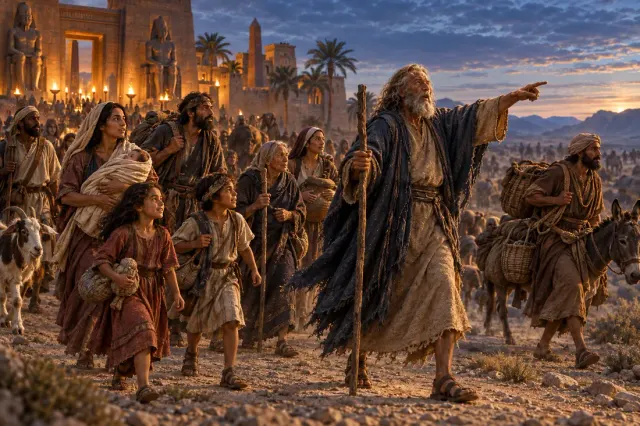
Exodus stretches the camera from one urgent night to centuries of sojourning. Four hundred and thirty years are named, then the departure is located on "the selfsame day," giving a sharply defined ending to a long condition. The chronology itself has generated interpretive difficulty because the KJV wording associates the period with Egypt, while other ancient textual forms include Canaan and Galatians 3:17 speaks of 430 years between covenant and law. The verse should not be flattened into a certainty the wording does not supply. What Exodus emphasizes most clearly is the appointed night. The LORD brings out his hosts, and that night becomes one later generations are to observe. Centuries of waiting, one specific departure, and repeated remembrance are placed beside each other. The date matters because of the act attached to it, not because Exodus supplies a modern calendar conversion.
Deep dive
The move from centuries to "the selfsame day" gives the departure a sharply defined place within a much longer history. The people have not simply escaped during a fortunate lapse in palace security. Exodus presents their release as the ending of an extended period and identifies the departing company as the LORD's hosts. That description gives their multitude an ordered corporate identity without requiring every family member to be imagined as an armed soldier.
The 430 years present a genuine interpretive issue. The KJV wording associates the sojourn with Egypt. An ancient textual form represented by the Septuagint explicitly includes Canaan as well as Egypt, while Galatians 3:17 speaks of 430 years between the covenant and the law. Accordingly, one reading assigns the full period to Egypt; another understands the period more broadly to include the patriarchal sojourn before Jacob's family entered Egypt. These are not identical chronologies, and the KJV sentence should not be silently rewritten to remove the difference.
Verse 42 returns from the calculation to the night itself. It belongs to the LORD because he brought Israel out, and it belongs in the repeated observance of later generations. The scale of time changes without losing the connection: centuries of sojourning, a particular night of release, and generations of remembrance. The date matters because of the act attached to it. Exodus supplies that framework without naming the reigning Pharaoh or giving a modern calendar date.
Words to trace: Egypt, LORD, children, Israel, land, night
Verse-by-verse path
- Exodus 12:40
Genesis 15:13 promised Abraham “four hundred years” of affliction in a round number, and 15:16 said the return would come “in the fourth generation”. Chapter 6’s genealogy counts exactly four from Levi: Levi, Kohath, Amram, Moses. How the long years and the short line fit is a question the verse leaves standing.
- Exodus 12:41
“The selfsame day” is be’etsem hayom, literally “on the bone of the day”, meaning exactly that day. Israel is called “the hosts of the LORD” for the first time, tsiv’ot YHWH, making them the army of the LORD of hosts.
- Exodus 12:42
“A night to be much observed” is leil shimmurim, literally “a night of watchings”. It uses the same word twice: God kept watch that night to bring them out, and Israel keeps watch every year to remember it. Jewish tradition calls Passover night “the night of guarding”.
Exodus 12:40-42
King James Version40Now the sojourning of the children of Israel, who dwelt in Egypt, was four hundred and thirty years.
41And it came to pass at the end of the four hundred and thirty years, even the selfsame day it came to pass, that all the hosts of the LORD went out from the land of Egypt.
42It is a night to be much observed unto the LORD for bringing them out from the land of Egypt: this is that night of the LORD to be observed of all the children of Israel in their generations.
Exodus 12:43-51
A Guarded Meal with a Way for Outsiders to Enter
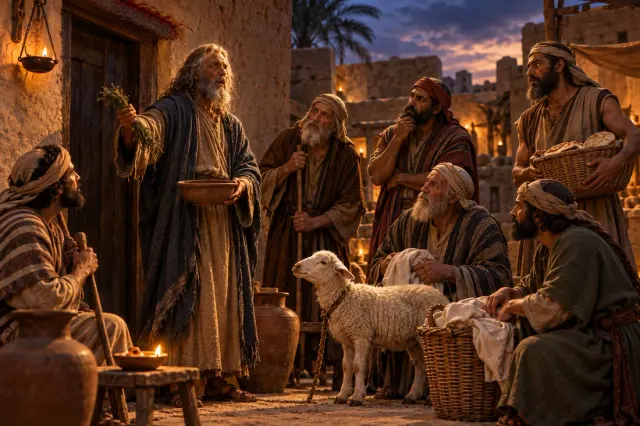
The final Passover instructions guard the meal without making foreign birth an absolute barrier. An outsider cannot simply join as an uncommitted guest, yet a resident stranger who desires to keep Passover may enter the observance through circumcision of the males in his household and then be treated as one born in the land. The same law governs native and admitted stranger. Household servants are distinguished as well: a purchased servant may eat after circumcision, while hired status alone does not establish covenant participation. The rules belong to the social world Exodus describes rather than erasing its institutions. The animal remains within one house, and no bone is to be broken. The chapter closes where it began, with obedience and departure: Israel does as commanded, and the LORD brings the people out of Egypt by their ordered companies.
Deep dive
The repeated word "stranger" can make the rules sound contradictory unless the conditions are followed. An outsider may not simply join the meal as an uncommitted visitor. Yet a resident stranger who wishes to keep Passover may enter its observance when the males of his household receive circumcision. He is then treated as one born in the land. The boundary is real, but it is not an absolute claim that foreign birth can never be crossed. The same rule governs the native-born and the admitted stranger.
The treatment of servants also belongs to the actual social world of the passage. A purchased servant may eat after circumcision, whereas hired employment does not by itself establish this covenant participation. Exodus regulates households that include slavery; it does not abolish that institution in these verses. At the same time, participation is not simply reserved for the household's economically independent members. Covenant marking, rather than wealth or employment alone, determines the stated access to the meal.
The animal must be eaten within one house, without carrying its flesh outside or breaking a bone. John 19:36 later makes the unbroken bones of Jesus a point of scriptural fulfillment, language that recalls this Passover rule as well as Psalm 34:20. The connection depends on a specific detail, not a free association with any sacrifice. Exodus ends by repeating that Israel acted as commanded and that the LORD brought the people out. The chapter has moved through instructions, death, departure, and membership, but its final subject remains the LORD who accomplishes the release.
Words to trace: LORD, Israel, keep, stranger, Aaron, children
Verse-by-verse path
- Exodus 12:43
“Stranger” here is ben nekhar, a son of a foreign land, an outsider with no bond to Israel. This verse and the next begin rules for who eats, given after the departure, to regulate future Passovers in the land.
- Exodus 12:44
A slave bought with money belongs to the household, and once circumcised he eats with the family. Genesis 17:12–13 already required the circumcision of slaves bought with money, as members of Abraham’s house.
- Exodus 12:45
“Foreigner” is toshav, a temporary resident, and a hired servant is sakhir, paid by the day. Neither belongs to the house permanently, and so neither eats. The distinction turns on belonging, not on ethnicity.
- Exodus 12:46
“Neither shall ye break a bone thereof” is quoted in John 19:36 of Jesus on the cross: “A bone of him shall not be broken.” The lamb is eaten in one house and stays whole in death, and Psalm 34:20 applies the same protection to the righteous.
- Exodus 12:47
“All the congregation” makes the Passover a duty for every Israelite, not optional devotion. Numbers 9:13 later says anyone who could keep it and does not “shall be cut off”.
- Exodus 12:48
“Let him come near” uses qarav, the verb used of approaching an altar with an offering. A stranger who is circumcised becomes “as one that is born in the land”, ezrach, the native-born. Circumcision is the doorway, not ancestry.
- Exodus 12:49
“One law” is torah achat, the first time in Exodus that torah names a body of law. The principle returns in Numbers 15:16, “one law and one manner shall be for you, and for the stranger”. Here it is laid down at the table of the first festival.
- Exodus 12:50
The same doubled formula of obedience as in verse 28 and in 7:6. The chapter frames the whole ritual law between two reports of Israel doing exactly what was commanded.
- Exodus 12:51
“By their armies” is the last word of the chapter, as in 6:26 when the commission first described them that way. The promise of 6:26 is now done. The verse repeats verse 41, closing the account of the departure as it began.
Exodus 12:43-51
King James Version43And the LORD said unto Moses and Aaron, This is the ordinance of the passover: There shall no stranger eat thereof:
44But every man’s servant that is bought for money, when thou hast circumcised him, then shall he eat thereof.
45A foreigner and an hired servant shall not eat thereof.
46In one house shall it be eaten; thou shalt not carry forth ought of the flesh abroad out of the house; neither shall ye break a bone thereof.
47All the congregation of Israel shall keep it.
48And when a stranger shall sojourn with thee, and will keep the passover to the LORD, let all his males be circumcised, and then let him come near and keep it; and he shall be as one that is born in the land: for no uncircumcised person shall eat thereof.
49One law shall be to him that is homeborn, and unto the stranger that sojourneth among you.
50Thus did all the children of Israel; as the LORD commanded Moses and Aaron, so did they.
51And it came to pass the selfsame day, that the LORD did bring the children of Israel out of the land of Egypt by their armies.
Questions to keep in mind while reading
- Identify the people addressed and the covenant setting.
- Distinguish rescue, worship, holiness, justice, and community responsibility.
- Read commands in their literary and covenant context before making a modern application.
Text first
Where readers differ
The chapter summary begins with what the passage says and how its parts fit together. It does not assume one denomination has already settled every question. Where a conclusion depends on a tradition, literary theory, or historical reconstruction, that dependence is named openly.
The KJV text is presented first. Interpretive conclusions are labeled, and differences are introduced only when they help a reader understand why serious communities do not always reach the same answer.
Comparative interpretive notes for this chapter are in preparation. Until reviewed notes are ready, this page separates the KJV text from summary and application without claiming that serious readers agree on every question.
Questions beneath the surface
- What account of God, human freedom, responsibility, and the good life emerges from Exodus 12?
- Which tension does the chapter refuse to resolve quickly?
- What changes when the chapter is read as part of the whole canon rather than as an isolated moral lesson?
- Where might a sincere reader confuse a familiar tradition with something the text states directly?
Questions for serious personal contemplation
These open-ended questions make room for tension, honest response, prayer, and conclusions that remain accountable to the chapter.
Observe without rushing
What part of Exodus 12 makes you stop, feel unsettled, or feel surprised, and why?
Which detail in the passage would be easiest to overlook? How does that detail change your understanding?
Where do you see tension between what happens and this focus: A household preparing and eating the Passover in readiness to leave?
What important question does the passage leave open instead of resolving quickly?
Examine your inner life honestly
Which person, response, fear, or desire in the passage feels most like your own life right now?
What assumption about God, other people, or yourself does this text challenge?
Which part would you rather soften, avoid, or explain away too quickly? What might that reaction reveal?
If this Scripture could ask you one direct question, what do you think it would ask?
Respond with wisdom and courage
What do you need to remember, confess, grieve, thank God for, or trust after reading this passage?
How might another faithful person read this situation differently without ignoring the text?
What obedient response would be costly, uncomfortable, or slow, yet still faithful to Scripture?
What question will you carry into prayer this week, and which verses will you keep in front of you?
Music and video connected to the passage
Related media appears when its Scripture reference overlaps this study. Music and video can illuminate a theme while the biblical text remains the foundation.