The big picture
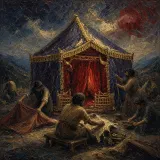
The Book of Exodus widens the sanctuary's boundaries into smell, water, money, and repeated daily practice. The gold incense altar stands near the veil but has a sharply limited use; holiness does not make it a surface for whatever offering someone chooses. The census payment places rich and poor under the same half-shekel assessment and directs the money into the sanctuary's service. A brass laver makes washing recurrent rather than a one-time feature of ordination. The anointing oil and incense are both carefully made and carefully restricted. Their recipes can be known without becoming private property for ordinary use or personal pleasure. Across these instructions, sacred use is concrete and bounded. Nearness has locations, service has preparation, and beautiful materials remain governed by purpose rather than by the assumption that anything costly or fragrant is automatically acceptable.
In this chapter
- A Second Altar with a Different Task Exodus 30:1-10
The incense altar is gold, horned, portable, and placed before the veil, but the Book of Exodus makes its identity depend on what happens there and what emphatically does not.
- The Rich Person's Life Receives No Higher Assessment Exodus 30:11-16
The census turns counting people into a matter of ransom, atonement, and exact equality.
- Ordination Does Not Replace Washing Exodus 30:17-21
A priest can be washed for consecration and still need to wash again.
- The Sanctuary's Oil Is Not a Personal Fragrance Exodus 30:22-33
The anointing oil is described with enough precision to be made, and then immediately fenced off from ordinary imitation.
- The Fragrance Has an Appointed Destination Exodus 30:34-38
The incense closes the chapter with a boundary narrow enough to reach private pleasure.

Scripture beside the summary
Exodus · King James Version · 38Exodus 30:1-10
A Second Altar with a Different Task
The incense altar is gold, horned, portable, and placed before the veil, but the Book of Exodus makes its identity depend on what happens there and what emphatically does not. Morning and evening incense accompany the tending of the lamps, joining scent to the sanctuary's daily rhythm. Yet this altar is not a holy surface available for every religious impulse. Strange incense, burnt offerings, food offerings, and drink offerings are all excluded. Nearness to the ark does not erase distinctions of use. Once a year, blood is applied to its horns for atonement, so even the altar associated with fragrance and regular service is not reduced to pleasant atmosphere. Its location points toward the place where God has promised to meet Moses, while the veil still marks separation. The whole object is defined by a combination of proximity, restriction, maintenance, and atonement. Gold and sweetness do not make its purpose vague. They make its carefully bounded purpose more visible.
Deep dive
This altar is smaller than the courtyard altar and serves a different purpose. Its location before the veil places it near the ark without putting it inside the most holy place. The description connects it to the mercy seat beyond that boundary, where God has promised to meet Moses. Nearness and separation remain present together.
Incense is burned when Aaron tends the lamps in the morning and lights them at evening. The services are coordinated rather than left as independent acts whenever a priest happens to remember them. The prohibited offerings matter just as much: no unauthorized incense, burnt sacrifice, food offering, or drink offering belongs on this altar. Its holiness does not make it a universal surface for religious activity.
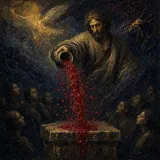
Once a year, blood is applied to its horns for atonement. The altar's regular fragrant service therefore does not remove the need for that solemn act. The chapter refuses to let pleasant scent become the entire meaning of the object. Its position, permitted use, maintenance, and atonement all define its place in the sanctuary.
Words to trace: incense, burn, Aaron, gold, horns, offering
Verse-by-verse path
- Exodus 30:1
The word for incense, qetoret, comes from qatar, to go up in smoke. It was at this altar that Zacharias was serving when the angel appeared to him “on the right side of the altar of incense” (Luke 1:11).
- Exodus 30:2
At a cubit square and two high, about eighteen inches by three feet, this is the smallest altar in the sanctuary. Small horned limestone altars of much this size have been excavated at Megiddo and other Israelite sites.
- Exodus 30:3
Gold everywhere, top, sides and horns, is why the rest of the book calls it “the golden altar” (39:38; 40:5), to tell it from the bronze one in the court. Revelation 8:3 sees “the golden altar which was before the throne”.
- Exodus 30:4
The Hebrew is unclear whether there are two rings in all, one on each side, or two on each side, four in total, as the ark had. The verse says “two golden rings” and then “upon the two sides”, and both readings have defenders.
- Exodus 30:5
Numbers 4:11 describes the march: the golden altar is covered with a cloth of blue, wrapped in tachash skins, and then put on its staves. The gold was never meant to be seen on the road.
- Exodus 30:6
Hebrews 9:3–4 speaks of the holiest place as having “the golden censer”, and 1 Kings 6:22 calls Solomon’s incense altar the one “by the oracle”. It stood outside the veil but belonged to what lay behind it.
- Exodus 30:7
“Dresseth” is heitiv, to make good: trimming wicks and refilling the lamps. In the Second Temple, the Mishnah says, the incense was assigned by lot to a priest who had never offered it before, so that most priests did it once in a lifetime.
- Exodus 30:8
The incense is lit with the evening lamps, so the smoke of the day ends where it began, at the lampstand. Revelation 5:8 connects the imagery to worship: the elders hold “golden vials full of odours, which are the prayers of saints”.
- Exodus 30:9
“Strange incense” is qetoret zarah. Aaron’s sons Nadab and Abihu died offering “strange fire”, esh zarah, before the LORD (Leviticus 10:1–2): the same adjective, and the same kind of unauthorised act.
- Exodus 30:10
The Day of Atonement is meant here; Leviticus 16:18–19 has the high priest put blood on the horns of the altar. “Atonements” is the plural kippurim, the word that gives Yom Kippur its name.
Exodus 30:1-10
King James Version1And thou shalt make an altar to burn incense upon: of shittim wood shalt thou make it.
2A cubit shall be the length thereof, and a cubit the breadth thereof; foursquare shall it be: and two cubits shall be the height thereof: the horns thereof shall be of the same.
3And thou shalt overlay it with pure gold, the top thereof, and the sides thereof round about, and the horns thereof; and thou shalt make unto it a crown of gold round about.
4And two golden rings shalt thou make to it under the crown of it, by the two corners thereof, upon the two sides of it shalt thou make it; and they shall be for places for the staves to bear it withal.
5And thou shalt make the staves of shittim wood, and overlay them with gold.
6And thou shalt put it before the vail that is by the ark of the testimony, before the mercy seat that is over the testimony, where I will meet with thee.
7And Aaron shall burn thereon sweet incense every morning: when he dresseth the lamps, he shall burn incense upon it.
8And when Aaron lighteth the lamps at even, he shall burn incense upon it, a perpetual incense before the LORD throughout your generations.
9Ye shall offer no strange incense thereon, nor burnt sacrifice, nor meat offering; neither shall ye pour drink offering thereon.
10And Aaron shall make an atonement upon the horns of it once in a year with the blood of the sin offering of atonements: once in the year shall he make atonement upon it throughout your generations: it is most holy unto the LORD.
Exodus 30:11-16
The Rich Person's Life Receives No Higher Assessment
The census turns counting people into a matter of ransom, atonement, and exact equality. Every eligible Israelite pays the same half-shekel. Wealth cannot buy a larger place in the count, and poverty does not lower the stated assessment. That makes this payment different from the freewill gifts used for construction, where people bring according to what they possess and are willing to give. Here the amount attached to each counted life is deliberately fixed. The Book of Exodus also links the numbering to the danger of plague without supplying a theory that makes every census everywhere forbidden. The concern is this commanded numbering and the way it must be carried out. The money then receives a destination rather than disappearing into a sacred treasury with no accounting. It goes to the service of the tabernacle and serves as a memorial before the LORD. Later, the Book of Exodus will show the silver in the sanctuary itself. The equal assessment becomes part of the building Israel worships around.
Deep dive
The census payment is not scaled to wealth. The rich may not add more and the poor may not give less. This differs from the willing material contributions, where possessions and capacity vary. Here the stipulated amount marks each counted person's life under the same requirement. A larger payment cannot purchase a more important entry in the numbering.
The census is attached to a warning about plague and to the language of ransom and atonement. Exodus does not explain why every feature of numbering is dangerous, and it does not say that any count under any circumstances is forbidden. It gives a particular means of conducting this one with the required acknowledgment before God.
The money is assigned to the service of the tent and becomes a memorial for Israel. Exodus 38:25–28 will report its amount and use, especially in the silver bases. That later accounting gives the instruction a material continuation. The payment is not left as an unspecified religious fee whose destination disappears from the record.
Words to trace: LORD, shekel, atonement, children, half, Israel
Verse-by-verse path
- Exodus 30:11
With the incense altar the furniture is complete, and a new speech begins. It turns from objects to people, and to the counting of Israel’s men.
- Exodus 30:12
David’s census in 2 Samuel 24 ends in a plague that kills seventy thousand, and no ransom is mentioned there. This verse names the danger centuries before that count is taken.
- Exodus 30:13
To “pass among them that are numbered” is to cross over to the counted side, a picture of counting by passing people across a line, as flocks “pass again under the hands of him that telleth them” (Jeremiah 33:13). A gerah is literally a grain, the smallest weight.
- Exodus 30:14
Twenty is the age at which men go to war (Numbers 1:3). The same age marks the wilderness judgment: of those counted “from twenty years old and upward”, none but Caleb and Joshua would enter the land (Numbers 14:29–30).
- Exodus 30:15
Matthew 17:24–27 shows the tax in the first century: the collectors of the didrachma, the half shekel, ask Peter whether Jesus pays, and Peter finds a stater, worth two half shekels, in a fish’s mouth, enough for both of them.
- Exodus 30:16
The collection outlived the wilderness. King Joash revives “the collection... of Moses the servant of God” to repair the temple (2 Chronicles 24:6, 9), and after the exile Nehemiah 10:32 sets it at a third of a shekel.
Exodus 30:11-16
King James Version11And the LORD spake unto Moses, saying,
12When thou takest the sum of the children of Israel after their number, then shall they give every man a ransom for his soul unto the LORD, when thou numberest them; that there be no plague among them, when thou numberest them.
13This they shall give, every one that passeth among them that are numbered, half a shekel after the shekel of the sanctuary: (a shekel is twenty gerahs:) an half shekel shall be the offering of the LORD.
14Every one that passeth among them that are numbered, from twenty years old and above, shall give an offering unto the LORD.
15The rich shall not give more, and the poor shall not give less than half a shekel, when they give an offering unto the LORD, to make an atonement for your souls.
16And thou shalt take the atonement money of the children of Israel, and shalt appoint it for the service of the tabernacle of the congregation; that it may be a memorial unto the children of Israel before the LORD, to make an atonement for your souls.
Exodus 30:17-21
Ordination Does Not Replace Washing
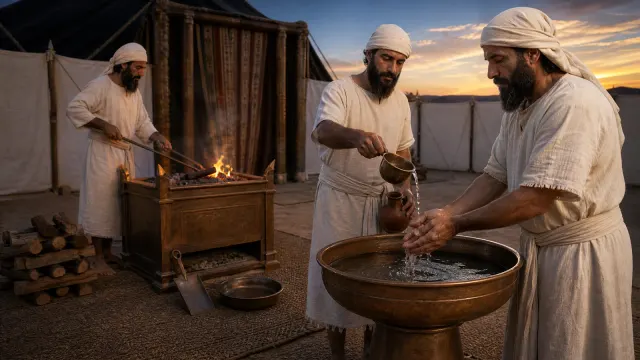
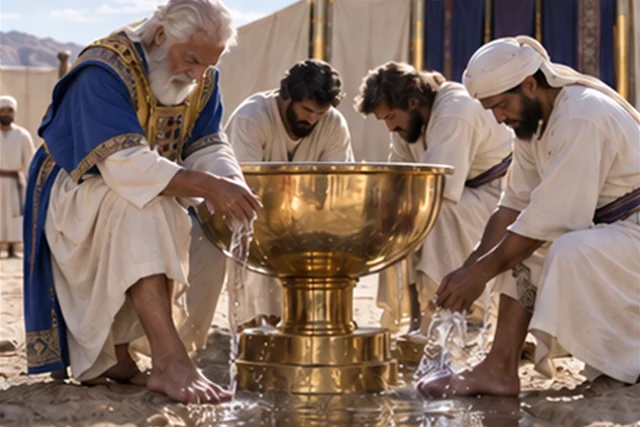
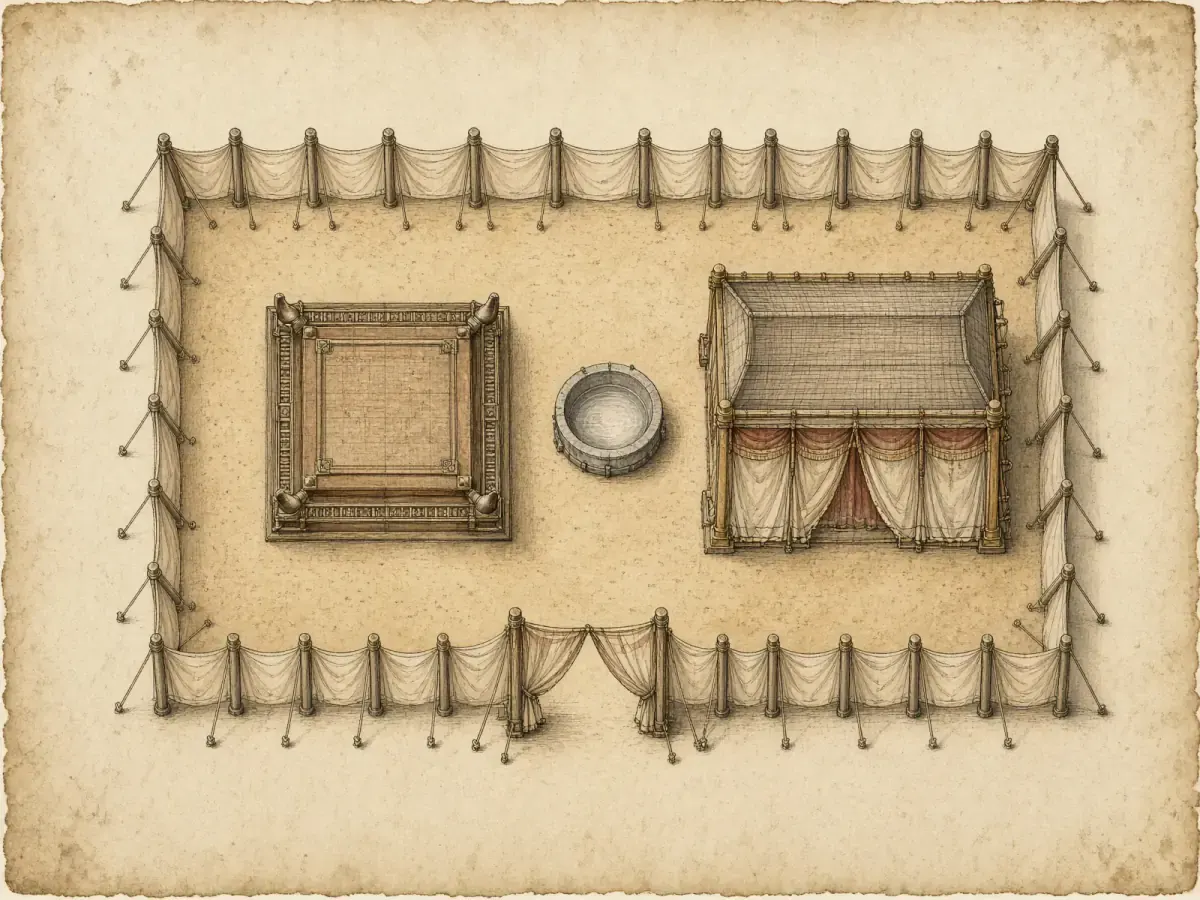
A priest can be washed for consecration and still need to wash again. That is the quiet force of the laver. The Book of Exodus places it between the altar and the tent, directly in the route of ministry, and requires Aaron and his sons to wash hands and feet when they enter or approach the altar. Ordination has not produced a class of men who have graduated beyond ordinary commanded preparation. The washing is recurrent because the service is recurrent. Strikingly, the basin receives no dimensions here. In a long architectural sequence packed with measurements, the Book of Exodus is content to give material, location, and purpose without inviting a speculative reconstruction of size or capacity. The repeated warning "that they die not" makes equally clear that the act is not merely workplace hygiene. Nor is the water presented as an independent magical substance. The emphasis remains on commanded washing at a commanded threshold. Priesthood gives access to service, but it does not cancel the conditions attached to approach.
Deep dive
The chapter gives the basin a material, a supporting base, a position, and a purpose, but no dimensions. That omission is worth respecting in a sequence otherwise full of measurements. The function is clear without a reconstructed capacity or an exact shape supplied from imagination.
Washing here is recurrent. The earlier full washing at consecration does not eliminate the priests' obligation to wash hands and feet as they serve. The basin stands where the movement between altar and tent requires attention to it. Repetition is built into the route of ministry.
The warning about death is repeated, making clear that this is not merely a suggestion about keeping a busy workplace tidy. Exodus frames the washing as a condition of approaching holy service. It does not give a medical explanation, nor does it describe the water as a substance with independent magical power. The emphasis falls on the commanded act at the commanded threshold, performed by people whose priestly status does not exempt them.
Words to trace: wash, altar, brass, congregation, feet, hands
Verse-by-verse path
- Exodus 30:17
Another short speech, for the one piece of furniture in the sanctuary made for water. Everything else holds fire, blood, oil, bread or testimony.
- Exodus 30:18
Exodus 38:8 records where the bronze came from: “the lookingglasses of the women assembling” at the door of the tent. Polished bronze mirrors became the basin in which priests washed. The “foot” is its stand, kan.
- Exodus 30:19
Hands and feet only, because these are what touch holy things and holy ground. The priests evidently served barefoot, as Moses stood unshod before the bush in 3:5; the text never mentions priestly sandals.
- Exodus 30:20
Each of the two places of service needs its own washing: going into the tent, and coming near to the altar. Jesus’ saying in John 13:10 has the same shape: “He that is washed needeth not save to wash his feet.”
- Exodus 30:21
Psalm 26:6 turns the washing into a line of prayer: “I will wash mine hands in innocency: so will I compass thine altar, O LORD.” The later Jewish rite of washing the hands before eating traces part of its lineage to this command.
Exodus 30:17-21
King James Version17And the LORD spake unto Moses, saying,
18Thou shalt also make a laver of brass, and his foot also of brass, to wash withal: and thou shalt put it between the tabernacle of the congregation and the altar, and thou shalt put water therein.
19For Aaron and his sons shall wash their hands and their feet thereat:
20When they go into the tabernacle of the congregation, they shall wash with water, that they die not; or when they come near to the altar to minister, to burn offering made by fire unto the LORD:
21So they shall wash their hands and their feet, that they die not: and it shall be a statute for ever to them, even to him and to his seed throughout their generations.
Exodus 30:22-33
The Sanctuary's Oil Is Not a Personal Fragrance
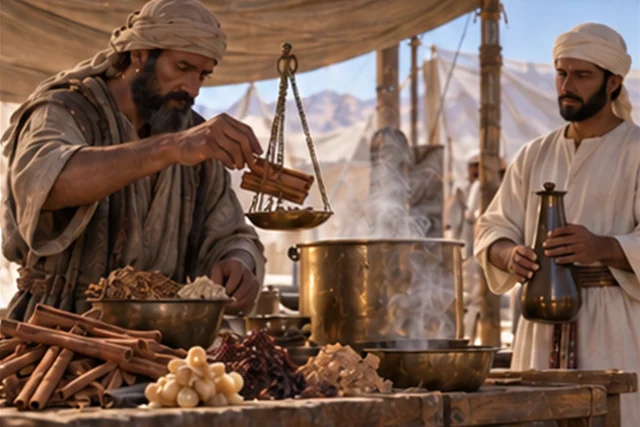
The anointing oil is described with enough precision to be made, and then immediately fenced off from ordinary imitation. Myrrh, cinnamon, calamus, cassia, and olive oil are measured and compounded through the apothecary's skill, then used to set apart the tent, furniture, altars, laver, and priesthood. Knowing the recipe does not make the recipe common property. The Book of Exodus is especially careful with the line about pouring it on human flesh. Aaron and his sons have just been designated recipients of anointing, so the prohibition cannot sensibly cancel the commanded act. It distinguishes authorized consecration from personal or unauthorized use. The same logic governs copying the formula. The oil's holiness is tied to its appointed purpose, not to secrecy about its ingredients or to the expense of the spices. This is a sacred compound with a job. A person may know exactly how it smells and how it is made while still having no permission to turn it into a private fragrance.
Deep dive
The recipe calls for specified spices, quantities, and olive oil, compounded through the apothecary's art. Skill is again part of the commission. The same oil marks the tent, its central furniture, the two altars, the washing basin, and Aaron's household. Their different functions are gathered into a common consecrated service.
The warning that it must not be poured on human flesh has to be read with the explicit instruction to anoint Aaron and his sons. The passage distinguishes authorized consecration from ordinary or unauthorized use; it is not canceling the act it has just commanded. The restriction protects the oil's appointed purpose without excluding the very priests for whom that purpose includes anointing.
The formula is not available for private copying, even though it has been described in detail. The restriction is attached to its holy purpose, not to secrecy about the ingredients. A person can know how a sacred compound is made and still have no authorization to make it for another use. The chapter makes that boundary explicit rather than treating beauty or expense as permission.
Words to trace: holy, shekels, vessels, altar, anoint, anointing
Verse-by-verse path
- Exodus 30:22
“Moreover” opens a fourth speech, and it brings the only two recipes in the Law of Moses: this oil and the incense of verse 34. Both come with a ban on copying them.
- Exodus 30:23
“Pure myrrh” is mor deror, free-flowing myrrh, the resin that seeps from the bark. Five hundred shekels is roughly twelve pounds; Esther’s preparation began with “six months with oil of myrrh” (Esther 2:12). The calamus, qaneh, is a fragrant cane.
- Exodus 30:24
Cassia, qiddah, is a bark related to cinnamon. Some fifteen hundred shekels of spice, well over thirty pounds, go into a hin of oil, about a gallon, and the rabbis debated how so little oil could take up so much; boiling out an extract is one answer.
- Exodus 30:25
The apothecary is a roqeach, a perfumer, from raqach, to mix spices. Ecclesiastes 10:1 uses his work for a proverb: “Dead flies cause the ointment of the apothecary to send forth a stinking savour.”
- Exodus 30:26
The list starts with the tent itself and then the ark, the holiest object, and works outward. Leviticus 8:10 and Numbers 7:1 record Moses anointing the tabernacle and everything in it.
- Exodus 30:27
The utensils are anointed with their furniture. The tongs and snuffdishes of 25:38 receive the same oil as the lampstand they serve, and the plates and bowls the same as the table.
- Exodus 30:28
The oil reaches out into the court, to the bronze altar and the laver, down to the laver’s stand. What stands in the open air is as fully consecrated as what stands behind the veil.
- Exodus 30:29
The Hebrew kol hannoge’a can also be read “whoever touches them must be holy”: a condition of approach rather than holiness passing by contact. Several modern translations prefer that reading here and at 29:37.
- Exodus 30:30
Leviticus 10:7 shows the anointing binding the sons after Nadab and Abihu died: they may not leave the door of the tent to mourn, “for the anointing oil of the LORD is upon you”.
- Exodus 30:31
A rabbinic tradition (Horayot 11b) held that the oil Moses made was never used up and lasted until King Josiah hid it away. The verse says only that it is holy “throughout your generations”.
- Exodus 30:32
“Man’s flesh” is adam, ordinary people. Kings were later anointed with oil, as Samuel anointed Saul from a vial (1 Samuel 10:1), but nothing says it was this compound; the prohibition is on copying the recipe and on common use.
- Exodus 30:33
“Cut off from his people” is the penalty called karet. It first appears in Genesis 17:14 for the uncircumcised, and in 12:15 for eating leaven at Passover. The copying of a perfume is placed in the same category.
Exodus 30:22-33
King James Version22Moreover the LORD spake unto Moses, saying,
23Take thou also unto thee principal spices, of pure myrrh five hundred shekels, and of sweet cinnamon half so much, even two hundred and fifty shekels, and of sweet calamus two hundred and fifty shekels,
24And of cassia five hundred shekels, after the shekel of the sanctuary, and of oil olive an hin:
25And thou shalt make it an oil of holy ointment, an ointment compound after the art of the apothecary: it shall be an holy anointing oil.
26And thou shalt anoint the tabernacle of the congregation therewith, and the ark of the testimony,
27And the table and all his vessels, and the candlestick and his vessels, and the altar of incense,
28And the altar of burnt offering with all his vessels, and the laver and his foot.
29And thou shalt sanctify them, that they may be most holy: whatsoever toucheth them shall be holy.
30And thou shalt anoint Aaron and his sons, and consecrate them, that they may minister unto me in the priest’s office.
31And thou shalt speak unto the children of Israel, saying, This shall be an holy anointing oil unto me throughout your generations.
32Upon man’s flesh shall it not be poured, neither shall ye make any other like it, after the composition of it: it is holy, and it shall be holy unto you.
33Whosoever compoundeth any like it, or whosoever putteth any of it upon a stranger, shall even be cut off from his people.
Exodus 30:34-38
The Fragrance Has an Appointed Destination
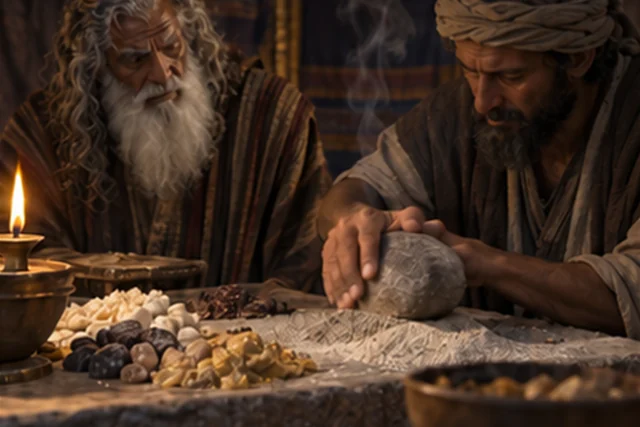
The incense closes the chapter with a boundary narrow enough to reach private pleasure. Named spices and frankincense are compounded in equal weight, ground fine, and placed before the testimony where God has promised to meet Moses. The workmanship is learnable and the fragrance is perceptible, but neither fact makes the finished product available for ordinary enjoyment. The Book of Exodus does not prohibit imitation only for a rival sanctuary or public ceremony. It specifically forbids making the same composition "to smell thereto." That small phrase turns the question of holiness into something as intimate as enjoying a scent for oneself. The restriction is not against beauty. The entire recipe is built around beauty of fragrance. The issue is destination and use. What is made for the holy place remains attached to the holy place. The chapter that began with a specialized altar ends by refusing to let its specialized fragrance drift into private ownership. Sacred purpose reaches all the way to the nose.
Deep dive
The incense combines named ingredients in equal weights and requires careful compounding and fine grinding. Exodus describes preparation that can be learned and performed, while the location before the testimony anchors the finished product to the promised meeting with God. Fragrance belongs to the service of the sanctuary, not merely to its atmosphere.
The final prohibition is unusually precise about intention: the compound must not be copied simply to enjoy its smell. That small sensory detail closes the chapter's larger concern. The temptation need not involve building a rival temple; appropriating the sanctuary's fragrance for oneself also crosses the stated boundary. The materials are describable and the scent is perceptible, but their appointed use is not therefore common property. The same chapter that identifies the rich and poor by an equal ransom ends by refusing private ownership of a holy pleasure.
Words to trace: holy, LORD, perfume, pure, spices, sweet
Verse-by-verse path
- Exodus 30:34
Stacte, nataf, is a drop of resin; onycha, shecheleth, is probably the shell plate of a sea snail, burned for its scent; galbanum, chelbenah, is a bitter resin. Frankincense, levonah, is named from lavan, white, for its pale colour.
- Exodus 30:35
“Tempered together” is memullach, literally salted. Leviticus 2:13 requires salt with every grain offering, and here even the incense is seasoned with it.
- Exodus 30:36
“Beat some of it very small” is shachaq, to grind to powder, the verb of Psalm 18:42, “Then did I beat them small as the dust before the wind.” The ground portion is laid “before the testimony”, as close to the ark as anything outside the veil.
- Exodus 30:37
In the Second Temple the house of Avtinas kept the method secret. The Mishnah (Yoma 3:11) records them criticised for it, and the Talmud gives their answer: they refused to teach it lest it be used in the worship of idols.
- Exodus 30:38
Later Jewish tradition (Keritot 6a) lists eleven ingredients in the temple incense, expanding the four named here. The verse names only one forbidden motive for copying it: to enjoy the scent for oneself.
Exodus 30:34-38
King James Version34And the LORD said unto Moses, Take unto thee sweet spices, stacte, and onycha, and galbanum; these sweet spices with pure frankincense: of each shall there be a like weight:
35And thou shalt make it a perfume, a confection after the art of the apothecary, tempered together, pure and holy:
36And thou shalt beat some of it very small, and put of it before the testimony in the tabernacle of the congregation, where I will meet with thee: it shall be unto you most holy.
37And as for the perfume which thou shalt make, ye shall not make to yourselves according to the composition thereof: it shall be unto thee holy for the LORD.
38Whosoever shall make like unto that, to smell thereto, shall even be cut off from his people.
Questions to keep in mind while reading
- Identify the people addressed and the covenant setting.
- Distinguish rescue, worship, holiness, justice, and community responsibility.
- Read commands in their literary and covenant context before making a modern application.
Text first
Where readers differ
The chapter summary begins with what the passage says and how its parts fit together. It does not assume one denomination has already settled every question. Where a conclusion depends on a tradition, literary theory, or historical reconstruction, that dependence is named openly.
The KJV text is presented first. Interpretive conclusions are labeled, and differences are introduced only when they help a reader understand why serious communities do not always reach the same answer.
Comparative interpretive notes for this chapter are in preparation. Until reviewed notes are ready, this page separates the KJV text from summary and application without claiming that serious readers agree on every question.
Questions beneath the surface
- What account of God, human freedom, responsibility, and the good life emerges from Exodus 30?
- Which tension does the chapter refuse to resolve quickly?
- What changes when the chapter is read as part of the whole canon rather than as an isolated moral lesson?
- Where might a sincere reader confuse a familiar tradition with something the text states directly?
Questions for serious personal contemplation
These open-ended questions make room for tension, honest response, prayer, and conclusions that remain accountable to the chapter.
Observe without rushing
What part of Exodus 30 makes you stop, feel unsettled, or feel surprised, and why?
Which detail in the passage would be easiest to overlook? How does that detail change your understanding?
Where do you see tension between what happens and this focus: Exodus 30 develops its own movement around LORD, holy, offering, incense, shekel?
What important question does the passage leave open instead of resolving quickly?
Examine your inner life honestly
Which person, response, fear, or desire in the passage feels most like your own life right now?
What assumption about God, other people, or yourself does this text challenge?
Which part would you rather soften, avoid, or explain away too quickly? What might that reaction reveal?
If this Scripture could ask you one direct question, what do you think it would ask?
Respond with wisdom and courage
What do you need to remember, confess, grieve, thank God for, or trust after reading this passage?
How might another faithful person read this situation differently without ignoring the text?
What obedient response would be costly, uncomfortable, or slow, yet still faithful to Scripture?
What question will you carry into prayer this week, and which verses will you keep in front of you?
Music and video connected to the passage
Related media appears when its Scripture reference overlaps this study. Music and video can illuminate a theme while the biblical text remains the foundation.