The big picture
Returning to the land means facing Esau. Jacob arranges gifts and divides his company, then prays by recalling God's promise. Alone at night, he wrestles with a mysterious opponent and receives a new name along with a lasting wound.
In this chapter
- Preparing to Meet Esau Genesis 32:1-12
Angels meet Jacob, yet news that Esau approaches with four hundred men leaves him afraid.
- Gifts Sent Ahead Genesis 32:13-21
Jacob sends successive groups of animals with carefully repeated messages.
- A Blessing and a Limp Genesis 32:22-32
After sending his household across the Jabbok, Jacob wrestles until daybreak.

Scripture beside the summary
Genesis · King James Version · 32Genesis 32:1-12
Preparing to Meet Esau
Angels meet Jacob, yet news that Esau approaches with four hundred men leaves him afraid. He divides the camp and prays, confessing unworthiness and asking for deliverance. The prayer places his fear inside the promise of return and abundant descendants.
Deep dive
The chapter opens with a meeting Jacob does not arrange. Angels of God encounter him, and he names the place Mahanaim. That disclosure of God's host stands immediately beside his anxious approach to Esau. The sight of divine company is not followed by a claim that Jacob feels no fear. Genesis records both the encounter and his distress.
His message carefully lowers his own status: Esau is "my lord," Jacob his servant. That language runs against the supremacy pronounced in Isaac's blessing, but its immediate purpose is explicit. Jacob seeks favour. He describes his wealth and long residence with Laban without beginning a fresh argument about the birthright.
The report of four hundred men gives Jacob a number but no statement of Esau's intention. He prepares for an attack; Genesis has not yet said Esau plans one. His divided camps are therefore a response to feared possibilities, not proof of the approaching brother's motive. The same distinction will matter when the next chapter records what Esau actually does. For now, survival is being calculated in the severe terms of one company escaping if the other is struck.
The prayer begins by identifying the God of Abraham and Isaac as the LORD who commanded this return. Jacob is not appealing to a vague hope that travel will go well. He brings the present danger into relation with words already spoken to him. The command that brought him onto this road and the promise of good now frame his request for deliverance.
His comparison between one staff and two companies compresses the years away into a visible contrast. The returning man has far more to lose because he has received far more than he carried out. He explicitly disclaims worthiness for the mercies and faithfulness shown to him. The possessions that may provoke others' envy appear here as evidence of dependence.
The fear itself is not disguised. Jacob names his brother, names Esau again, and names the threatened mothers and children. He then recalls the promised multitude of descendants. The prayer sets vulnerability and promise in the same speech without pretending that their tension has already vanished. Its force lies partly in that refusal to speak as though the feared meeting has already ended safely.
Words to trace: Jacob, Esau, brother, company, flocks, lord, father, hand, saidst, Abraham, bands, become
Verse-by-verse path
- Genesis 32:1
Angels framed Jacob’s exile at both ends. Leaving the land he saw them on the ladder at Bethel (28:12); returning, they come to meet him. These are the only two places where Jacob sees a company of angels, and between them lie the twenty years with Laban.
- Genesis 32:2
Mahanaim, God’s host or camp, later became a city of Gilead. Saul’s son Ishbosheth was made king there (2 Samuel 2:8), and David fled there from Absalom (2 Samuel 17:24). The place-name outlasted the vision by centuries.
- Genesis 32:3
“Messengers” is malakhim, the same word as the “angels” of verse 1. God’s messengers met Jacob; now Jacob sends his own. Esau is already in Seir, though Genesis describes his move there only in 36:6–8, after this; the order of the account is not strict chronology.
- Genesis 32:4
“My lord” and “thy servant” are what the blessing of 27:29 had reversed: “be lord over thy brethren”. “I have sojourned” is garti; the rabbis noted that its letters add up to 613, the number of the commandments, and read it as Jacob saying he had kept them all while living with Laban.
- Genesis 32:5
Jacob lists oxen, asses, flocks and servants, but not the camels he has, and names no number. The message says he wants nothing, only “grace in thy sight”. Chen, grace or favour, becomes the key word of the meeting in 33:8, 10 and 15.
- Genesis 32:6
Four hundred men is the size of the band David led as an outlaw (1 Samuel 22:2; 25:13). It is a raiding force, not an escort. The messengers bring back a number and no message, and the silence is what frightens Jacob.
- Genesis 32:7
“Afraid” and “distressed” are two verbs, and Rashi read them separately: afraid that he would be killed, distressed that he might have to kill. “Two bands” is machanot, camps, the plural of the word in Mahanaim: after seeing God’s two camps, Jacob makes two of his own.
- Genesis 32:8
“Escape” is peletah, a surviving remnant, the word Joseph will use in 45:7: “to preserve you a posterity... and to save your lives by a great deliverance.” Jacob plans for losing half his household.
- Genesis 32:9
This is the longest prayer in Genesis. Jacob quotes God back to God, but not exactly: in 31:3 God said “I will be with thee”, and Jacob renders it “I will deal well with thee”. He addresses God by the two generations before him, as God named himself at Bethel.
- Genesis 32:10
“I am not worthy of the least” is one Hebrew word, qatonti, “I am small”, too small for all the kindness shown. When he crossed the Jordan going out, he had a staff; he is camped now within a day of the same river with two camps behind him.
- Genesis 32:11
“The mother with the children” is literally “mother upon children”, an idiom for a massacre that spares no one; Hosea 10:14 uses it of a mother “dashed in pieces upon her children”. Jacob names the danger twice, “from the hand of my brother, from the hand of Esau”.
- Genesis 32:12
“I will surely do thee good” doubles the verb. God never promised Jacob seed “as the sand of the sea”; he promised dust (28:14). Sand was the image given to Abraham on Moriah (22:17). Jacob reaches for his grandfather’s promise and claims it as his own.
Genesis 32:1-12
King James Version1And Jacob went on his way, and the angels of God met him.
2And when Jacob saw them, he said, This is God’s host: and he called the name of that place Mahanaim.
3And Jacob sent messengers before him to Esau his brother unto the land of Seir, the country of Edom.
4And he commanded them, saying, Thus shall ye speak unto my lord Esau; Thy servant Jacob saith thus, I have sojourned with Laban, and stayed there until now:
5And I have oxen, and asses, flocks, and menservants, and womenservants: and I have sent to tell my lord, that I may find grace in thy sight.
6And the messengers returned to Jacob, saying, We came to thy brother Esau, and also he cometh to meet thee, and four hundred men with him.
7Then Jacob was greatly afraid and distressed: and he divided the people that was with him, and the flocks, and herds, and the camels, into two bands;
8And said, If Esau come to the one company, and smite it, then the other company which is left shall escape.
9And Jacob said, O God of my father Abraham, and God of my father Isaac, the LORD which saidst unto me, Return unto thy country, and to thy kindred, and I will deal well with thee:
10I am not worthy of the least of all the mercies, and of all the truth, which thou hast shewed unto thy servant; for with my staff I passed over this Jordan; and now I am become two bands.
11Deliver me, I pray thee, from the hand of my brother, from the hand of Esau: for I fear him, lest he will come and smite me, and the mother with the children.
12And thou saidst, I will surely do thee good, and make thy seed as the sand of the sea, which cannot be numbered for multitude.
Genesis 32:13-21
Gifts Sent Ahead
Jacob sends successive groups of animals with carefully repeated messages. He hopes the gifts will appease Esau before they meet. Practical preparation accompanies prayer, but the elaborate arrangement also displays his uncertainty about whether his brother will receive him.

Deep dive
The inventory is large, but the arrangement is as important as the number of animals. Each drove is separated by space and accompanied by the same explanation. Esau is to meet the gifts in succession before he reaches Jacob. The procession turns a single offering into repeated encounters, each announcing that Jacob himself is still behind.
Genesis states Jacob's intention: to appease Esau before seeing his face, in the hope of acceptance. That supplies a motive for the gifts without requiring an elaborate theory about every earlier action. Prayer has been followed by planning, and the book does not interrupt the account to pronounce those activities mutually exclusive.
The language of the face begins gathering force here. Jacob wants to see his brother's face without being destroyed by the meeting. Before that encounter can take place, he will give another location a name associated with seeing God's face and surviving. The planned meeting with Esau supplies the visible horizon; the unplanned meeting during the night will change the man who approaches it.
Words to trace: Esau, present, drove, twenty, behind, brother
Verse-by-verse path
- Genesis 32:13
“A present” is minchah, the word for tribute paid to a king, as Ehud brings “a present” to Eglon of Moab (Judges 3:15), and later for the grain offering. Minchah, present, and machaneh, camp, sound alike, and the next verses play the two words off each other.
- Genesis 32:14
Two hundred she-goats to twenty he-goats, two hundred ewes to twenty rams: ten females to each male, the proportion of a breeding herd. Jacob, the expert stockman, sends a gift built to multiply.
- Genesis 32:15
Milch camels with their colts were the costliest animals in the present, since camel milk fed a household. “Kine” are cows. Counted up, the gift comes to five hundred and fifty head without the colts, a fortune driven toward a brother.
- Genesis 32:16
“A space” is revach, room, breathing space, from the root of Rehoboth, the well of 26:22 where Isaac found room. Every drove goes separately, so Esau has to keep meeting generosity before he meets Jacob.
- Genesis 32:17
Three questions anticipated: whose art thou, whither goest thou, whose are these? The servant is to answer them in reverse order of importance, ending with the one that matters most, where Jacob is.
- Genesis 32:18
“He is behind us” is acharenu. Jacob came out of the womb holding his brother’s heel (25:26), and here he is again behind, sending gifts in front. Whether the Book of Genesis intends the echo is an inference; the placing is plain.
- Genesis 32:19
Every driver is given the same words, so Esau will hear the same sentence three times and more. The message is meant to wear down anger by repetition, each drove another arrival with the same apology.
- Genesis 32:20
“Appease him” is akhapperah panav, literally “I will cover his face”, from kipper, the verb that later means atonement. “Accept of me” is “lift up my face”. The word face, panim, comes four times in this verse, and in the next scene Jacob will see a face he did not expect.
- Genesis 32:21
“Before him” is literally before his face again. The present, minchah, goes over; Jacob stays in the camp, machaneh. He has done all the arranging he can, and the night is not yet over.
Genesis 32:13-21
King James Version13And he lodged there that same night; and took of that which came to his hand a present for Esau his brother;
14Two hundred she goats, and twenty he goats, two hundred ewes, and twenty rams,
15Thirty milch camels with their colts, forty kine, and ten bulls, twenty she asses, and ten foals.
16And he delivered them into the hand of his servants, every drove by themselves; and said unto his servants, Pass over before me, and put a space betwixt drove and drove.
17And he commanded the foremost, saying, When Esau my brother meeteth thee, and asketh thee, saying, Whose art thou? and whither goest thou? and whose are these before thee?
18Then thou shalt say, They be thy servant Jacob’s; it is a present sent unto my lord Esau: and, behold, also he is behind us.
19And so commanded he the second, and the third, and all that followed the droves, saying, On this manner shall ye speak unto Esau, when ye find him.
20And say ye moreover, Behold, thy servant Jacob is behind us. For he said, I will appease him with the present that goeth before me, and afterward I will see his face; peradventure he will accept of me.
21So went the present over before him: and himself lodged that night in the company.
Genesis 32:22-32
A Blessing and a Limp
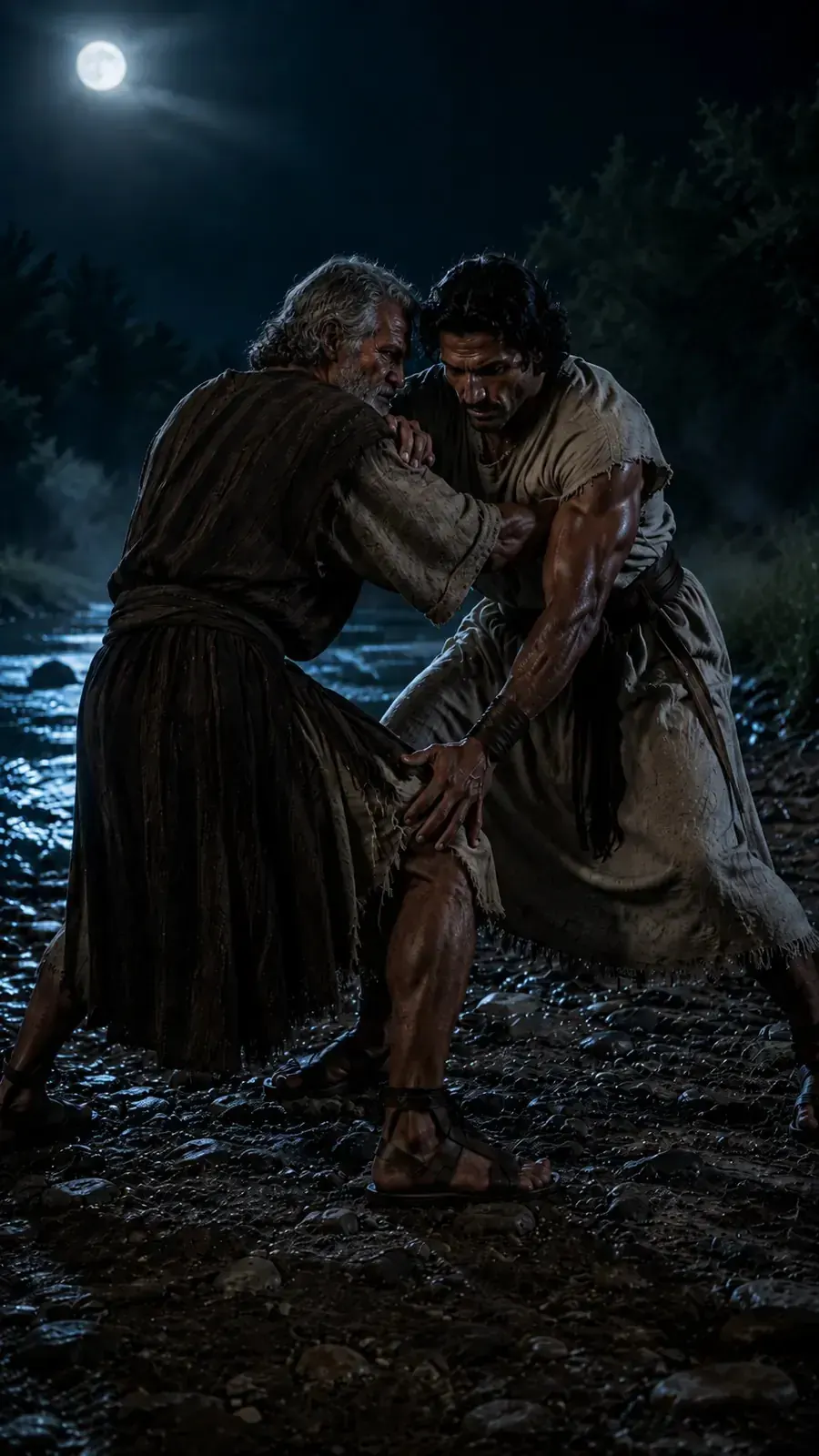
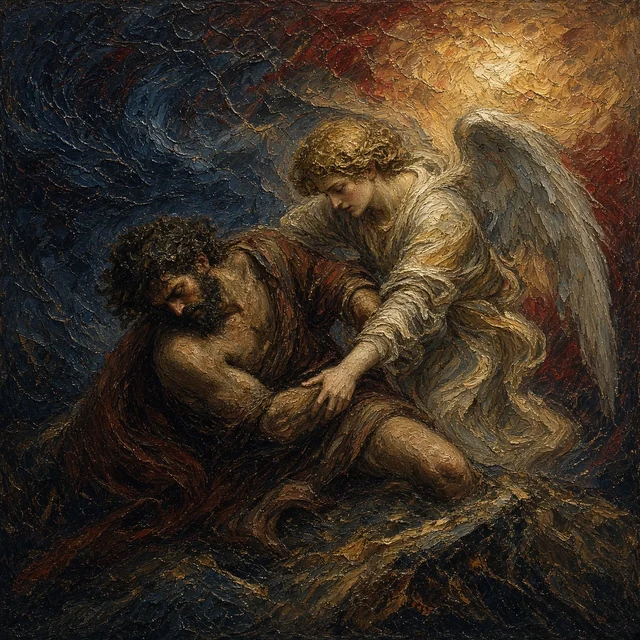
After sending his household across the Jabbok, Jacob wrestles until daybreak. His hip is injured, he persists in seeking a blessing, and he receives the name Israel. He names the place Peniel and leaves limping. The encounter changes his name and bodily condition without making him invulnerable.

Deep dive
The encounter begins without an introduction. A man wrestles with Jacob, and the contest lasts until daybreak. Genesis supplies the bodily struggle and the dislocated joint before explaining the encounter's significance. The touch that injures Jacob makes it impossible to read the outcome as a simple demonstration that he possesses greater physical power than his opponent. The man who is said to prevail is also the man left disabled.
Jacob insists on a blessing, and the answer first requires his name. In Genesis 27, a question about identity was answered with Esau's name. Here the answer is Jacob. The parallel does not require a confession speech that the passage never gives. Its force is in the spoken difference: the blessing now comes to the man under his own identity, which is then renamed Israel.
Genesis explains the new name through striving with God and men and prevailing. Jacob's reciprocal request for the other's name receives no corresponding disclosure. He is blessed without being given every answer. Hosea 12:3–5 later calls the opponent an angel and associates Jacob's prevailing with weeping and supplication. That later reading guards against turning the wrestling into a claim that sheer force has placed God under human control.
Jacob's explanation of Peniel identifies the encounter as seeing God "face to face" and living. Genesis has first called his opponent a man; Hosea calls him an angel. These descriptions have supported different accounts of how the divine appearance should be understood. The text presents a real encounter with God, but does not supply a complete explanation of the form in which that encounter occurs.
The sun rises as Jacob passes Penuel, and the sentence retains his limp. The new name has not made the injury disappear. Blessing, preservation, and bodily damage belong to the same departure from the night. A reading that stops at victory loses the detail Genesis places directly beside the sunrise.
The final verse extends the event into the practice of the children of Israel, who avoid the specified sinew. The nation's name and a remembered bodily restraint are both attached to their ancestor's encounter. The chapter does not end with an abstract account of strength. It ends with a people remembering where their renamed father was touched.
Words to trace: Jacob, name, hollow, prevailed, thigh, took, face, shrank, sinew, children
Verse-by-verse path
- Genesis 32:22
Eleven sons are counted; Benjamin is not yet born, and Dinah is not counted. A midrash says Jacob hid her in a chest so Esau would not see her. The Jabbok, now the Zarqa, runs in a deep gorge into the Jordan, and later marked the border of Ammon (Numbers 21:24).
- Genesis 32:23
The order is puzzling: verse 22 has Jacob crossing, verse 23 has him sending everyone across, and verse 24 finds him alone. He seems to have ferried the household over and come back, so that the river lies between him and all he owns.
- Genesis 32:24
“Wrestled” is yeavek, a verb found only here and in the next verse, perhaps from avaq, dust, grappling in the dust. Its sound joins three names, Yabboq the river, Yaaqov the man, and yeavek the struggle. His opponent is simply “a man”; Hosea 12:4 calls him an angel.
- Genesis 32:25
“The hollow of the thigh” is the hip socket. A touch, naga, is enough to put it out, which says something about who the opponent is. The thigh, yarekh, is the same part under which oaths were sworn (24:2 and 47:29).
- Genesis 32:26
“For the day breaketh” is given as the reason he must go, and it is never explained. The Talmud supposed it was the angels’ hour to sing before God at dawn. Jacob, who left his father’s tent with a stolen blessing, will not let go of this one without a blessing given.
- Genesis 32:27
At his father’s bedside Jacob’s answer to “Art thou my very son Esau?” was one word, ani, “I” (27:24). Here too the answer is a single word, but it is his own name, Yaaqov, the heel-grabber, and nothing more is added to it.
- Genesis 32:28
The King James takes the name from sar, prince: “as a prince hast thou power”. The verb is sarah, to strive, and the name itself, Yisrael, most naturally means “God strives” or “may God prevail”, with God as the subject. The name is given again at Bethel in 35:10.
- Genesis 32:29
“Wherefore is it that thou dost ask after my name?” is the question the angel puts to Manoah in Judges 13:18, “Why askest thou thus after my name, seeing it is secret?” The blessing is given, and the name is withheld.
- Genesis 32:30
Peniel means face of God. “No man shall see me, and live” (Exodus 33:20) states the fear behind Jacob’s relief; Gideon voices the same fear in Judges 6:22–23. “My life is preserved” is natsal, the verb of his prayer in verse 11, “deliver me”, answered from an unexpected quarter.
- Genesis 32:31
Peniel and Penuel are two spellings of one name; Penuel became a town Gideon later broke down (Judges 8:17). When Jacob left the land, he stopped “because the sun was set” (28:11). Now the sun rises on him as he returns. “Halted” is 1611 English for limped.
- Genesis 32:32
The sinew that shrank, gid ha-nasheh, is usually identified with the sciatic nerve, and Jewish practice still removes it from meat (Mishnah Chullin 7). No command is given here: Genesis records a custom and explains it by an event, the only food practice in the book traced to something that happened to a patriarch.
Genesis 32:22-32
King James Version22And he rose up that night, and took his two wives, and his two womenservants, and his eleven sons, and passed over the ford Jabbok.
23And he took them, and sent them over the brook, and sent over that he had.
24And Jacob was left alone; and there wrestled a man with him until the breaking of the day.
25And when he saw that he prevailed not against him, he touched the hollow of his thigh; and the hollow of Jacob’s thigh was out of joint, as he wrestled with him.
26And he said, Let me go, for the day breaketh. And he said, I will not let thee go, except thou bless me.
27And he said unto him, What is thy name? And he said, Jacob.
28And he said, Thy name shall be called no more Jacob, but Israel: for as a prince hast thou power with God and with men, and hast prevailed.
29And Jacob asked him, and said, Tell me, I pray thee, thy name. And he said, Wherefore is it that thou dost ask after my name? And he blessed him there.
30And Jacob called the name of the place Peniel: for I have seen God face to face, and my life is preserved.
31And as he passed over Penuel the sun rose upon him, and he halted upon his thigh.
32Therefore the children of Israel eat not of the sinew which shrank, which is upon the hollow of the thigh, unto this day: because he touched the hollow of Jacob’s thigh in the sinew that shrank.
Questions to keep in mind while reading
- Track who acts, who speaks, who is affected, and what changes.
- Notice repeated promises, failures, rescues, and consequences.
- Do not assume the account approves every action that is reported.
Text first
Where readers differ
The chapter summary begins with what the passage says and how its parts fit together. It does not assume one denomination has already settled every question. Where a conclusion depends on a tradition, literary theory, or historical reconstruction, that dependence is named openly.
The KJV text is presented first. Interpretive conclusions are labeled, and differences are introduced only when they help a reader understand why serious communities do not always reach the same answer.
The opponent is initially called a man; Jacob speaks of seeing God, and Hosea later refers to an angel. Preserve the textual complexity instead of supplying an unsupported physical portrait of God.
Questions beneath the surface
- What account of God, human freedom, responsibility, and the good life emerges from Genesis 32?
- Which tension does the chapter refuse to resolve quickly, especially around prayer, identity, reconciliation?
- What changes when the chapter is read as part of the whole canon rather than as an isolated moral lesson?
- Where might a sincere reader confuse a familiar tradition with something the text states directly?
Questions for serious personal contemplation
These open-ended questions make room for tension, honest response, prayer, and conclusions that remain accountable to the chapter.
Observe without rushing
What part of Genesis 32 makes you stop, feel unsettled, or feel surprised, and why?
Which detail in the passage would be easiest to overlook? How does that detail change your understanding?
Where do you see tension between what happens and this focus: Fear, prayer and the name Israel?
What important question does the passage leave open instead of resolving quickly?
Examine your inner life honestly
Which person, response, fear, or desire in the passage feels most like your own life right now?
What assumption about God, other people, or yourself does this text challenge?
Which part would you rather soften, avoid, or explain away too quickly? What might that reaction reveal?
If this Scripture could ask you one direct question, what do you think it would ask?
Respond with wisdom and courage
What do you need to remember, confess, grieve, thank God for, or trust after reading this passage?
How might another faithful person read this situation differently without ignoring the text?
What obedient response would be costly, uncomfortable, or slow, yet still faithful to Scripture?
What question will you carry into prayer this week, and which verses will you keep in front of you?
Music and video connected to the passage
Related media appears when its Scripture reference overlaps this study. Music and video can illuminate a theme while the biblical text remains the foundation.