The big picture
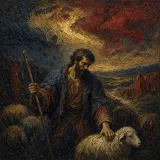
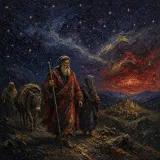
Jacob's prosperity generates hostility, and God tells him to return to his kindred. Rachel and Leah support leaving a household in which they feel exploited. Departure leads to pursuit, accusations and finally a covenant limiting future conflict.
In this chapter
- The Decision to Return Genesis 31:1-21
Jacob recounts changed wages and divine protection to his wives.
- A Search and a Reckoning Genesis 31:22-42
God warns Laban in a dream before he overtakes the family.
- A Covenant of Separation Genesis 31:43-55
A heap and pillar become witnesses to a boundary agreement.


Scripture beside the summary
Genesis · King James Version · 55Genesis 31:1-21
The Decision to Return
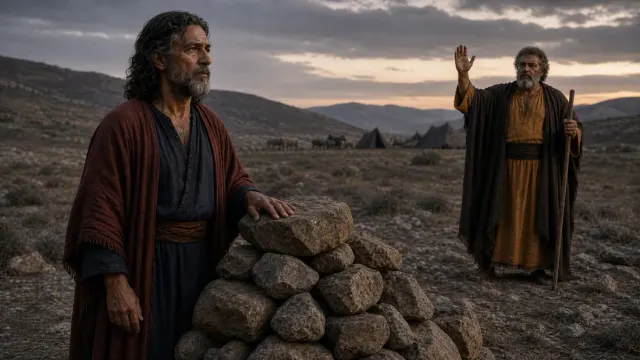
Jacob recounts changed wages and divine protection to his wives. They question how their father has treated them and agree to depart. Jacob leaves without announcing the move, while Rachel takes Laban's household gods. The Book of Genesis reveals her act although Jacob does not know about it.
Deep dive
Laban's sons describe Jacob's wealth as their father's property transferred away. Jacob sees the same shift in Laban's face. The command to return comes into an already altered relationship, but it does not originate merely in Jacob's reading of the household mood: the LORD speaks directly and renews the promise of presence.
Jacob calls Rachel and Leah into the field, where his account of the dispute centres on service, altered wages, and divine protection. He describes the breeding results in relation to Laban's changes of terms. His reported dream supplies the explanation absent from the detailed account of rods in chapter 30: God has seen Laban's treatment of him. The command is also linked to Bethel, the pillar, and the vow. Returning is part of an unfinished promise, not simply a search for a better employer.
Rachel and Leah, so often divided in the preceding chapters, give a joint answer. They describe themselves as treated like strangers and their marriage arrangements as a sale whose proceeds their father has consumed. The daughters whom Laban later claims were carried off unwillingly have already stated their agreement to leave. Their own speech must remain in view when his complaint arrives.
Genesis places two concealed actions beside one another. Rachel steals the images, while Jacob steals away without telling Laban. These are not identical acts, but the repeated language makes secrecy part of the departure on more than one level. The account identifies Rachel as the thief before Jacob's later denial puts him at a dangerous disadvantage.
The reason for taking the images is not supplied. Claims that they function here as inheritance documents, that Rachel wants to reform her father's worship, or that her motive is simply revenge go beyond what this passage establishes. Their possession matters to Laban, and their presence will imperil someone Jacob does not suspect.
Laban hears after three days and pursues with his relatives. Before the meeting, however, God warns him in a dream against speaking to Jacob "either good or bad." The encounter is therefore constrained before Jacob knows what has happened. The returning household is neither entirely innocent in every action nor left unprotected. Divine protection and Rachel's undisclosed theft are facts Genesis places in the same sequence.
Words to trace: cattle, father, Jacob, father’s, ringstraked, speckled, fled, gotten, Laban, rose
Verse-by-verse path
- Genesis 31:1
“Glory” is kavod, which at root means weight or heaviness; wealth is the weight a man carries. The same word will name the glory of the LORD filling the tabernacle (Exodus 40:34). Laban’s sons count Jacob’s success as a sum taken from their inheritance.
- Genesis 31:2
“As before” is the Hebrew idiom kitmol shilshom, “as yesterday and the day before”. Laban’s face has changed, and the change is described in the language of daily routine: the look that used to greet Jacob each morning has gone.
- Genesis 31:3
This is the first time God is recorded speaking to Jacob since Bethel, twenty years earlier. “I will be with thee” repeats the promise of 28:15 and fixes the destination: the land of his fathers, not merely away from Laban.
- Genesis 31:4
Jacob calls the sisters out to the open field, away from the tents and from anyone of Laban’s house who might overhear. He names Rachel first, though Leah is the elder and the mother of most of his children.
- Genesis 31:5
“The God of my father” is how Jacob still speaks of God here. His vow at Bethel ended “then shall the LORD be my God” (28:21), on the condition of a safe return, and that return has not yet happened; the connection is an inference, but the wording is careful.
- Genesis 31:6
“With all my power” is be-khol kochi, with all my strength. Jacob appeals to what the sisters have watched for themselves: “ye know”. The whole speech rests on their witness, not on his word alone.
- Genesis 31:7
“Ten times” is aseret monim, ten counts, a round number meaning over and over, as in Numbers 14:22 and Job 19:3. “Deceived” is hetel, to trifle with or make a fool of, the verb Samson uses of Delilah’s tricks: “thou hast mocked me” (Judges 16:10).
- Genesis 31:8
In Jacob’s telling there are no peeled rods and no troughs. Whatever Laban named as the wage, the flocks produced it. He gives the sisters the outcome, and in the next verse the cause, and leaves his own method out.
- Genesis 31:9
“Taken away” is natsal, to snatch away or rescue, the verb used when Israel “spoiled the Egyptians” as it left (Exodus 12:36). Some readers see Jacob’s departure from Laban as a first sketch of the exodus: service, unfair wages, flight with wealth, pursuit. The parallel is a reading, but a well-grounded one.
- Genesis 31:10
“Grisled” is beruddim, dappled or flecked, perhaps from barad, hail, as if the coat were spotted with hailstones. Zechariah 6:3 uses the word of the “grisled and bay horses” of his vision. This dream belongs to breeding time, possibly years before the command to leave.
- Genesis 31:11
Jacob reports two dreams as one, or one dream in two parts: the rams at breeding time, then the call to leave. An angel of God speaks, and in verse 13 the speaker says “I am the God of Beth-el”, so messenger and sender are one voice, as on Moriah.
- Genesis 31:12
“Lift up now thine eyes, and see” are the words God used to Abram in 13:14 when he showed him the land: “Lift up now thine eyes, and look.” Here the eyes are lifted to the rams, and what God reports seeing is Laban’s conduct.
- Genesis 31:13
God recalls the details himself: the pillar anointed and the vow vowed. The Greek smooths the title into “the God who appeared to thee in the place of God”; the Hebrew is simply “the God Beth-el”. Jacob is held to a promise he made at twenty years’ distance.
- Genesis 31:14
The verb “answered” is singular and feminine, so the Hebrew grammar has Rachel speaking and Leah joining. “Portion or inheritance” is cheleq ve-nachalah, the pair used of the Levites, who have “no part nor inheritance” among their brothers (Deuteronomy 10:9).
- Genesis 31:15
“Strangers” is nokhriyyot, foreign women, the word Ruth uses of herself in Ruth 2:10. “Sold us” means the fourteen years of labour were a bride-price, and custom would return part of it to the brides; “devoured our money” says Laban kept it all.
- Genesis 31:16
The sisters use Jacob’s word, natsal, “taken”, and claim the wealth as their children’s due. It is the only time in Genesis they speak with one voice, and the last thing they say is an instruction to their husband: whatever God has said, do it.
- Genesis 31:17
Rashi noted the order: Jacob sets his sons on the camels first, then his wives, while Esau in 36:6 takes “his wives, and his sons”. He read Jacob as putting the children first. The camels of 30:43 are now loaded for the road.
- Genesis 31:18
The Hebrew piles up words for property, goods he had gotten, cattle of his getting, which he had gotten, like a legal inventory: Jacob takes only what he earned. The destination is “Isaac his father”. His mother is not mentioned, and Genesis never records that he saw her again.
- Genesis 31:19
Sheep-shearing was a working festival with feasting that kept a man away from home, as with Nabal in 1 Samuel 25 and Absalom’s feast in 2 Samuel 13:23. The images are teraphim, household gods. Michal’s teraphim in 1 Samuel 19:13 were large enough to pass for David in bed; these are small enough for a saddle.
- Genesis 31:20
“Stole away unawares to Laban” is literally “stole the heart of Laban”, the heart being the mind: Jacob kept him in the dark. Some scholars hear a pun in “the Syrian”, arammi, and rimmah, to deceive, the word of 29:25. The man who asked Laban “wherefore then hast thou beguiled me?” now keeps Laban in the dark.
- Genesis 31:21
“The river” is the Euphrates. Joshua 24:3 recalls that God took Abraham “from the other side of the flood”, the same river, and some connect the word “Hebrew”, ivri, with ever, the other side. Jacob crosses back over the line his grandfather crossed.
Genesis 31:1-21
King James Version1And he heard the words of Laban’s sons, saying, Jacob hath taken away all that was our father’s; and of that which was our father’s hath he gotten all this glory.
2And Jacob beheld the countenance of Laban, and, behold, it was not toward him as before.
3And the LORD said unto Jacob, Return unto the land of thy fathers, and to thy kindred; and I will be with thee.
4And Jacob sent and called Rachel and Leah to the field unto his flock,
5And said unto them, I see your father’s countenance, that it is not toward me as before; but the God of my father hath been with me.
6And ye know that with all my power I have served your father.
7And your father hath deceived me, and changed my wages ten times; but God suffered him not to hurt me.
8If he said thus, The speckled shall be thy wages; then all the cattle bare speckled: and if he said thus, The ringstraked shall be thy hire; then bare all the cattle ringstraked.
9Thus God hath taken away the cattle of your father, and given them to me.
10And it came to pass at the time that the cattle conceived, that I lifted up mine eyes, and saw in a dream, and, behold, the rams which leaped upon the cattle were ringstraked, speckled, and grisled.
11And the angel of God spake unto me in a dream, saying, Jacob: And I said, Here am I.
12And he said, Lift up now thine eyes, and see, all the rams which leap upon the cattle are ringstraked, speckled, and grisled: for I have seen all that Laban doeth unto thee.
13I am the God of Beth-el, where thou anointedst the pillar, and where thou vowedst a vow unto me: now arise, get thee out from this land, and return unto the land of thy kindred.
14And Rachel and Leah answered and said unto him, Is there yet any portion or inheritance for us in our father’s house?
15Are we not counted of him strangers? for he hath sold us, and hath quite devoured also our money.
16For all the riches which God hath taken from our father, that is ours, and our children’s: now then, whatsoever God hath said unto thee, do.
17Then Jacob rose up, and set his sons and his wives upon camels;
18And he carried away all his cattle, and all his goods which he had gotten, the cattle of his getting, which he had gotten in Padan-aram, for to go to Isaac his father in the land of Canaan.
19And Laban went to shear his sheep: and Rachel had stolen the images that were her father’s.
20And Jacob stole away unawares to Laban the Syrian, in that he told him not that he fled.
21So he fled with all that he had; and he rose up, and passed over the river, and set his face toward the mount Gilead.
Genesis 31:22-42
A Search and a Reckoning
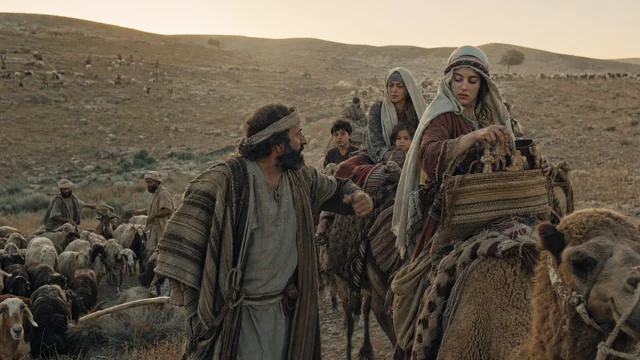
God warns Laban in a dream before he overtakes the family. Laban accuses Jacob of theft and searches for the gods, but Rachel conceals them. Jacob then describes twenty years of difficult service, losses borne and altered wages. Neither side is reduced to a perfectly innocent participant.
Deep dive
Genesis places two concealed actions beside one another. Rachel steals the images, while Jacob steals away without telling Laban. These are not identical acts, but the repeated language makes secrecy part of the departure on more than one level. The account identifies Rachel as the thief before Jacob's later denial puts him at a dangerous disadvantage.
The reason for taking the images is not supplied. Claims that they function here as inheritance documents, that Rachel wants to reform her father's worship, or that her motive is simply revenge go beyond what this passage establishes. Their possession matters to Laban, and their presence will imperil someone Jacob does not suspect.
Laban hears after three days and pursues with his relatives. Before the meeting, however, God warns him in a dream against speaking to Jacob "either good or bad." The encounter is therefore constrained before Jacob knows what has happened. The returning household is neither entirely innocent in every action nor left unprotected. Divine protection and Rachel's undisclosed theft are facts Genesis places in the same sequence.
Laban imagines the farewell he would have provided: music, rejoicing, and kisses. He also announces that he has power to harm Jacob, immediately acknowledging that God's warning has restrained him. The pleasant departure he describes sits beside both the present threat and his daughters' earlier complaint. Genesis gives enough competing testimony to keep his speech from becoming the account's unquestioned verdict.
Jacob answers the charge about leaving by admitting fear that Laban would take his daughters by force. On the images, however, he speaks without the crucial fact already given to the reader. His declaration that the thief should not live exposes the danger of his certainty. Genesis explicitly says he does not know Rachel stole them. Her later death is not identified by the book as the fulfilment of this declaration.
The search ends beneath Rachel, who sits on the camel's furniture containing the images and explains that the custom of women prevents her rising. The claimed condition is not independently confirmed. Laban searches but cannot find what he calls his gods. The contrast is sharp without further embellishment: the God who spoke in the night has limited Laban's power, while the objects he is hunting remain hidden under his seated daughter.
Jacob calls for the recovered evidence to be set before both groups of relatives. There is none to display. That does not mean no theft occurred, since Genesis has already identified Rachel's action; it means the accusation against Jacob has produced no visible proof. The gap between the reader's knowledge and the men's knowledge remains active even during Jacob's forceful defence.
His account of labour replaces the bare phrase "twenty years" with its contents. He describes protecting the flock, absorbing losses, enduring heat and frost, and losing sleep. Fourteen years went toward the marriages and six toward the cattle. In his telling, service has not been a casual contribution made while enjoying a relative's hospitality. It has consumed the working life of a substantial period.
Jacob then gives God's intervention an evidential place: the warning Laban himself reported confirms that God has seen his affliction and labour. The title "the fear of Isaac" identifies the God whom Isaac reveres; the speech is not saying that Isaac's personal anxiety appeared in Laban's dream. Protection is connected to the divine witness of work that Laban has not adequately acknowledged.
Words to trace: Jacob, Laban, brethren, days, dream, fled, tent, daughters, stolen, years, night
Verse-by-verse path
- Genesis 31:22
The report takes three days to reach Laban at the shearing. A household moving with flocks and small children would travel slowly, so the whole of Jacob’s chance lay in those three days.
- Genesis 31:23
Seven days’ journey to Gilead from Haran would mean over three hundred and fifty miles, hard for men riding hard and impossible for flocks in ten days. Some scholars think the numbers are schematic, others that Jacob’s camp lay south of Haran. Laban brings his kinsmen, a party able to fight.
- Genesis 31:24
The Hebrew is “from good to bad”: say nothing at all, neither persuasion nor threat. God speaks to a man outside the covenant line in a dream, as he spoke to Abimelech in 20:3. Laban keeps the command only in part: he talks at length and does nothing.
- Genesis 31:25
“Pitched” is taqa, to drive in the tent pegs. The two camps face each other on the same heights, the verse carefully giving each its tent and each its mountain before a word is spoken.
- Genesis 31:26
Laban accuses Jacob of stealing his heart, the phrase Genesis used of Jacob in verse 20. The verb ganav, steal, runs through the whole chapter, eight times in all. “Captives taken with the sword” is Laban’s version; his daughters gave theirs in verses 14 to 16.
- Genesis 31:27
“Tabret” is the toph, a hand drum, the timbrel Miriam plays at the Red Sea (Exodus 15:20). “Harp” is kinnor, a lyre, the instrument of Jubal in 4:21 and later of David. Laban describes a farewell no one had asked for.
- Genesis 31:28
“My sons” are his grandsons. “Done foolishly” is sakhal, the verb Samuel uses when he tells Saul, “Thou hast done foolishly” (1 Samuel 13:13). Laban turns a flight from him into a breach of manners.
- Genesis 31:29
“It is in the power of my hand” is yesh le-el yadi, literally “there is el to my hand”, using el, strength, a word that also means God. Deuteronomy 28:32 uses the same idiom. Laban boasts of his el and in the same breath admits that the God of Jacob’s father has tied his hands.
- Genesis 31:30
“Sore longedst” doubles the verb, nikhsof nikhsafta, from kasaf, to long for, the root of Psalm 84:2, “My soul longeth”. Laban grants the homesickness, then saves the real charge for last: “my gods”. Genesis calls them teraphim; Laban calls them elohai, my gods.
- Genesis 31:31
Jacob answers only the first charge. “Take by force” is gazal, to rob, the word for seizing what is not yours in Leviticus 19:13. He calls his flight self-defence against robbery, and says nothing yet about the gods.
- Genesis 31:32
“Discern” is hakker, to recognise, a verb that runs through Jacob’s life: Isaac “discerned him not” (27:23), Jacob’s sons will say “know now whether it be thy son’s coat” (37:32), and Tamar says “Discern, I pray thee, whose are these” (38:25). Here the object will not be found.
- Genesis 31:33
Laban searches in order: Jacob’s tent, Leah’s, the two maids’, and then Rachel’s, the favourite last. The Hebrew repeats his going in and out, drawing out the search tent by tent.
- Genesis 31:34
The “camel’s furniture” is kar ha-gamal, a riding saddle, a framed and cushioned seat strapped to the camel. The images must have been small. Laban goes over the whole tent with his hands and never touches the one thing his daughter is sitting on.
- Genesis 31:35
“The custom of women” is her period. Leviticus 15:20 later makes anything a menstruating woman sits on unclean, so the household gods sit under her, unclean, a satire on idols like Isaiah 46:1–2, where idols are a burden on weary beasts. Whether she was telling the truth, Genesis does not say.
- Genesis 31:36
“Chode” is chided, and the Hebrew is riv, a legal dispute, the word the prophets use for God’s lawsuit against his people (Micah 6:2). “Hotly pursued” is dalaq, to burn, to chase in heat. Jacob, who has not answered back in twenty years, answers now.
- Genesis 31:37
Jacob asks for a court on the spot: the stolen goods set out before both families, and the kinsmen to “judge betwixt us”. He is certain there is nothing to find, because he does not know what the reader knows.
- Genesis 31:38
“Cast their young” means miscarried. A shepherd could customarily eat from the flock he tended; Jacob says he did not even take the rams. He begins his case with the number, twenty years, and returns to it in verse 41.
- Genesis 31:39
The later law releases a shepherd from paying for an animal “torn in pieces” if he brings the remains as evidence (Exodus 22:13). Jacob paid anyway. “Torn” is terefah, and in 37:33 Jacob will cry over Joseph’s coat, “Joseph is without doubt rent in pieces”, from the same root.
- Genesis 31:40
Heat by day and frost by night are real in the steppe, where nights can freeze after scorching days. Jeremiah 36:30 pairs the same two words for the exposure of a king’s corpse. “My sleep departed from mine eyes” is a shepherd’s night watch, kept for someone else’s flock.
- Genesis 31:41
The ten changes of wage were first told to the wives in verse 7; now they are said to Laban’s face. Twenty years is set out as a sum: fourteen for two daughters, six for the flock. The verse is Jacob’s ledger.
- Genesis 31:42
“The fear of Isaac”, pachad yitschaq, is a title for God found only here and in verse 53. It may mean the God whom Isaac feared; W. F. Albright proposed “the Kinsman of Isaac” from a related word, and the question is still open. “Rebuked” comes from the same root as “judge” in verse 37: God has already given the verdict.
Genesis 31:22-42
King James Version22And it was told Laban on the third day that Jacob was fled.
23And he took his brethren with him, and pursued after him seven days’ journey; and they overtook him in the mount Gilead.
24And God came to Laban the Syrian in a dream by night, and said unto him, Take heed that thou speak not to Jacob either good or bad.
25Then Laban overtook Jacob. Now Jacob had pitched his tent in the mount: and Laban with his brethren pitched in the mount of Gilead.
26And Laban said to Jacob, What hast thou done, that thou hast stolen away unawares to me, and carried away my daughters, as captives taken with the sword?
27Wherefore didst thou flee away secretly, and steal away from me; and didst not tell me, that I might have sent thee away with mirth, and with songs, with tabret, and with harp?
28And hast not suffered me to kiss my sons and my daughters? thou hast now done foolishly in so doing.
29It is in the power of my hand to do you hurt: but the God of your father spake unto me yesternight, saying, Take thou heed that thou speak not to Jacob either good or bad.
30And now, though thou wouldest needs be gone, because thou sore longedst after thy father’s house, yet wherefore hast thou stolen my gods?
31And Jacob answered and said to Laban, Because I was afraid: for I said, Peradventure thou wouldest take by force thy daughters from me.
32With whomsoever thou findest thy gods, let him not live: before our brethren discern thou what is thine with me, and take it to thee. For Jacob knew not that Rachel had stolen them.
33And Laban went into Jacob’s tent, and into Leah’s tent, and into the two maidservants’ tents; but he found them not. Then went he out of Leah’s tent, and entered into Rachel’s tent.
34Now Rachel had taken the images, and put them in the camel’s furniture, and sat upon them. And Laban searched all the tent, but found them not.
35And she said to her father, Let it not displease my lord that I cannot rise up before thee; for the custom of women is upon me. And he searched, but found not the images.
36And Jacob was wroth, and chode with Laban: and Jacob answered and said to Laban, What is my trespass? what is my sin, that thou hast so hotly pursued after me?
37Whereas thou hast searched all my stuff, what hast thou found of all thy household stuff? set it here before my brethren and thy brethren, that they may judge betwixt us both.
38This twenty years have I been with thee; thy ewes and thy she goats have not cast their young, and the rams of thy flock have I not eaten.
39That which was torn of beasts I brought not unto thee; I bare the loss of it; of my hand didst thou require it, whether stolen by day, or stolen by night.
40Thus I was; in the day the drought consumed me, and the frost by night; and my sleep departed from mine eyes.
41Thus have I been twenty years in thy house; I served thee fourteen years for thy two daughters, and six years for thy cattle: and thou hast changed my wages ten times.
42Except the God of my father, the God of Abraham, and the fear of Isaac, had been with me, surely thou hadst sent me away now empty. God hath seen mine affliction and the labour of my hands, and rebuked thee yesternight.
Genesis 31:43-55
A Covenant of Separation
A heap and pillar become witnesses to a boundary agreement. Laban invokes divine oversight because the households will no longer watch one another directly. A meal and departure close the conflict. Peace here takes the form of defined limits rather than restored intimacy.

Deep dive
Laban's answer begins with a repeated claim of possession: daughters, children, cattle, everything in sight. It is a sweeping response to a speech about years of earned wages. Yet he moves from the claim to the practical concession that a covenant must now define the relationship. The family will leave, and his continuing authority cannot simply be assumed.
The heap receives two names, one from each man, before being identified as a witness. Their distinct names stand beside an agreed function. Laban's appeal that the LORD watch between them is not merely a tender farewell to an intimate friend. He immediately names the conduct he wants witnessed: mistreatment of his daughters or the taking of additional wives when no human observer is present.
The daughters' welfare matters in the terms, even though Laban's own treatment of them has been challenged earlier. The covenant preserves that tension rather than solving it by making him wholly protective or wholly indifferent. God's witness is invoked precisely where their continuing family relationship no longer supplies trust.
The heap and pillar are not simply monuments to a pleasant reunion. They mark a prohibition on crossing toward the other party "for harm." That qualification matters: the agreement addresses hostile approach rather than declaring that relatives can never travel across the location. What has just happened in Laban's pursuit is not to become the normal shape of their future dealings.
Laban invokes the God of Abraham and Nahor, while Jacob's oath is specifically by the fear of Isaac. Genesis retains their different formulations rather than smoothing the speeches into identical language. Jacob then offers sacrifice and a meal. The departure Laban earlier said he had been denied is finally possible: he kisses and blesses his descendants and returns home.
The final movement is not everybody travelling together again. Laban goes to his place, and Jacob will go on his way. The covenant makes a separation possible that continued bargaining had kept postponing.
Words to trace: daughters, Jacob, children, heap, Laban, witness, pillar, betwixt, bread
Verse-by-verse path
- Genesis 31:43
Laban says “my” four times, daughters, children, cattle, everything, and then asks what he can do. He does not mention the gods again. The search failed, and the claim he now makes is of ownership in general rather than of theft in particular.
- Genesis 31:44
“Let us make a covenant” is literally “let us cut”, karat, the verb that remembers the animals cut in two in 15:10. Laban proposes the treaty, and the witness he wants is to stand “between me and thee”, as if the two men need something standing in the space between them.
- Genesis 31:45
Jacob answers without a word by setting up a pillar, matsevah, his second, after the one at Bethel (28:18). There he raised a stone after God spoke to him; here he raises one after a man has.
- Genesis 31:46
“His brethren” here must mean the whole party, since Jacob had no kinsmen with him but his sons and servants; Laban’s men are included. The covenant meal is eaten on the heap itself, so the stones are witness to the eating.
- Genesis 31:47
Jegar-sahadutha is Aramaic, heap of witness, and Galeed is Hebrew for the same. These two words are the first Aramaic in the Bible. The two branches of Terah’s family now name one heap in two languages.
- Genesis 31:48
Galeed, gal-ed, is the explanation Genesis gives for the name of the whole region, Gilead, where the pursuit ended. Laban adds “this day”: the witness begins now, and it will outlive them both.
- Genesis 31:49
Mizpah means watchtower, from tsafah, to watch. The same Gilead has a Mizpah where Jephthah lives and makes his terrible vow (Judges 11:29–34). The watch Laban asks of the LORD is a watch set between two parties who will not see each other again.
- Genesis 31:50
Laban’s first term protects his daughters’ standing against further wives, the only stipulation of its kind in Genesis. “No man is with us” means there are no human witnesses to what Jacob will do far away, so God is named as the witness.
- Genesis 31:51
“Which I have cast” claims the heap and the pillar as Laban’s own work, though Jacob set up the pillar (verse 45) and Jacob’s party gathered the stones (verse 46). Laban has the last word on the memorial as on everything else.
- Genesis 31:52
The heap and pillar mark a line that later history kept: Gilead became the disputed ground between Israel and Aram, and Ahab died fighting the Arameans at Ramoth-gilead (1 Kings 22). Genesis states only the private terms: neither passes “for harm”.
- Genesis 31:53
The verb “judge” is plural in the Hebrew, as though Laban were calling on more than one god. “The God of their father”, meaning Terah, is missing from the Greek. Jacob does not swear by Nahor’s god or Terah’s; he swears by the one his father feared.
- Genesis 31:54
“Sacrifice” is zevach, a slaughtered offering eaten by those who offer it, the first time the word appears in the Bible. “Bread” means the whole meal. Enemies who eat together in the evening can part in the morning.
- Genesis 31:55
In printed Hebrew Bibles this verse is 32:1, so every verse of chapter 32 is numbered one higher there than in the King James. It is Laban’s last appearance: the kiss and the blessing he complained of missing in verse 28, and he “returned unto his place”.
Genesis 31:43-55
King James Version43And Laban answered and said unto Jacob, These daughters are my daughters, and these children are my children, and these cattle are my cattle, and all that thou seest is mine: and what can I do this day unto these my daughters, or unto their children which they have born?
44Now therefore come thou, let us make a covenant, I and thou; and let it be for a witness between me and thee.
45And Jacob took a stone, and set it up for a pillar.
46And Jacob said unto his brethren, Gather stones; and they took stones, and made an heap: and they did eat there upon the heap.
47And Laban called it Jegar-sahadutha: but Jacob called it Galeed.
48And Laban said, This heap is a witness between me and thee this day. Therefore was the name of it called Galeed;
49And Mizpah; for he said, The LORD watch between me and thee, when we are absent one from another.
50If thou shalt afflict my daughters, or if thou shalt take other wives beside my daughters, no man is with us; see, God is witness betwixt me and thee.
51And Laban said to Jacob, Behold this heap, and behold this pillar, which I have cast betwixt me and thee;
52This heap be witness, and this pillar be witness, that I will not pass over this heap to thee, and that thou shalt not pass over this heap and this pillar unto me, for harm.
53The God of Abraham, and the God of Nahor, the God of their father, judge betwixt us. And Jacob sware by the fear of his father Isaac.
54Then Jacob offered sacrifice upon the mount, and called his brethren to eat bread: and they did eat bread, and tarried all night in the mount.
55And early in the morning Laban rose up, and kissed his sons and his daughters, and blessed them: and Laban departed, and returned unto his place.
Questions to keep in mind while reading
- Track who acts, who speaks, who is affected, and what changes.
- Notice repeated promises, failures, rescues, and consequences.
- Do not assume the account approves every action that is reported.
Text first
Where readers differ
The chapter summary begins with what the passage says and how its parts fit together. It does not assume one denomination has already settled every question. Where a conclusion depends on a tradition, literary theory, or historical reconstruction, that dependence is named openly.
The KJV text is presented first. Interpretive conclusions are labeled, and differences are introduced only when they help a reader understand why serious communities do not always reach the same answer.
The Mizpah saying in verse 49 belongs to a tense boundary covenant. It is often quoted affectionately, but its immediate context is distrust and accountability.
Questions beneath the surface
- What account of God, human freedom, responsibility, and the good life emerges from Genesis 31?
- Which tension does the chapter refuse to resolve quickly, especially around return, boundaries, integrity?
- What changes when the chapter is read as part of the whole canon rather than as an isolated moral lesson?
- Where might a sincere reader confuse a familiar tradition with something the text states directly?
Questions for serious personal contemplation
These open-ended questions make room for tension, honest response, prayer, and conclusions that remain accountable to the chapter.
Observe without rushing
What part of Genesis 31 makes you stop, feel unsettled, or feel surprised, and why?
Which detail in the passage would be easiest to overlook? How does that detail change your understanding?
Where do you see tension between what happens and this focus: Leaving Laban and drawing a boundary?
What important question does the passage leave open instead of resolving quickly?
Examine your inner life honestly
Which person, response, fear, or desire in the passage feels most like your own life right now?
What assumption about God, other people, or yourself does this text challenge?
Which part would you rather soften, avoid, or explain away too quickly? What might that reaction reveal?
If this Scripture could ask you one direct question, what do you think it would ask?
Respond with wisdom and courage
What do you need to remember, confess, grieve, thank God for, or trust after reading this passage?
How might another faithful person read this situation differently without ignoring the text?
What obedient response would be costly, uncomfortable, or slow, yet still faithful to Scripture?
What question will you carry into prayer this week, and which verses will you keep in front of you?
Music and video connected to the passage
Related media appears when its Scripture reference overlaps this study. Music and video can illuminate a theme while the biblical text remains the foundation.