The big picture
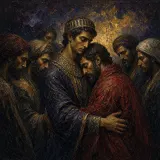
As Jacob nears death, Joseph brings Manasseh and Ephraim. Jacob recalls the promise at Luz, claims the boys within his own family and blesses them. The younger receives precedence despite Joseph's attempt to correct the arrangement.
In this chapter
- Remembering Promise and Loss Genesis 48:1-7
Jacob recounts God's appearance and the promise of fruitfulness and land.
- Hands Deliberately Crossed Genesis 48:8-16
Joseph positions the older Manasseh at Jacob's right, but Jacob crosses his hands.
- The Younger Before the Older Genesis 48:17-22
Joseph objects, but Jacob explains that both will become great while Ephraim will have the greater place.

Scripture beside the summary
Genesis · King James Version · 22Genesis 48:1-7
Remembering Promise and Loss
Jacob recounts God's appearance and the promise of fruitfulness and land. He treats Joseph's two sons as his own, giving them a place alongside Reuben and Simeon. He also remembers Rachel's death, connecting the family's future with a loss that still shapes his memory.
Deep dive
Joseph brings Manasseh and Ephraim to his sick father, and Jacob strengthens himself to sit up. The first matter he raises is not the mechanics of hand placement but the divine promise received at Luz. Fruitfulness, a multitude, and possession of the land establish the setting for what he is about to give. Joseph's sons were born outside Canaan, but that birthplace does not exclude them from the promised inheritance.
Jacob gives the two the standing of Reuben and Simeon within his own family. Joseph's branch will therefore be represented through two named sons rather than only through Joseph's name. Any later children of Joseph are distinguished from this particular grant. The mention of Rachel's death then brings the mother of Joseph back into the room's account of kinship. Jacob remembers where she died and where he buried her. Genesis does not explicitly turn that memory into a legal explanation of every feature of the adoption, but it refuses to let the formal words of inheritance become detached from the people whose deaths and births formed the household.
Words to trace: land, Joseph, Canaan, Egypt, Ephraim, Ephrath
Verse-by-verse path
- Genesis 48:1
This is the first time anyone in the Bible is said to be sick. The Talmud (Bava Metzia 87a) noticed it and said that until Jacob people died without warning, and Jacob asked for illness so he could take leave of his family. Joseph’s sons are named in birth order here, Manasseh first; it is the last time that order holds.
- Genesis 48:2
The bed is the one on which he bowed after Joseph’s oath (47:31), and the one into which he will “gather up his feet” when he dies (49:33). “Strengthened himself” means he gathered what strength he had to sit up for what he meant to say.
- Genesis 48:3
Jacob named that place Bethel twice (28:19; 35:15), yet here he calls it Luz, its old Canaanite name. He is speaking in Egypt of the town as it was when he first came there, a fugitive with a stone for a pillow.
- Genesis 48:4
Jacob quotes God’s words at Bethel (35:11–12) with changes. “A company of nations” becomes “a multitude of people”, and he adds “for an everlasting possession”, the phrase God used to Abraham in 17:8. He recites the promise that will make his next words stand.
- Genesis 48:5
Jacob puts Ephraim first before any hands are crossed. “As Reuben and Simeon” names the two eldest, both passed over in the next chapter. 1 Chronicles 5:1 explains that Reuben’s birthright “was given unto the sons of Joseph”, because he defiled his father’s bed.
- Genesis 48:6
No later children of Joseph are ever recorded; any would have been counted under Ephraim or Manasseh. This is why Israel still reckons twelve tribes when Joseph’s line counts twice and Levi receives no territory.
- Genesis 48:7
Rachel “died by me”, alai, literally “upon me”, the loss falling on him. Rashi read the verse as Jacob’s apology: he asks to be carried to Machpelah but did not carry Joseph’s mother there. “Padan” appears only here without “Aram”.
Genesis 48:1-7
King James Version1And it came to pass after these things, that one told Joseph, Behold, thy father is sick: and he took with him his two sons, Manasseh and Ephraim.
2And one told Jacob, and said, Behold, thy son Joseph cometh unto thee: and Israel strengthened himself, and sat upon the bed.
3And Jacob said unto Joseph, God Almighty appeared unto me at Luz in the land of Canaan, and blessed me,
4And said unto me, Behold, I will make thee fruitful, and multiply thee, and I will make of thee a multitude of people; and will give this land to thy seed after thee for an everlasting possession.
5And now thy two sons, Ephraim and Manasseh, which were born unto thee in the land of Egypt before I came unto thee into Egypt, are mine; as Reuben and Simeon, they shall be mine.
6And thy issue, which thou begettest after them, shall be thine, and shall be called after the name of their brethren in their inheritance.
7And as for me, when I came from Padan, Rachel died by me in the land of Canaan in the way, when yet there was but a little way to come unto Ephrath: and I buried her there in the way of Ephrath; the same is Beth-lehem.
Genesis 48:8-16
Hands Deliberately Crossed
Joseph positions the older Manasseh at Jacob's right, but Jacob crosses his hands. The blessing recalls God as shepherd throughout his life and the angel who redeemed him from evil. Jacob's remembered experience becomes language for the next generation's blessing.
Deep dive
Jacob's question about the sons is followed by the explanation that age has dimmed his sight. Joseph identifies them as God's gift to him "in this place," naming Egypt within the language of blessing rather than treating their origin there as a disqualification. Jacob embraces them and contrasts the present sight with what he once expected: he did not think he would see Joseph's face, and now Joseph's descendants are before him as well. The references to knees occur in this formal family encounter; the seventeen years since Jacob's arrival mean these are not newly born infants.
Joseph carefully places Manasseh toward Jacob's right hand and Ephraim toward his left. Jacob crosses the arrangement "wittingly." The text settles intention before Joseph objects. The blessing then invokes the God before whom Abraham and Isaac walked, the God who has fed Jacob throughout his life, and the Angel who redeemed him from evil. The language gathers guidance, provision, and deliverance into a prayer for the descendants now named within the same family. Being fed all his life does not contradict his earlier description of troubled years. It identifies sustaining care within those years rather than a life from which trouble was absent.
Words to trace: hand, Joseph, Israel, left, right, Abraham
Verse-by-verse path
- Genesis 48:8
Jacob has lived seventeen years in Egypt near these grandsons, so the question may belong to a formal adoption, where the children are identified before they are claimed. His failing sight, stated in verse 10, may also be part of it.
- Genesis 48:9
“Whom God hath given me” recalls Jacob’s own answer to Esau: “The children which God hath graciously given thy servant” (33:5). “In this place” is Egypt, and Joseph names it without complaint.
- Genesis 48:10
Isaac’s eyes were “dim” with kahah, a word for fading (27:1). Jacob’s are kavedu, heavy. The kiss and embrace come before the blessing, and before anything is said about hands.
- Genesis 48:11
“I had not thought” is pillalti, from palal, to judge or reckon, the root of the Hebrew verb to pray. Jacob could not have imagined seeing Joseph’s face; now he has his sons too.
- Genesis 48:12
Taking children “from between his knees” marks the adoption, the knees being where children were received as one’s own: Bilhah bore children “upon my knees” for Rachel (30:3), and Joseph’s great-grandsons are “brought up upon Joseph’s knees” (50:23). Then the viceroy of Egypt bows to the ground before his father.
- Genesis 48:13
Because they face each other, Joseph’s right is his father’s left. Ephraim, held in Joseph’s right hand, stands at Jacob’s left; Manasseh, in Joseph’s left, at Jacob’s right. The firstborn is set squarely under the hand of honour, and the verse records every hand.
- Genesis 48:14
“Guiding his hands wittingly” translates sikkel et-yadav. The verb elsewhere means to act wisely, hence the KJV; others, comparing an Arabic word, render it “crossed his hands”. Both senses fit: the crossing is deliberate. The right hand was the hand of honour.
- Genesis 48:15
“Fed me” is ro’eh, “shepherded me”. It is the first time God is called a shepherd in the Bible, and it comes from a man who kept sheep all his life. In the next chapter he calls God “the shepherd, the stone of Israel” (49:24).
- Genesis 48:16
“Redeemed” is ga’al, its first use in the Bible: the act of a kinsman who buys back a relative’s land or freedom, as Boaz does in Ruth 4. “Grow into a multitude” is vayidgu, from dag, fish: let them teem like fish.
Genesis 48:8-16
King James Version8And Israel beheld Joseph’s sons, and said, Who are these?
9And Joseph said unto his father, They are my sons, whom God hath given me in this place. And he said, Bring them, I pray thee, unto me, and I will bless them.
10Now the eyes of Israel were dim for age, so that he could not see. And he brought them near unto him; and he kissed them, and embraced them.
11And Israel said unto Joseph, I had not thought to see thy face: and, lo, God hath shewed me also thy seed.
12And Joseph brought them out from between his knees, and he bowed himself with his face to the earth.
13And Joseph took them both, Ephraim in his right hand toward Israel’s left hand, and Manasseh in his left hand toward Israel’s right hand, and brought them near unto him.
14And Israel stretched out his right hand, and laid it upon Ephraim’s head, who was the younger, and his left hand upon Manasseh’s head, guiding his hands wittingly; for Manasseh was the firstborn.
15And he blessed Joseph, and said, God, before whom my fathers Abraham and Isaac did walk, the God which fed me all my life long unto this day,
16The Angel which redeemed me from all evil, bless the lads; and let my name be named on them, and the name of my fathers Abraham and Isaac; and let them grow into a multitude in the midst of the earth.
Genesis 48:17-22
The Younger Before the Older
Joseph objects, but Jacob explains that both will become great while Ephraim will have the greater place. He also speaks of return to the ancestral land. The recurring Genesis reversal of expected seniority continues into the tribal future.
Deep dive
Joseph is displeased because the right hand is resting on the younger son. His attempt to move it assumes that the physical arrangement needs correction. Jacob's reply repeats his knowledge: "I know it, my son, I know it." Failing eyesight has not produced a mistaken identification. The scene resembles Isaac's blessing in Genesis 27 closely enough for the difference to matter. There an older father was misled about which son stood before him. Here the older father knows the birth order and deliberately gives precedence otherwise.
Manasseh is not dismissed or cursed. He will become a people and be great, but Ephraim's future will exceed his. Jacob then gives a form of blessing in which Ephraim's name precedes Manasseh's, making the crossed hands audible in the order of the names. Hebrews 11:21 specifically remembers Jacob's blessing of Joseph's sons as an act of faith. The later reference treats the scene as more than an elderly man's family preference: the blessing concerns a future Jacob will not remain alive to supervise.
Jacob puts his death and God's continuing presence in direct contrast. He will die; God will be with the family and bring it back. The future does not rest on the father living long enough to accompany every stage of it. That is why an inheritance outside their present country can be spoken of while the household is settled in Egypt. The grant looks beyond the place in which the speaker and his hearers currently have security.
The additional "portion" is the Hebrew shechem, a word for a shoulder or ridge that also plays on the place-name Shechem. The claim to have taken it with sword and bow is difficult to connect with an event already narrated. Genesis 33 records a purchase there, while chapter 34 attributes the attack to Simeon and Levi. Readings include an otherwise unrecorded acquisition and speech anticipating possession by Jacob's descendants. Genesis does not supply enough detail to settle the connection. Joshua 24:32 later locates Joseph's burial at Shechem in the parcel Jacob bought, giving a concrete later association without explaining away the disputed military wording.
Words to trace: father, head, Ephraim, hand, become, Joseph, Amorite, brethren, fathers, Israel
Verse-by-verse path
- Genesis 48:17
“It displeased him” is literally “it was evil in his eyes”. “He held up” is tamak, to grasp and support, the verb used when Aaron and Hur “stayed up” Moses’ hands (Exodus 17:12). Joseph takes hold of his father’s hand to move it.
- Genesis 48:18
“Not so, my father” is the only time Joseph contradicts Jacob. In 37:10 the father rebuked the son for a dream about rank; now the son tries to correct the father about rank.
- Genesis 48:19
In the wilderness census Manasseh numbered 52,700 and Ephraim 32,500 (Numbers 26:34, 37), so the younger’s greatness was not a matter of early numbers. By Moses’ blessing it was: “the ten thousands of Ephraim, and they are the thousands of Manasseh” (Deuteronomy 33:17).
- Genesis 48:20
Jewish fathers still bless their sons on the eve of the Sabbath with these words: “God make thee as Ephraim and as Manasseh.” The blessing Jacob gives becomes the blessing Israel says. Genesis adds that he set the younger first, even in the formula.
- Genesis 48:21
“Behold, I die” is hinneh anokhi met. Joseph will say the same to his brothers at the end of the book, “I die: and God will surely visit you” (50:24). The promise of return is passed from one dying man to the next.
- Genesis 48:22
“Portion” is shekhem, a shoulder or ridge of land, and the same word as the city of Shechem. Joseph’s bones were later buried at Shechem, in the ground Jacob bought (Joshua 24:32), and John 4:5 names “the parcel of ground that Jacob gave to his son Joseph”.
Genesis 48:17-22
King James Version17And when Joseph saw that his father laid his right hand upon the head of Ephraim, it displeased him: and he held up his father’s hand, to remove it from Ephraim’s head unto Manasseh’s head.
18And Joseph said unto his father, Not so, my father: for this is the firstborn; put thy right hand upon his head.
19And his father refused, and said, I know it, my son, I know it: he also shall become a people, and he also shall be great: but truly his younger brother shall be greater than he, and his seed shall become a multitude of nations.
20And he blessed them that day, saying, In thee shall Israel bless, saying, God make thee as Ephraim and as Manasseh: and he set Ephraim before Manasseh.
21And Israel said unto Joseph, Behold, I die: but God shall be with you, and bring you again unto the land of your fathers.
22Moreover I have given to thee one portion above thy brethren, which I took out of the hand of the Amorite with my sword and with my bow.
Questions to keep in mind while reading
- Track who acts, who speaks, who is affected, and what changes.
- Notice repeated promises, failures, rescues, and consequences.
- Do not assume the account approves every action that is reported.
Text first
Where readers differ
The chapter summary begins with what the passage says and how its parts fit together. It does not assume one denomination has already settled every question. Where a conclusion depends on a tradition, literary theory, or historical reconstruction, that dependence is named openly.
The KJV text is presented first. Interpretive conclusions are labeled, and differences are introduced only when they help a reader understand why serious communities do not always reach the same answer.
Jacob's adoption of Joseph's sons explains family and inheritance relationships in the narrative. It is not a declaration that younger siblings are always spiritually superior.
Questions beneath the surface
- What account of God, human freedom, responsibility, and the good life emerges from Genesis 48?
- Which tension does the chapter refuse to resolve quickly, especially around blessing, inheritance, hope?
- What changes when the chapter is read as part of the whole canon rather than as an isolated moral lesson?
- Where might a sincere reader confuse a familiar tradition with something the text states directly?
Questions for serious personal contemplation
These open-ended questions make room for tension, honest response, prayer, and conclusions that remain accountable to the chapter.
Observe without rushing
What part of Genesis 48 makes you stop, feel unsettled, or feel surprised, and why?
Which detail in the passage would be easiest to overlook? How does that detail change your understanding?
Where do you see tension between what happens and this focus: Crossed hands and an unexpected blessing?
What important question does the passage leave open instead of resolving quickly?
Examine your inner life honestly
Which person, response, fear, or desire in the passage feels most like your own life right now?
What assumption about God, other people, or yourself does this text challenge?
Which part would you rather soften, avoid, or explain away too quickly? What might that reaction reveal?
If this Scripture could ask you one direct question, what do you think it would ask?
Respond with wisdom and courage
What do you need to remember, confess, grieve, thank God for, or trust after reading this passage?
How might another faithful person read this situation differently without ignoring the text?
What obedient response would be costly, uncomfortable, or slow, yet still faithful to Scripture?
What question will you carry into prayer this week, and which verses will you keep in front of you?
Music and video connected to the passage
Related media appears when its Scripture reference overlaps this study. Music and video can illuminate a theme while the biblical text remains the foundation.