
The big picture
The Book of Jude is a letter that changes course in its opening lines. Jude meant to write about “the common salvation,” but men inside the congregation have turned grace into licence, so the subject becomes the faith “once delivered unto the saints.” The warning moves through three failures of place, Israel, the angels, and Sodom, then measures reckless speech against Michael’s restraint and names Cain, Balaam, and Core as precedents. Six images follow, and their force is emptiness: clouds without water, trees without fruit, wandering stars that cannot guide. Enoch’s prophecy adds judgment, while the apostles’ earlier warning removes the element of surprise. The closing movement turns from the intruders to the beloved, from exposure to building, praying, keeping, mercy, and rescue. Then the language of failure is answered directly: God is “able to keep you from falling” and to present you “faultless” with exceeding joy.
In this chapter
- A Letter Diverted Jude 1:1-4
The Book of Jude opens with a writer who identifies himself by service and family, not by office.
- Three That Did Not Keep Their Place Jude 1:5-7
The Book of Jude places three examples beside one another, and the first prevents an easy appeal to past rescue.
- Michael's Restraint, and Three Names Jude 1:8-11
The Book of Jude measures the intruders’ speech against an archangel who refuses to speak as freely as they do.
- Six Pictures of Emptiness, and a Prophecy from Outside Jude 1:12-16
The Book of Jude stops naming precedents and starts piling up pictures, but every picture fails in almost the same way.
- What the Apostles Had Already Said Jude 1:17-19
The Book of Jude turns again with the word “beloved” and asks for memory rather than surprise.
- Building, Keeping, and Pulling Out of the Fire Jude 1:20-25
After sixteen verses dominated by other people, the Book of Jude turns to the beloved and the language suddenly becomes ordinary: building up, praying, keeping, and looking for mercy.
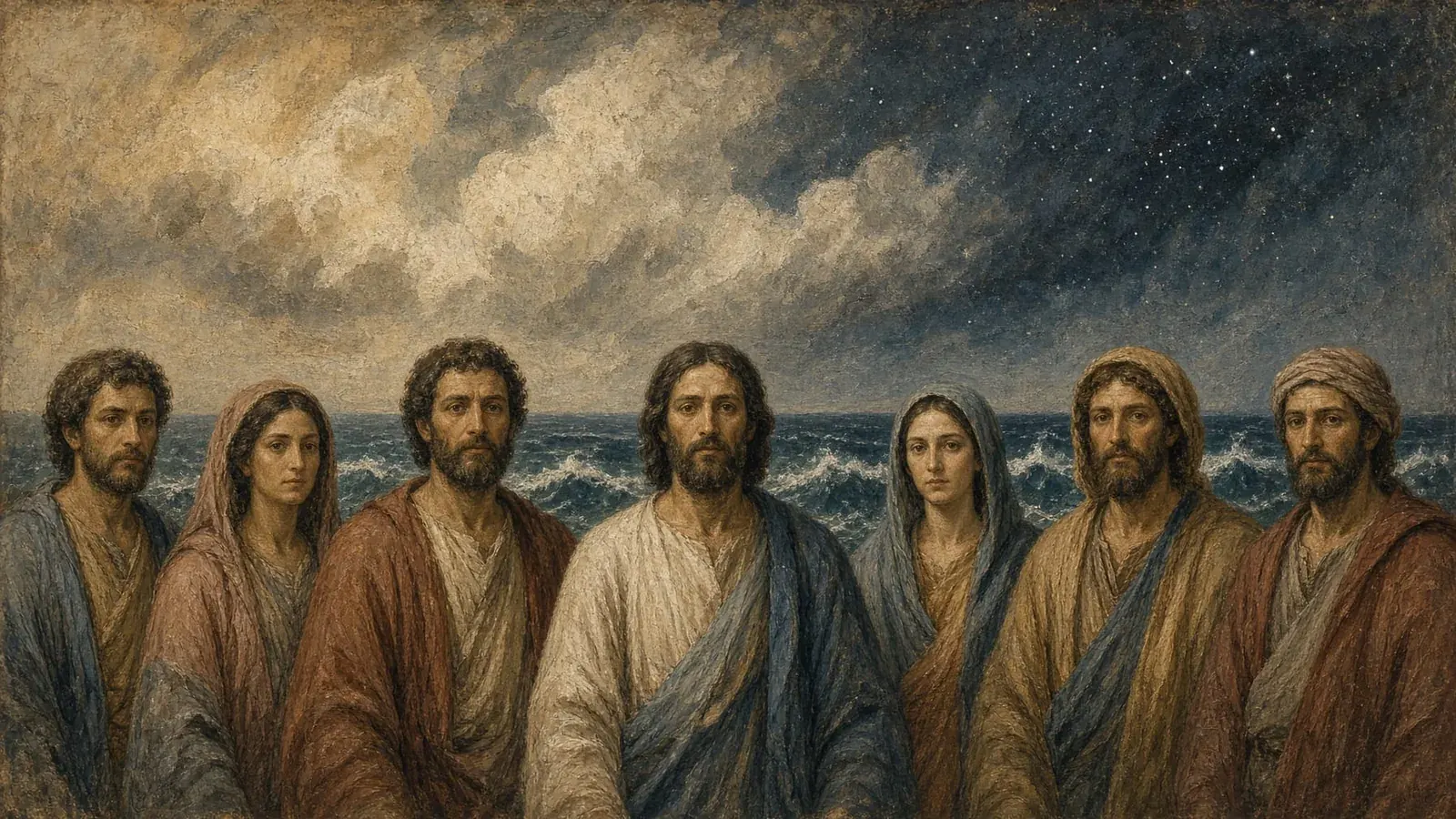

Scripture beside the summary
Jude · King James Version · 25Jude 1:1-4
A Letter Diverted
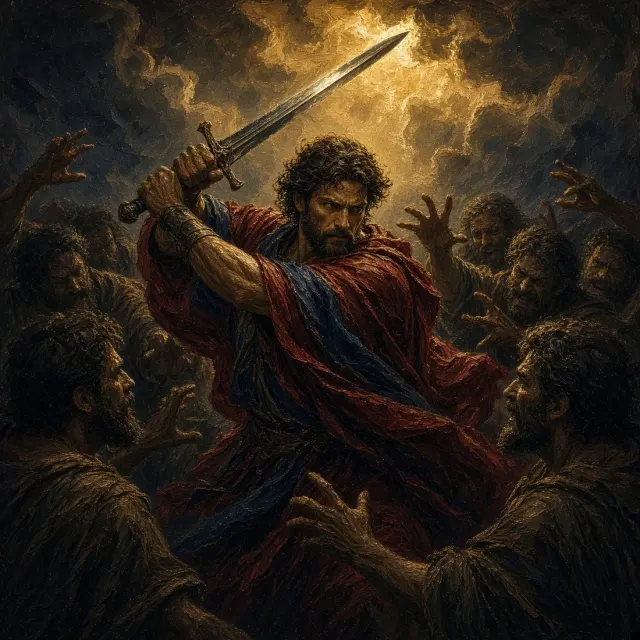
The Book of Jude opens with a writer who identifies himself by service and family, not by office. He is “the servant of Jesus Christ, and brother of James,” and the greeting describes the recipients as sanctified, preserved, and called before a single instruction is given. Then the letter exposes its own change of plan. Jude had been preparing to write about “the common salvation,” but something made another letter necessary. The pressure sits inside the congregation: certain men have “crept in unawares,” taking grace as their raw material and turning it into licence while denying the Lord they claim to stand under. That makes the phrase “once delivered unto the saints” carry unusual weight. The faith is not presented as something being reinvented for the emergency. It has already been handed over. Jude’s urgency comes from the collision between something received once and men who are quietly altering what that grace is allowed to mean.
Deep dive
The greeting identifies its author twice by relationship and not at all by office: servant of Jesus Christ, and brother of James. The James in question is almost certainly the brother of Jesus who led the church at Jerusalem, which makes this writer a brother of Jesus as well, and the letter declines to say so. The recipients are described with three passive participles, sanctified, preserved and called, so that everything true of them at the outset is something done to them.
Verse 3 is unusually candid about its own composition. The letter of Jude had been written toward "the common salvation" and became something else, because "it was needful for me to write unto you, and exhort you that ye should earnestly contend for the faith which was once delivered unto the saints". The verb epagonizesthai is athletic and appears nowhere else in the New Testament. The adverb hapax, once, carries the weight of the clause: the faith was handed over on one occasion and is not being handed over again.
The reason follows immediately. Certain men "crept in unawares", pareisedysan, a verb used of smuggling and of a disease entering a body. What they do is precise and is stated in two halves: they turn the grace of God into lasciviousness, and they deny the only Lord. The letter is not describing people who have rejected the message from outside. They are inside, and the grace is the raw material.
Words to trace: Christ, Jesus, Lord, write, Beloved, brother
Verse-by-verse path
- Jude 1:1
“Jude” is Ioudas, the same name as Judah and Judas; English Bibles spell it Jude here, which keeps him apart from Iscariot. Mark 6:3 lists a Juda among the brothers of Jesus. The oldest manuscripts read “beloved in God the Father” where the King James has “sanctified by God the Father”.
- Jude 1:2
“Be multiplied” is the optative wish of 1 Peter 1:2 and 2 Peter 1:2. Jude’s triad is his own: mercy, peace and love, with love where other letters put grace. Two of the three return in verse 21, where the readers keep themselves in the love of God and look for mercy.
- Jude 1:3
“Common salvation” means salvation held in common, shared by writer and readers, as Titus 1:4 speaks of “the common faith”; it does not mean ordinary. “Gave all diligence” pictures a writer already at work on another letter when the news arrived and made him set it aside.
- Jude 1:4
“Before of old ordained” is literally “written of beforehand”, progegrammenoi, a word used of public notices posted in advance: their sentence was already on the board, in the examples verses 5–16 go on to read out. In Greek one article governs “only Master” and “Lord”, and the word “God” is absent from the oldest copies, so both titles may belong to Jesus Christ.
Jude 1:1-4
King James Version1Jude, the servant of Jesus Christ, and brother of James, to them that are sanctified by God the Father, and preserved in Jesus Christ, and called:
2Mercy unto you, and peace, and love, be multiplied.
3Beloved, when I gave all diligence to write unto you of the common salvation, it was needful for me to write unto you, and exhort you that ye should earnestly contend for the faith which was once delivered unto the saints.
4For there are certain men crept in unawares, who were before of old ordained to this condemnation, ungodly men, turning the grace of our God into lasciviousness, and denying the only Lord God, and our Lord Jesus Christ.
Jude 1:5-7
Three That Did Not Keep Their Place
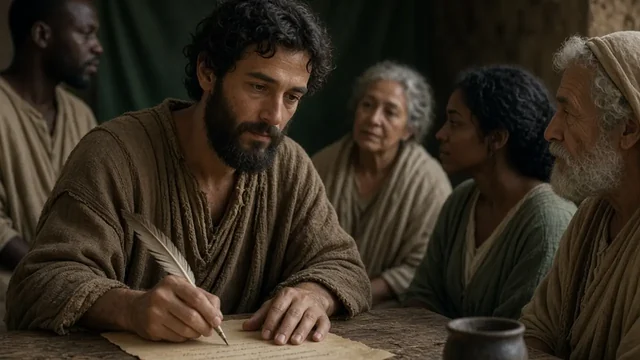
The Book of Jude places three examples beside one another, and the first prevents an easy appeal to past rescue. The Lord saved Israel out of Egypt and “afterward destroyed them that believed not.” Deliverance came first, but the wilderness generation still stands as a warning in a letter about turning grace into licence. The angels are described through the language of place. They “kept not their first estate” and “left their own habitation,” while the answer to that refusal is that they are now kept in everlasting chains under darkness. The wording makes the reversal hard to miss: those who would not keep are kept. Sodom and Gomorrha then appear “in like manner,” with “strange flesh” linking the cities to the preceding example in one long disputed pattern. Across all three cases, the emphasis falls on a place or condition given, then abandoned, and on judgment following after privilege rather than being made impossible by it.
Deep dive
The first example is the most pointed. The Lord "having saved the people out of the land of Egypt, afterward destroyed them that believed not". Deliverance came first and did not settle the matter. For readers being told that grace is not licence, the wilderness generation is the case that cannot be answered by appeal to having been rescued once.
The angels are described in language of place rather than of act: they "kept not their first estate", arche, their assigned rule or origin, and "left their own habitation", oiketerion, their proper dwelling. What they did is left unsaid. The reserving is in "everlasting chains under darkness", and the noun for chains, desmois, is set against the participle for keeping, so that those who did not keep are now kept.
Sodom and Gomorrha follow "in like manner", and the phrase "going after strange flesh", heteras sarkos, literally other flesh, has been read as connecting the cities to the angels of the previous verse rather than only describing the men of the city. The letter of Jude presents all three as one pattern: a place given, a place abandoned. The three examples appear again, in a different order, in the second chapter of the Second Epistle of Peter.
Words to trace: angels, believed, chains, cities, darkness, destroyed
Verse-by-verse path
- Jude 1:5
“Once” is hapax, the same adverb as “once delivered” in verse 3: the readers knew it fully, once for all. Several of the oldest manuscripts read “Jesus” where the King James has “the Lord”, making him the one who brought Israel out of Egypt. “Afterward” is literally “the second time”.
- Jude 1:6
The tradition behind the verse is found in 1 Enoch 6–10, where the Watchers come down on Mount Hermon and God has the leader bound and thrown into darkness until the great day of judgment. “The great day” is the phrase of Joel 2:31 and Revelation 6:17.
- Jude 1:7
“The cities about them” are Admah and Zeboim, named with Sodom in Deuteronomy 29:23 and Hosea 11:8; Zoar was spared at Lot’s plea. “Set forth” is used of something laid out for public view. “Suffering the vengeance” is a legal phrase, undergoing a penalty, and ancient writers pointed to the smoking wasteland by the Dead Sea as still visible.
Jude 1:5-7
King James Version5I will therefore put you in remembrance, though ye once knew this, how that the Lord, having saved the people out of the land of Egypt, afterward destroyed them that believed not.
6And the angels which kept not their first estate, but left their own habitation, he hath reserved in everlasting chains under darkness unto the judgment of the great day.
7Even as Sodom and Gomorrha, and the cities about them in like manner, giving themselves over to fornication, and going after strange flesh, are set forth for an example, suffering the vengeance of eternal fire.
Jude 1:8-11
Michael's Restraint, and Three Names
The Book of Jude measures the intruders’ speech against an archangel who refuses to speak as freely as they do. They defile the flesh, despise dominion, and speak evil of dignities, but Michael, disputing with the devil over the body of Moses, will not bring a railing accusation. He says only, “The Lord rebuke thee.” The incident comes from outside the Hebrew Scriptures, yet Jude uses it without apology because the contrast is the point: an archangel in a dispute of extraordinary scale shows a restraint these men do not. Their confidence is then stripped down further. They revile what they do not know, and what they know naturally becomes the very field in which they corrupt themselves. Verse 11 gives their course three old names at once: Cain, Balaam, and Core. The verbs sharpen the sequence. They have gone in a way, run greedily after an error for reward, and perished in gainsaying. Envy, hire, and rebellion are not presented as abstractions. Jude gives each one a face.
Deep dive
The men are called filthy dreamers, and three charges follow: they defile the flesh, despise dominion, and speak evil of dignities. Dignities is doxas, glories, most probably angelic powers, and the argument in verse 9 depends on that.
The incident of Michael disputing with the devil over the body of Moses is not in the Hebrew scriptures. Origen and others attributed it to a lost ending of the Assumption of Moses, and the letter of Jude cites it without apology. What it cites it for is a negative: Michael "durst not bring against him a railing accusation, but said, The Lord rebuke thee", the words Zechariah gives to the angel of the Lord. An archangel in dispute with the devil over the body of a prophet declines to use the language these men use freely.
Verse 10 completes the contrast with the same charge the Second Epistle of Peter makes: they revile what they do not know, and what they do know, they know naturally, as animals do. Verse 11 then names three precedents at once, Cain, Balaam and Core, and gives each a different verb: they have gone in the way, ran greedily after the error, and perished in the gainsaying. Envy, hire and rebellion. The third is the only one stated as already finished.
Words to trace: evil, know, accusation, archangel, Balaam, beasts
Verse-by-verse path
- Jude 1:8
“Dreamers” is enypniazomenoi, the word of the Greek Deuteronomy 13 for the “dreamer of dreams” who draws Israel after other gods; the likely sense is that these men claim visions as their authority. “Filthy” is the King James’s addition, as the Greek has only “dreaming”. “Dominion” is kyriotes, lordship.
- Jude 1:9
“Archangel” occurs only here and in 1 Thessalonians 4:16. Daniel calls Michael “one of the chief princes” (10:13) and the great prince who stands for Israel (12:1). “A railing accusation” is literally “a judgment of slander”: Michael would not pronounce a verdict in his own name and left it to the Lord.
- Jude 1:10
“Brute beasts” is aloga zoa, animals without logos, without reason or speech: men who use words so freely are compared to creatures that have none. “Corrupt themselves” can also be read “are destroyed”. What they know by instinct is where they perish.
- Jude 1:11
The only “woe” pronounced in the New Testament letters, the form of the prophets and of Jesus. A Targum on Genesis 4:8 makes Cain say there is no judgment and no judge, which fits these men well. Numbers 31:16 blames Balaam’s counsel for Israel’s sin at Peor, and “Core” is Korah (Numbers 16), spelled from the Greek.
Jude 1:8-11
King James Version8Likewise also these filthy dreamers defile the flesh, despise dominion, and speak evil of dignities.
9Yet Michael the archangel, when contending with the devil he disputed about the body of Moses, durst not bring against him a railing accusation, but said, The Lord rebuke thee.
10But these speak evil of those things which they know not: but what they know naturally, as brute beasts, in those things they corrupt themselves.
11Woe unto them! for they have gone in the way of Cain, and ran greedily after the error of Balaam for reward, and perished in the gainsaying of Core.
Jude 1:12-16
Six Pictures of Emptiness, and a Prophecy from Outside
The Book of Jude stops naming precedents and starts piling up pictures, but every picture fails in almost the same way. At the love feasts the intruders are spots or hidden rocks, while the shepherds feed themselves “without fear.” They are clouds without water, moved by wind before they can give what clouds are for. They are autumn trees without fruit, then “twice dead” and pulled up by the roots. They are raging waves that produce only their own shame, and wandering stars, lights useless for navigation, reserved for blackness. The accumulation is the argument: very little in the sequence attacks by force. Nearly everything is empty, misdirected, or unable to perform its proper work. Then Jude shifts from image to prophecy and quotes Enoch, “the seventh from Adam,” from a book outside the Hebrew canon. The letter does not settle the standing of that source. It takes from it a coming judgment and hammers the word “ungodly” four times until the charge fills the sentence.
Deep dive
The six figures are arranged by element and each turns on something failing to do what it exists for. Hidden rocks or spots at the love feasts, where the Greek spilades can mean either reefs that wreck a ship or stains at a table. Clouds without water, carried off by wind. Trees in autumn without fruit, twice dead and pulled up, so that both the fruiting and the rooting have failed. Raging sea waves foaming out shame, an image from Isaiah. Wandering stars, planetai, lights that cannot be navigated by, reserved to the blackness of darkness.
The accumulation is the argument. Nothing in the list is violent; everything in it is empty. The shepherds feed themselves, which is Ezekiel's charge against the shepherds of Israel, and the phrase "without fear" is the whole of the moral description.
Then Enoch is quoted, "the seventh from Adam", and the words come from the Book of Enoch, which is not in the Hebrew canon and was not in the canon of the churches that later received this letter. The letter of Jude quotes it as prophecy. Whether that constitutes an endorsement of the book has been disputed since Tertullian and Jerome, who came to opposite conclusions, and the letter itself says nothing about the standing of the source. What it takes from it is a coming in judgment and a fourfold hammering on the word ungodly, which the King James preserves exactly: ungodly among them, ungodly deeds, ungodly committed, ungodly sinners.
Words to trace: ungodly, fruit, Adam, admiration, advantage, blackness
Verse-by-verse path
- Jude 1:12
“Feasts of charity” is agapais, love feasts, the common meal of the early church, and the only certain use of the name in the New Testament. “Feeding themselves” is literally “shepherding themselves”. “Whose fruit withereth” renders phthinoporina, late autumn trees, stripped at the end of the season when a tree should have borne.
- Jude 1:13
“Darkness” is zophos, the same word used of the angels’ prison in verse 6, so the wandering stars end where the fallen angels are kept. In 1 Enoch 18 and 21 seven stars are bound for not rising at their appointed times, and Jude appears to have that picture in view.
- Jude 1:14
“Seventh from Adam” counts Adam as the first: Adam, Seth, Enos, Cainan, Mahalaleel, Jared, Enoch (Genesis 5). The quotation is 1 Enoch 1:9. “Cometh” is an aorist, literally “came”, the prophetic past that speaks of a future event as done. “Ten thousands” is myriads, uncountable holy ones.
- Jude 1:15
“Convince” in 1611 meant to convict, to prove guilty, from the Latin convincere. “Hard speeches” are harsh words spoken against God, the only item in the charge concerned with speech, and verse 16 takes it straight up with mouths full of “great swelling words”.
- Jude 1:16
“Murmurers” is gongystai, the word for Israel grumbling in the wilderness in Exodus 16 and Numbers 14, which ties back to verse 5. “Complainers” is mempsimoiroi, literally “blamers of their lot”. “Great swelling words” echoes Daniel 11:36, and “having men’s persons in admiration” means flattering faces for gain.
Jude 1:12-16
King James Version12These are spots in your feasts of charity, when they feast with you, feeding themselves without fear: clouds they are without water, carried about of winds; trees whose fruit withereth, without fruit, twice dead, plucked up by the roots;
13Raging waves of the sea, foaming out their own shame; wandering stars, to whom is reserved the blackness of darkness for ever.
14And Enoch also, the seventh from Adam, prophesied of these, saying, Behold, the Lord cometh with ten thousands of his saints,
15To execute judgment upon all, and to convince all that are ungodly among them of all their ungodly deeds which they have ungodly committed, and of all their hard speeches which ungodly sinners have spoken against him.
16These are murmurers, complainers, walking after their own lusts; and their mouth speaketh great swelling words, having men’s persons in admiration because of advantage.
Jude 1:17-19
What the Apostles Had Already Said
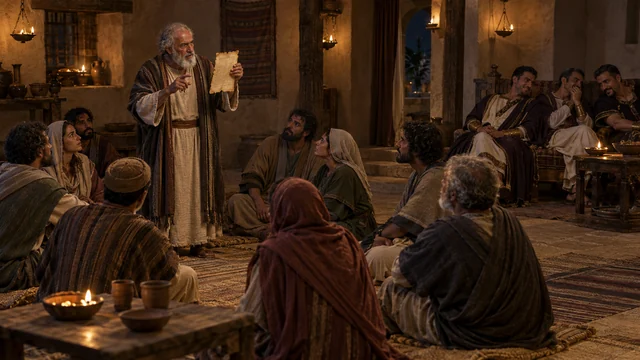
The Book of Jude turns again with the word “beloved” and asks for memory rather than surprise. The apostles had already said that mockers would come in the last time, walking after their own ungodly lusts. That does not make the intrusion harmless, but it changes the shape of the crisis. Men who “crept in unawares” were not therefore unforeseen, and the congregation is not encountering something outside what it had already been told to expect. Verse 19 then gives the letter’s sharpest definition of the men it has spent so long describing. “These be they who separate themselves, sensual, having not the Spirit.” The word rendered sensual belongs to natural life as distinct from spiritual life, which makes the final charge especially pointed. The men divide others while lacking the Spirit they would need for the position they imply they possess. Jude’s turn to apostolic warning takes the shock out of their novelty without taking the seriousness out of their presence.
Deep dive
The address changes to beloved, as it does at each turn in this letter, and the instruction is to remember. What the apostles spoke before is given in indirect speech rather than quoted, and its content is that mockers would come in the last time. The Second Epistle of Peter reports the same expectation in almost the same words.
The effect of the paragraph is to remove the shock. Men who crept in unawares were not unforeseen, and a congregation that was warned is not facing something outside the account it was given.
Verse 19 supplies the definition the letter has been working toward: "these be they who separate themselves, sensual, having not the Spirit". The word psychikoi, rendered sensual, means belonging to the natural life as distinct from the spiritual, and Paul uses it the same way to the Corinthians. The irony is that men who divide the congregation are themselves described as lacking what they claim to have in abundance.
Words to trace: apostles, beloved, Christ, Jesus, last, Lord
Verse-by-verse path
- Jude 1:17
“Spoken before” places the apostles in the past, and Jude does not count himself among them. Many infer that the letter was written when apostolic teaching had become a remembered inheritance, though the words could also mean only that the warning came earlier than the trouble.
- Jude 1:18
“Mockers”, empaiktai, occurs only here and in 2 Peter 3:3. “In the last time” assumes the readers already live in it. “Their own ungodly lusts” is literally “their own lusts of ungodlinesses”, keeping the word ungodly that verse 15 hammered four times.
- Jude 1:19
“Separate themselves” is apodiorizontes, a rare triple compound meaning to draw distinctions, to mark off classes; it may point to men who sorted the congregation into the spiritual and the rest. “Spirit” has no article, but the contrast with “praying in the Holy Ghost” in verse 20 shows it is God’s Spirit they lack.
Jude 1:17-19
King James Version17But, beloved, remember ye the words which were spoken before of the apostles of our Lord Jesus Christ;
18How that they told you there should be mockers in the last time, who should walk after their own ungodly lusts.
19These be they who separate themselves, sensual, having not the Spirit.
Jude 1:20-25
Building, Keeping, and Pulling Out of the Fire
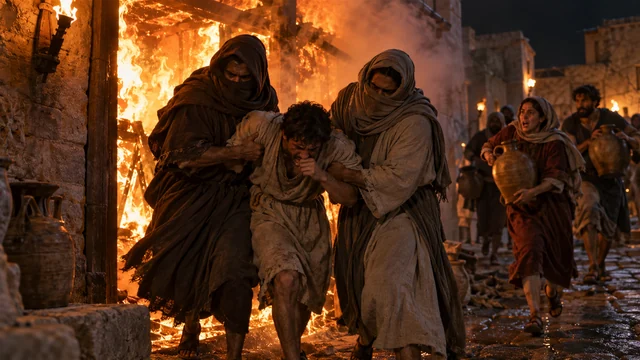
After sixteen verses dominated by other people, the Book of Jude turns to the beloved and the language suddenly becomes ordinary: building up, praying, keeping, and looking for mercy. The only direct imperative in that sequence is “keep yourselves in the love of God,” and even that command sits inside a sentence that ends by looking toward the mercy of Jesus Christ. The next lines refuse a single mechanical response to everyone caught in the damage. The King James follows a two-group reading of a text that survives in disturbed forms, but every form preserves a distinction: some are met with compassion, while others are rescued urgently, “pulling them out of the fire,” with caution for the rescuers themselves. Then the doxology answers the letter’s imagery almost word for word. Those who would not keep their place have filled the warning, but God is “able to keep you from falling.” The intruders are spots; the final prospect is to be presented “faultless.” The last word over the whole alarm is not fear, but “exceeding joy.”
Deep dive
After sixteen verses about other people, the instruction turns to the readers and is unexpectedly domestic: building up, praying, keeping, looking for. The imperative is only in "keep yourselves in the love of God", and even that is placed inside a sentence whose final word is mercy.
Verses 22 and 23 have a badly disturbed text, with manuscripts giving either two groups or three, and the King James follows a two group reading. What survives in every version is a distinction. Some are to be treated with compassion, others snatched out of the fire, and the last clause holds a caution for the rescuers themselves: "hating even the garment spotted by the flesh", where the chiton is the undergarment. The letter asks for rescue and does not ask for it to be done carelessly.
The doxology is among the fullest in the New Testament and answers the letter's own anxiety exactly. The men described could not keep their place; God is "able to keep you from falling". The intruders are spots and blemishes; the readers will be presented "faultless", amomous, the word used of an unblemished sacrifice. After a letter of unrelieved warning, the last note is exceeding joy.
Words to trace: glory, holy, keep, able, Amen, beloved
Verse-by-verse path
- Jude 1:20
“Building up” is the language of a house laid on a foundation, and the foundation is “most holy faith”, a superlative used of faith nowhere else. “Praying in the Holy Ghost” answers verse 19 directly: those without the Spirit set against those who pray in him.
- Jude 1:21
Verses 20 and 21 name the Holy Ghost, the love of God and the mercy of our Lord Jesus Christ in turn. “Looking for” is prosdechomenoi, the verb used of Simeon waiting for the consolation of Israel and Joseph of Arimathea waiting for the kingdom (Luke 2:25; 23:51).
- Jude 1:22
“Making a difference” is diakrinomenous, the same verb as “disputed” in verse 9, where Michael contends with the devil. It can also mean “wavering”, as in James 1:6, and several modern versions read “have mercy on some who doubt”, the King James having taken it as the helpers’ discernment.
- Jude 1:23
“Pulling them out of the fire” echoes Zechariah 3:2, “a brand plucked out of the fire”, the very verse in which the Lord says “The Lord rebuke thee, O Satan”, quoted in verse 9. In the next verse Joshua the high priest stands in filthy garments, which may lie behind the garment here.
- Jude 1:24
“From falling” is aptaistous, without stumbling, a word Greek writers used of a sure-footed horse. “Present” means to set standing. “Exceeding joy” is agalliasis, exultation, the festive gladness of Luke 1:44, where the child “leaped in my womb for joy”.
- Jude 1:25
The oldest manuscripts lack “wise” and add “through Jesus Christ our Lord” and “before all time”, so the doxology stretches over past, present and every age to come. “Majesty” is megalosyne, the word Hebrews 1:3 uses for God himself, “the Majesty on high”.
Jude 1:20-25
King James Version20But ye, beloved, building up yourselves on your most holy faith, praying in the Holy Ghost,
21Keep yourselves in the love of God, looking for the mercy of our Lord Jesus Christ unto eternal life.
22And of some have compassion, making a difference:
23And others save with fear, pulling them out of the fire; hating even the garment spotted by the flesh.
24Now unto him that is able to keep you from falling, and to present you faultless before the presence of his glory with exceeding joy,
25To the only wise God our Saviour, be glory and majesty, dominion and power, both now and ever. Amen.
Questions to keep in mind while reading
- Identify the audience, problem, argument, command, and pastoral purpose.
- Follow connecting words so that one sentence remains inside the author’s reasoning.
- Distinguish a universal theological claim from an instruction shaped by a particular situation.
Text first
Where readers differ
The chapter summary begins with what the passage says and how its parts fit together. It does not assume one denomination has already settled every question. Where a conclusion depends on a tradition, literary theory, or historical reconstruction, that dependence is named openly.
The KJV text is presented first. Interpretive conclusions are labeled, and differences are introduced only when they help a reader understand why serious communities do not always reach the same answer.
Comparative interpretive notes for this chapter are in preparation. Until reviewed notes are ready, this page separates the KJV text from summary and application without claiming that serious readers agree on every question.
Questions beneath the surface
- What account of God, human freedom, responsibility, and the good life emerges from Jude 1?
- Which tension does the chapter refuse to resolve quickly?
- What changes when the chapter is read as part of the whole canon rather than as an isolated moral lesson?
- Where might a sincere reader confuse a familiar tradition with something the text states directly?
Questions for serious personal contemplation
These open-ended questions make room for tension, honest response, prayer, and conclusions that remain accountable to the chapter.
Observe without rushing
What part of Jude 1 makes you stop, feel unsettled, or feel surprised, and why?
Which detail in the passage would be easiest to overlook? How does that detail change your understanding?
Where do you see tension between what happens and this focus: A church receiving the urgent appeal to contend for the faith as corrupt teachers slip into the gathering; Remembered judgments, barren clouds, fruitless trees, wild waves, and wandering stars illustrating the teachers’ character; Believers building one another up, praying, remaining in love, showing mercy, and pulling endangered people away from destruction with discernment; A worshiping community trusting God’s power to keep them from falling and present them with joy?
What important question does the passage leave open instead of resolving quickly?
Examine your inner life honestly
Which person, response, fear, or desire in the passage feels most like your own life right now?
What assumption about God, other people, or yourself does this text challenge?
Which part would you rather soften, avoid, or explain away too quickly? What might that reaction reveal?
If this Scripture could ask you one direct question, what do you think it would ask?
Respond with wisdom and courage
What do you need to remember, confess, grieve, thank God for, or trust after reading this passage?
How might another faithful person read this situation differently without ignoring the text?
What obedient response would be costly, uncomfortable, or slow, yet still faithful to Scripture?
What question will you carry into prayer this week, and which verses will you keep in front of you?
Music and video connected to the passage
Related media appears when its Scripture reference overlaps this study. Music and video can illuminate a theme while the biblical text remains the foundation.