The big picture
Judges 3 moves from explanation to examples. The nations left in the land test whether Israel will obey, but ordinary proximity becomes intermarriage and service to other gods. Othniel then provides the cycle in its cleanest form: Israel forgets the LORD, falls under foreign domination, cries out, receives a deliverer empowered by the Spirit, and enjoys forty years of rest. Ehud’s account is stranger and more detailed. His left hand, concealed dagger, Eglon’s private chamber, and the servants’ delay turn royal confidence into humiliation before Ehud rallies Israel and seizes the Jordan crossings. The chapter ends with only one line for Shamgar and his ox goad. Three deliverers receive radically different amounts of attention, but each is remembered because Israel was delivered.
In this chapter
- Testing Becomes Accommodation Judges 3:1-6
The nations left in the land serve more than one purpose in this opening.
- Othniel Brings the First Deliverance Judges 3:7-11
Othniel’s notice is the cycle of Judges in miniature.
- Ehud Overturns Moabite Power Judges 3:12-30
Ehud’s deliverance is built out of details that make Moabite power look secure until it suddenly is not.
- Shamgar Is Remembered in One Line Judges 3:31
Shamgar receives one verse, and the brevity is part of what the verse says.


Scripture beside the summary
Judges · King James Version · 31Judges 3:1-6
Testing Becomes Accommodation
The nations left in the land serve more than one purpose in this opening. A generation without battle experience learns war, but verse 4 identifies the deeper test: will Israel hearken to the commandments of the LORD? The answer unfolds through a quiet sequence rather than one dramatic act. Israel dwells among the peoples, marriages bind households together, and service to their gods follows. Judges presents the danger as covenant assimilation, not ethnicity. The concern is not that different bloodlines touched, but that ordinary alliances carried worship with them until Israel’s distinct allegiance blurred. The progression is almost domestic in its pace, which is precisely why it matters. Testing occurs in daily life as much as on a battlefield, and accommodation becomes visible only after proximity has ripened into loyalties that the covenant had explicitly forbidden.

Deep dive
Verses 1 and 2 describe military testing, while verse 4 identifies the deeper question as obedience to the LORD’s commandments. The presence of the nations is therefore not only about learning battle. It reveals whether Israel will maintain covenant allegiance when ordinary life creates pressure to blend in.
Verses 5 and 6 move from proximity to marriage and then to worship. The text should not be turned into a racial prohibition. The stated concern is covenant loyalty and service to other gods. The sequence shows how daily alliances can carry spiritual commitments that are easy to ignore at first.
Words to trace: Israel, Canaanites, children, daughters, dwelt, Hivites
Verse-by-verse path
- Judges 3:1
The chapter picks up 2:22–23 and names what was left. Moses had described the wilderness the same way: God led Israel forty years “to humble thee, and to prove thee, to know what was in thine heart” (Deuteronomy 8:2). The wars of Canaan were now history the young had only heard about.
- Judges 3:2
“To teach them war” uses lamad, the verb Moses used for learning the law: “that ye may learn them, and keep, and do them” (Deuteronomy 5:1). Isaiah’s vision reverses the phrase: “neither shall they learn war any more” (Isaiah 2:4).
- Judges 3:3
Baal-hermon suggests that Mount Hermon carried a shrine of Baal (compare 1 Chronicles 5:23). The Sidonians are the Phoenicians of the coast, and “the entering in of Hamath” was the northern limit the promise had set (Numbers 34:8).
- Judges 3:4
“To know whether” is the language of a test that reveals: God said to Abraham after Moriah, “now I know that thou fearest God” (Genesis 22:12). The second purpose of the remaining nations is not military at all but moral: to show whether Israel would listen.
- Judges 3:5
These six peoples are named in exactly this order at the burning bush, where God promised to bring Israel into “the place of the Canaanites, and the Hittites, and the Amorites, and the Perizzites, and the Hivites, and the Jebusites” (Exodus 3:8). Israel came to that place, and settled among them.
- Judges 3:6
Deuteronomy 7:3–4 had forbidden these marriages and given the reason: “For they will turn away thy son from following me, that they may serve other gods.” This verse records the prohibited act and then the result the law had predicted, in the same order.
Judges 3:1-6
King James Version1Now these are the nations which the LORD left, to prove Israel by them, even as many of Israel as had not known all the wars of Canaan;
2Only that the generations of the children of Israel might know, to teach them war, at the least such as before knew nothing thereof;
3Namely, five lords of the Philistines, and all the Canaanites, and the Sidonians, and the Hivites that dwelt in mount Lebanon, from mount Baal-hermon unto the entering in of Hamath.
4And they were to prove Israel by them, to know whether they would hearken unto the commandments of the LORD, which he commanded their fathers by the hand of Moses.
5And the children of Israel dwelt among the Canaanites, Hittites, and Amorites, and Perizzites, and Hivites, and Jebusites:
6And they took their daughters to be their wives, and gave their daughters to their sons, and served their gods.
Judges 3:7-11
Othniel Brings the First Deliverance
Othniel’s notice is the cycle of Judges in miniature. Israel does evil, forgets the LORD, and serves other gods. Foreign domination follows for eight years. The people cry out, the LORD raises a deliverer, and the Spirit of the LORD comes upon Othniel as he judges and goes to war. The language keeps the source of rescue clear even while Othniel acts decisively: the LORD delivers Chushan-rishathaim into his hand. Then comes forty years of rest, five times the length of the oppression. Mercy occupies more time in the account than bondage. Yet the last sentence quietly closes the window: Othniel dies. Judges has already warned what happens when a judge is gone, so even a clean deliverance carries an expiration date. The land can rest while the deeper problem remains unresolved.

Deep dive
This compact account provides the basic pattern with unusual clarity. Israel does evil, experiences foreign domination, cries to the LORD, and receives a deliverer raised up by God. Othniel judges and goes to war, but verse 10 attributes empowering presence to the Spirit of the LORD.
The forty years of rest exceed the eight years of oppression, placing mercy in the foreground. Even so, the account ends with Othniel’s death, and the next unit begins with renewed evil. The judge can interrupt oppression, but the judge does not permanently change Israel’s heart.
Words to trace: LORD, Israel, children, Chushan, rishathaim, hand
Verse-by-verse path
- Judges 3:7
“Groves” is asherot, not trees but wooden cult poles for the goddess Asherah. Inscriptions found at Kuntillet Ajrud in the Sinai, from about 800 BC, bless people “by YHWH and his Asherah”, which shows how closely the two worships could be mixed. “Forgat” is the failure Deuteronomy 8:11 warned against.
- Judges 3:8
Chushan-rishathaim means “Cushan of double wickedness”, most likely a mocking nickname. “Mesopotamia” is Aram-naharaim, “Aram of the two rivers”. Because Othniel came from the south, some scholars suggest Aram is a misreading of Edom, which in Hebrew differs by one letter.
- Judges 3:9
“Cried” is zaaq, the cry Israel raised in Egypt (Exodus 2:23). “Deliverer” is moshia, a saviour, from the root of Joshua’s name. The first judge comes from Judah, the tribe God had named to go up first (1:2).
- Judges 3:10
This is the first of the notices in Judges that the Spirit of the LORD came upon a deliverer; the same is said of Gideon (6:34), Jephthah (11:29) and Samson (13:25; 14:6, 19; 15:14). “Prevailed” is azaz, grew strong.
- Judges 3:11
Forty years, a generation, recurs through Judges (5:31; 8:28; 13:1). Added end to end, the book’s periods of oppression and rest come to more than 1 Kings 6:1 allows for the 480 years from the exodus to the temple, which has led many to think some judges overlapped.
Judges 3:7-11
King James Version7And the children of Israel did evil in the sight of the LORD, and forgat the LORD their God, and served Baalim and the groves.
8Therefore the anger of the LORD was hot against Israel, and he sold them into the hand of Chushan-rishathaim king of Mesopotamia: and the children of Israel served Chushan-rishathaim eight years.
9And when the children of Israel cried unto the LORD, the LORD raised up a deliverer to the children of Israel, who delivered them, even Othniel the son of Kenaz, Caleb’s younger brother.
10And the Spirit of the LORD came upon him, and he judged Israel, and went out to war: and the LORD delivered Chushan-rishathaim king of Mesopotamia into his hand; and his hand prevailed against Chushan-rishathaim.
11And the land had rest forty years. And Othniel the son of Kenaz died.
Judges 3:12-30
Ehud Overturns Moabite Power
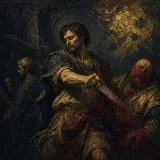
Ehud’s deliverance is built out of details that make Moabite power look secure until it suddenly is not. Eglon receives tribute, sits in a private summer chamber, and dismisses attendants when Ehud claims to have a secret message. Ehud’s left hand, the placement of the dagger, the king’s body, the locked doors, and the servants waiting in embarrassment all turn royal control into irony. Yet the Book of Judges does not let the private killing carry the whole rescue. Ehud escapes, sounds a trumpet, gathers Israel, and seizes the Jordan fords so Moab cannot recover. His own explanation is the chapter’s interpretation: “the LORD hath delivered your enemies” into Israel’s hand. The long rest that follows belongs to a public deliverance, not merely to the success of one hidden weapon in one private room.

Deep dive
The Book of Judges builds the episode through physical and verbal detail: Ehud’s left hand, the two-edged dagger, Eglon’s body, the private upper chamber, and the servants’ delay. These details create irony and suspense while showing how an apparently controlled royal setting becomes the place where Moabite power collapses.
The rescue is larger than the assassination. Ehud returns, sounds a trumpet, calls Israel to follow, and leads the seizure of the Jordan fords. Verse 28 gives the theological interpretation: the LORD has delivered the enemies into Israel’s hand. The account reports violent deliverance in an ancient conflict; it does not authorize private violence in the name of a personal cause.
Words to trace: Israel, Ehud, LORD, Moab, children, Eglon
Verse-by-verse path
- Judges 3:12
“Strengthened” is chizzeq, the verb used of God hardening, literally strengthening, Pharaoh’s heart (Exodus 9:12). Here God strengthens a foreign king against Israel. Eglon’s name comes from egel, a calf, a name that the next verses make grimly apt.
- Judges 3:13
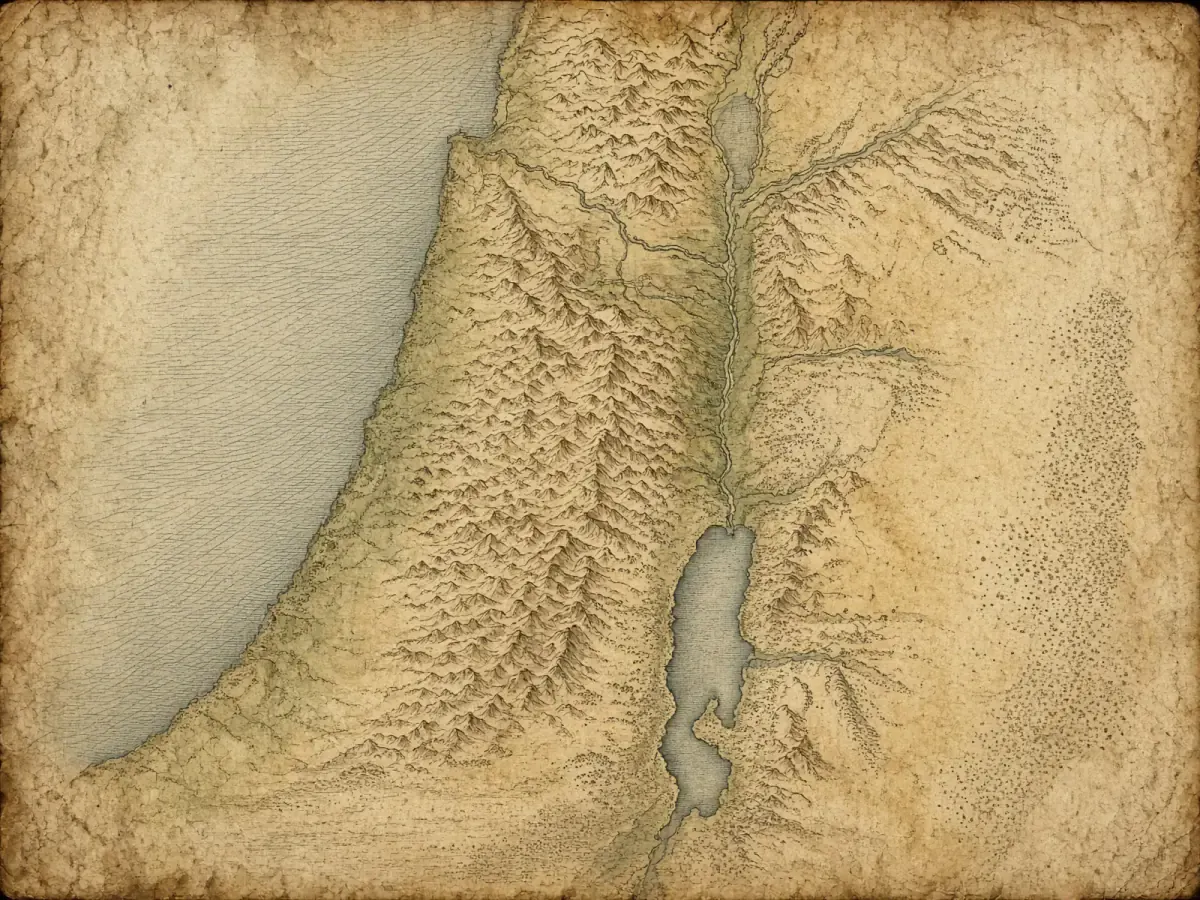
“The city of palm trees” is Jericho (Deuteronomy 34:3). Joshua had cursed anyone who refounded it, and it lay unwalled; Moab, with Ammon and Amalek, uses it as a foothold on the west bank.
- Judges 3:14
The years of servitude grow as the book goes on: eight under Chushan, eighteen under Eglon, twenty under Jabin (4:3), seven under Midian (6:1), eighteen under Ammon (10:8), forty under the Philistines (13:1).
- Judges 3:15
“Lefthanded” is literally “bound in his right hand”. Benjamin means “son of the right hand”, yet the tribe was famous for left handed men: Judges 20:16 counts seven hundred of them who could sling a stone at a hair and not miss. The “present” is minchah, the tribute.
- Judges 3:16
“A cubit length” translates gomed, a measure found only here, probably shorter than the ordinary cubit, perhaps about a foot. Strapped on the right thigh, the dagger sat where a guard checking a right handed man would not expect it.
- Judges 3:17
“Fat” is bari, the word for the well fed cows of Pharaoh’s dream (Genesis 41:2) and for fatted animals. The king named for a calf is described in the language of cattle ready for slaughter.
- Judges 3:18
Ehud first escorts the tribute bearers away. The whole delegation leaves the court together, which gives him a reason to be seen departing and a reason, when he returns alone, to claim a private message.
- Judges 3:19
“Quarries” is pesilim, a word that elsewhere means carved images, as in “burn their graven images” (Deuteronomy 7:5). Ehud turns back at the idols near Gilgal, perhaps images set up by the Moabites, or perhaps the stones Joshua raised there (Joshua 4:20). “Keep silence” is one word, has, “hush”.
- Judges 3:20
“Summer parlour” is literally “the upper room of coolness”, a rooftop chamber catching the breeze. “A message from God” is devar Elohim, and davar means both word and thing: what Ehud brings from God is a thing, the dagger. The king stands, perhaps out of respect for an oracle, and exposes himself.
- Judges 3:21
Three quick verbs, put forth, took, thrust, tell the act in one breath. The next chapter tells Jael’s deed with the same speed and the same verb for driving the blade home, “smote the nail” (4:21). Both oppressors fall to a hidden weapon in a private room.
- Judges 3:22
“The dirt came out” translates a word found nowhere else, parshedonah. It may mean the king’s bowels emptied, or that Ehud went out through some opening; both readings have ancient support. Either way, the detail is meant to be ugly.
- Judges 3:23
“Porch” is misderonah, another word found only here, perhaps a vestibule or colonnade. Some scholars propose that Ehud left through a latrine opening while the doors stayed bolted behind him; the text says only that he shut and locked the doors and went out.
- Judges 3:24
“Covereth his feet” is a Hebrew euphemism for relieving oneself, used when Saul went into the cave at En-gedi (1 Samuel 24:3). The locked doors and the smell of verse 22 support the servants’ guess, and the guess buys Ehud time.
- Judges 3:25
“Tarried till they were ashamed” means they waited until the delay became embarrassing. The key was probably a large wooden key that lifted the bolt from outside. “Behold, their lord was fallen down dead” uses the same “behold” that reveals Sisera dead in Jael’s tent (4:22).
- Judges 3:26
Seirath, “the wooded place” or “the hairy place”, is otherwise unknown, somewhere in the hill country of Ephraim. Ehud passes the idols near Gilgal a second time, now going the other way.
- Judges 3:27
“Blew” is the same Hebrew verb as “thrust” in verse 21, taqa, to drive in or to blast: the dagger and the trumpet are sounded with one verb. “He before them” shows the judge leading the charge down from the hills in person.
- Judges 3:28
Seizing the fords of Jordan cut the Moabites west of the river off from home. Gideon’s allies do the same to Midian (7:24), and Jephthah’s men to Ephraim at the Shibboleth test (12:5–6). “Follow after me” is literally “pursue after me”.
- Judges 3:29
“Lusty” is shamen, literally “fat”, the adjective the King James renders as robust. Every Moabite soldier who falls is described with the word that fits their king: ten thousand fat men for one fat king.
- Judges 3:30
Eighty years is the longest rest in the Book of Judges, twice the usual forty. “Subdued” is kana, to be humbled, brought low: the kingdom that had subdued Israel for eighteen years is itself brought under Israel’s hand.
Judges 3:12-30
King James Version12And the children of Israel did evil again in the sight of the LORD: and the LORD strengthened Eglon the king of Moab against Israel, because they had done evil in the sight of the LORD.
13And he gathered unto him the children of Ammon and Amalek, and went and smote Israel, and possessed the city of palm trees.
14So the children of Israel served Eglon the king of Moab eighteen years.
15But when the children of Israel cried unto the LORD, the LORD raised them up a deliverer, Ehud the son of Gera, a Benjamite, a man lefthanded: and by him the children of Israel sent a present unto Eglon the king of Moab.
16But Ehud made him a dagger which had two edges, of a cubit length; and he did gird it under his raiment upon his right thigh.
17And he brought the present unto Eglon king of Moab: and Eglon was a very fat man.
18And when he had made an end to offer the present, he sent away the people that bare the present.
19But he himself turned again from the quarries that were by Gilgal, and said, I have a secret errand unto thee, O king: who said, Keep silence. And all that stood by him went out from him.
20And Ehud came unto him; and he was sitting in a summer parlour, which he had for himself alone. And Ehud said, I have a message from God unto thee. And he arose out of his seat.
21And Ehud put forth his left hand, and took the dagger from his right thigh, and thrust it into his belly:
22And the haft also went in after the blade; and the fat closed upon the blade, so that he could not draw the dagger out of his belly; and the dirt came out.
23Then Ehud went forth through the porch, and shut the doors of the parlour upon him, and locked them.
24When he was gone out, his servants came; and when they saw that, behold, the doors of the parlour were locked, they said, Surely he covereth his feet in his summer chamber.
25And they tarried till they were ashamed: and, behold, he opened not the doors of the parlour; therefore they took a key, and opened them: and, behold, their lord was fallen down dead on the earth.
26And Ehud escaped while they tarried, and passed beyond the quarries, and escaped unto Seirath.
27And it came to pass, when he was come, that he blew a trumpet in the mountain of Ephraim, and the children of Israel went down with him from the mount, and he before them.
28And he said unto them, Follow after me: for the LORD hath delivered your enemies the Moabites into your hand. And they went down after him, and took the fords of Jordan toward Moab, and suffered not a man to pass over.
29And they slew of Moab at that time about ten thousand men, all lusty, and all men of valour; and there escaped not a man.
30So Moab was subdued that day under the hand of Israel. And the land had rest fourscore years.
Judges 3:31
Shamgar Is Remembered in One Line
Shamgar receives one verse, and the brevity is part of what the verse says. There is no call scene, no genealogy beyond “son of Anath,” no description of the battle, and no explanation of how six hundred Philistines were struck. Judges refuses to fill in the gaps. What survives is his name, the unexpected instrument in his hand, and the result: “he also delivered Israel.” An ox goad belongs to agricultural life rather than conventional military display, which makes the means memorable without turning the object itself into a formula. The verse fits a pattern already emerging in Judges, where deliverance can arrive through people and resources that do not look impressive by normal measures. Shamgar’s importance rests not on an invented biography but on the rescue the text actually records.

Deep dive
The brief notice gives no call narrative, chronology, or explanation of the battle. Its restraint matters. Shamgar should be remembered for the deliverance the verse reports without filling the silence with an invented biography.
An ox goad was associated with ordinary agricultural work, so the object emphasizes an unexpected instrument rather than conventional military status. The point is not that every ordinary tool becomes a weapon, but that rescue in Judges repeatedly comes through people and means the powerful might overlook.
Words to trace: Anath, delivered, goad, Israel, Philistines, Shamgar
Verse-by-verse path
- Judges 3:31
An ox goad is malmad habbaqar, literally a “cattle teacher”, from lamad, the verb of verse 2, “to teach them war”. Deborah’s song remembers Shamgar’s time as one when “the highways were unoccupied, and the travellers walked through byways” (5:6). The Philistines appear here for the first time in the book.
Judges 3:31
King James Version31And after him was Shamgar the son of Anath, which slew of the Philistines six hundred men with an ox goad: and he also delivered Israel.
Questions to keep in mind while reading
- Track who acts, who speaks, who is affected, and what changes.
- Notice repeated promises, failures, rescues, and consequences.
- Do not assume the account approves every action that is reported.
Text first
Where readers differ
The chapter summary begins with what the passage says and how its parts fit together. It does not assume one denomination has already settled every question. Where a conclusion depends on a tradition, literary theory, or historical reconstruction, that dependence is named openly.
The KJV text is presented first. Interpretive conclusions are labeled, and differences are introduced only when they help a reader understand why serious communities do not always reach the same answer.
Comparative interpretive notes for this chapter are in preparation. Until reviewed notes are ready, this page separates the KJV text from summary and application without claiming that serious readers agree on every question.
Questions beneath the surface
- What account of God, human freedom, responsibility, and the good life emerges from Judges 3?
- Which tension does the chapter refuse to resolve quickly?
- What changes when the chapter is read as part of the whole canon rather than as an isolated moral lesson?
- Where might a sincere reader confuse a familiar tradition with something the text states directly?
Questions for serious personal contemplation
These open-ended questions make room for tension, honest response, prayer, and conclusions that remain accountable to the chapter.
Observe without rushing
What part of Judges 3 makes you stop, feel unsettled, or feel surprised, and why?
Which detail in the passage would be easiest to overlook? How does that detail change your understanding?
Where do you see tension between what happens and this focus: Othniel’s deliverance, Ehud approaching Eglon, and Shamgar defending Israel?
What important question does the passage leave open instead of resolving quickly?
Examine your inner life honestly
Which person, response, fear, or desire in the passage feels most like your own life right now?
What assumption about God, other people, or yourself does this text challenge?
Which part would you rather soften, avoid, or explain away too quickly? What might that reaction reveal?
If this Scripture could ask you one direct question, what do you think it would ask?
Respond with wisdom and courage
What do you need to remember, confess, grieve, thank God for, or trust after reading this passage?
How might another faithful person read this situation differently without ignoring the text?
What obedient response would be costly, uncomfortable, or slow, yet still faithful to Scripture?
What question will you carry into prayer this week, and which verses will you keep in front of you?
Music and video connected to the passage
Related media appears when its Scripture reference overlaps this study. Music and video can illuminate a theme while the biblical text remains the foundation.