The big picture
Mark opens by telling the reader more than most people inside the account yet know. John arrives as the promised messenger and deliberately refuses center stage. Heaven identifies Jesus as the beloved Son, and the Spirit immediately drives him into the wilderness. From there the chapter accelerates through kingdom preaching, interrupted workdays, astonished synagogue hearers, sickness, unclean spirits, and a city packed at a doorway. Yet popularity never takes control of Jesus' direction. Before daylight he withdraws to pray, then leaves a successful location because other towns must hear the proclamation. The final cleansing intensifies the tension. A man receives both compassion and a specific instruction, ignores the instruction, and spreads the report so widely that Jesus can no longer enter towns openly.
Central truth
Mark 1:1–13 opens the Gospel by identifying Jesus as the Son of God, placing John’s wilderness ministry in the prophetic preparation of the Lord’s way, and moving Jesus from baptismal affirmation directly into Spirit-driven testing. Mark 1:14–45 presents Jesus announcing God’s kingdom with authority that summons disciples, commands unclean spirits, heals disease, seeks solitary prayer, and touches a leper while refusing to let popular demand dictate his mission.

The study notes have a page of their own
The movement by movement analysis, the words to trace, the verse by verse notes and where readers differ are written for someone studying alone. They are on the Deep Personal Reflections page for this chapter. This page is the lesson.
A chapter-specific teaching brief
These anchors come from this chapter itself. They help a teacher use the Level 1 overview, the Level 2 study, and the Scripture text as one lesson.
Open with the chapter’s first image
Mark 1:1: “The beginning of the gospel of Jesus Christ, the Son of God;”
Slow down at the turning point
Mark 1:24: “Saying, Let us alone; what have we to do with thee, thou Jesus of Nazareth? art thou come to destroy us? I know thee who thou art, the Holy One of God.”
Keep this word trail visible
Jesus, John, Galilee, devils, immediately, spirit
What to explain, in order
Teach the passage in this order. Each step names the verses it rests on, so every point can be shown in the text before it is applied.
Mark 1:1–13
Mark 1:1
Begin with the title the book gives itself
Read verse 1 slowly and stop. “The beginning of the gospel of Jesus Christ, the Son of God” is the heading over everything that follows. Explain that gospel means good news, an announcement of something that has happened, not advice. Christ is the title Messiah, the anointed king Israel was waiting for, and Son of God is the claim the voice from heaven will make in verse 11 and a Roman soldier at the cross in 15:39. Teach it first because the reader is being given the answer to the question the whole book asks.
Mark 1:2-3
The way is prepared in the prophets
Show that Mark opens the action with a quotation, not a scene. The words come from Malachi 3:1 and Isaiah 40:3, joined and introduced as from the prophets. Have the class read Isaiah 40:3 so they hear the original setting: a road through the desert for the LORD himself to come to his people. The weight falls on “Prepare ye the way of the Lord”. Explain that this places Jesus where Isaiah places God. Do this before John appears, because the quotation tells you what John is for.
Mark 1:4-8
John the forerunner, and what he refuses to be
Now bring John on. He baptizes in the wilderness and preaches “the baptism of repentance for the remission of sins”. Explain repentance as a turning of the whole life, shown publicly in the river. The crowd is large, all Judea and Jerusalem, and John could have made himself the centre. Instead his preaching points away from himself to one mightier, whose sandal strap he is unworthy to untie. Explain baptize with the Holy Ghost as a promise that the coming one will do what water cannot: give God's own Spirit.
Mark 1:9-11
The heavens opened and the Son named
Slow the room down here. Jesus comes from Nazareth, a village of no reputation, and is baptized like everyone else. Then Mark reports that he sees the heavens opened. Explain that the image is of a sky torn open, God no longer distant. The Spirit descends like a dove, and the voice speaks in the second person, to Jesus himself. Note the three persons present together without building a lecture on it. The point to land is that his identity is spoken by God before he has preached a sermon or healed anyone.
Mark 1:12-13
Driven out, tested, attended
Read verse 12 directly after verse 11 so the jolt is felt. Mark's word immediately appears here for the first of many times, and the verb driveth is forceful: the Spirit sends him out. Explain that the wilderness recalls Israel's forty years, and that Jesus, unlike Israel, is not said to fail. Then give the four details of verse 13 and no others. Teach this last because it shows what the beloved Son's first act is: not a public display, but faithful endurance where no one is watching.
Mark 1:14–45
Mark 1:14-15
The announcement that frames everything
Note the setting first: John has been put in prison, so the forerunner's work is finished and Jesus begins. Then put verse 15 on the board in four parts. Explain the time is fulfilled as the moment the prophets pointed to has arrived, and the kingdom of God as God's reign, his rule breaking in through Jesus. Repent means turn, and believe the gospel means trust the good news itself. Teach this first because every scene that follows shows what the kingdom looks like when it arrives.
Mark 1:16-20
Called by name, and the cost rises
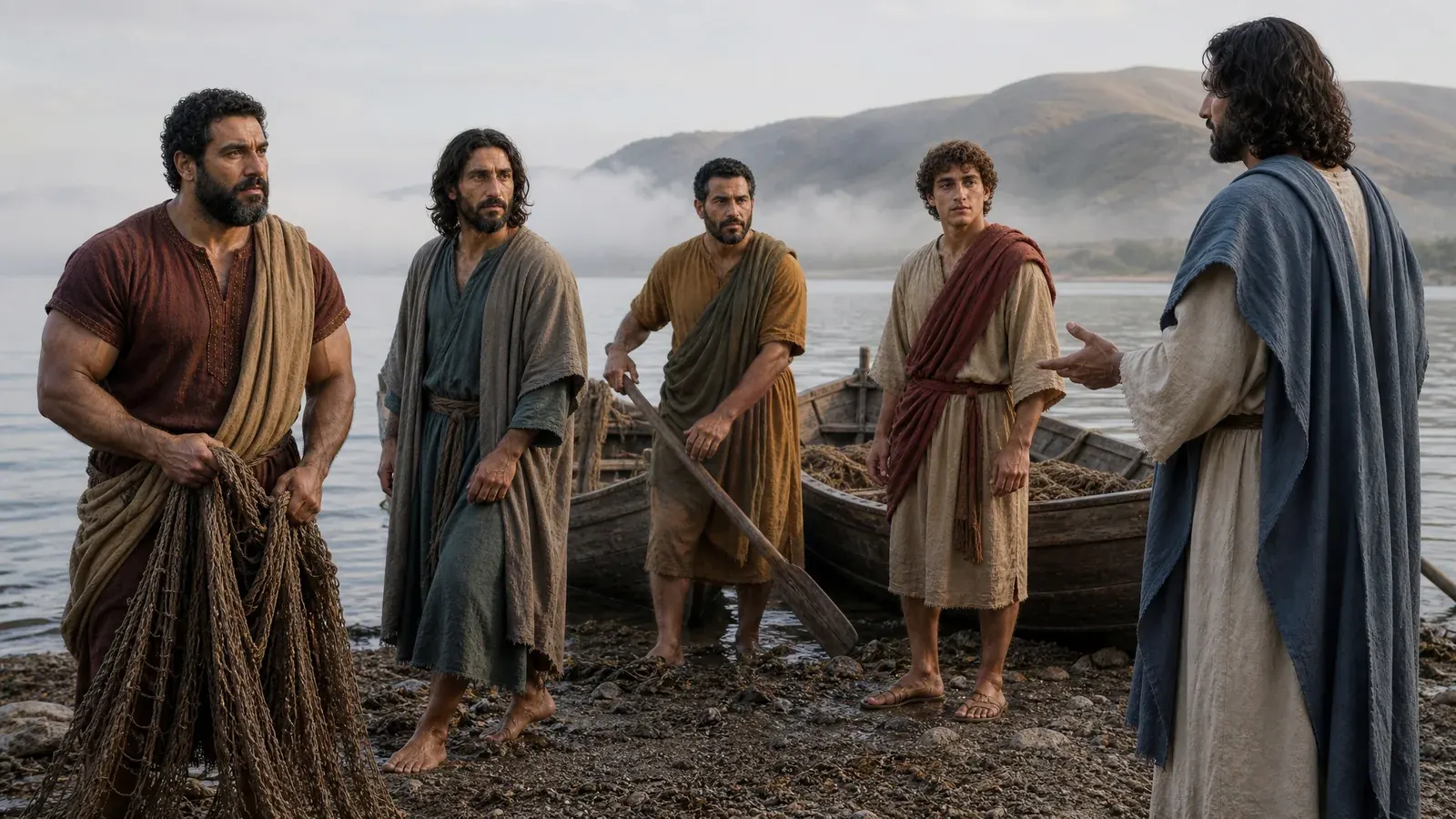
Read the two call scenes side by side. Jesus sees them at work and calls them with a promise: “I will make you to become fishers of men”. Explain that he takes their ordinary skill and gives it a new object. Draw out the difference between the pairs: the first leave nets, the second leave a father and a boat with hired men. Mark's repeated straightway shows a response without bargaining. Teach the calls here because the following scenes are what these four will now watch at close range.
Mark 1:21-28
Authority in word and command
In the synagogue at Capernaum the people are astonished at his doctrine, and the reason given is authority. Then the unclean spirit cries out and names him, “the Holy One of God”. Explain that Jesus silences it because he will not take his testimony from that source. The spirit leaves with convulsion and a cry. Point out the crowd's own conclusion in verse 27, which joins teaching and power. Teach this as one scene: the kingdom announced in verse 15 now confronts the forces opposed to it.
Mark 1:29-34
From one household to the whole city
Move to the house. Simon's mother-in-law lies sick, and Jesus “took her by the hand, and lifted her up”. Note that she ministered unto them, which means she served, the same word used of the angels in verse 13. Restored, she takes her place in the household. Then at sunset, when the Sabbath ends, the whole city comes. Explain why they wait for sunset. Note that he healed many, a word to read honestly, and that again he silences the devils.
Mark 1:35-39
Prayer before the next step
Teach verse 35 as the hinge of the passage. After the busiest day so far, Jesus withdraws in the dark to pray. The disciples hunt him down, and Simon's report presses him to return. His answer redirects them to the towns and gives his reason. Explain that the Book of Mark rarely shows Jesus praying, so each time matters; here prayer precedes a refusal of popular demand. Place it before the leper so the class sees his purpose before they see his compassion.
Mark 1:40-45
The touch, the command and the cost
The leper kneels and says, “If thou wilt, thou canst make me clean”. He does not doubt the power, only the will. Jesus, moved with compassion, touches him first and then speaks, “I will; be thou clean”. Explain that touching a leper made a person unclean under the law, yet here the cleanness flows the other way. Then the command: tell no one, go to the priest, as Moses commanded. The man's disobedience pushes Jesus into desert places. End on that exchange.
Where learners get stuck
The misreadings this passage tends to produce, and how to answer each from the text.
Mark 1:1–13
“Jesus was baptized because he needed his sins forgiven.”
Read 1:4-5 beside 1:9-11. The crowd comes “confessing their sins”, but Mark records no confession from Jesus, and what follows is not forgiveness but the Father's word, “in whom I am well pleased”. Mark does not explain why Jesus was baptized, and you should not invent a reason. It is enough to show that he stands with the people in the river while the voice from heaven sets him apart from them.
“The wilderness came because God's approval was taken away.”
Verse 11 and verse 12 are joined by immediately, and the subject of verse 12 is the Spirit who has just come upon him. The testing is God's direction, not a punishment. Verse 13 ends with angels serving him, so he is not abandoned there either. Use this to help learners who think hard seasons mean God is displeased. The beloved Son was loved and tested in the same breath.
“Mark leaves out the temptations, so he must not think they matter.”
Mark is the shortest Gospel and moves at speed throughout, so brevity is his habit, not a judgement. The two verses still carry weight: forty days, Satan, beasts and angels. Mark's interest is that the conflict with Satan has begun, and the rest of chapter 1 shows Jesus overpowering unclean spirits (1:23-27, 1:34). Say that Matthew 4 and Luke 4 give the details, and let Mark's short line stand as his own.
“John was just a strange desert preacher, so his message is about lifestyle.”
Verse 6 describes his clothing and food, and some hear only eccentricity. Point to 2 Kings 1:8, where Elijah is described in nearly the same way, and to Malachi 4:5, which promised Elijah before the day of the LORD. The description tells the reader who John is in God's plan. His message, in verses 7-8, is about the one coming after him, not about camel's hair or locusts.
Mark 1:14–45
“If you have enough faith, Jesus will heal you as he healed these people.”
Read 1:34 carefully: he healed “many”, and in 1:38 he leaves people who are still seeking him in order to preach elsewhere. The leper in 1:40 does not claim a right to healing but asks, If thou wilt. The passage shows Jesus' power and compassion, and the kingdom's arrival. It does not give a formula that guarantees healing on demand. Teach the leper's humility, and handle anyone in the room who is ill with great gentleness.
“The disciples left their families, so following Jesus means cutting off your parents.”
Verse 20 says James and John left their father in the ship “with the hired servants”, so he is not abandoned to ruin. Within ten verses Jesus is in Simon's family home caring for his mother-in-law (1:29-31). The call puts Jesus first, and in their case it meant leaving a trade. It does not license neglect of family; Jesus will rebuke exactly that in 7:10-13.
“Jesus silenced the demons because he did not want anyone to know who he was.”
He silences them “because they knew him” (1:34), yet he openly preaches in the synagogues (1:39). The point is the source and the timing. He will not have his identity announced by unclean spirits, and the Book of Mark lets the truth about him be learned through his works, his words and finally his cross, where a centurion says it (15:39). Keep the explanation short and return to the text.
“The healed leper did a good thing by telling everyone.”
Verse 44 gave him two instructions: say nothing, and go to the priest as a testimony. Verse 45 shows the effect of ignoring them: Jesus can no longer enter the city openly. The text does not condemn his joy, but it does show that his choice cost Jesus his freedom of movement. Let learners see that obedience is not the same as enthusiasm, without making the man a villain.
Learning objectives
- Trace the movement from prophetic preparation in verses 2–3 to John’s ministry, Jesus’ baptism, and the wilderness testing.
- Explain how John distinguishes his water baptism from the work of the coming mightier one in verses 7–8.
- Identify the three divine actions surrounding Jesus in verses 10–12: the heavens opening, the Spirit descending, and the heavenly voice speaking.
- Compare the titles and descriptions applied to Jesus in verses 1, 3, 7, and 11 without flattening them into one generic statement.
- Explain why Mark’s repeated sense of urgency matters to the transition from baptism to wilderness testing.
- State what verses 12–13 explicitly say about the Spirit, Satan, the wild beasts, and the angels without adding details from other Gospel accounts.
- Summarize Jesus’ proclamation in verses 14–15 using the four elements Mark gives: fulfilled time, near kingdom, repentance, and belief in the gospel.
- Compare the responses of Simon and Andrew with James and John when Jesus calls them in verses 16–20.
- Identify how the Capernaum synagogue scene demonstrates authority in both teaching and command.
- Trace the widening circle of need from the synagogue to Simon’s house, the city at the door, the solitary place, and the towns of Galilee.
- Explain why Jesus’ decision in verses 38–39 prevents the healing ministry from being reduced to crowd management in one town.
- Describe the tension created when the cleansed leper publicizes the matter despite Jesus’ direct instruction in verses 43–45.
Teacher preparation
- Read Isaiah 40:3 and Malachi 3:1 beside Mark 1:2–3 so you can explain why Mark joins prophetic language around the preparation of the Lord’s way.
- Note that the King James wording in verse 12 says the Spirit 'driveth' Jesus into the wilderness. Prepare to distinguish forceful divine direction from any suggestion that Jesus is unwilling.
- Locate Judea, Jerusalem, the Jordan, Nazareth, Galilee, and the wilderness on a simple map. The geography moves quickly, and the class should see how much ground Mark covers in thirteen verses.
- Keep the Synoptic temptation accounts nearby, but do not import their details into Mark. Mark gives forty days, Satan, wild beasts, and angelic ministry, and leaves the specific temptations unstated.
- Plan to slow the room at verses 10–11. Mark’s rapid pace can tempt a teacher to hurry past the identification of Jesus as the beloved Son, which is one of the passage’s strongest claims.
- Prepare a map showing the Sea of Galilee, Capernaum, and the surrounding Galilean region so the movement in verses 16–39 is visible rather than abstract.
- Review the King James use of 'straightway' and 'anon' in this chapter. Explain them in ordinary English before discussion so older vocabulary does not become the main obstacle.
- Read Leviticus 13–14 for the priestly examination connected with leprosy, especially the role of priestly verification. This will clarify why Jesus sends the cleansed man to the priest in verse 44.
- Distinguish the passage’s descriptions of sickness, fever, unclean spirits, and leprosy. Do not collapse every form of suffering into the same category.
- Plan how to handle verse 35 without romanticizing solitude. The text connects Jesus’ early withdrawal with prayer and then with a decision to preach elsewhere.
Evidence and interpretation checks
Explicit
Mark 1:1 names Jesus Christ as the Son of God; verses 4–8 describe John’s baptism and preaching; verses 9–11 report Jesus’ baptism, the Spirit’s descent, and the heavenly voice; verses 12–13 report the wilderness testing. Mark 1:15 records Jesus’ kingdom proclamation; verses 16–20 record four fishermen leaving work and family ties to follow him; verses 21–28 show authoritative teaching and command; verses 29–45 report healing, prayer, travel, and cleansing.
Scripture-supported
Mark 1:2–3 explicitly introduces prophetic Scripture, drawing language associated with Malachi 3:1 and Isaiah 40:3. It is therefore warranted to teach John’s ministry as fulfillment-shaped preparation rather than as an isolated religious movement. The instruction in Mark 1:44 to show oneself to the priest and offer what Moses commanded is supported by Leviticus 13–14, where priests examine conditions and restoration to communal worship is regulated.
Strong inference
Because the voice in verse 11 identifies Jesus as the beloved Son immediately before the wilderness testing, the testing should be read in light of his affirmed identity rather than as a search to discover who he is. The move in verses 35–39 from prayer to preaching elsewhere strongly suggests that Jesus refuses to let local popularity determine the boundaries of his work. Simon can say everyone seeks him, yet Jesus names other towns as the next destination.
Possible or traditional reading
Teachers often connect the forty days of verse 13 with Israel’s forty years and Moses’ forty-day periods. The numerical echo is plausible and useful, but Mark does not explain the number, so present the connection as a biblical resonance rather than an explicit interpretation supplied by this passage. The leper’s action in verse 45 is often preached simply as enthusiastic evangelism. Mark explicitly says Jesus had charged him and that the man spread the matter anyway, with the result that Jesus could no longer openly enter the city. Treat the disobedience and its consequence seriously.
Limit
Mark 1:13 does not name the individual temptations, describe a dialogue with Satan, or explain the significance of the wild beasts. Do not make any of those details carry more weight than Mark gives them here. The passage does not explain why some demons are silenced while human witnesses later speak, nor does it give a complete theory of sickness and spiritual oppression. Teach the distinctions Mark records and stop where the text stops.
Discussion with answer guidance
1. Why does Mark begin with written prophecy before John himself appears?
What a good answer contains
Verses 2-3 put Scripture on the page before any person acts: “As it is written in the prophets”, then the messenger sent before the Lord's face and the voice crying in the wilderness. By the time John appears in verse 4, the reader already knows his job is to prepare a way for someone else. A strong answer says the Book of Mark lets prophecy define John before his clothes, diet or crowds can. A weak answer treats the quotation as decoration and starts the lesson at John's camel's hair.
Show teacher guidance
Require attention to verses 2–3. A strong answer should notice that John is introduced as preparation for the Lord’s way, so his ministry is framed by Scripture before his clothing, diet, baptism, or popularity are described.
2. What contrast does John make between himself and the coming one in verses 7–8?
What a good answer contains
John makes two contrasts. The first is personal: the coming one is “mightier than I”, and John is not worthy to stoop and unloose his shoes, the task of the lowest servant (1:7). The second is about what each one does: “I indeed have baptized you with water: but he shall baptize you with the Holy Ghost” (1:8). A good answer keeps both. An answer that says only that Jesus is greater has missed that John defines the difference by the gift each brings.
Show teacher guidance
Look for both personal unworthiness and the difference between water baptism and baptism with the Holy Ghost. Do not accept only 'Jesus is greater' if the answer ignores how John states the difference.
3. What happens at Jesus’ baptism that the crowds coming to John in verses 4–5 are not said to experience?
What a good answer contains
The crowds of verse 5 go out, are baptized and confess their sins. Nothing more is said to happen to them. With Jesus, Mark reports three things in quick order: “he saw the heavens opened”, the Spirit descends like a dove upon him, and a voice from heaven speaks to him (1:10-11). Note that Jesus confesses no sins. A strong answer stays with what Mark says and does not borrow the crowd's confession onto Jesus or the dove onto the crowd.
Show teacher guidance
Anchor the answer in verses 10–11: the heavens open, the Spirit descends like a dove upon Jesus, and the heavenly voice addresses him as the beloved Son. Keep the comparison inside Mark’s wording.
4. Why is verse 12 striking immediately after verse 11?
What a good answer contains
Verse 11 is the Father's word of love, “Thou art my beloved Son, in whom I am well pleased”, and verse 12 opens with “immediately the Spirit driveth him into the wilderness”. The same Spirit that came down on him now sends him out. A good answer sees that approval leads straight into testing, not into ease. A weak answer reads the wilderness as a sign that something went wrong after the baptism, when Mark presents it as the Spirit's own direction.
Show teacher guidance
Have the class put the two verses side by side. The beloved Son is not led from affirmation into comfort but is immediately driven by the Spirit into the wilderness. The sequence is the point.
5. What four details does Mark actually give about the wilderness period in verse 13?
What a good answer contains
Verse 13 gives four things: forty days in the wilderness, “tempted of Satan”, “with the wild beasts”, and “the angels ministered unto him”. That is all Mark says. A strong answer lists these four and stops. If someone describes stones turned to bread or the pinnacle of the temple, thank them and name where those details come from, the longer accounts in Matthew and Luke, so that the class learns to read Mark as Mark.
Show teacher guidance
Expect forty days, temptation by Satan, presence with wild beasts, and ministry by angels. If someone supplies stones, temple pinnacle, or kingdoms, identify those as details from other Gospel accounts rather than from Mark.
6. How does this opening prepare a reader for the question of Jesus’ identity in the rest of Mark?
What a good answer contains
The reader is told in verse 1 that Jesus is the Christ and “the Son of God”, hears John call him mightier in verse 7, and hears the voice from heaven in verse 11. The people in the book will take chapters to see this, and the disciples will struggle with it until chapter 8. A good answer names that tension: the reader knows more than the characters, so the reader watches how slowly others recognise him and asks whether they would have seen it.
Show teacher guidance
Bring answers back to verses 1, 7–8, and 11. The reader receives unusually strong identification before many characters in Mark do, which creates a useful tension for everything that follows.
7. What four claims or commands make up Jesus’ preaching in verse 15?
What a good answer contains
Verse 15 holds two announcements and two commands: “The time is fulfilled”, “the kingdom of God is at hand”, “repent ye”, and “believe the gospel”. The announcements come first, so the commands answer something God has done. A strong answer names all four and keeps their order. A weak answer reduces the verse to repent, as if the message were only a demand, or to believe, as if no turning were asked for.
Show teacher guidance
Expect the fulfilled time, the kingdom of God at hand, repent, and believe the gospel. Require all four so the verse is not reduced to a single slogan.
8. What do the four fishermen leave, and what does Mark emphasize about the speed of their response?
What a good answer contains
Simon and Andrew leave their nets (1:18); James and John leave their nets and “their father Zebedee in the ship with the hired servants” (1:20). The second call costs more: family and the family business. Both responses are marked by straightway. A good answer notices the rising cost and the unhesitating response, and that the hired servants mean Zebedee is not left destitute, so the text is not about abandoning family in need.
Show teacher guidance
Use verses 18 and 20. Simon and Andrew leave nets; James and John leave their father Zebedee in the ship with hired servants. Both calls receive an immediate response.
9. What makes the synagogue audience compare Jesus’ teaching with that of the scribes in verse 22?
What a good answer contains
Verse 22 says it outright: “he taught them as one that had authority, and not as the scribes”. The scribes taught by citing earlier teachers; Jesus speaks in his own name. Then verses 23-27 demonstrate it, because the same voice that taught silences and expels an unclean spirit, and the crowd joins the two: “what new doctrine is this? for with authority commandeth he even the unclean spirits”. The strong answer keeps teaching and command together.
Show teacher guidance
The stated contrast is authority. Then connect verses 23–27, where his spoken command also demonstrates authority over the unclean spirit.
10. What does Jesus do after the whole city gathers at the door, and why does the next morning matter?
What a good answer contains
At evening “all the city was gathered together at the door” (1:33), and he heals many and casts out many devils. Then “rising up a great while before day, he went out, and departed into a solitary place, and there prayed” (1:35). A good answer sees the movement from crowded demand to solitary prayer, and that prayer comes right before the decision of verse 38. A weak answer makes prayer a rest break rather than the place where his direction is held.
Show teacher guidance
Verses 32–35 move from intense public demand to solitary prayer before dawn. Keep the sequence intact before discussing what it may teach about ministry.
11. How does Jesus answer Simon’s report that everyone is seeking him?
What a good answer contains
Simon reports, “All men seek for thee”, which sounds like success. Jesus answers, “Let us go into the next towns, that I may preach there also: for therefore came I forth” (1:38). He does not return to the crowd waiting for more healings. A strong answer says preaching is named as his purpose, and the healings serve it rather than replace it. Watch for answers that suggest Jesus did not care about the sick; verse 41 says he was moved with compassion.
Show teacher guidance
Verse 38 is decisive. Jesus proposes going to nearby towns to preach there also and gives the reason that this is why he came forth.
12. What consequence follows the cleansed man’s decision to publish the matter widely?
What a good answer contains
The man was told to say nothing and to go to the priest (1:44). Instead he “began to publish it much”, and the result is that Jesus “could no more openly enter into the city, but was without in desert places” (1:45). The healed man moves into the towns and Jesus is pushed out to the edges, where the leper used to live. A good answer names that exchange and does not praise disobedience as harmless enthusiasm.
Show teacher guidance
Verse 45 says Jesus could no longer openly enter the city but remained outside in desert places, while people continued coming to him from every quarter. Do not describe the man’s action as costless zeal.
Responsible application
Heart and habits
Ask the class to name habits of reading that would keep verse 11 and verse 12 together rather than treating divine approval as a promise of immediate ease.
Relationships and community
Examine how John uses his public influence in verses 7–8. Ask what features of his speech keep attention on the one coming after him rather than on himself.
Earned by this passage
Give the class a list of details from the temptation accounts across the Gospels and have them mark only what Mark 1:12–13 states. Use the exercise to practice respecting the boundaries of a passage.
Session plans
Two timings of the same lesson. The shorter keeps the reading, the central discussion and one response; the longer gives the confusions and the application their own time.
Mark 1:1–13
45 minutes
Read the opening
Read 1:1-13 aloud without stopping. Ask the class to count the titles given to Jesus and to note every change of place.
Prophecy and the forerunner
Read 1:2-8 again with Isaiah 40:3 open. Take questions one and two, and handle the confusion about John's clothing (confusion four) in a minute.
The heavens opened
Work through 1:9-11 clause by clause with question three. Deal with confusion one, that Jesus was baptized for his own sins, from the text of verse 5 and verse 11.
Straight into the wilderness
Read verses 11 and 12 together and ask question four, then question five. Address confusion two, that testing means God is displeased.
The reader knows
Ask question six. Write Son of God on the board and tell the class to watch for who says it next in Mark.
Response and handout
Choose the first application, give out the handout and read the key verse together before praying.
90 minutes
What do people call Jesus
Ask the group to list titles people give Jesus today. Keep the list visible, then read verse 1 and compare.
Read and map
Read 1:1-13 aloud. Mark Judea, Jerusalem, the Jordan, Nazareth and the wilderness on a sketch map.
The prophets and the voice
Read Isaiah 40:3-5 and Malachi 3:1, then Mark 1:2-3. Take question one and explain that the way prepared is the way of the Lord himself.
John who points away
Read 1:4-8 with 2 Kings 1:8. Take question two and confusion four. Ask what it looks like to be a voice that points away from itself.
The baptism
Work 1:9-11 slowly. Take question three and confusion one. Read Psalm 2:7 and Isaiah 42:1 as background to the words of the voice, briefly.
Driven into the wilderness
Read verses 12-13. Take questions four and five, then confusions two and three. Compare Mark's verse 13 with Matthew 4:1-11 only to show what Mark leaves out.
Who is he
Take question six. Return to the opening list of titles and ask which of them the passage confirms, corrects or adds to.
Application and handout
In pairs, work through one of the three applications. Read the key verse aloud together, give out the handout and close in prayer.
Mark 1:14–45
45 minutes
Hear the whole chapter section
Read 1:14-45 aloud. Ask the class to list each place Jesus goes, in order.
The message and the calls
Put verse 15 on the board in four parts. Take questions one and two together, and briefly address the confusion about families (confusion two).
Authority in Capernaum
Read 1:21-34. Take question three. Address confusion three, why the demons are silenced, in two or three sentences.
Prayer and purpose
Read 1:35-39 and take questions four and five. Ask what Jesus chose not to do that morning.
The leper
Read 1:40-45 and take question six. Handle confusion one, healing on demand, with care for anyone who is ill.
Handout
Read the key verse aloud, give out the handout and close in prayer.
90 minutes
What would you do with fame
Ask the group what someone does when everyone is looking for them. Then read 1:37 and hold the answer until later.
The announcement
Read 1:14-15 and Isaiah 52:7. Take question one and write the four parts of verse 15 on the board.
The calls
Read 1:16-20. Take question two and confusion two. Ask what ordinary skill of theirs Jesus took up into his call.
Synagogue and house
Read 1:21-34. Take question three and confusion three. Explain why the city waited for sunset.
Before dawn
Read 1:35-39 and take questions four and five. Return to the opening question about fame and compare it with verse 38.
The leper and the cost
Read 1:40-45 with Leviticus 13:45-46 beside it. Take question six, then confusions one and four. Give time to the touch in verse 41.
Application
Work through the first application in groups of three, contrasting verse 37 with verse 38 in their own week.
Handout and prayer
Read the key verse together, hand out the sheet, and pray for those who are sick without promising outcomes.
Adapting the lesson
Mark 1:1–13
Children
Use a road picture: lay a long strip of paper on the floor and let children clear stones off it while you read “Prepare ye the way of the Lord”. Then show a bowl of water and a paper dove for the baptism. Read verse 11 as the most important words, and let them repeat it. Keep the wilderness simple: Jesus was there forty days, and angels helped him. Do not frighten them with Satan.
Youth
Ask what it is like to be praised in public and then face something hard straight after. Read verses 11-12 together. Let them notice that God's approval did not make life easy. Spend time on John as someone with a big following who keeps saying it is not about him, and ask what that would look like online. Keep the conversation on the text rather than on any one person's struggles.
Adults
Give time to the Old Testament background: Isaiah 40, Malachi 3, Elijah in 2 Kings 1:8, and the voice's echo of Psalm 2:7. Let adults see how much the opening claims for Jesus through borrowed Scripture. Then press the pastoral point of verses 11-12 for those who read hardship as rejection, and let them test that against the order of the verses.
One to one
Read the thirteen verses aloud together and ask which line stood out. If it is verse 11, ask what it would mean to them to be addressed by God in that way through Jesus. If they are in a difficult season, sit with verses 12-13 and the angels who served him, without promising that their hardship will end soon.
Mark 1:14–45
Children
Act out the fishermen with a blanket for a net: when you say Come, they drop it and follow you round the room. For the leper, explain simply that he had a skin sickness and people kept away, but Jesus touched him. Let them notice the touch came before the words. Do not suggest that sick people they know will be healed if they pray hard enough.
Youth
Start with verse 37 and 38: everybody wants him, and he walks away to preach elsewhere. Ask how they decide what to say no to. Then look at the four fishermen leaving their work, and ask what it would mean today to have your skills redirected. Be careful with healing: some in the room may have prayed for someone who was not healed. Let the leper's If thou wilt be honest language.
Adults
Give attention to the structure: announcement, call, authority, a full day, prayer, and the leper. Ask how verse 35 shapes the rest. Discuss the law of Leviticus 13 behind the touch. Let adults reflect on how they handle demand and purpose. Be ready for questions about why some are healed and some are not; answer from the text and do not offer formulas.
One to one
Read the passage together and ask which person in it they most identify with: the fishermen, the mother-in-law, the crowd, or the leper. Follow their answer. If they are ill or grieving someone who was not healed, read verse 41 for Jesus' compassion and let them speak freely. Pray with them using the leper's own words.
Song and video learning lab
A song or video may interpret, compress, or dramatize the text. Its value becomes clearer when its choices are compared with Scripture.
- Before the media: the exact passage and its central movement.
- During the media: the words, people, events, and emotions the artist emphasizes.
- After the media: what it clarifies, what it leaves out, and what belongs back in the biblical text.
Handout
One page for learners to take home. The print button prints this section alone.
Mark 1:1–13
The passage in brief
Mark begins by saying who Jesus is: the Christ, the Son of God. The prophets had promised a messenger who would prepare the way of the Lord, and John the Baptist is that messenger, calling people to turn back to God and pointing to someone greater. When Jesus is baptized, heaven opens, the Spirit comes down on him like a dove, and God calls him his beloved Son. Straight away the Spirit sends him into the wilderness, where he is tested by Satan for forty days and angels serve him.
A verse to keep
And there came a voice from heaven, saying, Thou art my beloved Son, in whom I am well pleased.
Mark 1:11 · King James Version
Questions to take home
What do verses 1-3 tell you about Jesus before he even appears?
How does John keep attention on Jesus rather than on himself in verses 7-8?
What does the order of verses 11 and 12 teach you about God's love and hard times?
This week
Read verse 11 each morning this week and remember that God's love for his Son does not depend on easy days.
Mark 1:14–45
The passage in brief
After John is put in prison, Jesus begins preaching that God's kingdom has come near and that people should turn and believe. He calls four fishermen, who leave their work at once. In Capernaum he teaches with authority and drives out an unclean spirit, heals Simon's mother-in-law, and that evening heals many. Early the next morning he prays alone, then moves on to preach in other towns. A leper asks to be made clean, and Jesus touches him and heals him.
A verse to keep
And saying, The time is fulfilled, and the kingdom of God is at hand: repent ye, and believe the gospel.
Mark 1:15 · King James Version
Questions to take home
What four things does Jesus say in verse 15?
Why do you think Jesus went to pray in verse 35 after such a full day?
What did the leper believe about Jesus, and what was he unsure of (1:40)?
This week
Before you start each day this week, take five minutes alone to pray before you answer anyone's demands.
Music and video connected to the passage
Related media appears when its Scripture reference overlaps this study. Music and video can illuminate a theme while the biblical text remains the foundation.