The big picture
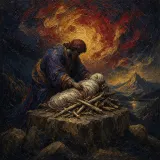
Hezekiah begins his reign at the doors his father shut. In the first month of the first year, he opens and repairs the temple, calls priests and Levites back to their responsibilities, and names the neglect of the house as part of Judah's recent disaster. The cleansing takes sixteen days and depends on named workers performing distinct tasks. Objects discarded under Ahaz are recovered and sanctified, but a clean building is only the beginning. Offerings are made for the kingdom, sanctuary, Judah, and expressly for all Israel. Then sacrifice and music begin together according to the inherited arrangements associated with David and the prophets. The restoration is orderly without pretending to be effortless. When the congregation brings offerings in abundance, too few priests are ready, so Levites help until the work is done. The chapter ends with rejoicing at something achieved suddenly, but not magically. Sixteen days of cleansing, renewed sacrifice, recovered instruments, sanctified ministers, and a people's unexpected response stand behind the open doors.
In this chapter
- The First Month Begins at the Doors 2 Chronicles 29:1-11
Hezekiah's first recorded action is almost aggressively specific: first year, first month, open the doors.
- Restoration Takes Named Workers and Sixteen Days 2 Chronicles 29:12-19
The restoration gets names and a calendar.
- The Offering Reaches Beyond Judah 2 Chronicles 29:20-24
Once the house is clean, Hezekiah does not treat the repair itself as sufficient.
- The Offering and the Song Begin Together 2 Chronicles 29:25-30
The music returns under an authority the chapter takes pains to name.
- The Response Outgrows the Available Staff 2 Chronicles 29:31-36
The congregation's response becomes so large that the restored system strains under it.

Scripture beside the summary
2 Chronicles · King James Version · 362 Chronicles 29:1-11
The First Month Begins at the Doors
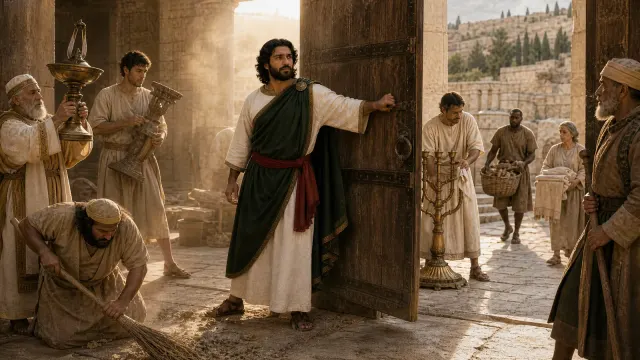
Hezekiah's first recorded action is almost aggressively specific: first year, first month, open the doors. Ahaz had ended his reign by shutting the house of the LORD; his son begins by repairing the entrance and summoning the ministers back to work. In Hezekiah's speech, religious neglect is described through things a person could have seen. Doors were shut, lamps went dark, incense ceased, offerings stopped, and people literally turned their backs on the sanctuary. He also connects that abandonment with Judah's visible losses, including people killed and families taken captive. The proposed answer is covenant renewal, not merely building maintenance. Before priests and Levites cleanse the house, they must sanctify themselves. Their office gives them responsibility, not immunity from preparation. Hezekiah calls them to stand before the LORD and minister without claiming their priestly work for himself. After Uzziah's attempt to cross that boundary, the distinction matters. The king can reopen the house and command attention to it while still respecting who is appointed to serve inside it.
Deep dive
The precision of the opening matters: first year, first month, open doors. Hezekiah does not begin with a campaign or a palace extension. His first recorded work reverses Ahaz's last sustained attack on the temple. The contrast with David in the preceding chapter is also reversed; this king's right conduct is measured positively against David's.
His speech describes abandonment through physical actions. Faces have turned away, backs have turned toward the house, doors have shut, lamps have gone out, and the appointed offerings have ceased. The language makes neglect observable rather than leaving it as an abstract religious failure. Hezekiah also names the human consequences, including relatives killed or taken captive. His proposed covenant is directed toward the turning away of divine wrath.
Before the ministers cleanse the house, they are to sanctify themselves. Their appointment to stand before the LORD is the ground of their responsibility. The king calls them his sons while addressing their neglected service; he is summoning the priestly and Levitical body to its work, not claiming its altar duties for himself as Uzziah did.
Words to trace: LORD, fathers, doors, eyes, first, holy
Verse-by-verse path
- 2 Chronicles 29:1
Hezekiah, Hizqiyyahu, means “the LORD strengthens”, carrying the verb hazaq that has run through every reign in the book. His mother is Abi in 2 Kings 18:2. Her father Zechariah might be Isaiah’s trusted witness of that name (Isaiah 8:2), but nothing makes the link certain.
- 2 Chronicles 29:2
Kings says of Hezekiah that “after him was none like him among all the kings of Judah” (2 Kings 18:5), and gives most of its space to Sennacherib’s invasion. The Book of 2 Chronicles gives him four chapters and spends three of them on the temple and its worship.
- 2 Chronicles 29:3
“Repaired” is hazaq, the root of the king’s own name. 2 Kings 18:16 records the bitter sequel: years later Hezekiah stripped the gold from “the doors of the temple of the LORD” to pay Sennacherib. The doors he repairs first are the ones he will have to strip.
- 2 Chronicles 29:4
The “east street” is an open square on the east side, before the temple’s main entrance, since the building faced east. The ministers are gathered outside because the house itself is not yet fit to enter.
- 2 Chronicles 29:5
“Filthiness” is niddah, the word for the impurity of menstruation (Leviticus 15:19), the strongest term for defilement in the law, which the prophets applied to idols. “Levites” in this speech covers the whole tribe, priests included.
- 2 Chronicles 29:6
Turning the back on the house was a literal posture: Ezekiel saw men in the temple court “with their backs toward the temple of the LORD, and their faces toward the east”, worshipping the sun (Ezekiel 8:16). “Habitation” is mishkan, the word for the tabernacle.
- 2 Chronicles 29:7
Hezekiah lists the lamps, the incense and the burnt offerings: the very services Abijah boasted of in 13:11 as proof that Judah had not forsaken the LORD. Two centuries later all of them had stopped.
- 2 Chronicles 29:8
“Trouble, astonishment, and hissing” is the vocabulary of Jeremiah (Jeremiah 19:8, 29:18). A hissing was the low whistle a passer-by gave at the sight of a ruin. “As ye see with your eyes” appeals to what the listeners already knew.
- 2 Chronicles 29:9
The captives of 28:8 had been sent home from Samaria, so Hezekiah must mean those taken to Damascus and by Edom (28:5, 17), whom no one returned. Fathers, sons, daughters and wives: every member of a household is named in the loss.
- 2 Chronicles 29:10
“It is in mine heart” is what David said of building the temple (1 Chronicles 22:7). This is the book’s third covenant of renewal, after Asa’s (15:12) and Jehoiada’s (23:16). Its aim is stated first: that the burning anger may turn.
- 2 Chronicles 29:11
“My sons” is how a teacher addresses pupils in Proverbs. “Be not now negligent” uses a rare verb for being careless or at ease. The rest echoes Deuteronomy 10:8, where the LORD set Levi apart “to stand before the LORD to minister unto him”.
2 Chronicles 29:1-11
King James Version1Hezekiah began to reign when he was five and twenty years old, and he reigned nine and twenty years in Jerusalem. And his mother’s name was Abijah, the daughter of Zechariah.
2And he did that which was right in the sight of the LORD, according to all that David his father had done.
3He in the first year of his reign, in the first month, opened the doors of the house of the LORD, and repaired them.
4And he brought in the priests and the Levites, and gathered them together into the east street,
5And said unto them, Hear me, ye Levites, sanctify now yourselves, and sanctify the house of the LORD God of your fathers, and carry forth the filthiness out of the holy place.
6For our fathers have trespassed, and done that which was evil in the eyes of the LORD our God, and have forsaken him, and have turned away their faces from the habitation of the LORD, and turned their backs.
7Also they have shut up the doors of the porch, and put out the lamps, and have not burned incense nor offered burnt offerings in the holy place unto the God of Israel.
8Wherefore the wrath of the LORD was upon Judah and Jerusalem, and he hath delivered them to trouble, to astonishment, and to hissing, as ye see with your eyes.
9For, lo, our fathers have fallen by the sword, and our sons and our daughters and our wives are in captivity for this.
10Now it is in mine heart to make a covenant with the LORD God of Israel, that his fierce wrath may turn away from us.
11My sons, be not now negligent: for the LORD hath chosen you to stand before him, to serve him, and that ye should minister unto him, and burn incense.
2 Chronicles 29:12-19
Restoration Takes Named Workers and Sixteen Days
The restoration gets names and a calendar. Kohathites, Merarites, Gershonites, and families associated with temple music are identified among those who rise to the work, so the cleansing is not performed by an anonymous crowd. Priests and Levites also handle different stages of removing uncleanness. Priests bring it from the inner house into the court, and Levites carry it onward to the Kidron. The Book of 2 Chronicles preserves these boundaries even while everyone is working toward the same goal. Time matters too. The work begins on the first day of the month, reaches the porch by the eighth, and finishes on the sixteenth. That date places the normal Passover time behind them and prepares the scheduling problem in the next chapter. When the workers report to Hezekiah, they name more than swept floors. Altar, table, vessels, and especially objects discarded by Ahaz are prepared again. Restoration means recovering the equipment and order required for service, not simply making the building look clean.
Deep dive
The names place actual families within the restoration. Kohathites, Merarites, and Gershonites appear alongside the houses associated with temple music. These are not interchangeable workers who happen to be available. The service is being reassembled through the people appointed to its several responsibilities.
The removal of uncleanness also respects a boundary. Priests bring it from the inner part of the house into the court; Levites carry it onward to the Kidron. The chapter later allows practical help where staffing is short, but it does not begin by dissolving the distinctions of temple service. Their report names the altar, table, and vessels because readiness means more than clearing a room.
The dated sequence reaches completion on the sixteenth day of the first month. That is already beyond the usual fourteenth-day Passover date, a detail that helps explain the next chapter's timing. The final report reaches back to Ahaz by naming the vessels he cast away. Objects associated with his transgression are now prepared and sanctified for the service he had interrupted.
Words to trace: LORD, sons, house, first, king, month
Verse-by-verse path
- 2 Chronicles 29:12
Levi had three sons, Kohath, Merari and Gershon (Numbers 3:17), and each house sends two men. Mahath, Amasai, Joel and Azariah are all names in the Kohathite line of 1 Chronicles 6:35–36; families reused ancestral names. Eden son of Joah seems to stand beside his father Joah.
- 2 Chronicles 29:13
Elizaphan was the Kohathite chief of Numbers 3:30, and as Elzaphan he was one of the two cousins who carried the bodies of Nadab and Abihu out of the sanctuary (Leviticus 10:4). His descendants now carry out uncleanness again. Zechariah and Mattaniah represent Asaph’s singers.
- 2 Chronicles 29:14
With Heman and Jeduthun, all three of David’s musical guilds are present (1 Chronicles 25:1–6). The fourteen names form seven pairs: the three branches of Levi, the house of Elizaphan, and the three choirs. The singers work as cleaners before they sing.
- 2 Chronicles 29:15
“By the words of the LORD” sets the king’s order under the law’s authority: Hezekiah commands what the LORD has already required. The fourteen named leaders gather their kinsmen, so the work is done by families.
- 2 Chronicles 29:16
The Kidron valley ran below the temple’s east side and was where Jerusalem’s refuse and unclean things were destroyed; Josiah later burned the Asherah there and scattered its dust “upon the graves of the children of the people” (2 Kings 23:6).
- 2 Chronicles 29:17
The work moves from outside inward: eight days for the courts, reaching the porch on the eighth, and eight days for the house itself. The sixteenth day of the first month is two days past the fourteenth, the date the law fixed for the Passover.
- 2 Chronicles 29:18
The report names the altar of burnt offering and the table of shewbread with their vessels, and says nothing of the lampstands or the incense altar, though their neglect was listed in verse 7. Perhaps the report is selective, or those had simply been left in place.
- 2 Chronicles 29:19
“Cast away” is zanah, to reject, the verb David used when he warned Solomon, “if thou forsake him, he will cast thee off for ever” (1 Chronicles 28:9). Ahaz had cast off the vessels; the Levites bring them back and set them before the altar.
2 Chronicles 29:12-19
King James Version12Then the Levites arose, Mahath the son of Amasai, and Joel the son of Azariah, of the sons of the Kohathites: and of the sons of Merari, Kish the son of Abdi, and Azariah the son of Jehalelel: and of the Gershonites; Joah the son of Zimmah, and Eden the son of Joah:
13And of the sons of Elizaphan; Shimri, and Jeiel: and of the sons of Asaph; Zechariah, and Mattaniah:
14And of the sons of Heman; Jehiel, and Shimei: and of the sons of Jeduthun; Shemaiah, and Uzziel.
15And they gathered their brethren, and sanctified themselves, and came, according to the commandment of the king, by the words of the LORD, to cleanse the house of the LORD.
16And the priests went into the inner part of the house of the LORD, to cleanse it, and brought out all the uncleanness that they found in the temple of the LORD into the court of the house of the LORD. And the Levites took it, to carry it out abroad into the brook Kidron.
17Now they began on the first day of the first month to sanctify, and on the eighth day of the month came they to the porch of the LORD: so they sanctified the house of the LORD in eight days; and in the sixteenth day of the first month they made an end.
18Then they went in to Hezekiah the king, and said, We have cleansed all the house of the LORD, and the altar of burnt offering, with all the vessels thereof, and the shewbread table, with all the vessels thereof.
19Moreover all the vessels, which king Ahaz in his reign did cast away in his transgression, have we prepared and sanctified, and, behold, they are before the altar of the LORD.
2 Chronicles 29:20-24
The Offering Reaches Beyond Judah
Once the house is clean, Hezekiah does not treat the repair itself as sufficient. He rises early, gathers the city's rulers, and brings offerings for the kingdom, sanctuary, and Judah. The handling of the animals and blood returns the altar to active service, and the goats presented before king and congregation make the act publicly connected with the people standing there. Then the scope widens beyond the southern kingdom. Hezekiah commands that the burnt offering and sin offering be made "for all Israel." That phrase matters because the throne he occupies rules Judah, not the old united monarchy. The restored worship at Jerusalem is nevertheless conceived with the larger people in view. The next chapter will send letters north to Ephraim and Manasseh, but the movement starts here at the altar. Before anyone from the northern tribes answers an invitation, the renewed service names them within its concern. A reopened temple becomes more than a local royal project; its atonement is expressly directed toward all Israel.

Deep dive
A cleansed building is not treated as the whole restoration. The king rises early, gathers the rulers, and comes with offerings that address the kingdom, sanctuary, and people. The account distinguishes the animals brought, the handling of blood, and the goats presented before king and congregation. Their laying hands upon the goats publicly associates them with the offering; the rite concerns those standing there, not merely the condition of the temple furniture.
The geographical reach then becomes explicit. Although Hezekiah governs Judah, the burnt offering and sin offering are commanded for "all Israel." The expression is repeated rather than left to be inferred. The renewed service in Jerusalem is not conceived only as the private religious repair of the southern monarchy. That enlarged scope prepares the letters to the northern tribes in chapter 30. First the altar service names all Israel; then the invitation seeks to gather people from beyond Judah around it.
Words to trace: altar, blood, killed, offering, seven, king
Verse-by-verse path
- 2 Chronicles 29:20
Rising early is the mark of urgency in Hebrew narrative, as with Abraham on the morning he set out for Moriah (Genesis 22:3). The “rulers of the city” are its leading officials, who now climb to the temple behind their king.
- 2 Chronicles 29:21
Seven of each kind is a lavish, complete offering. The law asked for one young bull for a sin of the whole congregation (Leviticus 4:14) and one goat for a ruler (Leviticus 4:23). The three purposes, kingdom, sanctuary and Judah, cover the dynasty, the building and the people.
- 2 Chronicles 29:22
“Sprinkled” is zaraq, to dash or throw the blood against the altar’s sides, as for a burnt offering (Leviticus 1:5). The verse repeats the action for each kind of animal, bullocks, rams, lambs, as if counting them onto the altar one by one.
- 2 Chronicles 29:23
The goats are held back from the rest and brought out separately, because they are the sin offering. Leviticus 4:15 has the elders lay their hands on the bull offered for the congregation’s sin; here king and congregation together lay hands on the goats.
- 2 Chronicles 29:24
“Made reconciliation” is hitte, to purge of sin, from the same root as “sin offering”; “atonement” is kipper. Burnt offering and sin offering together are the pair offered for the whole people on the Day of Atonement (Leviticus 16:24). The reach of the rite is set by the king’s explicit order.
2 Chronicles 29:20-24
King James Version20Then Hezekiah the king rose early, and gathered the rulers of the city, and went up to the house of the LORD.
21And they brought seven bullocks, and seven rams, and seven lambs, and seven he goats, for a sin offering for the kingdom, and for the sanctuary, and for Judah. And he commanded the priests the sons of Aaron to offer them on the altar of the LORD.
22So they killed the bullocks, and the priests received the blood, and sprinkled it on the altar: likewise, when they had killed the rams, they sprinkled the blood upon the altar: they killed also the lambs, and they sprinkled the blood upon the altar.
23And they brought forth the he goats for the sin offering before the king and the congregation; and they laid their hands upon them:
24And the priests killed them, and they made reconciliation with their blood upon the altar, to make an atonement for all Israel: for the king commanded that the burnt offering and the sin offering should be made for all Israel.
2 Chronicles 29:25-30
The Offering and the Song Begin Together
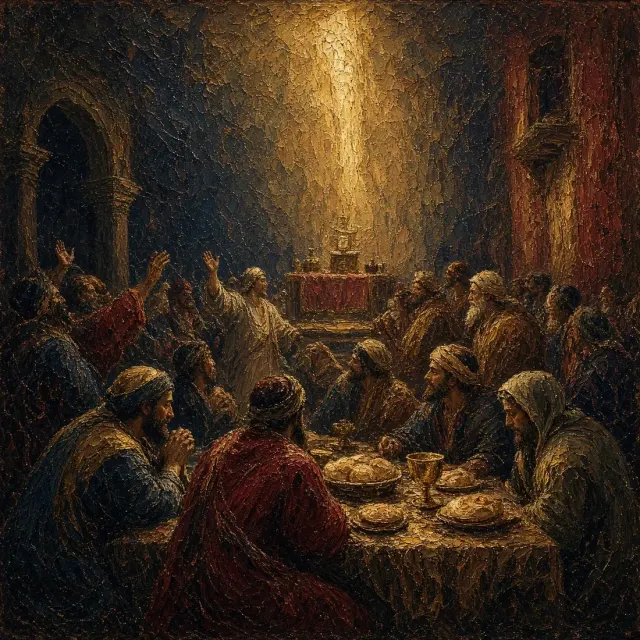
The music returns under an authority the chapter takes pains to name. Levites stand with cymbals, psalteries, and harps according to arrangements associated with David, Gad, and Nathan, while priests hold the trumpets. This is not Hezekiah inventing a festive soundtrack for a new reign. The received order is connected with the LORD's command through his prophets. Then timing binds music to sacrifice: when the burnt offering begins, "the song of the LORD began also," and the singing and trumpets continue until the offering is finished. The chapter refuses to divide solemn worship from vigorous praise as though one must cancel the other. The congregation bows, singers sing, trumpets sound, and afterward the Levites praise with the words of David and Asaph with gladness. Music is not an intermission inserted around the real service. It moves with the offering itself. The reopened house has regained not only vessels and ministers but the sound of an inherited worship that Ahaz had silenced.
Deep dive
The musical arrangements are given an authority beyond royal preference. David, Gad, and Nathan are named, and their direction is identified with the LORD's command through his prophets. Levites stand with the instruments associated with David, while priests hold trumpets. The restoration concerns who serves, what they use, and the received order of their work.
The account makes the timing audible. When the burnt offering begins, the song begins; singing, trumpets, and congregational worship continue until the offering is finished. Music is not described as an interval inserted between more important business. It accompanies the act itself. The words of David and Asaph then give the praise an inherited language, though no particular psalm is identified. Gladness and bowing appear together. The chapter does not oppose the energy of the restored music to the solemnity of the service; both belong to the same gathering in the reopened house.
Words to trace: David, LORD, offering, burnt, king, Levites
Verse-by-verse path
- 2 Chronicles 29:25
Only here does Scripture say the temple music was commanded through Gad and Nathan as well as David. Gad was the seer of the census plague (1 Chronicles 21:9), Nathan the prophet of the covenant (1 Chronicles 17). Cymbals, psalteries and harps are the three instruments of 1 Chronicles 15:16.
- 2 Chronicles 29:26
“The instruments of David” are those David made for praise (1 Chronicles 23:5). Amos 6:5 attacks idle revellers who “invent to themselves instruments of musick, like David”, so David’s reputation as an instrument maker was proverbial. The trumpets stay with the priests, as in Numbers 10:8.
- 2 Chronicles 29:27
“The song of the LORD” is shir YHWH, the phrase the exiles use in Psalm 137:4, “How shall we sing the LORD’s song in a strange land?” The music begins at the moment the fire takes the burnt offering.
- 2 Chronicles 29:28
A whole burnt offering of this size would take hours to burn, and the Hebrew uses participles, worshipping, singing, sounding, for continuous action. The congregation stays prostrate while the choir sings over them.
- 2 Chronicles 29:29
The king bows in the court, the opposite of Uzziah, who pushed past the priests into the house (26:16). “All that were present with him” includes the officials of verse 20. Worship at the end repeats the worship during.
- 2 Chronicles 29:30
Asaph is called “the seer”, a prophet in his own right. Twelve psalms bear his name (Psalms 50 and 73–83). “The words of David, and of Asaph” suggests that a collection of psalms under their names was already in use in Hezekiah’s day.
2 Chronicles 29:25-30
King James Version25And he set the Levites in the house of the LORD with cymbals, with psalteries, and with harps, according to the commandment of David, and of Gad the king’s seer, and Nathan the prophet: for so was the commandment of the LORD by his prophets.
26And the Levites stood with the instruments of David, and the priests with the trumpets.
27And Hezekiah commanded to offer the burnt offering upon the altar. And when the burnt offering began, the song of the LORD began also with the trumpets, and with the instruments ordained by David king of Israel.
28And all the congregation worshipped, and the singers sang, and the trumpeters sounded: and all this continued until the burnt offering was finished.
29And when they had made an end of offering, the king and all that were present with him bowed themselves, and worshipped.
30Moreover Hezekiah the king and the princes commanded the Levites to sing praise unto the LORD with the words of David, and of Asaph the seer. And they sang praises with gladness, and they bowed their heads and worshipped.
2 Chronicles 29:31-36
The Response Outgrows the Available Staff
The congregation's response becomes so large that the restored system strains under it. Sacrifices, thank offerings, and freehearted burnt offerings arrive in abundance, and the problem is no longer whether anyone will participate. There are too few sanctified priests to flay all the offerings. The Book of 2 Chronicles does not conceal that awkwardness to make renewal look perfectly coordinated. It says plainly that the Levites were more upright in preparing themselves than the priests and that they helped until the work was finished and additional priests were ready. Office remains meaningful, but readiness matters too. By the end, the service of the house is said to be set in order, and Hezekiah and the people rejoice because God had prepared the people. The closing remark that the thing was done "suddenly" does not erase the sixteen days of cleansing already counted. What happens quickly is the broad reassembly of worship and response after years of closure, not a building cleaning itself without labor.
Deep dive
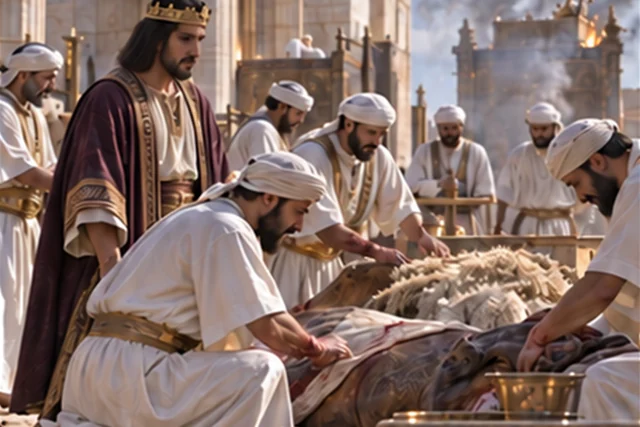
The account moves from the king's initial provision to gifts from the congregation, including burnt offerings brought by those of a free heart. This is a response, not merely compliance with an itemized royal contribution. Its scale creates a staffing problem. There are too few sanctified priests to flay all the offerings, and their Levitical brethren help until the work is completed and more priests are ready.
The comparison is candid: the Levites have been more upright in preparing themselves than the priests. The Book of 2 Chronicles does not tidy away that unevenness to make the restoration look effortless. Priestly responsibilities remain, but the readiness of the people and Levites has outrun that of some who hold the office.
The final rejoicing credits God with preparing the people. The work's suddenness does not mean that the house became clean without labor; the chapter has counted sixteen days and named the workers. What comes together rapidly is the renewed service and the people's response after the preceding reign's deliberate closure.
Words to trace: offerings, burnt, LORD, priests, congregation, consecrated
Verse-by-verse path
- 2 Chronicles 29:31
“Consecrated yourselves” is literally “filled your hand”, the ordination idiom for priests (Exodus 29:9). Thank offerings, todah, were peace offerings largely eaten by the worshippers. The burnt offerings, wholly burned, were left to those “of a free heart”, the willing.
- 2 Chronicles 29:32
Seventy bullocks, a hundred rams and two hundred lambs, all burnt entirely. The congregation’s gifts outnumber the king’s twenty-eight animals of verse 21 more than tenfold.
- 2 Chronicles 29:33
“Consecrated things” here means the holy offerings that were eaten, peace offerings for the feast. Six hundred oxen and three thousand sheep dwarf the burnt offerings of verse 32, which suggests a large public meal in the courts.
- 2 Chronicles 29:34
Leviticus 1:6 has the worshipper flay his own burnt offering, but by this period it was work for the clergy. Levites taking on priestly labour in an emergency will recur at Josiah’s Passover (35:11). The comparison with the priests’ readiness is the Book of 2 Chronicles’ own, and it is not flattering.
- 2 Chronicles 29:35
Drink offerings of wine went with each burnt offering (Numbers 15:1–10). “Set in order” is tikkon, from kun, the verb of preparing that failed Rehoboam in 12:14. The phrase marks the full restoration of the daily service.
- 2 Chronicles 29:36
“God had prepared the people” uses the same verb kun again: what Jehoshaphat’s people lacked in 20:33 is now God’s own work. “Suddenly” is pitom, the word for the unexpected, a surprise even to those who had worked for it.
2 Chronicles 29:31-36
King James Version31Then Hezekiah answered and said, Now ye have consecrated yourselves unto the LORD, come near and bring sacrifices and thank offerings into the house of the LORD. And the congregation brought in sacrifices and thank offerings; and as many as were of a free heart burnt offerings.
32And the number of the burnt offerings, which the congregation brought, was threescore and ten bullocks, an hundred rams, and two hundred lambs: all these were for a burnt offering to the LORD.
33And the consecrated things were six hundred oxen and three thousand sheep.
34But the priests were too few, so that they could not flay all the burnt offerings: wherefore their brethren the Levites did help them, till the work was ended, and until the other priests had sanctified themselves: for the Levites were more upright in heart to sanctify themselves than the priests.
35And also the burnt offerings were in abundance, with the fat of the peace offerings, and the drink offerings for every burnt offering. So the service of the house of the LORD was set in order.
36And Hezekiah rejoiced, and all the people, that God had prepared the people: for the thing was done suddenly.
Questions to keep in mind while reading
- Track who acts, who speaks, who is affected, and what changes.
- Notice repeated promises, failures, rescues, and consequences.
- Do not assume the account approves every action that is reported.
Text first
Where readers differ
The chapter summary begins with what the passage says and how its parts fit together. It does not assume one denomination has already settled every question. Where a conclusion depends on a tradition, literary theory, or historical reconstruction, that dependence is named openly.
The KJV text is presented first. Interpretive conclusions are labeled, and differences are introduced only when they help a reader understand why serious communities do not always reach the same answer.
Comparative interpretive notes for this chapter are in preparation. Until reviewed notes are ready, this page separates the KJV text from summary and application without claiming that serious readers agree on every question.
Questions beneath the surface
- What account of God, human freedom, responsibility, and the good life emerges from 2 Chronicles 29?
- Which tension does the chapter refuse to resolve quickly?
- What changes when the chapter is read as part of the whole canon rather than as an isolated moral lesson?
- Where might a sincere reader confuse a familiar tradition with something the text states directly?
Questions for serious personal contemplation
These open-ended questions make room for tension, honest response, prayer, and conclusions that remain accountable to the chapter.
Observe without rushing
What part of 2 Chronicles 29 makes you stop, feel unsettled, or feel surprised, and why?
Which detail in the passage would be easiest to overlook? How does that detail change your understanding?
Where do you see tension between what happens and this focus: 2 Chronicles 29 develops its own movement around LORD, burnt, house, offering, king?
What important question does the passage leave open instead of resolving quickly?
Examine your inner life honestly
Which person, response, fear, or desire in the passage feels most like your own life right now?
What assumption about God, other people, or yourself does this text challenge?
Which part would you rather soften, avoid, or explain away too quickly? What might that reaction reveal?
If this Scripture could ask you one direct question, what do you think it would ask?
Respond with wisdom and courage
What do you need to remember, confess, grieve, thank God for, or trust after reading this passage?
How might another faithful person read this situation differently without ignoring the text?
What obedient response would be costly, uncomfortable, or slow, yet still faithful to Scripture?
What question will you carry into prayer this week, and which verses will you keep in front of you?
Music and video connected to the passage
Related media appears when its Scripture reference overlaps this study. Music and video can illuminate a theme while the biblical text remains the foundation.