The big picture
Judges 19 opens with “no king in Israel” and proceeds toward the book’s most horrifying evidence of social collapse. A Levite travels to bring his concubine back from her father’s house, where generous hospitality repeatedly delays departure until late in the day. The travelers refuse Jebus because it is a foreign city and continue to Israelite Gibeah, only to find no welcome in the square until an elderly outsider receives them. Men of the city surround the house and demand the male guest. The host offers women, and the Levite sends out his concubine. She is abused through the night and collapses at the threshold. He later dismembers her body and sends the pieces through Israel, producing national shock while continuing the chapter’s grim pattern of using her body for male purposes.
In this chapter
- A Delayed Departure Leaves the Travelers on the Road Judges 19:1-10
The opening of Judges 19 is almost painfully ordinary compared with what follows.
- Gibeah Offers No Welcome Until an Outsider Intervenes Judges 19:11-21
The servant suggests stopping in Jebus, but the Levite refuses because it is not an Israelite city.
- The Woman Bears the Violence While Men Protect Themselves Judges 19:22-30
The men surrounding the house commit the central crime of the chapter, but the men inside do not become righteous by comparison.

Scripture beside the summary
Judges · King James Version · 30Judges 19:1-10
A Delayed Departure Leaves the Travelers on the Road
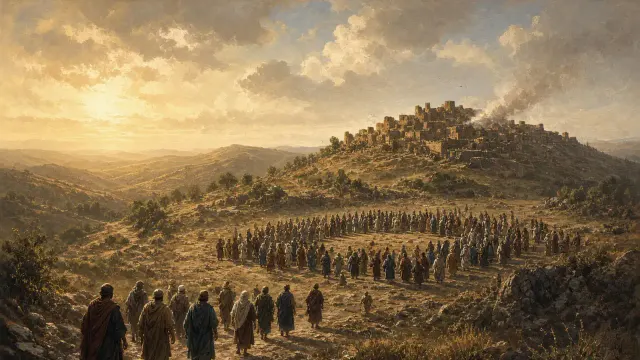
The opening of Judges 19 is almost painfully ordinary compared with what follows. A Levite’s concubine has returned to her father’s house in Bethlehem, and after four months the Levite goes to speak kindly and bring her back. Her father welcomes him with food, drink, lodging, and repeated invitations to stay another night. Hospitality is abundant, but each delay pushes the eventual departure later. By the fifth day the travelers leave when daylight is already failing. The chapter’s first line, “there was no king in Israel,” places this household sequence inside the larger collapse Judges has been tracing. The late departure does not cause the crime that will occur in Gibeah, and responsibility remains with those who commit it. Still, the repeated delays create the practical circumstances in which the group must decide where to spend the night before darkness overtakes them.
Deep dive
The chapter opens by repeating that Israel has no king, placing the household account inside national disorder. The KJV says the concubine played the whore, while ancient textual witnesses and modern translations differ, with some describing anger or departure. The certain narrative fact is that she returns to her father’s house and the Levite later seeks to bring her back.
Hospitality at Bethlehem is abundant but poorly timed. The father’s repeated urging keeps the travelers until daylight is nearly gone, and their late departure limits safe choices. This is not presented as the cause of the later crime, which belongs to the perpetrators. It does show how ordinary decisions accumulate within a narrative before the group reaches Gibeah.
Words to trace: father, damsel’s, concubine, depart, heart, rose
Verse-by-verse path
- Judges 19:1
A second Levite, a second link between mount Ephraim and Bethlehem: chapters 17 and 19 open on the same two places, travelled in opposite directions. A concubine, pilegesh, was a wife of secondary rank, often without a dowry, yet the chapter will call him her husband and her father his father in law.
- Judges 19:2
The Hebrew verb is zanah, to act as a harlot, but the Greek and some Latin witnesses read that she was angry with him. Going home to her father is an odd move for an adulteress, who would face death, which is why many think anger is the older reading. Four months is long enough for the breach to look final.
- Judges 19:3
“Speak friendly” is literally “speak to her heart”, the phrase Shechem uses of Dinah (Genesis 34:3) and Boaz of Ruth (Ruth 2:13): tender, persuasive speech. The father “rejoiced” to see him, perhaps because a daughter returned from her husband brought shame on the house.
- Judges 19:4
Three days is the customary span of hospitality, and a guest who stayed it had been honoured in full. From here on the father is named five times by his relationships, father in law and the damsel’s father, as if his family tie to the Levite is the thing being tested.
- Judges 19:5
“Comfort thine heart” is literally “sustain your heart”, the phrase Abraham uses in Genesis 18:5 when he offers the three visitors “a morsel of bread”. The morsel is a figure of speech; it turns into a meal and a day.
- Judges 19:6
“Be content” is ho’el, the same verb as the Levite being “content” with Micah in 17:11. “Let thine heart be merry” is the drinking phrase; the same words will return in verse 22 at the old man’s table, when the mob arrives.
- Judges 19:7
“Urged” is the verb used of Lot pressing the angels to stay in Sodom (Genesis 19:3). The echo is quiet here and loud by verse 22.
- Judges 19:8
“Until afternoon” is literally “until the day declined”. Each morning the Levite rises early and each morning he is kept, and the fifth day is lost like the fourth.
- Judges 19:9
The father uses two phrases for the waning light, the day “draweth toward evening” and “groweth to an end”, the second literally “the camping time of the day”, the hour to pitch a tent. His reasoning is sound. It is the Levite who will not listen this time.
- Judges 19:10
Jebus is the old name of Jerusalem, still held by the Jebusites (Judges 1:21), about six miles north of Bethlehem. Setting out that late, the party can reach no Israelite town before dark except Gibeah or Ramah, a few miles further on.
Judges 19:1-10
King James Version1And it came to pass in those days, when there was no king in Israel, that there was a certain Levite sojourning on the side of mount Ephraim, who took to him a concubine out of Beth-lehem-judah.
2And his concubine played the whore against him, and went away from him unto her father’s house to Beth-lehem-judah, and was there four whole months.
3And her husband arose, and went after her, to speak friendly unto her, and to bring her again, having his servant with him, and a couple of asses: and she brought him into her father’s house: and when the father of the damsel saw him, he rejoiced to meet him.
4And his father in law, the damsel’s father, retained him; and he abode with him three days: so they did eat and drink, and lodged there.
5And it came to pass on the fourth day, when they arose early in the morning, that he rose up to depart: and the damsel’s father said unto his son in law, Comfort thine heart with a morsel of bread, and afterward go your way.
6And they sat down, and did eat and drink both of them together: for the damsel’s father had said unto the man, Be content, I pray thee, and tarry all night, and let thine heart be merry.
7And when the man rose up to depart, his father in law urged him: therefore he lodged there again.
8And he arose early in the morning on the fifth day to depart: and the damsel’s father said, Comfort thine heart, I pray thee. And they tarried until afternoon, and they did eat both of them.
9And when the man rose up to depart, he, and his concubine, and his servant, his father in law, the damsel’s father, said unto him, Behold, now the day draweth toward evening, I pray you tarry all night: behold, the day groweth to an end, lodge here, that thine heart may be merry; and to morrow get you early on your way, that thou mayest go home.
10But the man would not tarry that night, but he rose up and departed, and came over against Jebus, which is Jerusalem; and there were with him two asses saddled, his concubine also was with him.
Judges 19:11-21
Gibeah Offers No Welcome Until an Outsider Intervenes
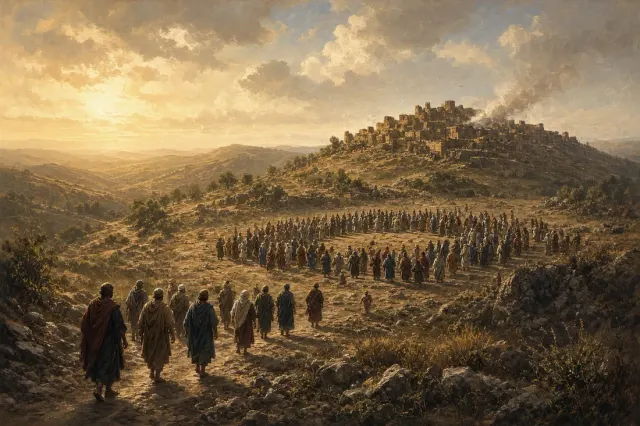
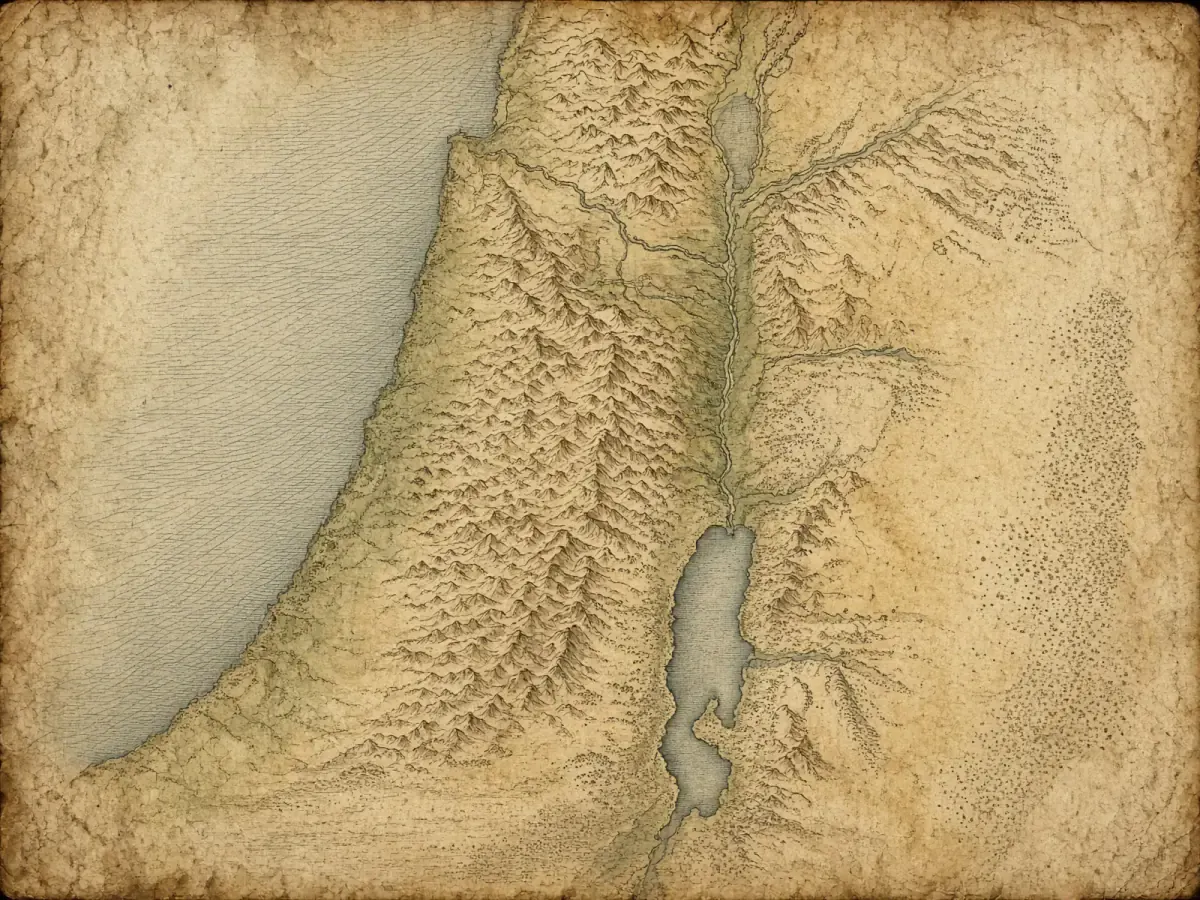
The servant suggests stopping in Jebus, but the Levite refuses because it is not an Israelite city. He expects greater safety among his own people and presses on to Gibeah. That expectation creates the section’s bitter irony. The travelers sit in the public square with food for themselves and fodder for their animals, yet no resident offers lodging until an elderly man from Ephraim, himself a sojourner, comes home from the fields. He asks about their journey, hears that “there is no man that receiveth me to house,” and immediately brings them in. The details of washing feet, feeding animals, eating, and drinking establish real hospitality before the chapter tears that safety apart. Covenant identity should have made Gibeah more trustworthy than a foreign city. Instead, the only person who acts as host is someone who does not originally belong there.
Deep dive
The decision to avoid a city of strangers creates bitter irony. The Levite expects greater safety among fellow Israelites, but the public square in Gibeah provides no hospitality. The eventual host is himself a temporary resident from Ephraim. Social belonging has ceased to produce the covenant care that should distinguish Israel.
The host asks the travelers not to remain in the street and provides food, fodder, water, and lodging. These careful details establish genuine welcome immediately before its violation. The account’s indictment is not aimed at cities or strangers as such. It concerns a community whose covenant identity has become detached from protection of vulnerable guests and neighbors.
Words to trace: Gibeah, city, house, lodge, street, aside
Verse-by-verse path
- Judges 19:11
“Far spent” is literally “had gone down greatly”. The servant proposes the obvious and sensible thing. He is the only person in the chapter whose advice would have kept everyone safe.
- Judges 19:12
The Levite rejects Jebus because it is a “city of a stranger”, nokri, a foreigner. His confidence in Israelite towns over pagan ones is the assumption the next thirteen verses destroy.
- Judges 19:13
Gibeah and Ramah stand close together on the ridge road north of Jerusalem, about three and five miles north of Jebus. Ramah will be Samuel’s home (1 Samuel 1:19), and Gibeah Saul’s (1 Samuel 10:26).
- Judges 19:14
“Which belongeth to Benjamin” sets up the civil war of chapters 20 and 21. The sun sets on them here as it set on Jacob at Bethel (Genesis 28:11), but there will be no ladder at Gibeah.
- Judges 19:15
“A street” is the rechov, the open square just inside the gate, where travellers waited to be offered lodging. Lot’s visitors offered to spend the night in the same kind of square (Genesis 19:2). Hospitality to strangers was an obligation, and no one in Gibeah honours it.
- Judges 19:16
The old man is himself a sojourner from mount Ephraim, like the Levite. The added clause, “but the men of the place were Benjamites”, marks the distinction pointedly: the one outsider is kind and the natives are not.
- Judges 19:17
“Lifted up his eyes” is the Hebrew idiom for noticing, used of Abraham seeing the three men at Mamre (Genesis 18:2). His two questions, whither and whence, are the questions of a host sizing up a guest.
- Judges 19:18
“The house of the LORD” in the Hebrew may be a scribal expansion; the Greek reads “to my house”. If the Hebrew stands, the Levite is travelling to Shiloh, which makes the refusal of shelter to a man going to the sanctuary all the sharper.
- Judges 19:19
He lists what he carries so as to cost no host a thing: straw and fodder for the donkeys, bread and wine for the people. He asks only for a roof. “Thy handmaid” and “thy servants” are courteous speech, the traveller placing his party at the old man’s service.
- Judges 19:20
“Peace be with thee” is shalom lekha, a guarantee of safety as much as a greeting. “Lodge not in the street” shows the old man knows what happens in Gibeah’s square after dark.
- Judges 19:21
Fodder, footwashing, food and drink: every act of hospitality is recorded, in the order Abraham followed in Genesis 18:4–5. The full list makes the violation that follows all the worse.
Judges 19:11-21
King James Version11And when they were by Jebus, the day was far spent; and the servant said unto his master, Come, I pray thee, and let us turn in into this city of the Jebusites, and lodge in it.
12And his master said unto him, We will not turn aside hither into the city of a stranger, that is not of the children of Israel; we will pass over to Gibeah.
13And he said unto his servant, Come, and let us draw near to one of these places to lodge all night, in Gibeah, or in Ramah.
14And they passed on and went their way; and the sun went down upon them when they were by Gibeah, which belongeth to Benjamin.
15And they turned aside thither, to go in and to lodge in Gibeah: and when he went in, he sat him down in a street of the city: for there was no man that took them into his house to lodging.
16And, behold, there came an old man from his work out of the field at even, which was also of mount Ephraim; and he sojourned in Gibeah: but the men of the place were Benjamites.
17And when he had lifted up his eyes, he saw a wayfaring man in the street of the city: and the old man said, Whither goest thou? and whence comest thou?
18And he said unto him, We are passing from Beth-lehem-judah toward the side of mount Ephraim; from thence am I: and I went to Beth-lehem-judah, but I am now going to the house of the LORD; and there is no man that receiveth me to house.
19Yet there is both straw and provender for our asses; and there is bread and wine also for me, and for thy handmaid, and for the young man which is with thy servants: there is no want of any thing.
20And the old man said, Peace be with thee; howsoever let all thy wants lie upon me; only lodge not in the street.
21So he brought him into his house, and gave provender unto the asses: and they washed their feet, and did eat and drink.
Judges 19:22-30
The Woman Bears the Violence While Men Protect Themselves
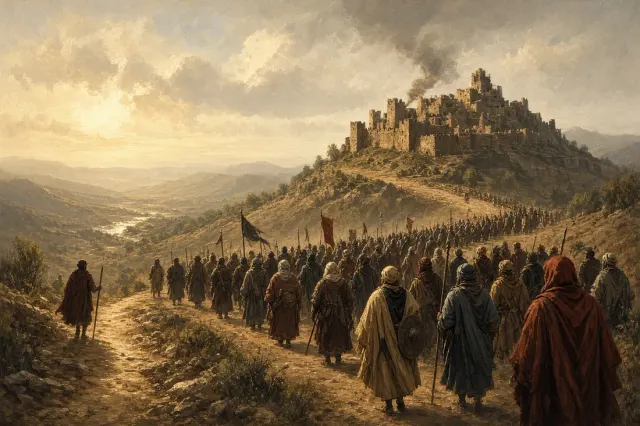
The men surrounding the house commit the central crime of the chapter, but the men inside do not become righteous by comparison. The host pleads against violating his male guest and then offers his daughter and the Levite’s concubine. The Levite ultimately brings the woman outside, where the mob sexually abuses her through the night. At dawn she returns and collapses with her hands on the threshold. Judges gives her no speech. In the morning the Levite opens the door, tells her to get up, and receives no answer. What follows continues the dehumanization: he carries her home, dismembers her body into twelve pieces, and sends them through Israel. The act successfully creates national outrage, but the woman’s body is again used as an instrument in male action. The horror lies not only in Gibeah’s mob but in a society where the vulnerable are sacrificed by those claiming to protect order.
Deep dive
The host’s offer and the Levite’s surrender of the woman are not acts of righteous hospitality. The men inside preserve themselves by exposing women to sexual violence, and the mob commits the central crime. The Book of Judges gives no speech to the victim and records her hands at the threshold. Teaching must not imply consent, blame her, reenact the assault, or turn her suffering into spectacle.
The Levite’s command for her to rise is chilling, and the text does not explicitly state when he recognizes her death. Dismembering and distributing her body produces national shock, but it also continues treating her body as an instrument for male action. The closing call to consider and speak should begin by naming the evil accurately and centering the person who was harmed, not merely the outrage of those who receive the message.
Words to trace: house, concubine, door, took, Israel, lord
Verse-by-verse path
- Judges 19:22
“Sons of Belial” means worthless or lawless men; the word combines “without” and “profit”. The demand repeats the men of Sodom in Genesis 19:5 almost word for word, “bring them out… that we may know them”. An Israelite town now speaks as Sodom spoke.
- Judges 19:23
“Folly” is nevalah, the word for outrageous sexual wrong, used of the rape of Dinah (Genesis 34:7) and of Amnon’s crime (2 Samuel 13:12). The host calls them “my brethren” and appeals to the sanctity of a guest under his roof.
- Judges 19:24
The offer copies Lot’s in Genesis 19:8, and again two women are offered. “Humble” is anah, to violate. The host treats the protection of a male guest as the law of hospitality and the women under his roof as exchangeable. The Book of Judges records it without approval.
- Judges 19:25
At Sodom the angels struck the mob blind and pulled Lot inside. Here no one intervenes. “The man” who takes her out is ambiguous in the Hebrew, but the context points to the Levite. The verse measures the night in hours: all the night, until the morning, until dawn.
- Judges 19:26
She comes back to the house where “her lord” is, adon, master, the only word the verse gives for him. She falls at the door and lies there until full daylight. The Book of Judges counts the time the Levite spent asleep behind that door.
- Judges 19:27
He opens the door “to go his way”, intending to leave, not to look for her. The detail of her hands on the threshold is the image the chapter chooses to hold: reaching for the house that had given her up.
- Judges 19:28
“Up, and let us be going” is two words in Hebrew, curt as a command to an animal. “None answered” leaves open whether she was already dead; the Greek adds “for she was dead”, the Hebrew does not say.
- Judges 19:29
“Knife” has the article, ha-ma’akheleth, the knife, the same word used of Abraham’s knife over Isaac (Genesis 22:10). Twelve pieces for twelve tribes, a grim summons. Saul will later cut up oxen and send them out the same way (1 Samuel 11:7).
- Judges 19:30
The comparison runs back to the Exodus, the founding of the nation: nothing like it since Israel came out of Egypt. The three commands, consider, take advice, speak, are what the Book of Judges has been showing Israel failing to do for chapters.
Judges 19:22-30
King James Version22Now as they were making their hearts merry, behold, the men of the city, certain sons of Belial, beset the house round about, and beat at the door, and spake to the master of the house, the old man, saying, Bring forth the man that came into thine house, that we may know him.
23And the man, the master of the house, went out unto them, and said unto them, Nay, my brethren, nay, I pray you, do not so wickedly; seeing that this man is come into mine house, do not this folly.
24Behold, here is my daughter a maiden, and his concubine; them I will bring out now, and humble ye them, and do with them what seemeth good unto you: but unto this man do not so vile a thing.
25But the men would not hearken to him: so the man took his concubine, and brought her forth unto them; and they knew her, and abused her all the night until the morning: and when the day began to spring, they let her go.
26Then came the woman in the dawning of the day, and fell down at the door of the man’s house where her lord was, till it was light.
27And her lord rose up in the morning, and opened the doors of the house, and went out to go his way: and, behold, the woman his concubine was fallen down at the door of the house, and her hands were upon the threshold.
28And he said unto her, Up, and let us be going. But none answered. Then the man took her up upon an ass, and the man rose up, and gat him unto his place.
29And when he was come into his house, he took a knife, and laid hold on his concubine, and divided her, together with her bones, into twelve pieces, and sent her into all the coasts of Israel.
30And it was so, that all that saw it said, There was no such deed done nor seen from the day that the children of Israel came up out of the land of Egypt unto this day: consider of it, take advice, and speak your minds.
Questions to keep in mind while reading
- Track who acts, who speaks, who is affected, and what changes.
- Notice repeated promises, failures, rescues, and consequences.
- Do not assume the account approves every action that is reported.
Text first
Where readers differ
The chapter summary begins with what the passage says and how its parts fit together. It does not assume one denomination has already settled every question. Where a conclusion depends on a tradition, literary theory, or historical reconstruction, that dependence is named openly.
The KJV text is presented first. Interpretive conclusions are labeled, and differences are introduced only when they help a reader understand why serious communities do not always reach the same answer.
Comparative interpretive notes for this chapter are in preparation. Until reviewed notes are ready, this page separates the KJV text from summary and application without claiming that serious readers agree on every question.
Questions beneath the surface
- What account of God, human freedom, responsibility, and the good life emerges from Judges 19?
- Which tension does the chapter refuse to resolve quickly?
- What changes when the chapter is read as part of the whole canon rather than as an isolated moral lesson?
- Where might a sincere reader confuse a familiar tradition with something the text states directly?
Questions for serious personal contemplation
These open-ended questions make room for tension, honest response, prayer, and conclusions that remain accountable to the chapter.
Observe without rushing
What part of Judges 19 makes you stop, feel unsettled, or feel surprised, and why?
Which detail in the passage would be easiest to overlook? How does that detail change your understanding?
Where do you see tension between what happens and this focus: Judges 19 develops its own movement around house, father, concubine, rose, city?
What important question does the passage leave open instead of resolving quickly?
Examine your inner life honestly
Which person, response, fear, or desire in the passage feels most like your own life right now?
What assumption about God, other people, or yourself does this text challenge?
Which part would you rather soften, avoid, or explain away too quickly? What might that reaction reveal?
If this Scripture could ask you one direct question, what do you think it would ask?
Respond with wisdom and courage
What do you need to remember, confess, grieve, thank God for, or trust after reading this passage?
How might another faithful person read this situation differently without ignoring the text?
What obedient response would be costly, uncomfortable, or slow, yet still faithful to Scripture?
What question will you carry into prayer this week, and which verses will you keep in front of you?
Music and video connected to the passage
Related media appears when its Scripture reference overlaps this study. Music and video can illuminate a theme while the biblical text remains the foundation.