The big picture
The Book of 1 Kings begins with David still king but visibly failing in strength, and that gap between bodily weakness and continuing authority creates room for a succession crisis. Adonijah fills the opening with chariots, runners, powerful supporters, and a feast that looks royal until its exclusions are noticed. Nathan and Bathsheba bring David back into the decision, reminding him of his oath concerning Solomon and forcing a private intention into public action. David responds with unmistakable symbols of authorization: his own mule, his own servants, Zadok’s anointing, the trumpet, and Solomon’s occupation of the throne. The city’s celebration reaches Adonijah’s banquet as unwelcome news, and his supporters scatter. Yet the chapter does not end with revenge. Adonijah seeks refuge at the altar and receives conditional mercy from Solomon. The throne changes hands through competing claims, remembered promises, public ceremony, and a final act of restraint that leaves the defeated claimant alive but accountable for what he does next.
In this chapter
- The King Depends on Someone Else for Warmth 1 Kings 1:1-4
The Book of 1 Kings opens with a king who cannot get warm.
- Adonijah Supplies His Own Coronation 1 Kings 1:5-10
Adonijah does not wait to be made king.
- A Promise Brought Back Into the Room 1 Kings 1:11-27
Nathan and Bathsheba do not treat Adonijah’s feast as palace gossip.
- David’s Mule Carries David’s Decision 1 Kings 1:28-40
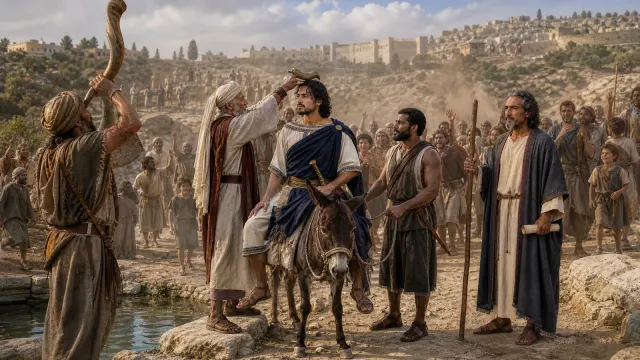
David answers the succession crisis by turning a private oath into a public event that can be seen, heard, and followed through Jerusalem.
- Good Tidings for the Other Banquet 1 Kings 1:41-48
Adonijah’s feast ends just as another celebration becomes impossible to ignore.
- A Hand on the Altar, a Condition on Mercy 1 Kings 1:49-53
The guests vanish before Adonijah can turn his coronation feast into a resistance movement.
Scripture beside the summary
1 Kings · King James Version · 531 Kings 1:1-4
The King Depends on Someone Else for Warmth
The Book of 1 Kings opens with a king who cannot get warm. Before anyone argues over the throne, David is shown needing clothes, attendants, and finally the constant care of Abishag of Shunem. That physical dependence matters because the kingdom is still waiting on decisions only David can authorize. His body is failing faster than his office has disappeared. Abishag is brought into the most private part of the royal household, yet the account carefully adds that David “knew her not.” That detail closes one door while opening another that will matter in the next chapter, when her connection to David becomes politically charged. For now she is neither claimant nor counselor. She serves a weakened king whose authority remains intact, and the succession crisis begins in the space between those two facts: David is increasingly unable to act without help, but Israel still has no lawful successor until he does.
Deep dive
The Book of 1 Kings begins with a body rather than a battle. Clothes cannot warm David, and the servants’ proposed remedy requires someone to remain beside him. The contrast with the commands, processions, and competing claims that follow is exact: the king on whom the kingdom still depends is himself dependent on care. His weakness creates an opening for others to act, but it does not yet transfer his authority to anyone.
Abishag is named, located by her home in Shunem, and described as beautiful and attentive. The statement that David did not know her prevents a particular misunderstanding, and it will matter when Adonijah asks to marry her in chapter 2. Her intimate place in the royal household is established without making her David’s sexual partner. She receives no speech here. The account records her service, not an opinion about the succession.
Words to trace: king, damsel, fair, heat, lord, sought
Verse-by-verse path
- 1 Kings 1:1
“Stricken in years” is literally “come into days”, said of Abraham (Genesis 24:1) and Joshua (Joshua 23:1) near their ends. David came to the throne at thirty and reigned forty years (2 Samuel 5:4), so he is about seventy. The man who ran at Goliath now cannot keep warm under blankets.
- 1 Kings 1:2
“Cherish” is sokenet, a word for an attendant or steward; a related form names Shebna the treasurer in Isaiah 22:15. “Stand before the king” is court language for serving him. The servants start in the third person, “my lord the king”, and slip into “thy bosom”, speaking to David directly.
- 1 Kings 1:3
A search through all Israel for one young woman recalls the search for a queen in Esther 2:2–3. Shunem lay in Issachar at the edge of the Jezreel valley, where the Philistines camped before Saul’s last battle (1 Samuel 28:4), and where Elisha later lodged with a Shunammite woman (2 Kings 4:8).
- 1 Kings 1:4
“Ministered” is sharat, the verb for priestly service and for Joshua’s service to Moses. The verse gives her beauty, her care and her work, and its closing clause, “knew her not”, sets the terms on which her name will matter again.
1 Kings 1:1-4
King James Version1Now king David was old and stricken in years; and they covered him with clothes, but he gat no heat.
2Wherefore his servants said unto him, Let there be sought for my lord the king a young virgin: and let her stand before the king, and let her cherish him, and let her lie in thy bosom, that my lord the king may get heat.
3So they sought for a fair damsel throughout all the coasts of Israel, and found Abishag a Shunammite, and brought her to the king.
4And the damsel was very fair, and cherished the king, and ministered to him: but the king knew her not.
1 Kings 1:5-10
Adonijah Supplies His Own Coronation
Adonijah does not wait to be made king. He starts looking like one. Chariots, horsemen, fifty runners, a feast, a priest, and a famous commander give his claim all the furniture of royalty before David has supplied the one thing that matters most: authorization. The Book of 1 Kings says he “exalted himself,” making the source of the initiative impossible to miss. It also slips in a quieter explanation for how he reached this point: David had never asked him, “Why hast thou done so?” The guest list reveals as much as the spectacle. Joab and Abiathar are present, but Zadok, Nathan, Benaiah, David’s mighty men, and Solomon are outside the celebration. Adonijah can assemble an impressive coalition, but he cannot make the exclusions disappear. His banquet is therefore both a show of strength and a map of the opposition, with the empty places around his table telling the reader exactly where the fault line runs.
Deep dive
Adonijah’s first royal appointment is himself. The words "exalted himself" place the initiative with the prince, not David or a divine announcement. Chariots, horsemen, and fifty runners give his claim a visible shape. The arrangement recalls Absalom’s preparations in 2 Samuel 15:1, and the reference to Adonijah’s birth after Absalom keeps the earlier succession disaster close to this one. His appearance is impressive; the account does not confuse appearance with authorization.
The comment that David had never challenged his conduct exposes a longstanding absence of restraint. Meanwhile, Joab and Abiathar provide military and priestly support, but neither institution is united behind him. Zadok, Nathan, Benaiah, and David’s mighty men remain outside his circle. The invitation list is therefore more than a social detail. Solomon and the people likely to defend his claim are precisely those who do not receive a place at the table. Adonijah’s banquet displays a coalition while concealing a division.
Words to trace: Adonijah, Benaiah, king’s, mighty, Nathan, priest
Verse-by-verse path
- 1 Kings 1:5
Adonijah was David’s fourth son, born at Hebron (2 Samuel 3:4). Amnon and Absalom were dead and Chileab is never heard of again, so he was probably the eldest surviving. The Hebrew “I” in “I will be king” is emphatic.
- 1 Kings 1:6
“Displeased” is ’atsav, to pain or grieve; David never once hurt him with a question. “Goodly” is said of Saul (1 Samuel 9:2) and Absalom’s beauty is described at length (2 Samuel 14:25). “Bare him after Absalom” means next in birth order; they had different mothers.
- 1 Kings 1:7
“Conferred with” is literally “his words were with”. Joab had been David’s commander since Hebron, and Abiathar was the only priest who escaped Saul’s massacre at Nob (1 Samuel 22:20). Adonijah has won two of David’s oldest companions.
- 1 Kings 1:8
Shimei and Rei are otherwise unknown; this Shimei is probably not the Benjamite curser, and some identify him with Shimei son of Elah, one of Solomon’s officers (4:18). “The mighty men” are the warriors named in 2 Samuel 23.
- 1 Kings 1:9
“Slew” is zabach, to kill for a sacrificial feast, as Absalom offered sacrifices when he launched his revolt at Hebron (2 Samuel 15:12). Zoheleth may mean “serpent” or “sliding” stone. En-rogel is the spring where David’s messengers once hid from Absalom (2 Samuel 17:17).
- 1 Kings 1:10
The list of the uninvited is also the cast of the next thirty verses: Nathan plans, Benaiah escorts, Solomon rides. Adonijah’s guest list drew the line between the two parties more clearly than any speech.
1 Kings 1:5-10
King James Version5Then Adonijah the son of Haggith exalted himself, saying, I will be king: and he prepared him chariots and horsemen, and fifty men to run before him.
6And his father had not displeased him at any time in saying, Why hast thou done so? and he also was a very goodly man; and his mother bare him after Absalom.
7And he conferred with Joab the son of Zeruiah, and with Abiathar the priest: and they following Adonijah helped him.
8But Zadok the priest, and Benaiah the son of Jehoiada, and Nathan the prophet, and Shimei, and Rei, and the mighty men which belonged to David, were not with Adonijah.
9And Adonijah slew sheep and oxen and fat cattle by the stone of Zoheleth, which is by En-rogel, and called all his brethren the king’s sons, and all the men of Judah the king’s servants:
10But Nathan the prophet, and Benaiah, and the mighty men, and Solomon his brother, he called not.
1 Kings 1:11-27
A Promise Brought Back Into the Room
Nathan and Bathsheba do not treat Adonijah’s feast as palace gossip. They treat it as a succession already moving in public while David remains uninformed in private. Nathan’s plan is coordinated, and the Book of 1 Kings makes no attempt to hide that coordination. Bathsheba goes first, recalls David’s oath concerning Solomon, and names the danger plainly: once David is dead, she and her son may be counted offenders. Nathan follows with a different pressure point, asking whether David has quietly authorized Adonijah without telling the servants who would expect to know. The two speeches overlap, but they are not duplicates. Bathsheba speaks from a vulnerable household; Nathan speaks from the king’s excluded circle. Together they force one issue back into the room where it belongs. A promise about the future cannot remain private while another son is already being hailed as king. David must either confirm the claim around him or publicly disown it.
Deep dive
Nathan begins with danger to Bathsheba and Solomon, not a detached constitutional question. Bathsheba makes the danger explicit: after David’s death, she and her son could be treated as offenders. Their vulnerability explains the urgency of reaching the king while his judgment can still settle the matter. The repeated contrast between what Adonijah is doing and what David does not know makes ignorance inside the palace the crisis’s enabling condition.
Bathsheba invokes David’s oath that Solomon would succeed him. The earlier occasion of that oath is not supplied here, so its setting should not be invented. Nathan enters as arranged and approaches from another angle: whether David himself has authorized Adonijah’s accession without telling his established servants. Both speeches require David to distinguish a decision made by the king from one being made around him.
The Book of 1 Kings openly describes this coordination. It neither hides the strategy nor says that strategy makes the claim false. David will confirm the oath himself in verse 30. Bathsheba speaks from the endangered household; Nathan speaks as an excluded royal adviser and prophet. Their words converge on the same practical point: the succession cannot remain an unspoken intention while another son is already being acclaimed.
Words to trace: king, LORD, Solomon, Adonijah, reign, throne
Verse-by-verse path
- 1 Kings 1:11
Bathsheba has not appeared since the birth of Solomon, when Nathan brought the name Jedidiah, “beloved of the LORD” (2 Samuel 12:24–25). The same prophet now comes to her again. “Doth reign” is a completed verb: Adonijah has made himself king.
- 1 Kings 1:12
“Counsel” is ’etsah, the word of Ahithophel and Hushai. New dynasties in Israel often killed the rival house; Baasha and Jehu wiped out their predecessors’ families (1 Kings 15:29; 2 Kings 10). Nathan’s fear for Bathsheba and her son is realistic.
- 1 Kings 1:13
“Sit upon my throne” becomes the chapter’s refrain, recurring about ten times in the mouths of Nathan, Bathsheba, David, Benaiah, Jonathan and the servants. “Assuredly” translates the emphatic particle ki, the tone of a formal oath.
- 1 Kings 1:14
“Confirm” is literally “fill up”, to complete someone’s words. Deuteronomy 19:15 required two witnesses to establish a matter, and Nathan arranges for the king to hear two.
- 1 Kings 1:15
“The chamber” is the inner room. The book repeats that the king was very old, and places Abishag at work in the room: Bathsheba, once the young woman David sent for, enters as another young woman attends him.
- 1 Kings 1:16
Two verbs, bowed and did obeisance, the full prostration of the court. David’s reply is two Hebrew words, literally “what to thee?”, the question of a tired king.
- 1 Kings 1:17
Nathan’s script in verse 13 did not include “by the LORD thy God”. Bathsheba adds it, making the promise an oath sworn in the divine name, and so a matter David cannot set aside without breaking faith with the LORD.
- 1 Kings 1:18
Hebrew “now” (’attah) and “thou” (’attah) sound identical, and many manuscripts read the second as “and thou, my lord the king, knowest it not”. Either way she sets Adonijah’s reign against the king’s ignorance.
- 1 Kings 1:19
Her list includes Abiathar and Joab but not Nathan, Zadok or Benaiah, and she calls her son “Solomon thy servant”, a courtier’s humility on his behalf. The details of the feast, oxen, fatlings and sheep in abundance, are meant to show how public the thing already is.
- 1 Kings 1:20
The eyes of Israel are on David, while David’s own eyes have been closed to what his son is doing. Her request is for a word, spoken publicly, naming the successor.
- 1 Kings 1:21
“Sleep with his fathers” is the formula that closes nearly every reign in Kings; its first use for David is in 2:10. “Offenders” is chatta’im, literally “sinners”, those who have missed the mark, here those treated as guilty by a new regime.
- 1 Kings 1:22
The timing is exactly as Nathan planned in verse 14. The book lets the arrangement show without comment, the prophet’s step landing on the queen’s last word.
- 1 Kings 1:23
Nathan is announced by servants, a formal entrance that makes his visit look like a separate audience. He bows “with his face to the ground”, the fullest court gesture, where Bathsheba’s bow was not described so.
- 1 Kings 1:24
Nathan uses the very words of the oath, “shall reign after me, and he shall sit upon my throne”, with Adonijah’s name in Solomon’s place. David hears his own promise spoken back to him with the wrong son in it.
- 1 Kings 1:25
“Gone down” fits the site; En-rogel lies below the city. “God save king Adonijah” is literally “let king Adonijah live”, the cry Hushai gave Absalom (2 Samuel 16:16). Nathan adds “the captains of the host”, a detail Bathsheba did not have.
- 1 Kings 1:26
“Me, even me thy servant” puts Nathan first on his list of those left out. He does not mention the oath at all; that part belonged to Bathsheba, and the prophet leaves it to her.
- 1 Kings 1:27
Nathan was the prophet who brought David the promise of a lasting house (2 Samuel 7). His question asks whether the king has now decided the matter of that house without telling him. Some manuscripts read “thy servants”, plural, meaning the whole loyal circle.
1 Kings 1:11-27
King James Version11Wherefore Nathan spake unto Bath-sheba the mother of Solomon, saying, Hast thou not heard that Adonijah the son of Haggith doth reign, and David our lord knoweth it not?
12Now therefore come, let me, I pray thee, give thee counsel, that thou mayest save thine own life, and the life of thy son Solomon.
13Go and get thee in unto king David, and say unto him, Didst not thou, my lord, O king, swear unto thine handmaid, saying, Assuredly Solomon thy son shall reign after me, and he shall sit upon my throne? why then doth Adonijah reign?
14Behold, while thou yet talkest there with the king, I also will come in after thee, and confirm thy words.
15And Bath-sheba went in unto the king into the chamber: and the king was very old; and Abishag the Shunammite ministered unto the king.
16And Bath-sheba bowed, and did obeisance unto the king. And the king said, What wouldest thou?
17And she said unto him, My lord, thou swarest by the LORD thy God unto thine handmaid, saying, Assuredly Solomon thy son shall reign after me, and he shall sit upon my throne.
18And now, behold, Adonijah reigneth; and now, my lord the king, thou knowest it not:
19And he hath slain oxen and fat cattle and sheep in abundance, and hath called all the sons of the king, and Abiathar the priest, and Joab the captain of the host: but Solomon thy servant hath he not called.
20And thou, my lord, O king, the eyes of all Israel are upon thee, that thou shouldest tell them who shall sit on the throne of my lord the king after him.
21Otherwise it shall come to pass, when my lord the king shall sleep with his fathers, that I and my son Solomon shall be counted offenders.
22And, lo, while she yet talked with the king, Nathan the prophet also came in.
23And they told the king, saying, Behold Nathan the prophet. And when he was come in before the king, he bowed himself before the king with his face to the ground.
24And Nathan said, My lord, O king, hast thou said, Adonijah shall reign after me, and he shall sit upon my throne?
25For he is gone down this day, and hath slain oxen and fat cattle and sheep in abundance, and hath called all the king’s sons, and the captains of the host, and Abiathar the priest; and, behold, they eat and drink before him, and say, God save king Adonijah.
26But me, even me thy servant, and Zadok the priest, and Benaiah the son of Jehoiada, and thy servant Solomon, hath he not called.
27Is this thing done by my lord the king, and thou hast not shewed it unto thy servant, who should sit on the throne of my lord the king after him?
1 Kings 1:28-40
David’s Mule Carries David’s Decision
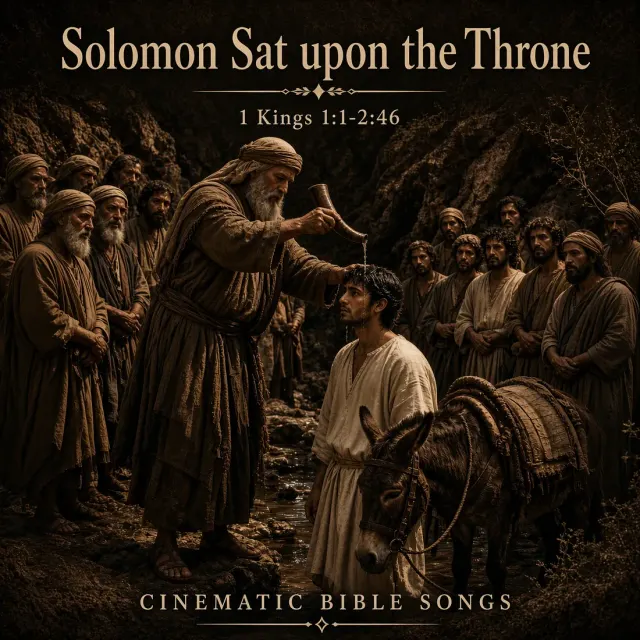
David answers the succession crisis by turning a private oath into a public event that can be seen, heard, and followed through Jerusalem. Every detail carries his authority. Solomon rides David’s own mule, travels with David’s servants, is anointed by Zadok in Nathan’s presence, and is ordered to sit on David’s throne. Adonijah had assembled the appearance of kingship for himself; Solomon receives the reigning king’s actual commission. David is still the frail man introduced at the chapter’s opening, but frailty has not made his command ambiguous. He says what he swore will be done “this day,” and the machinery of legitimate succession starts moving at once. Benaiah’s “Amen” adds an important distinction: David can appoint, while the LORD’s confirmation is still sought. Then the trumpet sounds, the people erupt in joy, and the decision leaves the bedroom. What had been an oath remembered by Bathsheba is now loud enough for the city to hear.

Deep dive
David’s answer repeatedly binds intention to immediacy. What he swore before will be done this day. The frailty described at the beginning has not erased his ability to issue a clear command, and each element of that command answers a weakness in Adonijah’s position. Solomon rides David’s own mule, travels with David’s servants, is anointed by the men David commissions, and is to sit on David’s throne. This is more than a competing celebration. It is a succession authorized by the reigning king.
Benaiah’s answer distinguishes human appointment from divine confirmation: he assents and asks that the LORD say the same. His hope that Solomon’s throne will exceed David’s is spoken to David himself and receives no rebuke. The ceremony proceeds with oil from the tabernacle, a trumpet, and public acclamation. The language about the earth splitting under the sound conveys the scale of the rejoicing; it does not require an additional earthquake absent from the account. The once-private promise has become something the city can hear.
Words to trace: king, LORD, Solomon, David, priest, throne
Verse-by-verse path
- 1 Kings 1:28
Bathsheba had evidently withdrawn when Nathan was announced, as court etiquette required, and she is called back. The king now summons, where before he was only visited.
- 1 Kings 1:29
David swore these words once before: “As the LORD liveth, who hath redeemed my soul out of all adversity” to the killers of Ishbosheth (2 Samuel 4:9). The oath of his early reign returns at its end.
- 1 Kings 1:30
“In my stead” is new: Solomon will not only reign after David but sit on the throne in his place now, while David lives. The effect is a co-regency, the living king handing over the seat himself.
- 1 Kings 1:31
“Let my lord king David live for ever” is the formula for addressing a king; Nehemiah uses it to Artaxerxes (Nehemiah 2:3). Spoken to a man at the end of his strength, it is courtesy and also the gratitude of a woman whose son has just been spared.
- 1 Kings 1:32
Priest, prophet and soldier: David summons one man from each of the three institutions that have to agree for a succession to hold. Adonijah had a priest and a general, but no prophet and not the guard.
- 1 Kings 1:33
Gihon was the spring in the Kidron valley below the city of David, its main water source, later channelled by Hezekiah’s tunnel (2 Chronicles 32:30). It lies within earshot of En-rogel, about half a mile down the same valley.
- 1 Kings 1:34
Saul and David were each anointed by a prophet alone, Samuel. Solomon is anointed by a priest and a prophet together. The trumpet is the shofar, the ram’s horn used for proclamations, as when Absalom had himself proclaimed at Hebron (2 Samuel 15:10).
- 1 Kings 1:35
“Ruler” is nagid, the title given to Saul and David when the LORD designated them (1 Samuel 9:16; 2 Samuel 7:8). “Over Israel and over Judah” names both halves of the kingdom separately, the two that had argued over David at the Jordan.
- 1 Kings 1:36
Benaiah commands the guard, so his “Amen” is the assent of the men with weapons in the palace. “Say so too” asks the LORD to speak the same word David has just spoken, making the king’s decree a thing to be ratified above.
- 1 Kings 1:37
“The LORD was with him” is the Books of Samuel’s summary of David’s rise (1 Samuel 16:18; 18:14). Benaiah asks that the phrase pass to the son, and then goes further: a greater throne.
- 1 Kings 1:38
The procession “went down” to Gihon and will “come up” again to the palace (verses 35 and 40). The topography carries the ceremony: down to the spring for the anointing, up to the throne for the seating.
- 1 Kings 1:39
The tabernacle here is the tent David pitched for the ark (2 Samuel 6:17), and the oil is presumably the holy anointing oil of Exodus 30:25. Samuel anointed David from a horn (1 Samuel 16:13) but Saul from a vial (1 Samuel 10:1); Solomon gets the horn.
- 1 Kings 1:40
“Pipes” are the chalil, a reed flute of festival and of prophetic bands; the prophets Saul met came down “with a psaltery, and a tabret, and a pipe” (1 Samuel 10:5). The sound carries down the Kidron valley to the other feast.
1 Kings 1:28-40
King James Version28Then king David answered and said, Call me Bath-sheba. And she came into the king’s presence, and stood before the king.
29And the king sware, and said, As the LORD liveth, that hath redeemed my soul out of all distress,
30Even as I sware unto thee by the LORD God of Israel, saying, Assuredly Solomon thy son shall reign after me, and he shall sit upon my throne in my stead; even so will I certainly do this day.
31Then Bath-sheba bowed with her face to the earth, and did reverence to the king, and said, Let my lord king David live for ever.
32And king David said, Call me Zadok the priest, and Nathan the prophet, and Benaiah the son of Jehoiada. And they came before the king.
33The king also said unto them, Take with you the servants of your lord, and cause Solomon my son to ride upon mine own mule, and bring him down to Gihon:
34And let Zadok the priest and Nathan the prophet anoint him there king over Israel: and blow ye with the trumpet, and say, God save king Solomon.
35Then ye shall come up after him, that he may come and sit upon my throne; for he shall be king in my stead: and I have appointed him to be ruler over Israel and over Judah.
36And Benaiah the son of Jehoiada answered the king, and said, Amen: the LORD God of my lord the king say so too.
37As the LORD hath been with my lord the king, even so be he with Solomon, and make his throne greater than the throne of my lord king David.
38So Zadok the priest, and Nathan the prophet, and Benaiah the son of Jehoiada, and the Cherethites, and the Pelethites, went down, and caused Solomon to ride upon king David’s mule, and brought him to Gihon.
39And Zadok the priest took an horn of oil out of the tabernacle, and anointed Solomon. And they blew the trumpet; and all the people said, God save king Solomon.
40And all the people came up after him, and the people piped with pipes, and rejoiced with great joy, so that the earth rent with the sound of them.
1 Kings 1:41-48
Good Tidings for the Other Banquet
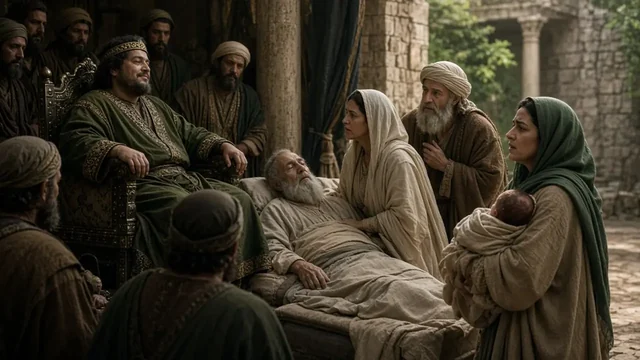
Adonijah’s feast ends just as another celebration becomes impossible to ignore. Joab hears the trumpet first and knows the city’s uproar demands an explanation. Adonijah expects Jonathan to bring “good tidings,” but the good news belongs to someone else. Jonathan’s report arrives almost like an inventory of everything Adonijah lacked: David ordered the action, David’s mule carried Solomon, Zadok and Nathan anointed him, the people rejoiced, and Solomon is already sitting on the throne. The news even reaches back into David’s chamber, where the old king bows on his bed and blesses the LORD for allowing him to see a successor seated in his lifetime. That final detail closes the argument. The same bed that displayed David’s weakness at the start of the chapter becomes the place from which he acknowledges Solomon. Adonijah has not merely lost a contest of noise or popularity. The reigning king himself has recognized another son, and the rival banquet has been overtaken by a finished succession.
Deep dive
Adonijah greets Jonathan as a capable man who must be bringing good news. The confidence lasts only until Jonathan begins speaking. The feast has continued long enough for the succession to be settled somewhere else. Joab, alert to the trumpet, has already recognized that the noise needs explaining, but no one at the table can explain it in Adonijah’s favor.
Jonathan’s report repeats the authorized procession in detail. Its accumulation matters: David commissioned it, the recognized servants accompanied it, Zadok and Nathan performed the anointing, the city rejoiced, and Solomon now occupies the throne. The report then goes inside David’s chamber. There the servants bless the new reign and David bows on his bed, thanking the LORD that he has seen a successor seated while he is still alive. The bed that first marked his weakness becomes the place of his acknowledgment. Adonijah has not merely been outcheered; David has publicly and personally recognized someone else.
Words to trace: king, throne, Adonijah, LORD, priest, Solomon
Verse-by-verse path
- 1 Kings 1:41
The guests hear it at the end of the meal, full and relaxed. Joab, the old soldier, picks out the shofar from the roar of the city before anyone else does. “Uproar” is a word for the roaring of a crowd or of the sea.
- 1 Kings 1:42
Jonathan son of Abiathar waited at this same spring, En-rogel, to carry news to David in Absalom’s revolt (2 Samuel 17:17). He is the messenger again, at the same spot, this time for the other side. “Valiant man” is ish chayil, a man of worth.
- 1 Kings 1:43
“Verily” translates aval, “no, but” or “on the contrary”; Jonathan’s first word cancels Adonijah’s hope before the sentence is out. He still calls David “our lord”, which tells the table where authority lies.
- 1 Kings 1:44
Adonijah had fifty men to run before him (verse 5). Solomon rode escorted by the Cherethites and Pelethites, the professional royal guard. Jonathan names them in his report because at this table the guard is what counts.
- 1 Kings 1:45
“Rang again” meant echoed in 1611, the sound bouncing back. Jonathan ends by pointing at the sound itself, “this is the noise that ye have heard”, the answer to Joab’s question of verse 41.
- 1 Kings 1:46
Jonathan’s report builds by piling up “and also” in Hebrew, gam, here and again at the start of verses 47 and 48, each addition worse for the listeners. The throne is already occupied.
- 1 Kings 1:47
The servants outbid Benaiah’s blessing, asking a better name as well as a greater throne. David bowing on his bed recalls Jacob, who at the end of his life “bowed himself upon the bed’s head” (Genesis 47:31).
- 1 Kings 1:48
“Blessed be the LORD God of Israel, which hath given” will return twice in this lane’s chapters, from Hiram, who blesses the LORD for giving David a wise son (5:7), and from Solomon at the temple’s dedication (8:15). David is the first to say it over Solomon.
1 Kings 1:41-48
King James Version41And Adonijah and all the guests that were with him heard it as they had made an end of eating. And when Joab heard the sound of the trumpet, he said, Wherefore is this noise of the city being in an uproar?
42And while he yet spake, behold, Jonathan the son of Abiathar the priest came: and Adonijah said unto him, Come in; for thou art a valiant man, and bringest good tidings.
43And Jonathan answered and said to Adonijah, Verily our lord king David hath made Solomon king.
44And the king hath sent with him Zadok the priest, and Nathan the prophet, and Benaiah the son of Jehoiada, and the Cherethites, and the Pelethites, and they have caused him to ride upon the king’s mule:
45And Zadok the priest and Nathan the prophet have anointed him king in Gihon: and they are come up from thence rejoicing, so that the city rang again. This is the noise that ye have heard.
46And also Solomon sitteth on the throne of the kingdom.
47And moreover the king’s servants came to bless our lord king David, saying, God make the name of Solomon better than thy name, and make his throne greater than thy throne. And the king bowed himself upon the bed.
48And also thus said the king, Blessed be the LORD God of Israel, which hath given one to sit on my throne this day, mine eyes even seeing it.
1 Kings 1:49-53
A Hand on the Altar, a Condition on Mercy
The guests vanish before Adonijah can turn his coronation feast into a resistance movement. “Every man his way” is almost brutally efficient: the coalition that looked formidable over dinner dissolves as soon as Solomon’s kingship becomes real. Adonijah then moves from announcing “I will be king” to asking King Solomon not to kill “his servant.” He grasps the horns of the altar, seeking protection, but Solomon refuses to make the sanctuary a magic shield against whatever Adonijah may do next. The mercy offered is explicit and conditional. If he proves worthy, not a hair will fall; if wickedness is found in him, he will die. That leaves the chapter in a deliberately unsettled place. Adonijah is brought down from the altar, bows to Solomon, and is sent home alive. No execution seals the new reign on this day. Instead, his future rests on conduct, and chapter 2 will test whether his next request can be separated from the claim he has just abandoned.
Deep dive
The coalition dissolves with remarkable economy: the guests rise and each goes his own way. No defense of Adonijah’s claim follows. His movement toward the altar replaces the earlier display of royal confidence with a plea for survival. The man who announced that he would be king now asks King Solomon to spare his servant. That change in address registers the result before Solomon issues a ruling.
Grasping the altar’s horns is an appeal for sanctuary, but Solomon does not treat contact with the altar as an unconditional guarantee. He promises safety if Adonijah proves worthy and death if wickedness is found in him. This is conditional clemency, not a finding that nothing has happened. Adonijah is brought down, bows, and is sent home. The chapter closes without an execution, but the wording leaves his future open. Chapter 2 will turn precisely on whether a later request can be separated from this earlier claim to the throne.
Words to trace: Solomon, king, Adonijah, altar, caught, hold
Verse-by-verse path
- 1 Kings 1:49
“Afraid” is charad, to tremble violently, the word for Isaac trembling when he realised the blessing had gone to the other son (Genesis 27:33). The guests rise from the table and leave without a word.
- 1 Kings 1:50
The horns were the projecting corners of the altar, smeared with sacrificial blood (Exodus 29:12). Exodus 21:13–14 grants refuge at the altar for an unintended killing but allows a deliberate murderer to be taken from it; the question of which Adonijah is will not be settled today.
- 1 Kings 1:51
Adonijah asks for what this whole chapter has turned on, an oath, and he calls himself Solomon’s “servant” within a day of saying “I will be king”. “With the sword” will return when David speaks of Shimei (2:8).
- 1 Kings 1:52
“Not an hair... fall to the earth” was the people’s oath saving Jonathan from Saul (1 Samuel 14:45) and David’s promise to the woman of Tekoa about her son (2 Samuel 14:11). “A worthy man” is ben chayil, the same worth Adonijah credited Jonathan with in verse 42.
- 1 Kings 1:53
“Go to thine house” is a dismissal with limits, not a restoration to favour. David dealt with Absalom the same way: “let him turn to his own house, and let him not see my face” (2 Samuel 14:24).
1 Kings 1:49-53
King James Version49And all the guests that were with Adonijah were afraid, and rose up, and went every man his way.
50And Adonijah feared because of Solomon, and arose, and went, and caught hold on the horns of the altar.
51And it was told Solomon, saying, Behold, Adonijah feareth king Solomon: for, lo, he hath caught hold on the horns of the altar, saying, Let king Solomon swear unto me to day that he will not slay his servant with the sword.
52And Solomon said, If he will shew himself a worthy man, there shall not an hair of him fall to the earth: but if wickedness shall be found in him, he shall die.
53So king Solomon sent, and they brought him down from the altar. And he came and bowed himself to king Solomon: and Solomon said unto him, Go to thine house.
Questions to keep in mind while reading
- Track who acts, who speaks, who is affected, and what changes.
- Notice repeated promises, failures, rescues, and consequences.
- Do not assume the account approves every action that is reported.
Text first
Where readers differ
The chapter summary begins with what the passage says and how its parts fit together. It does not assume one denomination has already settled every question. Where a conclusion depends on a tradition, literary theory, or historical reconstruction, that dependence is named openly.
The KJV text is presented first. Interpretive conclusions are labeled, and differences are introduced only when they help a reader understand why serious communities do not always reach the same answer.
Comparative interpretive notes for this chapter are in preparation. Until reviewed notes are ready, this page separates the KJV text from summary and application without claiming that serious readers agree on every question.
Questions beneath the surface
- What account of God, human freedom, responsibility, and the good life emerges from 1 Kings 1?
- Which tension does the chapter refuse to resolve quickly?
- What changes when the chapter is read as part of the whole canon rather than as an isolated moral lesson?
- Where might a sincere reader confuse a familiar tradition with something the text states directly?
Questions for serious personal contemplation
These open-ended questions make room for tension, honest response, prayer, and conclusions that remain accountable to the chapter.
Observe without rushing
What part of 1 Kings 1 makes you stop, feel unsettled, or feel surprised, and why?
Which detail in the passage would be easiest to overlook? How does that detail change your understanding?
Where do you see tension between what happens and this focus: 1 Kings 1 develops its own movement around king, Solomon, LORD, Adonijah, throne?
What important question does the passage leave open instead of resolving quickly?
Examine your inner life honestly
Which person, response, fear, or desire in the passage feels most like your own life right now?
What assumption about God, other people, or yourself does this text challenge?
Which part would you rather soften, avoid, or explain away too quickly? What might that reaction reveal?
If this Scripture could ask you one direct question, what do you think it would ask?
Respond with wisdom and courage
What do you need to remember, confess, grieve, thank God for, or trust after reading this passage?
How might another faithful person read this situation differently without ignoring the text?
What obedient response would be costly, uncomfortable, or slow, yet still faithful to Scripture?
What question will you carry into prayer this week, and which verses will you keep in front of you?
Music and video connected to the passage
Related media appears when its Scripture reference overlaps this study. Music and video can illuminate a theme while the biblical text remains the foundation.