The big picture
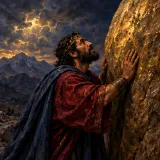
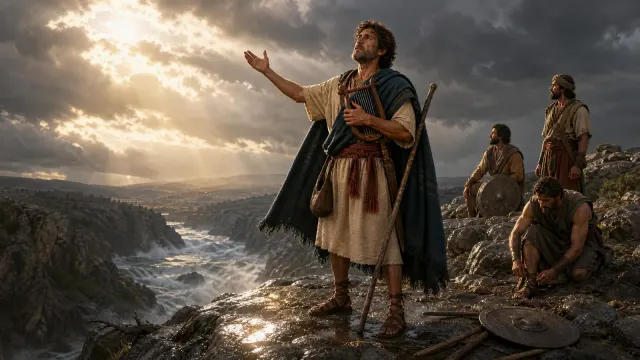
David's song makes the Book of 2 Samuel sound suddenly larger than the court, the battlefield, or the family crisis. He remembers danger as waves, snares, darkness, violent men, and enemies too strong for him, then answers every enclosure with a LORD who is rock, fortress, shield, tower, refuge, and savior. One cry sets earth and heaven trembling in the poem's imagery, and the same God who seems to bend the skies reaches down to draw David into a "large place." The song is intensely personal without making David self-sufficient. God lights his darkness, steadies his feet, teaches his hands, gives him strength, and makes victory possible. Even the hard military language remains framed by dependence. The difficult claims of righteousness stand beside the sins the book has already exposed, so they cannot be read as a claim of flawless life. The song ends by carrying mercy beyond completed battles to David's seed and the enduring promise attached to his house.
In this chapter
- A Cry Reaches Farther Than the Danger Can Surround 2 Samuel 22:1-7
David begins by piling refuge upon refuge: rock, fortress, deliverer, shield, high tower, refuge, savior.
- The Rescue Is Described with a Storm's Full Vocabulary 2 Samuel 22:8-16
The answer to David's cry is described as though creation itself has been pulled into motion.
- Wide Ground and the Difficult Claim of Clean Hands 2 Samuel 22:17-25
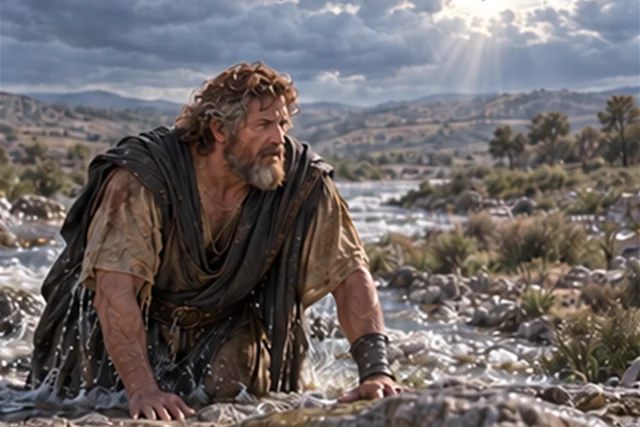
After the storm imagery, the rescue becomes startlingly personal: "he took me." David is drawn out of many waters and delivered from enemies he openly calls stronger than himself.
- The King's Lamp Is Not Self-Lit 2 Samuel 22:26-31
The paired lines about mercy, uprightness, purity, and perversity describe a world in which God cannot be manipulated into treating crookedness as straight.
- The Hands That Fight Are Hands That Have Been Taught 2 Samuel 22:32-43
David's body fills this movement, but almost every capability is traced back to God.
- The Song Ends with Offspring Still Beyond Its Horizon 2 Samuel 22:44-51
The song's final horizon is wider than one battlefield.

Scripture beside the summary
2 Samuel · King James Version · 512 Samuel 22:1-7
A Cry Reaches Farther Than the Danger Can Surround
David begins by piling refuge upon refuge: rock, fortress, deliverer, shield, high tower, refuge, savior. The accumulation fits a life in which danger has not come in only one form. Against those solid images stand waves, floods, sorrows, and snares that surround him before he can escape. The Book of 2 Samuel lets David name the imbalance plainly. He is not celebrating a strength that made rescue unnecessary. He remembers being enclosed by forces he could not simply outmuscle. Then the movement turns on one act: he cries, and the cry is heard. The distance between a hunted man and the divine temple does not prevent the voice from reaching God's ears. The section therefore begins the song with dependence rather than triumph. Before any battlefield skill or royal authority appears, David's own account of deliverance starts with the admission that he needed shelter outside himself and that the LORD heard him.
Deep dive
The introduction gathers deliverance from all David's enemies and specifically from Saul. It does not require the song to have been composed only after the events immediately preceding it. Psalm 18 preserves a closely parallel form, placing this royal thanksgiving within the Psalter as well as within the history of the reign. Here the poem supplies David's own sustained account of dependence after chapters that have shown both his victories and his need to be rescued.
Rock, fortress, shield, high tower, refuge, and savior accumulate because one image is not enough for the kinds of danger remembered. Some stand firm, some defend, and some actively deliver. The opposing images are enclosing waves and snares that arrive before escape is possible. The KJV's "prevented" means confronted or came before, not prevented in the usual modern sense. The song moves from being surrounded by death to being heard by God.
The cry enters the LORD's temple. Since the poem already speaks on a cosmic scale and does not depend on Solomon's later building, the language should not be treated as proof that David is singing after that temple's construction. The central contrast is distance overcome: the endangered voice reaches the divine hearing. The response that follows will expand until the whole created order seems drawn into the rescue.
Words to trace: LORD, compassed, death, enemies, hand, rock
Verse-by-verse path
- 2 Samuel 22:1
“Spake... the words of this song” is the formula that introduces Moses’ song in Deuteronomy 31:30, sung near the end of his life. The heading matches the title of Psalm 18 almost word for word; the Psalter kept the same poem with small differences throughout.
- 2 Samuel 22:2
“Rock” here is sela’, a crag or cliff, and “fortress” is metsudah, the word for the strongholds David hid in while Saul hunted him (1 Samuel 22:4–5) and for the stronghold of Zion he took (5:7). The hiding places of his youth become names for God.
- 2 Samuel 22:3
The “horn” is a bull’s horn, an image of strength; Hannah sang “mine horn is exalted” (1 Samuel 2:1), and Zacharias calls Jesus “an horn of salvation... in the house of his servant David” (Luke 1:69). The last clause, “thou savest me from violence”, is not in Psalm 18.
- 2 Samuel 22:4
“Worthy to be praised” is one Hebrew word, mehullal, “the praised one”. The verse states the principle before the history: call, and be saved. Everything from verse 5 onward is the account that proves it.
- 2 Samuel 22:5
“Waves” are breakers, water crashing over. “Ungodly men” translates beliya’al, Belial, the same word Shimei hurled at David (16:7) and the book used of Sheba (20:1). Where Psalm 18:4 has “the sorrows of death”, this text has the waves.
- 2 Samuel 22:6
“Hell” is Sheol, the grave and the realm of the dead, not the later place of punishment. “Sorrows” is better “cords”: the picture is a hunter’s ropes and nets closing around an animal before it can run.
- 2 Samuel 22:7
Two verbs, “called” and “cried”, the second a shout for help. The last clause is shorter than in Psalm 18:6, which reads “my cry came before him, even into his ears”; here the cry goes straight in.
2 Samuel 22:1-7
King James Version1And David spake unto the LORD the words of this song in the day that the LORD had delivered him out of the hand of all his enemies, and out of the hand of Saul:
2And he said, The LORD is my rock, and my fortress, and my deliverer;
3The God of my rock; in him will I trust: he is my shield, and the horn of my salvation, my high tower, and my refuge, my saviour; thou savest me from violence.
4I will call on the LORD, who is worthy to be praised: so shall I be saved from mine enemies.
5When the waves of death compassed me, the floods of ungodly men made me afraid;
6The sorrows of hell compassed me about; the snares of death prevented me;
7In my distress I called upon the LORD, and cried to my God: and he did hear my voice out of his temple, and my cry did enter into his ears.
2 Samuel 22:8-16
The Rescue Is Described with a Storm's Full Vocabulary
The answer to David's cry is described as though creation itself has been pulled into motion. Earth shakes, heaven trembles, smoke and fire convey wrath, darkness gathers beneath divine descent, and thunder becomes the LORD's voice. Lightning is pictured as arrows, while sea channels and the foundations of the world are laid bare at the rebuke. The Book of 2 Samuel is not supplying a weather report for each battle in David's reign. The imagery is poetic because ordinary military description is too small for what the singer wants to say about the one who rescues him. Even darkness, normally associated with threat, becomes part of God's pavilion rather than a region outside divine command. The scale of the language answers the scale of David's helplessness. The LORD who hears is not merely another combatant entering the field. The whole created order becomes vocabulary for power greater than the forces that had enclosed the king.
Deep dive
The song answers one cry with a universe in motion. Earth and heaven shake; smoke and fire convey wrath; the heavens bend as the LORD descends. Darkness is not merely his absence, since the poem makes it part of his surrounding pavilion. The images overlap rather than forming a diagram of divine anatomy or travel. Their purpose is to present the responder as greater than the forces enclosing David.
Thunder becomes the LORD's voice, lightning his arrows, and the sea's channels and the world's foundations are exposed at his rebuke. The imagery belongs to a poetic manifestation of divine power, not a report that every battle in David's reign was accompanied by a documented earthquake and lightning strike. Treating it as a military weather log would miss the relation between scale and meaning. The rescue feels cosmic because the one who hears commands what no earthly enemy can command.
The movement downward also prepares the next section's movement upward. The LORD descends in power and then draws David from the waters. The elaborate middle of the storm is not a decorative pause unrelated to the endangered man. It gives the hand that reaches him its identity.
Words to trace: coals, darkness, fire, foundations, heaven, kindled
Verse-by-verse path
- 2 Samuel 22:8
Psalm 18:7 reads “the foundations also of the hills”; this text has “the foundations of heaven”, the pillars on which the sky was pictured as resting (Job 26:11). The quake runs from the ground to the roof of the world.
- 2 Samuel 22:9
The Hebrew word for nostrils, ’aph, is also the ordinary word for anger, which was felt as heat in the nose. The poem takes the idiom literally: smoke from the nostrils, fire from the mouth, coals catching.
- 2 Samuel 22:10
“Bowed” is to stretch or bend down. “Darkness” is ’araphel, the thick darkness of Sinai into which Moses drew near “where God was” (Exodus 20:21). The storm cloud is imagined as the floor under God’s feet.
- 2 Samuel 22:11
“He was seen” here is wayyera; Psalm 18:10 reads wayyede, “he flew swiftly”. In the old Hebrew script the letters for r and d were nearly identical, and this is one of the textbook cases of the two being confused in copying.
- 2 Samuel 22:12
“Pavilions” is sukkot, booths or shelters, the word of the Feast of Tabernacles. “Dark waters” here is literally “a gathering of waters”, where Psalm 18:11 has “darkness of waters”: rain clouds heaped up as a tent around God.
- 2 Samuel 22:13
Psalm 18:12 has hailstones in this line and the next; this version keeps only the coals. Brightness and darkness sit side by side in the storm, the glare before God kindling coals inside the black cloud.
- 2 Samuel 22:14
“Most High” is Elyon, the title under which Melchizedek blessed Abram (Genesis 14:18–20). Thunder as God’s voice appears in the song of Hannah, where the LORD “thunder[s] upon them” from heaven against his enemies (1 Samuel 2:10).
- 2 Samuel 22:15
“Discomfited” is hamam, to throw into panic, the verb for the LORD troubling Egypt’s army at the sea (Exodus 14:24) and routing Sisera (Judges 4:15). The arrows and the lightning are the same thing said twice.
- 2 Samuel 22:16
“The blast of the breath of his nostrils” comes from the song at the sea: “with the blast of thy nostrils the waters were gathered together” (Exodus 15:8). The sea floor laid bare is the Red Sea crossing, pressed into David’s own deliverance.
2 Samuel 22:8-16
King James Version8Then the earth shook and trembled; the foundations of heaven moved and shook, because he was wroth.
9There went up a smoke out of his nostrils, and fire out of his mouth devoured: coals were kindled by it.
10He bowed the heavens also, and came down; and darkness was under his feet.
11And he rode upon a cherub, and did fly: and he was seen upon the wings of the wind.
12And he made darkness pavilions round about him, dark waters, and thick clouds of the skies.
13Through the brightness before him were coals of fire kindled.
14The LORD thundered from heaven, and the most High uttered his voice.
15And he sent out arrows, and scattered them; lightning, and discomfited them.
16And the channels of the sea appeared, the foundations of the world were discovered, at the rebuking of the LORD, at the blast of the breath of his nostrils.
2 Samuel 22:17-25
Wide Ground and the Difficult Claim of Clean Hands
After the storm imagery, the rescue becomes startlingly personal: "he took me." David is drawn out of many waters and delivered from enemies he openly calls stronger than himself. The movement into "a large place" reverses the claustrophobia of waves and snares. Then the song makes its most difficult claim, that the LORD has rewarded David according to righteousness and cleanness of hands. The Book of 2 Samuel itself prevents those words from becoming a claim of sinless biography. Bathsheba, Uriah, Nathan's rebuke, and the consequences already recorded cannot be erased by one song. The language is therefore best held in the narrower tension the book creates, whether read as integrity in the conflicts being remembered or as fidelity restored after repentance. David places himself under God's judgments and sight, not above them. Winning has not made him righteous by definition, and failure elsewhere has not made every claim of upright conduct meaningless.
Deep dive
The rescue is first an admission of unequal strength. David's enemy is too strong for him, so deliverance cannot be explained as the inevitable triumph of the more capable warrior. The LORD brings him into a large place, reversing the earlier enclosure of waters and snares. Spaciousness becomes the felt shape of safety. The explanation that God delights in him belongs to the song's account of relationship, not to a claim that danger never seriously threatened him.
The declarations of righteousness and clean hands raise a question the Book of 2 Samuel itself makes unavoidable. It has already exposed David's conduct toward Bathsheba and Uriah. These lines cannot responsibly be turned into a claim that he has never sinned. They are often understood as a profession of fidelity and innocence in the conflicts being recalled, especially his conduct toward Saul, rather than a complete moral inventory of his lifetime. Other readings emphasize a restored relationship following repentance. The song does not date each assertion against every recorded failure.
The repeated references to God's judgments, statutes, and sight locate the claim before a standard outside the king's own success. David is not saying that winning proves whatever he did was right. The prose and the poem remain together in the book, preventing either an uncomplicated portrait of perfection or an interpretation that empties the language of uprightness of all meaning.
Words to trace: LORD, cleanness, delivered, kept, recompensed, righteousness
Verse-by-verse path
- 2 Samuel 22:17
“Drew me out” is mashah, a verb found only here, in Psalm 18:16 and in Exodus 2:10, where Pharaoh’s daughter names Moses because “I drew him out of the water”. David describes his rescue with the verb that named Moses.
- 2 Samuel 22:18
“Strong enemy” is singular, and verse 1 has just named Saul; then the line widens to the plural, “them that hated me”. The confession “too strong for me” is from the man who killed Goliath.
- 2 Samuel 22:19
“Prevented” again means “came against me first”. “Stay” is mish’an, a support one leans on, from the same root as the “staff” that comforts in Psalm 23:4.
- 2 Samuel 22:20
“Delighted” is chaphets, the verb David used when he left Jerusalem: “if he thus say, I have no delight in thee, behold, here am I” (15:26). The fear he voiced on the road is answered in the song.
- 2 Samuel 22:21
“Cleanness” is bor, the word for lye or soap, a washing agent. Clean hands were the sign of innocence of blood; the elders in Deuteronomy 21:6 wash their hands over the body to declare it. The claim is made in the vocabulary of that ritual.
- 2 Samuel 22:22
The Hebrew is compressed: “I have not been wicked away from my God”, as though wickedness were a road leading off from him. “The ways of the LORD” are the paths of his commands, the language of Deuteronomy.
- 2 Samuel 22:23
“Depart” is sur, to turn aside, the verb of Deuteronomy 17:20, where a king must read the law daily so “that he turn not aside from the commandment”. The line describes the king of the law of kingship.
- 2 Samuel 22:24
“Upright” is tamim, whole or blameless, the word used of Noah (Genesis 6:9) and asked of Abram (Genesis 17:1). “Kept myself from mine iniquity” means guarded myself against it, admitting there is an iniquity close enough to be guarded against.
- 2 Samuel 22:25
“Recompensed” is from shuv, to return, the same verb Shimei used: “the LORD hath returned upon thee all the blood of the house of Saul” (16:8). Shimei said the LORD was returning blood; David sings that the LORD returns according to righteousness.
2 Samuel 22:17-25
King James Version17He sent from above, he took me; he drew me out of many waters;
18He delivered me from my strong enemy, and from them that hated me: for they were too strong for me.
19They prevented me in the day of my calamity: but the LORD was my stay.
20He brought me forth also into a large place: he delivered me, because he delighted in me.
21The LORD rewarded me according to my righteousness: according to the cleanness of my hands hath he recompensed me.
22For I have kept the ways of the LORD, and have not wickedly departed from my God.
23For all his judgments were before me: and as for his statutes, I did not depart from them.
24I was also upright before him, and have kept myself from mine iniquity.
25Therefore the LORD hath recompensed me according to my righteousness; according to my cleanness in his eye sight.
2 Samuel 22:26-31
The King's Lamp Is Not Self-Lit
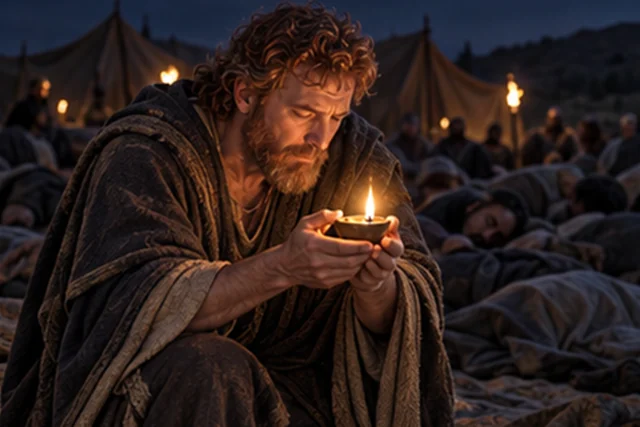
The paired lines about mercy, uprightness, purity, and perversity describe a world in which God cannot be manipulated into treating crookedness as straight. The KJV's "unsavoury" language is intentionally difficult to modern ears, but the contrast becomes clearer in the next line: the afflicted are saved, while haughty eyes are brought down. Then David makes one of the song's most revealing identifications. "Thou art my lamp, O LORD." His soldiers have called David the light of Israel, yet the king's own song names the source from which his light comes. The Book of 2 Samuel keeps those two descriptions from becoming rivals. David can be light to the people precisely while depending on the LORD to lighten his darkness. Troops and walls remain real obstacles, but they are no longer final limits. The section ends not in self-congratulation but with God's way called perfect and his tried word a shield for those who trust.
Deep dive
The paired statements about mercy, uprightness, purity, and perversity portray a correspondence in God's dealings with people. The KJV's "unsavoury" toward the froward does not describe God becoming morally corrupt. In the contrast, those who act crookedly encounter opposition rather than a deity they can straightforwardly manipulate to their advantage. The following line makes the direction explicit: afflicted people are saved, while the haughty are brought down.
David then calls the LORD his lamp. His men have just called David the light of Israel in 21:17; the poem identifies where David's own light comes from. Darkness, troops, and walls are not denied, but they are no longer the final limits of action. The movement ends with God's way as perfect and his word as tried. The shield is offered in the poem to all who trust, widening the address beyond the king without turning the passage into an instruction delivered by the commentary.
Words to trace: shew, thyself, LORD, merciful, pure, upright
Verse-by-verse path
- 2 Samuel 22:26
“Merciful” is chasid, one who practises chesed, loyal love. “Upright man” is literally “upright warrior”, gibbor, where Psalm 18:25 has only “man”. A soldier’s vocabulary runs through the moral lines.
- 2 Samuel 22:27
“Froward” is ’iqqesh, twisted or crooked, and “unsavoury” is from patal, to twist, the root of Naphtali’s name, “wrestlings” (Genesis 30:8). God meets the twister by out-twisting him, wrestling on his own ground.
- 2 Samuel 22:28
Psalm 18:27 says God “wilt bring down high looks”; here his eyes are fixed on the haughty in order to bring them down, a watch before the blow. Hannah sang the same reversal: “he bringeth low, and lifteth up” (1 Samuel 2:7).
- 2 Samuel 22:29
Psalm 18:28 reads “thou wilt light my candle”; this version says the LORD himself is the lamp. The word ner is the one used for the lamp of God that had not yet gone out in the sanctuary when Samuel was called (1 Samuel 3:3).
- 2 Samuel 22:30
“Troop” is gedud, a raiding band, the word David used at Ziklag when he asked, “Shall I pursue after this troop?” (1 Samuel 30:8). “Run through” may be “run at”. The wall is a city wall, scaled rather than breached.
- 2 Samuel 22:31
“Tried” is tseruphah, refined in the smelter until the dross is gone. Proverbs 30:5 repeats the line almost exactly: “Every word of God is pure: he is a shield unto them that put their trust in him.”
2 Samuel 22:26-31
King James Version26With the merciful thou wilt shew thyself merciful, and with the upright man thou wilt shew thyself upright.
27With the pure thou wilt shew thyself pure; and with the froward thou wilt shew thyself unsavoury.
28And the afflicted people thou wilt save: but thine eyes are upon the haughty, that thou mayest bring them down.
29For thou art my lamp, O LORD: and the LORD will lighten my darkness.
30For by thee I have run through a troop: by my God have I leaped over a wall.
31As for God, his way is perfect; the word of the LORD is tried: he is a buckler to all them that trust in him.
2 Samuel 22:32-43
The Hands That Fight Are Hands That Have Been Taught
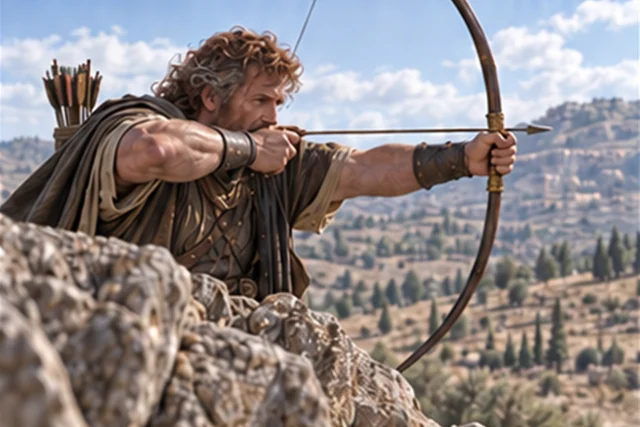
David's body fills this movement, but almost every capability is traced back to God. Feet become sure, arms strong, hands taught for war, steps widened, and strength fastened around him for battle. The Book of 2 Samuel does not oppose divine deliverance to human action. David pursues, fights, wounds, and overcomes, yet he describes those actions as possible because God has trained, guarded, and strengthened him. Even the startling line "thy gentleness hath made me great" sits inside severe military imagery rather than in a soft separate scene. The gentleness does not erase combat, and the combat does not erase dependence. The KJV's "bow of steel" should likewise be heard as an ancient image of extraordinary strength rather than imported into modern metallurgy. The closing images of enemies beaten like dust and mire are harsh royal victory language. They belong to actual conflict, not to a generalized permission for readers to turn every private opponent into one of David's enemies.
Deep dive
The song gives the rescued man a body capable of action: secure feet, strong arms, and hands taught to fight. The KJV's "bow of steel" renders Hebrew nechushah, identified as copper or bronze in the Brown–Driver–Briggs lexicon, rather than specifying a modern steel alloy. The emphasis is extraordinary strength supplied by God, not a technical description of weapon manufacture. Stable footing answers the earlier danger of slipping or being overwhelmed.
Within this account of force comes the striking attribution of greatness to divine gentleness. The poem does not contrast dependence with activity. David pursues, strikes, and prevails precisely as one who has been strengthened and sustained. The repeated credit to God prevents the list of actions from becoming an account of self-created military power, while the active verbs prevent deliverance from being mistaken for David doing nothing.
The defeated enemies are described in severe images of dust and street mire. These are words of ancient royal victory, and their violence should not be softened into a discussion of merely private frustrations. The poem celebrates actual deliverance through the defeat of opponents. It also distinguishes the one whose cry God heard from enemies whose appeal receives no answer. That contrast belongs to the singer's stated vindication within conflict, not to a general permission for later readers to identify every opponent with David's enemies.
Words to trace: feet, save, consumed, enemies, LORD, maketh
Verse-by-verse path
- 2 Samuel 22:32
The double question recalls Hannah again: “neither is there any rock like our God” (1 Samuel 2:2). The songs of Hannah and David frame the Books of Samuel, one near the start and one near the close, and share their key words.
- 2 Samuel 22:33
Psalm 18:32 reads “God that girdeth me with strength”; here God is himself the stronghold. The second half is difficult in Hebrew, and may mean “he sets the blameless free on his way”; the King James follows the psalm’s sense.
- 2 Samuel 22:34
The hind is the female deer, sure-footed on rock where an armed man would stumble. Habakkuk 3:19 borrows the line whole. “High places” here means the heights of the hills, the vantage ground in war.
- 2 Samuel 22:35
“Broken” is better “bent” or “drawn”: the verb means to press down, and a bow was strung and drawn by pressing. The boast is of strength to draw a stiff bow of bronze. Psalm 144:1 opens with the same thanks for hands taught to war.
- 2 Samuel 22:36
“Gentleness” renders ’anotkha, which can mean “thy stooping down” or “thy answering”; the Greek has “thy discipline”. Psalm 18:35 adds a line here, “thy right hand hath holden me up”, which this version lacks.
- 2 Samuel 22:37
“Feet” in the second half is literally “ankles”, the joint that turns on loose ground. Room to stride and ankles that hold: the sure footing of verse 34 again, now on the run.
- 2 Samuel 22:38
Psalm 18:37 has “overtaken them” where this text has “destroyed them”. The pursuit that does not turn back until the enemy is finished is what David did after the Amalekites at Ziklag, recovering everything (1 Samuel 30:17–19).
- 2 Samuel 22:39
Feet on the enemy was a victor’s gesture; Joshua had his captains put their feet on the necks of the five kings (Joshua 10:24). “Could not arise” answers the risers of the next verse.
- 2 Samuel 22:40
“Them that rose up against me” is the word Cushi used on the road to Mahanaim: “all that rise against thee to do thee hurt” (18:32). In a song gathered from the whole reign, the rebels of Absalom’s war are among the risers.
- 2 Samuel 22:41
To be given an enemy’s neck means seeing his back in flight; Exodus 23:27 promises to make Israel’s enemies “turn their backs”, literally their necks. The idiom is about rout, not execution.
- 2 Samuel 22:42
Psalm 18:41 says the enemies “cried”; here they “looked”. The phrase “he answered them not” is the one used of Saul in 1 Samuel 28:6, who enquired of the LORD and received no answer before he went to Endor.
- 2 Samuel 22:43
“Spread them abroad” is raqa’, to stamp flat or beat out, the root of the raqia, the firmament of Genesis 1:6, hammered thin. Psalm 18:42 has “cast them out as the dirt”; this version stamps them into the street.
2 Samuel 22:32-43
King James Version32For who is God, save the LORD? and who is a rock, save our God?
33God is my strength and power: and he maketh my way perfect.
34He maketh my feet like hinds’ feet: and setteth me upon my high places.
35He teacheth my hands to war; so that a bow of steel is broken by mine arms.
36Thou hast also given me the shield of thy salvation: and thy gentleness hath made me great.
37Thou hast enlarged my steps under me; so that my feet did not slip.
38I have pursued mine enemies, and destroyed them; and turned not again until I had consumed them.
39And I have consumed them, and wounded them, that they could not arise: yea, they are fallen under my feet.
40For thou hast girded me with strength to battle: them that rose up against me hast thou subdued under me.
41Thou hast also given me the necks of mine enemies, that I might destroy them that hate me.
42They looked, but there was none to save; even unto the LORD, but he answered them not.
43Then did I beat them as small as the dust of the earth, I did stamp them as the mire of the street, and did spread them abroad.
2 Samuel 22:44-51
The Song Ends with Offspring Still Beyond Its Horizon
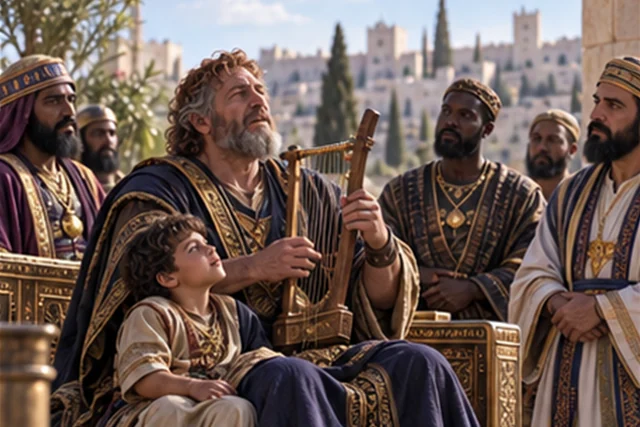
The song's final horizon is wider than one battlefield. David names deliverance from "the strivings of my people" as well as rule among foreign nations, which fits a reign endangered from inside the household and kingdom as well as from outside. Praise then travels in the opposite direction from conquest: David will thank the LORD "among the heathen," meaning among the nations. The Book of 2 Samuel closes the song by joining king, anointed one, David, and David's seed in one line of enduring mercy. That last phrase is larger than a list of victories already completed. It reaches back toward the covenant promise and forward beyond the singer's own lifetime. The song therefore does not end by claiming that every problem is over. David's house has already known rebellion, grief, and judgment. What survives the song's horizon is not confidence in a permanently trouble-free dynasty but confidence in the continuing mercy of the God who has repeatedly delivered.
Deep dive
The final movement includes strife among David's own people as well as submission by strangers. The distinction fits a reign whose dangers have come from household and kingdom as well as from surrounding armies. The KJV's "heathen" here refers to the nations; it should not be reduced to a modern insult for uncivilized people. Those nations appear both as peoples under the king and as the setting in which he will sing praise.
The thanksgiving among the nations has a later scriptural life. Romans 15:9 quotes the corresponding line in Psalm 18:49, parallel to 2 Samuel 22:50, in an argument about the Gentiles glorifying God for mercy. The reference is worth making precisely: Paul quotes the psalmic form, not a newly invented statement unrelated to this song. Royal thanksgiving becomes part of a wider account of praise among the nations.
The last line joins the LORD's king, his anointed, David, and David's offspring. Its enduring mercy recalls chapter 7 and carries the song past a list of completed campaigns. The promise outlives the man whose rescues have filled the poem. That is why the ending does not simply announce that every enemy has finally been defeated and every difficulty resolved. It rests the future of the house in the continuing mercy of the one being praised.
Words to trace: people, bringeth, delivered, heathen, LORD, rock
Verse-by-verse path
- 2 Samuel 22:44
Psalm 18:43 reads “made me the head”; here God has “kept” him as head. “A people which I knew not” means distant nations who had no dealings with Israel before, the kind of approach Hiram made with cedar and craftsmen (5:11).
- 2 Samuel 22:45
“Submit themselves” is kachash, which means to lie or cringe; the King James margin gives “yield feigned obedience”. Strangers who obey “as soon as they hear”, literally at the hearing of the ear, bow first and mean it later, if at all.
- 2 Samuel 22:46
“Fade away” is the withering of a leaf. “Afraid out of their close places” may mean creeping or limping out of their strongholds; the verb in this version differs from Psalm 18:45, and both are uncertain.
- 2 Samuel 22:47
“The LORD liveth” is the oath formula, “as the LORD liveth”, that runs all through the Books of Samuel, here turned from an oath into a shout of praise. “Rock” returns from verse 2, closing the frame.
- 2 Samuel 22:48
“Avengeth me” is literally “gives vengeances for me”. David had refused to take his own vengeance on Saul, saying “the LORD avenge me of thee: but mine hand shall not be upon thee” (1 Samuel 24:12). The song credits the vengeance where he had left it.
- 2 Samuel 22:49
“The violent man” is singular, a man of chamas, answering “thou savest me from violence” in verse 3. The poem opens and closes on the same word, and the singular may again have Saul in view.
- 2 Samuel 22:50
“Sing praises” is zamar, the verb of psalm singing, from which mizmor, a psalm, is made. The next chapter calls David “the sweet psalmist of Israel”, using the same root.
- 2 Samuel 22:51
The written Hebrew reads “tower”, migdol, while the scribal reading and Psalm 18:50 have “he magnifies”, making it “great salvation he gives to his king”. “For evermore”, ’ad olam, is the phrase of Nathan’s promise in 7:13 and 7:16.
2 Samuel 22:44-51
King James Version44Thou also hast delivered me from the strivings of my people, thou hast kept me to be head of the heathen: a people which I knew not shall serve me.
45Strangers shall submit themselves unto me: as soon as they hear, they shall be obedient unto me.
46Strangers shall fade away, and they shall be afraid out of their close places.
47The LORD liveth; and blessed be my rock; and exalted be the God of the rock of my salvation.
48It is God that avengeth me, and that bringeth down the people under me,
49And that bringeth me forth from mine enemies: thou also hast lifted me up on high above them that rose up against me: thou hast delivered me from the violent man.
50Therefore I will give thanks unto thee, O LORD, among the heathen, and I will sing praises unto thy name.
51He is the tower of salvation for his king: and sheweth mercy to his anointed, unto David, and to his seed for evermore.
Questions to keep in mind while reading
- Track who acts, who speaks, who is affected, and what changes.
- Notice repeated promises, failures, rescues, and consequences.
- Do not assume the account approves every action that is reported.
Text first
Where readers differ
The chapter summary begins with what the passage says and how its parts fit together. It does not assume one denomination has already settled every question. Where a conclusion depends on a tradition, literary theory, or historical reconstruction, that dependence is named openly.
The KJV text is presented first. Interpretive conclusions are labeled, and differences are introduced only when they help a reader understand why serious communities do not always reach the same answer.
Comparative interpretive notes for this chapter are in preparation. Until reviewed notes are ready, this page separates the KJV text from summary and application without claiming that serious readers agree on every question.
Questions beneath the surface
- What account of God, human freedom, responsibility, and the good life emerges from 2 Samuel 22?
- Which tension does the chapter refuse to resolve quickly?
- What changes when the chapter is read as part of the whole canon rather than as an isolated moral lesson?
- Where might a sincere reader confuse a familiar tradition with something the text states directly?
Questions for serious personal contemplation
These open-ended questions make room for tension, honest response, prayer, and conclusions that remain accountable to the chapter.
Observe without rushing
What part of 2 Samuel 22 makes you stop, feel unsettled, or feel surprised, and why?
Which detail in the passage would be easiest to overlook? How does that detail change your understanding?
Where do you see tension between what happens and this focus: 2 Samuel 22 develops its own movement around LORD, delivered, enemies, feet, rock?
What important question does the passage leave open instead of resolving quickly?
Examine your inner life honestly
Which person, response, fear, or desire in the passage feels most like your own life right now?
What assumption about God, other people, or yourself does this text challenge?
Which part would you rather soften, avoid, or explain away too quickly? What might that reaction reveal?
If this Scripture could ask you one direct question, what do you think it would ask?
Respond with wisdom and courage
What do you need to remember, confess, grieve, thank God for, or trust after reading this passage?
How might another faithful person read this situation differently without ignoring the text?
What obedient response would be costly, uncomfortable, or slow, yet still faithful to Scripture?
What question will you carry into prayer this week, and which verses will you keep in front of you?
Music and video connected to the passage
Related media appears when its Scripture reference overlaps this study. Music and video can illuminate a theme while the biblical text remains the foundation.