
The big picture
A man carried daily to the temple gate suddenly walks into the temple under his own strength, and the familiarity of his former place makes the change impossible to treat as anonymous rumor. Peter refuses the attention that immediately gathers around himself and John. Neither apostolic power nor personal holiness explains what the crowd has seen; the name of the risen Jesus does. From there the speech becomes larger than the healing. Peter names the rejection of the Holy and Just One, acknowledges that ignorance played a part, and still addresses his hearers as people to whom repentance and forgiveness remain open. The restored body becomes a sign inside a wider expectation of refreshing and restitution rather than the completion of everything promised. Moses' promised prophet and Abraham's promised blessing finally meet in Peter's appeal, where blessing is defined not as a stream of impressive benefits but as people being turned from their iniquities.
In this chapter
- The Man Who Used to Sit There Acts 3:1-10
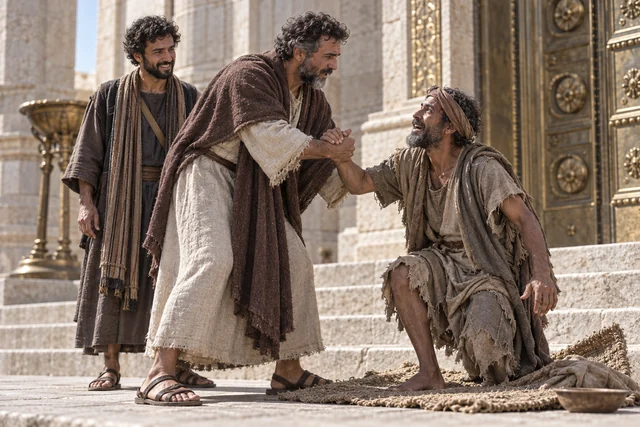
The miracle becomes persuasive partly because everybody knows where this man used to sit.
- Not by Their Own Holiness Acts 3:11-16
The healed man is holding Peter and John when the crowd rushes toward them, which makes Peter's first move almost abrupt: stop looking at us as though our own power or holiness made this happen.
- Ignorance Is Not the Last Word Acts 3:17-21
Peter has just spoken with severe clarity about Jesus' rejection, then addresses the people responsible as “brethren” and says they acted through ignorance, as did their rulers.
- The Blessing Turns People from Sin Acts 3:22-26
Peter closes by letting Moses and Abraham converge on the same demand.

Scripture beside the summary
Acts · King James Version · 26Acts 3:1-10
The Man Who Used to Sit There
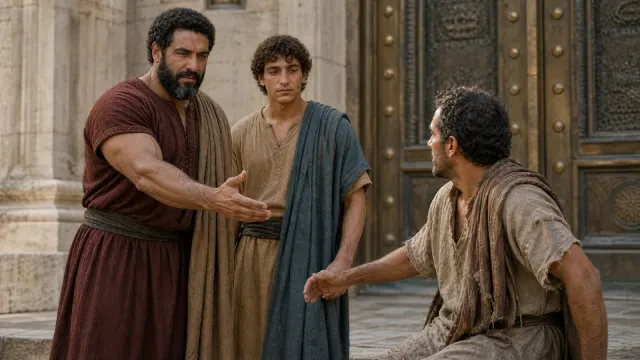
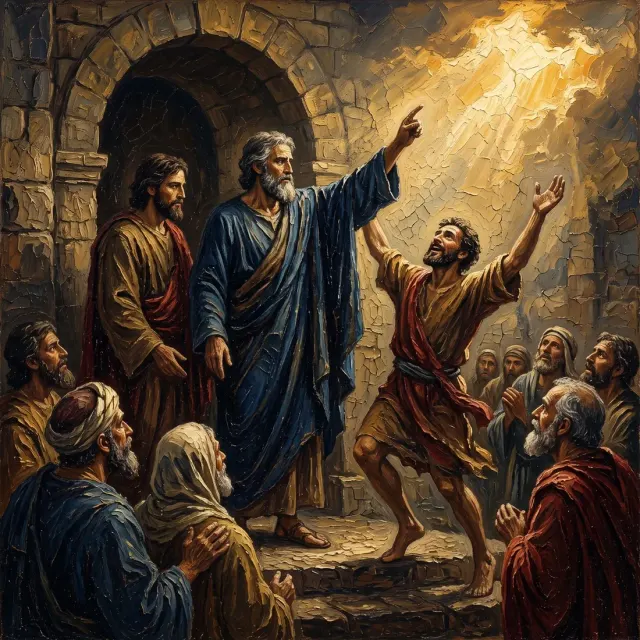
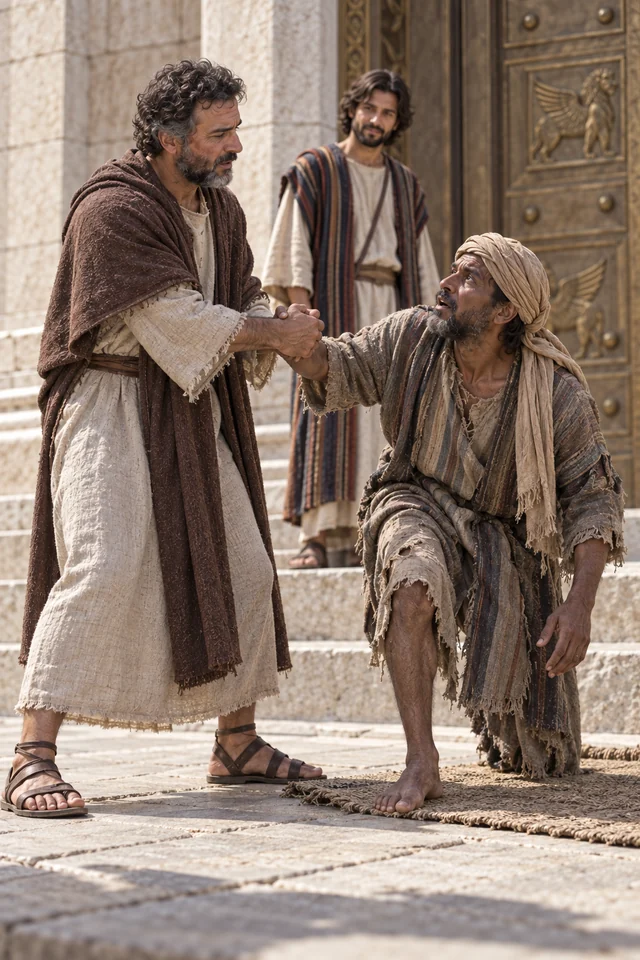
The miracle becomes persuasive partly because everybody knows where this man used to sit. He has been disabled from birth, carried daily to the Beautiful gate, and placed where worshippers have seen him asking for alms again and again. Peter first receives his attention by creating the expectation of money, then gives something the man had no reason to anticipate. The command comes in the name of Jesus Christ of Nazareth, and the change is immediate enough to overflow into movement: feet and ankles strengthen, he stands, walks, leaps, and enters the temple praising God. The Book of Acts does not introduce a faceless patient who vanishes once the miracle is complete. The crowd recognizes him as the same person from the gate. His former place of dependence becomes evidence precisely because it was so familiar. The spectacle is not merely that a man can walk, but that the man everyone knew as unable to walk is now moving among them.
Deep dive
The man is carried to a regular place at a regular hour of religious activity. That routine establishes both his dependence and the crowd's ability to recognize him afterward. Acts does not introduce an anonymous healed figure whom nobody can identify. The man now walking is the man they know from the gate. His age, supplied in Acts 4:22, will further rule out treating the condition as a passing inconvenience.
Peter first asks for his attention, and the man reasonably expects money. The answer begins with the absence of silver and gold, but the passage is not a general declaration that relief for the poor is inferior to preaching. The preceding chapter has just described material generosity. Here Peter gives what he is authorized to give in Jesus' name, takes the man's hand, and raises him. Feet and ankle bones gain strength immediately. The formerly stationary man enters the temple with an almost overflowing sequence of motion: walking, leaping, and praising. The gate is no longer merely his place of dependence.
Words to trace: temple, Peter, alms, John, Beautiful, entered
Verse-by-verse path
- Acts 3:1
The ninth hour, about three in the afternoon, was the time of the evening sacrifice and its prayers; Josephus says the daily offerings were made in the morning and at the ninth hour. Cornelius is praying at the same hour in 10:30. Peter and John were paired before, sent together to prepare the Passover (Luke 22:8).
- Acts 3:2
No other ancient source names a gate “Beautiful”. It is usually identified with the Nicanor Gate, whose Corinthian bronze Josephus says outshone gates plated with silver and gold, or else with a gate on the eastern side. Worshippers on their way to prayer were the likeliest to give, which is why he was laid there.
- Acts 3:3
“Alms” is eleemosyne, from the word for mercy. In Jewish piety giving to the poor was counted as righteousness; Tobit says “alms doth deliver from death” (Tobit 12:9), and the Hebrew word for righteousness, tsedaqah, came to mean charity. His request was a standard one, made in passing.
- Acts 3:4
The beggar has seen them only in passing, as one of hundreds of faces going through the gate. Peter answers with a fixed stare and a command, “Look on us”, which turns a routine exchange at the gate into a face-to-face encounter before a word about Jesus is spoken.
- Acts 3:5
“Expecting” is prosdokao, the verb Luke uses for the people who were “in expectation” whether John might be the Christ (Luke 3:15). The man waits for a coin. What he is about to receive lies outside anything he has learned to expect at that gate.
- Acts 3:6
This is the first healing in the Book of Acts, and it is done by naming Jesus rather than by any power claimed for Peter. “Of Nazareth” ties the name to an obscure hometown, the same one Pilate wrote over the cross. Several early manuscripts lack “rise up and”, reading simply “walk”.
- Acts 3:7
The words for “feet” and “ankle bones”, basis and sphydra, are rare, and in 1882 W. K. Hobart used such terms to argue that Luke wrote as a physician. H. J. Cadbury answered in 1926 that the same vocabulary appears in non-medical writers. The man is raised by the right hand, the hand of strength.
- Acts 3:8
Isaiah foresaw the day when “the lame man” would “leap as an hart” (Isaiah 35:6), and the verb here echoes it. The Book of Acts repeats the scene in Paul’s ministry: a man at Lystra, lame “from his mother’s womb”, who “leaped and walked” (14:8-10).
- Acts 3:9
“The people” is laos, Luke’s word for the people of Israel at large, as distinct from their rulers, who will react quite differently in the next chapter. “Praising God” is the response Luke records after healings in his Gospel too (Luke 18:43).
- Acts 3:10
“Knew” is epiginosko, to recognise, not merely to know about. “Amazement” is ekstasis, the root of “ecstasy”, being beside oneself, the same pair of reactions as when the paralytic walked home in Luke 5:26.
Acts 3:1-10
King James Version1Now Peter and John went up together into the temple at the hour of prayer, being the ninth hour.
2And a certain man lame from his mother’s womb was carried, whom they laid daily at the gate of the temple which is called Beautiful, to ask alms of them that entered into the temple;
3Who seeing Peter and John about to go into the temple asked an alms.
4And Peter, fastening his eyes upon him with John, said, Look on us.
5And he gave heed unto them, expecting to receive something of them.
6Then Peter said, Silver and gold have I none; but such as I have give I thee: In the name of Jesus Christ of Nazareth rise up and walk.
7And he took him by the right hand, and lifted him up: and immediately his feet and ankle bones received strength.
8And he leaping up stood, and walked, and entered with them into the temple, walking, and leaping, and praising God.
9And all the people saw him walking and praising God:
10And they knew that it was he which sat for alms at the Beautiful gate of the temple: and they were filled with wonder and amazement at that which had happened unto him.
Acts 3:11-16
Not by Their Own Holiness
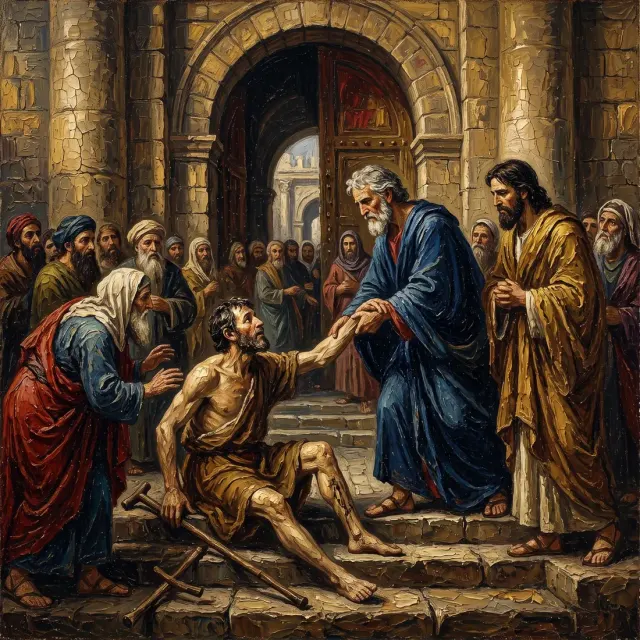
The healed man is holding Peter and John when the crowd rushes toward them, which makes Peter's first move almost abrupt: stop looking at us as though our own power or holiness made this happen. The Book of Acts refuses to turn the apostles into religious celebrities whose personal virtue can be measured by spectacular results. Peter names the God of Abraham, Isaac, and Jacob before naming Jesus, placing the event inside Israel's confession rather than beside it. Then the contrasts sharpen. The Holy and Just One was denied, a murderer was preferred, and the “Prince of life” was killed. God's resurrection reverses that human verdict. The man's strength is tied to Jesus' name and to faith through him, not to a technique belonging to Peter. The person standing in front of the crowd becomes the visible evidence that the source of the event is not the two men everyone is staring at. Peter uses the attention to redirect attention.
Deep dive
The healed man holds Peter and John, and the gathering crowd fixes its attention on them. Peter challenges precisely that direction of attention. The explanation is not that the two apostles possess a private reserve of power or unusual holiness. The denial is worth keeping intact: Acts does not present healing as a public measurement of how morally impressive the human agent happens to be.
Peter names the God of Abraham, Isaac, and Jacob before speaking of Jesus. He is arguing within Israel's confession, not announcing a different deity who has displaced it. His contrasts are severe: the Holy and Just One was rejected, a murderer was preferred, and the "Prince of life" was killed. The phrase places the killing and the source of life in deliberate collision, with resurrection as God's reversal of the verdict.
The man's soundness is connected with Jesus' name and faith through him. The passage does not explicitly identify every person's degree of faith or say that the beggar had first articulated a confession. It locates the effective agency in Jesus rather than turning the miracle into a technique. The man standing before the crowd is the visible subject of that claim.
Words to trace: denied, faith, name, people, Peter, presence
Verse-by-verse path
- Acts 3:11
Solomon’s porch was the colonnade along the east side of the outer court, which Josephus attributes to Solomon’s building. Jesus had walked there in winter at the feast of dedication (John 10:23), and the believers will meet there regularly (5:12). The healed man is clinging to his two benefactors.
- Acts 3:12
“Answered” with no question asked is a Hebrew way of saying he responded to what he saw. The crowd now “looks earnestly” at the apostles, the same verb as Peter’s fixed gaze at the man in verse 4. “Holiness” is eusebeia, piety, the reputation for devotion that could be imagined to earn a miracle.
- Acts 3:13
“His Son” is pais, which can mean child or servant, and “glorified his servant” comes straight from Isaiah 52:13: “my servant... shall be exalted and extolled”, where the Greek has “glorified”. The passage that follows in Isaiah is the suffering servant. Pilate “was determined” means he had given a ruling for release.
- Acts 3:14
“The Just One” becomes a title in the Book of Acts: Stephen uses it (7:52), and Ananias tells Paul he was chosen to see “that Just One” (22:14). At the cross the centurion said “Certainly this was a righteous man” (Luke 23:47). Luke says Barabbas had been jailed for sedition and murder (Luke 23:19).
- Acts 3:15
“Prince” is archegos, leader, pioneer or founder, the one who goes first and opens the way. It returns in 5:31, “a Prince and a Saviour”, and Hebrews uses it for “the captain of their salvation” (2:10) and “the author... of our faith” (12:2).
- Acts 3:16
The Greek is famously awkward, with “name” twice and “faith” twice, and C. C. Torrey argued that the first half of the Book of Acts was translated from Aramaic, citing clumsy sentences like this. “Perfect soundness” is holokleria, wholeness in every part, found only here in the New Testament.
Acts 3:11-16
King James Version11And as the lame man which was healed held Peter and John, all the people ran together unto them in the porch that is called Solomon’s, greatly wondering.
12And when Peter saw it, he answered unto the people, Ye men of Israel, why marvel ye at this? or why look ye so earnestly on us, as though by our own power or holiness we had made this man to walk?
13The God of Abraham, and of Isaac, and of Jacob, the God of our fathers, hath glorified his Son Jesus; whom ye delivered up, and denied him in the presence of Pilate, when he was determined to let him go.
14But ye denied the Holy One and the Just, and desired a murderer to be granted unto you;
15And killed the Prince of life, whom God hath raised from the dead; whereof we are witnesses.
16And his name through faith in his name hath made this man strong, whom ye see and know: yea, the faith which is by him hath given him this perfect soundness in the presence of you all.
Acts 3:17-21
Ignorance Is Not the Last Word
Peter has just spoken with severe clarity about Jesus' rejection, then addresses the people responsible as “brethren” and says they acted through ignorance, as did their rulers. That acknowledgment neither turns wrong into innocence nor turns guilt into a closed door. The speech moves directly toward repentance, conversion, sins blotted out, and “times of refreshing” from the Lord's presence. The horizon also widens far beyond one healed body. Jesus is received in heaven until the “restitution of all things” spoken by the prophets, language that has generated different interpretations about Israel, creation, and the shape of final restoration. The Book of Acts does not reduce that phrase to a promise that every individual will finally be saved, nor does it let the healed man's restored ankles exhaust it. The miracle belongs inside a divine purpose still moving toward completion. What the crowd has seen is real restoration, but Peter insists that it is not the whole of what God has promised.

Deep dive
"Through ignorance" modifies Peter's charge without removing it. He includes the rulers as well as his hearers, calls them brethren, and moves toward the possibility of sins being blotted out. Ignorance does not become innocence, but neither does involvement in Jesus' rejection become a declaration that forgiveness is unavailable. The same speech can name the wrong and address those responsible as people to whom the promise still comes.
The language of refreshing and restoration enlarges the horizon beyond the immediate healing. Jesus remains received in heaven until the times of restitution spoken of by the prophets. Interpretations differ over the precise timing and scope of this restoration, including its relation to Israel and the renewed creation. The passage ties it to God's prophetic promises; it does not independently state that every person will finally be saved. Nor does the man's restored body exhaust what Peter anticipates. The healing belongs within an unfinished divine purpose, rather than making the crowd's present moment the completion of everything promised.
Words to trace: Christ, mouth, prophets, times, began, blotted
Verse-by-verse path
- Acts 3:17
“Wot” is the 1611 present of the old verb to wit, to know. The Law distinguished sins done unwittingly, which could be atoned for, from sins done “presumptuously” (Numbers 15:22-31). Luke 23:34 has Jesus pray, “Father, forgive them; for they know not what they do.”
- Acts 3:18
No single prophet says in so many words that the Messiah must suffer; Peter speaks of “all his prophets” together. That was the reading the risen Jesus gave on the Emmaus road: “Ought not Christ to have suffered these things?” (Luke 24:26-27). The Greek says “his Christ”, God’s anointed.
- Acts 3:19
“Blotted out” is exaleipho, to wipe a wax tablet or sponge ink off papyrus, the verb of David’s prayer, “blot out all mine iniquities” (Psalm 51:9). “Refreshing” is anapsyxis, a cooling or breathing space, found only here in the New Testament. “Be converted” is an active verb: turn round.
- Acts 3:20
The oldest manuscripts read “appointed for you beforehand”, prokecheirismenon, not “preached before”, prokekerygmenon; the two words differ by a few letters, and the King James follows the second. The better text says Jesus was designated in advance as their Christ.
- Acts 3:21
“Restitution” is apokatastasis, the noun of the apostles’ question in 1:6. Origen later made the word the name of his hope that all things, perhaps even the devil, would be restored; that teaching was condemned in 553. “Must” is dei, divine necessity, as the Son of man “must” suffer in Luke 9:22.
Acts 3:17-21
King James Version17And now, brethren, I wot that through ignorance ye did it, as did also your rulers.
18But those things, which God before had shewed by the mouth of all his prophets, that Christ should suffer, he hath so fulfilled.
19Repent ye therefore, and be converted, that your sins may be blotted out, when the times of refreshing shall come from the presence of the Lord;
20And he shall send Jesus Christ, which before was preached unto you:
21Whom the heaven must receive until the times of restitution of all things, which God hath spoken by the mouth of all his holy prophets since the world began.
Acts 3:22-26
The Blessing Turns People from Sin
Peter closes by letting Moses and Abraham converge on the same demand. Moses promised that God would raise up a prophet whom the people must hear, so loyalty to Moses cannot be used as a reason to ignore the one Moses himself says must be heard. The warning attached to that prophet also keeps inherited privilege from becoming a guarantee that response no longer matters. Then Peter turns to the covenant with Abraham and the promise that all the kindreds of the earth will be blessed through his seed. Israel comes “first” in the final verse, which preserves priority without shrinking the blessing to Israel alone. Most strikingly, Peter defines what the blessing looks like. The speech began with a man who can suddenly walk, but it does not end by promising every hearer a comparable physical wonder. The blessing is Jesus turning people away from their iniquities. The deepest movement in the passage is moral and covenantal, not merely muscular.
Deep dive
Deuteronomy 18:15–19 supplies the promise of a prophet like Moses, and Peter makes hearing that prophet the crucial response. His appeal is not that reverence for Moses should be abandoned. It is that Moses' own instruction requires attention to the one God raises up. The warning about refusing the prophet prevents the language of inherited privilege from becoming a guarantee that response no longer matters.
Peter then calls his hearers children of the prophets and of the covenant with Abraham. Genesis 22:18 stands behind the promise that all the earth's kindreds will be blessed through Abraham's seed. The word "first" in the final verse preserves Israel's priority without limiting the blessing to Israel. Equally important is Peter's definition of the blessing: turning each person away from iniquities. The speech that began with restored ankles does not end by promising a succession of spectacular physical benefits. It places the deeper blessing in a changed relation to sin through the one God has sent.
Words to trace: fathers, hear, prophet, prophets, Abraham, bless
Verse-by-verse path
- Acts 3:22
Deuteronomy 18:15 fed a lively expectation. The Samaritans looked for a returning prophet like Moses, the Taheb; the Dead Sea Scrolls speak of “the Prophet” to come; and John the Baptist was asked, “Art thou that prophet?” (John 1:21). Stephen will cite the same verse in 7:37.
- Acts 3:23
The warning is not in Deuteronomy 18:19, which says only “I will require it of him”. “Shall be destroyed from among the people” is borrowed from Leviticus 23:29, the penalty for ignoring the Day of Atonement. Peter joins two texts of the Law into one.
- Acts 3:24
Samuel is counted as the first of the prophets after Moses, and he is the one who anointed David (1 Samuel 16:13). The prophets after him, beginning with Nathan’s promise of a house for David, carry the line of promise Peter has been tracing since chapter 2.
- Acts 3:25
“Children of the prophets” means heirs, those to whom the prophets’ promises belong, a Hebrew idiom. Genesis speaks of “nations” and “families” being blessed; Peter’s word is patriai, clans or kindreds, a family word, which makes the promise sound close at hand.
- Acts 3:26
“Raised up” may mean raised from the dead, or brought onto the scene as God “raised up” the prophet in verse 22. The last clause can be read two ways in Greek: Jesus blesses them by turning each one from his iniquities, or blesses them as each one turns away.
Acts 3:22-26
King James Version22For Moses truly said unto the fathers, A prophet shall the Lord your God raise up unto you of your brethren, like unto me; him shall ye hear in all things whatsoever he shall say unto you.
23And it shall come to pass, that every soul, which will not hear that prophet, shall be destroyed from among the people.
24Yea, and all the prophets from Samuel and those that follow after, as many as have spoken, have likewise foretold of these days.
25Ye are the children of the prophets, and of the covenant which God made with our fathers, saying unto Abraham, And in thy seed shall all the kindreds of the earth be blessed.
26Unto you first God, having raised up his Son Jesus, sent him to bless you, in turning away every one of you from his iniquities.
Questions to keep in mind while reading
- Track who acts, who speaks, who is affected, and what changes.
- Notice repeated promises, failures, rescues, and consequences.
- Do not assume the account approves every action that is reported.
Text first
Where readers differ
The chapter summary begins with what the passage says and how its parts fit together. It does not assume one denomination has already settled every question. Where a conclusion depends on a tradition, literary theory, or historical reconstruction, that dependence is named openly.
The KJV text is presented first. Interpretive conclusions are labeled, and differences are introduced only when they help a reader understand why serious communities do not always reach the same answer.
Comparative interpretive notes for this chapter are in preparation. Until reviewed notes are ready, this page separates the KJV text from summary and application without claiming that serious readers agree on every question.
Questions beneath the surface
- What account of God, human freedom, responsibility, and the good life emerges from Acts 3?
- Which tension does the chapter refuse to resolve quickly?
- What changes when the chapter is read as part of the whole canon rather than as an isolated moral lesson?
- Where might a sincere reader confuse a familiar tradition with something the text states directly?
Questions for serious personal contemplation
These open-ended questions make room for tension, honest response, prayer, and conclusions that remain accountable to the chapter.
Observe without rushing
What part of Acts 3 makes you stop, feel unsettled, or feel surprised, and why?
Which detail in the passage would be easiest to overlook? How does that detail change your understanding?
Where do you see tension between what happens and this focus: Acts 3 develops its own movement around Peter, temple, Jesus, John, people?
What important question does the passage leave open instead of resolving quickly?
Examine your inner life honestly
Which person, response, fear, or desire in the passage feels most like your own life right now?
What assumption about God, other people, or yourself does this text challenge?
Which part would you rather soften, avoid, or explain away too quickly? What might that reaction reveal?
If this Scripture could ask you one direct question, what do you think it would ask?
Respond with wisdom and courage
What do you need to remember, confess, grieve, thank God for, or trust after reading this passage?
How might another faithful person read this situation differently without ignoring the text?
What obedient response would be costly, uncomfortable, or slow, yet still faithful to Scripture?
What question will you carry into prayer this week, and which verses will you keep in front of you?
Music and video connected to the passage
Related media appears when its Scripture reference overlaps this study. Music and video can illuminate a theme while the biblical text remains the foundation.