The big picture
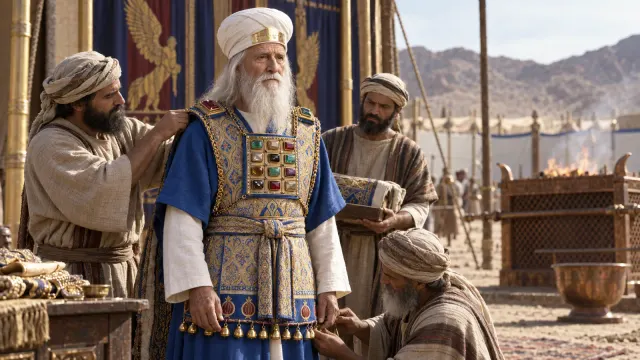
The Book of Exodus takes priestly clothing far beyond decoration. Aaron and his sons are appointed before the garments are described, and the splendor of gold, color, stone, and embroidery belongs to an office of service rather than private display. Israel's names are engraved first on Aaron's shoulders and then across the breastplate over his heart, turning workmanship into visible representation. Even the fastenings matter because those names are not supposed to work loose. The blue robe must survive being worn and must be heard in motion. The gold plate on the forehead joins "HOLINESS TO THE LORD" to the burden of bearing iniquity connected with holy gifts. After all that concentrated beauty, the chapter closes with linen covering and a warning about approach. Glory and ordinary bodily propriety occupy the same priestly wardrobe.
In this chapter
- Beauty Is Part of the Commission Exodus 28:1-5
Before a single gemstone is set, the Book of Exodus fixes the order of things: Aaron and his sons are appointed to the priesthood, then the garments are made for that appointed work.
- Six Names on Each Shoulder Exodus 28:6-14
The shoulder stones do something more interesting than decorate an already elaborate ephod.
- The People Remain Over the Priest's Heart Exodus 28:15-30
The breastplate brings Israel even closer than the shoulder stones.
- A Reinforced Opening and an Audible Hem Exodus 28:31-35
A robe made for holy service still has a weak point where a human head passes through it.
- Holiness Written Where the Face Is Seen Exodus 28:36-38
The brightest declaration on Aaron's clothing sits where everyone can see it: a pure gold plate engraved "HOLINESS TO THE LORD" and fixed to the front of the mitre.
- Glory Also Requires Ordinary Covering Exodus 28:39-43
After gold, gemstones, bells, embroidery, and an engraved crown, the Book of Exodus ends the wardrobe with linen breeches.
Scripture beside the summary
Exodus · King James Version · 43Exodus 28:1-5
Beauty Is Part of the Commission
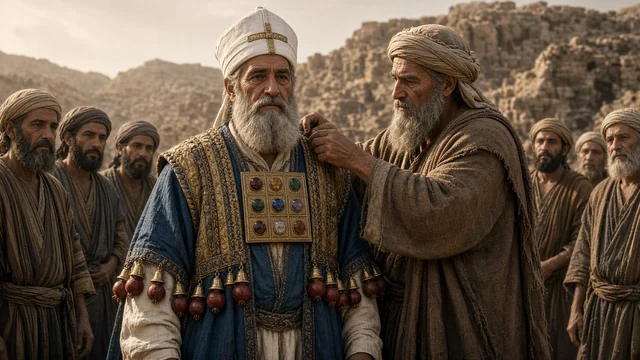
Before a single gemstone is set, the Book of Exodus fixes the order of things: Aaron and his sons are appointed to the priesthood, then the garments are made for that appointed work. The clothes do not create the office by looking impressive. They belong to it because the service has already been named. That keeps "glory and beauty" from becoming an embarrassed phrase the chapter needs to explain away. Fine work is part of the commission. So is the wisdom required to produce it. The wisehearted are filled for cutting, weaving, assembling, and shaping material into something worthy of consecrated use. Even the color palette ties Aaron to the sanctuary he will serve, since gold, blue, purple, scarlet, and fine linen have already become the visual language of the dwelling. The beauty is real, but it is never merely Aaron's. It is commissioned beauty, made for ministry.
Deep dive
Aaron's household is named before the garments are listed. The clothing belongs to an appointed office rather than creating that office through visual impressiveness. Its declared purposes include both glory and beauty, words the passage does not apologize for using. Fine work is part of the instruction.
The workers are described as wisehearted and filled with the spirit of wisdom. That wisdom takes the form of making garments suitable to consecrate Aaron for service. It is not restricted to speaking or governing; here it reaches cutting, weaving, and assembling material. The same colors and linen used in the sanctuary reappear in the clothing, linking the minister's appearance to the place in which he serves.
The repeated purpose is ministry to God. That emphasis keeps the garments from becoming a private display of Aaron's wealth. Their splendor is commissioned, funded, and made within Israel's common work, and the subsequent instructions repeatedly attach the people's names and needs to what he wears.
Words to trace: Aaron, garments, brother, minister, office, priest’s
Verse-by-verse path
- Exodus 28:1
“Take thou unto thee” is haqrev, bring near, the verb from which qorban, an offering, is built. Aaron and his sons are brought near the way a gift is. Of the four sons listed, Nadab and Abihu will not live to serve long; Eleazar and Ithamar carry the line on.
- Exodus 28:2
“Glory” is kavod, the word used for the glory that settled on the mountain in 24:16; “beauty” is tif’eret, splendour or adornment. The priest is to be dressed in the vocabulary of the presence he serves.
- Exodus 28:3
“Wise hearted” is chakhmei lev: in this chapter wisdom means skill of hand. The grammar is striking too: the garments are made “to consecrate him”, so the clothes themselves do part of the setting apart. “The spirit of wisdom” returns in Deuteronomy 34:9, of Joshua.
- Exodus 28:4
Six garments are listed, and not in the order they are then described: the breastplate comes first here but after the ephod below. The “broidered coat” is a checkered weave, tashbets. The mitre is a turban, and the gold plate and the breeches are not on this list at all.
- Exodus 28:5
Gold joins the sanctuary’s colours here for the first time as a thread. Exodus 39:3 explains how: the gold was beaten into thin plates and cut into wires, then worked in among the blue, purple, scarlet and linen.
Exodus 28:1-5
King James Version1And take thou unto thee Aaron thy brother, and his sons with him, from among the children of Israel, that he may minister unto me in the priest’s office, even Aaron, Nadab and Abihu, Eleazar and Ithamar, Aaron’s sons.
2And thou shalt make holy garments for Aaron thy brother for glory and for beauty.
3And thou shalt speak unto all that are wise hearted, whom I have filled with the spirit of wisdom, that they may make Aaron’s garments to consecrate him, that he may minister unto me in the priest’s office.
4And these are the garments which they shall make; a breastplate, and an ephod, and a robe, and a broidered coat, a mitre, and a girdle: and they shall make holy garments for Aaron thy brother, and his sons, that he may minister unto me in the priest’s office.
5And they shall take gold, and blue, and purple, and scarlet, and fine linen.
Exodus 28:6-14
Six Names on Each Shoulder
The shoulder stones do something more interesting than decorate an already elaborate ephod. Six names go on one stone and six on the other, ordered by birth and engraved like a signet. Israel is not represented by an anonymous symbol when Aaron enters. The tribes are named. The arrangement also resists turning the garment into a ranking system. No later prominence determines which tribe receives the preferred side, and no family gets a more valuable stone. The paired stones gather all twelve into the same act of remembrance. Then the Book of Exodus gives the shoulders a job beyond supporting cloth: Aaron is to bear those names before the LORD. Gold settings and wreathen chains keep the memorial fixed to the garment, but the weight of the passage is in the people attached to it. The priest enters where most Israelites will not, carrying their names into that restricted place.
Deep dive
The onyx stones carry the names according to birth, six on each shoulder. The order is given, and the purpose is stated: a memorial before the LORD. Nothing is said about ranking the tribes according to their later prominence or assigning a more valuable shoulder to a more important family. The paired stones gather the named people into one act of representation.
The engraving is compared to a signet's work, making the names deliberate and durable rather than temporary markings. Gold settings and twisted chains hold them within the garment's design. The KJV's "ouches" are settings, not an additional mysterious piece of priestly equipment. The instruction then says Aaron is to bear the names before God. The phrase turns weight and placement into part of the office: his shoulders do not carry only elaborate cloth. They carry an explicitly named Israel into the place where most of Israel will not enter.
Words to trace: gold, names, stones, work, children, ephod
Verse-by-verse path
- Exodus 28:6
The ephod’s shape is uncertain, perhaps an apron or a sleeveless vest. The word travels widely: the boy Samuel wore a linen ephod (1 Samuel 2:18), David danced before the ark in one (2 Samuel 6:14), and Gideon’s gold ephod became a snare to his house (Judges 8:27).
- Exodus 28:7
The ephod hangs from two shoulder straps, joined front and back. That is why the stones of verse 9 sit on the shoulders: they are set where the garment is fastened and bears its own weight.
- Exodus 28:8
“Curious” in 1611 meant made with care and skill, from the Latin curiosus, not strange. The band, cheshev, is woven “of the same”, all one piece with the ephod rather than a separate belt tied on.
- Exodus 28:9
These are the names of “the children of Israel”, Jacob’s twelve sons. An inference follows from verse 10’s “according to their birth”: the stones would carry Levi and a single Joseph, not the tribal list of Numbers in which Ephraim and Manasseh replace them.
- Exodus 28:10
The order is birth order, from Reuben to Benjamin. Josephus (Antiquities 3.7.5) says the six eldest were on the right shoulder, a detail Exodus does not give.
- Exodus 28:11
A signet was the seal a man carried and pressed into clay as his signature; Judah handed his to Tamar as a pledge (Genesis 38:18), and Pharaoh put his ring on Joseph’s hand (41:42). The names are cut with the permanence of a seal.
- Exodus 28:12
A “memorial” is zikkaron, a reminder, the word used of the Passover in 12:14: “this day shall be unto you for a memorial.” The feast was a memorial kept in the calendar; these stones are a memorial worn on a man.
- Exodus 28:13
“Ouches” is the English nouche, a brooch or clasp, misdivided: “a nouche” was heard as “an ouche”, the same slip that turned “a napron” into “an apron”. The verse is a single clause, and the settings it orders anchor both the stones and the chains that follow.
- Exodus 28:14
“Wreathen work” is literally rope work, gold twisted like cord rather than forged into links. These chains will later hang the breastplate from the shoulders, so the rope-like twist carries weight.
Exodus 28:6-14
King James Version6And they shall make the ephod of gold, of blue, and of purple, of scarlet, and fine twined linen, with cunning work.
7It shall have the two shoulderpieces thereof joined at the two edges thereof; and so it shall be joined together.
8And the curious girdle of the ephod, which is upon it, shall be of the same, according to the work thereof; even of gold, of blue, and purple, and scarlet, and fine twined linen.
9And thou shalt take two onyx stones, and grave on them the names of the children of Israel:
10Six of their names on one stone, and the other six names of the rest on the other stone, according to their birth.
11With the work of an engraver in stone, like the engravings of a signet, shalt thou engrave the two stones with the names of the children of Israel: thou shalt make them to be set in ouches of gold.
12And thou shalt put the two stones upon the shoulders of the ephod for stones of memorial unto the children of Israel: and Aaron shall bear their names before the LORD upon his two shoulders for a memorial.
13And thou shalt make ouches of gold;
14And two chains of pure gold at the ends; of wreathen work shalt thou make them, and fasten the wreathen chains to the ouches.
Exodus 28:15-30
The People Remain Over the Priest's Heart
The breastplate brings Israel even closer than the shoulder stones. Twelve separate stones now carry twelve separate names, and the chapter refuses to turn those minerals into a coded personality chart. Their clearest meaning is already engraved on them. These are Israel's tribes, individually named and collectively carried over Aaron's heart. The long run of rings, chains, settings, and blue lace may sound like workshop detail, but one purpose makes the hardware suddenly important: the breastplate must not come loose from the ephod. Representation has to stay attached while the priest serves. The Urim and Thummim enter the same piece of clothing, connected with judgment before the LORD, yet the Book of Exodus does not indulge curiosity about their appearance or mechanism. It tells what role they serve without pretending to explain how every answer is received. The mystery remains, while the responsibility is plain: Israel's names and judgment rest over Aaron's heart continually.

Deep dive
The breastplate moves from two collective shoulder stones to twelve individual stones, each engraved with a tribal name. The chapter gives their arrangement and the purpose of remembrance, but it does not assign character traits or future events to the minerals. Its clearest interpretation is written directly into the stones: these are the names of Israel.
The long description of chains, rings, and a blue lace is not incidental to that function. The breastplate must not work loose from the ephod. Representation has to stay attached during service. The practical fastening belongs beside the repeated phrase about bearing the names upon the heart. Exodus does not require a symbolic meaning for every ring to make the whole arrangement significant.
The Urim and Thummim are placed in the breastplate of judgment, yet their appearance and method of use are not given. Numbers 27:21 later connects the judgment of Urim with a priest's inquiry before the LORD, confirming their role in seeking a decision. That is firmer ground than pictures of glowing stones or a fully reconstructed mechanism. Aaron bears Israel's judgment upon his heart, but the chapter does not explain every detail of how an answer is received.
Words to trace: breastplate, ephod, gold, rings, ends, judgment
Verse-by-verse path
- Exodus 28:15
The Hebrew choshen is of uncertain origin. It is called the breastplate “of judgment”, mishpat, because of what verse 30 places inside it; the name looks forward to its use before it is described.
- Exodus 28:16
A span, zeret, is the spread of the open hand from thumb to little finger, about nine inches. Folded double, the square forms a pouch, which is where the Urim and Thummim of verse 30 are kept.
- Exodus 28:17
The identity of most of these stones is uncertain, and the King James names follow the Greek translation. The first, odem, comes from the root for red, the root of Adam and Edom, and is probably carnelian.
- Exodus 28:18
The yahalom here cannot have been a diamond, which ancient engravers had no tool to cut; it may have been a hard white stone such as jasper or rock crystal. The nophekh, “emerald”, may be turquoise, mined in Sinai since Egyptian times.
- Exodus 28:19
The leshem, “ligure”, is unknown; the King James takes ligurius from the Greek, itself obscure. The achlamah, “amethyst”, was linked by later Jewish tradition to chalam, to dream, as a charm against bad dreams, an association the text does not make.
- Exodus 28:20
The tarshish stone seems to be named after a place, as Tarshish is the port Jonah sailed for. The shoham is the only stone that appears both on the shoulders and in the breastplate. Yashpeh is the source of English jasper.
- Exodus 28:21
Ezekiel 28:13 lists nine of these same stones as the covering of the king of Tyre “in Eden the garden of God”, and Revelation 21:19–20 builds the foundations of the new Jerusalem from a similar list. Here each stone is simply a name.
- Exodus 28:22
The chains of verse 14 return, now attached to the breastplate itself. From here to verse 28 the instructions read like a fitting sequence: each ring and chain in order, so that whoever makes it can assemble it.
- Exodus 28:23
Two gold rings go on the upper corners of the breastplate. These are the points from which it will hang.
- Exodus 28:24
The twisted chains run through the upper rings. The breastplate is now suspended from its top edge, but not yet tied at the bottom.
- Exodus 28:25
The other ends of the chains are fixed to the gold settings on the shoulders. The same settings that hold the onyx stones now also carry the breastplate, so the two sets of names are physically joined.
- Exodus 28:26
The lower rings are set on the breastplate’s inner edge, “in the side of the ephod inward”, facing the garment. From the front no fastening would be seen.
- Exodus 28:27
Two more rings go on the ephod itself, low on the shoulder straps near the seam, “over against the other coupling”, just above the woven band. They are the anchors for the bottom corners.
- Exodus 28:28
The “lace of blue” is petil tekhelet, a blue cord, and Numbers 15:38 uses the same phrase for the blue cord every Israelite was to put in the tassels of his garment. The high priest’s fastening and the ordinary man’s fringe share a thread.
- Exodus 28:29
In Hebrew the heart, lev, is the seat of thought and will as much as feeling. The Song of Solomon 8:6 joins the same two images as this verse, a seal and a heart: “Set me as a seal upon thine heart.”
- Exodus 28:30
The words mean “lights and perfections”, and the Greek rendered them “manifestation and truth”. After the exile, Ezra 2:63 records that certain priestly claims had to wait “till there stood up a priest with Urim and with Thummim”; by then no one could use them.
Exodus 28:15-30
King James Version15And thou shalt make the breastplate of judgment with cunning work; after the work of the ephod thou shalt make it; of gold, of blue, and of purple, and of scarlet, and of fine twined linen, shalt thou make it.
16Foursquare it shall be being doubled; a span shall be the length thereof, and a span shall be the breadth thereof.
17And thou shalt set in it settings of stones, even four rows of stones: the first row shall be a sardius, a topaz, and a carbuncle: this shall be the first row.
18And the second row shall be an emerald, a sapphire, and a diamond.
19And the third row a ligure, an agate, and an amethyst.
20And the fourth row a beryl, and an onyx, and a jasper: they shall be set in gold in their inclosings.
21And the stones shall be with the names of the children of Israel, twelve, according to their names, like the engravings of a signet; every one with his name shall they be according to the twelve tribes.
22And thou shalt make upon the breastplate chains at the ends of wreathen work of pure gold.
23And thou shalt make upon the breastplate two rings of gold, and shalt put the two rings on the two ends of the breastplate.
24And thou shalt put the two wreathen chains of gold in the two rings which are on the ends of the breastplate.
25And the other two ends of the two wreathen chains thou shalt fasten in the two ouches, and put them on the shoulderpieces of the ephod before it.
26And thou shalt make two rings of gold, and thou shalt put them upon the two ends of the breastplate in the border thereof, which is in the side of the ephod inward.
27And two other rings of gold thou shalt make, and shalt put them on the two sides of the ephod underneath, toward the forepart thereof, over against the other coupling thereof, above the curious girdle of the ephod.
28And they shall bind the breastplate by the rings thereof unto the rings of the ephod with a lace of blue, that it may be above the curious girdle of the ephod, and that the breastplate be not loosed from the ephod.
29And Aaron shall bear the names of the children of Israel in the breastplate of judgment upon his heart, when he goeth in unto the holy place, for a memorial before the LORD continually.
30And thou shalt put in the breastplate of judgment the Urim and the Thummim; and they shall be upon Aaron’s heart, when he goeth in before the LORD: and Aaron shall bear the judgment of the children of Israel upon his heart before the LORD continually.
Exodus 28:31-35
A Reinforced Opening and an Audible Hem
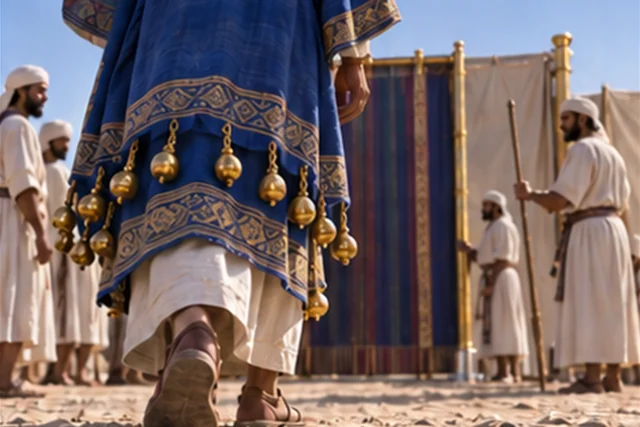
A robe made for holy service still has a weak point where a human head passes through it. The Book of Exodus notices. The opening is reinforced "as it were the hole of an habergeon" so the fabric does not tear, a wonderfully practical instruction in the middle of blue cloth, pomegranates, and gold. Then the hem becomes audible. Woven pomegranates alternate with bells, so Aaron's movement can be heard when he enters and leaves the holy place. The warning "that he die not" keeps those bells from being reduced to decorative theater. The Book of Exodus does not explain why sound is tied to safe approach, and there is no need to invent a mechanism it does not give. What it does make unmistakable is that the robe must work. It must survive being worn, move with the priest, and sound as commanded. Sacred clothing is not costume laid out for admiration. Its beauty has to function under the conditions of service.
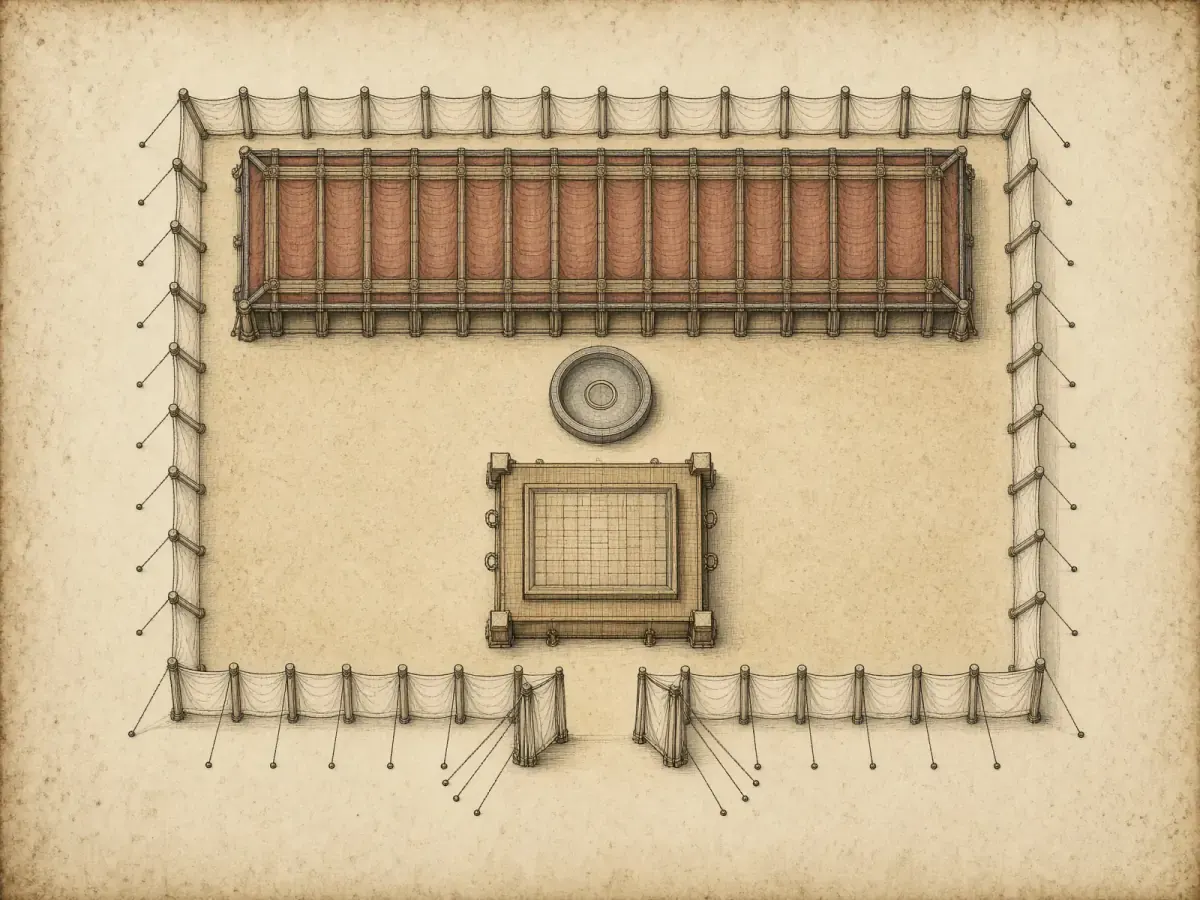
Deep dive
The opening for the head receives a woven binding so that the robe will not tear. Even here, in the midst of sacred clothing, the instructions notice a point of strain. The garment must survive being worn. Its colored pomegranates and alternating bells join visual pattern with audible movement.
The sound is to be heard when Aaron enters and leaves the holy place, and the warning about death gives this more than ornamental importance. Sound, clothing, and authorized approach belong together in the command. Exodus does not explain why this particular feature is required for safe approach; the warning remains more explicit than its rationale. What is clear is that the garment's appearance alone would not fulfill the instruction. The robe is not a costume worn to make an otherwise ordinary act look solemn. Its reinforced opening allows it to be worn, its hem is heard in movement, and both belong to the stipulated conditions of priestly service.
Words to trace: round, hole, bell, blue, golden, pomegranate
Verse-by-verse path
- Exodus 28:31
The robe, me’il, is a long outer garment, here all blue. Hannah made the boy Samuel a “little coat”, a small me’il, every year (1 Samuel 2:19), and Saul tore the skirt of Samuel’s me’il as he turned away (15:27).
- Exodus 28:32
A “habergeon” in 1611 was a sleeveless coat of mail, and the Hebrew tachra seems to mean the same: a neckline bound like armour. Leviticus 21:10 forbids the high priest to rend his clothes, and Caiaphas does exactly that in Matthew 26:65.
- Exodus 28:33
Pomegranates were among the fruit the spies brought back from Canaan (Numbers 13:23), and Solomon set two hundred of them round the capitals of his temple pillars (1 Kings 7:20). Here they are made of yarn, in the three colours, hanging from a hem in the wilderness.
- Exodus 28:34
The verse repeats the phrase as the hem repeats the pattern: a bell and a pomegranate, a bell and a pomegranate. Exodus gives no count, and later Jewish tradition supplied one, seventy two bells.
- Exodus 28:35
Ecclesiasticus 45:9 says the bells were made so that the sound “might be heard in the temple, for a memorial to the children of his people”. The popular picture of a rope tied to the high priest’s ankle is a medieval legend with no source in the Bible.
Exodus 28:31-35
King James Version31And thou shalt make the robe of the ephod all of blue.
32And there shall be an hole in the top of it, in the midst thereof: it shall have a binding of woven work round about the hole of it, as it were the hole of an habergeon, that it be not rent.
33And beneath upon the hem of it thou shalt make pomegranates of blue, and of purple, and of scarlet, round about the hem thereof; and bells of gold between them round about:
34A golden bell and a pomegranate, a golden bell and a pomegranate, upon the hem of the robe round about.
35And it shall be upon Aaron to minister: and his sound shall be heard when he goeth in unto the holy place before the LORD, and when he cometh out, that he die not.
Exodus 28:36-38
Holiness Written Where the Face Is Seen
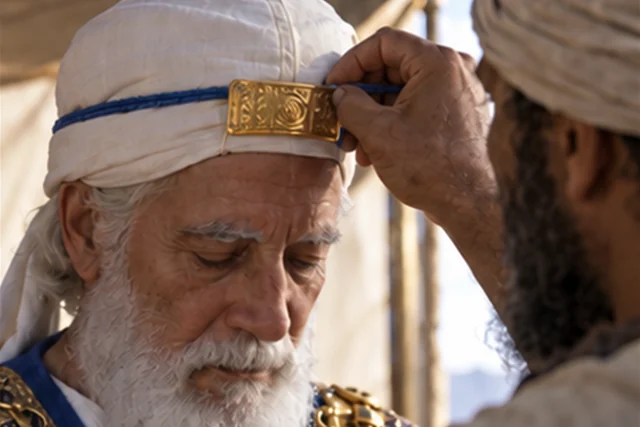
The brightest declaration on Aaron's clothing sits where everyone can see it: a pure gold plate engraved "HOLINESS TO THE LORD" and fixed to the front of the mitre. Yet the Book of Exodus refuses to let that visible holiness float free as a slogan. In the same breath, Aaron is assigned the burden of bearing "the iniquity of the holy things" offered by Israel. That is the uncomfortable center of the section. Things called holy can still be entangled with what is wrong, and the priestly office exists partly because the label itself does not solve the problem. The chapter does not catalogue every defect or offense contained in that phrase, but it connects acceptance of the gifts with Aaron's representative burden. The object that most loudly announces holiness is therefore attached to an office dealing with iniquity. Beauty reaches a peak here, but so does responsibility. The gold is not hiding the problem. It is sitting directly above it.
Deep dive
The engraving on the gold plate names holiness to the LORD, and its position on the forehead makes that declaration inseparable from the priest's public appearance. The wording is not Aaron's personal motto. It identifies the consecrated service in which he stands.
The difficult phrase is the "iniquity of the holy things." Gifts set apart for God can still involve iniquity, and Aaron's role includes bearing it so that the gifts may be accepted. The chapter does not explain every possible defect or offense within that phrase. Its immediate point is nevertheless substantial: calling an offering holy does not remove the need for mediation. The plate's proclamation and the priest's burden belong together. The object most visibly announcing holiness is attached to the instruction about bearing what is wrong in the holy gifts. Beauty reaches its most concentrated point here without letting the office forget the problem it exists to address.
Words to trace: forehead, holy, LORD, mitre, Aaron, Aaron’s
Verse-by-verse path
- Exodus 28:36
The plate is a tsits, literally a blossom or flower. Zechariah 14:20 imagines the same words, “Holiness unto the LORD”, engraved one day on the bells of horses, holiness reaching the most ordinary things.
- Exodus 28:37
The “mitre” is a mitsnefet, a turban wound from cloth (tsanaf means to wind round), nothing like a bishop’s pointed hat. The plate is tied onto it at the forehead with a blue cord.
- Exodus 28:38
“Accepted” is ratson, favour, the technical word for an offering that God receives with pleasure; Leviticus 1:3 uses it of the whole burnt offering, which is to be offered “of his own voluntary will”, literally for his acceptance.
Exodus 28:36-38
King James Version36And thou shalt make a plate of pure gold, and grave upon it, like the engravings of a signet, HOLINESS TO THE LORD.
37And thou shalt put it on a blue lace, that it may be upon the mitre; upon the forefront of the mitre it shall be.
38And it shall be upon Aaron’s forehead, that Aaron may bear the iniquity of the holy things, which the children of Israel shall hallow in all their holy gifts; and it shall be always upon his forehead, that they may be accepted before the LORD.
Exodus 28:39-43
Glory Also Requires Ordinary Covering
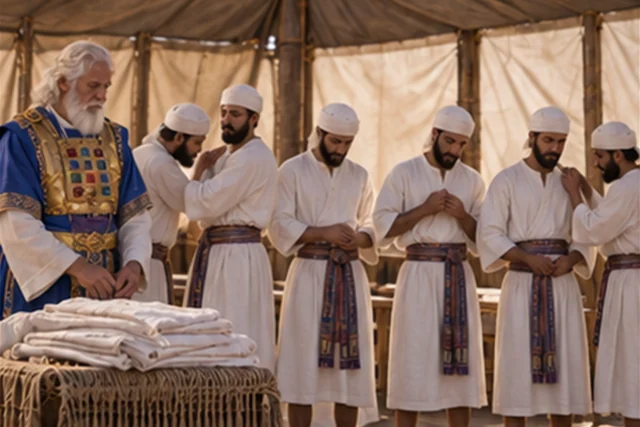
After gold, gemstones, bells, embroidery, and an engraved crown, the Book of Exodus ends the wardrobe with linen breeches. The move is almost deliberately plain. Aaron's sons receive coats, girdles, and head coverings for glory and beauty, but they do not receive Aaron's entire representative costume. Shared priestly service does not flatten every role into the same appearance. Nor does family connection remove the need for anointing, consecration, and sanctification. Then the final concern is bodily covering from the loins to the thighs. The garment is not designed to attract attention at all, yet the warning attached to it is severe: approaching the tent or altar without the prescribed covering means bearing iniquity and facing death. The chapter therefore refuses a false choice between splendor and modesty. Both belong to the same holy service. What is seen is prepared with extraordinary care, and what is not meant to be seen is governed just as carefully.
Deep dive
The sons receive coats, girdles, and head coverings for glory and beauty, but the chapter does not give them Aaron's complete set of representative garments. Shared priestly service does not mean identical clothing. Their anointing and consecration are also specified; being related to Aaron does not make the appointment ceremony unnecessary.
The final instructions concern linen breeches covering the body from the loins to the thighs. After gold, gemstones, and embroidered work, the chapter finishes with a garment whose purpose is explicitly modesty rather than display. The warning about bearing iniquity and dying accompanies this practical provision. That ending recalls the concern about exposure at the altar in Exodus 20:26. Sacred beauty and bodily propriety are not treated as competing subjects. The whole person who approaches must be prepared, including the parts of the clothing that are not meant to attract anyone's attention.
Words to trace: linen, sons, Aaron, fine, minister, Aaron’s
Verse-by-verse path
- Exodus 28:39
The coat is a ketonet, the word for Joseph’s coat in Genesis 37:3 and for the coats of skins God made for Adam and Eve (3:21). The girdle is embroidered, needlework, rather than woven like the ephod’s band.
- Exodus 28:40
The sons’ “bonnets” are migba’ot, from a root meaning a rounded height, suggesting a domed cap. They too are made “for glory and for beauty”, the phrase of verse 2, though their clothing is plainer than their father’s.
- Exodus 28:41
“Consecrate” renders the Hebrew idiom “fill their hand”, the standing phrase for ordination. It is used when Micah installs his son as a household priest in Judges 17:5. Three verbs follow each other here: anoint, fill the hand, sanctify.
- Exodus 28:42
The breeches are the only garment in the chapter for the lower body. Ezekiel 44:18 still requires them in his vision of the restored temple, with linen turbans, and adds that the priests must wear nothing “that causeth sweat”.
- Exodus 28:43
The breeches were not in the list of verse 4, and they apply inside the tent as well as at the altar. On the Day of Atonement, Leviticus 16:4 has the high priest lay aside the gold and colours and wear only linen, breeches included.
Exodus 28:39-43
King James Version39And thou shalt embroider the coat of fine linen, and thou shalt make the mitre of fine linen, and thou shalt make the girdle of needlework.
40And for Aaron’s sons thou shalt make coats, and thou shalt make for them girdles, and bonnets shalt thou make for them, for glory and for beauty.
41And thou shalt put them upon Aaron thy brother, and his sons with him; and shalt anoint them, and consecrate them, and sanctify them, that they may minister unto me in the priest’s office.
42And thou shalt make them linen breeches to cover their nakedness; from the loins even unto the thighs they shall reach:
43And they shall be upon Aaron, and upon his sons, when they come in unto the tabernacle of the congregation, or when they come near unto the altar to minister in the holy place; that they bear not iniquity, and die: it shall be a statute for ever unto him and his seed after him.
Questions to keep in mind while reading
- Identify the people addressed and the covenant setting.
- Distinguish rescue, worship, holiness, justice, and community responsibility.
- Read commands in their literary and covenant context before making a modern application.
Text first
Where readers differ
The chapter summary begins with what the passage says and how its parts fit together. It does not assume one denomination has already settled every question. Where a conclusion depends on a tradition, literary theory, or historical reconstruction, that dependence is named openly.
The KJV text is presented first. Interpretive conclusions are labeled, and differences are introduced only when they help a reader understand why serious communities do not always reach the same answer.
Comparative interpretive notes for this chapter are in preparation. Until reviewed notes are ready, this page separates the KJV text from summary and application without claiming that serious readers agree on every question.
Questions beneath the surface
- What account of God, human freedom, responsibility, and the good life emerges from Exodus 28?
- Which tension does the chapter refuse to resolve quickly?
- What changes when the chapter is read as part of the whole canon rather than as an isolated moral lesson?
- Where might a sincere reader confuse a familiar tradition with something the text states directly?
Questions for serious personal contemplation
These open-ended questions make room for tension, honest response, prayer, and conclusions that remain accountable to the chapter.
Observe without rushing
What part of Exodus 28 makes you stop, feel unsettled, or feel surprised, and why?
Which detail in the passage would be easiest to overlook? How does that detail change your understanding?
Where do you see tension between what happens and this focus: Exodus 28 develops its own movement around gold, ephod, Aaron, breastplate, blue?
What important question does the passage leave open instead of resolving quickly?
Examine your inner life honestly
Which person, response, fear, or desire in the passage feels most like your own life right now?
What assumption about God, other people, or yourself does this text challenge?
Which part would you rather soften, avoid, or explain away too quickly? What might that reaction reveal?
If this Scripture could ask you one direct question, what do you think it would ask?
Respond with wisdom and courage
What do you need to remember, confess, grieve, thank God for, or trust after reading this passage?
How might another faithful person read this situation differently without ignoring the text?
What obedient response would be costly, uncomfortable, or slow, yet still faithful to Scripture?
What question will you carry into prayer this week, and which verses will you keep in front of you?
Music and video connected to the passage
Related media appears when its Scripture reference overlaps this study. Music and video can illuminate a theme while the biblical text remains the foundation.