The big picture
The final chapter of 1 Chronicles gathers wealth, willingness, worship, succession, and mortality into one closing movement. David distinguishes the resources already prepared for the temple from an additional personal gift motivated by his affection for the house, and Israel’s leaders answer with willing offerings of their own. Yet the enormous totals do not make the donors benefactors standing above God. David’s prayer immediately declares that greatness, power, riches, honor, and the kingdom itself belong to the Lord, and that “of thine own have we given thee.” He then asks for something money cannot secure: enduring hearts for the people and wholehearted obedience for Solomon. The assembly worships, sacrifices, feasts, and publicly establishes the new king. Finally David dies. Riches and honor remain part of his epitaph, but so does finitude. The prepared work passes to the son.
In this chapter
- David's Affection Becomes a Named Gift 1 Chronicles 29:1-9
David has already accumulated vast resources, but he now marks off something more personal: because he has “set my affection to the house of my God,” he gives from his own property beyond what was previously prepared.
- The Donors Do Not Become God's Benefactors 1 Chronicles 29:10-15
The prayer refuses to let the donors become impressive enough to overshadow the recipient.
- A Prayer for the Heart After the Offering 1 Chronicles 29:16-19
The prayer comes back down from heaven and earth to the store piled for this particular house, and David says the same thing again: it all came from God’s hand and remains God’s own.
- The Throne Is Still the Lord's 1 Chronicles 29:20-25
The congregation bows, sacrifices, eats, drinks, and publicly establishes Solomon “the second time.” That phrase fits the earlier notice that David had already made him king, while this scene supplies the national assembly and anointing.
- David Ends; the Work Does Not 1 Chronicles 29:26-30
The book ends by stripping the famous king back to a measured human life: “David the son of Jesse” reigns forty years, dies, and is succeeded by his son.

Scripture beside the summary
1 Chronicles · King James Version · 301 Chronicles 29:1-9
David's Affection Becomes a Named Gift
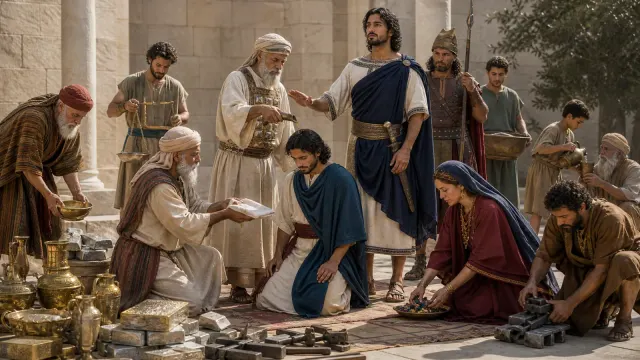
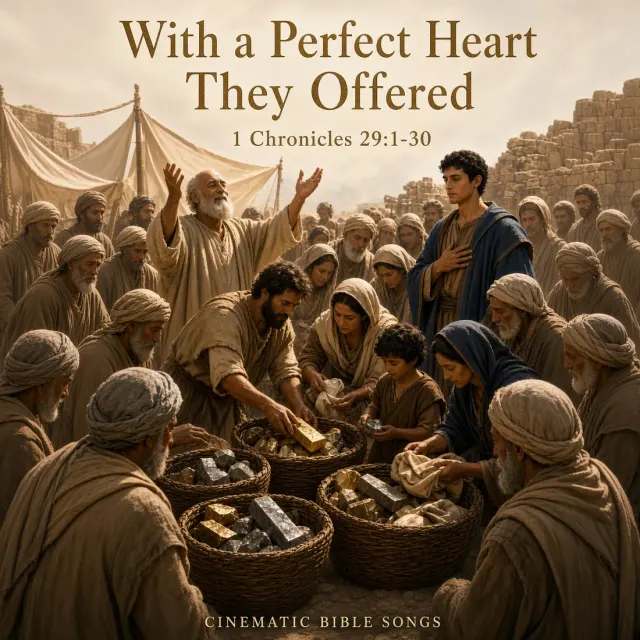
David has already accumulated vast resources, but he now marks off something more personal: because he has “set my affection to the house of my God,” he gives from his own property beyond what was previously prepared. The affection is not inferred from mood or facial expression; the passage names it and then gives it material form. Israel’s leaders respond in kind, and the repeated word is “willingly.” Their contributions are impressive, but First Chronicles is as interested in the manner of giving as in the total. The people rejoice because the offerings come with a “perfect heart.” That emphasis distinguishes this scene from earlier labor that was assigned rather than volunteered. Different kinds of contribution have appeared throughout the preparations, and the book does not pretend they all operate under identical conditions. Here, willing participation becomes part of the final public joy before Solomon takes the throne.
Deep dive
The work is great because the house is for the Lord, not because Solomon is personally grand enough to require it. The KJV calls the building a palace in this setting, emphasizing the dignity of its divine recipient rather than confusing it with the king's residence. Solomon's youth remains part of David's explanation of the need for collective provision.
David then distinguishes what he has prepared for the work from what he now gives out of his own substance. His affection for the house is explicitly stated and becomes measurable in the gift. It is not necessary to invent an inner emotion here; the passage has already named the connection between attachment and contribution.
The leaders' response is repeatedly described as willing. Their offering produces joy because it comes with a perfect, undivided heart. The book therefore records more than an impressive final total. It attends to the character of the participation and distinguishes these willing gifts from the assigned labor described earlier. Both materials and people are involved in the preparations, but not every form of contribution has been presented under identical conditions.
Words to trace: gold, silver, house, stones, talents, LORD
Verse-by-verse path
- 1 Chronicles 29:1
“Palace” is birah, a late word for a citadel or fortress. Elsewhere it names “Shushan the palace” in Esther 1:2 and the fortress beside the temple in Nehemiah 2:8, so the vocabulary belongs to the Chronicler’s own Persian-era Hebrew. Solomon is “young and tender”, David’s phrase from 22:5.
- 1 Chronicles 29:2
“Stones to be set” are stones for settings, like those in the high priest’s breastplate (Exodus 25:7). “Glistering stones” are literally stones of puk, the dark antimony Jezebel used to paint her eyes (2 Kings 9:30), probably a dark mortar or inlay. The marble is shayish, a white or alabaster stone.
- 1 Chronicles 29:3
“Mine own proper good” translates segullah, a private treasure. It is the word God uses of Israel at Sinai, “a peculiar treasure unto me above all people” (Exodus 19:5). David gives from what is his in the way Israel is God’s.
- 1 Chronicles 29:4
Ophir was the source of the finest gold, and Solomon’s ships would sail there for it (1 Kings 9:28); its location, somewhere in Arabia, East Africa or India, is still debated. “The houses” are the rooms of the temple complex, their walls to be overlaid with metal.
- 1 Chronicles 29:5
“Consecrate his service” is literally “fill his hand”, the Hebrew idiom for ordaining a priest (Exodus 28:41). David applies the priests’ ordination language to lay donors: anyone who gives is, in this one act, filling his hand for the LORD.
- 1 Chronicles 29:6
The donors are listed in the order of the registers in chapter 27: heads of families and tribal princes, the unit commanders, and the “rulers of the king’s work”, the stewards of 27:25–31. Every officer just appointed becomes a giver.
- 1 Chronicles 29:7
“Drams” are adarkonim, darics, the Persian gold coin first struck under Darius I, some five centuries after David. The Chronicler has converted part of the gift into the currency of his own day, a small window onto when the book was written.
- 1 Chronicles 29:8
At the tabernacle the rulers had likewise brought onyx and stones for setting (Exodus 35:27). Stones given here pass into the Gershonite treasury of 26:21–22, received by a named Levite so the gift is recorded.
- 1 Chronicles 29:9
Rejoicing over giving has a precedent at the tabernacle, where the people brought so much that Moses had to proclaim a halt to the offerings (Exodus 36:5–7). The word “willingly” comes twice in this one verse.
1 Chronicles 29:1-9
King James Version1Furthermore David the king said unto all the congregation, Solomon my son, whom alone God hath chosen, is yet young and tender, and the work is great: for the palace is not for man, but for the LORD God.
2Now I have prepared with all my might for the house of my God the gold for things to be made of gold, and the silver for things of silver, and the brass for things of brass, the iron for things of iron, and wood for things of wood; onyx stones, and stones to be set, glistering stones, and of divers colours, and all manner of precious stones, and marble stones in abundance.
3Moreover, because I have set my affection to the house of my God, I have of mine own proper good, of gold and silver, which I have given to the house of my God, over and above all that I have prepared for the holy house,
4Even three thousand talents of gold, of the gold of Ophir, and seven thousand talents of refined silver, to overlay the walls of the houses withal:
5The gold for things of gold, and the silver for things of silver, and for all manner of work to be made by the hands of artificers. And who then is willing to consecrate his service this day unto the LORD?
6Then the chief of the fathers and princes of the tribes of Israel, and the captains of thousands and of hundreds, with the rulers of the king’s work, offered willingly,
7And gave for the service of the house of God of gold five thousand talents and ten thousand drams, and of silver ten thousand talents, and of brass eighteen thousand talents, and one hundred thousand talents of iron.
8And they with whom precious stones were found gave them to the treasure of the house of the LORD, by the hand of Jehiel the Gershonite.
9Then the people rejoiced, for that they offered willingly, because with perfect heart they offered willingly to the LORD: and David the king also rejoiced with great joy.
1 Chronicles 29:10-15
The Donors Do Not Become God's Benefactors
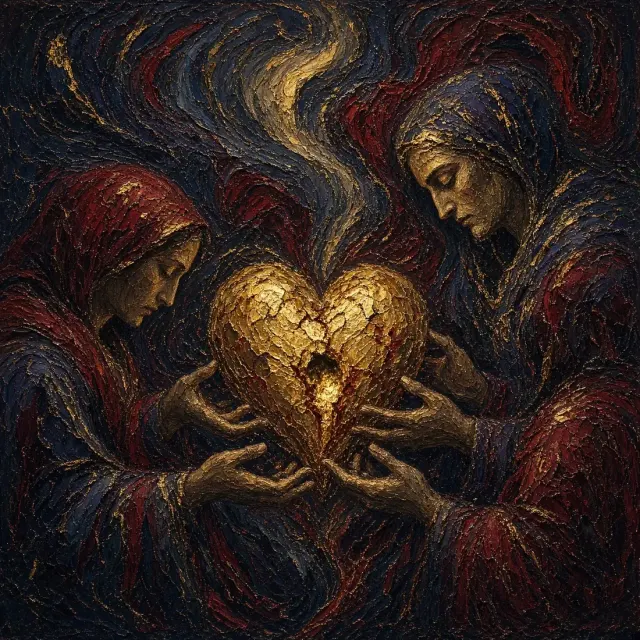
The prayer refuses to let the donors become impressive enough to overshadow the recipient. Greatness, power, glory, victory, majesty, wealth, honor, and the kingdom itself are all placed in God’s hands before David asks, “who am I, and what is my people” that they can give this way? The answer is devastating to any idea of divine indebtedness: “all things come of thee, and of thine own have we given thee.” The collection matters, but it does not turn God into a beneficiary of independent human owners. Then David adds mortality to abundance. This richly supplied, nationally gathered people are still “strangers” and “sojourners” before God, and their days are like a shadow. First Chronicles lets public joy, enormous wealth, and human transience occupy the same prayer. Possession does not make the possessors permanent.
Deep dive
The prayer begins with greatness, power, glory, victory, and majesty belonging to God. It does not open by reminding him how impressive the donors have been. The kingdom itself belongs to the Lord, so the reigning king's voice places his own authority beneath the rule he praises.
The acknowledgment that the gifts already come from God's hand changes the meaning of the entire collection. David and the people are not supplying a deficiency in divine wealth or placing God under an obligation to wealthy patrons. Their ability to give is itself received. The immense inventory remains important, but it cannot turn the donors into independent owners standing over against the one they honor.
Then the settled, richly supplied assembly is described as strangers and sojourners before God. The statement concerns their dependence and transience in his presence, not a denial that they have houses or an assigned land. Their days pass like a shadow. This confession is made during public rejoicing, not after all joy has collapsed. The Book of 1 Chronicles allows abundance and mortality to be spoken in the same breath: the resources are substantial, but the people bringing them do not become permanent by possessing them.
Words to trace: LORD, blessed, David, earth, hand, power
Verse-by-verse path
- 1 Chronicles 29:10
“Blessed be thou, LORD” is the form, barukh attah, that later became the standard opening of Jewish blessings. “Israel our father” means Jacob. “For ever and ever” is literally “from everlasting to everlasting”, the phrase of the doxologies that close Psalm 41 and Psalm 106.
- 1 Chronicles 29:11
The doxology that later copyists added to the Lord’s Prayer in Matthew 6:13, “thine is the kingdom, and the power, and the glory”, draws on this verse. The word for “victory”, netsach, also carries the sense of lasting splendour or endurance.
- 1 Chronicles 29:12
“In thine hand” is said twice, of power and of the ability to make great. Riches and honour are the very pair God will give Solomon unasked at Gibeon (2 Chronicles 1:11–12).
- 1 Chronicles 29:13
“Thy glorious name” is literally “the name of thy splendour”. The verb for thanks, hodah, is the same one used for confessing sin; in both, something is acknowledged openly before God.
- 1 Chronicles 29:14
“Who am I” repeats David’s first words after the promise of a house, “Who am I, O LORD God” (17:16). “After this sort” means in this manner. “Of thine own” is literally “from thy hand”: the gifts go back to the hand they came from.
- 1 Chronicles 29:15
“Strangers and sojourners” are gerim and toshavim, the words Abraham used when he asked the Hittites for a grave (Genesis 23:4), and the law says Israel is that to God (Leviticus 25:23). “None abiding” is miqveh, hope: there is no expectation of staying.
1 Chronicles 29:10-15
King James Version10Wherefore David blessed the LORD before all the congregation: and David said, Blessed be thou, LORD God of Israel our father, for ever and ever.
11Thine, O LORD, is the greatness, and the power, and the glory, and the victory, and the majesty: for all that is in the heaven and in the earth is thine; thine is the kingdom, O LORD, and thou art exalted as head above all.
12Both riches and honour come of thee, and thou reignest over all; and in thine hand is power and might; and in thine hand it is to make great, and to give strength unto all.
13Now therefore, our God, we thank thee, and praise thy glorious name.
14But who am I, and what is my people, that we should be able to offer so willingly after this sort? for all things come of thee, and of thine own have we given thee.
15For we are strangers before thee, and sojourners, as were all our fathers: our days on the earth are as a shadow, and there is none abiding.
1 Chronicles 29:16-19
A Prayer for the Heart After the Offering
The prayer comes back down from heaven and earth to the store piled for this particular house, and David says the same thing again: it all came from God’s hand and remains God’s own. But divine ownership does not make the human heart irrelevant. God tries the heart, David names the upright intention of his own gift, and the willing response of the people becomes something he wants preserved beyond this one successful day. He asks the God of Abraham, Isaac, and Israel to keep that disposition in their thoughts and prepare their hearts. Then Solomon receives the same concern. David can hand him gold, plans, officials, and workers, but not a faithful heart as though it were another object in the treasury. So he prays for wholehearted obedience and for completion of the house. The final preparation David cannot manufacture becomes the subject of prayer.

Deep dive
The prayer returns from the scale of all creation to the particular materials gathered for this house. They remain God's provision, and their presentation has taken place before a God who tests the heart. David names his own upright intention and the willing response he has seen in the people without claiming that a large donation makes future faithfulness automatic.
His next request concerns continuity. He asks the God of Abraham, Isaac, and Israel to preserve this disposition and prepare the people's hearts toward him. Those ancestral names reach back into the book's opening registers, joining the present assembly to the covenant history that gave it its identity. The willingness of this day is valuable enough to become the subject of prayer for the days beyond it.
The prayer for Solomon likewise asks for more than successful construction. Keeping the commandments and doing the work belong together. David has already prepared the physical means, but he cannot bequeath a faithful heart as though it were another quantity of gold in the treasury. That distinction gives the prayer its particular urgency at the end of his preparations.
Words to trace: heart, build, keep, LORD, people, uprightness
Verse-by-verse path
- 1 Chronicles 29:16
“Store” is hamon, a word more often used for a noisy crowd; here it is a mass of goods. Within one sentence the pronoun moves from “we have prepared” to “thine own”, the ownership shifting as the clause runs.
- 1 Chronicles 29:17
“Triest” is bachan, the assayer’s verb for testing metal. It fits a scene piled with gold and silver, as in Proverbs 17:3: “the fining pot is for silver, and the furnace for gold: but the LORD trieth the hearts.”
- 1 Chronicles 29:18
“Prepare their heart” is hakhen, to make firm or set in place. Chronicles later uses the same phrase as a verdict on kings: Rehoboam “prepared not his heart to seek the LORD” (2 Chronicles 12:14), and Jehoshaphat “prepared thine heart to seek God” (19:3).
- 1 Chronicles 29:19
Commandments, testimonies and statutes are the same three terms Josiah will vow to keep when he renews the covenant (2 Chronicles 34:31). The temple is again the birah of verse 1, so the prayer ends on the same word as the speech that opened the chapter.
1 Chronicles 29:16-19
King James Version16O LORD our God, all this store that we have prepared to build thee an house for thine holy name cometh of thine hand, and is all thine own.
17I know also, my God, that thou triest the heart, and hast pleasure in uprightness. As for me, in the uprightness of mine heart I have willingly offered all these things: and now have I seen with joy thy people, which are present here, to offer willingly unto thee.
18O LORD God of Abraham, Isaac, and of Israel, our fathers, keep this for ever in the imagination of the thoughts of the heart of thy people, and prepare their heart unto thee:
19And give unto Solomon my son a perfect heart, to keep thy commandments, thy testimonies, and thy statutes, and to do all these things, and to build the palace, for the which I have made provision.
1 Chronicles 29:20-25
The Throne Is Still the Lord's
The congregation bows, sacrifices, eats, drinks, and publicly establishes Solomon “the second time.” That phrase fits the earlier notice that David had already made him king, while this scene supplies the national assembly and anointing. The KJV says the people worship the Lord and the king, but the bodily act of bowing does not make David divine. The prayer immediately before it has placed every kingdom beneath God, and the next sentence keeps that hierarchy explicit by calling Solomon’s seat “the throne of the LORD.” Solomon does not replace God; he receives delegated kingship. The submission of princes, mighty men, and David’s sons then marks a transfer of allegiance that is public rather than merely familial. The future David prepared in plans and resources now has a living ruler acknowledged by the same leadership structure that helped build the transition.
Deep dive
The KJV says that the congregation worships the Lord and the king. The Hebrew verb shachah describes bowing or prostration and can refer to divine worship or homage before a human ruler. The shared bodily action does not make David divine. The prayer immediately preceding it has placed all power, wealth, and kingship under God, and the following description keeps that distinction intact.
The feast and sacrifices accompany Solomon's establishment for the second time. The book has already announced his making as king in 1 Chronicles 23:1; the present scene gives the public assembly and anointing. It does not require an invented account of every detail of the earlier occasion.
Solomon sits on the throne of the Lord as king in David's place. The formulation does not mean that he replaces God. It identifies the human throne as a delegated rule belonging to the Lord, echoing the divine ownership named in chapter 17. The submission of leaders, mighty men, and David's sons presents a public transfer of allegiance. The father's carefully prepared future is now placed under a living successor rather than left as a private intention.
Words to trace: LORD, king, David, Israel, Solomon, congregation
Verse-by-verse path
- 1 Chronicles 29:20
“Bowed down their heads, and worshipped” pairs two verbs, to bow the head and to prostrate oneself, the pair used by Abraham’s servant when he found Rebekah (Genesis 24:26) and by Israel on hearing the Passover instructions (Exodus 12:27).
- 1 Chronicles 29:21
The drink offerings were wine poured out with each burnt offering, measured by the animal (Numbers 15:5–10). “Sacrifices in abundance” are zevachim, peace offerings whose meat the worshippers ate, which is why the next verse turns to eating and drinking.
- 1 Chronicles 29:22
“Chief governor” is nagid, the title Samuel used when he anointed Saul (1 Samuel 10:1) and Abigail gave David (1 Samuel 25:30). Zadok is anointed alongside the king, anticipating Solomon’s removal of Abiathar and Zadok’s appointment in his place (1 Kings 2:35).
- 1 Chronicles 29:23
“Obeyed him” is literally “listened to him”. When Solomon’s son takes the throne, the northern tribes will refuse to listen, and the kingdom will split (2 Chronicles 10:16). Here all Israel hears.
- 1 Chronicles 29:24
“Submitted themselves” is literally “gave a hand under Solomon”, a gesture of pledged loyalty; Hezekiah uses the same idiom when he urges the north to “yield yourselves unto the LORD” (2 Chronicles 30:8). David’s sons include those who, in 1 Kings 1, had backed Adonijah.
- 1 Chronicles 29:25
“Royal majesty” is hod malkhut, the splendour of kingship. Only Saul and David had reigned before him, so the comparison is short, but 2 Chronicles 1:12 will extend it to every king after him as well.
1 Chronicles 29:20-25
King James Version20And David said to all the congregation, Now bless the LORD your God. And all the congregation blessed the LORD God of their fathers, and bowed down their heads, and worshipped the LORD, and the king.
21And they sacrificed sacrifices unto the LORD, and offered burnt offerings unto the LORD, on the morrow after that day, even a thousand bullocks, a thousand rams, and a thousand lambs, with their drink offerings, and sacrifices in abundance for all Israel:
22And did eat and drink before the LORD on that day with great gladness. And they made Solomon the son of David king the second time, and anointed him unto the LORD to be the chief governor, and Zadok to be priest.
23Then Solomon sat on the throne of the LORD as king instead of David his father, and prospered; and all Israel obeyed him.
24And all the princes, and the mighty men, and all the sons likewise of king David, submitted themselves unto Solomon the king.
25And the LORD magnified Solomon exceedingly in the sight of all Israel, and bestowed upon him such royal majesty as had not been on any king before him in Israel.
1 Chronicles 29:26-30
David Ends; the Work Does Not
The book ends by stripping the famous king back to a measured human life: “David the son of Jesse” reigns forty years, dies, and is succeeded by his son. After palaces, armies, treasuries, gifted musicians, and a national assembly, the patronymic matters. David still has a father, a lifespan, and an ending. The description of his “good old age,” riches, and honor gives the reign a positive close without erasing the census disaster or its dead. First Chronicles is capable of a favorable final assessment that does not require pretending the grave failures never happened. The references to records associated with Samuel, Nathan, and Gad then place David’s acts inside a larger remembered history. The king ends before the temple begins. The materials, workers, appointments, and dynastic promise remain, which is precisely how the book can close on death without closing the work.
Deep dive
The closing identification returns to David as the son of Jesse. After armies, palaces, treasuries, and a national assembly, the familiar ancestry remains. The king is still a man with a father and a finite span of years. His reign is measured, his death is recorded, and his son reigns in his place.
The description of a good old age, riches, and honor gives the reign a positive closing assessment without undoing the census account or its terrible consequences. This ending differs sharply from the battlefield collapse with which Saul's reign entered the book. David leaves a recognized successor and prepared work, not a body displayed in an enemy temple.
The reference to Samuel, Nathan, and Gad locates David's acts within records associated with prophetic witnesses and within events affecting surrounding kingdoms. Chronicles does not claim that its own selection exhausts all that happened. Its final achievement is more focused: the movement from Adam through Israel's families has reached a kingdom whose founder dies before the temple is built. The materials remain, the people are appointed, and the word concerning the house extends beyond the man who first wished to build it.
Words to trace: reigned, book, Israel, years, David, seer
Verse-by-verse path
- 1 Chronicles 29:26
David’s reign in this book began with all Israel gathering to him at Hebron (11:1) and ends with him reigning “over all Israel”. The deathbed instructions of 1 Kings 2:5–9, with their settling of scores against Joab and Shimei, have no place in this closing.
- 1 Chronicles 29:27
Second Samuel 5:5 gives the Hebron years as seven years and six months; Chronicles rounds them to seven. Forty is also the length of Saul’s and Solomon’s reigns in the traditional reckoning.
- 1 Chronicles 29:28
“A good old age”, seivah tovah, is what God promised Abraham (Genesis 15:15) and what Gideon received (Judges 8:32). Riches and honour are the gifts David had just said come from God (verse 12), and he dies holding both.
- 1 Chronicles 29:29
Three prophets are cited with three different Hebrew titles: Samuel the ro’eh, Nathan the navi, and Gad the chozeh. “First and last” means from beginning to end, the Chronicler’s standard way of pointing to fuller records.
- 1 Chronicles 29:30
“The times that went over him” are the events and seasons that passed over his head. The last words reach “all the kingdoms of the countries”, recalling 14:17, where “the fame of David went out into all lands.”
1 Chronicles 29:26-30
King James Version26Thus David the son of Jesse reigned over all Israel.
27And the time that he reigned over Israel was forty years; seven years reigned he in Hebron, and thirty and three years reigned he in Jerusalem.
28And he died in a good old age, full of days, riches, and honour: and Solomon his son reigned in his stead.
29Now the acts of David the king, first and last, behold, they are written in the book of Samuel the seer, and in the book of Nathan the prophet, and in the book of Gad the seer,
30With all his reign and his might, and the times that went over him, and over Israel, and over all the kingdoms of the countries.
Questions to keep in mind while reading
- Track who acts, who speaks, who is affected, and what changes.
- Notice repeated promises, failures, rescues, and consequences.
- Do not assume the account approves every action that is reported.
Text first
Where readers differ
The chapter summary begins with what the passage says and how its parts fit together. It does not assume one denomination has already settled every question. Where a conclusion depends on a tradition, literary theory, or historical reconstruction, that dependence is named openly.
The KJV text is presented first. Interpretive conclusions are labeled, and differences are introduced only when they help a reader understand why serious communities do not always reach the same answer.
Comparative interpretive notes for this chapter are in preparation. Until reviewed notes are ready, this page separates the KJV text from summary and application without claiming that serious readers agree on every question.
Questions beneath the surface
- What account of God, human freedom, responsibility, and the good life emerges from 1 Chronicles 29?
- Which tension does the chapter refuse to resolve quickly?
- What changes when the chapter is read as part of the whole canon rather than as an isolated moral lesson?
- Where might a sincere reader confuse a familiar tradition with something the text states directly?
Questions for serious personal contemplation
These open-ended questions make room for tension, honest response, prayer, and conclusions that remain accountable to the chapter.
Observe without rushing
What part of 1 Chronicles 29 makes you stop, feel unsettled, or feel surprised, and why?
Which detail in the passage would be easiest to overlook? How does that detail change your understanding?
Where do you see tension between what happens and this focus: 1 Chronicles 29 develops its own movement around LORD, David, Israel, king, gold?
What important question does the passage leave open instead of resolving quickly?
Examine your inner life honestly
Which person, response, fear, or desire in the passage feels most like your own life right now?
What assumption about God, other people, or yourself does this text challenge?
Which part would you rather soften, avoid, or explain away too quickly? What might that reaction reveal?
If this Scripture could ask you one direct question, what do you think it would ask?
Respond with wisdom and courage
What do you need to remember, confess, grieve, thank God for, or trust after reading this passage?
How might another faithful person read this situation differently without ignoring the text?
What obedient response would be costly, uncomfortable, or slow, yet still faithful to Scripture?
What question will you carry into prayer this week, and which verses will you keep in front of you?
Music and video connected to the passage
Related media appears when its Scripture reference overlaps this study. Music and video can illuminate a theme while the biblical text remains the foundation.