The big picture
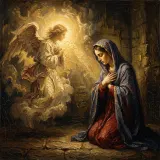
The Book of Luke 11 begins with prayer and ends with people trying to trap Jesus in his words. Between those points, the chapter keeps asking what it means to receive what God is already giving. Jesus teaches his disciples to pray to a Father whose generosity exceeds that of reluctant neighbors and flawed human parents, with the Holy Spirit as the climactic gift. When Jesus casts out a devil, some witnesses reinterpret deliverance as collaboration with Beelzebub, forcing a choice between a divided satanic kingdom and the arrival of God's stronger rule. Others demand a sign while the greater-than-Jonah and greater-than-Solomon stands before them. The lamp saying turns the problem from absent light to impaired reception. Then, at a Pharisee's table, polished externals are measured against inward greed, justice, love of God, and the burdens imposed by legal experts. The final image is devastatingly vocational: people holding the key of knowledge neither enter nor let others in. The response is not reconsideration but an organized effort to obtain an accusation.
In this chapter
- The Father Is Not the Reluctant Neighbor Luke 11:1-13
The disciples ask Jesus to teach prayer after seeing him pray, and the answer begins not with technique but with relationship and order: Father, name, kingdom, daily bread, forgiveness, protection.
- The Stronger One Has Entered the House Luke 11:14-26
A man who could not speak begins speaking after a devil is cast out, an observable liberation that some witnesses immediately reinterpret as evidence of alliance with Beelzebub.
- The Sign Seekers Are Already Being Addressed Luke 11:27-32
A woman in the crowd blesses Jesus by blessing the body that bore and nursed him, and Jesus turns the focus toward hearing and keeping God's word.
- The Lamp Is Not the Problem Luke 11:33-36
The lamp has not been hidden.
- The Polished Cup Does Not Settle the Matter Luke 11:37-44
A meal invitation turns on washing before dinner, but the issue is ritual cleansing rather than modern hygiene.
- The Keeper of the Key Blocks the Doorway Luke 11:45-54
The lawyer's protest is almost an invitation: "thus saying thou reproachest us also." Jesus accepts it.


Scripture beside the summary
Luke · King James Version · 54Luke 11:1-13
The Father Is Not the Reluctant Neighbor
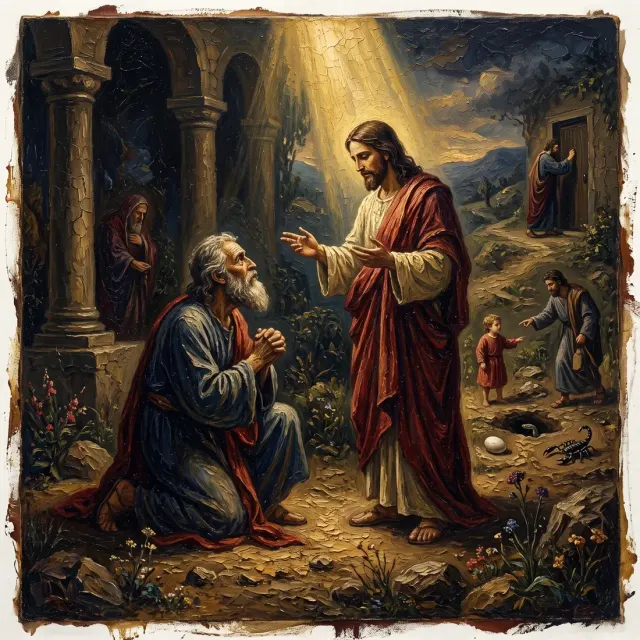
The disciples ask Jesus to teach prayer after seeing him pray, and the answer begins not with technique but with relationship and order: Father, name, kingdom, daily bread, forgiveness, protection. The repeated plural keeps even ordinary needs communal rather than turning prayer into a private shopping list. Forgiveness is also named alongside the petitioners' own treatment of debtors, refusing to separate received mercy from extended mercy. The midnight illustration then makes asking deliberately awkward. A traveler has arrived, hospitality requires food, the cupboard is empty, the neighbor is asleep, and the door is shut. "Importunity" carries the sense of shameless persistence, the refusal to let embarrassment end a real request. Yet the final father-and-child comparison prevents God from being reduced to a sleepy neighbor who gives bread simply to end the knocking. Even flawed fathers know the difference between food and harm. "How much more" does the heavenly Father give. The climax in the Book of Luke is the Holy Spirit, not a blank check for every object someone can name.
Deep dive
The request to learn prayer follows the disciples' observation of Jesus praying. The prayer he gives places God's name and kingdom before bread, forgiveness, and protection. Its plural language keeps those needs communal. Even the request for forgiveness names the petitioners' treatment of their debtors, so receiving mercy and extending it are not placed in separate compartments.
The midnight visitor asks for bread because another traveler has arrived. His request is inconvenient but concerns a real obligation of hospitality. The KJV's "importunity" translates anaideia, a word meaning shamelessness or impudence, often understood here as unabashed persistence. The scene is not polite enough to be easily dismissed: someone is at the door, the household is in bed, and supper for an unexpected guest still does not exist.
The following comparison establishes how the illustration should be read. Even flawed human fathers distinguish nourishment from harm; the heavenly Father's generosity exceeds theirs. God is therefore not simply identified with the man who wants the knocking to stop. The progression moves from an inconvenient request that receives an answer to a Father whose character warrants asking. Luke's climax is the gift of the Holy Spirit, not an unlimited guarantee that every requested object will be supplied.
Words to trace: friend, Father, rise, bread, children, disciples
Verse-by-verse path
- Luke 11:1
Luke shows Jesus praying at each turning point, at his baptism (3:21), before choosing the Twelve (6:12), before Peter’s confession (9:18). John’s disciples were known for their prayers (5:33), and a teacher’s own form of prayer marked out his followers as a group. The place is left unnamed.
- Luke 11:2
The oldest manuscripts of Luke begin simply “Father”, without “Our” or “which art in heaven”, and lack “Thy will be done”; the King James follows later copies that match Matthew 6:9-10. “Hallowed” means treated as holy, the hope of Ezekiel 36:23 that God will “sanctify my great name”.
- Luke 11:3
“Daily” is epiousios, a word no one has found in Greek before the gospels, and its sense is still argued: bread for today, for the coming day, or what is needed to live. Jerome reported that a Hebrew gospel read mahar, tomorrow. Luke’s “day by day” asks for a supply that keeps coming.
- Luke 11:4
Luke asks forgiveness of “sins” and then speaks of those “indebted to us”, where Matthew has debts in both halves; the Aramaic word hoba covers both debt and sin. “Every one” leaves no debtor out. “Deliver us from evil” is missing from the oldest copies of Luke.
- Luke 11:5
Travellers often walked by night to escape the heat, so a midnight arrival was plausible. Three loaves were small flat rounds, enough for a guest’s meal with some to spare. “Lend” is chraō, found only here in the New Testament: he means to pay the bread back.
- Luke 11:6
Kenneth Bailey, drawing on long experience of Middle Eastern village life, argued that a guest was received on behalf of the whole village, so that a host with nothing to set out shamed his neighbours as well. “In his journey” means the guest came straight off the road.
- Luke 11:7
A peasant house was often a single room, with the family sleeping together on a raised floor or mats. The door was barred with a wooden bolt through rings, and drawing it back would wake the children. “Trouble me not” is literally “do not give me labours”.
- Luke 11:8
“Importunity” renders anaideia, shamelessness. Readers divide on whose it is: most take it as the asker’s brazen persistence, while Bailey and others read it of the sleeper, who gets up to avoid the shame of refusing. “As many as he needeth” goes beyond the three loaves asked for.
- Luke 11:9
The three commands are present imperatives: keep asking, keep seeking, keep knocking. The passives, “it shall be given” and “it shall be opened”, leave the giver unnamed in a common Jewish way of speaking reverently of God’s action.
- Luke 11:10
The commands become a rule, with the same three verbs turned into participles. “Every one” is the same pas used in verse 4 of every debtor forgiven: the promise is as wide as the forgiveness asked for.
- Luke 11:11
Each pair is a look-alike: a round loaf and a round stone, a fish from the lake and a water snake. The best manuscripts of Luke have only the fish and serpent here; the bread and stone may have come in from Matthew 7:9.
- Luke 11:12
Only Luke has the egg and the scorpion. A pale desert scorpion curled up at rest is roughly the size and colour of an egg. Serpents and scorpions were just now what the seventy were given power to tread on (10:19).
- Luke 11:13
“Being evil” is blunt: the good human father is still called ponēros. “Heavenly Father” is literally “the Father from heaven”. Where Matthew 7:11 has “good things”, Luke names the Holy Spirit, the gift poured out in Acts 2 on those who had waited and prayed.
Luke 11:1-13
King James Version1And it came to pass, that, as he was praying in a certain place, when he ceased, one of his disciples said unto him, Lord, teach us to pray, as John also taught his disciples.
2And he said unto them, When ye pray, say, Our Father which art in heaven, Hallowed be thy name. Thy kingdom come. Thy will be done, as in heaven, so in earth.
3Give us day by day our daily bread.
4And forgive us our sins; for we also forgive every one that is indebted to us. And lead us not into temptation; but deliver us from evil.
5And he said unto them, Which of you shall have a friend, and shall go unto him at midnight, and say unto him, Friend, lend me three loaves;
6For a friend of mine in his journey is come to me, and I have nothing to set before him?
7And he from within shall answer and say, Trouble me not: the door is now shut, and my children are with me in bed; I cannot rise and give thee.
8I say unto you, Though he will not rise and give him, because he is his friend, yet because of his importunity he will rise and give him as many as he needeth.
9And I say unto you, Ask, and it shall be given you; seek, and ye shall find; knock, and it shall be opened unto you.
10For every one that asketh receiveth; and he that seeketh findeth; and to him that knocketh it shall be opened.
11If a son shall ask bread of any of you that is a father, will he give him a stone? or if he ask a fish, will he for a fish give him a serpent?
12Or if he shall ask an egg, will he offer him a scorpion?
13If ye then, being evil, know how to give good gifts unto your children: how much more shall your heavenly Father give the Holy Spirit to them that ask him?
Luke 11:14-26
The Stronger One Has Entered the House
A man who could not speak begins speaking after a devil is cast out, an observable liberation that some witnesses immediately reinterpret as evidence of alliance with Beelzebub. Jesus answers first by exposing the internal contradiction. A kingdom committed to dismantling itself is not preserving its rule, and the critics apply a different standard to comparable exorcisms among their own associates. Then he offers the alternative interpretation: "the finger of God." That phrase recalls Egypt's magicians recognizing power beyond them, while the image of a stronger man stripping an armed strong man makes the conflict unmistakable. Jesus does not portray equal powers negotiating terms. Armor is taken, the palace is overcome, and spoils are divided. The warning about an unclean spirit returning to a swept and decorated house then prevents mere vacancy from being confused with final safety. Orderliness by itself is not allegiance. Read with the saying about gathering and scattering, the danger is an improved-looking life that remains unclaimed by the stronger one who has entered the house.
Deep dive
The restored man's speech is an observable result, yet some witnesses reinterpret that liberation as evidence of an alliance with the chief of demons. Jesus first exposes the contradiction: a kingdom systematically dismantling its own rule is not securing its future. He also asks why comparable activity among their own associates is judged by a different standard. The charge depends on refusing him the interpretation granted to others.
The alternative is the "finger of God," wording that recalls the Egyptian magicians' recognition in Exodus 8:19. The kingdom has come upon the hearers because the strong man's apparent security has been broken by someone stronger. The image does not depict negotiations between equal powers. Armor is removed, and possessions formerly guarded are distributed as spoils.
The account of the returning spirit prevents deliverance from being confused with an adequate final condition merely because the house looks orderly. Sweeping and decoration cannot by themselves secure it. Read beside the gathering and scattering saying, the warning concerns the danger of an apparent improvement that has not become a decisive alignment with Jesus. Its purpose is not to provide an elaborate geography of spirits traveling through dry places.
Words to trace: devils, Beelzebub, divided, house, kingdom, devil
Verse-by-verse path
- Luke 11:14
“Dumb” is kōphos, a word that can mean mute or deaf or both. Luke calls the spirit itself dumb, as though its character had passed into the man, and the moment it leaves, the man speaks.
- Luke 11:15
Baal-zebub, “lord of flies”, was the god of Ekron whom King Ahaziah consulted (2 Kings 1:2). Most Greek manuscripts read Beelzebul, which may mean “lord of the dwelling”, a sense that fits the talk of houses and palaces in the verses that follow.
- Luke 11:16
A sign “from heaven” would be something unmistakable from the sky, like fire on Elijah’s altar or manna in the desert. “Tempting” is peirazō, testing, the word used of Israel putting God to the test in the wilderness. The demand is answered not here but in verse 29.
- Luke 11:17
Judaea had lived through this: the feud between the Hasmonean brothers Hyrcanus and Aristobulus opened the way for Pompey to take Jerusalem in 63 BC. “A house divided against a house falleth” can also be read as one house collapsing onto another, a picture of domino ruin.
- Luke 11:18
Only Luke spells out the charge as the premise of the argument: “because ye say”. Satan and Beelzebub are treated as the same figure, so the accusers are made to follow their own claim to its end.
- Luke 11:19
“Your sons” means your own followers. Jewish exorcists were well known: Acts 19:13-14 tells of the sons of Sceva, and Josephus describes one Eleazar driving out a demon before Vespasian. If the same act is holy in them, it cannot be satanic in Jesus.
- Luke 11:20
Matthew 12:28 has “the Spirit of God” where Luke has “finger”. “Is come upon you” is ephthasen, has already arrived, reached you before you expected: the kingdom is not only near, as in 10:9, but has overtaken them.
- Luke 11:21
“Strong man armed” is kathōplismenos, fully equipped, and his “palace” is aulē, a walled courtyard house. Isaiah 49:24-25 asks whether the prey can be taken from the mighty and answers that it can, which the parable plays out.
- Luke 11:22
“All his armour” is panoplia, the full kit of a heavy infantryman, a word found elsewhere in the New Testament only in Ephesians 6:11 and 13. Dividing the spoils was the victor’s act, and Isaiah 53:12 promises the servant a portion with the great and the spoil divided with the strong.
- Luke 11:23
Gathering and scattering is shepherd language: the LORD promises to seek out his flock and gather it from where it was scattered (Ezekiel 34:12-13). Anyone not helping to gather is, by default, helping the scattering.
- Luke 11:24
Waterless places were thought to be the haunts of demons; Isaiah 34:14 puts wild creatures and night spirits in the ruined desert. The spirit still calls the man “my house”, as though the tenancy had only been suspended.
- Luke 11:25
“Garnished” is kosmeō, put in order or adorned, the same word used of the temple’s goodly stones in 21:5. Matthew adds that the house is “empty”; Luke leaves the vacancy to be inferred from what follows.
- Luke 11:26
Seven is the number of completeness, so the second possession is total. “The last state of that man is worse than the first” is a sentence 2 Peter 2:20 applies to those who return to what they had escaped.
Luke 11:14-26
King James Version14And he was casting out a devil, and it was dumb. And it came to pass, when the devil was gone out, the dumb spake; and the people wondered.
15But some of them said, He casteth out devils through Beelzebub the chief of the devils.
16And others, tempting him, sought of him a sign from heaven.
17But he, knowing their thoughts, said unto them, Every kingdom divided against itself is brought to desolation; and a house divided against a house falleth.
18If Satan also be divided against himself, how shall his kingdom stand? because ye say that I cast out devils through Beelzebub.
19And if I by Beelzebub cast out devils, by whom do your sons cast them out? therefore shall they be your judges.
20But if I with the finger of God cast out devils, no doubt the kingdom of God is come upon you.
21When a strong man armed keepeth his palace, his goods are in peace:
22But when a stronger than he shall come upon him, and overcome him, he taketh from him all his armour wherein he trusted, and divideth his spoils.
23He that is not with me is against me: and he that gathereth not with me scattereth.
24When the unclean spirit is gone out of a man, he walketh through dry places, seeking rest; and finding none, he saith, I will return unto my house whence I came out.
25And when he cometh, he findeth it swept and garnished.
26Then goeth he, and taketh to him seven other spirits more wicked than himself; and they enter in, and dwell there: and the last state of that man is worse than the first.
Luke 11:27-32
The Sign Seekers Are Already Being Addressed
A woman in the crowd blesses Jesus by blessing the body that bore and nursed him, and Jesus turns the focus toward hearing and keeping God's word. The response does not require an insult to Mary. The Book of Luke has already portrayed her as precisely someone who receives, believes, and preserves what God says. The shift resists making biological nearness sufficient by itself. Then the crowd's demand for a sign provides the negative example of hearing. Jonah and the queen of the south become witnesses because earlier outsiders responded to lesser revelation: Nineveh repented at Jonah's preaching, and the queen traveled far to hear Solomon's wisdom. Now one greater than Jonah and Solomon is present, yet the response is a demand for more. The Book of Luke uses Jonah here to emphasize the prophet as a sign to Nineveh and the people's repentance. It does not repeat Matthew's explicit comparison involving three days. The force is immediate and uncomfortable: the sign seekers are not standing in darkness waiting for the first light to appear. They are already being addressed.
Deep dive
A woman praises Jesus by blessing the mother who bore and nursed him. His response does not need to be read as an insult to Mary, whom Luke has already portrayed as receiving God's word. It relocates blessedness from biological connection alone to hearing and keeping that word. Mary herself has been described in those terms, receiving the promise and treasuring what she hears.
The demand for a sign then exposes the opposite response. The crowd asks for further proof while the one greater than Jonah and Solomon is already speaking. Luke emphasizes the Ninevites' repentance at Jonah's preaching and the southern queen's journey to hear Solomon's wisdom. Both comparisons concern the response made to a message and messenger, not merely a preference for spectacular events.
Matthew 12:40 explicitly develops Jonah's three days as a comparison with Jesus' burial. Luke's formulation here places the emphasis on Jonah as a sign to the Ninevites and on their repentance. Importing Matthew's additional sentence as though Luke had written it would obscure Luke's particular contrast: people once responded to lesser revelation, while this generation demands more before responding to the greater.
Words to trace: generation, Jonas, sign, blessed, condemn, greater
Verse-by-verse path
- Luke 11:27
Only Luke records this interruption. Praising a son by blessing his mother was a familiar Jewish form, and it half fulfils Mary’s own words, “all generations shall call me blessed” (1:48). “Paps” was the ordinary 1611 word for breasts.
- Luke 11:28
“Yea rather” is menoun, a Greek particle that can confirm and correct in the same breath: yes, and more than that. “Keep” is phulassō, to guard, as a watchman keeps a gate.
- Luke 11:29
“Gathered thick together” is epathroizō, crowding in upon him, a word found only here. “Evil generation” recalls Moses’ phrase for the wilderness generation that would not enter the land, “this evil generation” (Deuteronomy 1:35).
- Luke 11:30
The future tense, “so shall also the Son of man be”, points ahead, perhaps to the resurrection, perhaps to the Son of man’s coming in judgment; interpreters differ. Nineveh saw no miracle, only a prophet from far off and a message of forty days.
- Luke 11:31
The queen of Sheba came from southwest Arabia, well over a thousand miles, to test Solomon with hard questions (1 Kings 10:1). “A greater” is neuter in the Greek, pleion, “something greater”, which may point beyond a person to what is happening in him.
- Luke 11:32
Nineveh was the Assyrian capital on the Tigris, Israel’s enemy, and in Jonah 3:5 the whole city from greatest to least put on sackcloth. To “rise up in the judgment” is courtroom language: the Gentile witnesses stand to testify. Luke places the queen before the Ninevites, in the order of their history.
Luke 11:27-32
King James Version27And it came to pass, as he spake these things, a certain woman of the company lifted up her voice, and said unto him, Blessed is the womb that bare thee, and the paps which thou hast sucked.
28But he said, Yea rather, blessed are they that hear the word of God, and keep it.
29And when the people were gathered thick together, he began to say, This is an evil generation: they seek a sign; and there shall no sign be given it, but the sign of Jonas the prophet.
30For as Jonas was a sign unto the Ninevites, so shall also the Son of man be to this generation.
31The queen of the south shall rise up in the judgment with the men of this generation, and condemn them: for she came from the utmost parts of the earth to hear the wisdom of Solomon; and, behold, a greater than Solomon is here.
32The men of Nineve shall rise up in the judgment with this generation, and shall condemn it: for they repented at the preaching of Jonas; and, behold, a greater than Jonas is here.
Luke 11:33-36
The Lamp Is Not the Problem
The lamp has not been hidden. It has been put where people entering can see, which makes this saying a pointed answer to those who keep asking for more evidence. Jesus' works and teaching have been public; the problem cannot be explained simply as a shortage of available light. So the image moves from lamp to eye. If the eye is "single," the body is filled with light; if the eye is evil, darkness follows. The KJV's wording carries both perceptual and moral force, especially with accusations of greed about to surface at the Pharisee's table. Jesus is not giving an anatomy lesson or claiming intelligence creates illumination. He is asking what happens when the faculty through which light is received has become disordered. The sharpest line is the warning that supposed light may itself be darkness. Confidence about seeing does not prove sight is sound. A fully illuminated body becomes the image of undivided reception, the opposite of explanations that look directly at liberation and call it satanic.
Deep dive
The lamp has been placed where people entering can see. Coming directly after the demand for another sign, the image resists the claim that adequate light has simply been withheld. Jesus' works and teaching have been public. The question moves instead to the eye through which that light is received.
The KJV's "single" describes an eye that admits light properly, contrasted with an "evil" eye and the darkness associated with it. The image can carry moral as well as perceptual force, particularly near the following accusations of greed. It should not be reduced to a medical diagnosis or made into a claim that intelligence itself supplies spiritual light.
The warning about supposed light being darkness gives the saying its edge. A person may be confident about seeing while the very faculty being trusted is impaired. The movement toward a wholly illuminated body depicts undivided reception, answering the divided explanations of Jesus' work that have occupied the chapter.
Words to trace: light, body, full, whole, candle, darkness
Verse-by-verse path
- Luke 11:33
The “secret place” is kryptē, a cellar or vault, and the “bushel” is a modios, a grain measure of about two gallons. Luke has a lamp saying already in 8:16, where the lamp is hidden under a vessel or a bed; here it is set against the demand for a sign.
- Luke 11:34
“Single” is haplous, simple, and the word family also meant generous; in Hebrew idiom an “evil eye” meant a grudging, stingy one (Deuteronomy 15:9, Proverbs 28:22). A generous eye and a stingy eye stand behind the English of healthy and diseased sight.
- Luke 11:35
“Take heed” is skopei, look out, a verb that is itself about looking: watch your own watching. The warning assumes a person may be confident of the very light that has failed.
- Luke 11:36
Found only in Luke, the verse is notoriously hard to translate, because its two halves seem to say the same thing. “Bright shining” is astrapē, a flash of lightning, the word used of Satan’s fall in 10:18.
Luke 11:33-36
King James Version33No man, when he hath lighted a candle, putteth it in a secret place, neither under a bushel, but on a candlestick, that they which come in may see the light.
34The light of the body is the eye: therefore when thine eye is single, thy whole body also is full of light; but when thine eye is evil, thy body also is full of darkness.
35Take heed therefore that the light which is in thee be not darkness.
36If thy whole body therefore be full of light, having no part dark, the whole shall be full of light, as when the bright shining of a candle doth give thee light.
Luke 11:37-44
The Polished Cup Does Not Settle the Matter
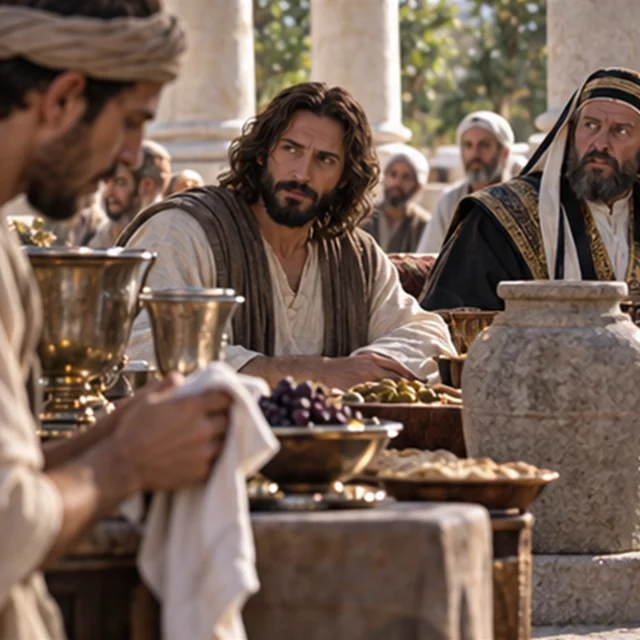
A meal invitation turns on washing before dinner, but the issue is ritual cleansing rather than modern hygiene. The host marvels that Jesus does not perform the expected washing, and Jesus answers with dishes polished on the outside while the inside remains full of "ravening and wickedness." The maker of the exterior also made the interior, so religious neatness cannot make inward grasping irrelevant. Almsgiving then gives the charge of greed a concrete opposite, but not a purchase price by which generosity buys purity. The next woe sharpens the imbalance. Mint, rue, and herbs receive careful tithes while judgment and the love of God are passed over. Jesus does not dismiss the details, adding, "these ought ye to have done," but refuses to let precision in small observances excuse neglect of weightier matters. The love of prominent seats and public greetings exposes another inward appetite. The unmarked grave reverses the desired appearance entirely: respected guides can become a source of contamination people do not even realize they have crossed.
Deep dive
The host marvels that Jesus has not washed before the meal. The exchange concerns religious cleansing, not a modern argument about hand hygiene. Jesus answers with the cup and platter: careful attention to their outside becomes a picture of a religious life whose visible order conceals grasping and wickedness within. The maker of the outside also made the inside, so the distinction cannot make the inward life irrelevant.
The reference to almsgiving turns the accusation of greed toward a concrete contrary action. It is not a price list for purchasing moral cleanliness. The following woe makes the central imbalance explicit: tiny herbs receive their tithe while justice and the love of God are passed over. Jesus adds that the former should not be left undone, preventing the contrast from becoming a simple dismissal of detail. The objection is misplaced proportion, not conscientiousness itself.
Prominent seats and public greetings expose the desire for recognition. The final image, an unmarked grave, reverses that desired appearance. Those presenting themselves as reliable guides become a source of contamination people do not recognize. The severity belongs to Jesus' stated judgment within this meal, not to an invitation to stereotype every Pharisee encountered elsewhere in Luke.
Words to trace: Pharisees, clean, love, Pharisee, alms, appear
Verse-by-verse path
- Luke 11:37
“Dine” is aristaō, from ariston, the earlier meal of the day rather than the main evening dinner. This is the second time in the Book of Luke that a Pharisee has Jesus to his table (7:36), and the conversation will again run through the host’s private thoughts.
- Luke 11:38
The Greek says literally that Jesus was not first “baptized” before dinner, baptizō in its plain sense of dipping or washing. Mark 7:3-4 explains the tradition of washing hands and vessels, which went beyond anything the law of Moses required of laymen.
- Luke 11:39
The “platter” is pinax, a flat serving board or dish. “Ravening” is harpagē, plunder or seizure, a strong word for greed that takes by force. Jesus speaks while the vessels he names may be on the table in front of them.
- Luke 11:40
“Ye fools” is aphrones, senseless, the word God addresses to the rich man with full barns in 12:20. The question appeals to creation: one maker is responsible for both surfaces, so neither is beneath his notice.
- Luke 11:41
“Such things as ye have” is ta enonta, literally “the things inside”, a pun: give away the contents of cup and dish and the question of their inner cleanness is settled. The verse puts generosity where the ritual washing stood.
- Luke 11:42
Deuteronomy 14:22 required a tenth of the yield of seed. Luke names rue, a bitter garden herb, where Matthew 23:23 has anise and cummin, and the Mishnah later lists rue among things exempt from tithe, so tithing it went beyond the law. “Judgment” means justice, as in Micah 6:8.
- Luke 11:43
The “uppermost seats” were the front bench of the synagogue, facing the congregation, where the eminent were seen by everyone. “Greetings in the markets” were the formal salutations with honorific titles, received in the busiest public space of the town.
- Luke 11:44
Touching a grave made a person unclean for seven days (Numbers 19:16), and graves were whitewashed each spring so pilgrims would not stumble on them before Passover. An unmarked grave defiles people without their knowing. Many manuscripts of Luke lack “scribes and Pharisees, hypocrites” here.
Luke 11:37-44
King James Version37And as he spake, a certain Pharisee besought him to dine with him: and he went in, and sat down to meat.
38And when the Pharisee saw it, he marvelled that he had not first washed before dinner.
39And the Lord said unto him, Now do ye Pharisees make clean the outside of the cup and the platter; but your inward part is full of ravening and wickedness.
40Ye fools, did not he that made that which is without make that which is within also?
41But rather give alms of such things as ye have; and, behold, all things are clean unto you.
42But woe unto you, Pharisees! for ye tithe mint and rue and all manner of herbs, and pass over judgment and the love of God: these ought ye to have done, and not to leave the other undone.
43Woe unto you, Pharisees! for ye love the uppermost seats in the synagogues, and greetings in the markets.
44Woe unto you, scribes and Pharisees, hypocrites! for ye are as graves which appear not, and the men that walk over them are not aware of them.
Luke 11:45-54
The Keeper of the Key Blocks the Doorway
The lawyer's protest is almost an invitation: "thus saying thou reproachest us also." Jesus accepts it. The experts who help interpret the law are judged by the burdens they load onto others while refusing even a finger's participation in those burdens themselves. The image makes professional distance physical. The tombs of the prophets then expose another contradiction. Honoring dead messengers does not establish agreement with their message when the same pattern of resistance continues toward living ones. The reference from Abel to Zacharias stretches the charge across a long history of righteous blood, while the Book of Luke wisely supplies no extra biography for the Zacharias he names. Then comes the "key of knowledge," one of the chapter's sharpest occupational images. Those entrusted with opening understanding do not enter and actively hinder others who are trying. The final response begins to perform the accusation in real time. Scribes and Pharisees press Jesus with questions not to learn but to catch something from his mouth that can be turned into a charge.

Deep dive
One lawyer points out that Jesus' words insult his group as well. The answer does not offer the exemption he seems to expect. Expertise in the law is judged by what it places on others and what the experts themselves will bear. The contrast between grievous burdens and an untouched finger makes their unequal participation visible in almost physical terms.
Building prophets' tombs might appear to honor the dead. Jesus instead places that activity beside the continued rejection of God's messengers: commemorating earlier victims does not establish agreement with their message when the same resistance persists. Abel and Zacharias mark the range of the bloodshed invoked. The latter is commonly connected with the killing in 2 Chronicles 24:20–22, though identification and the precise scope of the reference are discussed. Luke supplies the location of the death without a father's name.
The "key of knowledge" makes the charge specifically vocational. Those charged with opening understanding neither enter nor permit others to do so. The conclusion then shows scribes and Pharisees pressing Jesus with questions to trap him in his words. Their activity is no longer represented as a search for interpretation. The encounter about obstructed knowledge ends with an organized attempt to obtain grounds for accusation.
Words to trace: blood, lawyers, prophets, build, burdens, fathers
Verse-by-verse path
- Luke 11:45
“Reproachest” is hybrizō, to insult or treat outrageously, a heavy word. The lawyers were experts in the law, and many were Pharisees themselves, so the man hears the last three woes landing on his own profession.
- Luke 11:46
“Lade” is phortizō, to load a pack animal, and “grievous to be borne” is one word, hard to carry. The finger returns from verse 20: Jesus drives out devils with the finger of God, while the lawyers will not lift a finger to ease a load.
- Luke 11:47
Memorial tombs for prophets and holy men were being built in this period; Josephus says Herod the Great raised a monument of white stone at the entrance to David’s tomb. Several of the great tombs still standing in the Kidron valley date from this era.
- Luke 11:48
“Allow” in 1611 meant approve or sanction; the Greek syneudokeō, to consent together, is the verb used of Saul consenting to Stephen’s death (Acts 8:1). By finishing the tombs, the sons put their names to the fathers’ work.
- Luke 11:49
“The wisdom of God” speaks as a person, whether quoting a lost writing or Jesus speaking as God’s wisdom; Matthew 23:34 has simply “I send”. Luke’s pair, prophets and apostles, reaches past the Old Testament to the messengers Acts will describe.
- Luke 11:50
“Required” is ekzēteō, sought out, the language of blood-guilt from Genesis 9:5, where God says of shed blood, “will I require it”. “Foundation of the world” uses katabolē, a laying down, the founding moment of creation.
- Luke 11:51
Abel’s blood cried from the ground (Genesis 4:10), and the dying Zechariah said, “The LORD look upon it, and require it” (2 Chronicles 24:22), the verb that closes this verse twice. “Between the altar and the temple” places the murder in the court of the priests.
- Luke 11:52
“Taken away” is airō, to carry off, as if the lawyers had pocketed the key. Matthew 23:13 speaks of shutting up the kingdom; Luke makes the locked door one of knowledge, the understanding of Scripture that the experts claimed to hold.
- Luke 11:53
“Urge him vehemently” is deinōs enechein, to press hard with a grudge, the phrase Mark 6:19 uses of Herodias against John. “Provoke him to speak” is apostomatizō, found only here, to make someone answer off the cuff, as a teacher fires questions at a pupil.
- Luke 11:54
Two hunting words close the chapter: enedreuō, to lie in ambush, and thēreuō, to hunt game, found only here in the New Testament. The meal that began with washing ends with his hosts stalking him for a word to use in court.
Luke 11:45-54
King James Version45Then answered one of the lawyers, and said unto him, Master, thus saying thou reproachest us also.
46And he said, Woe unto you also, ye lawyers! for ye lade men with burdens grievous to be borne, and ye yourselves touch not the burdens with one of your fingers.
47Woe unto you! for ye build the sepulchres of the prophets, and your fathers killed them.
48Truly ye bear witness that ye allow the deeds of your fathers: for they indeed killed them, and ye build their sepulchres.
49Therefore also said the wisdom of God, I will send them prophets and apostles, and some of them they shall slay and persecute:
50That the blood of all the prophets, which was shed from the foundation of the world, may be required of this generation;
51From the blood of Abel unto the blood of Zacharias, which perished between the altar and the temple: verily I say unto you, It shall be required of this generation.
52Woe unto you, lawyers! for ye have taken away the key of knowledge: ye entered not in yourselves, and them that were entering in ye hindered.
53And as he said these things unto them, the scribes and the Pharisees began to urge him vehemently, and to provoke him to speak of many things:
54Laying wait for him, and seeking to catch something out of his mouth, that they might accuse him.
Questions to keep in mind while reading
- Watch what Jesus says and does, and how people respond.
- Trace kingdom, discipleship, opposition, cross, and resurrection in the evangelist’s own sequence.
- Let later doctrine clarify the scene without erasing its immediate setting.
Text first
Where readers differ
The chapter summary begins with what the passage says and how its parts fit together. It does not assume one denomination has already settled every question. Where a conclusion depends on a tradition, literary theory, or historical reconstruction, that dependence is named openly.
The KJV text is presented first. Interpretive conclusions are labeled, and differences are introduced only when they help a reader understand why serious communities do not always reach the same answer.
Comparative interpretive notes for this chapter are in preparation. Until reviewed notes are ready, this page separates the KJV text from summary and application without claiming that serious readers agree on every question.
Questions beneath the surface
- What account of God, human freedom, responsibility, and the good life emerges from Luke 11?
- Which tension does the chapter refuse to resolve quickly?
- What changes when the chapter is read as part of the whole canon rather than as an isolated moral lesson?
- Where might a sincere reader confuse a familiar tradition with something the text states directly?
Questions for serious personal contemplation
These open-ended questions make room for tension, honest response, prayer, and conclusions that remain accountable to the chapter.
Observe without rushing
What part of Luke 11 makes you stop, feel unsettled, or feel surprised, and why?
Which detail in the passage would be easiest to overlook? How does that detail change your understanding?
Where do you see tension between what happens and this focus: Luke 11 develops its own movement around light, generation, devils, full, Pharisees?
What important question does the passage leave open instead of resolving quickly?
Examine your inner life honestly
Which person, response, fear, or desire in the passage feels most like your own life right now?
What assumption about God, other people, or yourself does this text challenge?
Which part would you rather soften, avoid, or explain away too quickly? What might that reaction reveal?
If this Scripture could ask you one direct question, what do you think it would ask?
Respond with wisdom and courage
What do you need to remember, confess, grieve, thank God for, or trust after reading this passage?
How might another faithful person read this situation differently without ignoring the text?
What obedient response would be costly, uncomfortable, or slow, yet still faithful to Scripture?
What question will you carry into prayer this week, and which verses will you keep in front of you?
Music and video connected to the passage
Related media appears when its Scripture reference overlaps this study. Music and video can illuminate a theme while the biblical text remains the foundation.