The big picture
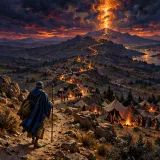
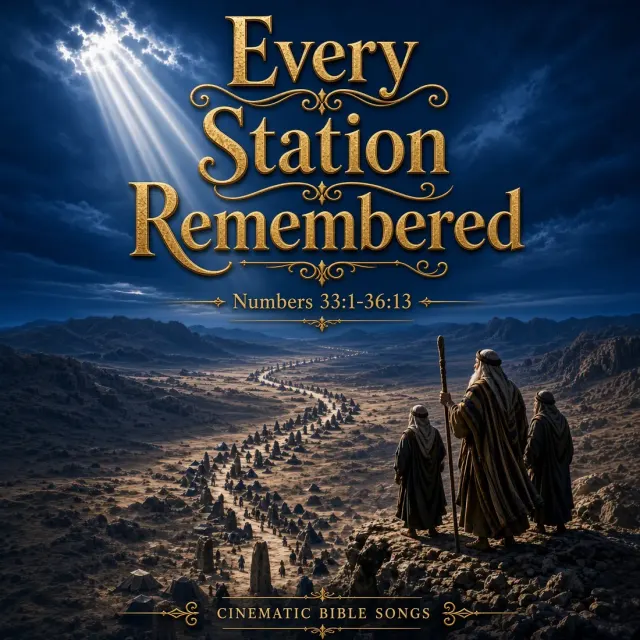
Numbers 33 turns Israel's wilderness movement into a written itinerary commanded by the LORD. The route begins with an exact date, the day after Passover, while Egypt buries its firstborn, and then proceeds through a long sequence of departures and encampments. Most stations receive only a name, which gives special weight to the few details preserved: Elim has twelve fountains and seventy palms, Rephidim has no water, and Aaron's death is fixed to the first day of the fifth month in the fortieth year. The record finally reaches the plains of Moab by Jordan near Jericho. At that point the chapter shifts from the road already traveled to the land ahead, commanding the removal of Canaan's inhabitants and cult objects, the division of territory by lot, and warning that Israel itself is not exempt from judgment in the land it receives.
In this chapter
- The Departure Has a Date and a Written Record Numbers 33:1-4
Numbers does not present the itinerary as a convenient list added after the important material.
- Water Appears in the List, and Then Does Not Numbers 33:5-15
The itinerary moves quickly from Rameses through Succoth and Etham, across the sea, through the wilderness, and toward Sinai.
- Many Stations, Little Explanation Numbers 33:16-37
From Sinai to Kadesh and then Mount Hor, the itinerary becomes almost pure sequence.
- One Death Interrupts the Departures Numbers 33:38-49
The repeated travel formula pauses for a death.
- The Warning Applies to Israel Too Numbers 33:50-56
At the end of the itinerary, the chapter turns from remembering the road to defining the conditions of possession ahead.

Scripture beside the summary
Numbers · King James Version · 56Numbers 33:1-4
The Departure Has a Date and a Written Record
Numbers does not present the itinerary as a convenient list added after the important material. It says Moses wrote Israel's departures and journeys at the LORD's command, giving the route itself the status of a preserved record. The first entry then receives an exact date: the fifteenth day of the first month, the morning after Passover. Israel leaves Rameses "with an high hand" in the sight of Egypt, but the same moment is marked by Egyptian burial of the firstborn. The departure therefore stands beside the deaths that preceded it and cannot be reduced to a clean escape scene. Numbers also says that the LORD executed judgments upon Egypt's gods, placing a theological claim inside the travel notice. Before the long chain of place-names begins, the chapter establishes what sort of road this is: a remembered route whose first movement is tied to deliverance, judgment, and a date.
Deep dive
Before the list begins, Numbers explains why it exists: Moses wrote down the departures according to their journeys at the LORD's command. The itinerary is not merely an editor's convenient way of getting the people to the next scene. Within the account, the route itself is something to preserve. The paired language of departures and journeys gives the repeated place-names the character of a record rather than a collection of unrelated geographical curiosities.
The date of departure is then made unusually exact: the fifteenth day of the first month, on the day after the Passover. Israel leaves openly while the Egyptians bury their firstborn, and the passage also describes the LORD's judgments upon Egypt's gods. The two peoples occupy the same moment very differently. Israel's departure cannot be detached from the deaths in Egypt, nor does the text reduce those judgments to a successful escape from human guards. The itinerary begins with an act of deliverance whose cost and theological claim remain in the frame.
Words to trace: journeys, LORD, children, Egyptians, first, goings
Verse-by-verse path
- Numbers 33:1
“With their armies” is letsiv’otam, “by their hosts”, the military word Exodus 12:41 and 12:51 use for the night Israel left Egypt. The list is framed as the march of an army in formation, “under the hand of Moses and Aaron”, the two brothers who began it.
- Numbers 33:2
The Torah rarely says that Moses wrote something down: the war with Amalek (Exodus 17:14), the book of the covenant (Exodus 24:4), the song and the law of Deuteronomy 31. The verse turns its own phrase round, “goings out according to their journeys... journeys according to their goings out”, a mirror at the head of the list.
- Numbers 33:3
“On the morrow after the passover” is the phrase Joshua 5:11 uses for the day Israel first ate the produce of Canaan. The exodus and the end of the wilderness are dated by the same words. “An high hand” means openly and defiantly, as in Exodus 14:8.
- Numbers 33:4
The Hebrew participle means “were burying”: Egypt was burying its dead as Israel walked out. The line on Egypt’s gods fulfils Exodus 12:12, “against all the gods of Egypt I will execute judgment”, said on the night before.
Numbers 33:1-4
King James Version1These are the journeys of the children of Israel, which went forth out of the land of Egypt with their armies under the hand of Moses and Aaron.
2And Moses wrote their goings out according to their journeys by the commandment of the LORD: and these are their journeys according to their goings out.
3And they departed from Rameses in the first month, on the fifteenth day of the first month; on the morrow after the passover the children of Israel went out with an high hand in the sight of all the Egyptians.
4For the Egyptians buried all their firstborn, which the LORD had smitten among them: upon their gods also the LORD executed judgments.
Numbers 33:5-15
Water Appears in the List, and Then Does Not
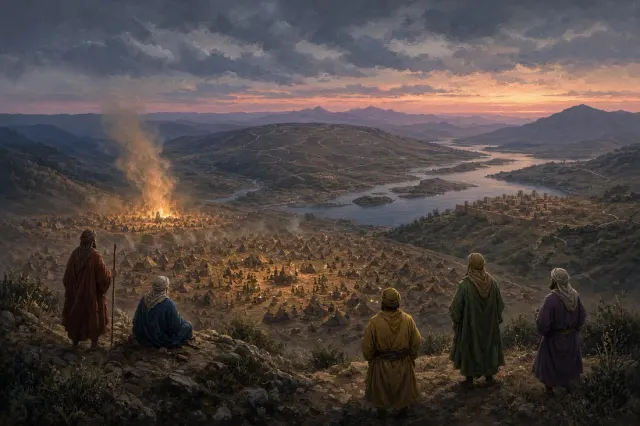
The itinerary moves quickly from Rameses through Succoth and Etham, across the sea, through the wilderness, and toward Sinai. Because most stations receive only the regular formula of departure and encampment, the brief interruptions become unusually noticeable. Elim is remembered for twelve fountains of water and seventy palm trees. Rephidim is remembered for the opposite reason: there was no water for the people to drink. Numbers does not turn the numbers at Elim into a hidden code, and it does not retell the full dispute associated with Rephidim. It simply lets abundance and want sit inside the route. Even the crossing of the sea is compressed into one movement between stations. The repeated travel language can carry both extraordinary events and ordinary relocation without pretending they were equally dramatic. The list preserves continuity, while its few details tell the reader which moments the record chooses not to leave bare.
Deep dive
Most stations receive only the formula of departure and encampment, so an added detail deserves attention. At Elim the record pauses for twelve fountains and seventy palm trees. At Rephidim it pauses to state that there was no water for the people to drink. A list of names has briefly become a record of what sustained the camp, and what it lacked.
The passage does not explain the numbers at Elim as a hidden code, and it does not retell the entire water dispute at Rephidim. Its selectivity is the point. The route preserves the place of provision and the place of want without turning either stop into a full account. Crossing the sea is likewise included in a single movement between stations. The same repeated verbs carry both extraordinary events and ordinary relocations, allowing the itinerary to retain continuity without pretending that every encampment held the same significance.
Words to trace: pitched, removed, wilderness, encamped, departed, Elim
Verse-by-verse path
- Numbers 33:5
Rameses is one of the two store cities Exodus 1:11 says Israel was forced to build. The march begins from a city of their own bondage. Succoth means booths or shelters, a camp name before it was a town.
- Numbers 33:6
Etham, “in the edge of the wilderness”, is where Exodus 13:20–22 first shows the pillar of cloud by day and fire by night. The itinerary records the camp and leaves the pillar out.
- Numbers 33:7
“Turned again” is the doubling back of Exodus 14:2–3, meant to make Pharaoh think Israel was lost. Migdol means “tower”, the word for an Egyptian frontier fort. Baal-zephon is named for a Canaanite storm god, “lord of the north”, whose shrine stood by the sea.
- Numbers 33:8
The crossing of the sea takes one clause, and no more is said. Exodus 15:22 calls the desert beyond it “the wilderness of Shur”; here it is “the wilderness of Etham”, the district of the camp before the crossing. Marah means bitter, for the water Moses sweetened with a tree.
- Numbers 33:9
Elim means “great trees”, likely terebinths or palms, a fitting name for an oasis. It is the one stop in the list where the text says only good things. Exodus 16:1 dates the arrival in the wilderness of Sin after it to one month after leaving Egypt.
- Numbers 33:10
A camp “by the Red sea” after Elim appears nowhere in Exodus, which moves straight from Elim to the wilderness of Sin (16:1). The itinerary knows a stage the account in Exodus skipped, probably along the shore of the Gulf of Suez.
- Numbers 33:11
The manna was first given in the wilderness of Sin (Exodus 16), and the itinerary does not say so. Sin here is a place name, not the English word; it may be related to the name Sinai.
- Numbers 33:12
Dophkah occurs only here and in the next verse. Some scholars have linked it to the Egyptian word for turquoise and the mines at Serabit el-Khadim in western Sinai; that is a conjecture from the sound, not a settled identification.
- Numbers 33:13
Alush, like Dophkah, is not in Exodus. Between the wilderness of Sin and Rephidim, Exodus 17:1 says only that Israel journeyed “after their journeys”, and this list fills in two of them.
- Numbers 33:14
At Rephidim Amalek attacked, Joshua first appears in Scripture leading the fight, and Jethro came to Moses (Exodus 17–18). The itinerary keeps only one fact about the place: the lack of water that gave it the names Massah and Meribah.
- Numbers 33:15
Israel arrived at Sinai in the third month (Exodus 19:1) and left on the twentieth day of the second month of the second year (10:11). The best part of a year, the giving of the law and the building of the tabernacle, is one line in the list.
Numbers 33:5-15
King James Version5And the children of Israel removed from Rameses, and pitched in Succoth.
6And they departed from Succoth, and pitched in Etham, which is in the edge of the wilderness.
7And they removed from Etham, and turned again unto Pi-hahiroth, which is before Baal-zephon: and they pitched before Migdol.
8And they departed from before Pi-hahiroth, and passed through the midst of the sea into the wilderness, and went three days’ journey in the wilderness of Etham, and pitched in Marah.
9And they removed from Marah, and came unto Elim: and in Elim were twelve fountains of water, and threescore and ten palm trees; and they pitched there.
10And they removed from Elim, and encamped by the Red sea.
11And they removed from the Red sea, and encamped in the wilderness of Sin.
12And they took their journey out of the wilderness of Sin, and encamped in Dophkah.
13And they departed from Dophkah, and encamped in Alush.
14And they removed from Alush, and encamped at Rephidim, where was no water for the people to drink.
15And they departed from Rephidim, and pitched in the wilderness of Sinai.
Numbers 33:16-37
Many Stations, Little Explanation
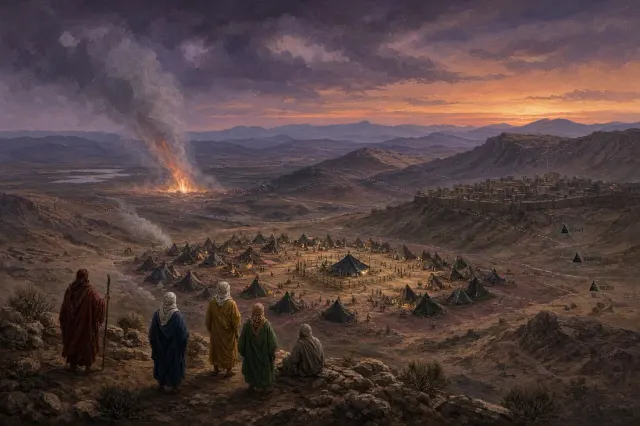
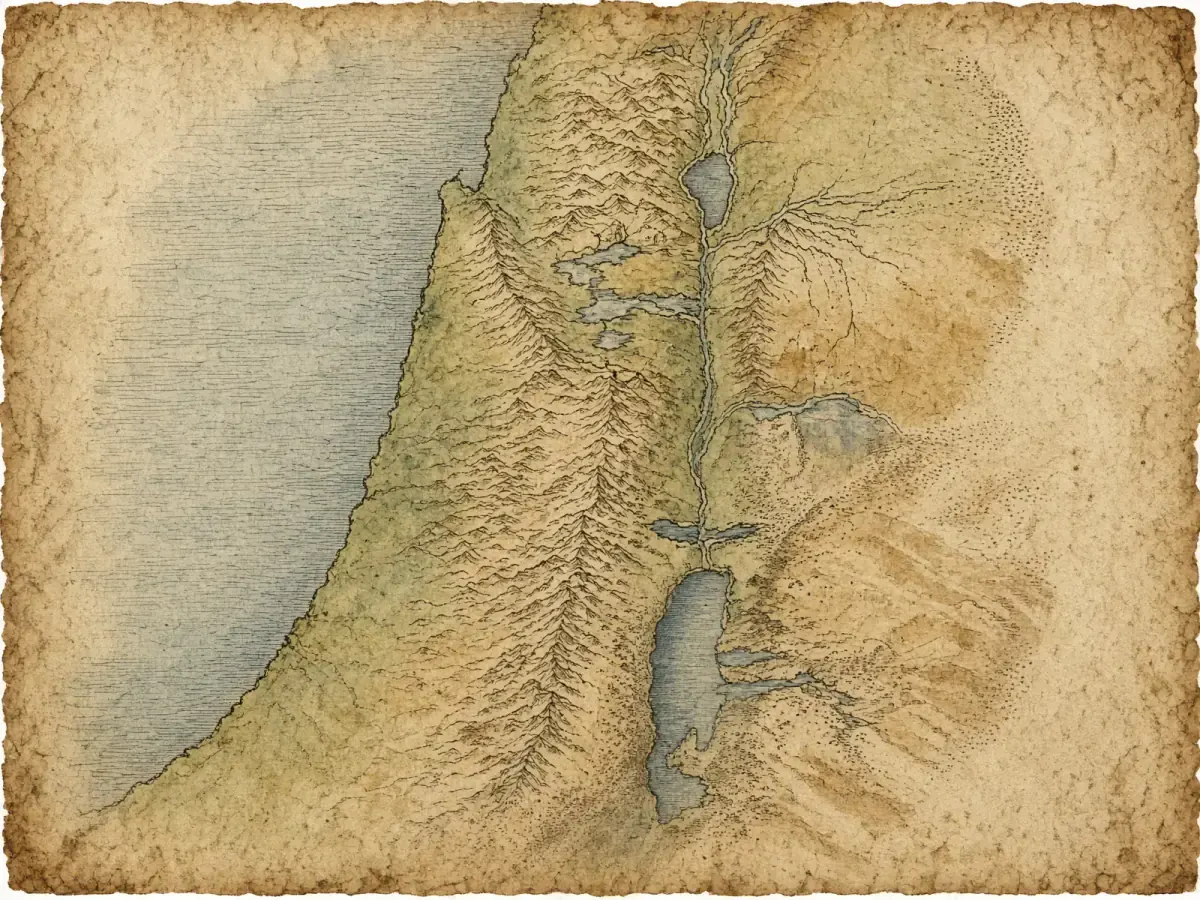
From Sinai to Kadesh and then Mount Hor, the itinerary becomes almost pure sequence. Israel departs, encamps, moves again, and leaves behind a chain of names that often carry no explanation of what happened there or how long the camp remained. That restraint is part of the record's meaning. Numbers does not invite the reader to invent an event for every silent station or to turn the list into a complete diary the text never supplies. Some names are known mainly because the route preserves them. Kadesh is identified with the wilderness of Zin, and Mount Hor reconnects the list with places already important elsewhere in Numbers, but the long middle stretch remains deliberately spare. The accumulation itself lets the extent of the journey register. There is room in this record for places whose only surviving fact is that Israel camped there, lived there for some unreported interval, and eventually packed up to move again.
Deep dive
The list's restraint matters. Several names are known chiefly through such route notices, and this passage supplies neither the length of every stay nor an incident to attach to each location. A modern reconstruction that confidently fills every interval with a particular event would be adding what the itinerary omits. The repeated movements establish a sequence; they do not provide a complete travel diary.
Kadesh is expressly located in the wilderness of Zin, and Mount Hor is reached near the close of this section. Those identifiable points reconnect the list with the leadership crisis of chapter 20. Between Sinai and that setting, the accumulation of names lets the extent of the journey register without inventing speeches or episodes for the silent stations. Numbers has room for places where the only preserved fact is that Israel pitched its tents and later moved on.
Words to trace: pitched, removed, departed, encamped, mount, Bene
Verse-by-verse path
- Numbers 33:16
Kibroth-hattaavah means “the graves of craving”, the name given after the quails in 11:34. Taberah, where fire burned in the camp in 11:3, is missing; it was probably a place within the same stage, not a separate camp.
- Numbers 33:17
Hazeroth means enclosures or settlements. Miriam and Aaron spoke against Moses there, and Miriam was shut out of the camp seven days while the people waited (12:1–16). The list gives the place and not the quarrel.
- Numbers 33:18
Rithmah comes from rotem, the broom bush, the shrub Elijah lay under in 1 Kings 19:4, where the King James says “juniper”. Rabbinic tradition placed the sending of the spies here, since 12:16 has Israel go from Hazeroth into Paran; the text of Numbers 33 does not say so.
- Numbers 33:19
Rimmon-parez means “pomegranate of the breach”. From Rithmah to Ezion-gaber runs a stretch of eighteen stations almost unknown outside this list; only Deuteronomy 2:8 and 10:6–7 name any of them again.
- Numbers 33:20
Libnah means whiteness, perhaps from white poplars or pale rock. It is not the Libnah in the lowlands of Judah that Joshua took (Joshua 10:29); the name was simply common.
- Numbers 33:21
Rissah is known only from this verse and the next. Its meaning and site are uncertain, and the list gives no event. It is one of the places where the only fact preserved is a night or a season under canvas.
- Numbers 33:22
Kehelathah comes from qahal, assembly. Some rabbinic readers placed Korah’s gathering of the congregation against Moses here, because the name means “assembling”; that is a reading of the name, not a record.
- Numbers 33:23
Mount Shapher, “the mountain of beauty” or “pleasantness”, is the only mountain named between Sinai and Hor. Its site is unknown.
- Numbers 33:24
Haradah comes from charad, to tremble or be afraid. The name may describe the place or recall something that happened there; the list gives only the stop.
- Numbers 33:25
Makheloth means “assemblies”, from the same root as Kehelathah three stops before. Two camps in quick succession were named for gatherings, which suggests places where the tribes came together after being spread out.
- Numbers 33:26
Tahath means “beneath” or “the low place”. It is also a personal name among the Kohathites and Ephraimites in 1 Chronicles 6:24 and 7:20, a reminder that places and people often shared names.
- Numbers 33:27
Tarah is spelled in Hebrew exactly like Terah, the name of Abraham’s father (Genesis 11:24). The King James distinguishes them by vowel only. Nothing else is known of the place.
- Numbers 33:28
Mithcah means sweetness, from matoq, sweet. Near the start of the list stood Marah, bitter; now a station bears the opposite name.
- Numbers 33:29
Hashmonah sounds like Heshmon, a town in the south of Judah (Joshua 15:27), and like Hashmon, the ancestor after whom Josephus says the Hasmonean family was named. No link has been shown; the likeness is only in the sound.
- Numbers 33:30
Moseroth means bonds or fetters. Deuteronomy 10:6 says “Mosera: there Aaron died, and there he was buried”, while this chapter puts his death on Mount Hor. Mosera may be the district in which Mount Hor lay; the two lists take the stations in different order.
- Numbers 33:31
Bene-jaakan means “the sons of Jaakan”, a clan name, Akan among the Horites of Seir in Genesis 36:27. Deuteronomy 10:6 calls it “Beeroth of the children of Jaakan”, the wells of that clan, so the place was named for the people who owned its water.
- Numbers 33:32
Hor-hagidgad, “the hollow of Gidgad”, is the Gudgodah of Deuteronomy 10:7. The two lists are clearly using the same route, even as their spellings differ.
- Numbers 33:33
Jotbathah is the one station in this stretch that Scripture describes. Deuteronomy 10:7 calls it “Jotbath, a land of rivers of waters”, a wadi of running streams in a dry country.
- Numbers 33:34
Ebronah comes from the root avar, to cross over, and may mean a ford or a passage. It is named only here and in the next verse.
- Numbers 33:35
Ezion-gaber, at the head of the Gulf of Aqaba, later became Solomon’s port: he “made a navy of ships in Ezion-geber, which is beside Eloth, on the shore of the Red sea” (1 Kings 9:26). Jehoshaphat’s fleet was wrecked there (1 Kings 22:48).
- Numbers 33:36
From Ezion-gaber on the gulf to Kadesh is a long march north. Miriam died at Kadesh (20:1); the itinerary records Aaron’s death two verses later but not hers.
- Numbers 33:37
“In the edge of the land of Edom” marks the border because Edom had refused Israel passage (20:14–21). Josephus placed Mount Hor near Petra, the present Jebel Harun; many scholars prefer a hill nearer Kadesh, given the wording here and at 20:22–23.
Numbers 33:16-37
King James Version16And they removed from the desert of Sinai, and pitched at Kibroth-hattaavah.
17And they departed from Kibroth-hattaavah, and encamped at Hazeroth.
18And they departed from Hazeroth, and pitched in Rithmah.
19And they departed from Rithmah, and pitched at Rimmon-parez.
20And they departed from Rimmon-parez, and pitched in Libnah.
21And they removed from Libnah, and pitched at Rissah.
22And they journeyed from Rissah, and pitched in Kehelathah.
23And they went from Kehelathah, and pitched in mount Shapher.
24And they removed from mount Shapher, and encamped in Haradah.
25And they removed from Haradah, and pitched in Makheloth.
26And they removed from Makheloth, and encamped at Tahath.
27And they departed from Tahath, and pitched at Tarah.
28And they removed from Tarah, and pitched in Mithcah.
29And they went from Mithcah, and pitched in Hashmonah.
30And they departed from Hashmonah, and encamped at Moseroth.
31And they departed from Moseroth, and pitched in Bene-jaakan.
32And they removed from Bene-jaakan, and encamped at Hor-hagidgad.
33And they went from Hor-hagidgad, and pitched in Jotbathah.
34And they removed from Jotbathah, and encamped at Ebronah.
35And they departed from Ebronah, and encamped at Ezion-gaber.
36And they removed from Ezion-gaber, and pitched in the wilderness of Zin, which is Kadesh.
37And they removed from Kadesh, and pitched in mount Hor, in the edge of the land of Edom.
Numbers 33:38-49
One Death Interrupts the Departures
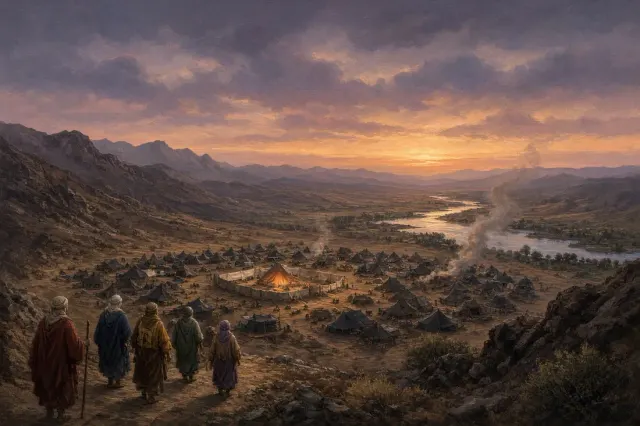
The repeated travel formula pauses for a death. Aaron goes up Mount Hor at the LORD's command and dies there on the first day of the fifth month in the fortieth year after the exodus, at the age of 123. Those details fix the earlier mountain scene inside the final wilderness year and mark the itinerary with the absence of one of the two leaders named at its beginning. King Arad's notice then briefly recalls Israel's approach to Canaan, after which the departures resume through Zalmonah, Punon, Oboth, and further stations until the camp reaches the plains of Moab. Its position is not described as one isolated tent by a marker. Israel is spread from Beth-jesimoth to Abel-shittim near the Jordan opposite Jericho. The recorded road has reached the setting for the book's final instructions, and the list yields to preparation for a crossing Numbers itself will not narrate.
Deep dive
The formula of moving and encamping breaks for Aaron. His death falls on the first day of the fifth month of the fortieth year, and his age is given as 123. This fixes chapter 20's mountain scene within the final year of the wilderness period. A journey that might otherwise appear to consist only of places is marked by the absence of the man who had shared its leadership.
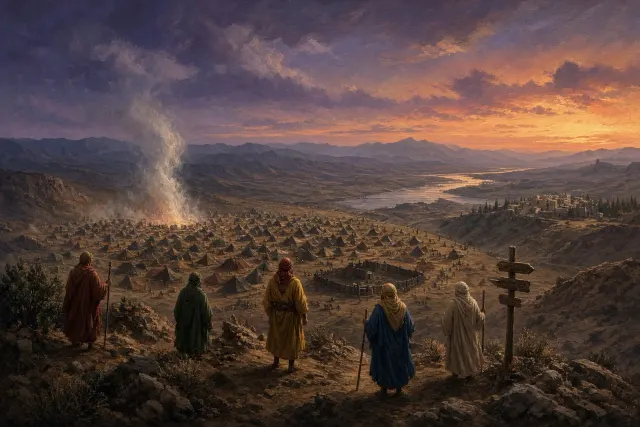
The notice that the king of Arad heard of Israel's approach also recalls chapter 21, though the itinerary does not repeat the battle. After further stages, the camp reaches the plains of Moab. Its extent is described from Beth-jesimoth to Abel-shittim, not as a single tent pitched neatly beside a signpost. The route has reached the setting of the final chapters of Numbers: east of the Jordan, across from Jericho. The repeated departures now yield to instructions for a crossing that this book will not itself describe.
Words to trace: pitched, departed, Abarim, Moab, mount, Aaron
Verse-by-verse path
- Numbers 33:38
The day, the month and the year are all given. No other death in the Torah is dated so exactly. The first of the fifth month is still kept in Jewish tradition as the anniversary of Aaron’s death.
- Numbers 33:39
The number checks against Exodus 7:7, where Aaron was eighty three when he spoke to Pharaoh. Forty years later he is a hundred and twenty three. Moses, three years younger, will die at a hundred and twenty (Deuteronomy 34:7).
- Numbers 33:40
The King James makes “king Arad” a man’s name here and in 21:1; the Hebrew reads “the Canaanite, the king of Arad”, a town in the Negev. The verse interrupts the list with a notice and leaves the reader to recall what followed at Hormah (21:3).
- Numbers 33:41
Zalmonah may come from tsel, shade. Some interpreters placed the fiery serpents of 21:4–9 around this stretch, which ran south round Edom by the road of the Red Sea; the list names no event.
- Numbers 33:42
Punon is generally identified with Feinan in the Arabah, one of the great copper mining districts of the ancient Near East. Moses made the serpent of nechoshet, copper or bronze (21:9); whether it happened near Punon the text does not say, but the metal was at hand.
- Numbers 33:43
Oboth appears in 21:10–11 as well. From here the two accounts of the route run together, and chapter 21 adds a song of the well and stations of its own that this record leaves out.
- Numbers 33:44
Ije-abarim means “the ruins of Abarim” or “the heaps of the regions beyond”, on the border of Moab. The next verse shortens it to Iim, “heaps”, as though the place had a nickname.
- Numbers 33:45
Dibon-gad takes its second name from the Gadites who rebuilt it (32:34). The itinerary calls the town by the name it came to bear under Israel’s occupation, not by its Moabite name alone.
- Numbers 33:46
Almon-diblathaim means something like “Almon of the two fig cakes”, from develah, a pressed cake of figs. Jeremiah 48:22 names Beth-diblathaim among Moab’s towns, and Mesha’s inscription says he built it.
- Numbers 33:47
Nebo is the summit from which Moses will look over the land and die (Deuteronomy 34:1). The camp in the mountains “before Nebo” brings Israel within sight of the place where the book of Deuteronomy ends.
- Numbers 33:48
From Rameses to the plains of Moab the chapter names forty two places. Everything from 22:1 to the end of Deuteronomy happens at this last one, with Israel camped on the valley floor opposite Jericho.
- Numbers 33:49
Abel-shittim, “meadow of acacias”, is the Shittim where the people “began to commit whoredom with the daughters of Moab” (25:1). It is also the camp from which Joshua sends two spies to Jericho (Joshua 2:1). Beth-jesimoth means “house of the wastes”.
Numbers 33:38-49
King James Version38And Aaron the priest went up into mount Hor at the commandment of the LORD, and died there, in the fortieth year after the children of Israel were come out of the land of Egypt, in the first day of the fifth month.
39And Aaron was an hundred and twenty and three years old when he died in mount Hor.
40And king Arad the Canaanite, which dwelt in the south in the land of Canaan, heard of the coming of the children of Israel.
41And they departed from mount Hor, and pitched in Zalmonah.
42And they departed from Zalmonah, and pitched in Punon.
43And they departed from Punon, and pitched in Oboth.
44And they departed from Oboth, and pitched in Ije-abarim, in the border of Moab.
45And they departed from Iim, and pitched in Dibon-gad.
46And they removed from Dibon-gad, and encamped in Almon-diblathaim.
47And they removed from Almon-diblathaim, and pitched in the mountains of Abarim, before Nebo.
48And they departed from the mountains of Abarim, and pitched in the plains of Moab by Jordan near Jericho.
49And they pitched by Jordan, from Beth-jesimoth even unto Abel-shittim in the plains of Moab.
Numbers 33:50-56
The Warning Applies to Israel Too
At the end of the itinerary, the chapter turns from remembering the road to defining the conditions of possession ahead. Israel is commanded to drive out the inhabitants of Canaan and destroy their "pictures," molten images, and high places. In this context, the KJV's "pictures" belongs with cultic objects and worship sites rather than serving as a ban on every kind of image. The land is then to be divided by lot, with larger groups receiving larger portions and smaller groups less. Yet possession comes with a warning sharp enough to prevent the land from becoming an unconditional badge of security. Inhabitants left in place will become persistent sources of injury and distress, and the final sentence places Israel itself under judgment: the LORD can do to Israel what he intended to do to those being displaced. Arrival, therefore, does not make the new occupants immune from the moral conditions attached to the land.
Deep dive
The instruction is more than a direction to move into vacant territory. It requires driving out inhabitants and destroying the objects and places of their worship. In this setting the KJV's "pictures" occur alongside molten images and high places; the target is cultic imagery, not a general prohibition of every kind of drawing. The land is then to be distributed by lot, with the size of the inheritance related to the size of the group, as in chapter 26.
The warning describes the inhabitants left in place as persistent sources of injury and distress. Its language returns in Joshua 23:13, where thorns in the eyes form part of another warning about continued relations with the nations. But the final sentence here goes further than predicting conflict with neighbours. The LORD threatens to do to Israel what he had intended to do to those being displaced. Possession of the land does not provide an exemption from the judgment associated with it. The itinerary therefore ends without presenting arrival as an unconditional guarantee of security.
Words to trace: land, inheritance, inhabitants, destroy, drive, dwell
Verse-by-verse path
- Numbers 33:50
The phrase “in the plains of Moab by Jordan near Jericho” opens this speech and 35:1 and closes the book at 36:13. The last laws of Numbers are all given at the camp the itinerary has just reached.
- Numbers 33:51
“When ye are passed over” is a participle in Hebrew, “when ye are crossing”, as if the crossing were already under way. The same Hebrew wording opens the law of the cities of refuge in 35:10.
- Numbers 33:52
“Quite pluck down” means pull down completely; in 1611 “quite” meant entirely. The bamot, high places, were hilltop shrines. Israel’s own kings would later worship at them, Solomon among them (1 Kings 3:3), until Josiah defiled them (2 Kings 23:8).
- Numbers 33:53
“Dispossess” and “possess” are the same Hebrew verb, yarash, in two forms: to drive out an occupant and to take the place as heir. The land changes hands in one word, and the reason given is simply “I have given you the land”.
- Numbers 33:54
“Where his lot falleth” is literally “to where the lot goes out for him”, the lot coming out of a jar or fold of a garment. Joshua 19:1 uses the same verb: “the second lot came forth to Simeon”. The rule of 26:54 is restated almost word for word.
- Numbers 33:55
The judgment came at Bochim: “they shall be as thorns in your sides, and their gods shall be a snare unto you” (Judges 2:3). “Pricks” is sikkim, a word found only here, a thorn or splinter driven into the eye.
- Numbers 33:56
Leviticus 18:28 had already warned “that the land spue not you out also... as it spued out the nations that were before you”. “I thought to do” is dimmiti, “I intended” or “planned”. The warning closes the itinerary with the prospect of another departure.
Numbers 33:50-56
King James Version50And the LORD spake unto Moses in the plains of Moab by Jordan near Jericho, saying,
51Speak unto the children of Israel, and say unto them, When ye are passed over Jordan into the land of Canaan;
52Then ye shall drive out all the inhabitants of the land from before you, and destroy all their pictures, and destroy all their molten images, and quite pluck down all their high places:
53And ye shall dispossess the inhabitants of the land, and dwell therein: for I have given you the land to possess it.
54And ye shall divide the land by lot for an inheritance among your families: and to the more ye shall give the more inheritance, and to the fewer ye shall give the less inheritance: every man’s inheritance shall be in the place where his lot falleth; according to the tribes of your fathers ye shall inherit.
55But if ye will not drive out the inhabitants of the land from before you; then it shall come to pass, that those which ye let remain of them shall be pricks in your eyes, and thorns in your sides, and shall vex you in the land wherein ye dwell.
56Moreover it shall come to pass, that I shall do unto you, as I thought to do unto them.
Questions to keep in mind while reading
- Identify the people addressed and the covenant setting.
- Distinguish rescue, worship, holiness, justice, and community responsibility.
- Read commands in their literary and covenant context before making a modern application.
Text first
Where readers differ
The chapter summary begins with what the passage says and how its parts fit together. It does not assume one denomination has already settled every question. Where a conclusion depends on a tradition, literary theory, or historical reconstruction, that dependence is named openly.
The KJV text is presented first. Interpretive conclusions are labeled, and differences are introduced only when they help a reader understand why serious communities do not always reach the same answer.
Comparative interpretive notes for this chapter are in preparation. Until reviewed notes are ready, this page separates the KJV text from summary and application without claiming that serious readers agree on every question.
Questions beneath the surface
- What account of God, human freedom, responsibility, and the good life emerges from Numbers 33?
- Which tension does the chapter refuse to resolve quickly?
- What changes when the chapter is read as part of the whole canon rather than as an isolated moral lesson?
- Where might a sincere reader confuse a familiar tradition with something the text states directly?
Questions for serious personal contemplation
These open-ended questions make room for tension, honest response, prayer, and conclusions that remain accountable to the chapter.
Observe without rushing
What part of Numbers 33 makes you stop, feel unsettled, or feel surprised, and why?
Which detail in the passage would be easiest to overlook? How does that detail change your understanding?
Where do you see tension between what happens and this focus: Numbers 33 develops its own movement around pitched, departed, removed, encamped, land?
What important question does the passage leave open instead of resolving quickly?
Examine your inner life honestly
Which person, response, fear, or desire in the passage feels most like your own life right now?
What assumption about God, other people, or yourself does this text challenge?
Which part would you rather soften, avoid, or explain away too quickly? What might that reaction reveal?
If this Scripture could ask you one direct question, what do you think it would ask?
Respond with wisdom and courage
What do you need to remember, confess, grieve, thank God for, or trust after reading this passage?
How might another faithful person read this situation differently without ignoring the text?
What obedient response would be costly, uncomfortable, or slow, yet still faithful to Scripture?
What question will you carry into prayer this week, and which verses will you keep in front of you?
Music and video connected to the passage
Related media appears when its Scripture reference overlaps this study. Music and video can illuminate a theme while the biblical text remains the foundation.