
The big picture
Jehu's anointing begins in a private room at Ramothgilead and explodes into a rapid coup. A young prophet pours the oil, names the judgment on Ahab's house, and leaves before anyone can negotiate with him. Jehu's fellow officers first mock the messenger and then immediately proclaim Jehu king. Speed governs everything that follows. Joram's watchmen see the approach, messengers vanish into Jehu's company, and both Joram of Israel and Ahaziah of Judah ride out to meet him. The confrontation lands in Naboth's field, where Jehu explicitly ties Joram's death to the blood remembered from Ahab's reign. Ahaziah also falls while fleeing. Jezebel then meets Jehu from a window with an accusation drawn from Israel's own royal record, but palace attendants turn against her. Her violent death and unburied remains close the chapter under Elijah's earlier word. The long-delayed judgment reaches Jezreel in a matter of hours.
In this chapter
- Oil in an Inner Room, Then an Immediate Departure 2 Kings 9:1-10
Jehu's kingship begins in a room small enough to keep the first act private.
- The Officers Dismiss the Messenger and Embrace His Message 2 Kings 9:11-16
The officers call the visitor a "mad fellow," but contempt for the messenger lasts only until they hear the message.
- The Field Remembers Naboth 2 Kings 9:17-26
Jezreel's watchman recognizes Jehu before the king understands what his arrival means.
- Judah's King Falls in Israel's Upheaval 2 Kings 9:27-29
Ahaziah's death shows how thoroughly Judah's alliance with Ahab's house has carried the southern kingdom into a northern reckoning.
- Jezebel Names Zimri; Jehu Recalls Elijah 2 Kings 9:30-37
Jezebel does not greet Jehu as a frightened woman begging for mercy.

Scripture beside the summary
2 Kings · King James Version · 372 Kings 9:1-10
Oil in an Inner Room, Then an Immediate Departure
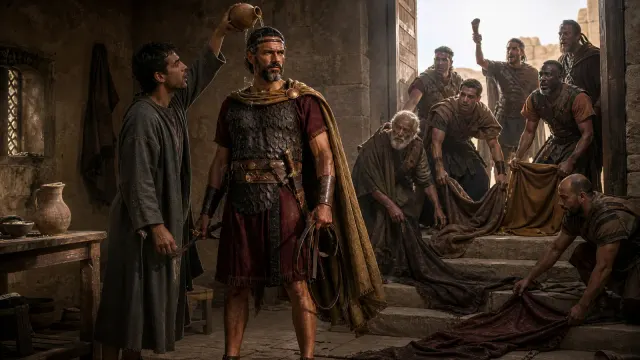
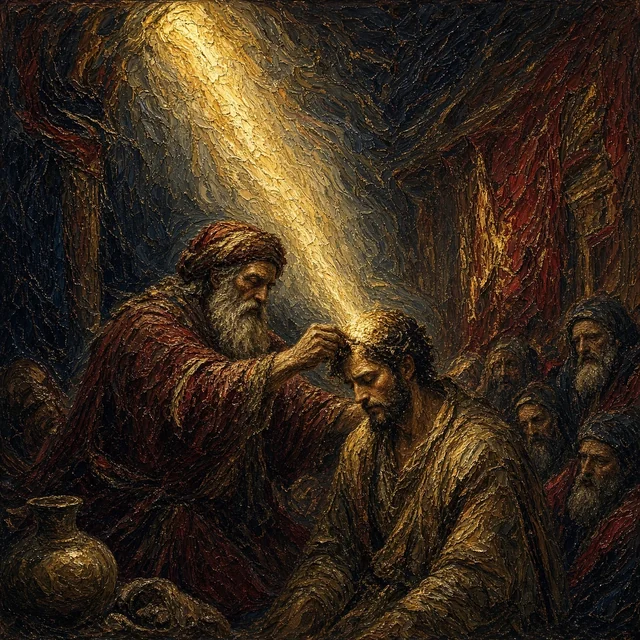
Jehu's kingship begins in a room small enough to keep the first act private. Elisha does not go himself but sends one of the prophetic company with oil, precise instructions, and an order to flee as soon as the message is delivered. That speed matters. The anointing cannot be turned into a conference or a negotiation with the messenger. The announcement names Jehu king over "the people of the LORD" and then gives his rise a purpose larger than ambition: the blood of the LORD's servants and prophets is to be answered in the house of Ahab, with Jezebel named directly. The comparisons with Jeroboam and Baasha place another apparently durable dynasty inside a familiar pattern of disappearance. Yet the young prophet's role remains sharply limited. He speaks, pours the oil, opens the door, and runs. By the time Jehu's fellow officers demand an explanation, the man who carried the word is gone. The claim remains in the room after its human bearer has made himself unavailable.
Deep dive
The messenger is instructed to separate Jehu from his fellow officers and take him into an inner room. The anointing begins privately, before any public acclaim. Its source is a prophetic commission, and the people over whom Jehu is appointed are called the LORD's people. The new title is therefore not merely an advancement offered by Jehu's military colleagues.
The young prophet's expanded announcement explains the target of the judgment. Jezebel's violence against the LORD's servants and prophets stands behind the destruction of Ahab's house. The comparison with Jeroboam's and Baasha's dynasties places this coming end within a repeated pattern already established in 1 Kings. A royal house that seemed permanent can disappear as completely as the families it replaced.
The instructions also have unusual speed built into them: deliver the word, open the door, flee. The messenger obeys. His disappearance prevents a leisurely negotiation over the meaning of the oil. When Jehu returns to the officers, the new claim is already upon him, but its bearer is no longer available for interrogation.
Words to trace: house, Ahab, Israel, LORD, anointed, blood
Verse-by-verse path
- 2 Kings 9:1
The “box of oil” is a pak, a small flask, the same word used when Samuel anointed Saul with “a vial of oil” (1 Samuel 10:1). Ramoth-gilead, where Ahab died, is now the front line against Hazael.
- 2 Kings 9:2
Jehu is usually called “son of Nimshi” (1 Kings 19:16), his grandfather’s name serving as the family name. This Jehoshaphat is his father, not the king of Judah. “His brethren” are his fellow officers.
- 2 Kings 9:3
Elijah had been told at Horeb to anoint Jehu (1 Kings 19:16). A generation later it is done by a young man sent by Elijah’s successor, with a flask, one sentence and an open door.
- 2 Kings 9:4
The Hebrew doubles the phrase awkwardly: “the young man, the young man the prophet”. Some read it as “the servant of the prophet”, Elisha’s own attendant sent on the errand.
- 2 Kings 9:5
The captains are sitting in council. Jehu’s question, “Unto which of all us?”, shows that none among them outranked the rest by title. The messenger uses the same address, “O captain”, both times, and waits to be asked.
- 2 Kings 9:6
Elisha’s instruction in verse 3 was one sentence. The oracle actually spoken runs to five verses, naming Ahab, Jezebel and the prophets’ blood. Jehu is anointed over “the people of the LORD”, a phrase that claims Israel for its God rather than for its king.
- 2 Kings 9:7
Jezebel had “cut off the prophets of the LORD” (1 Kings 18:4). “Ahab thy master” reminds Jehu that he served in Ahab’s own chariot corps, as verse 25 confirms.
- 2 Kings 9:8
The young prophet repeats Elijah’s sentence from Naboth’s vineyard almost word for word, a generation after it was spoken. “Perish” is the verb for being lost or destroyed utterly, and the promise is to leave no male of the house.
- 2 Kings 9:9
Baasha had been the destroyer of Jeroboam’s house before his own house was destroyed in turn. The pattern carries a warning for the destroyer too, and Hosea 1:4 later announces judgment on the house of Jehu for “the blood of Jezreel”.
- 2 Kings 9:10
“None to bury her” goes beyond Elijah’s words in 1 Kings 21:23, which spoke only of dogs. Then the young man does exactly the three things he was told: pour, speak, flee.
2 Kings 9:1-10
King James Version1And Elisha the prophet called one of the children of the prophets, and said unto him, Gird up thy loins, and take this box of oil in thine hand, and go to Ramoth-gilead:
2And when thou comest thither, look out there Jehu the son of Jehoshaphat the son of Nimshi, and go in, and make him arise up from among his brethren, and carry him to an inner chamber;
3Then take the box of oil, and pour it on his head, and say, Thus saith the LORD, I have anointed thee king over Israel. Then open the door, and flee, and tarry not.
4So the young man, even the young man the prophet, went to Ramoth-gilead.
5And when he came, behold, the captains of the host were sitting; and he said, I have an errand to thee, O captain. And Jehu said, Unto which of all us? And he said, To thee, O captain.
6And he arose, and went into the house; and he poured the oil on his head, and said unto him, Thus saith the LORD God of Israel, I have anointed thee king over the people of the LORD, even over Israel.
7And thou shalt smite the house of Ahab thy master, that I may avenge the blood of my servants the prophets, and the blood of all the servants of the LORD, at the hand of Jezebel.
8For the whole house of Ahab shall perish: and I will cut off from Ahab him that pisseth against the wall, and him that is shut up and left in Israel:
9And I will make the house of Ahab like the house of Jeroboam the son of Nebat, and like the house of Baasha the son of Ahijah:
10And the dogs shall eat Jezebel in the portion of Jezreel, and there shall be none to bury her. And he opened the door, and fled.
2 Kings 9:11-16
The Officers Dismiss the Messenger and Embrace His Message
The officers call the visitor a "mad fellow," but contempt for the messenger lasts only until they hear the message. Then garments come off shoulders, a makeshift platform appears on the stairs, trumpets sound, and "Jehu is king" replaces mockery almost instantly. The reversal is one of the chapter's sharpest human moments. They do not need to respect the young prophet socially in order to act on what he said. The Book of 2 Kings also names Jehu's action for what it is politically: a conspiracy against Joram. The prophetic commission does not make the mechanics of a coup disappear. Joram is away from Ramothgilead recovering from wounds, the officers are together with Jehu, and the opportunity is obvious. Jehu immediately controls information, forbidding anyone from slipping out to warn Jezreel. Then he rides there himself. The private room has become a military movement, and the same secrecy that protected the anointing now protects the revolt long enough for Jehu to reach the wounded king before news does.
Deep dive
The officers' language changes faster than their opinion of the messenger. They dismiss him as a "mad fellow," insist on hearing what he said, and then spread their garments beneath the man he has anointed. Whatever contempt they express for the visitor, his message receives prompt practical acceptance. The improvised use of garments and the trumpet turn the private anointing into public recognition.
The Book of 2 Kings immediately calls what follows a conspiracy against Joram. That description is not erased by the prophetic commission. The account holds the announced judgment and the human mechanics of a coup within the same sequence. Joram has left the military position at Ramothgilead because of his wounds, while Jehu has the assembled officers around him.
Jehu's first concern is information control: no one is to leave and warn Jezreel. He then goes there himself. The scene moves from a room that had to be entered privately to a city that must not be notified prematurely. The revolt depends on speed and surprise even though the judgment it carries has a much longer history.
Words to trace: king, Jehu, Joram, Jezreel, Hazael, Israel
Verse-by-verse path
- 2 Kings 9:11
“Mad fellow” is meshugga, a contemptuous word for prophets also found in Jeremiah 29:26 and Hosea 9:7. Jehu’s reply, “ye know the man, and his communication”, dismisses it all as the babble they would expect, testing whether they will let it drop.
- 2 Kings 9:12
“It is false” is one Hebrew word, sheqer, a lie: they will not accept the dodge. Jehu then repeats only the core sentence of the oracle, the one about kingship, and not the bloodshed.
- 2 Kings 9:13
Spreading their cloaks on the bare steps makes an improvised throne, and trumpets were blown at royal proclamations, as when Solomon was anointed (1 Kings 1:39). The whole acclamation takes place on a staircase within minutes.
- 2 Kings 9:14
“Conspired” is qashar, the verb used of Baasha’s coup against Nadab (1 Kings 15:27) and Zimri’s against Elah (16:9). The parenthesis explains that Joram had been holding Ramoth-gilead against Hazael, which is why the army was there.
- 2 Kings 9:15
The parenthesis repeats 8:29 so the reader knows where Joram is. “If it be your minds” is literally “if it is your will”. Sealing the town keeps the news from reaching Jezreel before Jehu does.
- 2 Kings 9:16
Ramoth-gilead to Jezreel is about seventy kilometres, down to the Jordan, across it and up the Jezreel valley. Ahaziah’s presence is a reminder from 8:29 that turns into a death sentence.
2 Kings 9:11-16
King James Version11Then Jehu came forth to the servants of his lord: and one said unto him, Is all well? wherefore came this mad fellow to thee? And he said unto them, Ye know the man, and his communication.
12And they said, It is false; tell us now. And he said, Thus and thus spake he to me, saying, Thus saith the LORD, I have anointed thee king over Israel.
13Then they hasted, and took every man his garment, and put it under him on the top of the stairs, and blew with trumpets, saying, Jehu is king.
14So Jehu the son of Jehoshaphat the son of Nimshi conspired against Joram. (Now Joram had kept Ramoth-gilead, he and all Israel, because of Hazael king of Syria.
15But king Joram was returned to be healed in Jezreel of the wounds which the Syrians had given him, when he fought with Hazael king of Syria.) And Jehu said, If it be your minds, then let none go forth nor escape out of the city to go to tell it in Jezreel.
16So Jehu rode in a chariot, and went to Jezreel; for Joram lay there. And Ahaziah king of Judah was come down to see Joram.
2 Kings 9:17-26
The Field Remembers Naboth
Jezreel's watchman recognizes Jehu before the king understands what his arrival means. The identifying detail is his driving, so distinctive that a man on a tower can name him at a distance. Joram sends one horseman and then another to ask, "Is it peace?" Neither returns. Each is absorbed into Jehu's company while the watchman reports the growing evidence from above. When Joram and Ahaziah finally ride out themselves, the meeting occurs in Naboth's field. That location refuses to let the confrontation be only about today's coup. Jehu rejects the language of peace, Joram cries treachery, and an arrow kills him. Then Jehu speaks to Bidkar about the older word concerning Naboth's blood and orders the body thrown into that very ground. The field once taken for royal convenience becomes the place where Ahab's heir is discarded. The Book of 2 Kings lets the participants supply their own accusations, but the geographical memory supplies something harder to evade: the land itself connects the present death with an earlier royal crime.

Deep dive
The watchman can identify Jehu by the way he drives before Joram understands why he is coming. It is a memorable touch: a man's approach has become recognizable at a distance. Meanwhile, both horsemen sent to inquire about peace are absorbed into his following. The king receives observations, but not the answers he expects. His command system is dissolving in front of the watchtower.
Joram finally goes out with Ahaziah, and the meeting takes place in Naboth's portion. The location turns a royal confrontation into a reckoning with an earlier act of dispossession. Jehu's refusal of peace explicitly names Jezebel's practices, while Joram names Jehu's action treachery. The opposing descriptions belong to the participants. The Book of 2 Kings then anchors the death in the remembered divine word rather than in either man's slogan alone.
Jehu tells Bidkar that both of them had heard the announcement concerning Naboth and his sons. The mention of the sons adds a detail not developed in 1 Kings 21. Joram's body is cast into the very ground linked to that bloodshed. Land taken for royal advantage has become the location where the royal household loses its heir.
Words to trace: Jehu, peace, Joram, king, LORD, Ahaziah
Verse-by-verse path
- 2 Kings 9:17
“A company” translates shiph’ah, a mass or throng: at first the watchman sees only a body of men and dust. Joram’s question, “Is it peace?”, is the chapter’s word, shalom, and it will be asked five times.
- 2 Kings 9:18
“What hast thou to do with peace?” turns Joram’s greeting into a question about sides. “Turn thee behind me” means fall in at the rear of my company, and the rider does.
- 2 Kings 9:19
The second horseman asks the same question in the same words and receives the same answer. The repetition is the point: Joram is losing men one at a time without knowing why.
- 2 Kings 9:20
“Furiously” is beshigga’on, in madness, from the same root as the “mad fellow” of verse 11. The officers called the prophet mad; the watchman now calls Jehu’s driving mad.
- 2 Kings 9:21
“Make ready” is literally “bind”, harness the horses. Instead of shutting the gate, two kings drive out of a walled city to meet a force they cannot identify, and they meet it on the ground Ahab took.
- 2 Kings 9:22
“Whoredoms” is the prophets’ word for idolatry, unfaithfulness to the LORD pictured as adultery, and “witchcrafts” names sorcery. The charges are religious. Jehu answers the question of peace by naming the king’s mother.
- 2 Kings 9:23
“Turned his hands” means turned the reins, wheeling the chariot. “Treachery” is mirmah, deceit, the word Isaac used when Jacob stole the blessing (Genesis 27:35).
- 2 Kings 9:24
“With his full strength” is literally “filled his hand with the bow”. The arrow strikes between the shoulders of a man in flight. His father Ahab died from an arrow shot “at a venture”; the son is killed by an aimed one.
- 2 Kings 9:25
Bidkar is a shalish, a senior chariot officer. Jehu recalls that the two of them rode behind Ahab on the day Elijah met him in Naboth’s vineyard, so the book gives an eyewitness to 1 Kings 21. “Burden” is massa, a heavy oracle laid on someone.
- 2 Kings 9:26
Jehu quotes the oracle in a form 1 Kings 21 does not record: “yesterday”, which dates the word to the day after the killing, and “this plat”, a single plot of ground. He remembers wording that the earlier chapter left out.
2 Kings 9:17-26
King James Version17And there stood a watchman on the tower in Jezreel, and he spied the company of Jehu as he came, and said, I see a company. And Joram said, Take an horseman, and send to meet them, and let him say, Is it peace?
18So there went one on horseback to meet him, and said, Thus saith the king, Is it peace? And Jehu said, What hast thou to do with peace? turn thee behind me. And the watchman told, saying, The messenger came to them, but he cometh not again.
19Then he sent out a second on horseback, which came to them, and said, Thus saith the king, Is it peace? And Jehu answered, What hast thou to do with peace? turn thee behind me.
20And the watchman told, saying, He came even unto them, and cometh not again: and the driving is like the driving of Jehu the son of Nimshi; for he driveth furiously.
21And Joram said, Make ready. And his chariot was made ready. And Joram king of Israel and Ahaziah king of Judah went out, each in his chariot, and they went out against Jehu, and met him in the portion of Naboth the Jezreelite.
22And it came to pass, when Joram saw Jehu, that he said, Is it peace, Jehu? And he answered, What peace, so long as the whoredoms of thy mother Jezebel and her witchcrafts are so many?
23And Joram turned his hands, and fled, and said to Ahaziah, There is treachery, O Ahaziah.
24And Jehu drew a bow with his full strength, and smote Jehoram between his arms, and the arrow went out at his heart, and he sunk down in his chariot.
25Then said Jehu to Bidkar his captain, Take up, and cast him in the portion of the field of Naboth the Jezreelite: for remember how that, when I and thou rode together after Ahab his father, the LORD laid this burden upon him;
26Surely I have seen yesterday the blood of Naboth, and the blood of his sons, saith the LORD; and I will requite thee in this plat, saith the LORD. Now therefore take and cast him into the plat of ground, according to the word of the LORD.
2 Kings 9:27-29
Judah's King Falls in Israel's Upheaval
Ahaziah's death shows how thoroughly Judah's alliance with Ahab's house has carried the southern kingdom into a northern reckoning. He is not an accidental tourist at Jezreel. Chapter 8 has already explained the family connection, the shared campaign, and the visit to wounded Joram. When Joram falls, Ahaziah flees, but Jehu orders him struck as well. The passage records pursuit, wounding, escape toward Megiddo, and death without adding a last speech that might tidy the moment. His servants then carry him back to Jerusalem for burial with his fathers. That burial marks a difference from Joram, whose body has been thrown into Naboth's field. Two kings die in one upheaval, but The Book of 2 Kings does not collapse Israel and Judah into a single monarchy. Their royal identities remain distinct even in shared disaster. The closing year notice may require careful chronological comparison with neighboring synchronisms, yet the main line is clear enough: Judah has lost its king, and Athaliah is about to answer that loss with violence of her own.
Deep dive
Ahaziah is not merely standing near an unrelated northern crisis. The preceding chapter has emphasized his connection to Ahab's house, and his presence at Jezreel results from that relationship. Jehu orders him struck as he flees. The Book of 2 Kings records the pursuit, wound, flight to Megiddo, and death without giving him a final speech.
His burial differs from Joram's. Servants take his body back to Jerusalem for burial with his fathers, while Joram has been thrown into Naboth's field. The distinction preserves the separate identities of the kingdoms even as the same revolt reaches both. The closing accession synchronism is one of several tightly packed notices in these chapters whose relation to neighboring year numbers is not fully explained in the text. The central sequence is nevertheless clear: Judah loses a king, and his mother Athaliah will respond to that death in chapter 11.
Words to trace: Ahaziah, chariot, fled, Judah, Ahab, began
Verse-by-verse path
- 2 Kings 9:27
The “garden house” may be Beth-haggan, often identified with En-gannim near modern Jenin, south of Jezreel. Megiddo lies northwest. Second Chronicles 22:9 gives a different account, with Ahaziah hiding in Samaria before he is found and brought to Jehu.
- 2 Kings 9:28
Chronicles says he was buried because he was the grandson of Jehoshaphat, “who sought the LORD with all his heart” (2 Chronicles 22:9). His servants take the body home by chariot, and Jehu does not stop them.
- 2 Kings 9:29
The accession note sits out of place, after his death, as if the book closes the record of his reign as it ends. Second Chronicles 21:17 calls the same king Jehoahaz, the two parts of his name reversed.
2 Kings 9:27-29
King James Version27But when Ahaziah the king of Judah saw this, he fled by the way of the garden house. And Jehu followed after him, and said, Smite him also in the chariot. And they did so at the going up to Gur, which is by Ibleam. And he fled to Megiddo, and died there.
28And his servants carried him in a chariot to Jerusalem, and buried him in his sepulchre with his fathers in the city of David.
29And in the eleventh year of Joram the son of Ahab began Ahaziah to reign over Judah.
2 Kings 9:30-37
Jezebel Names Zimri; Jehu Recalls Elijah
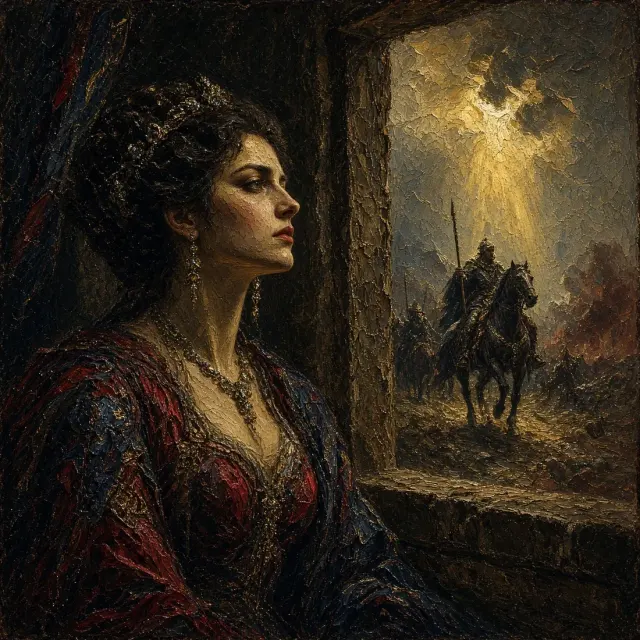
Jezebel does not greet Jehu as a frightened woman begging for mercy. She arranges her appearance, looks from the window, and calls him by the memory of Zimri, the master-killer whose reign lasted only seven days. Her question, "Had Zimri peace?", is an accusation sharpened by royal record. The Book of 2 Kings gives no warrant for turning the cosmetics into a seduction scene when her actual words are political contempt. Jehu answers not by debating her but by looking past her for allies inside the palace. Two or three eunuchs appear. With that glance, Jezebel's household support evaporates. They throw her down, and the account describes the death without softening it. Jehu later eats, drinks, and only afterward orders burial because she is a king's daughter. Even that limited royal dignity cannot be carried out. The remains are too fragmentary, and Jehu recalls Elijah's word concerning dogs in Jezreel. Jezebel's final loss is not only power and life but the recognizable grave that royal status ordinarily expects.
Deep dive
Jezebel prepares her appearance and looks from the window. The text does not call this an attempt at seduction, and her actual words are an accusation. By invoking Zimri, the killer of his master whose reign lasted only seven days in 1 Kings 16:15–20, she frames Jehu as another doomed usurper. She answers a military arrival with a pointed precedent from Israel's own royal history.
Jehu's reply is addressed above her to whoever will support him. Two or three eunuchs appear, and the palace's internal allegiance changes in a few lines. The men near Jezebel, rather than an assault on her chamber by Jehu's troops, bring her down. The account describes the killing starkly and then moves to Jehu eating and drinking. The juxtaposition gives no room for a sentimental account of his conduct.
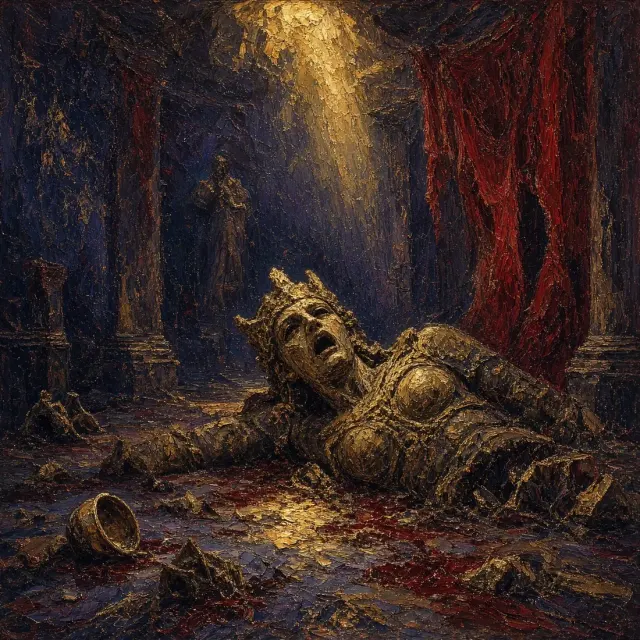
His later instruction to bury her recognizes that she is a king's daughter. That royal status cannot secure the burial he orders: too little remains. Jehu identifies the result with Elijah's word. The final loss is therefore not only life and power but the recognizable body around which a royal memorial might be formed. The passage's own connection is prophetic fulfillment, not an invented account of Jezebel's final emotions.
Words to trace: Jezebel, face, Jezreel, bury, Jehu, looked
Verse-by-verse path
- 2 Kings 9:30
“Painted her face” is literally “put her eyes in antimony”, the dark kohl that outlined the eyes (Jeremiah 4:30). “Tired her head” means dressed her hair. A woman at a window is a favourite motif on Phoenician ivories, some found at Samaria itself.
- 2 Kings 9:31
Zimri killed King Elah and reigned seven days before Omri besieged him and he burned the palace over himself (1 Kings 16:9–18). Omri was Jezebel’s father-in-law, so the regicide she names was put down by the founder of her own dynasty.
- 2 Kings 9:32
“Who is on my side? who?” echoes Moses at the golden calf, “Who is on the LORD’s side?” (Exodus 32:26), after which the Levites came forward with swords. The eunuchs are palace attendants who choose in a moment which master to serve.
- 2 Kings 9:33
“Throw her down” is literally “let her drop”. “Trode her under foot” means the horses and chariot went over her; it is the verb used of the crowd trampling the officer at the gate in 7:17.
- 2 Kings 9:34
Jezebel was the daughter of Ethbaal, king of the Sidonians (1 Kings 16:31), so burial is owed to her rank if not to her person. Jehu calls her “this cursed woman” in the same breath as he grants it.
- 2 Kings 9:35
What remained were the parts with least flesh: the skull, the feet and the palms of the hands. The detail is set down without comment.
- 2 Kings 9:36
Jehu quotes Elijah, but his quotation blends Elijah’s sentence in 1 Kings 21:23 with the young prophet’s words in verse 10. He attributes the whole to “his servant Elijah the Tishbite”.
- 2 Kings 9:37
Unburied corpses “as dung upon the face of the field” is an image Jeremiah will use (Jeremiah 8:2; 9:22). Her name may echo a Phoenician cry to Baal, “Where is the prince?”; now no grave will let anyone say, “This is Jezebel.”
2 Kings 9:30-37
King James Version30And when Jehu was come to Jezreel, Jezebel heard of it; and she painted her face, and tired her head, and looked out at a window.
31And as Jehu entered in at the gate, she said, Had Zimri peace, who slew his master?
32And he lifted up his face to the window, and said, Who is on my side? who? And there looked out to him two or three eunuchs.
33And he said, Throw her down. So they threw her down: and some of her blood was sprinkled on the wall, and on the horses: and he trode her under foot.
34And when he was come in, he did eat and drink, and said, Go, see now this cursed woman, and bury her: for she is a king’s daughter.
35And they went to bury her: but they found no more of her than the skull, and the feet, and the palms of her hands.
36Wherefore they came again, and told him. And he said, This is the word of the LORD, which he spake by his servant Elijah the Tishbite, saying, In the portion of Jezreel shall dogs eat the flesh of Jezebel:
37And the carcase of Jezebel shall be as dung upon the face of the field in the portion of Jezreel; so that they shall not say, This is Jezebel.
Questions to keep in mind while reading
- Track who acts, who speaks, who is affected, and what changes.
- Notice repeated promises, failures, rescues, and consequences.
- Do not assume the account approves every action that is reported.
Text first
Where readers differ
The chapter summary begins with what the passage says and how its parts fit together. It does not assume one denomination has already settled every question. Where a conclusion depends on a tradition, literary theory, or historical reconstruction, that dependence is named openly.
The KJV text is presented first. Interpretive conclusions are labeled, and differences are introduced only when they help a reader understand why serious communities do not always reach the same answer.
Comparative interpretive notes for this chapter are in preparation. Until reviewed notes are ready, this page separates the KJV text from summary and application without claiming that serious readers agree on every question.
Questions beneath the surface
- What account of God, human freedom, responsibility, and the good life emerges from 2 Kings 9?
- Which tension does the chapter refuse to resolve quickly?
- What changes when the chapter is read as part of the whole canon rather than as an isolated moral lesson?
- Where might a sincere reader confuse a familiar tradition with something the text states directly?
Questions for serious personal contemplation
These open-ended questions make room for tension, honest response, prayer, and conclusions that remain accountable to the chapter.
Observe without rushing
What part of 2 Kings 9 makes you stop, feel unsettled, or feel surprised, and why?
Which detail in the passage would be easiest to overlook? How does that detail change your understanding?
Where do you see tension between what happens and this focus: 2 Kings 9 develops its own movement around Jehu, king, Joram, LORD, Jezreel?
What important question does the passage leave open instead of resolving quickly?
Examine your inner life honestly
Which person, response, fear, or desire in the passage feels most like your own life right now?
What assumption about God, other people, or yourself does this text challenge?
Which part would you rather soften, avoid, or explain away too quickly? What might that reaction reveal?
If this Scripture could ask you one direct question, what do you think it would ask?
Respond with wisdom and courage
What do you need to remember, confess, grieve, thank God for, or trust after reading this passage?
How might another faithful person read this situation differently without ignoring the text?
What obedient response would be costly, uncomfortable, or slow, yet still faithful to Scripture?
What question will you carry into prayer this week, and which verses will you keep in front of you?
Music and video connected to the passage
Related media appears when its Scripture reference overlaps this study. Music and video can illuminate a theme while the biblical text remains the foundation.