The big picture
Jonathan breaks the military stalemate with one armourbearer and a conviction carefully phrased as possibility: the LORD can save by many or by few. His attack becomes the opening through which a much larger Philistine collapse occurs, and the Book of 1 Samuel credits the day's salvation to the LORD. Saul then creates a second crisis inside the victorious army by binding hungry soldiers under an oath not to eat until evening. Jonathan, who never heard the command, tastes honey and later becomes the target of his father's death sentence when divine inquiry falls silent. The people refuse that sentence and rescue the man who helped rescue them. The chapter closes by refusing a simple portrait of Saul. It records real victories, a functioning royal household, and effective military leadership alongside an oath that weakened his own army and nearly killed his son.
In this chapter
- Two Men Leave the Waiting Army 1 Samuel 14:1-7
Saul remains with roughly six hundred men, a priest, and the recognized apparatus of leadership, while Jonathan quietly leaves with one armourbearer.
- The Invitation That Becomes the Sign 1 Samuel 14:8-15
Jonathan sets a test with two genuinely different outcomes.
- The Army Discovers That the Battle Has Started 1 Samuel 14:16-23
Saul's watchmen first notice not Jonathan but a Philistine multitude melting away.
- Honey in the Wood, Hunger in the Ranks 1 Samuel 14:24-35
Saul's oath makes hunger part of the army's burden: no one may eat until evening and until he is avenged on his enemies.
- The People Refuse the King's Sentence 1 Samuel 14:36-46
When Saul proposes a night pursuit, the priest interrupts with the sensible question of divine counsel.
- Real Victories, an Unfinished Reign 1 Samuel 14:47-52
The closing survey widens the lens so that one disastrous oath does not swallow Saul's whole reign.

Scripture beside the summary
1 Samuel · King James Version · 521 Samuel 14:1-7
Two Men Leave the Waiting Army
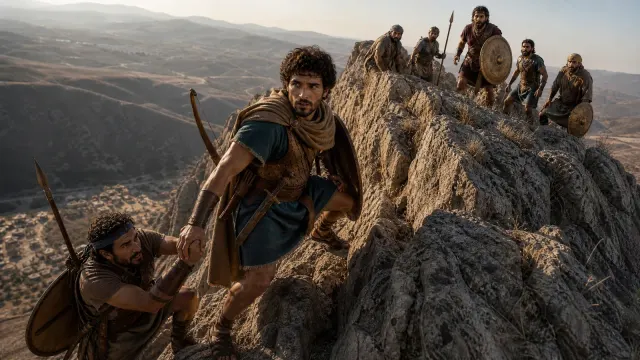
Saul remains with roughly six hundred men, a priest, and the recognized apparatus of leadership, while Jonathan quietly leaves with one armourbearer. The Book of 1 Samuel does not present Jonathan as a man who has received a secret guarantee of success. His own words are more restrained and more daring at once: “it may be that the LORD will work for us,” because the LORD is not limited by numbers. Divine ability is certain; the outcome of this particular move is not claimed in advance. The terrain makes the decision concrete. Two sharp rocks narrow the passage, and the route toward the garrison is physically difficult. Meanwhile the priest beside Saul belongs to Eli's family, carrying that complicated priestly history into the royal camp. The main army, royal authority, priestly equipment, and numerical strength all remain together. Initiative begins elsewhere, with two men, a steep approach, and an armourbearer who answers Jonathan's proposal with wholehearted loyalty: “I am with thee according to thy heart.”
Deep dive
Saul remains with six hundred men while Jonathan moves with one armourbearer. The difference is not merely between a large force and a small one. Jonathan states a reason why numbers cannot settle the outcome: the LORD is not restrained by them. Yet his words begin with "it may be". Confidence in divine ability is joined to uncertainty about the particular undertaking. He does not announce a revelation that the Book of 1 Samuel has never reported.
The account carefully locates the passes and names the two rocks before the climb. Terrain will make this a physically difficult approach, not a victory achieved by overlooking military realities. Meanwhile, the priest with Saul belongs to Eli's family, whose history is compressed into the genealogy in verse 3. Royal authority, priestly equipment, and the main body of troops remain together. The initiative begins elsewhere, with a proposal and the armourbearer's willing reply.
Words to trace: Jonathan, garrison, side, armour, bare, Gibeah
Verse-by-verse path
- 1 Samuel 14:1
“The young man that bare his armour” was the prince’s squire, carrying shield and spare weapons and finishing off the fallen. “He told not his father” is set down plainly, and it sounds different after 20:2, where Jonathan insists that his father tells him everything.
- 1 Samuel 14:2
Saul sits under a pomegranate tree, in Hebrew a rimmon, with six hundred men. The last six hundred Benjaminites to survive a disaster held out at the rock Rimmon (Judges 20:47). Migron lies on the same invasion road Isaiah traces past Michmash (Isaiah 10:28).
- 1 Samuel 14:3
The priest’s pedigree reaches back through Ichabod, the child named “no glory” on the day the ark was lost (4:21), to Eli himself, whose house was placed under sentence in 2:31–33. The royal camp carries a condemned priesthood with it. Ahiah is probably the Ahimelech of 22:9, also a son of Ahitub.
- 1 Samuel 14:4
“Sharp rock” is literally “a tooth of the crag”, a jagged spur on each side of the pass. Seneh means “thorny”, the word for the burning bush (Exodus 3:2). Bozez is less certain, perhaps “shining” or “slippery”. The two crags are named like landmarks a soldier would remember.
- 1 Samuel 14:5
“Forefront” renders a word meaning a column or pillar of rock. One crag faced north toward Michmash and the other south; the standard Hebrew text reads Geba again, as in 13:16. The gorge between them is still traced today in the Wadi es-Suweinit.
- 1 Samuel 14:6
“Uncircumcised” is soldiers’ contempt, and David will reach for the same word about Goliath (17:26, 36). “No restraint to the LORD” means nothing holds him back, with the word used of a womb being shut or rain being held. Many or few is Gideon’s lesson (Judges 7:2), put in a sentence.
- 1 Samuel 14:7
“According to thy heart” uses the same Hebrew construction as the “man after his own heart” of 13:14, one verse after Saul was told he had lost the kingdom. The armourbearer says “heart” twice in a short reply. The Greek renders it “as your heart is, so is my heart”.
1 Samuel 14:1-7
King James Version1Now it came to pass upon a day, that Jonathan the son of Saul said unto the young man that bare his armour, Come, and let us go over to the Philistines’ garrison, that is on the other side. But he told not his father.
2And Saul tarried in the uttermost part of Gibeah under a pomegranate tree which is in Migron: and the people that were with him were about six hundred men;
3And Ahiah, the son of Ahitub, I-chabod’s brother, the son of Phinehas, the son of Eli, the LORD’s priest in Shiloh, wearing an ephod. And the people knew not that Jonathan was gone.
4And between the passages, by which Jonathan sought to go over unto the Philistines’ garrison, there was a sharp rock on the one side, and a sharp rock on the other side: and the name of the one was Bozez, and the name of the other Seneh.
5The forefront of the one was situate northward over against Michmash, and the other southward over against Gibeah.
6And Jonathan said to the young man that bare his armour, Come, and let us go over unto the garrison of these uncircumcised: it may be that the LORD will work for us: for there is no restraint to the LORD to save by many or by few.
7And his armourbearer said unto him, Do all that is in thine heart: turn thee; behold, I am with thee according to thy heart.
1 Samuel 14:8-15
The Invitation That Becomes the Sign
Jonathan sets a test with two genuinely different outcomes. If the Philistines tell them to wait, they will stay put. If the Philistines say, “Come up,” they will climb and take that invitation as the sign to advance. The Book of 1 Samuel does not let Jonathan baptize every possible response as approval for what he already wants to do. The Philistines see the two men, mock the Hebrews for crawling out of hiding, and call them upward. Their taunt becomes the agreed sign. Jonathan and his armourbearer then have to climb “upon his hands and upon his feet,” a detail that keeps faith from floating above terrain and muscle. They strike about twenty men in a small area, but the scale suddenly outruns the size of their assault. Terror reaches the host, the field, the garrison, and the spoilers, and the earth itself trembles. A physically tiny attack becomes the opening of a disturbance no pair of fighters could manufacture merely through numbers.
Deep dive
Jonathan does not interpret every possible response as permission to advance. He has specified one response that will mean waiting and another that will mean climbing. The Philistines supply the second while mocking Israelites who have hidden themselves. Their taunt leaves Jonathan and his armourbearer to make the difficult climb. Within Jonathan's declared test, those same words mean that the LORD has delivered the position into Israel's hand. One sentence carries opposite meanings on opposite sides of the rocks.
The climb still requires hands and feet. The armourbearer follows and participates in the fighting; the description preserves the effort and partnership rather than letting confidence replace action. About twenty men fall in the first small area of combat. Then the scale changes: terror reaches the garrison, raiding parties, and surrounding force, while the earth trembles. The account moves from a tightly measured patch of ground to a disturbance that Jonathan could not have produced simply by the size of his assault.
Words to trace: Jonathan, armourbearer, garrison, delivered, hand, LORD
Verse-by-verse path
- 1 Samuel 14:8
“Discover ourselves” is the 1611 sense of uncover, to show ourselves in the open. Jonathan deliberately gives up surprise, the one advantage two men might have had against a garrison, and makes being seen part of the plan.
- 1 Samuel 14:9
“Tarry” is dommu, “be still”, the verb Joshua used when he told the sun to stand still over Gibeon (Joshua 10:12). If the enemy says it, Jonathan will obey an order from the Philistines, which is part of what makes the test honest.
- 1 Samuel 14:10
Asking for a sign has precedent: Abraham’s servant at the well (Genesis 24:14) and Gideon with the fleece (Judges 6:36–40). Saul himself received three signs at his anointing (10:7). Jonathan sets the terms so that the enemy’s own words decide, and speaks of the victory as already done.
- 1 Samuel 14:11
The first half of the plan is carried out in the very words of verse 8. The garrison sees two men, not an army, and takes them for stragglers crawling out of hiding. The taunt proves the Philistines expect no attack from below.
- 1 Samuel 14:12
“We will shew you a thing” is a soldier’s threat, roughly “we’ll teach you a lesson”. Jonathan subtly enlarges his claim: in verse 10 the LORD delivered them “into our hand”, and now “into the hand of Israel”. Two men climb on behalf of a nation that does not know they have gone.
- 1 Samuel 14:13
The division of labour is exact. Jonathan knocks men down, and the armourbearer, following behind, kills them, the squire’s grim task of finishing the fallen, as Abimelech’s armourbearer was asked to do (Judges 9:54). Climbing on hands and feet means neither could hold a shield while doing it.
- 1 Samuel 14:14
The Hebrew is compressed, roughly “half a furrow of a yoke of field”. The King James “acre” fits well, since the English acre began as the land one yoke of oxen could plough in a day. Twenty men fall in a space a farmer could cover before lunch.
- 1 Samuel 14:15
The Hebrew says the trembling was “a trembling of God”, which can mean an extremely great panic or a terror sent by God, and the book leaves both open. The word “trembling” appears four times over. The earth quakes, as thunder had routed the Philistines at Mizpah (7:10).
1 Samuel 14:8-15
King James Version8Then said Jonathan, Behold, we will pass over unto these men, and we will discover ourselves unto them.
9If they say thus unto us, Tarry until we come to you; then we will stand still in our place, and will not go up unto them.
10But if they say thus, Come up unto us; then we will go up: for the LORD hath delivered them into our hand: and this shall be a sign unto us.
11And both of them discovered themselves unto the garrison of the Philistines: and the Philistines said, Behold, the Hebrews come forth out of the holes where they had hid themselves.
12And the men of the garrison answered Jonathan and his armourbearer, and said, Come up to us, and we will shew you a thing. And Jonathan said unto his armourbearer, Come up after me: for the LORD hath delivered them into the hand of Israel.
13And Jonathan climbed up upon his hands and upon his feet, and his armourbearer after him: and they fell before Jonathan; and his armourbearer slew after him.
14And that first slaughter, which Jonathan and his armourbearer made, was about twenty men, within as it were an half acre of land, which a yoke of oxen might plow.
15And there was trembling in the host, in the field, and among all the people: the garrison, and the spoilers, they also trembled, and the earth quaked: so it was a very great trembling.
1 Samuel 14:16-23
The Army Discovers That the Battle Has Started
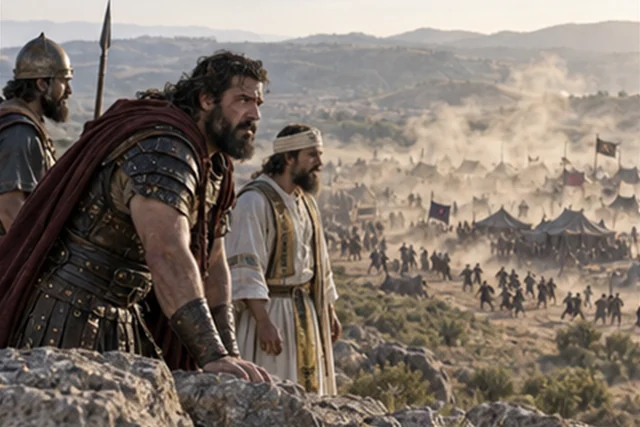
Saul's watchmen first notice not Jonathan but a Philistine multitude melting away. A count of Saul's own force then reveals who is missing. The Book of 1 Samuel lets Jonathan's initiative become known by absence before anyone in the camp understands what he has done. Saul begins a religious consultation, but the rising noise from the enemy host interrupts it, and he tells the priest to withdraw his hand. The KJV refers here to the ark, while other textual witnesses preserve “ephod,” a real textual difference rather than two interchangeable names. On the battlefield, the scattered pieces of Israel begin coming back together. Hebrews who had been with the Philistines turn to the Israelite side, and men hiding in the hills join the pursuit. Philistine swords are already turned against fellow Philistines. Saul and his army genuinely enter the fight, but they enter a deliverance already in motion. The chapter sums up the day with one sentence that keeps every human achievement in scale: “So the LORD saved Israel that day.”
Deep dive
Saul first identifies the missing men by taking a count. Jonathan's initiative becomes known through absence before its effects can be fully understood. Saul then begins a religious consultation, but the increasing noise leads him to interrupt it. The KJV reads "the ark of God" in verse 18. The NET translators' textual note identifies a Greek reading, "ephod", which fits the priestly equipment mentioned in verse 3. These are different textual readings, not two names for the same object; the KJV's wording remains the basis here.
The battlefield gathers people whom the previous crisis had separated. Hebrews formerly with the Philistines turn against them, while Israelites hiding in the hills join the pursuit. The Philistines' swords are already striking their own companions. Saul and his force genuinely enter the battle, but they enter a deliverance already unfolding. Verse 23 assigns the decisive agency to the LORD, preventing either Jonathan's daring or Saul's command from becoming the whole explanation.
Words to trace: Saul, battle, Israel, Philistines, Jonathan, people
Verse-by-verse path
- 1 Samuel 14:16
“Melted away” is the verb Rahab used of Canaan’s nerve before Israel (Joshua 2:9). The watchmen at Gibeah are looking across the gorge and see the enemy camp dissolving before anyone in Israel’s camp knows why.
- 1 Samuel 14:17
Saul numbers his men again, the verb of Bezek (11:8) and of Gilgal (13:15). Each count in these chapters is smaller than the last: three hundred and thirty thousand, then six hundred, and now the discovery that two are gone and they are the two who matter.
- 1 Samuel 14:18
Saul’s order “bring hither” is the same command David will give Abiathar when he wants the ephod (23:9; 30:7). The ark had been lodged at Kiriath-jearim since 7:1–2, which is one reason many readers find the Greek “ephod” easier to picture in a battle camp.
- 1 Samuel 14:19
“Withdraw thine hand” suggests the priest’s hand was already reaching into the ephod’s pouch for the lots, though that is an inference. Saul cuts off the inquiry because the noise is growing. Before the night is out, God will not answer him when he asks (verse 37).
- 1 Samuel 14:20
“Every man’s sword was against his fellow” is Gideon’s victory repeated almost word for word (Judges 7:22). “Discomfiture” translates mehumah, a panicked confusion, the word used for the deadly panic that swept the Philistine cities when the ark came among them (5:9, 11).
- 1 Samuel 14:21
Some Hebrews had been serving in the Philistine camp, conscripts or mercenaries, and they change sides mid-battle. The Philistine lords remember this kind of thing in 29:4 when they refuse to let David march with them: “lest in the battle he be an adversary to us.”
- 1 Samuel 14:22
The men who had hidden in caves and pits in 13:6 come out of the hill country of Ephraim once the enemy is running. “Followed hard” is the verb for clinging close, the verb of Ruth cleaving to Naomi (Ruth 1:14), here used of a pursuit.
- 1 Samuel 14:23
“So the LORD saved Israel that day” repeats almost exactly the line after the Red Sea: “Thus the LORD saved Israel that day” (Exodus 14:30). Beth-aven lies west of Michmash; the fight has moved off the ridge and is rolling downhill.
1 Samuel 14:16-23
King James Version16And the watchmen of Saul in Gibeah of Benjamin looked; and, behold, the multitude melted away, and they went on beating down one another.
17Then said Saul unto the people that were with him, Number now, and see who is gone from us. And when they had numbered, behold, Jonathan and his armourbearer were not there.
18And Saul said unto Ahiah, Bring hither the ark of God. For the ark of God was at that time with the children of Israel.
19And it came to pass, while Saul talked unto the priest, that the noise that was in the host of the Philistines went on and increased: and Saul said unto the priest, Withdraw thine hand.
20And Saul and all the people that were with him assembled themselves, and they came to the battle: and, behold, every man’s sword was against his fellow, and there was a very great discomfiture.
21Moreover the Hebrews that were with the Philistines before that time, which went up with them into the camp from the country round about, even they also turned to be with the Israelites that were with Saul and Jonathan.
22Likewise all the men of Israel which had hid themselves in mount Ephraim, when they heard that the Philistines fled, even they also followed hard after them in the battle.
23So the LORD saved Israel that day: and the battle passed over unto Beth-aven.
1 Samuel 14:24-35
Honey in the Wood, Hunger in the Ranks
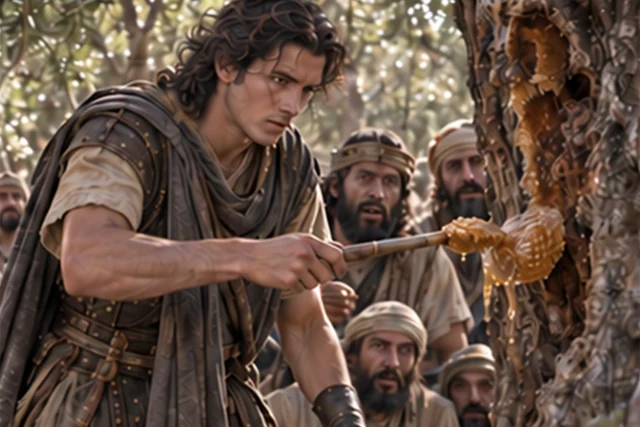
Saul's oath makes hunger part of the army's burden: no one may eat until evening and until he is avenged on his enemies. The language centers the king's vengeance, while the Book of 1 Samuel immediately leads the exhausted soldiers into a wood where honey is visibly available. Nobody eats because they fear the oath. Jonathan, who did not hear it, tastes a little with the end of his rod, and “his eyes were enlightened.” The effect is renewed strength, not moral collapse. Jonathan then names the practical damage his father has done by keeping food from men in pursuit. Later the army's hunger contributes to a frantic rush upon captured animals, and the people eat meat with the blood. Saul correctly identifies that act as sin and arranges an orderly slaughter on a great stone. The chapter therefore refuses to make every Saul decision wrong merely because one oath was damaging. He can impose a bad command and then respond properly to a different violation. His first recorded altar rises inside that complicated mixture.
Deep dive
The oath ties the army's hunger to Saul's personal vengeance: no food until evening and until he has been avenged on his enemies. Jonathan, absent when the command was imposed, eats the readily available honey. The immediate result is not corruption or military collapse but renewed strength, described through his enlightened eyes. His criticism names the practical cost of the king's restriction. The troops have food within reach, yet the command makes exhaustion part of their pursuit.
After the fighting, hunger contributes to a disorderly rush upon the spoil, and the people eat meat with the blood. Saul recognizes this as sin and arranges a controlled place for slaughter. The account therefore distinguishes his damaging oath from his proper intervention over the blood; it does not make every action of his uniformly wrong. His first recorded altar also appears here. Religious activity is abundant, but it has not prevented a royal command from weakening the very army it was meant to drive forward.
Words to trace: people, LORD, Saul, blood, father, food
Verse-by-verse path
- 1 Samuel 14:24
“Distressed” is the verb from which Exodus names the Egyptian taskmasters (Exodus 5:6); Saul’s oath makes him a driver of his own men. “Adjured” means put under a sworn curse. The oath ends in the first person: “that I may be avenged”, one verse after the LORD is said to have saved.
- 1 Samuel 14:25
The land of milk and honey becomes literal: wild honey lies on the forest floor, dripping from combs in trees or rocks. The Hebrew phrase “all they of the land” is awkward and may mean simply that the whole army entered the wood.
- 1 Samuel 14:26
“The honey dropped” is literally “a flow of honey”. The detail that no one put hand to mouth is the measure of how seriously the oath was held. Hungry men walked past food on the ground rather than risk the curse.
- 1 Samuel 14:27
Jonathan eats without breaking stride, dipping the tip of his staff and lifting it to his mouth. The Hebrew margin says his eyes “brightened”; the written consonants read “saw”. Either way, the verse repeats “put his hand to his mouth” from verse 26, so the one exception is exactly measured.
- 1 Samuel 14:28
The soldier quotes the oath but drops Saul’s words about his own vengeance and adds “this day”. “Straitly” means strictly. The last clause, “the people were faint”, reads like the account’s own aside, showing the cost before Jonathan names it.
- 1 Samuel 14:29
“Troubled” is achar, the verb in Joshua’s sentence on Achan: “Why hast thou troubled us?” (Joshua 7:25). Achan broke a ban and was found by lot; the lot is about to fall here too, but Jonathan uses the verb against his father, not himself. Elijah and Ahab trade the same word (1 Kings 18:17–18).
- 1 Samuel 14:30
“If haply” means “if only”. Jonathan argues entirely on military grounds, not piety: fed men pursue further. His question is left hanging, and verse 46 will answer it when the Philistines get away to their own place.
- 1 Samuel 14:31
From Michmash to Aijalon is some twenty miles west and downhill, through the Beth-horon descent to the valley where Joshua once asked the moon to stand still (Joshua 10:12). The day’s pursuit covers a great distance on empty stomachs, and the verse closes with the result: very faint.
- 1 Samuel 14:32
“Flew upon” is the verb for a bird of prey swooping, and Samuel will throw it at Saul himself in 15:19: “didst fly upon the spoil”. Slaughtering “on the ground” meant the animals lay flat and the blood could not drain away before the meat was cut.
- 1 Samuel 14:33
The law forbade eating flesh with its blood (Leviticus 19:26; Deuteronomy 12:23). “Ye have transgressed” is bagad, to deal faithlessly. The great stone gave a raised slaughtering place where the blood could run off, and the command makes the king the supervisor of a correct slaughter.
- 1 Samuel 14:34
The oath ran “until evening”, so by the time the herds are brought in “that night” eating has become lawful. Saul sends runners through the army, and every man leads his own ox to the stone. Disorder is turned into procedure in a single order.
- 1 Samuel 14:35
The Hebrew reads awkwardly: “with it he began to build an altar to the LORD”, which may mean this was his first altar or that he began one and did not finish it. It may be the great stone of verse 33 that becomes the altar, though that is an inference.
1 Samuel 14:24-35
King James Version24And the men of Israel were distressed that day: for Saul had adjured the people, saying, Cursed be the man that eateth any food until evening, that I may be avenged on mine enemies. So none of the people tasted any food.
25And all they of the land came to a wood; and there was honey upon the ground.
26And when the people were come into the wood, behold, the honey dropped; but no man put his hand to his mouth: for the people feared the oath.
27But Jonathan heard not when his father charged the people with the oath: wherefore he put forth the end of the rod that was in his hand, and dipped it in an honeycomb, and put his hand to his mouth; and his eyes were enlightened.
28Then answered one of the people, and said, Thy father straitly charged the people with an oath, saying, Cursed be the man that eateth any food this day. And the people were faint.
29Then said Jonathan, My father hath troubled the land: see, I pray you, how mine eyes have been enlightened, because I tasted a little of this honey.
30How much more, if haply the people had eaten freely to day of the spoil of their enemies which they found? for had there not been now a much greater slaughter among the Philistines?
31And they smote the Philistines that day from Michmash to Aijalon: and the people were very faint.
32And the people flew upon the spoil, and took sheep, and oxen, and calves, and slew them on the ground: and the people did eat them with the blood.
33Then they told Saul, saying, Behold, the people sin against the LORD, in that they eat with the blood. And he said, Ye have transgressed: roll a great stone unto me this day.
34And Saul said, Disperse yourselves among the people, and say unto them, Bring me hither every man his ox, and every man his sheep, and slay them here, and eat; and sin not against the LORD in eating with the blood. And all the people brought every man his ox with him that night, and slew them there.
35And Saul built an altar unto the LORD: the same was the first altar that he built unto the LORD.
1 Samuel 14:36-46
The People Refuse the King's Sentence
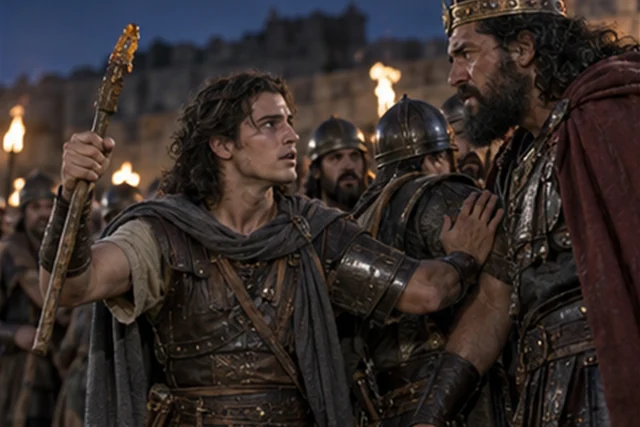
When Saul proposes a night pursuit, the priest interrupts with the sensible question of divine counsel. This time no answer comes. Saul immediately assumes there is sin in the camp and swears that the offender will die even if it is Jonathan. The Book of 1 Samuel has already told the reader what Saul does not yet know: Jonathan broke the oath unknowingly. The lot identifies him, and Jonathan admits exactly what he did, “I did but taste a little honey.” Saul still insists on death. Then the people answer the king with their own oath before the living LORD and refuse the sentence. Their reason is not sentimentality about the prince. Jonathan “hath wrought with God this day” in the salvation Israel has just experienced. The army rescues its rescuer from royal enforcement of a command he never heard. The irony is severe. Jonathan survived the climb toward a Philistine garrison, but the danger that nearly kills him comes afterward from his father's oath. Saul abandons the pursuit, and the Philistines return to their place.
Deep dive
Saul moves from divine silence to the conviction that someone must die, even naming Jonathan before the offender is identified. The people's silence leaves the accusation unanswered, while the account has already distinguished Jonathan's ignorance of the oath from an intentional breach. When the lot singles him out, Jonathan admits the small act plainly. Identification of the oath's breaker does not itself demonstrate that Saul's oath was wise or that the death penalty he has attached to it is just.
Two sworn declarations now collide. Saul invokes God to insist that Jonathan must die; the people invoke the living LORD to insist that not one hair of his head will fall. Their stated reason is the day's public evidence: Jonathan has worked with God in bringing deliverance. The army rescues its rescuer from its own king. Saul then abandons the pursuit. The chapter's strangest threat to Jonathan has come not from the steep approach to the Philistine garrison, but from the command structure behind him.
Words to trace: Saul, Jonathan, people, Israel, Philistines, LORD
Verse-by-verse path
- 1 Samuel 14:36
The people reply “Do whatsoever seemeth good unto thee”, literally “good in thine eyes”, and will say it again in verse 40. It is the priest, not the king, who remembers to consult God, after Saul cut short the last inquiry in verse 19.
- 1 Samuel 14:37
Saul frames two yes-or-no questions, the form the sacred lots could answer. “He answered him not that day” is the first silence. By 28:6 it has become total: the LORD answers him neither by dreams, nor by Urim, nor by prophets.
- 1 Samuel 14:38
“The chief of the people” is literally “the corners” of the people, the cornerstones that hold a structure together, the same word used of the leaders at Mizpah in Judges 20:2. Saul assumes the silence has a culprit before any inquiry has been made.
- 1 Samuel 14:39
Saul borrows the language of verse 23 in his oath, “the LORD liveth, which saveth Israel”, and uses it to promise a death. This is the day’s second oath. The people’s silence answers the king as God’s silence answered him.
- 1 Samuel 14:40
The royal house stands on one side and the whole army on the other, a picture of the division the oath has made. The people answer with the same words as verse 36, but now their agreement sounds like withdrawal rather than enthusiasm.
- 1 Samuel 14:41
“Give a perfect lot” translates havah tamim; the Greek has a far longer prayer: if the guilt is in me or Jonathan, give Urim; if in the people, give Thummim. Tamim and Thummim share a root, and many think the Hebrew lost a line. “Taken” is the verb used when the lot captured Achan (Joshua 7:16–18) and Saul himself (10:20–21).
- 1 Samuel 14:42
Saul orders the final throw between himself and his son. The Greek text adds an exchange here: Saul declares that whoever is taken will die, the people protest that this shall not be, and Saul overrules them. The Hebrew gives only the command and its result.
- 1 Samuel 14:43
“Tell me what thou hast done” is Joshua’s command to Achan (Joshua 7:19). Jonathan’s last words, literally “here I am, I will die”, can be heard as resignation or as a stunned protest at the price of a mouthful of honey.
- 1 Samuel 14:44
“God do so and more also” is the self-curse formula Eli used on young Samuel (3:17) and Ruth on herself (Ruth 1:17). Saul ends by naming his son to his face. This is his third oath in a single day, and each has narrowed toward Jonathan.
- 1 Samuel 14:45
“Rescued” is padah, the verb for ransoming, used of buying back a firstborn (Exodus 13:13). The people swear by the living LORD against the king’s oath by the same LORD. “Not one hair of his head” is a proverbial guarantee, repeated later at 2 Samuel 14:11 and 1 Kings 1:52.
- 1 Samuel 14:46
The pursuit ends without the night raid Saul proposed, and the Philistines survive to fight again, which is just what Jonathan predicted in verse 30. “Their own place” means home to the coastal cities; they will be back at the valley of Elah by chapter 17.
1 Samuel 14:36-46
King James Version36And Saul said, Let us go down after the Philistines by night, and spoil them until the morning light, and let us not leave a man of them. And they said, Do whatsoever seemeth good unto thee. Then said the priest, Let us draw near hither unto God.
37And Saul asked counsel of God, Shall I go down after the Philistines? wilt thou deliver them into the hand of Israel? But he answered him not that day.
38And Saul said, Draw ye near hither, all the chief of the people: and know and see wherein this sin hath been this day.
39For, as the LORD liveth, which saveth Israel, though it be in Jonathan my son, he shall surely die. But there was not a man among all the people that answered him.
40Then said he unto all Israel, Be ye on one side, and I and Jonathan my son will be on the other side. And the people said unto Saul, Do what seemeth good unto thee.
41Therefore Saul said unto the LORD God of Israel, Give a perfect lot. And Saul and Jonathan were taken: but the people escaped.
42And Saul said, Cast lots between me and Jonathan my son. And Jonathan was taken.
43Then Saul said to Jonathan, Tell me what thou hast done. And Jonathan told him, and said, I did but taste a little honey with the end of the rod that was in mine hand, and, lo, I must die.
44And Saul answered, God do so and more also: for thou shalt surely die, Jonathan.
45And the people said unto Saul, Shall Jonathan die, who hath wrought this great salvation in Israel? God forbid: as the LORD liveth, there shall not one hair of his head fall to the ground; for he hath wrought with God this day. So the people rescued Jonathan, that he died not.
46Then Saul went up from following the Philistines: and the Philistines went to their own place.
1 Samuel 14:47-52
Real Victories, an Unfinished Reign
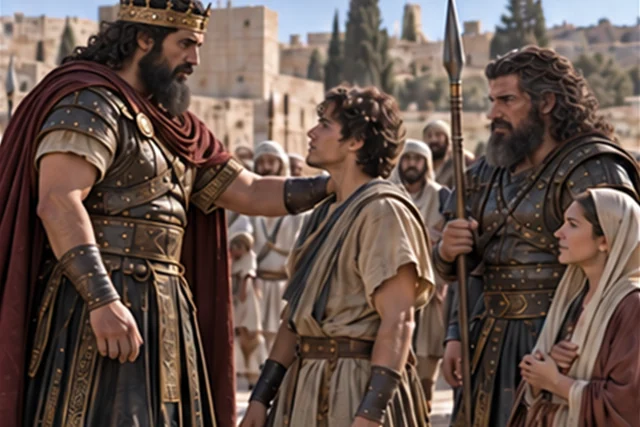
The closing survey widens the lens so that one disastrous oath does not swallow Saul's whole reign. The Book of 1 Samuel records warfare against Moab, Ammon, Edom, Zobah, the Philistines, and Amalek, and it explicitly says Saul delivered Israel from plunderers. His family and military command are named, including Jonathan, his daughters, his wife Ahinoam, and Abner. These are real achievements and real structures of rule, not illusions later invalidated by Saul's failures. Yet the final sentence quietly reconnects the successful king to Samuel's old warning. The Philistine war remains severe “all the days of Saul,” and whenever Saul sees a strong or valiant man, “he took him unto him.” Recruitment is now a continuing royal practice. That does not make every enlistment an abuse, but the wording gives concrete form to the earlier warning that the king would take Israel's sons for his service. The monarchy is functioning, defending Israel, and making the sustained claims monarchy was always going to make.
Deep dive
The survey broadens the view beyond one difficult day. Saul fights enemies on several fronts, delivers Israel from plunderers, and establishes a recognizable royal household and command. These achievements are part of the Book of 1 Samuel's account of him. His failures are not a reason to pretend that he never protected Israel or exercised effective military leadership. The account can acknowledge deliverance while continuing to question the king's obedience.
The final observation returns to recruitment. Whenever Saul sees a strong or valiant man, he takes him into his service. That practice gives concrete form to Samuel's warning in 8:11 about the king taking Israel's sons. The wording need not make every recruitment an abuse to establish the connection. A standing royal war effort now claims men continuously, and the Philistine conflict remains severe throughout Saul's reign.
Words to trace: Saul, name, Abner, father, host, Israel
Verse-by-verse path
- 1 Samuel 14:47
“Took the kingdom” uses lakad, the verb of the lot that “took” Saul and Jonathan in verses 41 and 42. “Vexed them” follows the Hebrew “acted wickedly” or “condemned”; the Greek reads “was victorious”, which differs by a single Hebrew letter. Zobah was an Aramean kingdom north of Damascus, later fought by David (2 Samuel 8:3).
- 1 Samuel 14:48
“Gathered an host” can also be read “did valiantly”, the phrase used in Numbers 24:18. Delivering Israel from “them that spoiled them” is the exact formula of the judges (Judges 2:16). The Amalekite campaign mentioned here is told at length in the next chapter.
- 1 Samuel 14:49
Ishui is not named elsewhere; the lists in 31:2 and 1 Chronicles 8:33 have Abinadab and Eshbaal among Saul’s sons, and some identify Ishui with one of them. Merab and Michal are introduced now because both will be offered to David in 18:17–27.
- 1 Samuel 14:50
Ahinoam is also the name of David’s wife from Jezreel (25:43). Some scholars have suggested the two are one woman taken with Saul’s house, reading 2 Samuel 12:8, but that is speculation. Whether “Saul’s uncle” means Ner or Abner is ambiguous in the Hebrew.
- 1 Samuel 14:51
The next verse settles verse 50: Kish and Ner were both sons of Abiel (compare 9:1), so Ner is Saul’s uncle and Abner his cousin. The army’s commander is family, the usual arrangement for a young royal house that could not yet trust outsiders.
- 1 Samuel 14:52
“Strong man” is gibbor and “valiant man” is ben chayil. Two chapters later a servant recommends David to Saul in almost the same terms, “a mighty valiant man” (16:18), and Saul takes him on. This closing habit is how David enters the court.
1 Samuel 14:47-52
King James Version47So Saul took the kingdom over Israel, and fought against all his enemies on every side, against Moab, and against the children of Ammon, and against Edom, and against the kings of Zobah, and against the Philistines: and whithersoever he turned himself, he vexed them.
48And he gathered an host, and smote the Amalekites, and delivered Israel out of the hands of them that spoiled them.
49Now the sons of Saul were Jonathan, and Ishui, and Melchi-shua: and the names of his two daughters were these; the name of the firstborn Merab, and the name of the younger Michal:
50And the name of Saul’s wife was Ahinoam, the daughter of Ahimaaz: and the name of the captain of his host was Abner, the son of Ner, Saul’s uncle.
51And Kish was the father of Saul; and Ner the father of Abner was the son of Abiel.
52And there was sore war against the Philistines all the days of Saul: and when Saul saw any strong man, or any valiant man, he took him unto him.
Questions to keep in mind while reading
- Track who acts, who speaks, who is affected, and what changes.
- Notice repeated promises, failures, rescues, and consequences.
- Do not assume the account approves every action that is reported.
Text first
Where readers differ
The chapter summary begins with what the passage says and how its parts fit together. It does not assume one denomination has already settled every question. Where a conclusion depends on a tradition, literary theory, or historical reconstruction, that dependence is named openly.
The KJV text is presented first. Interpretive conclusions are labeled, and differences are introduced only when they help a reader understand why serious communities do not always reach the same answer.
Comparative interpretive notes for this chapter are in preparation. Until reviewed notes are ready, this page separates the KJV text from summary and application without claiming that serious readers agree on every question.
Questions beneath the surface
- What account of God, human freedom, responsibility, and the good life emerges from 1 Samuel 14?
- Which tension does the chapter refuse to resolve quickly?
- What changes when the chapter is read as part of the whole canon rather than as an isolated moral lesson?
- Where might a sincere reader confuse a familiar tradition with something the text states directly?
Questions for serious personal contemplation
These open-ended questions make room for tension, honest response, prayer, and conclusions that remain accountable to the chapter.
Observe without rushing
What part of 1 Samuel 14 makes you stop, feel unsettled, or feel surprised, and why?
Which detail in the passage would be easiest to overlook? How does that detail change your understanding?
Where do you see tension between what happens and this focus: 1 Samuel 14 develops its own movement around Saul, people, Jonathan, Philistines, Israel?
What important question does the passage leave open instead of resolving quickly?
Examine your inner life honestly
Which person, response, fear, or desire in the passage feels most like your own life right now?
What assumption about God, other people, or yourself does this text challenge?
Which part would you rather soften, avoid, or explain away too quickly? What might that reaction reveal?
If this Scripture could ask you one direct question, what do you think it would ask?
Respond with wisdom and courage
What do you need to remember, confess, grieve, thank God for, or trust after reading this passage?
How might another faithful person read this situation differently without ignoring the text?
What obedient response would be costly, uncomfortable, or slow, yet still faithful to Scripture?
What question will you carry into prayer this week, and which verses will you keep in front of you?
Music and video connected to the passage
Related media appears when its Scripture reference overlaps this study. Music and video can illuminate a theme while the biblical text remains the foundation.