The big picture
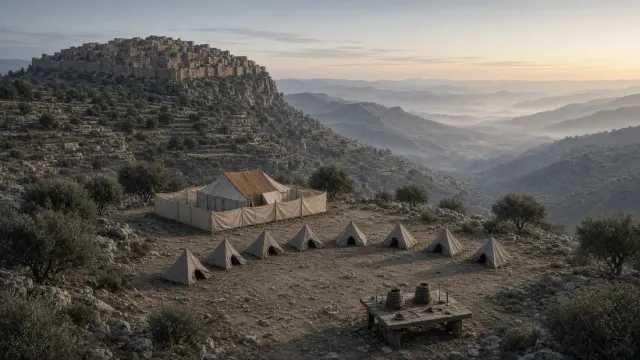
Joshua 18 opens with the tabernacle settled at Shiloh and seven tribes still unsettled in their inheritance. That tension drives the chapter. The land can be described as subdued while significant administrative work remains undone. Joshua answers delay with a survey: representatives walk the land, record it by cities, divide the description into seven parts, and return to Shiloh, where the lots are cast before the LORD. Benjamin's inheritance then demonstrates how relational these boundaries are. Its lines repeat landmarks already used for Judah and fit the tribe between Judah and Joseph. The city list adds another caution. Jericho, Gibeon, and Jerusalem appear together, but their earlier histories are not thereby made identical. The chapter treats maps and lists as precise claims about inheritance, not as shortcuts that erase what the book has already said about each place.
In this chapter
- A Subdued Land Still Has to Be Surveyed Joshua 18:1-10
The line "the land was subdued" sounds like an ending until the next verse says seven tribes have not received their inheritance.
- Benjamin Fits Between Two Already Named Neighbours Joshua 18:11-20
Benjamin's border makes sense only in company.
- A City List Carries Several Kinds of Past Joshua 18:21-28
A list can put Jericho, Gibeon, Beeroth, Chephirah, and Jerusalem on the same page without claiming that the same thing happened in each place.

Scripture beside the summary
Joshua · King James Version · 28Joshua 18:1-10
A Subdued Land Still Has to Be Surveyed
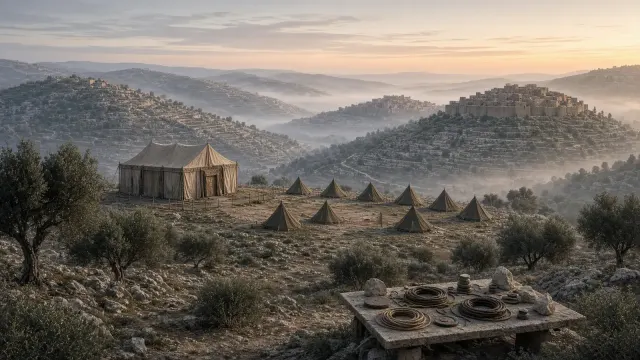
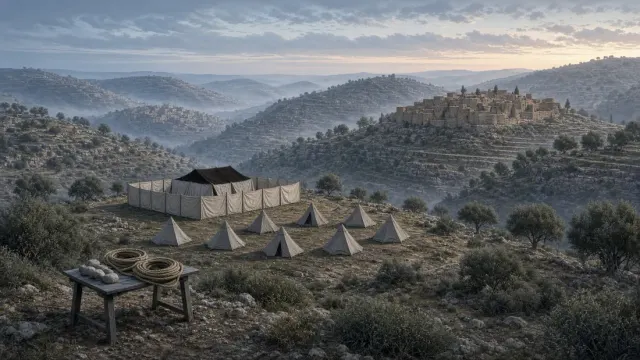
The line "the land was subdued" sounds like an ending until the next verse says seven tribes have not received their inheritance. Joshua 18 lives inside that gap. Victory has created the conditions for possession, but nobody is allowed to pretend the remaining work will perform itself. Joshua calls the delay "slack" and answers it with a remarkably unromantic task: walk the land, describe it by cities, put the description in writing, and bring it back. The lots will be cast before the LORD at Shiloh, but the sacred setting does not remove the need for competent surveying. Nor does the survey turn the allocation into a purely human transaction. The Book of Joshua deliberately keeps both together. After chapters of battles and marches, pen, distance, city lists, and careful division become the means by which a conquered land becomes an inheritance actually assigned to waiting families.
Deep dive
The opening holds two facts side by side: the land is subdued before Israel, and seven tribes have not yet received their inheritance. The first does not automatically accomplish the second. Joshua's charge that the people are "slack" concerns this unfinished movement into possession, not a denial of the victories already won.
His response combines a survey with the casting of lots. Representatives walk through the land and describe it by cities in seven divisions. They return with a written record, not merely an encouraging opinion of the countryside. Judah and Joseph retain their established territories; the remaining distribution has a defined scope.
The repeated location is Shiloh, where the congregation has assembled and the tabernacle has been set up. Joshua casts the lots there "before the LORD". The physical survey does not replace that setting, and the sacred setting does not make the survey unnecessary. The land is described before it is assigned. After chapters dominated by marching and battle, careful administrative work becomes the means by which the victory reaches the tribes still waiting for their portions.
Words to trace: land, LORD, Joshua, children, describe, inheritance
Verse-by-verse path
- Joshua 18:1
“Subdued” is kabash, the verb of Genesis 1:28, “replenish the earth, and subdue it.” Shiloh, some twenty miles north of Jerusalem, kept the tabernacle until the days of Eli (1 Samuel 1:3; 4:3), and Jeremiah later pointed to its ruins: “go ye now unto my place which was in Shiloh” (Jeremiah 7:12).
- Joshua 18:2
The seven are Benjamin, Simeon, Zebulun, Issachar, Asher, Naphtali and Dan. The Hebrew says they had not yet “divided” their inheritance. The land was held, but most of the tribes still had no address in it.
- Joshua 18:3
“Slack” is mitrappim, letting the hands drop, from rapha, the verb Gibeon used when it begged Joshua, “Slack not thy hand” (10:6). “How long” is the complaint God made against Israel in the wilderness: “How long will this people provoke me?” (Numbers 14:11).
- Joshua 18:4
Three men from each of seven tribes makes twenty one surveyors. “Describe” is katav, to write: they are to walk the land and put it on paper. “Go through” is the verb of God’s word to Abraham, “walk through the land in the length of it and in the breadth of it” (Genesis 13:17).
- Joshua 18:5
Judah in the south and Joseph in the north are already settled, and the other tribes will be fitted around them. The two great houses already bracket the land as the later kingdoms of Judah and Israel, whose leading tribe was Ephraim, would divide it.
- Joshua 18:6
Josephus says Joshua sent men “skilful in geometry” to measure the land, and that they reported on its quality as well as its size (Antiquities 5.1.21). The verse itself asks only for a written description brought back “hither”, to Shiloh, for the lot.
- Joshua 18:7
Levi’s share is named a third way. In 13:14 it was the sacrifices, in 13:33 the LORD himself, and here “the priesthood of the LORD”. Office, offering and God are three descriptions of one portion.
- Joshua 18:8
Joshua’s instruction is given three times in five verses (4, 6, 8), and “come again to me” recurs each time. The survey is not to become a settling party; the surveyors are to return so that the lot is cast in one place for all.
- Joshua 18:9
“In a book” means on a scroll, a written survey of the land city by city. Shiloh is still called “the host”, the camp, a military word used even though the war is over.
- Joshua 18:10
Micah 2:5 later threatens the land grabbers of his day that they will have “none that shall cast a cord by lot in the congregation of the LORD”: no share in the next division. The lot at Shiloh set the pattern Micah’s threat assumes.
Joshua 18:1-10
King James Version1And the whole congregation of the children of Israel assembled together at Shiloh, and set up the tabernacle of the congregation there. And the land was subdued before them.
2And there remained among the children of Israel seven tribes, which had not yet received their inheritance.
3And Joshua said unto the children of Israel, How long are ye slack to go to possess the land, which the LORD God of your fathers hath given you?
4Give out from among you three men for each tribe: and I will send them, and they shall rise, and go through the land, and describe it according to the inheritance of them; and they shall come again to me.
5And they shall divide it into seven parts: Judah shall abide in their coast on the south, and the house of Joseph shall abide in their coasts on the north.
6Ye shall therefore describe the land into seven parts, and bring the description hither to me, that I may cast lots for you here before the LORD our God.
7But the Levites have no part among you; for the priesthood of the LORD is their inheritance: and Gad, and Reuben, and half the tribe of Manasseh, have received their inheritance beyond Jordan on the east, which Moses the servant of the LORD gave them.
8And the men arose, and went away: and Joshua charged them that went to describe the land, saying, Go and walk through the land, and describe it, and come again to me, that I may here cast lots for you before the LORD in Shiloh.
9And the men went and passed through the land, and described it by cities into seven parts in a book, and came again to Joshua to the host at Shiloh.
10And Joshua cast lots for them in Shiloh before the LORD: and there Joshua divided the land unto the children of Israel according to their divisions.
Joshua 18:11-20
Benjamin Fits Between Two Already Named Neighbours
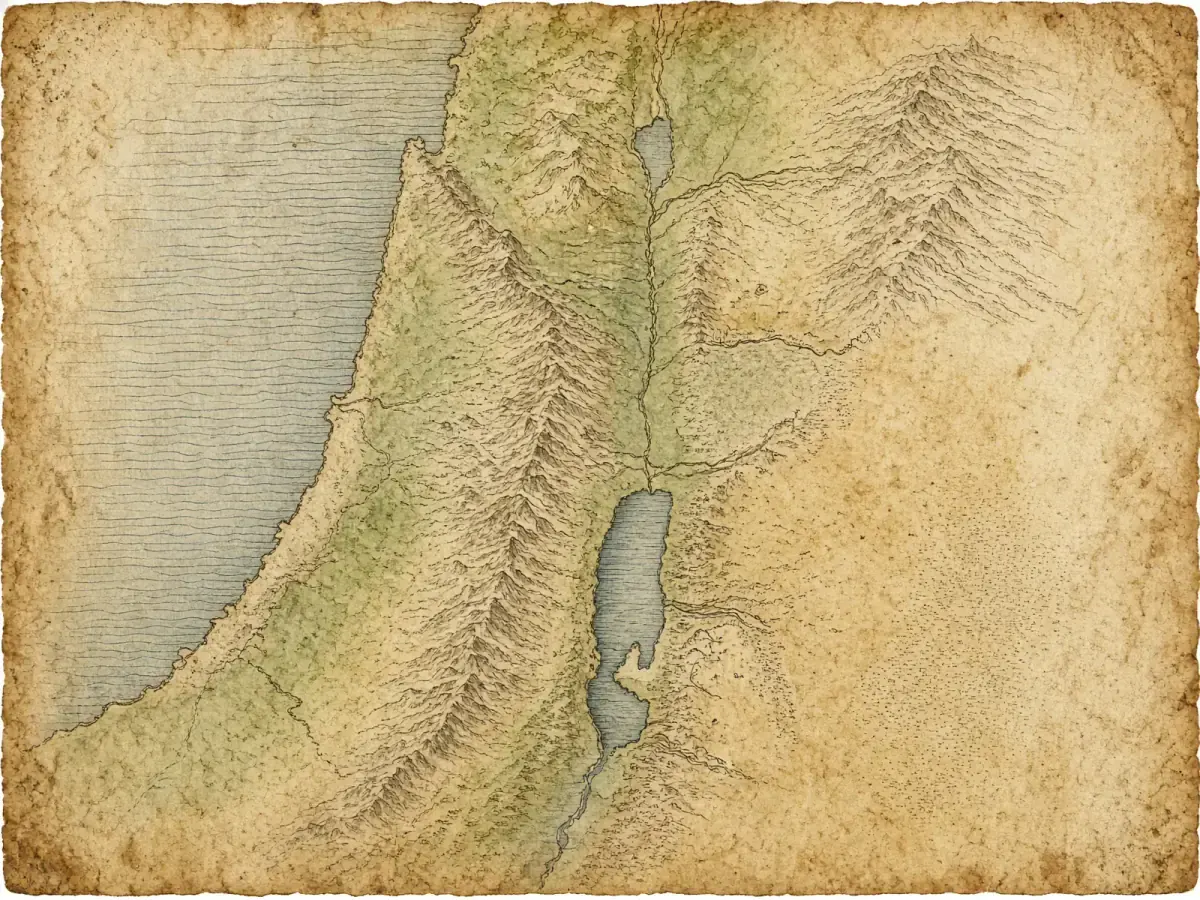
Benjamin's border makes sense only in company. The first thing said about the lot is that it lies between Judah and Joseph, and the details that follow keep proving the point. Landmarks already familiar from Judah's northern line reappear from Benjamin's side, while Jordan closes the inheritance on the east. The repetition is not clutter. It is what a shared boundary should look like when described for two neighbours. A map drawn tribe by tribe will necessarily tell some geographical facts twice, because the same valley, spring, or stone can be the edge of more than one inheritance. The Book of Joshua uses that repetition to show fit rather than isolation. Benjamin does not receive a floating territory with no relation to what came before. Its place is defined by contact with already named inheritances, then handed down "according to their families," bringing the map back from landmarks to households.
Deep dive
The first statement locates Benjamin between Judah and the children of Joseph. The detailed boundary that follows is therefore relational: Benjamin's inheritance meets territories already described, rather than appearing as an isolated addition to the map.
Several southern landmarks repeat Judah's northern boundary in chapter 15, including the waters of Nephtoah, the valley of Hinnom, Enrogel, and the stone of Bohan. The repetition is useful rather than accidental. A shared boundary can be described from the perspective of each neighbouring inheritance. Jordan supplies Benjamin's eastern edge, while the southern line reaches the northern bay of the salt sea. The formula "according to their families" then returns the surveyed outline to the households who receive it. The geography establishes both where Benjamin belongs and how that belonging fits beside the other tribes.
Words to trace: border, side, Beth, children, north, south
Verse-by-verse path
- Joshua 18:11
The lot “came up”, as if drawn out of a vessel. Benjamin, Rachel’s second son and Joseph’s only full brother, is placed between Judah and Joseph. When the kingdom split, Benjamin went with Judah (1 Kings 12:21).
- Joshua 18:12
“The side of Jericho” is katef, the shoulder, the word for a hillside that recurs through these boundary lists. The northern line climbs from the Jordan past Jericho into the hills and ends at the wilderness of Beth-aven, near Bethel.
- Joshua 18:13
Here Luz is identified with Bethel, which is listed among Benjamin’s towns (verse 22). Elsewhere Bethel is counted to Ephraim (1 Chronicles 7:28), and the house of Joseph took it (Judges 1:22). A town on a border could be claimed from both sides.
- Joshua 18:14
“The west quarter” is literally “the sea side”, since the sea lay to the west. The line ends at Kirjath-jearim, noted as “a city of the children of Judah”: Benjamin’s western edge stops at a Judahite town.
- Joshua 18:15
The southern border of Benjamin is Judah’s northern border traced in reverse, west to east, where chapter 15 traced it east to west. The same springs and valleys mark both tribes, told from each side of the line.
- Joshua 18:16
“The side of Jebusi” is again katef, the shoulder of the Jebusite ridge. The line runs just south of it, putting the city in Benjamin’s portion. The Talmud (Yoma 12a) held that the later temple itself straddled this border, partly in Judah and partly in Benjamin.
- Joshua 18:17
Geliloth, “circles”, stands where Judah’s list has Gilgal (15:7), and the two names share a root, a sign that the same place is meant. En-shemesh, “spring of the sun”, is often placed at a spring on the road down to Jericho.
- Joshua 18:18
“Arabah” here is probably Beth-arabah, as the Greek reads; the town appears in both Judah’s list (15:61) and Benjamin’s (verse 22). The line drops from the hills into the Jordan valley.
- Joshua 18:19
The border ends at the mouth of the Jordan, the same spot where Judah’s northern border began (15:5). The two descriptions meet end to end, so that Benjamin’s south and Judah’s north are one line walked twice.
- Joshua 18:20
Benjamin’s territory was among the smallest, yet from it came Ehud (Judges 3:15), Saul (1 Samuel 9:1–2), Mordecai (Esther 2:5) and Paul, who named his tribe with evident pride (Philippians 3:5).
Joshua 18:11-20
King James Version11And the lot of the tribe of the children of Benjamin came up according to their families: and the coast of their lot came forth between the children of Judah and the children of Joseph.
12And their border on the north side was from Jordan; and the border went up to the side of Jericho on the north side, and went up through the mountains westward; and the goings out thereof were at the wilderness of Beth-aven.
13And the border went over from thence toward Luz, to the side of Luz, which is Beth-el, southward; and the border descended to Ataroth-adar, near the hill that lieth on the south side of the nether Beth-horon.
14And the border was drawn thence, and compassed the corner of the sea southward, from the hill that lieth before Beth-horon southward; and the goings out thereof were at Kirjath-baal, which is Kirjath-jearim, a city of the children of Judah: this was the west quarter.
15And the south quarter was from the end of Kirjath-jearim, and the border went out on the west, and went out to the well of waters of Nephtoah:
16And the border came down to the end of the mountain that lieth before the valley of the son of Hinnom, and which is in the valley of the giants on the north, and descended to the valley of Hinnom, to the side of Jebusi on the south, and descended to En-rogel,
17And was drawn from the north, and went forth to En-shemesh, and went forth toward Geliloth, which is over against the going up of Adummim, and descended to the stone of Bohan the son of Reuben,
18And passed along toward the side over against Arabah northward, and went down unto Arabah:
19And the border passed along to the side of Beth-hoglah northward: and the outgoings of the border were at the north bay of the salt sea at the south end of Jordan: this was the south coast.
20And Jordan was the border of it on the east side. This was the inheritance of the children of Benjamin, by the coasts thereof round about, according to their families.
Joshua 18:21-28
A City List Carries Several Kinds of Past
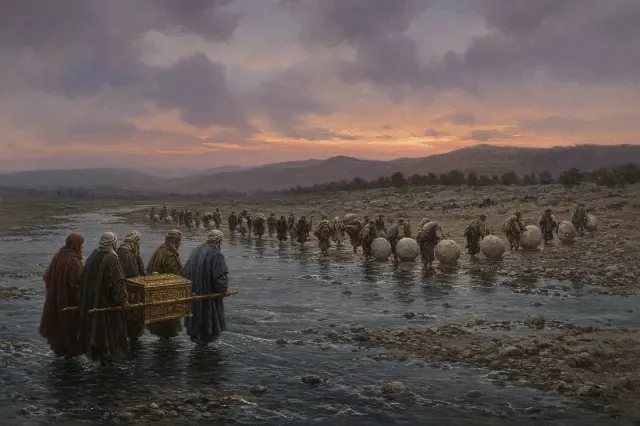
A list can put Jericho, Gibeon, Beeroth, Chephirah, and Jerusalem on the same page without claiming that the same thing happened in each place. That is the quiet discipline required by Benjamin's city register. Jericho carries the memory of destruction. The Gibeonite cities carry the oath that spared them. Jerusalem is named as Jebusi even after the book has already said its Jebusite inhabitants remain. The Book of Joshua does not pause here to retell those accounts because the purpose of this list is different. It identifies places within Benjamin's inheritance. The danger is reading more into the register than the register says. Assignment is not a second conquest account, and a city name is not proof that every occupation problem has been resolved. The two groups of cities and their villages complete Benjamin's portion while preserving all the complications that earlier chapters have already attached to those names.
Deep dive
Jericho, Gibeon, Beeroth, Chephirah, and Jerusalem do not arrive in this list with identical circumstances. Jericho was destroyed; the Gibeonite cities were spared under oath; Jerusalem's Jebusites were expressly said to remain in Joshua 15:63. The register does not retell those accounts or cancel their distinctions.
This is why a city list cannot be treated as a catalogue of places newly captured in the same manner. It identifies locations within an inheritance. Jerusalem is explicitly equated with Jebusi, connecting the geographical entry with the earlier notice about its inhabitants. The two closing groups, each with its villages, complete Benjamin's portion at household scale while leaving the book's already stated conditions of possession intact.
Words to trace: Beth, cities, Benjamin, children, families, villages
Verse-by-verse path
- Joshua 18:21
Jericho, the first city taken, becomes a Benjamite town. It was later refounded by Hiel of Bethel in Ahab’s day, at the cost Joshua had pronounced (1 Kings 16:34). The valley of Keziz, “cut off”, appears nowhere else.
- Joshua 18:22
Mount Zemaraim is where King Abijah of Judah stood and addressed Jeroboam’s army before battle, charging them with forsaking the LORD (2 Chronicles 13:4). Bethel, Jeroboam’s royal shrine, is listed here as a Benjamite town.
- Joshua 18:23
This Ophrah is Benjamin’s, on the road a Philistine raiding party later took (1 Samuel 13:17), different from Gideon’s Ophrah of the Abiezrites (Judges 6:11). Parah means “heifer”; Avim may recall the Avites of 13:3.
- Joshua 18:24
Chephar-haammonai means “village of the Ammonites”, perhaps an Ammonite settlement within Benjamin. Gaba, or Geba, became the northern limit of Judah, so that Josiah’s reform ran “from Geba to Beer-sheba” (2 Kings 23:8).
- Joshua 18:25
Jeremiah 31:15 sets Rachel weeping for her children in Ramah, and it was at Ramah that Jeremiah was released from his chains among the captives bound for Babylon (Jeremiah 40:1). Gibeon and Beeroth are two of the four Gibeonite cities of chapter 9.
- Joshua 18:26
Mizpeh of Benjamin is where Samuel gathered Israel to pray (1 Samuel 7:5), where Saul was chosen by lot (10:17–21), and where Gedaliah governed Judah after Jerusalem fell (Jeremiah 40:6). Mozah survives as Motza, just west of Jerusalem.
- Joshua 18:27
Irpeel means “God heals”. Rekem is also the name of one of the Midianite kings killed with Balaam (13:21). None of these three towns is mentioned anywhere else in the Old Testament.
- Joshua 18:28
Saul and Jonathan were finally buried “in Zelah, in the sepulchre of Kish his father” (2 Samuel 21:14). Gibeath is Gibeah of Saul, his home and capital (1 Samuel 11:4). Benjamin’s city list closes with the tomb and the seat of Israel’s first king.
Joshua 18:21-28
King James Version21Now the cities of the tribe of the children of Benjamin according to their families were Jericho, and Beth-hoglah, and the valley of Keziz,
22And Beth-arabah, and Zemaraim, and Beth-el,
23And Avim, and Parah, and Ophrah,
24And Chephar-haammonai, and Ophni, and Gaba; twelve cities with their villages:
25Gibeon, and Ramah, and Beeroth,
26And Mizpeh, and Chephirah, and Mozah,
27And Rekem, and Irpeel, and Taralah,
28And Zelah, Eleph, and Jebusi, which is Jerusalem, Gibeath, and Kirjath; fourteen cities with their villages. This is the inheritance of the children of Benjamin according to their families.
Questions to keep in mind while reading
- Track who acts, who speaks, who is affected, and what changes.
- Notice repeated promises, failures, rescues, and consequences.
- Do not assume the account approves every action that is reported.
Text first
Where readers differ
The chapter summary begins with what the passage says and how its parts fit together. It does not assume one denomination has already settled every question. Where a conclusion depends on a tradition, literary theory, or historical reconstruction, that dependence is named openly.
The KJV text is presented first. Interpretive conclusions are labeled, and differences are introduced only when they help a reader understand why serious communities do not always reach the same answer.
Comparative interpretive notes for this chapter are in preparation. Until reviewed notes are ready, this page separates the KJV text from summary and application without claiming that serious readers agree on every question.
Questions beneath the surface
- What account of God, human freedom, responsibility, and the good life emerges from Joshua 18?
- Which tension does the chapter refuse to resolve quickly?
- What changes when the chapter is read as part of the whole canon rather than as an isolated moral lesson?
- Where might a sincere reader confuse a familiar tradition with something the text states directly?
Questions for serious personal contemplation
These open-ended questions make room for tension, honest response, prayer, and conclusions that remain accountable to the chapter.
Observe without rushing
What part of Joshua 18 makes you stop, feel unsettled, or feel surprised, and why?
Which detail in the passage would be easiest to overlook? How does that detail change your understanding?
Where do you see tension between what happens and this focus: Joshua 18 develops its own movement around children, border, side, Beth, land?
What important question does the passage leave open instead of resolving quickly?
Examine your inner life honestly
Which person, response, fear, or desire in the passage feels most like your own life right now?
What assumption about God, other people, or yourself does this text challenge?
Which part would you rather soften, avoid, or explain away too quickly? What might that reaction reveal?
If this Scripture could ask you one direct question, what do you think it would ask?
Respond with wisdom and courage
What do you need to remember, confess, grieve, thank God for, or trust after reading this passage?
How might another faithful person read this situation differently without ignoring the text?
What obedient response would be costly, uncomfortable, or slow, yet still faithful to Scripture?
What question will you carry into prayer this week, and which verses will you keep in front of you?
Music and video connected to the passage
Related media appears when its Scripture reference overlaps this study. Music and video can illuminate a theme while the biblical text remains the foundation.