The big picture
Joshua 19 completes the remaining tribal lots, but the completion is not mechanically uniform. Simeon's inheritance is deliberately carved from Judah's oversized portion. Zebulun, Issachar, Asher, and Naphtali are traced through northern borders whose place-names require attention to context, and one phrase in Naphtali's line remains genuinely difficult rather than being forced into certainty. Dan's allotted towns lead into a brief account of a second city taken and renamed, showing that a register can suddenly open into action. Only after the tribes have received their inheritances does Joshua receive the city he requested. The chapter then returns to Shiloh, Eleazar, the tribal heads, the tabernacle, and the lots cast before the LORD. Distribution ends where it has been administered publicly. Even Joshua, the man dividing the land, enters the finished map as a recipient rather than as its owner.
In this chapter
- Simeon's Inheritance Comes from Judah's Surplus Joshua 19:1-9
Simeon's inheritance is not squeezed awkwardly beside Judah.
- Zebulun and Issachar Receive Their Own Ground Joshua 19:10-23
Zebulun and Issachar receive the kind of treatment that can look repetitive until one notices how much the local setting controls the names.
- Northern Borders and an Unresolved Judah Joshua 19:24-39
Asher's line reaches toward Sidon and Tyre, and Naphtali's list includes Hazor, but none of those names turns the allotment register into a series of conquest notices.
- Dan's List Opens Into a Second Location Joshua 19:40-48
Dan's allotment begins as another city list and then, almost without warning, becomes an account of movement beyond that first list.
- The Distributor Becomes a Recipient Joshua 19:49-51
Joshua has spent chapter after chapter helping divide the land, and only when the tribal work is finished does his own request appear.
Scripture beside the summary
Joshua · King James Version · 51Joshua 19:1-9
Simeon's Inheritance Comes from Judah's Surplus
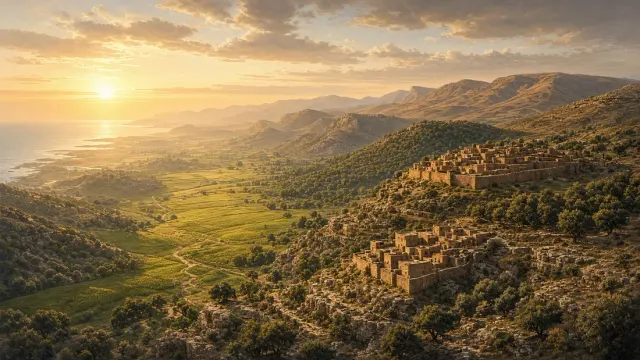
Simeon's inheritance is not squeezed awkwardly beside Judah. It is taken from inside Judah, and Joshua 19 says why. Judah's first allotment was larger than it needed, so part of that territory becomes the distinct inheritance of Simeon's families. The repeated town names are therefore evidence of adjustment, not competing claims accidentally left unresolved. This is one of the places where the Book of Joshua shows that the distribution can be corrected in use without treating the earlier grant as a failure. Simeon still receives cities and villages "according to their families"; being located within Judah does not make the tribe's inheritance imaginary or secondary. The map is allowed to become more exact as the needs of the tribes become clearer. Instead of insisting that every first line remain untouched, the chapter explains the overlap and lets the larger portion make room for a neighbour.
Deep dive
Several names in Simeon's list have already appeared among Judah's southern towns. Verse 9 explains the overlap directly: Judah's portion was too much for it, so Simeon's inheritance was taken from within that portion. Their overlap reflects a stated adjustment within the distribution rather than two territorial claims left unexplained.
Simeon nevertheless receives an inheritance "according to their families", with cities and surrounding villages like the other tribes. Its location within Judah does not make the grant disappear as a distinct tribal allotment. The repeated explanation at the beginning and end of the section gives this arrangement particular emphasis. The distribution is completed by adjusting the use of an already described territory, rather than insisting that every tribe must receive a wholly detached block of land.
Words to trace: children, inheritance, Simeon, cities, Judah, villages
Verse-by-verse path
- Joshua 19:1
Jacob had said of Simeon and Levi, “I will divide them in Jacob, and scatter them in Israel” (Genesis 49:7). Both came true in the allotment: Levi was spread through the other tribes in cities, and Simeon was placed inside Judah. Simeon’s is the second lot of the seven.
- Joshua 19:2
The King James “or Sheba” renders “and Sheba” in the Hebrew. To reach the total of thirteen in verse 6, Sheba must be counted with Beer-sheba as one place, or else be the Shema of Judah’s list (15:26) in a variant form.
- Joshua 19:3
The Simeon list follows Judah’s southern list (15:26–32) closely, and it appears a third time in 1 Chronicles 4:28–31, which adds a note of its own: “These were their cities unto the reign of David.” Balah here is the Baalah of 15:29.
- Joshua 19:4
Bethul stands where Judah’s list has Chesil (15:30), and 1 Chronicles 4:30 has Bethuel. Hormah was one of the towns to which David sent a share of the Amalekite spoil (1 Samuel 30:30).
- Joshua 19:5
Beth-marcaboth means “house of chariots” and Hazar-susah “village of horses”. In Judah’s list the same slots hold Madmannah and Sansannah (15:31), so these may be later names from a time when the towns served as chariot and horse depots.
- Joshua 19:6
Sharuhen appears in an Egyptian soldier’s tomb inscription: Ahmose son of Ebana records that after the Hyksos were driven out of Egypt, Pharaoh Ahmose besieged Sharuhen for three years. Beth-lebaoth means “house of lionesses”.
- Joshua 19:7
Here Ain and Remmon are counted as two to make four cities. Ether and Ashan also appear in Judah’s lowland list (15:42), so Simeon’s holdings reached beyond the Negev into the Shephelah.
- Joshua 19:8
“Ramath of the south” is Ramah of the Negev, probably the “south Ramoth” to which David sent gifts from the Amalekite spoil (1 Samuel 30:27). Baalath-beer means “lady of the well”, a name suited to a place in dry country.
- Joshua 19:9
Simeon survived as a tribe mostly by being absorbed into Judah. 1 Chronicles 4:39–43 records Simeonite clans in Hezekiah’s day migrating to Gedor and to Mount Seir in search of pasture, and after that the tribe fades from the record.
Joshua 19:1-9
King James Version1And the second lot came forth to Simeon, even for the tribe of the children of Simeon according to their families: and their inheritance was within the inheritance of the children of Judah.
2And they had in their inheritance Beer-sheba, or Sheba, and Moladah,
3And Hazar-shual, and Balah, and Azem,
4And Eltolad, and Bethul, and Hormah,
5And Ziklag, and Beth-marcaboth, and Hazar-susah,
6And Beth-lebaoth, and Sharuhen; thirteen cities and their villages:
7Ain, Remmon, and Ether, and Ashan; four cities and their villages:
8And all the villages that were round about these cities to Baalath-beer, Ramath of the south. This is the inheritance of the tribe of the children of Simeon according to their families.
9Out of the portion of the children of Judah was the inheritance of the children of Simeon: for the part of the children of Judah was too much for them: therefore the children of Simeon had their inheritance within the inheritance of them.
Joshua 19:10-23
Zebulun and Issachar Receive Their Own Ground
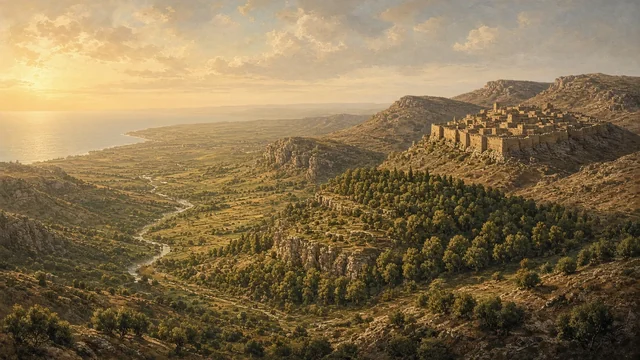
Zebulun and Issachar receive the kind of treatment that can look repetitive until one notices how much the local setting controls the names. Sarid anchors Zebulun's boundary, while Issachar is described through towns reaching toward Tabor and Jordan. A familiar name such as Bethlehem does not automatically transport the reader south into Judah; here the tribal context says otherwise. Jezreel likewise arrives with baggage from Joseph's earlier complaint about iron chariots in the valley. Its inclusion in Issachar's allotment does not announce that every earlier difficulty has vanished. The Book of Joshua is assigning claims, not issuing a fresh occupation report after every place-name. That distinction keeps the register honest. Cities and villages locate the inheritance for families, while the book's previous notices about resistance or unsettled control remain in force unless the text itself changes them.
Deep dive
Zebulun's boundaries and Issachar's towns move the register through the northern territories. Sarid provides a point from which Zebulun's line is traced in different directions, while Issachar's description names Jezreel and reaches toward Tabor and Jordan. Each grant closes with the same recognition of families, cities, and villages.
The Bethlehem named with Zebulun is not automatically the Bethlehem of Judah simply because the name is familiar. The tribal setting must govern the identification. Jezreel, meanwhile, recalls the valley whose Canaanite chariots troubled Joseph's descendants in Joshua 17:16. Its appearance in an allotment does not report that those difficulties have evaporated. The lists establish which families have a claim in the region; they are not repeated assurances that every named town has been peacefully occupied.
Words to trace: border, children, cities, families, villages, Beth
Verse-by-verse path
- Joshua 19:10
Jacob had said “Zebulun shall dwell at the haven of the sea” (Genesis 49:13), yet the boundaries given here do not clearly reach the coast. Sarid, where the description starts, is often placed at Tel Shadud in the Jezreel valley.
- Joshua 19:11
“The river that is before Jokneam” is the brook Kishon, which runs past Jokneam at the foot of Carmel. It is the river that swept away Sisera’s army (Judges 5:21) and where Elijah killed the prophets of Baal (1 Kings 18:40).
- Joshua 19:12
Chisloth-tabor means “the flanks of Tabor”. Japhia, the modern village of Yafa, lies just southwest of Nazareth. Nazareth itself is never named in the Old Testament; it lay somewhere inside this stretch of Zebulun’s border.
- Joshua 19:13
Gittah-hepher is Gath-hepher, the home town of the prophet Jonah son of Amittai (2 Kings 14:25). The prophet sent to Nineveh came from a village in Zebulun, a few miles from Nazareth.
- Joshua 19:14
Hannathon appears in the Amarna letters as Hinnatuna, where, the king of Babylon complained to Pharaoh, Babylonian merchants had been robbed and killed. The border reaches its northern point there before turning into the valley of Jiphthah-el.
- Joshua 19:15
Nahallal became a Levitical city (21:35), and a modern village in the Jezreel valley has taken its name, Nahalal. Ibzan, one of the minor judges, came from “Bethlehem” (Judges 12:8), and some think this northern Bethlehem was his town.
- Joshua 19:16
Isaiah joins this tribe with its neighbour in a famous promise: “the land of Zebulun and the land of Naphtali... Galilee of the nations” (Isaiah 9:1). Matthew 4:13–15 quotes it when Jesus settles in Capernaum.
- Joshua 19:17
Jacob’s blessing pictured Issachar as “a strong ass couching down between two burdens”, who “saw that rest was good, and the land that it was pleasant” and bowed to labour (Genesis 49:14–15). Its lot falls on the rich plain of Jezreel.
- Joshua 19:18
Shunem is where the Philistines camped before the battle of Gilboa (1 Samuel 28:4), the home of Abishag who nursed the aged David (1 Kings 1:3), and of the woman who built Elisha a room on her roof (2 Kings 4:8–10).
- Joshua 19:19
Anaharath appears in an Egyptian inscription of Pharaoh Amenhotep II, who records plundering it on a campaign in Canaan, and Hapharaim is often read in Shishak’s list of towns at Karnak. Both were known outside Israel before and after this list.
- Joshua 19:20
Kishion was later given to the Levites (21:28). Rabbith and Abez appear nowhere else. The list moves across the plain town by town, many of them otherwise lost to history.
- Joshua 19:21
This En-gannim, “spring of gardens”, is Issachar’s, not the town of the same name in Judah (15:34); it is usually identified with modern Jenin at the southern edge of the Jezreel valley.
- Joshua 19:22
Mount Tabor rises alone out of the plain; Barak gathered his ten thousand men on it before the battle with Sisera (Judges 4:6, 14). This Beth-shemesh, “house of the sun”, is a northern town, not the Judahite one where the ark returned.
- Joshua 19:23
Deborah’s song names the tribe with praise: “the princes of Issachar were with Deborah” (Judges 5:15). Tola, one of the minor judges, was “a man of Issachar” (Judges 10:1). 1 Chronicles 12:32 remembers its men as those “that had understanding of the times”.
Joshua 19:10-23
King James Version10And the third lot came up for the children of Zebulun according to their families: and the border of their inheritance was unto Sarid:
11And their border went up toward the sea, and Maralah, and reached to Dabbasheth, and reached to the river that is before Jokneam;
12And turned from Sarid eastward toward the sunrising unto the border of Chisloth-tabor, and then goeth out to Daberath, and goeth up to Japhia,
13And from thence passeth on along on the east to Gittah-hepher, to Ittah-kazin, and goeth out to Remmon-methoar to Neah;
14And the border compasseth it on the north side to Hannathon: and the outgoings thereof are in the valley of Jiphthah-el:
15And Kattath, and Nahallal, and Shimron, and Idalah, and Beth-lehem: twelve cities with their villages.
16This is the inheritance of the children of Zebulun according to their families, these cities with their villages.
17And the fourth lot came out to Issachar, for the children of Issachar according to their families.
18And their border was toward Jezreel, and Chesulloth, and Shunem,
19And Hapharaim, and Shion, and Anaharath,
20And Rabbith, and Kishion, and Abez,
21And Remeth, and En-gannim, and En-haddah, and Beth-pazzez;
22And the coast reacheth to Tabor, and Shahazimah, and Beth-shemesh; and the outgoings of their border were at Jordan: sixteen cities with their villages.
23This is the inheritance of the tribe of the children of Issachar according to their families, the cities and their villages.
Joshua 19:24-39
Northern Borders and an Unresolved Judah
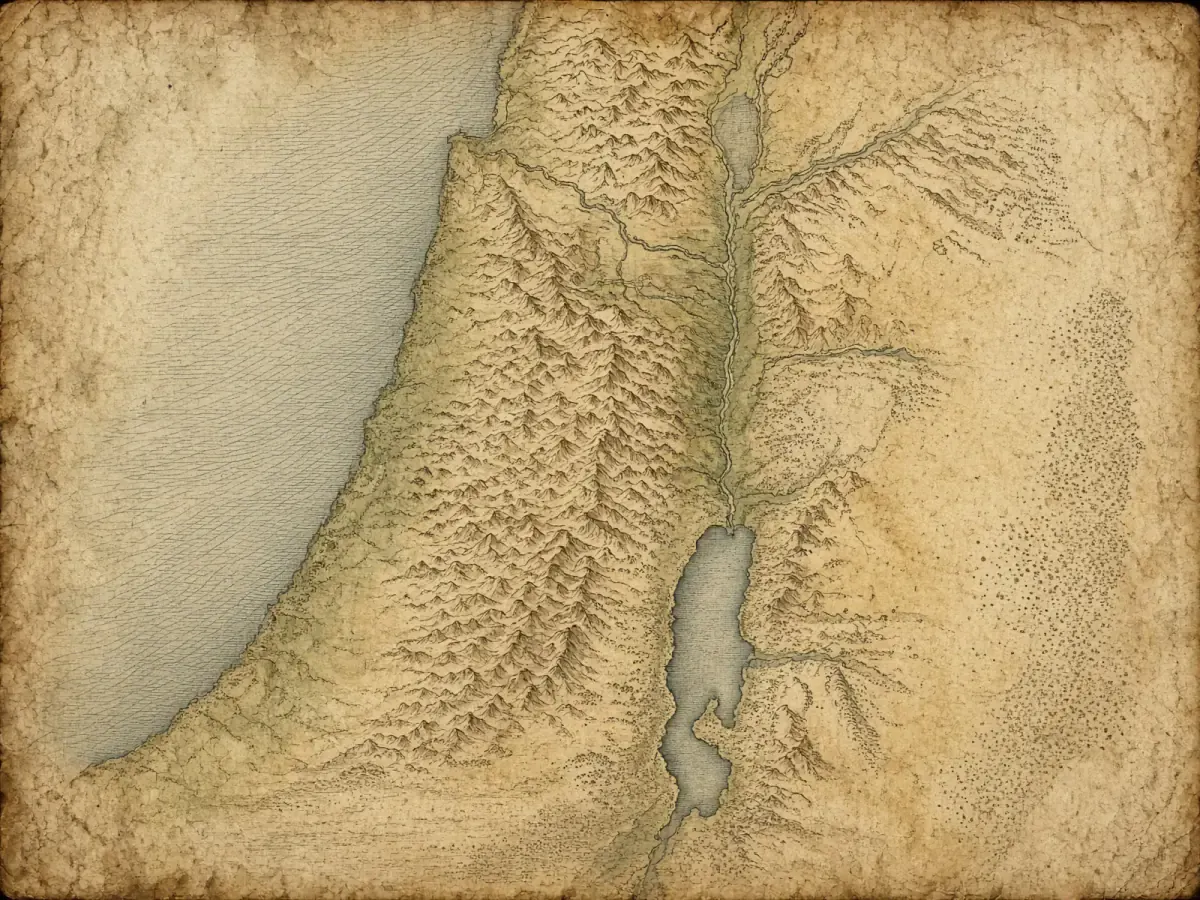
Asher's line reaches toward Sidon and Tyre, and Naphtali's list includes Hazor, but none of those names turns the allotment register into a series of conquest notices. The chapter is drawing territorial relations, not pretending every prominent city has passed through the same military history. That caution becomes especially important at the phrase "Judah upon Jordan" in Naphtali's boundary. The wording is difficult because Judah's principal territory lies far to the south, and several explanations have been offered without one being established. The right summary is therefore not a clever reconstruction but an honest boundary on certainty itself. Zebulun, Asher, and Jordan give clearer points around the line; the Judah reference does not. Joshua 19 is precise enough to say where the evidence becomes less precise, which is better than making an uncertain map look tidy by inventing confidence the text does not provide.
Deep dive
Asher's description reaches toward great Zidon and the strong city Tyre. These are boundary references, not accounts of Israel capturing either city. Naphtali's list similarly brings Hazor, already prominent in the northern campaign, into the register of an inheritance. The fortified towns belong to a geographical description whose claims are not identical to a military progress report.
The wording "Judah upon Jordan" in verse 34 presents a real difficulty because Judah's principal territory lies well to the south of Naphtali. Commentators have proposed a local place-name, a reference to settlements connected with Judahite ancestry, or a textual problem; the Cambridge Bible for Schools and Colleges and the Pulpit Commentary discuss the passage at Joshua 19:34. None of these possibilities is established merely by reading the line. An exact reconstruction of this part of the border therefore remains uncertain. Zebulun, Asher, and Jordan provide clearer surrounding points.
Words to trace: children, cities, coast, Beth, families, reacheth
Verse-by-verse path
- Joshua 19:24
Asher’s lot takes in the coastal plain of western Galilee. The tribe’s best known member in the Bible appears at its very end: Anna the prophetess, “of the tribe of Aser”, who spoke of the child Jesus in the temple (Luke 2:36–38).
- Joshua 19:25
Helkath, “portion” or “smooth field”, became a Levitical city (21:31). Beten means “belly” or “hollow”. Achshaph was already counted among the kings Joshua defeated (12:20).
- Joshua 19:26
Carmel is the ridge where Elijah faced the prophets of Baal (1 Kings 18:19–40). Shihor-libnath may be a river south of Carmel. Alammelech means “the king’s oak”, and Misheal became the Levitical city Mishal (21:30).
- Joshua 19:27
Cabul is the district of twenty towns Solomon gave Hiram king of Tyre, who disliked them and called them “the land of Cabul”, perhaps meaning “good for nothing” (1 Kings 9:13). “On the left hand” means northward, as the right hand meant south.
- Joshua 19:28
The name here is Ebron, spelled with a different first letter from Hebron in Judah; it is probably the Abdon given to the Levites (21:30). This Kanah is a northern town near Tyre, not the brook Kanah of 16:8.
- Joshua 19:29
This is the first mention of Tyre in the Bible, already “the strong city”. Its king Hiram would supply cedar and craftsmen for David’s palace and Solomon’s temple (2 Samuel 5:11; 1 Kings 5:1–10). This Achzib is a coastal town, different from the Achzib of Judah (15:44).
- Joshua 19:30
Judges 1:31–32 lists Aphik and Rehob among the cities Asher did not drive out, “but the Asherites dwelt among the Canaanites”. In Asher the pattern is reversed from elsewhere: Israel lives among the Canaanites rather than the Canaanites among Israel.
- Joshua 19:31
Asher did not come to Deborah’s battle: “Asher continued on the sea shore, and abode in his breaches” (Judges 5:17). The tribe on the coast stayed with its harbours while others fought.
- Joshua 19:32
Jacob’s blessing gave Naphtali a single line: “Naphtali is a hind let loose: he giveth goodly words” (Genesis 49:21). Its lot is the hill country of eastern and upper Galilee, west of the lake and the Jordan.
- Joshua 19:33
“Allon to Zaanannim” is “the oak in Zaanannim”, the place where Heber the Kenite had pitched his tent (Judges 4:11). Sisera would flee to that tent and die at the hand of Jael. This Jabneel is a northern town, not the Jabneel of Judah’s coast.
- Joshua 19:34
Aznoth-tabor means “the ears of Tabor”, perhaps the hills beside the mountain. The border is given mostly by its neighbours: Zebulun to the south, Asher to the west, and on the east the puzzling “Judah upon Jordan”.
- Joshua 19:35
Hammath, “hot springs”, lay on the lake shore south of Tiberias, where hot springs still flow. The Talmud (Megillah 6a) identified Rakkath with Tiberias itself. Chinnereth is the town that gave the lake its old name.
- Joshua 19:36
Hazor, the city Israel burned (11:13), reappears as a town of Naphtali: the great mound was rebuilt and lived in again. Ramah, “height”, is one of several towns of that name, this one in the hills of upper Galilee.
- Joshua 19:37
Kedesh will be named a city of refuge in the next chapter (20:7). This Edrei is a Galilean town, not Og’s Edrei in Bashan (12:4). En-hazor means “spring of Hazor”.
- Joshua 19:38
Beth-anath means “house of Anath”, the Canaanite goddess of war, and Judges 1:33 says Naphtali did not drive out its people. The judge Shamgar is called “the son of Anath” (Judges 3:31), bearing the goddess’s name. Migdal-el means “tower of God”.
- Joshua 19:39
Deborah praised Naphtali alongside Zebulun as a people “that jeoparded their lives unto the death in the high places of the field” (Judges 5:18). Barak son of Abinoam came from Kedesh in Naphtali (Judges 4:6).
Joshua 19:24-39
King James Version24And the fifth lot came out for the tribe of the children of Asher according to their families.
25And their border was Helkath, and Hali, and Beten, and Achshaph,
26And Alammelech, and Amad, and Misheal; and reacheth to Carmel westward, and to Shihor-libnath;
27And turneth toward the sunrising to Beth-dagon, and reacheth to Zebulun, and to the valley of Jiphthah-el toward the north side of Beth-emek, and Neiel, and goeth out to Cabul on the left hand,
28And Hebron, and Rehob, and Hammon, and Kanah, even unto great Zidon;
29And then the coast turneth to Ramah, and to the strong city Tyre; and the coast turneth to Hosah; and the outgoings thereof are at the sea from the coast to Achzib:
30Ummah also, and Aphek, and Rehob: twenty and two cities with their villages.
31This is the inheritance of the tribe of the children of Asher according to their families, these cities with their villages.
32The sixth lot came out to the children of Naphtali, even for the children of Naphtali according to their families.
33And their coast was from Heleph, from Allon to Zaanannim, and Adami, Nekeb, and Jabneel, unto Lakum; and the outgoings thereof were at Jordan:
34And then the coast turneth westward to Aznoth-tabor, and goeth out from thence to Hukkok, and reacheth to Zebulun on the south side, and reacheth to Asher on the west side, and to Judah upon Jordan toward the sunrising.
35And the fenced cities are Ziddim, Zer, and Hammath, Rakkath, and Chinnereth,
36And Adamah, and Ramah, and Hazor,
37And Kedesh, and Edrei, and En-hazor,
38And Iron, and Migdal-el, Horem, and Beth-anath, and Beth-shemesh; nineteen cities with their villages.
39This is the inheritance of the tribe of the children of Naphtali according to their families, the cities and their villages.
Joshua 19:40-48
Dan's List Opens Into a Second Location
Dan's allotment begins as another city list and then, almost without warning, becomes an account of movement beyond that first list. The tribe's assigned territory proves too small in effective use, and Leshem is attacked, possessed, inhabited, and renamed Dan. The Book of Joshua compresses the episode into a single verse because its immediate purpose is territorial, yet the verbs do not permit the relocation to be mistaken for a harmless administrative transfer. The Book of Judges gives a fuller and darker account of the same northern move. Joshua does not import all of those later details here, but neither does brevity make the event morally blank. The inheritance register needs the second location explained, so it gives just enough action to show how it entered Dan's possession. The result is a list with a seam in it, a place where geography exposes history rather than hiding it.
Deep dive
The towns from Zorah and Eshtaol toward the region of Japho describe Dan's initial allotment. Verse 47 then interrupts the register with action: Dan's people fight against Leshem, take it, kill its inhabitants, dwell there, and give it their ancestor's name. The additional city is not presented as a harmless change of address.
Judges 18:27–31 gives the fuller account of the capture and renaming of Laish, the city called Leshem here, and includes the establishment of a graven image. Joshua's compressed notice serves the inheritance register; Judges places the event within a much more troubling account of worship and violence. The shorter notice does not supply those later details, but neither does its brevity turn the relocation into an endorsement of everything associated with it. Dan's territorial outcome requires a qualification that the ordinary list alone cannot provide.
Words to trace: children, coast, families, inheritance, Leshem, tribe
Verse-by-verse path
- Joshua 19:40
Dan receives the seventh and last lot, though in the census on the plains of Moab it was the second largest tribe, 64,400 men (Numbers 26:43). The largest remaining tribe is given the last and smallest portion.
- Joshua 19:41
Zorah and Eshtaol also appear in Judah’s list (15:33), and Ir-shemesh, “city of the sun”, is Beth-shemesh. Dan’s allotment was cut from the Shephelah on Judah’s western edge. Samson’s father Manoah was “of Zorah, of the family of the Danites” (Judges 13:2).
- Joshua 19:42
Judges 1:35 names Aijalon and Shaalbim among places where “the Amorites would dwell”, until the house of Joseph put them to forced labour. Shaalabbin means “place of foxes”; Aijalon is the valley over which the moon stood still (10:12).
- Joshua 19:43
Thimnathah is Timnah, the town where Samson took a Philistine wife (Judges 14:1). Ekron, one of the five Philistine cities, is named in Dan’s portion, though Dan never held it. Elon means “terebinth”.
- Joshua 19:44
Sennacherib’s annals record his defeat of an Egyptian army at Eltekeh in 701 BC. Gibbethon, “of the Philistines”, is where King Nadab of Israel was killed during a siege and where the army later proclaimed Omri king (1 Kings 15:27; 16:15–16).
- Joshua 19:45
Bene-berak, “sons of lightning”, survives as Bnei Brak near Tel Aviv. The Passover Haggadah tells of five rabbis, Akiva among them, who sat all night in Bene-berak recounting the exodus until their students came to say it was time for the morning Shema.
- Joshua 19:46
Me-jarkon, “waters of the Yarkon”, is the river that reaches the sea at Tel Aviv. Japho is Joppa, modern Jaffa, the port where Hiram floated cedar from Lebanon on rafts for Solomon’s temple (2 Chronicles 2:16).
- Joshua 19:47
“Went out too little” is literally “went out from them”: the territory slipped from their grasp. Judges 1:34 says the Amorites forced Dan into the hills and would not let them come down to the valley. At Tel Dan, excavators found in 1993 an Aramaic inscription naming the “house of David”.
- Joshua 19:48
The closing formula treats the original allotment as Dan’s inheritance, despite the move north. Deborah’s song asks, “why did Dan remain in ships?” (Judges 5:17), which suggests some Danites worked the coast before the migration.
Joshua 19:40-48
King James Version40And the seventh lot came out for the tribe of the children of Dan according to their families.
41And the coast of their inheritance was Zorah, and Eshtaol, and Ir-shemesh,
42And Shaalabbin, and Ajalon, and Jethlah,
43And Elon, and Thimnathah, and Ekron,
44And Eltekeh, and Gibbethon, and Baalath,
45And Jehud, and Bene-berak, and Gath-rimmon,
46And Me-jarkon, and Rakkon, with the border before Japho.
47And the coast of the children of Dan went out too little for them: therefore the children of Dan went up to fight against Leshem, and took it, and smote it with the edge of the sword, and possessed it, and dwelt therein, and called Leshem, Dan, after the name of Dan their father.
48This is the inheritance of the tribe of the children of Dan according to their families, these cities with their villages.
Joshua 19:49-51
The Distributor Becomes a Recipient
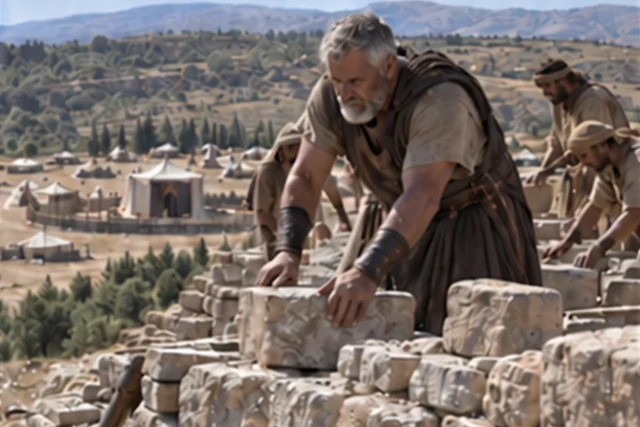
Joshua has spent chapter after chapter helping divide the land, and only when the tribal work is finished does his own request appear. That order keeps the commander from looking like a ruler who secured the best private estate before everyone else was served. Israel gives him Timnath-serah according to the LORD's word, and he builds and dwells there. The distributor becomes one more recipient inside the inheritance he has administered. The closing sentence immediately widens the lens again: Eleazar, Joshua, and the tribal heads are named together at Shiloh, before the LORD, at the door of the tabernacle. The end of the division is therefore public, ordered, and larger than Joshua's personal reward. Caleb's earlier grant and Joshua's final one bracket the western allotments, but the chapter finishes not with either man. It finishes with the country divided among Israel under the stated process.
Deep dive
The order is carefully stated: after the land has been divided, the children of Israel give Joshua an inheritance among them. The man who has administered the distribution now appears as one of its recipients. His city is granted according to the LORD's word, and he builds and inhabits it; the book does not depict him taking an undefined royal estate out of the common land.
Caleb's individual request stood near the beginning of the western allotments, and Joshua's now stands at their end. The two men associated with the earlier faithful reconnaissance receive particular places within the inheritance. The final sentence then returns from Joshua's city to Eleazar, the tribal heads, Shiloh, and the door of the tabernacle. The completed distribution belongs to the whole people and its appointed authorities, not simply to the achievement of its most visible commander.
Words to trace: inheritance, children, city, dividing, gave, Israel
Verse-by-verse path
- Joshua 19:49
Joshua and Caleb were the only two men of the Sinai generation promised entry (Numbers 14:30), and they are the only two individuals given towns by name in the allotment. Joshua’s is given last, after every tribe, and by “the children of Israel”, not by himself.
- Joshua 19:50
Judges 2:9 calls the town Timnath-heres, “portion of the sun”, with two letters reversed from Timnath-serah, “portion that remains”. Some think the spelling was altered to avoid a name honouring the sun. Joshua was buried there (24:30).
- Joshua 19:51
The verse names the same three authorities as 14:1, Eleazar, Joshua and the heads of the fathers, so the allotment section begins and ends with the same trio. The last words, “So they made an end”, close the division of the land.
Joshua 19:49-51
King James Version49When they had made an end of dividing the land for inheritance by their coasts, the children of Israel gave an inheritance to Joshua the son of Nun among them:
50According to the word of the LORD they gave him the city which he asked, even Timnath-serah in mount Ephraim: and he built the city, and dwelt therein.
51These are the inheritances, which Eleazar the priest, and Joshua the son of Nun, and the heads of the fathers of the tribes of the children of Israel, divided for an inheritance by lot in Shiloh before the LORD, at the door of the tabernacle of the congregation. So they made an end of dividing the country.
Questions to keep in mind while reading
- Track who acts, who speaks, who is affected, and what changes.
- Notice repeated promises, failures, rescues, and consequences.
- Do not assume the account approves every action that is reported.
Text first
Where readers differ
The chapter summary begins with what the passage says and how its parts fit together. It does not assume one denomination has already settled every question. Where a conclusion depends on a tradition, literary theory, or historical reconstruction, that dependence is named openly.
The KJV text is presented first. Interpretive conclusions are labeled, and differences are introduced only when they help a reader understand why serious communities do not always reach the same answer.
Comparative interpretive notes for this chapter are in preparation. Until reviewed notes are ready, this page separates the KJV text from summary and application without claiming that serious readers agree on every question.
Questions beneath the surface
- What account of God, human freedom, responsibility, and the good life emerges from Joshua 19?
- Which tension does the chapter refuse to resolve quickly?
- What changes when the chapter is read as part of the whole canon rather than as an isolated moral lesson?
- Where might a sincere reader confuse a familiar tradition with something the text states directly?
Questions for serious personal contemplation
These open-ended questions make room for tension, honest response, prayer, and conclusions that remain accountable to the chapter.
Observe without rushing
What part of Joshua 19 makes you stop, feel unsettled, or feel surprised, and why?
Which detail in the passage would be easiest to overlook? How does that detail change your understanding?
Where do you see tension between what happens and this focus: Joshua 19 develops its own movement around children, inheritance, cities, families, villages?
What important question does the passage leave open instead of resolving quickly?
Examine your inner life honestly
Which person, response, fear, or desire in the passage feels most like your own life right now?
What assumption about God, other people, or yourself does this text challenge?
Which part would you rather soften, avoid, or explain away too quickly? What might that reaction reveal?
If this Scripture could ask you one direct question, what do you think it would ask?
Respond with wisdom and courage
What do you need to remember, confess, grieve, thank God for, or trust after reading this passage?
How might another faithful person read this situation differently without ignoring the text?
What obedient response would be costly, uncomfortable, or slow, yet still faithful to Scripture?
What question will you carry into prayer this week, and which verses will you keep in front of you?
Music and video connected to the passage
Related media appears when its Scripture reference overlaps this study. Music and video can illuminate a theme while the biblical text remains the foundation.