The big picture
Psalm 105 is a long exercise in remembering who has been carrying the promise. Abraham’s family is small, mobile, and landless. Joseph is sold, chained, and forgotten before he governs. Israel grows in Egypt and is oppressed before Moses and Aaron are sent. The wilderness still needs food, shade, light, and water after Egypt has been left behind. Through every change, The Book of Psalms keeps the governing verbs with God: he remembers, sends, protects, judges, brings out, gives, and sustains. The covenant is not portrayed as a shortcut around history. It travels through famine, prison, royal power, plagues, desert, and inherited land. The final verse refuses to let possession be the endpoint. The land is given so that covenant life may be lived there.
In this chapter
- Remembering Is a Public Undertaking Psalms 105:1-6
Psalm 105 makes memory noisy.
- An Inheritance Promised to People Without One Psalms 105:7-15
The promise of land first belongs to people who do not possess it.
- Joseph Is Sent Before Anyone Recognizes a Mission Psalms 105:16-22
Joseph is “sent” before anyone involved in selling him could possibly describe the event that way.
- The Household Becomes a People, and the Conflict Widens Psalms 105:23-36
A household becomes a people, and the scale of conflict expands with it.
- Departure Brings Provision Rather Than Mere Escape Psalms 105:37-41
Leaving Egypt solves one crisis and immediately exposes another: rescued people still need to live tomorrow.
- The Destination Has a Purpose Psalms 105:42-45
The final verses of Psalm 105 return to the word that has been quietly governing the entire chapter: “remembered.” Famine, chains, plagues, wilderness, and migration have not knocked Abraham’s promise off course.


Scripture beside the summary
Psalms · King James Version · 45Psalms 105:1-6
Remembering Is a Public Undertaking
Psalm 105 makes memory noisy. The descendants of Abraham are told to sing, talk, make known, seek, and remember, as though private recollection would be too small for what the chapter is about. The Book of Psalms gives praise concrete content: deeds, wonders, judgments, and a covenant with a history. The people are not told simply to feel grateful. They are told what to keep in circulation among one another. That matters because their identity began before any of them were present. Abraham’s seed inherits a relationship it did not initiate, so remembering becomes an act of belonging. The next section will say that God remembers the covenant already. Human memory therefore answers divine faithfulness rather than creating it. The community speaks because something has happened, and what has happened must not be allowed to become silent.

Deep dive
The opening does not leave praise as a general statement that God is impressive. It supplies subjects for conversation: deeds, wonders, and judgments. Singing and talking belong together. The community's memory is to become audible, and the repeated commands give that memory several settings rather than confining it to one ceremonial moment. Even the appeal to seek God's face stands among instructions to recall what he has done.
The address to Abraham's seed and Jacob's children identifies the people entrusted with this recollection. Their identity rests on a relationship that began before their own lives. That makes the word "remember" especially important: these descendants must actively recall the covenant, while the next section declares that God has remembered it already. Human recollection answers divine faithfulness; it does not manufacture the relationship it celebrates.
Words to trace: LORD, seek, name, sing, works, Abraham
Verse-by-verse path
- Psalms 105:1
Verses 1 to 15 appear again as the first part of the song sung when David brought the ark to Jerusalem (1 Chronicles 16:8–22), which then continues with Psalm 96. The opening line is also nearly identical to Isaiah 12:4: “call upon his name, declare his doings among the people.”
- Psalms 105:2
“Sing” and “sing psalms” are two verbs, shiru and zammeru, the voice and then the voice with instruments. “Talk ye” means rehearse aloud, go over the deeds in conversation. The long list of wonders that follows is exactly that talk, written out.
- Psalms 105:3
“Glory ye” is hithallelu, make your boast, from the same root as hallelujah. Jeremiah 9:24 uses it: “let him that glorieth glory in this, that he understandeth and knoweth me.” Those who seek, not those who have already arrived, are told to rejoice.
- Psalms 105:4
Two different verbs for seeking are used, darash and biqqesh. In the Psalms the ark can be called God’s “strength”: Psalm 78:61 says he “delivered his strength into captivity”, and Psalm 132:8 speaks of “the ark of thy strength”. Sung when the ark came to Zion, “seek his strength” may point to it.
- Psalms 105:5
“The judgments of his mouth” are the verdicts God pronounced. Exodus 12:12 calls the last plague exactly that: “against all the gods of Egypt I will execute judgment”. The psalm will spend verses 26 to 36 recalling those sentences.
- Psalms 105:6
Where this line says “seed of Abraham”, 1 Chronicles 16:13 reads “seed of Israel”. God calls Abraham “my servant” in Genesis 26:24. “His chosen” is plural in Hebrew, “his chosen ones”, so it applies to the children of Jacob, not to Jacob alone.
Psalms 105:1-6
King James Version1O give thanks unto the LORD; call upon his name: make known his deeds among the people.
2Sing unto him, sing psalms unto him: talk ye of all his wondrous works.
3Glory ye in his holy name: let the heart of them rejoice that seek the LORD.
4Seek the LORD, and his strength: seek his face evermore.
5Remember his marvellous works that he hath done; his wonders, and the judgments of his mouth;
6O ye seed of Abraham his servant, ye children of Jacob his chosen.
Psalms 105:7-15
An Inheritance Promised to People Without One
The promise of land first belongs to people who do not possess it. That is the tension Psalm 105 refuses to skip. Abraham, Isaac, and Jacob are few, moving among kingdoms, living as strangers inside the territory named as their inheritance. The Book of Psalms stretches “a thousand generations” over this vulnerable beginning, making the scale of the promise almost absurd beside the scale of the household. They have no army large enough to secure the future by force. Protection comes while possession is still absent. Kings are restrained for the sake of people who cannot match royal power on its own terms. The line “Touch not mine anointed” belongs to that setting of exposed patriarchs and should not be converted into a blanket shield for later officeholders. Here the marvel is that an inheritance can be carried by wanderers who cannot yet enforce their claim.

Deep dive
The span of "a thousand generations" is set beside a strikingly small beginning. Abraham, Isaac, and Jacob have a promise of land while living as strangers and moving between kingdoms. The contrast matters more than their eventual numbers. Nothing in the household's early circumstances looks sufficient to secure the inheritance. The promise is carried by people who cannot enforce it through territorial power.
The prohibition against touching God's "anointed" belongs within that account of vulnerable patriarchs protected from kings. It is not introduced as a rule shielding every later religious officeholder from scrutiny. Here, the protected figures have neither a settled nation nor an army to match the rulers around them. The psalm's emphasis falls on God's intervention on their behalf. Their lack of possession does not mean the covenant has been forgotten; divine protection operates while the inheritance is still a promise.
Words to trace: covenant, Abraham, anointed, Canaan, commanded, confirmed
Verse-by-verse path
- Psalms 105:7
The sentence narrows at once: the LORD whose judgments reach the whole earth is “our God”, the God of one family. The rest of the psalm explains how a God of all the earth came to be bound to that family.
- Psalms 105:8
1 Chronicles 16:15 turns this into a command to the people: “Be ye mindful always of his covenant.” Here it is God who remembers. “A thousand generations” is the measure of Deuteronomy 7:9, the God who “keepeth covenant and mercy with them that love him... to a thousand generations”.
- Psalms 105:9
The covenant with Abraham was “made”, literally cut, in Genesis 15:18, among the halved animals. The oath to Isaac is recorded in Genesis 26:3: “I will perform the oath which I sware unto Abraham thy father.” Three patriarchs, one promise handed on.
- Psalms 105:10
Both of Jacob’s names appear. At Bethel, in Genesis 35:10–12, God renamed him Israel and repeated the land promise under the new name. “Law” is choq, a statute or fixed decree: the promise is given the permanence of a legal ordinance.
- Psalms 105:11
“Unto thee” is singular and “your inheritance” is plural: one man is promised, and a nation receives. “Lot” is chevel, a measuring cord, so the inheritance is land surveyed and parcelled out, as the tribes’ portions were in Joshua 17:5.
- Psalms 105:12
“Few men in number” is the phrase Jacob used in Genesis 34:30, after Shechem, when he feared the Canaanites would destroy him: “I being few in number.” 1 Chronicles 16:19 has “When ye were but few”, placing the singers themselves among the vulnerable ancestors.
- Psalms 105:13
Abraham moved from Ur to Haran to Canaan to Egypt and to Gerar; Isaac lived in Gerar among the Philistines; Jacob went to Haran and back, then down to Egypt. The verse compresses three generations of tents moving from one ruler’s land to another’s.
- Psalms 105:14
Two kings were rebuked for the patriarchs’ sake: Pharaoh was struck with plagues for taking Sarai (Genesis 12:17), and Abimelech king of Gerar was warned in a dream, “thou art but a dead man” (Genesis 20:3). The same thing happened to Isaac with a later Abimelech (Genesis 26).
- Psalms 105:15
The patriarchs were never anointed with oil; “anointed” here means set apart by God. Abraham is the first person the Bible calls a prophet, in God’s words to Abimelech: “he is a prophet, and he shall pray for thee” (Genesis 20:7).
Psalms 105:7-15
King James Version7He is the LORD our God: his judgments are in all the earth.
8He hath remembered his covenant for ever, the word which he commanded to a thousand generations.
9Which covenant he made with Abraham, and his oath unto Isaac;
10And confirmed the same unto Jacob for a law, and to Israel for an everlasting covenant:
11Saying, Unto thee will I give the land of Canaan, the lot of your inheritance:
12When they were but a few men in number; yea, very few, and strangers in it.
13When they went from one nation to another, from one kingdom to another people;
14He suffered no man to do them wrong: yea, he reproved kings for their sakes;
15Saying, Touch not mine anointed, and do my prophets no harm.
Psalms 105:16-22
Joseph Is Sent Before Anyone Recognizes a Mission
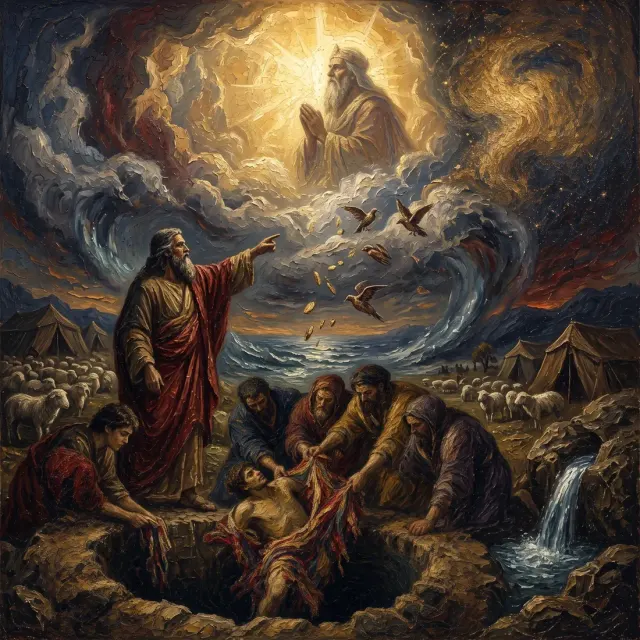
Joseph is “sent” before anyone involved in selling him could possibly describe the event that way. Psalm 105 holds that divine purpose beside the brutality of slavery and prison rather than using one to erase the other. The Book of Psalms lets the iron stay on Joseph’s body. His feet hurt, confinement is real, and the word he carries becomes a test while fulfillment remains out of sight. Providence does not make the cell comfortable or the betrayal kind. Then the reversal arrives through the same royal world that held him. The prisoner is released, made ruler, and placed over a household and officials far above his former station. The person once treated as property becomes someone who instructs elders. The section’s power lies in that long distance between being “sent” and being recognized as useful to the purpose for which he was sent.

Deep dive
Joseph enters the account as a man "sent" ahead and immediately as a man sold into slavery. Those descriptions occupy the same verse. The psalm does not require the sale to become benevolent before it can belong within God's purpose. It then lingers on the bodily cost: fettered feet and iron. Providence has not made imprisonment comfortable, and the movement toward deliverance does not erase the distance Joseph travels through humiliation.
The word that "tried him" gives the waiting period its particular tension. Fulfillment has not yet arrived, so the promise itself becomes a test rather than an available explanation for every day in confinement. Release reverses Joseph's position within the same royal world that held him. He now instructs its elders, called "senators" in the KJV. The prisoner becomes a teacher of those whose age and rank would ordinarily place them above him.
Words to trace: LORD, ruler, word, bind, brake, bread
Verse-by-verse path
- Psalms 105:16
“Called for” is qara, to summon, as a master calls a servant: the famine comes when it is sent for. “Staff of bread” is the phrase of Leviticus 26:26, bread as the stick a person leans on to stay upright. Break it, and a whole land falls.
- Psalms 105:17
Joseph said it himself to his brothers: “God did send me before you to preserve life” (Genesis 45:5). Genesis 37:28 gives the price, twenty pieces of silver. The psalm places “sent” and “sold” in one sentence and does not resolve the tension between them.
- Psalms 105:18
Genesis never says Joseph was put in chains; the psalm supplies the detail. The second half is literally “his soul came into iron”, which the Latin rendered “the iron pierced his soul”, and the old English Prayer Book made famous as “the iron entered into his soul”.
- Psalms 105:19
Whose word “came” is disputed: Joseph’s interpretation of the dreams coming true, or God’s promise reaching its moment. “Tried” is tsaraf, to refine, the smelter’s verb for purifying silver in a furnace. The iron of verse 18 was part of the refining.
- Psalms 105:20
Genesis 41:14: “Then Pharaoh sent and called Joseph, and they brought him hastily out of the dungeon.” In verse 14 God reproved kings; here a king becomes the instrument of the promise, sending and loosing on God’s timetable.
- Psalms 105:21
Pharaoh’s words were “Thou shalt be over my house” (Genesis 41:40), and Joseph later calls himself “lord of all his house” (Genesis 45:8). “Substance” is qinyan, possessions, the grain and wealth of Egypt stored against the famine.
- Psalms 105:22
“At his pleasure” is literally “by his soul”, the same word nefesh as in verse 18, where his soul came into iron. The man once bound now binds princes. “Senators” is zeqenim, elders; Pharaoh called Joseph “discreet and wise” (Genesis 41:39).
Psalms 105:16-22
King James Version16Moreover he called for a famine upon the land: he brake the whole staff of bread.
17He sent a man before them, even Joseph, who was sold for a servant:
18Whose feet they hurt with fetters: he was laid in iron:
19Until the time that his word came: the word of the LORD tried him.
20The king sent and loosed him; even the ruler of the people, and let him go free.
21He made him lord of his house, and ruler of all his substance:
22To bind his princes at his pleasure; and teach his senators wisdom.
Psalms 105:23-36
The Household Becomes a People, and the Conflict Widens
A household becomes a people, and the scale of conflict expands with it. Psalm 105 moves from Jacob’s arrival in Egypt to national hostility, then to Moses and Aaron entering the scene as sent servants. The Book of Psalms does not soften the difficult statement that God turns Egyptian hearts against his people, nor does it pretend to explain every dimension of agency and responsibility in one line. Instead it follows the conflict through signs that reach water, crops, animals, royal bedrooms, trees, fields, and firstborn children. Egypt’s power looks comprehensive until the plagues touch every level at which that power sustains and protects life. Frogs in the chambers of kings make the point with almost embarrassing precision. Two commissioned servants stand before an imperial system, and the chapter insists that being sent matters more than appearing impressive.
Deep dive
The psalm moves quickly from a migrant family to a people stronger than their adversaries. Its account of hostility is equally forceful: God is said to turn Egyptian hearts against his people. The line makes divine agency part of the conflict without explaining the full relationship between God's purpose and Egyptian responsibility. It should not be softened into a claim that oppression simply happened outside the movement of the account.
The signs then reach water, crops, animals, royal bedrooms, and finally the firstborn. Frogs entering the chambers of kings are a particularly pointed detail. Royal architecture offers no privileged exemption. The sequence is selective rather than a complete reproduction of Exodus, and its emphasis is cumulative: the resources by which Egypt sustains life and displays power cannot resist God's command. Against that enormous apparatus stand two commissioned servants, Moses and Aaron, whose significance comes from being sent.
Words to trace: land, coasts, people, smote, spake, trees
Verse-by-verse path
- Psalms 105:23
Egypt is “the land of Ham” because Mizraim, the Hebrew name for Egypt, was a son of Ham (Genesis 10:6). “Sojourned” is gur, to live as a resident alien. Jacob’s sons told Pharaoh, “For to sojourn in the land are we come” (Genesis 47:4).
- Psalms 105:24
Exodus 1:7 describes the growth with a pile of verbs: they “increased abundantly, and multiplied, and waxed exceeding mighty”. Pharaoh’s complaint in Exodus 1:9, “the people... are more and mightier than we”, is the fear this verse confirms.
- Psalms 105:25
“Deal subtilly” is hitnakkel, to plot craftily, the verb of Genesis 37:18, where Joseph’s brothers “conspired against him to slay him”. Egypt plots against the family the way the brothers plotted against Joseph. The first half puts even Egypt’s hatred under God’s hand.
- Psalms 105:26
“Moses his servant” is the title of Moses’ epitaph, “Moses the servant of the LORD” (Deuteronomy 34:5). Aaron’s choosing was proved when his rod budded, blossomed and bore almonds overnight among the rods of the tribes (Numbers 17:8).
- Psalms 105:27
The Hebrew is literally “they set among them the words of his signs”. The signs were a message as well as a blow. “The land of Ham” is repeated from verse 23, keeping Egypt identified by its ancestor.
- Psalms 105:28
Darkness, the ninth plague in Exodus, comes first here. The Hebrew says “they rebelled not against his word”, meaning Moses and Aaron obeyed, or the darkness itself did; the ancient Greek and Syriac drop the “not” and make it the Egyptians who rebelled.
- Psalms 105:29
Exodus 7:21 records that “the fish that was in the river died; and the river stank”. The Nile was Egypt’s life. The psalm recalls eight plagues, not ten, and leaves out the cattle disease and the boils altogether.
- Psalms 105:30
“Brought forth” is sharats, to swarm, the verb of Genesis 1:20, “Let the waters bring forth abundantly”. Here the swarming is a curse. Exodus 8:3 says the frogs would come “into thy bedchamber, and upon thy bed”, the king’s private rooms.
- Psalms 105:31
“Divers sorts of flies” renders arov, a swarm; the rendering follows the Jewish reading of the word as a mixture of creatures. “Lice” are kinnim, probably gnats or mosquitoes. The psalm reverses the Exodus order of these two. “Coasts” means borders, all their territory.
- Psalms 105:32
In Egypt rain was rare, the land being watered by the Nile, so rain itself was strange; this rain was hail. Exodus 9:24 describes “fire mingled with the hail, very grievous”, which is the flaming fire here, lightning running along the ground.
- Psalms 105:33
Exodus 9:25 says the hail “brake every tree of the field”. Vines and fig trees are the psalm’s own detail, and Egypt did grow vines; Pharaoh’s butler dreamed of one with three branches (Genesis 40:10). The trees of a vineyard and an orchard take years to replace.
- Psalms 105:34
“Caterpillers” is yeleq, young locusts in their hopping stage, one of the stages listed in Joel 1:4. Exodus 10:14 says of this swarm, “before them there were no such locusts as they, neither after them shall be such”.
- Psalms 105:35
“Herbs” is esev, everything green. Exodus 10:15 reports, “there remained not any green thing in the trees, or in the herbs of the field”. What the hail had spared, the locusts finished.
- Psalms 105:36
“The chief of all their strength” is reshit onam, the firstfruits of their vigour, Jacob’s phrase for Reuben in Genesis 49:3, “my firstborn, my might, and the beginning of my strength”. Psalm 78:51 uses the same words for the same night.
Psalms 105:23-36
King James Version23Israel also came into Egypt; and Jacob sojourned in the land of Ham.
24And he increased his people greatly; and made them stronger than their enemies.
25He turned their heart to hate his people, to deal subtilly with his servants.
26He sent Moses his servant; and Aaron whom he had chosen.
27They shewed his signs among them, and wonders in the land of Ham.
28He sent darkness, and made it dark; and they rebelled not against his word.
29He turned their waters into blood, and slew their fish.
30Their land brought forth frogs in abundance, in the chambers of their kings.
31He spake, and there came divers sorts of flies, and lice in all their coasts.
32He gave them hail for rain, and flaming fire in their land.
33He smote their vines also and their fig trees; and brake the trees of their coasts.
34He spake, and the locusts came, and caterpillers, and that without number,
35And did eat up all the herbs in their land, and devoured the fruit of their ground.
36He smote also all the firstborn in their land, the chief of all their strength.
Psalms 105:37-41
Departure Brings Provision Rather Than Mere Escape
Leaving Egypt solves one crisis and immediately exposes another: rescued people still need to live tomorrow. Psalm 105 therefore describes departure with silver and gold, then keeps going into cloud, fire, quails, bread, and water. The Book of Psalms presents deliverance as more than getting through the gate. The people require covering by day, light by night, food in hunger, and water where the landscape offers none. The rock is the sharpest image because it gives from the least promising material. Dryness does not merely stop being dangerous; it becomes a riverlike source. The chapter does not recount every complaint preserved elsewhere, because its selected line of attention is the giver’s persistence. Egypt was glad to see the people leave, but freedom would be fragile if the one who brought them out did not also keep sustaining them after the applause of escape was over.

Deep dive
Egypt's relief at Israel's departure reverses the earlier determination to hold the people. Fear has changed the calculation. The silver and gold also prevent the exit from appearing as a flight in which the rescued emerge stripped of everything. The psalm presents a supplied departure, then follows it with provision in the wilderness. Escape from Egypt is not the end of the practical problem of keeping a people alive.
Cloud, fire, quails, bread, and water answer different needs. Their variety gives substance to the claim of divine care without pausing for an abstract definition. The rock becoming a source of running water offers the sharpest reversal: the landscape's least promising material supplies what the desert lacks. Psalm 105 selects these gifts without recounting every quarrel associated with them in Exodus and Numbers. Its chosen line of attention is the giver's faithfulness, not a claim that the recipients never complained.
Words to trace: asked, bread, cloud, covering, departed, Egypt
Verse-by-verse path
- Psalms 105:37
Genesis 15:14 promised Abraham that his descendants would come out “with great substance”, and Exodus 12:35–36 records the silver and gold asked of the Egyptians. “Feeble” is koshel, one who stumbles. A column of slaves left with no straggler.
- Psalms 105:38
Exodus 12:33 records the Egyptians urging Israel out in haste: “We be all dead men.” “Fear” is pachad, dread, the terror that Exodus 15:16 says fell on the nations afterward. The oppressors ended by begging their slaves to leave.
- Psalms 105:39
“Covering” is masakh, a screen, the word for the hanging at the door of the tabernacle (Exodus 26:36). Here the cloud is shade from the desert sun rather than a guide, as in Isaiah 4:5–6, where a cloud by day is “a shadow in the daytime from the heat”.
- Psalms 105:40
The Hebrew verb is singular, “he asked”, the people as one. The psalm leaves out that the asking was grumbling (Exodus 16:2) and that the quails came with a plague (Numbers 11:33); Psalm 78:18–31 tells that side. “Bread of heaven” is the manna of Exodus 16:4.
- Psalms 105:41
Water from the rock came at Horeb (Exodus 17:6) and again at Kadesh (Numbers 20:11). “Gushed” is zuv, to flow, the verb of the land “flowing with milk and honey”. A river ran through dry ground, where no water should have been.
Psalms 105:37-41
King James Version37He brought them forth also with silver and gold: and there was not one feeble person among their tribes.
38Egypt was glad when they departed: for the fear of them fell upon them.
39He spread a cloud for a covering; and fire to give light in the night.
40The people asked, and he brought quails, and satisfied them with the bread of heaven.
41He opened the rock, and the waters gushed out; they ran in the dry places like a river.
Psalms 105:42-45
The Destination Has a Purpose
The final verses of Psalm 105 return to the word that has been quietly governing the entire chapter: “remembered.” Famine, chains, plagues, wilderness, and migration have not knocked Abraham’s promise off course. The Book of Psalms frames human remembering with divine remembering, then gives the land itself a purpose. The chapter could have ended with possession, wealth, or the satisfaction of inheriting fields others had worked. Instead it ends with statutes and laws. The gift is meant to become a setting for covenant obedience. That closing purpose clause keeps the inheritance from becoming a trophy. Arrival is not the same thing as completion. The people receive land in order to live as the people of the God who remembered them through every earlier stage. Praise therefore answers not only what was given, but what the gift is for.
Deep dive
The verb "remembered" returns to explain everything that has intervened. Famine, Joseph's rise, the plagues, and wilderness provision have not displaced the promise to Abraham. They belong to the route by which it reaches a later generation. The return of that word gives the long account a frame: the community is told to remember because God has remembered first.
The final movement could have ended with the acquisition of land and the labor of other peoples. Instead, it adds a purpose clause. The inheritance is given so that Israel might observe God's statutes and keep his laws. Possession is therefore not the psalm's ultimate definition of success. The promised land supplies a setting for covenant life. The concluding praise acknowledges a gift whose intended outcome is more demanding than arriving, owning, and enjoying what others have built.
Words to trace: people, Abraham, chosen, gave, gladness, heathen
Verse-by-verse path
- Psalms 105:42
“Promise” is davar, word: “his holy word”, the “word which he commanded to a thousand generations” in verse 8. Genesis 15:13–14 had told Abraham of a four hundred year affliction in a strange land, and a going out afterward with great substance. The psalm has just told how that word came true.
- Psalms 105:43
“Joy” is sason and “gladness” rinnah, a ringing shout. The psalm tells the exodus without mentioning the crossing of the Red Sea at all, and without Pharaoh’s army; it goes straight from the plagues to the wilderness. Its interest is in what God gave, not in whom he defeated.
- Psalms 105:44
Deuteronomy 6:10–11 promised “great and goodly cities, which thou buildedst not... vineyards and olive trees, which thou plantedst not”, and Joshua 24:13 says it was fulfilled. “Labour” is amal, the toil of others, inherited without the sweat.
- Psalms 105:45
The psalm has not mentioned Sinai, yet it ends on statutes and laws. “Observe” and “keep” are shamar and natsar, two verbs of guarding. The final hallelujah closes this psalm, and Psalm 106 opens with the same word.
Psalms 105:42-45
King James Version42For he remembered his holy promise, and Abraham his servant.
43And he brought forth his people with joy, and his chosen with gladness:
44And gave them the lands of the heathen: and they inherited the labour of the people;
45That they might observe his statutes, and keep his laws. Praise ye the LORD.
Questions to keep in mind while reading
- Follow the speaker, images, parallel lines, questions, and emotional movement.
- Notice where tension or suffering resists an easy answer.
- Read a saying as wisdom for faithful discernment, not as a mechanical promise detached from context.
Text first
Where readers differ
The chapter summary begins with what the passage says and how its parts fit together. It does not assume one denomination has already settled every question. Where a conclusion depends on a tradition, literary theory, or historical reconstruction, that dependence is named openly.
The KJV text is presented first. Interpretive conclusions are labeled, and differences are introduced only when they help a reader understand why serious communities do not always reach the same answer.
Comparative interpretive notes for this chapter are in preparation. Until reviewed notes are ready, this page separates the KJV text from summary and application without claiming that serious readers agree on every question.
Questions beneath the surface
- What account of God, human freedom, responsibility, and the good life emerges from Psalms 105?
- Which tension does the chapter refuse to resolve quickly?
- What changes when the chapter is read as part of the whole canon rather than as an isolated moral lesson?
- Where might a sincere reader confuse a familiar tradition with something the text states directly?
Questions for serious personal contemplation
These open-ended questions make room for tension, honest response, prayer, and conclusions that remain accountable to the chapter.
Observe without rushing
What part of Psalms 105 makes you stop, feel unsettled, or feel surprised, and why?
Which detail in the passage would be easiest to overlook? How does that detail change your understanding?
Where do you see tension between what happens and this focus: Psalms 105 develops its own movement around land, people, LORD, servant, word?
What important question does the passage leave open instead of resolving quickly?
Examine your inner life honestly
Which person, response, fear, or desire in the passage feels most like your own life right now?
What assumption about God, other people, or yourself does this text challenge?
Which part would you rather soften, avoid, or explain away too quickly? What might that reaction reveal?
If this Scripture could ask you one direct question, what do you think it would ask?
Respond with wisdom and courage
What do you need to remember, confess, grieve, thank God for, or trust after reading this passage?
How might another faithful person read this situation differently without ignoring the text?
What obedient response would be costly, uncomfortable, or slow, yet still faithful to Scripture?
What question will you carry into prayer this week, and which verses will you keep in front of you?
Music and video connected to the passage
Related media appears when its Scripture reference overlaps this study. Music and video can illuminate a theme while the biblical text remains the foundation.